



Belkin Introduces iPhone-Enabled WeMo Crock-Pot Slow Cooker [iOS Blog]
Belkin has introduced a new Crock-Pot-brand slow cooker integrated with the company’s WeMo home automation technology. According to Belkin, this will be the first of a number of WeMo enabled small appliances, including items like space heaters.
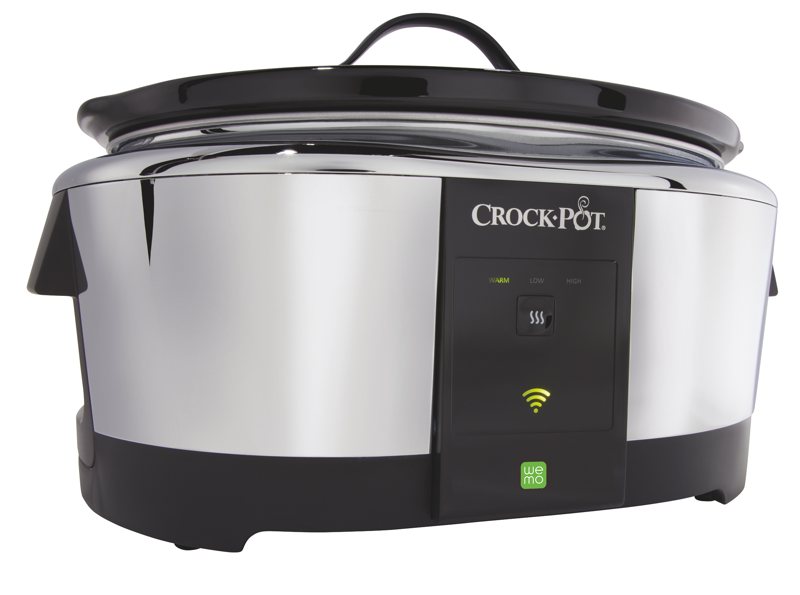
The Wi-Fi-enabled cooker looks nearly identical to other similar slow cookers, with controls on the front for toggling warm, low and high settings — but chefs can use the WeMo iOS app to adjust temperatures and set automated on/off timers.
The “Crock-Pot Smart Slow Cooker enabled with WeMo” will be available for $99.99 this spring.
Belkin also announced new LED light bulbs that work with the WeMo system, similar to Philips’ Hue bulbs.
     |
Apple Releases iOS 7.1 Beta 3 to Developers
Apple today released the third beta of iOS 7.1 to registered developers for testing purposes, following the release of the second iOS 7.1 beta in mid-December. The update is has a build number of 11d5127c and is available via an over-the-air update or through Apple’s developer center website.

The first and second betas of iOS 7.1 bundled multiple bug fixes along with several new features including a new “Button Shapes” option in Accessibility and a more prominent location for Touch ID and Passcode options.
| |
WiTricity Announces New Wireless Charging System Design for iPhone 5/5s
Wireless power firm WiTricity today announced the release of a reference design for its new wireless charging system aimed at the iPhone 5 and iPhone 5s. Moving beyond existing induction power transfer technologies such as Powermat that require direct contact with a charging pad, WiTricity’s system supports power transfer over short distances using magnetic resonance, allowing charging pads to be kept out of sight such as mounted on the bottom surface of a desk.

The WiTricity charging system for the iPhone 5/5s includes a wireless charging hub and a charging sleeve that fits an iPhone 5 or 5s. Similar to other protective covers, the WiTricity sleeve quickly slides onto an iPhone 5/5s and is powered when in proximity to the WiTricity charging hub. Capable of charging two phones concurrently, the charging hub can be placed on top of a table as an upright or flat charging pad, or mounted underneath a table or desk for charging through the surface. By mounting the charging pad under a surface, smartphone users are freed from the tangle of charging cords and cluttered desktops.
We first explored Apple’s connection to WiTricity in July 2011 after it was reported that Apple was working on a “new way of charging” the iPhone, and while that way turned out to simply be the Lightning connector introduced in the iPhone 5, Apple does clearly have an interest in wireless charging and WiTricity’s technology in particular.
Patent applications from Apple have outlined how the company could use something in line with WiTricity’s technology to allow a computer such as an iMac to serve as a wireless charging hub, with accessories and other devices such as keyboard, mice, and iOS devices able to be charged simply by being in close proximity to the iMac. Shortly after the publication of a key Apple patent application on the concept, WiTricity even demoed how such a system would work.
WiTricity’s system announced today is a reference design not meant for direct sale to consumers, but it will allow the company to partner with a variety of other firms such as device manufacturers, accessory companies, and furniture makers to explore implementation of the technology.
| |

App Store Sales Top $10 Billion in 2013, Over $1 Billion in December
 Apple announced today that App Store sales topped $10 billion in 2013, including a record breaking $1 billion in December alone, where App Store customers downloaded almost three billion apps. Overall, Apple has paid out over $15 billion to App Store developers.
“We’d like to thank our customers for making 2013 the best year ever for the App Store,” said Eddy Cue, Apple’s senior vice president of Internet Software and Services. “The lineup of apps for the holiday season was astonishing and we look forward to seeing what developers create in 2014.”
In May of 2013, Apple hit 50 billion worldwide app downloads, which it celebrated with a promotion for a $10,000 gift card for the person who downloaded the 50 billionth app. The App Store also reached one million live apps in December.
| |

How to make a CES keynote

Last night, director Michael Bay made an abrupt stage exit during Samsung’s day zero CES press conference. It was awkward, but little more than a square of toilet paper on the bottom of a tennis shoe compared to last year’s Qualcomm keynote. A bizarre mix of stilted theatrics, celebrity appearances and product demos, the presentation was like nothing we’d ever seen — until we took a look back. Qualcomm may have jacked its keynote up on steroids, but many of the tricks it pulled out were already tried-and-true standards. As Sony’s Kaz Hirai prepares to kick things off at CES 2014 this morning, we reflect on 20-plus years of innovative speeches, futuristic predictions and just plain strange behavior.
This is how you make a CES keynote.
Step 1: Think big

John Sculley with Apple’s Newton PDA (Photo by Marty Katz//Time Life Pictures/Getty Images)
When former Apple CEO John Sculley took the stage at the 1992 Winter CES, he set in motion a decade of digital divining by industry bigwigs like Aereo champion Barry Diller and Sony CEO Sir Howard Stringer. Sculley presented a bold vision of the future not only for the US economy and workers on the whole, but also for Apple’s future. His was a world where hand-held devices would lead to a fundamental shift in the way we work and learn. He saw computers, and PDAs specifically, as “revitalizing America’s role” in the global economy by making everyone more productive. The eventual offspring of this line of thinking was the ill-fated Newton. Of course, Apple would eventually return to the idea of a portable computer that embraced many of Sculley’s ideas, but his predictions weren’t exactly spot-on.
Sculley’s not alone. Many of CES’ keynote speakers have painted pictures of the future that were either ill-timed or just plain off. Michael Bloomberg kicked off the 1997 CES with a speech that focused on a new era of digital media distribution. He foretold a robust publishing industry, where writers were in higher demand and readers received the news on digital broadsheets. “The newspaper of a few years from now is made of cloth with transistors hidden in it and essentially a cellular phone with a battery hidden it there as well,” he said.
One year earlier, Compaq CEO Eckhard Pfeiffer spoke of a robust connected home becoming the norm in 2000. His theoretical abode had a computer in every room, each tailored to the needs of its user. In the kitchen, a touch- and gesture-based computer would bring the man of the house CNN Headline News, email, fax and the day’s appointments while he sipped his coffee. In the bedroom, his wife would connect with her doctor through a large-screen PC that also provided weather alerts and restaurant reviews for an upcoming trip to China. Meanwhile, his teenage daughter would connect to her friends in Germany via her I-phone (that’s a capital “I” for internet).
Step 2: Announce something

Bill Gates first appeared on the CES stage in 1995, and in 2000, he gave his first CES kickoff keynote, beginning a 12-year run for Microsoft in that slot. In just over a decade, he and his successor, Steve Ballmer turned the opening night talk from a look at tech’s crystal ball into a platform for launching new products, services and ideas. In 2000, Gates introduced the company’s new Pocket PC and Reader e-book software. The following year, he upped the game showing off the Xbox and teasing “the future of gaming.” Some of these talks were more product heavy than others, but in the time that he was at the helm, Gates announced and demoed everything from smartwatches to internet-connected TVs and HP’s aptly named TouchSmart PC.
It wasn’t all about gadgets during Microsoft’s keynote reign, however. When Ballmer took over in 2009, he announced availability of Windows 7 beta in addition to Windows Live partnerships with Dell, Facebook and Verizon. The following year, Microsoft gave the audience a glimpse at what would become Kinect. That focus on product releases took a turn for the dramatic in 2013, when Qualcomm’s Dr. Paul E. Jacobs took to the stage with a smattering of disparate cultural personalities to unveil its latest processor, the Snapdragon 800.
Step 3: Hire a celebrity

Bill Gates and the Rock show off the Xbox (Photo by Jeff Christensen/Liaison)
With a cast of characters like Archbishop Desmond Tutu, Pacific Rim director Guillermo del Toro, Maroon 5 and even Big Bird, you’d be forgiven for thinking last year’s keynote felt more like an incredibly intricate high school production of Xanadu than a self-serious press conference. While Jacobs’ state of the industry addresses was by far the most star-studded to date, employing celebrities for the occasion isn’t new. Gates enlisted Dwayne “The Rock” Johnson to show off the Xbox in 2001. In 2004, Jay Leno joined him in introducing MSN Video, followed by Conan O’Brien in 2005. To mark his last appearance as the opening keynote speaker in 2012, Ballmer sat down for a conversation with Ryan Seacrest. The following excerpt from that interview demonstrates just how awkward these cameos can be.
Seacrest: I like that. When you said Metro you looked at me in a strange way, or I thought. Is it the jacket, or the sweater, or the combination?
Ballmer: I was going to say it’s a new design and a new year, but you take it from there, for Microsoft and Ryan.
Seacrest: I’m your mascot.
Step 4: Man up

Steve Ballmer crashes the Qualcomm keynote (Photographer: Andrew Harrer/Bloomberg via Getty Images)
As in the boardroom, so on the CES stage. Over the past 20 years, only four of 63 headlining keynote speakers have been women. Of course, Yahoo CEO Marissa Mayer is slated for a talk of her own on Tuesday and Facebook’s Carolyn Everson will return for her second appearance during a panel discussion Wednesday, but all of their fellow speakers share two things in common. You guessed it: an X and a Y chromosome. This may not come as a shock to those who follow the tech industry closely, but it’s a particularly vexing state of being for a conference (and an entire market) that thrives on innovation and change.
Step 5: If all else fails, get weird
Lead image: AP Photo/Julie Jacobson
CES 2014: Apogee Debuts MiC 96k Microphone and JAM 96k Guitar Interface for Mac, iPhone, and iPad [Mac Blog]
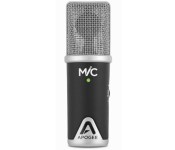
Audio recording company Apogee announced two new devices at CES 2014, including the MiC 96k professional digital microphone and the JAM 96k guitar interface adapter for Mac, iPhone, and iPad.

The MiC 96k combines a microphone, preamp, and an analog-to-digital converter in a compact package, which can output 24-bit/96 KHZ audio recording. The product’s body includes a steel-mesh housing with a gain control knob and multicolor LED, and a port on the bottom that is compatible with Apple’s Lightning and 30-pin connector or a USB interface. Garageband and Logic are compatible with the MiC 96k out of the box, with iOS apps also supported.

Meanwhile, the JAM 96k is compatible with electric, bass, and acoustic guitars accompanied by pickups, and can also yield 24-bit/96 KHZ audio recording. The device also features upgraded sound quality from Apogee’s JAM, including tube amp tone emulation, a built in analog-to-digital converter and instrument preamp. The device comes with connection cables for iOS devices and the Mac, and is compatible with Garageband, Logic, and various iOS apps.
The MiC 96k and JAM 96k retail for $229 and $129 respectively, and are both available now from Apogee’s online store.
| |

CES 2014: ClearView Audio Shows Off ‘Clio’ Clear Glass Wireless Speaker [iOS Blog]
ClearView Audio showed off its Clio Bluetooth wireless speaker at CES 2014, which boasts a unique “invisible” design consisting of an ultra-thin, curved acrylic glass transducer. The speaker’s design allows for it to output sound in multiple directions, with volume up/down, mute, and Bluetooth buttons on its side.
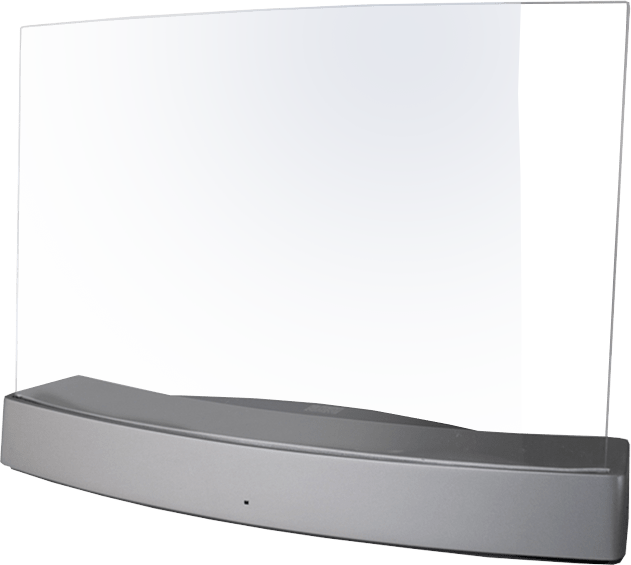
ClearView Audio is also touting its patented “Edge Motion” audio system in the speaker, which pushes sound through the side of the device instead of the rear like traditional cone speakers:
ClearView Audio’s patented Edge Motion audio systems use a differentiating mechanical principal to generate sound. Instead of pushing from behind, like a traditional cone speaker does, Edge Motion-driven speakers actuate a thin membrane along the side in a manner that creates an extremely efficient, piston-like motion in front. The resultant speaker system is thin and lightweight with the ability to produce a rich, full sound across the audio range.

The Clio is available for pre-order at $349 from Clearview Audio’s website, and is expected to ship in late March.
| |

Kindle for iOS updated with flashcards, notebook filters and better search

Thinking about replacing your textbooks with an iPad Air? Amazon’s trying to make the transition a little better for you. The latest update to Kindle iOS app adds flashcards and improved in-book search for print replica textbooks, giving students a better way to find the topics they need for class, as well as a convenient way to catalog and study them. The update packs in a handful of items for non-students too, including page footers that display page numbers and time left (for audiobooks), a redesigned dictionary for iOS 7, an updated X-Ray experience and a new set of Notebook filters for sorting through annotations. It’s not quite as hefty as the app’s recent redesign, but if you’re looking for some new features for the semester, you can get them at the app store.
Filed under: Tablets, Mobile, Apple, Amazon
Via: TheNextWeb
Source: iTunes

Typo case marries an iPhone 5s and a BlackBerry Q10, with Ryan Seacrest officiating (hands-on)

Why Typo, of all the names for a smartphone keyboard? The company answers the obvious question with a Wikipedia quote.
A typographical error (often shortened to typo) is a mistake made in the typing process … The term includes errors due to mechanical failure or slips of the hand or finger.
Well, yeah, sure, but that doesn’t really answer the question we — oh, wait, there’s more: “For many of us at Typo, typing on our iPhones is a slow, tedious one- or two-finger affair. Our desire is to avoid making Typos by using the Typo Keyboard.” Ah, so you named it “Typo” because you want people to use it to not make typos — sort of a reverse Orwellian doublethink approach to product naming. You know, like the MacBook Backpain. The Typo harnesses Ryan Seacrest’s deep pockets to the tune of $1 million, in order to address an issue that hardly anyone seems to talk (read: complain) about anymore: the death of the smartphone keyboard.

For the American Idol host, it’s a problem big enough so as to require a low seven-figure investment. And while we could certainly spend the day pondering precisely how much it might have cost for the television personality to purchase a controlling share in troubled QWERTY enthusiasts BlackBerry, we’ll instead focus on where the money ended up. Simply put, the Typo is a case that snaps onto your iPhone 5 or 5s, adding a full QWERTY keyboard to the bottom. It’s not the first keyboard case we’ve seen for the iPhone, though past models have largely stuck to a slider form factor, letting you type in landscape mode and stash the thing out of view when you’re not using it.
The Typo, on the other hand, adds the keyboard to the bottom of the device, a decision that drew immediate comparisons to BlackBerry handsets the moment it was unveiled (not to mention a recent lawsuit). And the similarities aren’t fleeting. The pad looks remarkably like the one you find on the Q10, right down to the thick white lines separating the rows and the beveled keys for speedy touch-typing. There are some issues with the placement — for starters, there’s the fact that it completely covers the iPhone’s large home button, though Typo’s fixed this with the addition of a small button with a square icon in the bottom right-hand corner, so you don’t have to pull the case off every time you need to exit out of a program.

What the company can’t really fix, however, is the nearly one inch it adds to the iPhone’s already long, skinny body. In fact, the press material notes that the final version of the hardware will actually be 1.7 millimeters taller than the beta version we tried out. The other big issue is also pretty clear after analyzing the Typo for a second: The phone is really, really top heavy. Look at how Dana’s holding it in that lead image. That’s no coincidence. She’s propping up the back, due to the really weird center of gravity the case creates. And because it’s not a slider, you’ll have to deal with that keyboard sticking out any time you want to, say, play a game in landscape mode. The upside, as Typo notes, however, is that the removal of the virtual keyboard means you’ve got a lot more screen real estate for typing.
The case’s build quality is actually pretty nice, overall. It has a matte black, soft-touch back, akin to a Mophie, that feels fairly good and offers some tracking for your fingers during that inevitable cradling. The Bluetooth pairing process is pretty straightforward as well. We managed to accomplish that in less than a minute, with the space bar showcasing a nice glowing blue light to let you know when things are ready. The keys are pretty decent — not quite BlackBerry-level, but a lot nicer than other keyboards we’ve tried, and while there’s a bit of a learning curve, that’s to be expected for any new device keyboard.

There’s also a button for backlighting. That’ll likely have an effect on battery life, though with the week of active use you’re supposed to get on a single charge, you’ll probably be all right. And when the battery is about ready to go, you’ll see yet another light warning you that it’s time for a charge. There are holes for access to the necessary buttons and ports, with a micro-USB socket on the left side to charge the keyboard.
All of that will run you $99 when the Typo goes live on the 13th. The case does what it claims, but like the Q10 itself, this feels like an instance of too little too late, as so many of those BlackBerry loyalists who were eagerly awaiting a new device with a decent keyboard eventually jumped ship out of frustration, only to realize that a virtual keyboard wasn’t quite so bad as they’d imagined. If you continue to die a little every time you type on your iPhone’s screen, perhaps this thing is worth a look.
Filed under: Cellphones, Mobile, Apple

Apple’s ‘Red Friday’ Lunar New Year Sale to Take Place on January 10 in Asia
Apple today announced its annual Lunar New Year sale, a one day event for Asian countries that is also known as “Red Friday” because of its similarity to November’s Black Friday sales.

During the event, which celebrates the Chinese New Year, Apple will be offering deals on Macs, iPads, iPods, and accessories like the Smart Cover. It is unclear whether Apple will offer traditional price cuts or instead give customers gift cards with purchase as it did in the United States during Black Friday. In previous years, Apple has offered modest cash discounts on products.
Discounted prices will be available in China, Hong Kong, Malaysia, Singapore, South Korea, Taiwan, and Thailand, on Friday, January 10. Last week, Apple also held its annual “Lucky bag“ promotion for Japanese customers.
(Thanks, Andrew!)
| |

