



Adobe Releases ‘Critical’ Update for Flash After Security Vulnerability Discovered [Mac Blog]
 Adobe has released a “critical update” for its Adobe Flash Player software on both Mac and Windows, addressing a zero-day vulnerability that gives complete control over comprised systems to hackers.
The vulnerability affects all Macs with Adobe Flash Player version 12.0.0.43 and earlier and all users are urged to update immediately. Adobe has a site where users can check what version of Flash they have installed. The latest version of Flash can be downloaded from Adobe’s website.
Adobe has released security updates for Adobe Flash Player 12.0.0.43 and earlier versions for Windows and Macintosh and Adobe Flash Player 11.2.202.335 and earlier versions for Linux. These updates address a critical vulnerability that could potentially allow an attacker to remotely take control of the affected system. Adobe is aware of reports that an exploit for this vulnerability exists in the wild, and recommends users update their product installations to the latest versions.
These updates resolve an integer underflow vulnerability that could be exploited to execute arbitrary code on the affected system.
Adobe thanked Alexander Polyakov and Anton Ivanov of Kaspersky Labs for discovering the vulnerability, but the company did not specify precisely how it works.
     |
iOS 7.1 Beta 5 Tidbits: Redesigned Shift and Caps Lock, Public Launch Expected Soon
Earlier today, Apple released the fifth beta of iOS 7.1 to developers, which included both bug fixes and a minor updates to the operating system. While previous iOS 7.1 betas introduced several visual changes, iOS 7.1 beta 5 included just a few additional tweaks to further streamline the look of iOS 7 ahead of a prospective public release.
Keyboard: In iOS 7.1 beta 3, Apple introduced a new design for the shift key, which was unpopular with many beta testers as it made it unclear when shift and caps lock were activated. With iOS 7.1 beta 5, Apple has tweaked the keys once again to make it clearer when shift and caps lock are enabled.
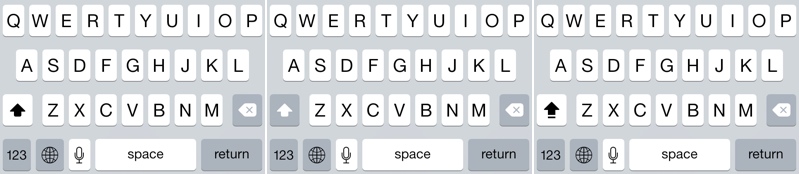 Shift enabled to the left, shift disabled in middle, caps lock enabled to the right
Wallpaper: Apple has been tweaking the way wallpaper is handled throughout the iOS 7.1 beta testing period. Beta 3 introduced a “Motion” option to turn off parallax for wallpapers and renamed the function to “Perspective Zoom” in beta 5.
iTunes Radio: iTunes Radio has gained a new “Buy Album” button which accompanies the option to buy an individual song that is playing.

Siri: Siri has gained new natural sounding voices for English (Australia), English (United Kingdom), Japanese, and Chinese (Mandarin – China).
Calendar: iOS 7.1 beta 2 introduced a new event list view within the Calendar app. In beta 5, the toggle for the list view has been made bolder and easier to see.

AirDrop: According to several reports on our forums, AirDrop appears to be experiencing some issues in iOS 7.1 beta 5.
iOS 7 Jailbreak: Apple patched an evasi0n iOS 7 jailbreak exploit in beta 4 and it appears to have issued another patch for additional exploits in beta 5.
Previous iOS 7.1 betas have also included a number of significant features like a “Button Shapes” option in Accessibility, more prominence for Touch ID and Passcode options, a new look for several aspects of the Phone dialer and shutdown screen, a new animation for ”Slide to Unlock” and a slightly revamped color for the Phone, FaceTime, and Messages app icons.
Details on features in past beta releases can be found in our previous beta posts: Beta 1, Beta 2, Beta 3, Beta 4.
Though a December report from BGR indicated that iOS 7.1 would not be released to the public until March, today’s build number, which is not much different than the build number of beta 4 indicates the software could be nearing a public launch.
A new report from BGR issued today also retracts the initial March release estimate and suggests the software will be released to the public in the “coming weeks” following the debut of a golden master build of iOS 7.1 for developers.
| |

Apple and carriers will donate free devices and broadband to US schools

The White House won’t be going it alone as it brings US classrooms into the internet era through its ConnectED initiative — it just revealed that a host of technology firms will also lend a hand. Apple plans to donate $100 million in iPads, MacBooks and software to underprivileged schools, while Autodesk and O’Reilly Media will give away free software and content. Microsoft, in turn, will heavily discount Windows to lower educational PC prices. Carriers are getting in on the action, too. AT&T and Sprint have both pledged to offer free wireless broadband to schools for multiple years; Verizon isn’t giving away service, but it will donate up to $100 million in cash and other commitments. The combined efforts aren’t going to fix the American education system by themselves, but they could create a level playing field for schools across the country.
[Image credit: Johan Larsson, Flickr]
Filed under: Wireless, Networking, Internet, Apple, Microsoft, Verizon, Sprint, AT&T
Source: The White House Blog, AT&T, Sprint
Apple and Samsung Continue to Dominate U.S. Smartphone Usage Share
ComScore today released the results of its monthly rolling survey of U.S. mobile phone users for the October-December 2013 period, showing that Apple’s U.S. smartphone market share has increased 1.2 percentage points since September, for a total share of 41.8 percent. Though Apple’s share continues to grow, it still lags behind Android’s total share of 51.5 percent, down 0.3 percent since September.
Looking at handset manufacturers, Apple and Samsung continue to dominate the category, growing their control of the market by 1.2 percent each over the three month period. Motorola, LG and HTC round out the top five, with all of them seeing flat or negative growth.
In Apple’s earnings call last month, CEO Tim Cook warned that U.S. iPhone sales were weaker than expected because of U.S. carriers changing their upgrade policies. As a result, seeing share growth despite the headwinds is a positive sign for the company.
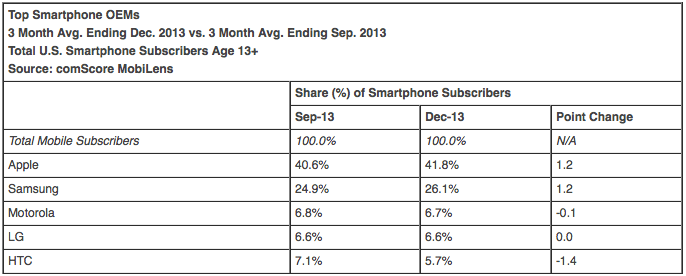
156 million people in the U.S. owned smartphones (65.2 percent mobile market penetration) during the three months ending in December, up 3.2 percent since September. Apple ranked as the top OEM with 41.8 percent of U.S. smartphone subscribers (up 1.2 percentage points from September). Samsung ranked second with 26.1 percent market share (up 1.2 percentage points), followed by Motorola with 6.7 percent, LG with 6.6 percent and HTC with 5.7 percent.
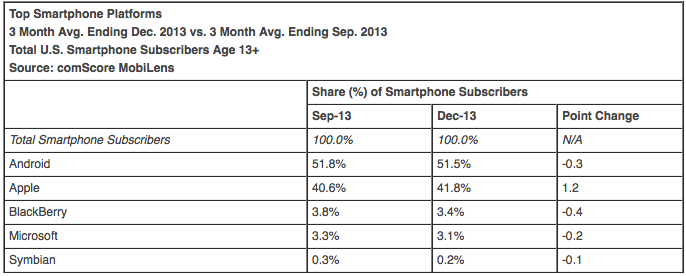
Apple grew its smartphone market share by 0.6 percent from November, largely at the expense of Android and BlackBerry. Despite a significant marketing effort, Micrsoft’s Windows Mobile has failed to gain any traction over the past three months, dropping 0.2 percent from 3.3% to 3.1% of total platform share.
ComScore’s data tracks installed user base rather than new handset sales, which means it is more reflective of real-world usage but slower to respond to shifting market trends than some other studies.
| |
FiftyThree Files for Trademark on ‘Paper’ After Facebook App Release [iOS Blog]
 FiftyThree, the company behind popular iPad sketching app Paper, has filed for a trademark on the term “Paper” following the announcement of Facebook’s magazine-style news curation tool, also named Paper.
First discovered by TechCrunch, the trademark was filed with the United States Patent and Trademark Office on January 30, the same day Facebook initially unveiled its new app. As noted by FiftyThree co-founder Georg Petschnigg in an open letter, FiftyThree was not given advanced notice of Facebook’s plans and was taken by surprise by the app release.
Though FiftyThree previously filed for a trademark on the term “Paper by FiftyThree” it did not have a trademark for “Paper” at the time that Facebook created its app. According to two trademark lawyers that spoke to TechCrunch, while the trademark is newly filed, FiftyThree could have a case if it proceeds with a lawsuit as trademarks are partially use-based and it has been using the Paper app name since early 2012.
Trademarks, to a degree, are use-based. This means that “just by using a mark in a particular field, you’ve got rights,” said Cardona. “Some are state-based and some are federal-based, but if I start using a mark before you in the same area of goods or services, I’ve got rights to the mark over you.”
It remains unclear whether FiftyThree will win the trademark, as paper is a term used by many other products, apps, and services that predate even its own app. FiftyThree has not said whether it will pursue legal action against Facebook, but Petschnigg says the company is “keeping its options open.”
For now, FiftyThree has asked Facebook to “build a brand name of their own” and to stop “using our brand name.”
Paper by FiftyThree can be downloaded from the App Store for free. [Direct Link]
Paper by Facebook can be downloaded from the App Store for free. [Direct Link]
| |
Apple Releases iOS 7.1 Beta 5 to Developers
Apple today released the fifth beta of iOS 7.1 to registered developers for testing prposes, following the release of the fourth iOS 7.1 beta on January 20.
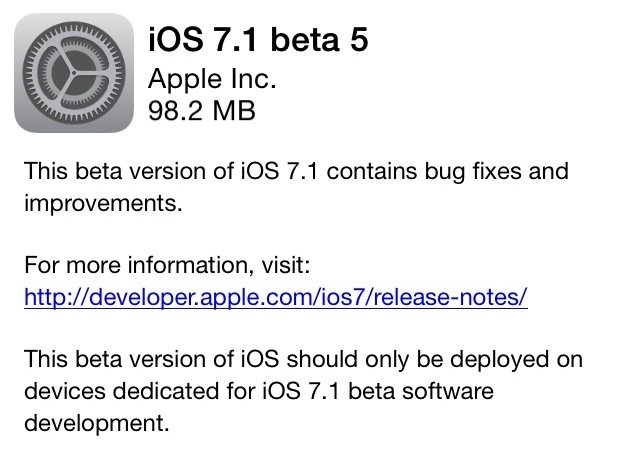
The update has a build number of 11D5145e and is available via an over-the-air update and will be available through Apple’s developer center website.
| |

Apple Pledges $100 Million in Equipment to President Obama’s ConnectED Initiative for Schools
U.S. President Barack Obama today is announcing $750 million in corporate commitments for his ConnectED initiative to provide students with greater access to high-speed Internet connections. Apple is a key member of the group and has pledged $100 million in iPads, computers and other tools, according to an Associated Press report.
Apple is pledging $100 million in iPads, computers and other tools. AT&T and Sprint are contributing free Internet service through their wireless networks. Verizon is pitching in up to $100 million in cash and in-kind contributions. And Microsoft is making Windows available at discounted prices and offering 12 million free copies of Microsoft Office software.
Obama was to announce the commitments Tuesday at a middle school in the Maryland suburbs near Washington. Also in the pipeline: an addition $2 billion that the Federal Communications Commission is setting aside from service fees over two years to connect another 20 million students to high-speed Internet.

During the recent State of the Union address, President Obama mentioned that Apple and other tech companies would be providing the hardware and software needed to connect over 15,000 schools and 20 million students to the Internet in the next two years. Apple confirmed its role in the project in a statement provided to The Loop, but did not offer any specific details on its role at that time.
These corporate contributions will help fulfill ConnectED’s goal of connecting 99 percent of U.S. students to the Internet within five years. When President Obama announced this goal last June, only one in five students had access to a broadband Internet connection.
Note: Due to the political nature of the discussion regarding this topic, the discussion thread is located in our Politics, Religion, Social Issues forum. All forum members and site visitors are welcome to read and follow the thread, but posting is limited to forum members with at least 100 posts.
| |
North Korea’s Official ‘Red Star’ Operating System Borrows Heavily From OS X [Mac Blog]
Screenshots from the latest version of North Korea’s home-grown “Red Star” Linux operating system reveal a striking resemblance to OS X, as shown in a new report from IDG News Service. The new look seen in version 3.0 of the software replaces the Windows-inspired design of version 2.0.
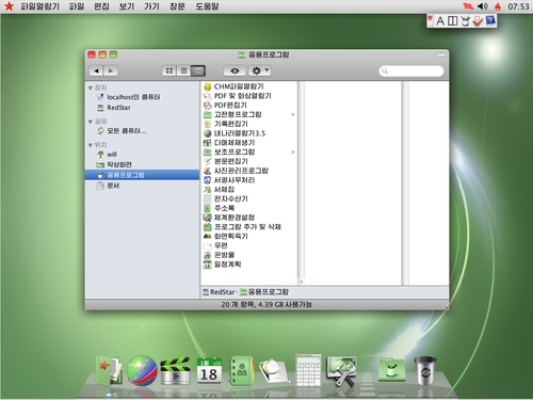
If imitation is the sincerest form of flattery, might the folks in Cupertino be pleased when they see the latest version of North Korea’s home-grown operating system?
Version 3.0 of Red Star Linux presents users with a radical refresh of its desktop design, one that closely resembles Mac OS X.
Screenshots of the operating system were provided to IDG by Will Scott, a visiting professor at Pyongyang University of Science and Technology (PUST) who bought the OS in Pyongyang from a local Korea Computer Center (KCC) dealer. KCC is the government’s information research technology center and has been in charge of developing Red Star Linux for more than a decade.
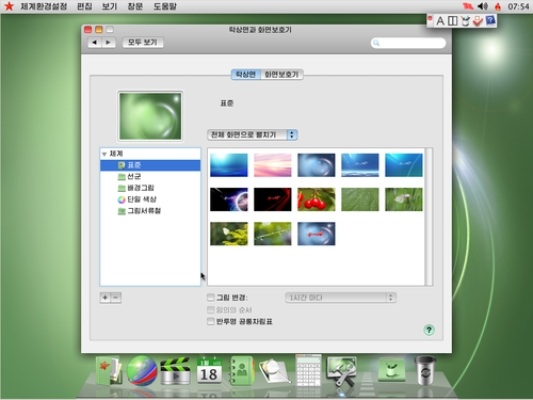
Red Star OS is the official operating system of North Korea and is localized for the country. It features Naenara (‘My Country’), a version of the Mozilla Firefox browser that connects to the country’s nationwide intranet. Version 3.0 shown above was released last year, but has until now not received significant attention outside of North Korea due to the country’s relative isolation from the world community.
Note: Due to the political nature of the discussion regarding this topic, the discussion thread is located in our Politics, Religion, Social Issues forum. All forum members and site visitors are welcome to read and follow the thread, but posting is limited to forum members with at least 100 posts.
| |

iPhone 6 Rumored to Include 10+-Megapixel Camera with f/1.8 Aperture and Improved Filter
 Sources from Taiwan’s industrial chain claim the iPhone 6 will have at least a 10-megapixel camera with an aperture of f/1.8, reports Chinese website IT168 [Google Translate, via GforGames]. This would be an improvement over the current iPhone 5s, which has an 8-megapixel camera with a narrower f/2.2 aperture.
The report also claims Apple will change the filter used on the iPhone 6 camera, replacing the hybrid IR filter used on the iPhone 5s with a resin lens filter manufactured by Japanese company JSR. JSR is known for its ARTON Resins, which are used in digital and video cameras with CMOS image sensors. JSR claims its ARTON filters are lighter and thinner than comparable IR filters and take clearer images due to the resin’s ability to minimize the color shifts of CMOS image sensors.
The IT168 story contradicts an earlier report from the The China Post that claims Apple will continue to use a 8-megapixel sensor in its next iPhone. According to analysts from Nomura Securities, the camera module in the iPhone 6 instead will see improvements in other areas such as optical image stabilization.
(Thanks, Vlad!)
| |

Satya Nadella Appointed Microsoft CEO as Bill Gates Shifts from Chairman to ‘Technology Advisor’
Microsoft announced today that it has appointed company veteran Satya Nadella as Chief Executive Officer to replace retiring Steve Ballmer. Nadella will take over as CEO and join the Board of Directors effective immediately.

As part of this leadership change, Bill Gates is stepping down as Chairman of the Board of Directors and will take a position as “Founder and Technology Advisor”. John Thompson, former CEO of Symantec, will assume the role of Board Chairman. This will mark a significant shift for Gates, who has been asked by Nadella to take a more active role in product development within the company.
Microsoft also announced that Bill Gates, previously Chairman of the Board of Directors, will assume a new role on the Board as Founder and Technology Advisor, and will devote more time to the company, supporting Nadella in shaping technology and product direction.
Gates will work three days each week at Microsoft and will remain actively involved in the Bill & Melinda Gates Foundation, reports Re/code.
| |

