


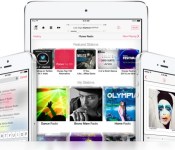
Apple Considering Dramatic Overhaul of iTunes to Address Declining Music Downloads
Apple is considering a dramatic overhaul of its iTunes music store as iTunes Radio has failed to stop declining music downloads, reports Billboard. As reported earlier this year, the company may create an on-demand music streaming service similar to Spotify in order to boost sales as well as an Android iTunes app.

“iTunes Radio hasn’t solved the problem of refreshing the iTunes store,” said a senior label executive. “While listeners are clicking the buy buttons, the traffic it is driving is in the low single digits of listeners.”
Only one to two percent of iTunes Radio listeners go on to buy songs and digital music sales were down some 5.7 percent in 2013, according to a January report. Overall music downloads have been declining upwards of 15 percent while iTunes is also losing money to competitors like YouTube, Spotify, and Pandora.
iTunes still accounts for upwards of 40 percent of U.S. music sales revenue and iTunes Radio is the third largest music streaming service after Pandora and iHeartRadio, but it has not thus far generated the sales that Apple expected.
According to the report, Apple’s options for improving iTunes are being debated internally and among the company’s content partners as it works to overcome competition from Android and an increasing consumer preference for streaming music services.
Meanwhile, in the U.S., Apple is losing its most valuable customers. “Two-thirds of its high-value customers are now in subscription services,” said one source. “That has been an eye-opener for them.”
While iTunes Radio allows users to create radio stations based on song selections, an on-demand service similar to Spotify would potentially allow users to select songs at will and could carry a monthly fee. iTunes Radio is available for free and supported by ads, with Apple also making its iTunes Match service available to customers.
With an on-demand subscription service, Apple could supply all music models customers are interested in, offering a la carte downloads via iTunes, free music via iTunes Radio, and a premium on-demand service. According to one music executive, Apple has radical plans for iTunes in store, which could lead to a “completely different” experience in three to five years.

Dropbox Announces ‘Carousel’ Photo and Video App, Mailbox for Desktop
Dropbox today announced several new products for its desktop and mobile consumers, including Mailbox for OS X and a new photo and video sharing app called Carousel.
Carousel is a standalone app that is designed to organize a user’s entire collection of photos stored via Dropbox, separating them into an event-based timeline that also highlights important moments and supports private messages. Photos automatically backup to Dropbox and sync across all platforms. They can also be shared in batches with and saved to other users’ timelines via email or phone number, regardless of whether or not the user has a Dropbox account.

According to Dropbox, the app, deemed “one place for all your memories” backs up photos to Dropbox, with storage being tied to the amount of space in a user’s Dropbox account.
We’d like you to meet Carousel: a gallery for all the photos and videos from your life. It combines the photos in your Dropbox with the photos on your phone, and automatically backs up new ones as you take them. Carousel sorts all these memories by event so you can easily travel back in time to any photo from any date. And unlike other mobile galleries, the size of your Carousel isn’t constrained by the space on your phone, which means you can finally have your entire life’s memories in one place.
While Dropbox already allows automatic camera uploads and image storage, photos are generally dumped into a single folder that doesn’t offer many organizational options. Carousel will bring a whole new photo viewing and sharing experience that will make it much easier for users to browse through their image collections. The app will be live later today.
Along with Carousel, Dropbox has also announced plans to bring its popular Mailbox app for iOS to the desktop. There are few details available on the OS X version of the app, but it will likely function similarly to the iOS app, allowing users to “snooze” messages and organize them into lists. There’s no prospective launch date on the horizon, but Dropbox is accepting beta signups.


Apple’s Recent Hires from Broadcom Boost Rumors of In-House Baseband Chip Development
Apple recently hired two high-level baseband hardware engineers who left their longtime positions at Broadcom to join the team at Apple, reports AppleInsider. The discovery of these recent hires follows a report earlier this week that suggests Apple is assembling a team of engineers to develop its own baseband chips for future iPhone models. This baseband hardware controls the radio functions of a device, handling cellular connectivity details such as signal generation, modulation and more.

The first hire in January 2014 was RF engineer Xiping Wang, who spent over ten years at Broadcom as a Design Engineer and manager of Hardware Development Engineering. Wang was followed by principal engineer and Chip Lead Paul Chang, who joined Apple in February 2014. At Broadcom, Chang was a hardware lead, overseeing the team that developed baseband transceivers for Nokia and Samsung mobile devices.
All together, Apple has assembled at least 30 mid- and senior-level baseband software and hardware engineers from Broadcom and current iPhone baseband vendor Qualcomm over the past three years. Apple is also advertising more than 50 additional openings related to RF chip design, an indication that the build-up is not yet complete.
Apple currently purchases its baseband hardware from Qualcomm, but has recently made acquisitions that would bring more of its chip development in-house. Last year, Apple acquired low-power wireless chip provider Passif Semiconductor and is ARM-based “A” series processor that powers its iPhone, iPad, iPod touch and Apple TV. The A7 is the most recent processor in the series and is described as providing “desktop class” performance for Apple’s mobile devices.

Harvard students learn about Apple’s history through manga

There’s no doubt that Harvard’s Business School is serious business, but its students are surprisingly learning about the history of Apple’s two Steves through a non-traditional medium: manga. Professor Noam Wasserman has been teaching about Wozniak’s and Jobs’ friendship and eventual falling out for years as a cautionary tale. But, for the first time, he’s using a more visual medium that portrays the two tech titans as smooth, baby-faced young’uns with big anime eyes as a supplement to the course’s text. To be clear, it’s not that Jobs manga you’ve likely heard of in the past. This particular Japanese-style comics is actually an adaptation of Wasserman’s Harvard case study titled “Apple’s Core,” which tells the story of Apple’s early days.
The one responsible for turning the study into a graphic novel, however, is another professor named Thomas Alexander, who got the idea during a stint teaching at a business institute in the Philippines. He realized that the story would resonate more with his students (who were mainly from India, China, Korea, the Philippines and Europe) if it were a lot more visual.
He said:
None of them had English as a strong suit. So I knew that to give them a 30- to 50-page written text, they will not read this. The participation will not be there.
That’s why Alexander turned Apple’s Core into a 30-page script and hired an artist to bring Apple’s history to life. Wasserman, in turn, found it so intriguing, that he’s now giving it out as optional reading material. If you’re wondering, Harvard’s MBA students seem receptive to the idea of learning from a graphic novel — enough, at least, to grab all 20 copies Wasserman made last semester.
[Image credit: Apple Core, Harvard Business School]
Source: Harvard

Apple Mulled Acquisition Offer for Square, but Deal Looks Unlikely for Now
With a goal to overhaul the online payments industry and a new revolving credit facility worth $200 million, analysts and technology pundits are wondering where Square is headed next. At least one theory proposed by Re/Code explores the possibility of an Apple acquisition.

Both Apple and Google have been rumored to be in talks with Square in the past year about a possible acquisition, but no firm offers have been made. Square is not actively trying to sell the company, but it would entertain a premium offer insider sources claim, unless it was from Google.
Either way, a sale to Google would disappoint Dorsey, according to multiple people familiar with his thinking. For one, he was reportedly put off by Google after being involved in acquisition talks between his former company, Twitter, and the search giant. He also believes, sources said, that his company’s design aesthetic and values match up much more closely with Apple than Google.
Square has close ties to Apple with its hardware chief Jesse Dorogusker leaving his position as director of engineering for the iPod, iPhone and iPad accessories at Apple to join the mobile payments startup.
A Square acquisition would be beneficial for both Apple and Square claims Re/Code. Square’s future would be secured by Apple’s cash reserves and its favorable position in retail, while Apple would be able to use Square’s payment expertise to jump start any plans it has for a mobile payment system. Apple, though, may be ready to enable online purchases via an iPhone, but it likely is not ready for the robust offline system offered by Square.
But Apple’s entrance into mobile payments is much more likely to start with services that use its iPhones to help make online purchases easier to consummate rather than moving into offline payments, industry sources say. Square wouldn’t be of much help in that regard. As such, Apple has soured on the idea of making an acquisition offer to Square for now, according to sources familiar with the company’s thinking.
Apple may be developing a mobile payment service that would allow consumers to pay for physical goods using information stored in their iTunes accounts. The company is thought to have moved Jennifer Bailey from her position in Apple’s online stores to a new role that places her in charge of building a payment service for the company.
Apple already has the underpinnings of such a payment system with the millions of credit cards stored in customer’s iTunes accounts and its Passbook digital wallet app. CEO Tim Cook hinted at the possibility of mobile payments during a recent earning conference call, saying there is “a big opportunity on the platform.”
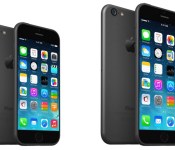
Mass Production of 4.7-Inch iPhone 6 Set for July, 5.5-Inch Version Beginning in September
According to Japanese website EMSOne [Google Translate, via G for Games], Apple is planning to begin mass production of the 4.7-inch iPhone 6 in July with the larger 5.5-inch version to enter mass production in September.
The report notes that both versions of the next-generation iPhone will go on sale at some point during the fourth quarter of this year, with the 4.7-inch iPhone being announced and released earlier than the 5.5-inch iPhone.

Renderings of iPhone 6 (4.7″) and iPhone 6 (5.7″) based on leaked schematics
The news comes as a report from Reuters last month stated that Apple would begin production of the 4.7-inch display to be used in the iPhone 6 this May for the device’s release this fall. The report also noted that the 5.5-inch version of the iPhone 6 would be delayed due to difficulties with in-cell production technology, and would start production several months after the 4.7-inch version.
A report last month from Japanese newspaper Nikkei stated that the iPhone 6 could launch “as early as September” and will be offered in 4.7-inch and 5.5-inch display sizes. This contrasted a claim from UBS analyst Steve Milunovich, who said that the 4.7-inch version of the iPhone 6 might be the only model to launch later this year, as a timeframe for the larger 5.5-inch version was unclear.
Internal documents from the second ongoing trial between Apple and Samsung also indicate that Apple is poised to release a larger phone, as a slide deck from an April 2013 presentation showed that customers want less expensive and most notably, larger screen smartphones.
In addition to a larger display, Apple’s next-generation iPhone is expected to feature a durable, sapphire screen, and a thinner, bezel-free design in addition to processor and camera upgrades.
Apple Testing Maps Notifications to Inform Users of Fixed Problems
 Apple seems to be testing a new notification feature in its Maps application, based on a report and screenshots captured by a MacRumors reader.
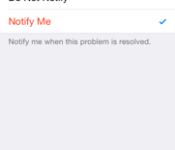
The user reported an error to Apple in the Maps app on April 6 and was given an option to receive a notification when the issue was resolved, with Apple sending a push notification on April 8 indicating the problem had been fixed.
It appears that the feature is still in testing at this point and it is unclear when it might be made available to all users. The initial user who first spotted the feature says that the option has only appeared intermittently, but a MacRumors forum user was able to confirm that he had seen it as well. MacRumors has been unable to reproduce it.
While Apple has allowed users to report errors since Maps first debuted in September of 2012, the company has not previously provided notifications that let users know when a problem has been fixed. Notably, Google currently includes support for a similar feature in its mapping service, notifying users via email about the progress of a reported problem or suggested edit.
News of the notification feature comes as Apple continues to work hard on improving its mapping app after facing significant criticism over data inaccuracies when the app first launched alongside iOS 6. Apple CEO Tim Cook publicly apologized for Maps after the problematic launch, stating that the company was “extremely sorry” for the frustration it had caused, promising to work “non stop” until Maps was improved.
Maps notifications would allow users to know that Apple is actively listening to reports and working diligently on fixing errors. Apple’s mapping application has been notable for providing potentially dangerous information at times, as it has directed drivers in Alaska onto an airport taxiway used by the Fairbanks International Airport and directed motorists in Victoria, Australia to the middle of the wilderness.
Screenshots showing the correction notification:

Push notification and notice that Maps data has been corrected
Apple has hired dozens of “ground truth” experts around the world to improve the quality of its mapping service and acquired a number of mapping apps throughout the past year, including HopStop, Locationary, BroadMap, and Embark. It is also likely that Apple features major improvements to the Maps app in iOS 8, such as adding transit directions for the first time and enhancing points of interest.
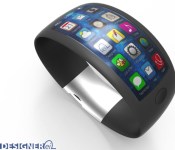
Apple Expected to Unveil iWatch in September as Suppliers Deliver Circuit Board Samples
Three Apple suppliers have delivered samples of flexible circuit boards for the iWatch as the device is now expected to be unveiled in September, reports DigiTimes.

Screen-centric iWatch concept by DesignerEI
Flexible PCB suppliers Flexium Interconnect, Zhen Ding Technology Holding and Career Technology reportedly have delivered FPCB samples for use in iWatch devices to Apple for validation, according to industry sources.
The news follows a report yesterday from Taiwan’s Economic Daily News which indicated that the iWatch will launch in the third quarter of this year, with Apple targeting production of 65 million units by the end of 2014. A reveal in September would mean that the device would be released shortly thereafter, most likely alongside the iPhone 6 and iOS 8.
While details about the iWatch have been slim, most reports have pointed to the device featuring biometric sensors to track a number of health-related statistics, including UV light exposure, heart rate, and skin temperature. Apple is also said to be releasing a “Healthbook” app with iOS 8 that will work with the iPhone and iWatch to track other health statistics like weight, heart, rate, and calories.

Apple Calls in Experts to Explain Why Samsung Owes $2B in Damages
In the ongoing Samsung vs. Apple lawsuit, two experts hired by Apple took the stand on Tuesday to explain to the jury why Samsung deserves to pay $2 billion in damages for infringing on Apple’s patents.
First up was John Hauser, a professor of marketing at the MIT Sloan School of Management, who argued (via CNET) that the specific features patented by Apple, such as slide to unlock, made Samsung’s devices far more appealing to consumers.

To reach that conclusion, Hauser surveyed 966 Samsung device users (507 phone owners and 459 tablet owners) to measure the percentage of consumers who would buy devices with specific features, including universal search, background syncing, quick links, automatic word correction, and slide-to-unlock, among others.
Those metrics were then used to determine how much people would pay for the Apple-patented features that Samsung included in its devices, with Hauser coming to the conclusion that customers would shell out $32 to $102 for each feature.
“The features that were enabled by the patents at issue in this case have a measurable impact on consumer demand for Samsung devices,” Hauser said during his testimony Tuesday.
During cross examination, Samsung objected to Hauser’s methodology, which had concluded that Samsung largely sold devices due to the features copied from Apple, and criticized it for overlooking the importance of the Samsung brand and the Android operating system.
Following Hauser’s testimony, MIT-trained economist Chris Vellturo took the stand (via Re/code) to explain how Apple arrived at its $2 billion number. The damages, he said, are a mix of lost profits and estimated reasonable royalties on the millions Samsung devices that have been accused of infringing on Apple’s patents.
“It’s a very large market and Samsung has made a lot of sales into that market,” Vellturo said, before getting into the specifics of how he came to his estimate. Samsung’s alleged infringement, he said, came at a time of dramatic growth in the market as many people were buying their first smartphone.
“It’s a particularly significant period for Samsung to have been infringing,” Vellturo said, adding that one’s first smartphone purchase is a key determining factor in future phone and tablet purchases. He added that Samsung was behind in ease of use and took Apple’s know-how to aid its effort to be more competitive.
In the original Apple vs. Samsung trial, Samsung was ordered to pay Apple $890 million in damages. The latest suit focuses on newer devices, including the Galaxy S III, Galaxy Note II, Galaxy Tab 10.1, the iPhone 4/4s/5, the iPad 2/3/4, the iPad mini, and fourth and fifth generation iPod touch.
Following today’s expert testimony, Apple is nearing the end of its case against Samsung. Next week, Samsung will present its infringement case against Apple, where it is asking for $7 million in damages. The entire trial is expected to continue until April 29 or 30, at which point the jury will enter deliberations.
iPhone Remains Popular With Teens as iPad Interest Plateaus
Apple’s iPhone continues to grow in popularity with U.S. teenagers, according to Piper Jaffray analyst Gene Munster’s latest semiannual teen survey [PDF], which asked 7,500 teens about their device preferences. 61 percent of teens now own an iPhone, compared to 55 percent from a survey conducted in October 2013 and 40 percent in the fall of 2012.
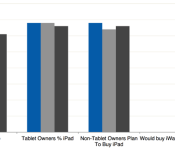
67 percent of teens expect their next phone to be an iPhone, up slightly from October’s survey. When it comes to tablets, 60 percent of teens own one, up from 56 percent in the fall. 66 percent of those own an iPad (55% full-sized, 11% mini), which is down slightly from 68 percent, with ownership shifting further towards the mini. 18 percent of teens who don’t own a tablet expect to buy one in the next sixth months and of those prospective buyers, 66 percent plan to choose an iPad.

The Spring 2014 survey also covered prospective teen interest in an Apple smart watch, which the company is said to be developing. Of the 7,500 teenagers surveyed, six percent currently own a smart watch and 17 percent of teens would buy an iWatch if Apple were to sell it for $350 or less.
The bigger takeaway from our survey is that 17% of teens suggested they would be interested in an iWatch, which we believe is an indication of consumer thirst for not only the iWatch specifically, but the new product categories that have been promised by Apple.
In the past, Samsung has attempted to position its Galaxy phones as the choice for teenagers by portraying the iPhone as “uncool,” but this marketing tactic appears to be largely unsuccessful given the segment’s growing interest in Apple products.
Despite the iPhone’s popularity, the iPad has become slightly less popular with teenagers as competitors like Google and Kindle have released more affordable options. Android tablets in particular have seen consistent growth among teens, even after the launch of the Retina iPad mini and the thinner and lighter iPad Air.

