


T-Mobile Ending All Overage Charges, Challenging Rivals to Follow [iOS Blog]
T-Mobile is kicking off a new campaign targeting overage fees as part of its ongoing Uncarrier initiative that aims to disrupt the wireless industry in the U.S. Starting in May, the U.S. carrier is eliminating overage charges for all its customers regardless of their cellular plan. The wireless carrier also challenges its competitors to do the same.

With this move, T-Mobile is abolishing those additional charges that are levied when a customer exceeds their available minutes or allotted data for their cellular plan. These extra calling minutes or gigabytes of data are charged at a much higher rate and can easily add hundreds of dollars on to a customer’s base monthly bill. Estimates cited by T-Mobile suggest consumers paid up to $1 billion in penalties last year for these punitive charges.
“Charging overage fees is a greedy, predatory practice that needs to go,” continued T-Mobile CEO John Legere. “Starting in May for bills arriving in June – regardless of whether you’re on Simple Choice, Simple Starter or an older plan, we’re abolishing overages for good. Period.”
Besides removing overage fees, T-Mobile’s Legere also started an online petition that asks AT&T, Verizon and Sprint to end overage fees, saying they are “no longer welcomed in this industry.”
This petition is part of a larger initiative by T-Mobile to shake up the cellular industry in the United States with a series of promotions and policy changes, including ETF buyouts for customers who switch from a rival carrier, early upgrades and no-contract cellular plans.
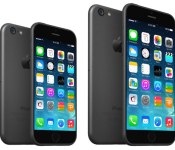
Apple Reportedly Negotiating with Carriers for $100 Price Increase on iPhone 6
Apple is negotiating with wireless carriers to raise the price of the iPhone 6 by $100, claims Jefferies analyst Peter Misek (Via StreetInsider). Carriers initially are refusing to negotiate on the iPhone’s $199 base price, but they may not be able to resist as the iPhone 6 is shaping up to be 2014′s blockbuster handset.
“The possibility may at first seem far-fetched in light of investor concerns regarding possible carrier subsidy and handset price cuts due to smartphone saturation and lack of differentiation,” Misek comments. “But we think this general lack of differentiation could be the reason why Apple may be able to get a price increase. Carriers realize that the iPhone 6 will likely be the only headline-worthy high-end phone launched this year and that they will lose subs if they do not offer it.”

Apple is expected to ship the iPhone 6 later this year, with rumors suggesting the phone will be available with a 4.7-inch touchscreen display at first. A larger 5.5-inch version may follow at the end of this year or early next year.
Along with a larger display, the next-generation iPhone may include a thinner design, Apple’s new A8 processor, a Touch ID fingerprint sensor, 1GB of RAM, and an improved camera with optical image stabilization. The iPhone 6 is expected to run iOS 8, which may feature a new Healthbook app, improved Maps and a possible Siri API.
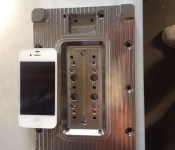
New Photo of Alleged iPhone 6 Manufacturing Mold Hints at 4.7-Inch Display
Over the weekend, several photos surfaced reportedly showing details on manufacturing molds for the iPhone 6. While the manufacturing mold photos left it unclear as to the size of the device body it would yield, a new photo shared by Nowhereelse.fr [Google Translate] shows a nearly identical mold with an iPhone 4s placed next to it for comparison. Calculations based on the comparison suggest that the mold could in fact yield a device with a display of roughly 4.7 inches, in line with the rumored size for the smaller of the two iPhone 6 models.

One source of uncertainty lies in the shape of the mold, which is tapered. But Nowhereelse.fr believes that there are additional pieces yet to be attached to the bottom of the mold, pieces which would result in the iPhone’s body being formed at the wider portion of the mold depression.
Some of the holes that were drilled into the block in fact serve to fix the inserts which will form a crude which is then machined housing (finishes) using a CNC milling machine. Thus, and assuming that my theory is correct, the dimensions of the box will be determined by the widest part and not the bottom of the mold.
In this assumption, I started to resize the photo to scale against me in reference to the size of the iPhone 4s. I then measured the dimensions of the widest part of the mold which is approximately 138mm long by 64mm wide.
By superimposing and resizing an iPhone 5s image into the mold and aligning it with the wider portion of the depression, Nowhereelse.fr determines that the device’s screen would be roughly 12 centimeters or 4.7 inches diagonally.
 iPhone 5s superimposed and resized to 4.7-inch display (Source: Nowehereelse.fr)
Apple’s iPhone 6 is expected to launch later this year, with the 4.7-inch model perhaps preceding an even larger 5.5-inch model by a few months. Jefferies analyst Peter Misek today reported that Apple is negotiating with carriers for a $100 price increase on the iPhone 6 as the device gets larger and the company packs more technology into it.

Microsoft’s ‘Age of Empires: World Domination’ to Launch on iOS This Summer [iOS Blog]
Microsoft and Japanese gaming firm KLab Inc. have revealed Age of Empires: World Domination, the first title based on the popular PC strategy franchise for iOS devices. The game features a revamped real-time battle system optimized for mobile devices, as players choose between the Celts, Vikings, Franks, or Huns to build the ultimate army for use in online multiplayer combat.
The game’s unveiling comes a year after a report by Japanese business newspaper Nikkei indicated that Microsoft would be bringing a number of its Xbox and Windows games to the iPhone in a collaborative effort with KLab. Specifically, Age of Empires was said to be the first title stemming from the partnership in the form of a free-to-play title. With the forthcoming release of Age of Empires: World Domination on iOS, it is likely that other titles from Microsoft will appear on Apple’s mobile platform in the near future.
Age of Empires: World Domination will launch on iOS this summer, as interested users can pre-register on the game’s official website for exclusive access and more information.
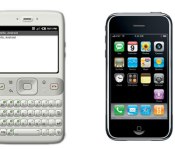
Before the iPhone was announced, Android didn’t support touchscreen input

Ahead of Apple revealing its first smartphone, Google’s plans for Android back in 2006 involved physical keys for control and no touchscreen input support. Revealed in court documents from the ensuing Apple-Samsung legal fray, the early specification says that “the product [Android] was designed with the presence of discrete physical buttons as an assumption. However, there is nothing fundamental in the product’s architecture that prevents the support of touchscreen in the future.” (The above render is from Google’s initial SDK, but by then, touchscreen integration was now part of the official spec.)
In this 2006 documentation, many of the Android staples (both in software and hardware) get a mention, including removable storage, third-party application support, widgets, notifications and all those Google services. Between the announcement of the iPhone and finalizing Android’s software requirements, touchscreen input was not only supported — multi-input touch was required, and our phones were never the same again.
Filed under: Cellphones, Mobile, Apple, Google
Via: Recode
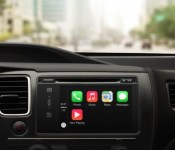
Alpine Planning to Release Aftermarket CarPlay Console This Fall
Car electronics manufacturer Alpine will begin selling a standalone aftermarket console that will support Apple’s CarPlay vehicle integration feature, reports Japanese business newspaper Nikkei. Alpine’s offering, which will likely be the first aftermarket device to support CarPlay, is said to hit the United States and Europe this year with a cost of around $500 to $700.

While CarPlay will be found in a number of announced and upcoming vehicles from manufacturers such as Mercedes-Benz, Volvo, BMW, Ford, GM, and Honda, the integration of the system into older vehicles has been a topic of much discussion in recent months. Pioneer Electronics expressed interest in implementing CarPlay compatibility with its existing and future products, only to back away from its comments soon after. Other companies, such as Kenwood, have indicated to MacRumors that CarPlay is only being looked at for integration and that adoption is not currently imminent.
Recently, automotive peripheral company Clarion also hinted at the possibility of bringing CarPlay its aftermarket in-dash systems. In an email to MacRumors, the firm noted that it has been working with Apple “from the start” and that it would be further developing its Smart Access in-car infotainment system and CarPlay for different purposes. Ultimately, the company stated that it will support CarPlay in both its aftermarket and OEM products at some point in the future.
Apple announced its CarPlay iOS vehicle integration feature last month at the Geneva International Motor Show. The feature allows an iPhone to take over the in-dash display of a car, providing Siri voice controlled access to aspects such as navigation, phone functions, messages, and music. The feature was included in Apple’s iOS 7.1 update and works with Lighting-enabled iPhones including the iPhone 5s, iPhone 5c, and iPhone 5.

Photos of New Building at Apple’s European Headquarters Show Glass Exterior, Spacious Interior [Mac Blog]
Photos of Apple’s new “Building 4″ office building located at its European headquarters in Cork, Ireland have surfaced on the website of Bennett Construction. The images show off the location’s glass exterior and spacious interior that features multiple office floors, a cafeteria with kitchen, a conference room equipped with large monitors, and a lounge-type area.


Apple’s European headquarters opened in 1980 as the company’s first location outside of the United States. In April 2012, it was reported that Apple would be adding 500 new jobs at the location, bringing the total headcount at the site to 3,300. The campus was also in the news that same year after Greenpeace activists scaled one of the location’s buildings to protest Apple’s use of coal-derived power at its data centers, although the company has earned high marks from the environmental activist group since then for pursuing renewable energy.


Work of course continues on Apple’s large Campus 2 project back in the United States, as the company has begun the first phase of its construction after the demolition of Hewlett Packard’s former offices. That phase will involve a 2.8 million square foot ring-shaped main building with an underground parking facility capable of holding approximately 2,400 cars, and the assembly of a 100,000 square foot fitness center and 120,000 square foot auditorium. The project is expected to be completed in 2016.



NDS4iOS Nintendo DS Emulator Now Available to Download
NDS4iOS, a Nintendo DS emulator that runs on both non-jailbroken and jailbroken iOS devices, is now available to install through an over-the air download, reports TouchArcade.
Similar to the first version of the popular GBA4iOS Game Boy emulator, NDS4iOS requires a device’s date to be set back to a prior date, specifically February 8, 2014. The emulator allows users to play Nintendo DS ROMs directly on their iPads and iPhones, and is compatible with iOS devices running iOS 5.1.1 and above. NDS4iOS also includes features such as Dropbox integration and iOS 7 controller support, as well as a settings menu that contains options for control pad style and position.

Although several emulators such as the iMAME arcade emulator have snuck into the App Store via shell apps in the past, they are usually pulled by Apple within hours or days after being released. However, NDS4iOS is able to overcome Apple’s restrictions as it bypasses the App Store entirely. Instead, the emulator can be installed directly on an iOS device by visiting its official website and tapping a download link.
The initial release of NDS4iOS follows a major update to GBA4iOS in February, which added controller skins for Game Boy Advance and Game Boy Color games as well as iOS 7 controller support, Dropbox integration, and a in-app web browser that can be used to download games from any ROM website. The emulator also temporarily allowed non-jailbroken users to install GBA4iOS without a date change via an Apple Enterprise certificate, however that was revoked soon afterwards.
NDS4iOS is available to install now through the emulator’s official website.

Alleged Images of iPhone 6 Chassis and Manufacturing Molds Surface
A new set of leaks showing alleged manufacturing molds and chassis sketches of the iPhone 6 have surfaced on Chinese microblogging site Weibo [Google Translate, via GforGames].


The photos are said to come from a factory belonging to Apple manufacturing partner Foxconn, as the first set of images show very detailed drawings of the chassis for a smartphone-type device, while the second set images are said to be of the manufacturing die used for Apple’s next-generation iPhone.

While the validity of the images cannot be confirmed, the leak follows a number of others in the past few months. Last month, another set of images posted on Weibo depicted an alleged iPhone 6 model under development at Foxconn, while Japanese magazine MacFan published alleged design drawings of what appeared to be 4.7-inch and 5.7-inch iPhone 6 models. This was followed by a photo reportedly showing cases designed for the larger next-generation iPhone that were consistent with the design drawings.
Apple is expected to ship the iPhone 6 later this year, which has been heavily rumored to come in two different sizes: 4.7 inches and 5.5 inches. Recent reports have noted that the smaller 4.7 inch version will ship in the third quarter of 2014, while the larger version may ship later this year or early next year due to production challenges.
Along with a larger screen, both models of the next-generation iPhone are said to include a thinner design, new A8 processor, Touch ID fingerprint sensor, 1GB of RAM, and an improved camera with optical image stabilization.

Gadget Rewind 2004: Rio Carbon
It’s our 10th birthday, and to celebrate we’ll be revisiting some of the key devices of the last decade. So please be kind, rewind.

Before the Rio Carbon arrived to take on Apple’s iPod juggernaut in 2004, there was Diamond Multimedia’s first stab at the digital music market: the Rio PMP300, a portable music player released in 1998. Since it was one of the first portable MP3 players ever to be sold, Diamond ended up embroiled in a fight for the future of the format. The PMP300′s ability to play digital music files downloaded from a computer led to a groundbreaking legal battle with the Recording Industry Association of America (RIAA). The RIAA challenged the company in court, claiming that its use of digital music files was copyright infringement, but Diamond won out and cleared the way for a new wave of portable music players (PMPs) to hit the market.
In the years that followed, Diamond Multimedia released over a dozen portable players. But it was 2004′s sleek Rio Carbon that caught consumers’ attention, a device praised by many reviewers for its superior audio quality. The timing of its commercial release also positioned it as a head-to-head competitor to Apple’s iPod mini. The Carbon offered a 5GB hard drive where the iPod mini only had 4GB, and its chrome, pebble-like body matched Apple’s tiny player for size — even weighing slightly less. The Carbon’s remarkably smudge-resistant exterior and 20-hour battery life trounced the iPod mini’s meager 8-hour span. It even featured USB charging, which was far more convenient than Apple’s reliance on proprietary cables. It was this attention to detail that made the Rio Carbon such an attractive alternative for consumers and earned it many lifelong fans.
It wasn’t just the hardware that drew customers to the Rio Carbon; it had some compelling software chops as well. The Carbon stood out from the PMP pack by offering users the ability to bookmark audio and record digital voice memos. It was also compatible with Windows Media DRM 10.0, a digital rights-management solution that allowed users to store and play songs from subscription services like Napster to Go and Rhapsody to Go. The Carbon also offered users an open ecosystem, giving them the freedom to sync and manage files from Windows Media Player 10, iTunes, MSN Music and several others.
Although the Rio Carbon was a solid effort from a small, enthusiastic company in the PMP space, it ultimately failed to stave off the inevitable market crush from Apple’s iPod. And by 2005, just one year past the Carbon’s introduction, the brand shuttered. Even Microsoft, a company with the vast resources to take on Apple, struggled to succeed with its now scrapped Zune digital audio player. In the end, Apple’s iPod surfaced as the undisputed king of the portable music player hill, a title it’s now ceded to the multitasking machines our smartphones have become today.
Did you own a Rio Carbon? Add it to your Engadget profile as a device you had (or still have) and join the discussion to reminisce or share photos of your device with other like-minded gadget fans.
Filed under: Apple

