


Rising Sapphire Display Cost May Limit Production of 5.5-Inch iPhone 6
A new post on Weibo citing supply chain sources (Google Translate, via GforGames) claims Apple’s 5.5-inch iPhone may see a limited production volume due to the use of high quality sapphire as a display material. According to the report, the high cost of producing the sapphire may hinder Apple’s ability to include the scratch-resistant material in a large number of its smartphone models.

The report notes that Apple’s sapphire display may cost 1743 yuan (or $280) in materials, which is a significant jump over the $44 estimated for the 4-inch Retina display used in the iPhone 5s. This extra expense could increase the retail price of the next generation iPhone by approximately 50 percent, which may price the smartphone beyond the affordability point for most consumers.
These latest reports suggest that the sapphire screen costs around 1743 yuan (or $280), which would raise the final cost of the device to about 8000 yuan (or $1285) – at least in China. At the moment, the 16 GB iPhone 5S costs 5288 yuan in China ($850), whereas the beefier 64 GB variant is retailed at the price of 6888 yuan (or $1106)
This rumor corresponds with an earlier report from analyst Ming-Chi Kuo, who suggested that supply constraints may force Apple to reserve the sapphire display for premium iPhone models such as the 64GB version of the 5.5-inch iPhone 6.
Though Apple still buys sapphire from third-party suppliers, the company is starting to produce the material in small quantities at its Arizona facility. The sapphire production plant, which is financed by Apple and operated by GT Advanced, is expected to produce between 100 and 200 million sapphire displays, enough for an entire line of devices when it reaches full operating capacity.

Apple to Host iPhone Upgrade Event at Retail Stores
 Apple is planning to hold an iPhone upgrade event at its stores this week in an effort to boost sales, a source told 9to5Mac. Starting this week, Apple will be emailing owners of older iPhone models who are upgrade eligible about the new event, and will apparently separate from Apple’s current iPhone trade-in program.
This event will be held in multiple states across the United States, and Apple is said to be preparing for an influx of visitors to its stores on the levels of traffic driven to stores for new product debuts. Apple will brief Apple Retail management on the initiative tomorrow, according to the source.
Apple will be launching other new marketing and sales initiatives to help increase iPhone sales as well. There’s no word on what types of marketing and initiatives Apple could use, but they will be tied to Apple’s retail stores.
New Apple retail chief Angela Ahrendts, who officially joined the company on May 1 and began her first full week today, will oversee the program.
Apple once again noted that iPhone sales hit another record for Q2 2014, making up 57 percent of Apple’s sales for the quarter for all products. CEO Tim Cook also noted in the conference call that Apple has started selling iPhone 4′s in the “very, very low single digit percentage” and last year said he wanted to sell more iPhones in stores.

New Retail SVP Angela Ahrendts Receives Signing Bonus Worth $68 Million [Mac Blog]
 New Apple Senior Vice President of Retail and Online Stores Angela Ahrendts has received a signing bonus potentially worth $68 million at current share prices, in the form of 113,334 restricted stock units that vest over the next four years.
Ahrendts will receive shares spread over several different vesting periods between June 1, 2014 and June 14, 2018, assuming Ahrendts stays with the company. Were Apple’s share price to rise, the RSUs could potentially be worth significantly more over that time.
A restricted stock unit is a standard form of stock compensation that reward employees for staying with the company. They are used as general compensation and for employee retention. Each RSU converts to one share of stock on its vesting date, typically set annually based on award date.
Because of Apple’s upcoming 7:1 stock split, awarded RSUs will be multiplied by seven to maintain value. Apple does award dividends to employee holders of RSUs as if they were standard shares, so the more than 110,000 shares that Ahrendts holds will be worth nearly $1.5 million in yearly dividend payments.
Angela Ahrendts officially joined Apple earlier this month.
Samsung’s ‘Infringe First and Stall as Long as Possible’ Strategies Are Nothing New
On the day that a San Jose jury submitted a final verdict on the damages that Samsung owes Apple in the second United States patent infringement lawsuit between the two companies, Vanity Fair has published a lengthy piece that takes a look at Samsung’s long (and successful) history of using patent infringement as a business tactic.
Back in 2010, before Apple filed an initial lawsuit against Samsung, executives from Cupertino (including lawyers) met with Samsung executives in Seoul, where it was made clear by Samsung VP Seungho Ahn if Apple chose to pursue a lawsuit, Samsung would countersue with its own patents. “We’ve been building cell phones forever,” Ahn told Chip Lutton, an Apple lawyer at the time. “We have our own patents, and Apple is probably violating some of those.”
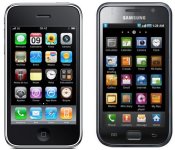
 The iPhone compared to the Samsung Galaxy S
As it turns out, stealing key ideas from other companies and then using its own portfolio of patents to draw out lawsuits is a tactic that Samsung used long before Apple came into the picture.
According to various court records and people who have worked with Samsung, ignoring competitors’ patents is not uncommon for the Korean company. And once it’s caught it launches into the same sort of tactics used in the Apple case: countersue, delay, lose, delay, appeal, and then, when defeat is approaching, settle.
In 2007, Sharp filed a lawsuit against Samsung, alleging that the South Korean company had violated its patents. Samsung countersued, drawing out the lawsuit as it continued to produce TV sets using the stolen technology, building up its TV business. Samsung was found guilty of patent infringement years later in 2009, at which point it settled with Sharp to avoid an import ban.
There’s a similar story with Pioneer, who filed a patent infringement lawsuit against Samsung over plasma television technology in 2006. Samsung countersued, dragging on litigation and appeals until a 2009 settlement. The long and expensive legal battle caused Pioneer to shut down its television business while Samsung thrived. Samsung has pulled the same stunt with Kodak, Apple, and several other technology companies.
Samsung hit Apple with the same tactic following the release of the iPhone. As has been documented during the ongoing global lawsuits between the two companies, Samsung evaluated the iPhone feature-by-feature and came up with 126 instances where Apple’s iPhone was better than its own offerings, which led to the development of the Galaxy S.
Bit by bit, the new model for a Samsung smartphone began to look–and function–just like the iPhone. Icons on the home screen had similarly rounded corners, size, and false depth created by a reflective shine across the image. The icon for the phone function went from being a drawing of a keypad to a virtually identical reproduction of the iPhone’s image of a handset. The bezel with the rounded corners, the glass spreading out across the entire face of the phone, the home button at the bottom–all of it almost the same.
Following the release of the Galaxy S and Samsung’s refusal to sign licensing agreements with Apple due to its former history of successfully avoiding significant penalties for copying intellectual property, Apple filed its first lawsuit against Samsung. Samsung, of course, followed, leading to where we are today — Samsung has thus far been ordered to pay Apple just over a billion dollars in the United States after two lawsuits, but appeals are far from over. Samsung has continued to develop its Galaxy line of devices and has cemented itself as Apple’s biggest competitor.
Meanwhile, as has happened with other cases where Samsung violated a company’s patents, it has continued to develop new and better phones throughout the litigation to the point where even some people who have worked with Apple say the Korean company is now a strong competitor on the technology and not just a copycat anymore.
The full story, which covers Samsung’s history, its past patent lawsuits and other legal woes, Apple’s creation of the original iPhone, and the dispute between the two companies, can be read over at Vanity Fair.
Apple’s Stock Price Breaches $600 for First Time in 18 Months
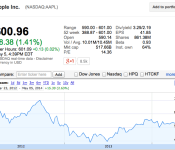
Apple’s share price has closed above the $600 mark for the first time since October 2012, some 18 months ago. It illustrate a significant recovery for Apple’s stock, which hit a low of $388/share in late June 2013.
The price is mostly psychological, made even more so by the fact that Apple will split its stock by a 7/1 ratio next month, dropping the price down to roughly $85 per share at current prices. The stock split is meant to allow more investors the opportunity to invest in the company.

Apple’s market capitalization is roughly $518 billion, well ahead of Exxon Mobil’s $444 billion. Apple is the most valuable publicly traded company in the world. The company’s all time high share price is $702.10, originally hit in September 2012.

Apple’s heart rate monitoring headphones were a hoax

Remember a couple of days ago when the internet was going all frothy-mouthed over a rumor that Apple would be releasing new EarPods with iBeacon integration and built-in heart rate sensors? Well, turns out to have been a rather poorly thought out joke — one that just happened to jibe with past rumors. The source of the supposed leak came clean about the hoax and apologized for, well, everything. For putting it out there in the first place, for failing to correct sites that reported it as fact, for failing to reach out to people who contacted him to confirm his story — basically for letting the entire thing spiral out of control.
The leak started as a post on Secret, the anonymous social network that gives people a safe place to confess their deepest, darkest secrets. The culprit in this case claims to have been experimenting with it as a platform for telling jokes and dreamed up this whopper while sitting on the can one morning. (No seriously, this is one guy’s take on literal bathroom humor.) With zero sourcing or any concern about what might happen if someone thought it was a legitimate leak he posted the following:
Apple’s new EarPods will have sensors in them, for heart rate & blood pressure. Also iBeacons so they don’t get lost. They will require the lightning port, it’s why the audio jack was moved to the bottom.
Apparently the lack of sourcing and complete anonymity didn’t bother most of the internet, which turned into an over-zealous echo chamber. From there it was just a matter of eager reporters filling in the gaps with their own bits of conjecture, and the story took off. To be fair, Apple had filed a patent for something similar and the company recently hired Eric Winokur from MIT who specializes in wearable medical devices. But according to the person behind the Secret post, he was unaware of these details. And just to be clear he does not and never did work for Apple. But now the truth is out there and we can all go back to ignoring anonymous, unfounded rumors… or not. This is the internet after all.
Source: Earpod Secret, Secret

Nokia Refocusing on HERE Maps Integration for iOS and Android [iOS Blog]
A pair of LinkedIn job listings spotted by Nokia Power User is being interpreted as a sign that Nokia’s HERE mapping and location services may be returning to iOS, but Nokia’s Pino Bonetti points out that the company is simply focused on delivering SDK tools to allow third-party developers to incorporate HERE maps into their apps.
Hi guys, just to clarify, a mobile SDK is not an app. We are providing tools to our partners so that they can build apps with our maps. We already announced this on our blog (HERE Three Sixty) and you can already see some action: Amazon is using our maps in their Kindle Fire, Deutsche Telekom is using our maps for their Arrival Control app on iOS and Android.
With Microsoft having closed its purchase of Nokia’s devices unit late last month, a scaled-down Nokia will need to focus on other areas where it holds a leadership advantage, and HERE is one way Nokia can leverage its NAVTEQ mapping expertise.
As for a standalone HERE app for iOS, it does not appear that Nokia has any public plans to return to the platform. Nokia’s HERE Maps app was previously available to iOS owners, but the app was pulled by Nokia last December due to compatibility problems with iOS 7. The company put the blame for the removal on Apple, claiming that changes in iOS 7 “harm the user experience.”

The job listings seek experienced developers to work on the company’s mobile engineering team as they assist in the building of “advanced location-based services applications for the Android and iOS platforms.”
As an Android / iOS developer you will be a key member of our growing mobile engineering team, developing industry-leading mobile SDKs / applications. This is an experienced position that requires fluency in the latest Java capabilities and improvements in the Android and iOS SDK. The ideal candidate is motivated to explore and deliver the best possible solutions to our customers.
Formerly known as Nokia Maps and Ovi Maps, the HERE service uses the Nokia-owned NAVTEQ mapping database to provide navigation services, transit maps and points-of-interest information. Nokia HERE is one of three business units remaining after Microsoft acquired Nokia’s mobile devices and services business.
HERE is attempting to gain traction in a crowded iOS marketplace dominated by rival Google Maps, iOS Maps and other third-party apps from Navigon and TomTom. After a rocky start in iOS 6 and some improvements and visual changes in iOS 7, Apple is rumored to be bolstering its Maps application in iOS 8 with new transit information, expanded points of interest, and improved cartography.
Apple Considering ‘Full Health and Fitness Services Platform’ Modeled on the App Store
Apple allegedly is looking beyond the iWatch wearable device and may be creating a new health and fitness ecosystem modeled on its successful iOS App Store, claims a mobile health executive who recently spoke to Reuters. Similar to the iOS App Store, this new platform may allow companies to develop their own mobile medical applications that could tie into Apple’s iWatch wearable device.
One mobile health executive, who asked not to be named, told Reuters he recently sat down with an Apple executive from the iWatch team. He said the company has aspirations beyond wearable devices, and is considering a full health and fitness services platform modeled on its apps store.
As part of iOS 8 later this year, Apple is rumored to be launching a new Healthbook app, which is expected to serve as a repository for health-related data acquired from a variety of sources. Based on the breadth of data the app appears to be able to track, it is unsurprising that Apple will be looking to open up the ecosystem to third parties to help users fill out all of the various content areas.
One company that could benefit from an Apple health and fitness ecosystem is Nike, which has scaled back its work on its Fuelband hardware to focus on expanding its software-based NikeFuel platform. Though Nike CEO Mark Parker would not directly comment on specific plans with Apple, Parker did note in a recent CNBC appearance that Apple is a longtime partner and that he is “excited about where that relationship will go forward.”
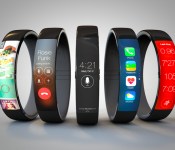
 iWatch concept by Todd Hamilton, based on the Nike FuelBand
Much of today’s report focuses on Apple’s health- and sensor-related hires over the past several years, most of which have previously been detailed and which have been focused around non-invasive monitoring of vital health parameters such as sleep, oxygen saturation and blood glucose levels. Apple has hired talent from notable companies such as pulse oximetry company Masimo, medical sensor company Vital Connect and Philips Sleep Research.
Apple’s latest reported hire is MIT researcher Eric Winokur, who worked on ear-worn devices for monitoring blood pressure and heart rate. Information about Winokur’s hiring surfaced alongside a sketchy rumor claiming Apple is planning to launch an EarPods model with integrated heart rate and blood pressure sensors. While a new Tumblr blog claims to be from the person who made up the rumor, Apple patent applications suggest the company has indeed considered the integration of biometric sensors into its headphone line in the past.
Apple’s sensor-laden iWatch has been rumored for several years, with most recent rumors suggesting that it may debut late this year. It is not expected to be unveiled at the company’s Worldwide Developers Conference set for early June.
iOS 7 Security Flaw Leaves Stored Email Attachments Unencrypted
Apple states that it uses data encryption to protect email message attachments, but a report from security researcher Andreas Kurtz, via ZDNet, claims iOS 7.0.4 and later does not include this security feature.
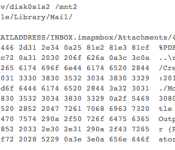
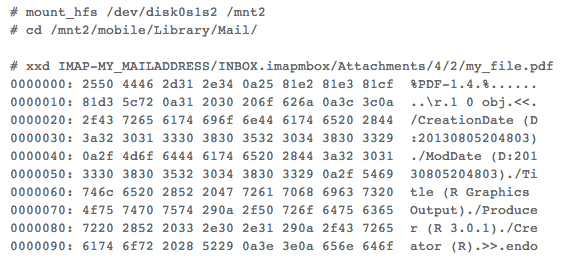 Kurtz detected this flaw in iOS by accessing the file system on an iPhone 4 running iOS 7.1 and 7.1.1. Browsing through the email folder for an IMAP account, Kurtz discovered that the email attachments were stored in an unencrypted state. Besides the iPhone 4, Kurtz also was able to reproduce this vulnerability on an iPhone 5s and an iPad 2 running iOS 7.0.4.
I verified this issue by restoring an iPhone 4 (GSM) device to the most recent iOS versions (7.1 and 7.1.1) and setting up an IMAP email account1, which provided me with some test emails and attachments. Afterwards, I shut down the device and accessed the file system using well-known techniques (DFU mode, custom ramdisk, SSH over usbmux). Finally, I mounted the iOS data partition and navigated to the actual email folder. Within this folder, I found all attachments accessible without any encryption/restriction
Kurtz reported this issue to Apple, which acknowledged the flaw, but provided no timetable for patching it. This isn’t the first security issue Apple has faced this year. The company recently patched a serious SSL connection verification flaw in both iOS and OS X that allowed an attacker with a “privileged network position” to capture data protected by SSL/TLS.
Apple Donates $500,000 to ‘SF Gives’ Anti-Poverty Initiative [Mac Blog]
Apple has donated $500,000 to SF Gives, an anti-poverty initiative formed by Salesforce.com CEO Marc Benioff and Tipping Point CEO Daniel Lurie, reports Fortune. Apple’s contribution comes ahead of the SF Gives’ Wednesday deadline, which looks to get 20 companies to contribute $500,000 each, or $10 million in total to fund charitable programs in the Bay Area.

The Cupertino, Calif.-based tech giant joins a list of 15 corporate contributors that includes Google, LinkedIn, and Zynga. Launched in early March, SF Gives is the brainchild of Salesforce.com (CRM) CEO Marc Benioff and Daniel Lurie, CEO of the nonprofit Tipping Point.
The donation also follows a number of charitable moves made directly by Apple in the past few years, including the establishment of a donation matching program for employees which generated $2.6 million in less than a year. Since 2006, Apple has also partnered with (Product) RED to contribute a total of $70 million towards HIV/AIDS programs in Africa. Through the collaboration, Apple has sold special (RED) products, including iPhone 5s cases, iPod nanos and shuffles, iPad Smart Covers, and iPhone Bumpers.

