



Apple Retail Under Angela Ahrendts: Focus on Mobile Payments, Customer Experience, and China
Angela Ahrendts officially joined Apple just under three weeks ago, but the new retail chief already has a solid plan in mind for improving both the online and retail Apple Store experience for customers. In a detailed report on Ahrendts, 9to5Mac suggests the retail leader will focus on three separate areas in her efforts to revamp Apple retail: China, mobile payments, and a redesign of the “end-to-end Apple Store sales experience.”
Growth in China is highly important to Ahrendts as it represents a major market where Apple hasn’t managed to gain a strong foothold. As of February, Apple only had seven percent of total smartphone market share in the country, but the company has worked to secure deals with all of China’s major carriers over the course of 2013, leaving it ripe for expansion. Ahrendts has plans to bolster Apple’s retail presence in the country, reaching 30 stores by 2016, up from the current 10 stores.

Along with expanding Apple’s footprint in China, Ahrendts is also said to be aiming for an overhaul of the end-to-end Apple Store sales experience, reimagining product discovery, customer interactions with employees, and mobile payment options, another tenet of Ahrendts’ three point plan. Over-the-phone service, Personal Setup, and the company’s trade-in programs may also see improvements under Ahrendts.
Ahrendts and new online stores VP Kupbens are seeking to improve mobile payments in Apple’s retail stores and mobile apps for both the online and in-person purchases. Ahrendts is said to be eyeing a major focus on blurring the lines between Apple’s online and physical stores in order to improve the overall experience for Apple customers.
As she settles into her role and begins enacting major changes to the retail and online sales experiences, Ahrendts has been visiting Apple stores close to Cupertino, in San Francisco and Palo Alto. Employees have described her as “honest,” “warm and genuine” and “so Apple.”
Ahrendts has also reportedly re-architectured Apple’s in-house retail team to better suit her needs, with longtime Vice President of Retail Stores Steve Cano moving on to international sales. Wendy Beckman, head of retail in Europe, and Denny Tuza, head of retail in China, will gain new responsibilities, while Apple’s VP of Apple Retail Real Estate Bob Bridger and the company’s VP of Retail Operations Jim Bean will both retain their roles. Bob Kupbens, the new VP of Online Retail will handle Apple’s online stores.
Back in October, when Ahrendts’ hiring was first announced, Apple CEO Tim Cook said he was “thrilled” she was joining the company, emphasizing that she shared Apple’s values, “focus on innovation,” and the company’s dedication to customer experience.
As CEO of Burberry, Ahrendts famously revamped the company’s entire shopping experience, and it’s likely that she will bring similar improvements to Apple customers at a time when the company is poised to launch several new major products, including the iPhone 6 and the iWatch.

Apple Allegedly Tapping Innolux as 3rd iPhone 6 Display Supplier Ahead of Expected Strong Demand [iOS Blog]
According to Taiwan’s Economic Daily News as reported by GforGames, Apple may be turning to Taiwnese supplier Innolux to provide display panels for its 4.7-inch iPhone 6 model. Apple reportedly has contracted with LG Display and Japan Display Corporation for the 4.7-inch panels, with Innolux added as a third partner to support the expected high demand for a larger iPhone model.

Apple may have been negotiating with Samsung and Sharp as well as Innolux for the panels, but the Cupertino company was said to have rejected offers from Samsung and Sharp.
Allegedly, the reason why Apple refused to collaborate with Samsung is because the Korean tech giant is too much of a direct competitor. As far as Sharp goes, Apple turned down the said company, following the analysis of the first wave of sample panels, which appear to be suffering from “Moire” issues.
Innolux has a long history of working with Apple on display technology, with the company reportedly suppling panels for previous Apple products such as the iPad 2 and the iPad 3.
It’s not surprising that Apple would bring in a third supplier for the iPhone 6 as demand is reportedly strong for a larger iPhone model, with Cantor Fitzgerald analyst Brian White calling the 4.7-inch iPhone 6 launch “a special one” for Apple. Apple’s next iPhone model is expected to arrive in two display sizes, with a 4.7-inch model likely debuting this fall, and the 5.5-inch possibly landing several months later.
Apple and Samsung Negotiating Agreement to Settle Patent Disputes Out of Court
Apple and Samsung may be close to reaching an agreement that would settle all patent infringement lawsuits out of court, claims Kim Yoo-chul of The Korea Times (Via Fortune). This account follows a previous report from late last week that Apple and Google/Motorola have reached an agreement to drop all ongoing litigation between the two companies.

Samsung and Apple are reportedly in the early stages of negotiation with some key details on royalty payments still under negotiation.
“Samsung has recently resumed working-level discussions with Apple and the key issue is how to dismiss all lawsuits,” one source said, declining to be named.
[…]
“Some more time will be needed to fix terms of details such as royalty payments in return for using patents owned by each before reaching a full agreement.”
Apple and Samsung recently faced off in a California court as part of the second US patent infringement lawsuit between the two companies. In the case that concluded earlier this month, the jury found that Samsung willfully infringed on three of the five Apple patents involved in the lawsuit and ordered the Korean company to pay Apple a sum of $119.6 million. Apple also was found guilty of infringing on one of Samsung’s patents with damages totaling $158,400.
Intel CEO ‘Guarantees’ Broadwell Chips by This Holiday Season
Intel CEO Brian Krzanich has stated that Intel’s next-generation Broadwell processors will launch during this holiday season, reports Reuters (via MacG).
“I can guarantee for holiday, and not at the last second of holiday,” Krzanich said in an interview. “Back to school – that’s a tight one. Back to school you have to really have it on-shelf in July, August. That’s going to be tough.”
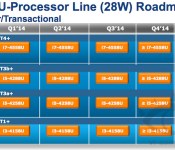
Originally expected to launch in Q3 2014, Krzanich noted that new manufacturing technologies are responsible for the delays surrounding Broadwell, but maintained that Intel is now on schedule to ship its new chips to manufacturers later this year. The statement comes after a leaked Intel roadmap surfaced this past February, which appeared to show an uncertain timetable for Apple’s 2014 Mac updates.
 A leaked Intel roadmap for 28-watt chips appropriate for 13-inch Retina MacBook Pro
With Intel’s Broadwell chips launching near the end of this year however, it is possible that Apple could either choose to wait until next year to integrate Broadwell chips into the Retina MacBook Pro or launch updated models with slightly faster Haswell chips. Apple updated its standard models of the MacBook Air last month with a faster 1.4 GHz dual-core Intel i5 processor while cutting the price by $100.
It is also possible that Intel’s new Broadwell chips could be used in the rumored 12-inch MacBook Air, which may coexist alongside or replace the current MacBook Air line. However, it is uncertain which specific chips Apple would use for the new notebook, as prior reports have pointed to the machine coming out towards the end of the third quarter.
As far as a next-generation iMac goes, Apple could also choose to hold off on an update until the appropriate Broadwell chips are out. However, a report last month claimed that Intel’s faster Haswell desktop CPUs could arrive in May, with Apple perhaps launching updates sooner rather than later.
Apple is also rumored to have a low-cost iMac in the works, which could utilize more cost-efficient chips. According to KGI Securities analyst Ming-Chi Kuo, the low-cost desktop computer could boost sales in critical foreign markets and increase shipments by up to 30 percent.
Original ‘Rainbow’ Apple HQ Signs Up for Auction, Bidding Starts at $10,000 [Mac Blog]
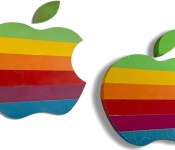
The original “rainbow” Apple logo signs that were used at Apple’s Cupertino, California headquarters are set to be auctioned off in June for somewhere between $10,000-$15,000, reports Design Taxi (via The Verge).
The signs will be auctioned off by British auction house Bonhams, with the larger, 46 x 49 inch version made out of foam and the smaller, 33 x 36 inch version made out of fiberglass. According to the auction, both signs were given to a longtime Apple employee after their removal in 1997.

Two original exterior office building signs, approximately 46 x 49 x 1 1/2 inches and 33 1/2 x 36 x 6 inches, each with separate stem piece; the larger sign made of stiff foam with 6 vinyl applied colors; the smaller sign made of fiberglass backed with metal, vinyl applied colors; edgewear to both signs, some colors with slight pealing at transitions, larger sign with one color showing significant craquelure, both with stray marks and outdoor wear.
 (Image credit: Glassdoor via Logo Design Love)
In use from 1977 to 1998, Apple’s rainbow logo was designed by graphic artist Rob Janoff. According to Janoff, the logo was designed in two weeks after an examination of physical cross-sections and real apples, with the multi-colored stripe design personally approved by Steve Jobs. Appearing on every product from the Apple II to the Newton PDA, the rainbow logo was retired in favor of a monochrome version, which is still in use today.

ABI Research: Samsung catching Apple in tablet shipments in 2014
 Apple pioneered the tablet device market and has had a headstart on its competitors for years, opening up a huge lead in the number of devices sold. That gap is gradually closing, however, and the latest statistics to support this comes from ABI Research who has just released its latest findings. According to the findings, in the first quarter of 2014, Apple still led with 16.4 million units shipped with Samsung in second place with 13 million units shipped, marking the first time the two giants have been so close in these figures. The key here is that Apple’s shipments in this quarter were actually down by 10.1% since a year ago, whereas Samsung has experienced a 10.80% increase in the same period.
Interestingly, while Android has a market share of tablet shipments totalling 56.3%, Samsung and Apple alone made up for 71.3% of the 41.3 million tablets shipped in Q1 this year. To put that in perspective, ASUS, who is a distant third in these standings, shipped 2.1 million tablets in Q1, which already takes into account the Nexus 7 tablets. Tablets may remain iOS’ realm for another quarter, but it won’t be long before Samsung overtakes them in the near future, and hopefully the other Android manufacturers can take a bit more of the cake too.
What do you think about these tablet figures? Are you surprised an any of these numbers? Let us know your thoughts in the comments.
Source: ABI Research via Phone Arena
//<![CDATA[
ord = window.ord || Math.floor(Math.random()*1E16);
document.write('’);
//]]>

Facebook Developing New Snapchat Competitor, May Launch This Month [iOS Blog]
Facebook is building a new app that will serve as a direct competitor to Snapchat, according to a report from the Financial Times. The project, which is codenamed “Slingshot”, will enable users to send each other pictures or short video messages through a simplified, grid-based interface similar to the one seen in messaging app TapTalk. Like Snapchat, photos and videos can only be taken in real time, and messages disappear after a specified time limit.
 Facebook’s new ephemeral messaging app is said to resemble TapTalk (pictured above)
Facebook head Mark Zuckerberg is said to be personally overseeing the project, with Slingshot’s development coming after Facebook attempted to buy Snapchat for $3 billion last year. The news also follows Facebook’s removal of its long defunct Facebook Poke app from the App Store earlier this month, which was the company’s first answer to Snapchat. Originally launched in December of 2012, Poke allowed users to send ephemeral photos, videos, text messages, and “poke” notifications to their friends.
According to the report, Slingshot could be released as early as this month on mobile platforms. Facebook previously launched its news content and curation app Paper this past February. The app was the first product to come out of Facebook’s Creative Labs initiative.

Italian Regulators Investigating Apple and Others Over ‘Freemium’ App Pricing Model [iOS Blog]
 The Wall Street Journal reports that Italy’s Antitrust and Competition Authority has launched an investigation to determine whether internet companies such as Apple, Google, and Amazon mislead people by offering in-app purchases for titles that are listed as free downloads.
Consumers could be led to think, contrary to reality, that a game is completely free and therefore they don’t know ahead of time the game’s true cost,” the regulator said in a statement. “It appears also that there is a lack of information regarding how to exclude or limit the possibility of making a purchase inside the app.
The news comes as Apple has been the target of multiple complaints from consumers and regulatory agencies over in-app purchases in recent years. After multiple parental complaints were filed with the FTC in 2011, Apple came to a settlement in January which saw the company provide $32 million in refunds to parents whose children purchased unauthorized in-app items.
Apple has also implemented a number of changes to its in-app purchase policies, including requiring a separate passcode entry for initiating in-app purchases, providing multiple notifications before a purchase is made, and obtaining express consent from consumers before billing them for an in-app purchase. The company has also displayed “Offers In-App Purchases” disclosure on individual app detail pages and inserted small “In-App Purchases” notifications for apps in Top Charts listings and elsewhere.
If found at fault, Apple could receive a maximum fine of €5 million, or approximately $6.8 million. Italian regulators previously fined Apple $1.2 million in late 2011 and another $260,000 in late 2012 over AppleCare practices, stating that the company was not providing customers with sufficient information about the two years of the free product warranty required under Italian law. As a result of this, Apple added an online statement on warranty disclosures to its customers in Italy. 
Add Apple CarPlay to your existing ride with Pioneer’s latest head units

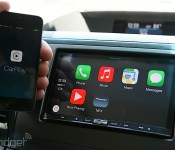
If you’re an iPhone user who’s dying to try out the new auto-friendly CarPlay interface, but can’t quite shell out the big bucks for a new Ferrari, Pioneer has good news for you: It recently announced that all of its 2014 NEX head units will be CarPlay-compatible. Indeed, if you already purchased one of Pioneer’s five aftermarket receiver models that were released earlier this year, you too can have CarPlay with a simple firmware update that’s coming out in a few months. I had the opportunity to see this in action with a Pioneer AVIC-8000NEX installed in a Toyota Sienna a couple days ago, and it’s exactly how it would appear in a car with CarPlay already built in.
All you need to get started is to plug your iPhone (it needs to be one with a Lightning cable) to the NEX unit and the CarPlay interface will appear. Just as we saw at the Geneva Auto Show in March, CarPlay’s interface mirrors that of iOS, even right down to the app icons. You’ll get access to the features that you want most when you’re driving around — voice calls, messaging, maps and music. The latter includes your iTunes library, of course, but CarPlay will also support third-party audio apps like iHeartRadio and Spotify at launch. Interacting with apps on the Pioneer head unit is the same as with a built-in system — you can either tap the screen or hit a button to activate Siri voice commands.
Ted Cardenas, Pioneer’s VP of marketing, took me on a little drive around San Francisco to get a real-world feel for CarPlay. What surprised me the most about the experience was how Siri really comes into its own as a way to deal with your phone while in the car. As an iPhone user, I’ll admit I almost never use Siri, preferring instead to just tap, swipe and type on the touchscreen. Of course, in a car, that’s a very unwise thing to do, which makes Siri invaluable. You can play music by saying, “Play,” and then the name of a song; make calls simply by saying, “Call,” followed by the person’s name; and say, “Read unread messages,” to prompt Siri to do just that.

When you get a new message, CarPlay will temporarily mute the song you’re listening to and you’ll hear a slight, unobtrusive ping. From there, you can tap the new-message banner, at which point Siri will tell you who it’s from. To ensure safety, CarPlay will never display the full message on the screen and defaults to Siri reading it out to you. From there, you can reply to the message by saying something like, “Tell John I’m running late.”
And because Siri lets you use natural language, getting directions to a place is as easy as saying, “How do I get to,” followed by the name of your destination. Compared to most in-car systems, where you have to follow a strict voice script, like adding your city and state and having to spell out an address, Siri seems a lot more user-friendly. And because Siri is connected to your phone, you can use it for other functions too. Cardenas demonstrated that you can tap the Siri button to request reminders or ask for the latest scores of a baseball game.

There are a few important caveats, however. For one thing, Pioneer’s NEX units won’t fit in every car. Vehicles that integrate climate control with entertainment, for example, can be difficult to accommodate. Further, some cars have steering wheel buttons that can be mapped to prompt Siri, while others don’t. You’ll still be able to use the touchscreen and the buttons on the Pioneer head unit, so it’s not a total loss, but the NEX’s compatibility with your car’s selector and volume controls can vary from manufacturer to manufacturer.
Last but not least, the Pioneer NEX receivers are not cheap. The cheapest — the AVH-4000NEX — will cost you close to $700, while the top-of-the-line AVIC-8000NEX is priced around $1,400 retail. That said, $1,400 is still a lot more affordable than getting a shiny, new luxury car from Ferrari, Mercedes or Volvo, especially if all you want is CarPlay. Pioneer tells us that if you bought a new NEX unit already, you can update it with a simple USB stick to get CarPlay, but if you wait until later in the year to get one — we’re hearing “early summer” — it’ll already be pre-installed. Until then, we suggest you peruse through the gallery above or view our hands-on below from the Geneva Auto Show to see if CarPlay is worth waiting for.
Apple Releases 11.2.1 iTunes Update to Fix Hidden ‘/Users’ Folder Bug
After Apple released OS X 10.9.3 yesterday, some users started experiencing a bug that hid their /Users folder. It appears that Apple has released a small iTunes update, numbered 11.2.1, to combat the bug. MacRumors forum member IzzyJG99 notes:
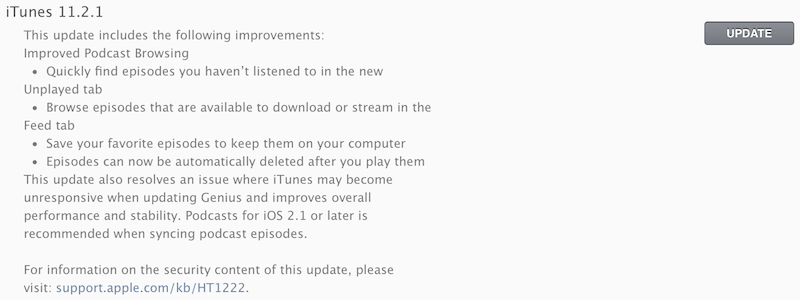
An update just popped up for me. iTunes 11.2.1 in the App Store. When it was done installing it had a little pop up about iPhoto Library. Now the User folder is showing up again.
Users can update to iTunes 11.2.1 via the updates tab in the Mac App Store or through OS X’s “Software Update” drop-down menu.

