


Siri in iOS 8 will let you identify songs and buy from iTunes

Siri is going to learn a few new tricks in iOS 8. As rumored, the voice assistant will now identify songs using Shazam; if you want to find out the name of a catchy track, you don’t have to fire up a separate app. You’ll also have the option of buying iTunes content. The speech recognition system is smarter, to boot — it now shows what you’re saying in real time, and you can start commands by speaking “hey, Siri” (much like Android KitKat’s “OK Google”) instead of holding down the home button. There’s no mention of integration with third-party apps so far, but this is still a big step forward for iOS users who prefer voice dictation for all their tasks.
Filed under: Cellphones, Tablets, Mobile, Apple

Apple will let you log into other apps with TouchID

Guess what folks! With iOS 8 Touch ID will finally be useful for something besides unlocking your phone and buying apps. During the big keynote at WWDC 2014 Apple announced the debut of an API for TouchID. That means other apps will be able to use the fingerprint scanner on your iPhone for authentication. Your actual fingerprint data is still stored securely on the hardware, and is never actually exposed to developers. That means you could quickly and easily order a bombproof case for your precious phone just by holding your thumb across the home button and never worry that a bug in the Amazon app could expose your fingerprint to nefarious actors. That should relive some of the pain associated with keeping all your various accounts secure — which, as you’ve been told countless times, should all have unique passwords with a mixture of letters, numbers and special characters. Android users may have in-app access to LastPass, but simply scanning your thumbprint seems that much easier.

iOS 8 apps can share data, features with each other

Apple’s annual developer conference is well underway, and it just revealed what could be a seismic shift in the iOS world: third party apps will soon be able talk to each other. Historically, applications on iOS have lived in their own silos, without being able to share data and features, but that’s set to change in iOS 8. Apple has given developers “Extensibility” tools — a suite of APIs, if you want to get technical — that they can wield to let their apps share everything from documents to translation services. A demo onstage showed a Bing extension for Safari doing inline translation of a Japanese website, and using Pinterest to share a photo from a website in just a few taps.

Of course, info sharing is bound to be a boon for third-party Twitter apps and other social networking services. This kind of interaction between apps has existed on other platforms like Android, and of course the best examples are support for third-party keyboards and widgets in notifications. Both features will be in the new iOS, but the implementation goes deeper. Apps can also select a default storage location that’s accessible by other apps — it’s not exactly a traditional file browser but it sounds close. As a security measure, iOS 8 will act as a middleman when it comes to sending data between apps, rather than letting applications chat directly with each other.

Picture-taking apps can also embed their filters and photo editing tools directly into the new Photos app, letting users make adjustments without bringing the images to yet another app. Finally, devs can create custom buttons for the action sheet (the popup menu that looks the same in every iOS app and lets you choose what to do next, shown above from iOS 7) so users can add watermarks, translate documents, or do anything else. We’ll have to wait and see how developers make use of the new tools, but there should be a mix of existing services and features ported over from Android, plus some entirely new takes on sharing.
Filed under: Software, Mobile, Apple
Source: Apple iOS 8 Developer site

Apple’s Swift is a new programming language with a focus on speed and ease of use

Apple’s used Objective-C as its programming language of choice for right around twenty years now, but it’s brought something new to its yearly developer conference: Swift, a new tongue of its own making. Apple describes its new lingua franca as “Objective-C without the C,” but it keeps (and improves on) the speed of its progenitors. In other words, iOS and OS X apps built with Swift should run even smoother and faster than counterparts made with the tried and true Objective-C. According to Cupertino, Swift can be used to craft anything from social networking apps to 3D games.
The proverbial baby isn’t going out with the bath water, however, as Swift code can run alongside Objective-C and C in the same application. Swift may also make life easier for developers in a number of ways, one of which is a “playground” feature that provides a preview of what’s being programmed. For example, Cook. and Co. demoed how a developer could visualize a flight path of an in-game blimp (in realtime, no less) just by tweaking a few lines of code.
If you’re raring to get into the nitty gritty of the language, you can read up on its finer points thanks to a free e-book Apple’s just released. Developers itching to get their hands dirty with Swift can download the XCode 6 Beta and get coding. However, submitting an app written with Swift to the App Store will have to wait until iOS 8 and OS X Yosemite arrive this fall.
Filed under: Apple
Source: Apple

iOS 8 to Include Support for System Wide Third-Party Keyboards [iOS Blog]
Apple today announced at its Worldwide Developers Conference that iOS 8 will support system wide third-party keyboards.
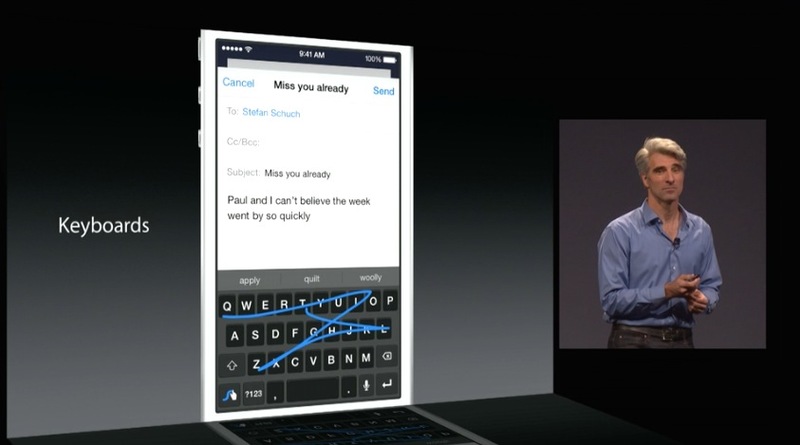
The company showed something that appeared to resemble the popular-gesture based keyboard Swype running on iOS 8, as software chief Craig Federighi noted that keyboards have the most restrictive sandbox to ensure user privacy and safety.
To this point, third-party keyboards such as SwiftKey Note and Flesky have launched for iOS, although their integration has been limited to note-taking in a separate app and allowing app developers to incorporate their keyboard, respectively. With this announcement, it is likely that both keyboards will launch for iOS with full integration at some point in the future.
Support for third-party keyboards will be included with iOS 8, with the new mobile operating system expected to launch this fall.
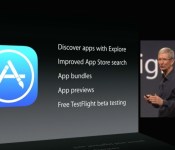
Apple to Enhance App Store with ‘Explore’ Tab, App Bundles, Beta Testing, and More [iOS Blog]
After showing off the main features for iOS 8 at its Worldwide Developers Conference today, Apple announced improvements for the App Store starting with iOS 8, including app bundles, integrated beta testing, improved search and more.

In order to improve discoverability, the App Store will soon add an “Explore” tab, allowing users to explore through categories and sub-categories easily. Search has also been improved, with the ability to see the top trending searches in the App Store and related searches.
Developers will also be able to bundle together apps, allowing users to buy multiple apps for a single discounted price. Also available to developers are previews, which allows developers to include short videos to tell users what their apps are all about.

Finally, developers can also invite users to beta test their apps in a new service called TestFlight, which allows developers to see information about their apps from right within the service. The service is free for developers, and stems from Apple’s acquisition of Burstly, which offered its own TestFlight beta management service, back in February.
Apple also announced that there are now 1.2 million apps in the App Store and nearly 300 million visitors to the App Store per week who are downloading apps. The App Store has also reached another significant milestone, passing 75 billion apps been downloaded since its 2008 debut.
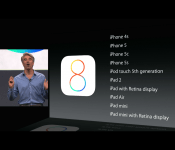
Apple to Discontinue Support for iPhone 4 in iOS 8 [iOS Blog]
Near the end of today’s keynote at the Worldwide Developers Conference that included a first look at iOS 8 among other things, Apple revealed what iOS devices will be compatible with its new mobile operating system this fall. That list included the iPhone 4s, iPhone 5, iPhone 5c, iPhone 5s, iPod touch 5th generation, iPad 2, iPad with Retina Display, iPad Air, iPad Mini, and iPad mini with Retina Display.

Notably missing from the list is the iPhone 4, which saw compatibility with iOS 7 last year and even saw improved performance with iOS 7.1. Apple restarted iPhone 4 production for countries including Brazil, India and Indonesia earlier this year, but the device will likely be now be discontinued again in the near future.
iOS 8 will launch this fall with revamped notification features, a new QuickType keyboard that adds predictive typing suggestions, an enhanced Messages app, a new Healthkit app that aggregates health-related metrics, improvements to Siri, and many more features.
Apple Announces Significant SDK Improvements with New ‘Swift’ Programming Language, CloudKit and More [iOS Blog]
Apple devoted the last third of its keynote address at the Worldwide Developer Conference today to improvements for its Software Development Kit (SDK), launching a new programming language called Swift, and development kits for health, home automation, iCloud and inter-app operability.
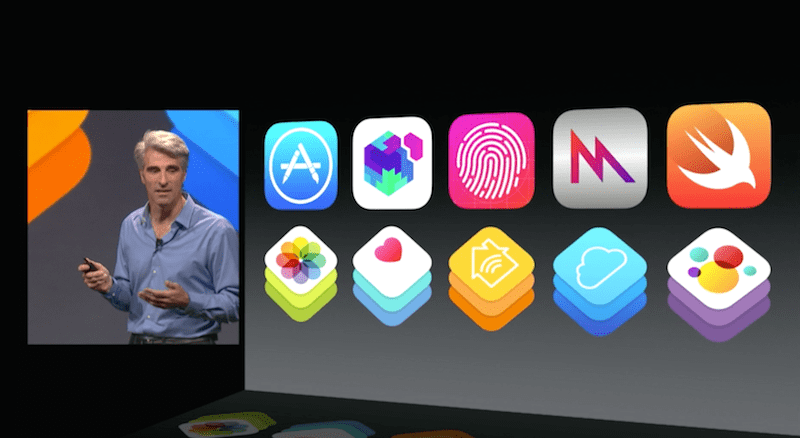
The announcement that got the biggest reaction from developers was Swift, a new programming language for Cocoa and Cocoa Touch that Apple calls modern, fast and powerful and designed for safety.
Swift is the result of the latest research on programming languages, combined with decades of experience building Apple platforms. Named parameters brought forward from Objective-C are expressed in a clean syntax that makes APIs in Swift even easier to read and maintain. Inferred types make code cleaner and less prone to mistakes, while modules eliminate headers and provide namespaces. Memory is managed automatically, and you don’t even need to type semi-colons.
Swift also includes “Playgrounds”, which allows developers to see the results of their code in a side panel in real time. The developer community appears extremely excited about Swift, with Realmac’s Nik Fletcher saying he had “no words”. Notable Apple pundit and developer John Gruber said that Swift is “huge, huge news” and the “future of all Apple development”.
iCloud has also been partly opened up for developers with a powerful new framework for developers called CloudKit. It allows developers to avoid costly and time-consuming coding the server-side of applications, with Apple providing huge amounts of cloud storage and computing power for free, albeit with extremely high limits to encourage tight coding.
Leverage the full power of iCloud and build apps with the new CloudKit framework. Now you can easily and securely store and efficiently retrieve your app data like structured data in a database or assets right from iCloud. CloudKit also enables your users to anonymously sign in to your apps with their iCloud Apple IDs without sharing their personal information.
Additionally, Apple announced lots of new APIs for developers to take further advantage of iOS. Extensibility allows apps from the App Store, which are usually isolated in sandboxes, to communicate with each other. For instance, the Pinterest app could be updated to provide a sharing option in Safari, or Bing could be updated to provide translations within Safari. Another example includes the Photos app, which can use filters from third-party apps like VSCO.
Apps from the App Store can send widgets to the Today pane in the Notification Center. For instance, ESPN’s SportsCenter could add a widget within the Today pane that allows users to easily check the latest sports scores without having to open the app. Widgets are also interactive, allowing users to, for example, bid for an item on eBay from within the Notification Center.
Other parts of iOS have been opened up to developers as well, including the ability for users to swap out the default iOS keyboard for third-party options like Swype. Touch ID has also been opened up to developers, allowing apps like Mint to use fingerprint scans instead of passwords.
Apple also announced its rumored home automation platform, called HomeKit. Previously, each home automation app used its own security protocols. Now, after working together with leaders in the home automation field, all apps can work together with a single protocol and secure pairings. This allows automated home devices, like Phillips’ Hue lights, to work with Siri. Users can now tell Siri something like “Siri, get ready for bed” to turn off the lights, close the garage and whatever other functions are automated in a users’ home.
Apple has also improved things for game developers, announcing Metal, which frees up resources for game developers to make better looking and more powerful games for iOS devices. For instance, EA would now be able to use its Frostbite engine for console games for games meant for iOS, like the upcoming Plants vs Zombies: Garden Warfare.
Xcode has been updated with live rendering, view debugging, performance testing, storyboards and more.
All of these SDK features are available for developers in the iOS 8 beta today, and will be available for consumers later this year in the fall. Much more information is available at Apple’s Developer website.

Video of Apple’s WWDC 2014 Keynote Now Available [Mac Blog]
Less than an hour after the end of the event, Apple has already posted video of today’s Worldwide Developers Conference keynote to its website. The video is also available on the “Apple Events” channel on the Apple TV.

Announcements at the event included:
– Apple Announces OS X Yosemite with Improved Cross-Device Connectivity and New User Interface
– Apple Announces iOS 8 with Interactive Notifications, QuickType, More
– Apple Announces Significant SDK Improvements with New ‘Swift’ Programming Language, CloudKit and More
Apple has also uploaded the “Apps We Can’t Live Without” video to YouTube, which played before the keynote and showcases how users view developers and the apps they build.

Apple’s WWDC 2014 in numbers: 40 million on Mavericks, 800 million iOS devices and more

Charts, graphs and stats: these are the things Apple keynotes are mad of, and today’s WWDC 2014 kickoff was no different. CEO Tim Cook took to the stage this morning at the Moscone center in San Francisco armed with enough numerical ammunition to put your best boardroom PowerPoint Keynote to shame. Cook kicked things off boasting over 40 million copies of OS X Mavericks installed and more than 50 percent of the install base working on its latest OS. He went on to point out that while PC sales continued to slip (down 5 percent, according to Cook), Apple’s computer sales are growing.
Developing …
However, according to Gartner’s Q1 2014 shipment estimates, Apple failed to crack the top five in worldwide shipments, coming in at number three in the US with 10.8 percent of the market.
In the OS wars, Apple may have strong adoption for its latest, but OS X still trails Windows by a large margin. Microsoft’s Windows 8 (released in late 2012) reached 200 million licenses by February of this year. While we don’t have internal numbers on its latest update, Windows 8.1 (released in October 2013) surpassed both Apple’s OS X 10.9 Mavericks and Microsoft’s own Windows 8 with 6.35 percent of the market according to May 2014 stats from Net Applications. Meanwhile, that same report pegs Windows 7 at 50 percent of the OS market. Regardless of its growth and reach, Apple is still a distant second in the race for desktop dominance.

In the smartphone market, iOS is still second to Android. According to Strategy Analytics, Apple’s mobile OS reached 15.5 percent of the market in 2013, down from 19.4 percent the year before, with Android hitting 78.9 percent, up from 68.8 percent in 2012. Despite those numbers, Cook mocked the competing operating system’s fragmentation issues, saying 98 percent of iOS users are now on iOS 7, while only nine percent of Android users are now on its latest OS, KitKat.
According to Cook, a 97 percent customer satisfaction rating shows why its had 130 million new iOS users in the last year and half of its Chinese customers switching from Android to iPhone in the last six months. To be fair, the iPhone just reached that country’s largest carrier, China Mobile, in January. As Cook not-so-lightly put it:
“They bought an Android phone, by mistake, then sought a better experience, and life …”
Taking a step back and looking at the big picture, Cook boasted a total of 800 million iOS devices shipped. Back in June of last year, that number was 600 million, up from 500 million in January, 2013. The iPhone, which launched in 2007, has since reached 500 million units shipped. Samsung, Apple’s biggest mobile rival, meanwhile, announced it sold 200 million Galaxy S smartphones (launched in 2010) as of February. So where does the rest of that 800 million come from? Apparently, Apple’s shipped 100 million total iPod Touches and 200 million iPads.
At this rate, we wouldn’t be shocked to hear Cook boasting iOS billions some time next year. In the mean time, Apple has more than just billions in profits to gloat about. As of today, users have downloaded 75 billion apps from the App Store, with 1.2 million apps to choose from and 300 million visits to the digital storefront every week.
Filed under: Cellphones, Desktops, Laptops, Software


