


Hardened Security Features of iPhone 5s Successfully Hacked in LAPD Murder Investigation
Los Angeles police investigators have discovered a workable method to bypass the hardened security features of a locked iPhone 5s, according to The Los Angeles Times.
In court documents seen by the newspaper yesterday, LAPD detectives found a “forensic cellphone expert” who could unlock the iPhone 5s belonging to April Jace, the slain wife of “The Shield” actor Michael Jace, who is accused of killing her at their L.A. home in 2014.
The claim appeared in a search warrant filed during the same period that the FBI was demanding Apple unlock the earlier model iPhone 5c of San Bernardino shooter Syed Rizwan Farook. In that high-profile case, the FBI eventually unlocked the phone with the help of professional hackers, paying them up to $1 million for a tool exploiting a security vulnerability.
According to FBI director James Comey, the method obtained by the bureau only worked on a “narrow slice of phones”, which did not include models of the iPhone 5s and after, presumably because the latter devices are equipped with Apple’s proprietary Secure Enclave, a separate security-hardened portion of the core processing chip with its own secure boot and personalized software where private encryption keys are stored and used to secure data.
Prior to the the FBI’s acquisition of its hacking method, several security experts warned that the ability the bureau sought from Apple would in fact work on later devices, while Apple claimed back in February that the method the FBI asked it for to unlock an iPhone 5c was also possible on newer devices with the Secure Enclave. According to TechCrunch, Apple said at the time that the technical solutions would be different than they are on the iPhone 5c, but not impossible.
According to The Times, the search warrant filed in the April Jace killing did not detail the method used by the LAPD to open the later-model iPhone 5s, nor did police reveal the identity of the cellphone expert. It’s also unclear what operating system April Jace’s phone had.
The iPhone 5s has been at the center of the investigation after it was claimed that the actor and his wife argued “about their relationship” via text message shortly before he is alleged to have shot her. Michael Jace’s attorneys successfully persuaded a judge to delay his murder trial, arguing that the dead woman’s phone should undergo a more exhaustive search than one initially conducted by police.
Shortly after her killing, April Jace’s cellphone was locked by a passcode, which “hindered” the investigation. But in January 2015, an Apple technician was ordered by an L.A. judge to help police extract data from the phone, according to the search warrant.
That attempt apparently failed to obtain any information and a second attempt by the L.A. County district attorney’s office the same month left the phone “disabled”. The following month, authorities tried to inspect the iPhone but it didn’t even turn on, the warrant stated.
But in March, investigators learned that a forensic cellphone expert could “override” the security features and let authorities view the phone’s contents. A senior investigator with the district attorney’s office was apparently then able to examine the phone in April. Jace, 53, is currently awaiting trial in the case.
Last week it was reported that the FBI will not reveal to Apple the method it used to hack into the iPhone of the San Bernardino shooter, because it does not have the rights to the technical data about how the method functions. Apple wants details on the flaw so a fix can be implemented. Until it does, the FBI can keep using the vulnerability so long as it remains unpatched.
Amid its dispute with the FBI, reports suggest Apple has already begun work on implementing stronger security measures to protect iOS devices in order to counter the threat of hackers rather than the government. Apple has also said it has revamped its internal security teams.
Note: Due to the political nature of the discussion regarding this topic, the discussion thread is located in our Politics, Religion, Social Issues forum. All forum members and site visitors are welcome to read and follow the thread, but posting is limited to forum members with at least 100 posts.
Discuss this article in our forums
Bentley Apple Watch App Puts In-Car Controls on Passenger’s Wrist
British luxury car maker Bentley has released an Apple Watch app that treats Bentayga SUV passengers to a bevy of car functions not seen before on a smartwatch.
The app uses “bespoke digital architecture” that synchronizes with the vehicle’s Touch Screen Remote (TSR) system, enabling passengers to access in-car climate control and entertainment systems, including the ability to adjust the heating, ventilation, and massage functions of their seats.
Elsewhere, users can also monitor real-time car information from within the app, such as vehicle speed, distance travelled, and outside temperature. Meanwhile, media functions for hi-fi and digital TV include the ability to change volume, adjust playback controls, and switch media sources.
And if the driver seat is too reclined for passengers’ liking, this can be adjusted from the app, too.
The Bentayga TSR app is a free download available on the App Store for iPhone and iPad. [Direct Link]
The Bentayga SUV starts at $229,100.
Discuss this article in our forums
iPhone 7 Chip Manufacturer Counts Cost of Earthquake Damage
The sole company responsible for manufacturing the processor in Apple’s upcoming iPhone 7 and iPhone 7 Plus has reduced its shipping estimates after its facilities were damaged in an earthquake (via DigiTimes).
Taiwan Semiconductor Manufacturing Company (TSMC) suffered the damage to its plants on February 6 when a 6.4-magnitude quake struck the southern part of the country.
Initially, TSMC reported that the damage incurred would reduce the amount of chips it could ship by less than 1 percent. However, this morning the company revised that estimate and said shipment numbers could be affected over the 1 percent mark, but stopped short of giving a specific number.

Mockup of iPhone 7 case showing flush rear camera and no antenna bands across rear
Despite the earthquake, TSMC stated it is confident of hitting target revenues of $5.9-6.0 billion in the first quarter of 2016. Whether the damage will affect production of the iPhone 7 chip, which is expected to begin in June, remains unclear.
TSMC reached a deal with Apple only last week to become the sole manufacturer for the iPhone 7’s processor, partly thanks to its 10-nanometer manufacturing process. Apple used both Samsung and TSMC to manufacture the chips for the iPhone 6s, perhaps in a bid to lower risks, but the arrangement caused some controversy after benchmarks indicated performance variances between the companies’ processors.
The processor in the iPhone 7 and iPhone 7 Plus is likely called the A10. Both devices are expected to debut in September. Leaks of the phones’ design suggest that it may have a flush rear camera and a lack of antenna bands on its back. Other rumors indicate that the 7 Plus may feature a dual-lens camera system and that it may be waterproof and not have a headphone jack.
Discuss this article in our forums
Airmail might be the perfect email app for your iPhone

Airmail is a well-known, well-received email client on Macs. But when you have a huge screen, keyboard and mouse, a good email app on the desktop doesn’t have to try so hard. However, making a good email app on a smartphone is a whole different can of worms. So here’s Airmail for iPhone, which launched last week. It gives you all kinds of ways to deal with (or delay) the email problem, and it’s claimed a space in my hallowed four-space iPhone dock. No more Mail, and no more Gmail.
I have two email accounts: my personal Gmail account and my Engadget address (which is also powered by Google). While I don’t have many inboxes, though, I do have a few legacy email addresses that auto-forward to the main Gmail address. It’s not a complicated or elaborate setup, but I lean heavily on email for work, travel, organizing app-based notifications (Twitter, Facebook, Amazon etc.) and communicating with folks back home. (I live overseas.) And because I deal with email throughout the workday, I’m willing to pay to make it easier. Specifically, $4.99 for the download. I’m likely to be in the minority, however.
It’s hard for email apps on the iPhone to make it big. Given that the preinstalled email app doesn’t do a bad job, and there’s no shortage of challengers, it’s hard for any single contender to break through, much less one you have to pay for. We’ve seen Dropbox’s Mailbox appear and disappear despite a handful of clever ideas, and Google’s Inbox-made automated responses aren’t perfect — and then you’re already splitting a fraction of users away from the Gmail app itself.
Airmail’s appeal on the iPhone is simply how much freedom you have to customize the app. This is particularly true for things that I constantly do. When immediately dealing with email from my lock screen, I can customize the two options. Want to star important emails before you’ve even opened them? Snooze for later? Archive that newsletter right now? You choose. You can toggle off starring functionality or sharing from the menus, or, when in the app itself, you can choose which folders (from which accounts) to have in the swipe-to-the-right lineup. You can even add tasteful spacers (gaps between folders, filters and accounts) if your design aesthetic demands it. If you’ve got one of Apple’s latest phones, you’ll also enjoy 3D Touch support for previewing emails. As it happens, I use a mere iPhone 6 Plus myself, so I didn’t get to test that out.

Within the settings, you’ll also find one of the most useful features: the sheer number of compatible apps you can pair with Airmail. Dropbox, Google Drive, Trello, Google Tasks, Pocket, Evernote and plenty more can all be connected to your inbox. Select an email and choose “action list” (or make it a swipe if you want to) and you can instantly create a PDF file of your email, load remote images or send it to Dropbox, among other tricks, all of which are usually several more touchscreen presses away. It’s not the easiest app to use, but it’s set up in such a way that the option you need is right where you expect it to be — or is duplicated in several places, so you can’t miss it.
Are there useless features here? Subjectively, yes. I don’t care if my inbox is labeled in icons or colors, as long as I can distinguish one account from another. Do I really need to reorder each divider of my email accounts (sent, unseen, drafts, spam)? Nope, but it’s there if I or, more important, you want the feature. That is the best thing about Airmail: It is what you make of it.
Love is in the air with AT&T’s buy one smartphone get one free program
Valentine’s day is a perfect excuse to upgrade your phone as well as your significant others’ device. AT&T is now running a buy one get one program on select smartphones for this celebration of love.

Here are the highlights of the program:
- Available to new and existing customers
- Both phones must be purchased on AT&T Next
- The first phone can be a new line or an upgrade
- The second phone must be a new line and purchased on AT&T Next 24
- Add both phones to a qualified plan, like Mobile Share Value, for as low as $70 a month for two phones
- Starting in up to three bill cycles you will receive up to $650 in 30 monthly bill credits

Remember one of the lines must be new so you cannot upgrade two lines with existing phone numbers. And the deal does apply to iPhones, Samsung and LG devices. Keep in mind that Mobile World Congress is just a couple weeks away where we will be getting the latest releases from Samsung and LG, so if you want the latest and greatest it might be in your best interest to wait.
Learn more at AT&T
The post Love is in the air with AT&T’s buy one smartphone get one free program appeared first on AndroidGuys.
iPhone soon becoming ‘full replacement’ for Apple TV remote

TV remotes are all well and good, but they have a nasty habit of coming up missing at the worst possible moment — Apple TV’s new wand isn’t immune to this malady. It should come as good news then that Cupertino’s planning an update for the remote app on iOS with new features like voice commands with Siri. The news comes by way of an interview with Apple’s Eddie Cue and Craig Federighi on tech pundit John Gruber’s podcast this week.
More than that, if you’re playing a two player game, an iPhone can sub in as a second controller. Handy! “It really is a full replacement,” Federighi says. Beyond “a couple of months,” though, there’s no firm release date for the update. If you want more insight into Apple TV stuff (like Bluetooth keyboard support), check out the full episode; app talk starts at 22:09.
Via: TechCrunch
Source: Daring Fireball
Apple is replacing USB-C cables that shipped with early MacBooks

If you were an early adopter of Apple’s slimmed-down MacBook, then this may apply to you. According to the company, a “limited number” of laptops sold between its launch in April of 2015 and June 2015 have USB-C cables that could fail due to an unspecified “design issue.” You can identify the faulty cables that need replacing by reading the label, which says “Designed by Apple in California. Assembled in China.” without a serial number after that. The MacBook was one of the first devices to support the new standard when it arrived last year, and since then we’ve come to learn that finding quality cables is both harder and more important than ever.

Registered owners and those who provided an address during checkout should receive a new cable by the end of the month, all others can kick off the replacement process by contacting visiting a Genius Bar/authorized repair center or contacting Apple directly. Of course, if you think you’ve already had to buy a new cable after a failure due to this issue, you should contact Apple about a refund. Of course, if Apple wants to avoid any future issues they should probably just stick to Benson-certified connectors, it’s what we do.
Via: MacRumors
Source: Apple
Apple urges judge to make up mind about unlocking phones for Feds

Today, Apple tried to prod New York Magistrate Judge James Orenstein into settling a months-old debate about unlocking an iPhone at the heart of a criminal investigation. A letter submitted by one of the company’s attorneys maintains these sorts of unlocking requests aren’t going to to stop anytime soon, and that both Apple and the Department of Justice agree the judge should make a ruling. And really, that’s about the only thing those two players agree about.
To fully understand this story, let’s flashback to October 2015 when a man named Jun Feng plead guilty after being charged with possessing and conspiring to distribute methamphetamine. Normally that would be the end of the story, but what happened after was even more interesting — federal prosecutors tried to compel Apple to unlock Feng’s iPhone 5s so they could sift through potentially juicy details hidden inside. If Feng had updated his phone to run iOS 8, there’s not a thing Apple could have done — the update brought with it strong file encryption and security so Apple can’t get at a device’s sensitive data. Older versions, like the iOS 7 build on Feng’s phone — didn’t have those enhanced protections, leaving Apple with the ability to unlock them if legally forced.
At the end of the day, the DoJ wanted Apple to unlock Feng’s phone to help with its ongoing investigation into a narcotics ring. Apple, meanwhile, was concerned how a forced extraction of data “could threaten the trust between Apple and its customers and substantially tarnish the Apple brand”. And until Judge Orinstein makes a decision — one that will definitely be appealed anyway — the folks in Cupertino and D.C. will remain in a sort of legal limbo.
Via: Ars Technica
Apple Launches USB-C Charge Cable Replacement Program for Retina MacBook
Apple today launched a worldwide replacement program for the USB-C charge cables that were shipped with the 12-inch Retina MacBook through June of 2015, as these cables can fail “due to a design issue.”
According to Apple, affected cables may cause the MacBook to not charge or to charge intermittently when it is connected to a power adapter. Cables with the issue can be identified by their labeling, which reads “Designed by Apple in California. Assembled in China.” Redesigned cables have the same text, but also include a serial number.
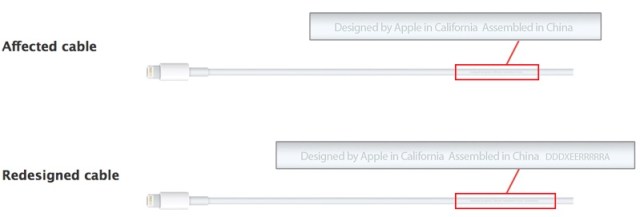
Apple is providing new, redesigned USB-C charge cables to MacBook owners with faulty cables at no cost. In addition to cables that shipped with the MacBook, the replacement program also includes faulty cables that were sold as standalone accessories.
Customers who supplied a valid mailing address when registering their product or purchasing it through the Apple Online Store will receive their new cables automatically, while other eligible MacBook owners can contact Apple Support, find an Apple Authorized Service Provider, or visit an Apple retail store to get their cables replaced. Affected USB-C charge cables can be replaced under this program until June 8, 2018.
The Retina MacBook first went on sale in April of 2015, so the problematic cables were sold for approximately two months before a redesigned version was released.
Discuss this article in our forums
Eddy Cue and Craig Federighi Discuss Bloated Software Accusations, Upcoming iTunes Plans
Eddy Cue and Craig Federighi spoke with John Gruber in this week’s episode of “The Talk Show,” where they commented on recent opinions that Apple’s software isn’t up to snuff and offered some details on a new version of iTunes coming in OS X 10.11.4.
Last week, Re/code‘s Walt Mossberg wrote a piece entitled “Apple’s Apps Need Work,” pointing towards a “gradual degradation” in quality in several Apple apps and services like iCloud, Mail, and Photos. iTunes for the desktop was one of the most heavily criticized apps, with Mossberg saying he “dreads” opening it because it’s “bloated, complex, and sluggish.”
During the podcast, Gruber asked Eddy Cue about Mossberg’s opinion, prompting him to give some background on how Apple wanted the iTunes experience to work. iTunes, Cue said, was designed at a time when people synced their devices via cable, so offering a centralized place with all of a user’s content was key. With Apple Music, Apple decided on a design that would put music front and center while also integrating cloud music with hard copies purchased through iTunes.

“We decided in the short term that what we wanted to do is really make it when you’re in music and iTunes, all you see is music,” said Cue. He went on to explain that Apple is continually re-evaluating iTunes, and there are plans to release a refreshed version alongside OS X 10.11.4 next month.
“That’s not to say we are continuing… and will continue to think about what’s the best way to architect the app and whether it makes sense to do a separate app for some of the components that are in there or all of the components that are in there. But right now, we think we’ve designed iTunes and you’ll see we’ve got a new refresh with the new version of OS X that’s coming out next month that makes it even easier to use in the music space.”
Cue and Federighi went on to talk about the issues that arise whenever Apple makes major changes to software, as there are always people who prefer not to see significant changes. According to Federighi, there’s a “tricky balancing act” with software updates.
“People are serious about their music and their collection, and so I think we debate pretty heavily internally the right way to evolve these things. We tend to err on the side of being pretty bold, but there’s a lot of responsibility.
The two also highlighted the immense scale that Apple is working on, with more than 1 billion active devices and 782 million iCloud users. More than 200,000 iMessages per second are sent at peak times, and there are more than 750 million transactions per week in the iTunes Store and the App Store. Apple Music has grown to 11 million subscribers and more than 2.5 million errors in Maps have been fixed, a number presented as evidence that Apple is continually working on its software.
“I would say first there’s nothing we care about more,” said Federighi, speaking on Apple’s software and services. He believes Apple’s core software quality has improved significantly over the course of the last five years, but pointed towards an ever-raising bar that pushes Apple to keep evolving and implementing new features. “Every year we realize the things we were good at last year and the techniques we were using to build the best software we can are not adequate for the next year because the bar keeps going up,” he said.
Federighi and Cue’s full discussion with John Gruber about the state of software, the desktop version of iTunes, and Apple’s efforts to expand its public beta program, can be listed to over on the Daring Fireball website.
Discuss this article in our forums
 AIVAnet