


Google Maps for iOS Updated to Display Search Results, Gmail Appointments On Map [iOS Blog]
 Google today updated its Google Maps app to version 3.2.0, adding several new functions to improve the utility of the app. Search results now appear with descriptions on the map to make choosing an option easier, and search results can be viewed on the map or on a list.
The locations of reservations and appointments drawn in from Gmail are also displayed directly on the map. While Google mentions Explore in the release notes to draw users to try the feature, the local point of interest feature is not new.
What’s new
– Search results appear with descriptions right on the map, to help you make choices quickly
– View search results on the map or in a list and easily switch between them
– See your reservations and appointments from Gmail labeled on the map -Try the new Explore, a local guide that shows you different places and activities depending on the location and time of day
Google Maps can be downloaded from the App Store for free. [Direct Link]

Smartphone Manufacturers ‘Lukewarm’ on Sapphire, Call Material Impractical Due to Cost and Supply
Rumors have suggested that Apple is using the sapphire garnered from its partnership with GT Advanced to produce sapphire crystal displays for the iPhone 6, and if true, such a move would normally inspire competitors to produce their own devices with sapphire displays.
It does not appear, however, that other major smartphone manufacturers are ready to adopt sapphire as a display solution, due to the expense of the material and its quality compared to the more popular Gorilla Glass.
Engadget, in an in-depth piece on sapphire displays, contacted multiple representatives from major smartphone companies, who had researched sapphire as a possible material and largely decided against it. LG, for example, said the material was too expensive.
“The cost and supply aren’t where we’d like them to be for sapphire to be practical just yet,” said Ken Hong, Global Communications Director for LG. “Sapphire’s durability and scratch-resistance are certainly attractive, but Gorilla Glass isn’t going to be displaced anytime soon.”
Sapphire is astronomically expensive compared to alternatives like Gorilla Glass, with a pane costing $30 compared to $3. Apple’s partnership with GT Advanced has allowed Apple to help fund advanced sapphire production methods that significantly lower manufacturing costs, however, a feat that most manufacturers will be unable to match.
A look at how GT Advanced produces sapphire
Sapphire is an appealing option due to its extreme hardness and its scratch resistance. Rated at a nine on the Mohs hardness scale, few materials aside from diamond can scratch sapphire, but as one representative pointed out, sapphire is highly brittle. “The sapphire is too hard to withstand bending. It’s easier to break during drop tests when the size of sapphire increases.”
Gorilla Glass manufacturer Corning has heavily criticized sapphire for the same reason, noting that its own product can withstand 2.5 times more pressure. Corning has also pointed out that Gorilla Glass is cheaper, far lighter, and more environmentally friendly as it takes less energy to produce. Sapphire also transmits less light, making it both dimmer and less clear unless specially treated.
 Strength test conducted by Corning, showing sapphire shattering at 161 pounds while Gorilla Glass survives
Yet another representative suggested that sapphire simply doesn’t make sense except from a marketing standpoint, which would certainly work for Apple as a way to distinguish itself as a more luxury smartphone option. Apple has always stood out from other manufacturers with its insistence on quality over price, setting it apart as a premium brand.
Though rumors have indicated Apple is planning to use sapphire displays in its smartphones, it remains unclear if the iPhone 6 will indeed feature a sapphire screen. It is possible the company’s sapphire is reserved for a different project, the iWatch, and it is also possible, based on circulating rumors, that only the larger 5.5-inch iPhone 6 will be equipped with a sapphire display.
Either way, it’s likely we will get our first glimpse of an Apple product that utilizes sapphire crystal later this year and as Engadget points out, it is likely that manufacturers will take advantage of sapphire for products like smart watches, later transitioning to larger products as supply techniques and production improve.

Sharp Seeking to Reduce Reliance on Apple, Regain Control of iPhone Display Plant [iOS Blog]
 Key display supplier Sharp is reportedly seeking to reduce its reliance on Apple, with sources telling Nikkei the company has offered Apple 30 billion yen ($293 million) to purchase the equipment located in Sharp’s Kameyama Plant No. 1 that currently churns out displays for the iPhone. Apple contributed roughly half of the 100 billion yen (~$1 billion) cost to convert the plant from large TV panels to small iPhone displays in 2012, with Apple owning the plant’s equipment.
By taking a leadership role in running the plant, Sharp apparently seeks to diversify its customer base. Being able to supply panels to Chinese smartphone manufacturers, for example, would make Sharp less dependent on Apple. The U.S. technology giant is said to be demanding that the Japanese company not supply panels to Samsung, Apple’s biggest smartphone rival.
According to the report, the plant is currently running at 90% capacity producing displays for the iPhone 6, giving Sharp some flexibility in the negotiations until demand from Apple starts to slow down with the natural cycle of iPhone production.
Apple typically sources its displays from several suppliers, and Apple’s main iOS device assembly partner Foxconn has reportedly been looking to partner with Sharp to begin some of its own production of iPhone and iPad displays. It is unclear how willing Apple will be to give up the display equipment, but if it does provide Sharp with some more flexibility there are still a number of display partners that could help fill any void left by Sharp’s diversification.
Reliance on Apple is major issue for many suppliers, both in terms of managing the cyclical nature of the business given Apple’s product release patterns and the potential for major disruptions of the companies’ revenue streams should Apple suddenly decide to change suppliers. As a result, it’s a delicate balancing act for many companies happy to have Apple’s business but looking for other opportunities to sustain themselves when Apple’s demand wanes.

Sapphire phone displays are tough, but the realities are even tougher

Sapphire is the birthstone of September, the traditional gift on your 45th wedding anniversary and a material associated with both luxury and ruggedness. It can be found in opulent products like jewelry, camera lenses and fancy watches. Given that, it’s also one of the toughest materials in the world, which makes it ideal for military-grade items like aviation displays and even missiles. So when rumors emerged that a sapphire display may be featured on the next iPhone, a chorus of excitement followed. However, many phone manufacturers don’t share the same sense of optimism that Apple might hold toward this different kind of next-gen display.
Earlier this week, YouTube vlogger Marques Brownlee showed what appears to be a sapphire display for the next iPhone. While the use of sapphire won’t be confirmed (or denied) by Apple until the product is released, the idea that it would want to use the material in its next flagship smartphone isn’t too hard to believe: The company announced late last year that it partnered with leading sapphire producer GT Advanced Technologies to build a manufacturing facility in Arizona. And according to a report from 9to5mac, the deal included enough new equipment to make around 100 million to 200 million iPhone-sized displays per year.
There’s one major reason why manufacturers are looking into using sapphire displays: The material is strong. Very strong. Sapphire is about four times as tough as glass. Gorilla Glass, regularly found protecting current smartphone screens, fares pretty well against hard objects too, but in order to scratch sapphire, you’d need to find something higher than nine on the Mohs scale — a system of measurement used to rate mineral hardness from one to 10, with 10 being the highest. (For comparison, Gorilla Glass rates a seven; sandpaper is a nine; and diamond is a 10)
It’s no coincidence that existing sapphire display phones are incredibly expensive.
Using sapphire instead of glass for a smartphone display isn’t a groundbreaking concept. The material is already used in the (admittedly far smaller) protective glass covering the iPhone camera, as well as the 5s home button (for Touch ID); and luxury brands like Vertu, Savelli and TAG Heuer use sapphire displays in their existing phones. However, it’s no coincidence that existing sapphire display phones are incredibly expensive — manufacturing sapphire is time-intensive, limited by available quantity and very costly. The price of sapphire camera lens covers is 2.6 times higher than glass. On a large phone display, the difference in cost is even higher; last year, GT Advanced reps estimated the cost for a pane of Gorilla Glass at $3, while sapphire was around $30.
I reached out to multiple representatives from major smartphone players and while most companies I talked to had already researched and analyzed the possibility of using sapphire, their impressions were much more lukewarm than I expected. “The cost and supply aren’t where we’d like them to be for sapphire to be practical just yet,” said Ken Hong, Global Communications Director for LG. “Sapphire’s durability and scratch-resistance are certainly attractive, but Gorilla Glass isn’t going to be displaced anytime soon.”
“Right now, the cost doesn’t justify the nominal benefit of sapphire over Gorilla Glass”
There are plenty of other issues associated with sapphire. It’s heavier than Gorilla Glass and the material remains less transparent than glass, meaning it would be more difficult to see the screen unless manufacturers add a special coating to increase transparency. (Even then, it still wouldn’t be as good as glass.) Additionally, each representative I talked to confirmed that while sapphire is durable, it certainly isn’t unbreakable. In fact, the larger the display is, the more brittle it becomes; “The sapphire is too hard to withstand bending,” said a representative of a top-tier phone maker who also asked to remain anonymous. “It’s easier to break during drop tests when the size of sapphire increases.”

Another representative replied, “In a cost-benefit analysis, I doubt [using sapphire] makes sense, unless there is some perceived marketing advantage.” Despite the potential downfalls of using such a material, that’s exactly what Apple would be gunning for by using the display in the iPhone: marketing power. Sapphire’s got a solid reputation; if the new iPhone features the same material used in premium watches, necklaces and earrings, and the company can throw it in without raising the price to consumers, Apple has a great new way to distinguish itself from the competition.
Only large companies with enough resources and bargaining power will be able to secure enough sapphire for mass production.
Even if other phone makers wanted to use sapphire displays, it would be difficult for them to secure enough inventory due to a very limited supply — a problem that the iPhone maker has avoided. “Apple uses its massive cash hoard to fund big upfront commitments for key components,” said Jan Dawson, chief analyst at Jackdaw Research. “[It’s] something that almost every other OEM but Samsung will struggle to do.” In other words, only large companies with enough resources and bargaining power will be able to secure enough sapphire for mass production.
This doesn’t mean that sapphire displays won’t be embraced in the future; they might just come in a different form. We wouldn’t be too surprised if multiple hardware manufacturers decided to use the material on smartwatches for now, since the screens — and the number of devices to build — would be much smaller and thus more affordable than smartphones. (The Moto 360, for example, is rumored to have a sapphire screen.) Then, as supply goes up and production becomes more cost-efficient, more doors may open for phone makers who want to give sapphire a shot.
Filed under: Cellphones, Wireless, Mobile, Apple, LG

Two weeks with PulseOn’s heart-rate monitoring wearable

Heart-rate monitoring chest straps won’t be with us for much longer, as wrist-worn devices are offering optical sensors that do exactly the same job. PulseOn is the latest, and having spun out of Nokia back in 2012, is now offering its first entry into the market, the, uh, PulseOn. Confusing nomenclature aside, the company is now accepting pre-orders through Indiegogo, which was used to help raise awareness as well as cash for the small outfit. We’ve spent some time with the first model to roll off the production line, so if you’re curious if it’s worth splashing $170 out on one, read on.
Open the box and the first thing you’ll notice is how small the actual hardware is, the chunky bezel actually makes it appear a lot bigger than it is around your wrist. The PulseOn has a knitted elastic strap which is either cheap or elegant, and looks like the sort of thing a diver would wear on their off-days. Despite this, the watch isn’t waterproof beyond being able to resist a meter’s worth of the stuff.

The other striking hardware feature is how the PulseOn charges. You need to connect the PulseOn to a microUSB-connected bulldog clip, ensuring that the two exposed electrodes on the clip match up perfectly with the corresponding points on the watch. It’s pleasingly different, which I have to commend, but that doesn’t make it an easy thing to use on a day-to-day basis, and if you found the original Pebble’s magnetic charger to be a tad frustrating, you may feel similarly here.
There are two buttons, one on each side, and unfortunately the control system is a tad on the opaque side. More than a few days in and we were still referencing the manual to work out which set of timed button presses got the hardware to do what we wanted. For instance, it’s a five-second press on the right key to activate and a seven-second press to turn it off again. Entering sport mode requires you to double-hit the left button, something we’ve not yet managed to get the knack of properly.
Once you’ve overcome this, however, life becomes reasonably easy. It’ll monitor your vital signs accurately when you take it out for a run. The only downside is that it’s almost useless without your phone riding shotgun. As much as it’s possible to use this hardware as a watch — albeit not that enjoyable — it’s really more specifically something designed as something you’d pull out of a drawer when you’re off on a run.

So, is it worth it? The problem is that the PulseOn sits in an awkward zone — well below fully featured alternatives, but also so far above casual wearables that it’s tough to recommend. The hardware’s really only designed for run tracking, but since it leverages your phone, what you’re really paying for is the sensor. If you’re a hardcore runner who is trying to up your fitness level and track your recovery time, then perhaps there’s some interest, but if you are that dedicated, why not just spend that little bit extra on dedicated hardware?
Source: Indiegogo

Apple Joins White House ‘SupplierPay’ Program to Speed Payments for Small Businesses [Mac Blog]
Apple, Coca-Cola and other high-profile companies across various sectors have agreed to participate in SupplierPay, a new White House initiative designed to accelerate payments for smaller firms in the company’s supply chain. President Barack Obama is expected to announce the program and early adopters later today, reports the Wall Street Journal.
The program will “strengthen small businesses by increasing their working capital, so they can grow their businesses and hire more workers,” the White House said in a statement.
SupplierPay is the private sector counterpart of the government’s existing QuickPay program that pays small business contractors before larger ones. Under QuickPay, businesses typically receive payment within two weeks of a completed project or service.

Apple in recent years has focused on supply chain issues, working to curb excessive overtime, underage workers and harsh working conditions in its supplier factories. The Cupertino company requires its suppliers to meet a code of conduct, routinely monitors its contract manufacturers for compliance with these fair labor practices and issues an annual Supplier Responsibility report to document its progress.

Apple’s Next-Generation A8 Chip Said to Top 2 GHz, Remain Dual-Core
Besides a larger display, Apple’s upcoming iPhone 6 also may feature a faster A8 processor that pushes the system-on-a-chip beyond the 2.0 GHz threshold, claims GforGames citing Chinese media source cnBeta [Google Translate].
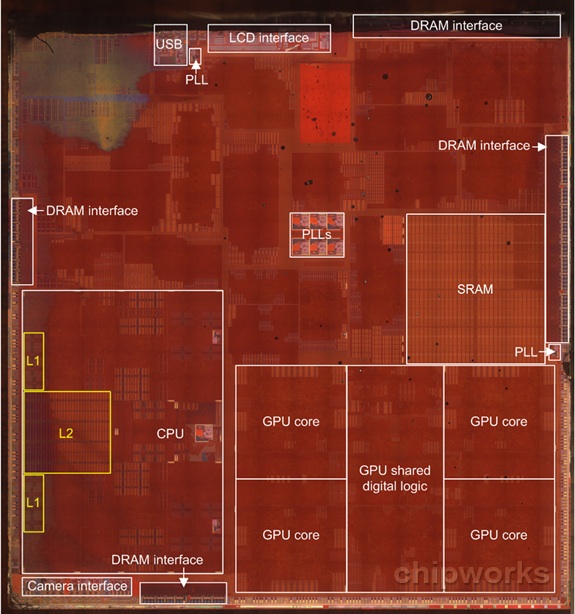
According to the latest information, Apple will reportedly increase the CPU frequency of its next-generation SoC to 2.0 GHz or higher per core, up from the 1.3 GHz (iPhone 5s and Retina iPad mini) or 1.4 GHz (iPad Air) of the A7 processor. The chip will keep the 64-bit, dual-core architecture of the current generation A7 CPU, but will be manufactured with a 20-nm process instead of the A7′s 28-nm. TSMC and Samsung are thought be the primary manufacturers that are producing the A8 chip for Apple’s upcoming iOS devices.
Though competing phones ship with quad-core processors, Apple’s possible decision to stay with a dual-core design may be the result of the company using a custom-designed chip optimized for iOS and not an off-the-shelf solution. This optimization already has been shown in the current dual-core A7, which offers “desktop class” performance that outperforms other players in the mobile phone marketplace. In its detailed analysis of the A7 after launch, AnandTech found that even though the A7′s performance is top-notch, there was still room for improvement as almost no iOS app took full advantage of A7′s available processing power.

China thinks the iPhone’s tracking features are a risk to national security

If there’s one thing that China has enjoyed doing this year, it’s taking pot-shots at the US as a result of the Snowden revelations. After banning Windows 8, allegedly pushing banks to ditch IBM hardware and calling for severe punishments on Apple and Google, the government is now gunning for the iPhone. Buried deep in iOS 7 is a Google Now-esque location tracking feature that can offer recommendations and improve the mapping experience. China, via its state television mouthpiece, believes that the system’s logs could be used by nefarious researchers to extract state secrets. Of course, as the company points out, the data is only uploaded to Apple’s servers with your explicit consent, and can be turned off — but then again, perhaps this latest bout of saber rattling is destined to direct attention away from China’s own espionage record.
Filed under: Cellphones, Mobile, Apple
Source: WSJ
Mix beats and loop vocals with Propellerhead’s Take for iOS

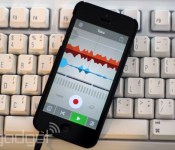
If you saw Reggie Watts’ musical set at Engadget Expand (don’t worry, there’s video after the break), then you probably noticed the table full of gear he needs to construct his loops. Propellerhead — the Swedish software company behind Reason, not the electronica duo — is hoping to lighten this load with Take, a creative vocal loop recorder that’s being given away free to iPhone users. The interface is reasonably simple, offering you a wide variety of pre-made backing loops as well as three tracks that you can rap, sing or otherwise make noise on. It’s tremendously easy to use, but it won’t compensate for your lack of musical talent, which is why we won’t be sharing our ham-fisted efforts with you.
Filed under: Cellphones, Portable Audio/Video, Software, Apple
Source: Take (App Store)

Expert Believes Alleged iPhone 6 Sapphire Front Panel Could Be ‘Legitimate’
Earlier this week, numerous videos of the alleged front panel of the 4.7-inch iPhone 6 surfaced, which showed the screen being put through stress tests involving significant bending and scratching. While those videos referred to the front panel as being made of sapphire crystal, there was no way to confirm that the display were made of the durable material.
Now, Professional Neil Alford, who is a member of the Department of Materials at the Imperial College in London, tells The Guardian that the alleged “sapphire panel” could “well be legitimate.” Alford believes that the stress tests performed on the screen indicate that the panel is made of sapphire, adding that Apple likely overcame a number of challenges in making the part thin and durable.
Alford concurs: “In my opinion the screen being shown off in the video could well be a sapphire screen. If you make sapphire thin enough, and it’s flaw free, you can bend it quite considerably because it has an enormous strength.”
He added: “I think they will be doing some sort of a lamination – binding different crystal cuts of sapphire together – boosting the toughness of the material, while they may also have induced some sort of a strain in the surface of the glass – either compression or tension – which means that it has extra strength,” he said.
Alford noted that Apple had contacted him in January 2013 to discuss sapphire screens, indicating that Apple has likely been hard at work on creating the screen afterward. Past rumors have suggested that Apple will be using a sapphire display in the iPhone 6, but other reports have claimed that the more durable material could be exclusive to the larger 5.5-inch iPhone 6 due to supply constraints.
Apple’s 4.7-inch iPhone 6 is expected to launch this September, while the larger 5.5-inch version has been rumored to be released at the same time. In addition to a larger display, both devices are likely to include a thinner housing, a faster A8 processor, and an improved camera.

