


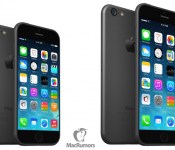
Apple Facing Production Issues with iPhone 6 as 5.5-Inch Version May Be Delayed Until 2015
The launch of Apple’s 5.5-inch iPhone 6 may be delayed into 2015 as Apple’s production issues with the smaller 4.7-inch version will likely carry over into the larger model, according to a new report from KGI Securities analyst Ming-Chi Kuo.

Production bottlenecks on 4.7-inch iPhone 6 center on the yield rate of in-cell touch panel and metal casing. As in-cell touch panel becomes larger in size, the edge of the panel may become insensitive to touch. Meanwhile, under new manufacturing process for the iPhone 6 metal casing, color unevenness is an issue.
Kuo adds that these problems become more complicated with the larger 5.5-inch iPhone 6. As these new concerns are coupled with earlier concerns about the production of sapphire displays for the larger device, the analyst believes that the 5.5-inch iPhone 6 may not launch by the end of 2014, or may launch after October in very limited quantities. In the event that the 5.5-inch iPhone 6 is delayed to next year, Kuo believes that Apple will cut the prices of the iPhone 5s and iPhone 5c alongside the launch of the 4.7-inch iPhone 6.
Early rumors about the 5.5-inch iPhone 6 pointed towards production issues with the device’s display and battery life. However, a report from Bloomberg last month noted that both models would enter production and launch at the same time. Concerns over the metal casings used for the iPhone 6 were also reported late last month, as Apple rejected casings from partner Catcher Technology. However, those issues were said to be over parts found within the casings as opposed to color disfiguration mentioned in this latest report.
Apple is expected to announce and launch the iPhone 6 in September. In addition to a larger screen, both models of the device are expected to include a thinner profile and a faster A8 processor. Both sizes of the iPhone 6 are also expected to feature improved cameras, with the bigger model featuring an optical image stabilization system, while the smaller one will include an enhanced camera module.

IRL: The Retina display MacBook Pro and Sony’s SRS-BTX300 Bluetooth speaker

We’ve got a twofer this week, folks. As that lead shot up there suggests, we’ll be revisiting the Retina display MacBook Pro — the 13-inch version, to be exact. And then, past the break, we’ll also give you a mini-review of Sony’s SRS-BTX300 Bluetooth speaker.
Apple MacBook Air
 My history with laptops reads like a Goldilocks tale: some were too big, some were too small and some were definitely too hot (hello, 12-inch PowerBook). However, I might have found something “just right” in the 13-inch MacBook Pro with Retina display that I bought at the end of 2013.
To me, it’s a good balance between size and power. It’s portable enough that it’s no major burden in my bag — important when hiking around trade shows — but there’s still plenty of screen area and performance (at least on my unit with a 2.4GHz Core i5 and 8GB of RAM) when I need to do some serious media editing. The Retina screen also gets around the limited workspaces that I’ve seen on many small laptops. While the computer isn’t going to have as big a virtual workspace as some of its rivals, there’s still plenty of room to breathe.
The real highlight, though, is the battery: it’s a monster. I have yet to run low on power when unplugged, even when I go out of my way to drain the energy cells dry. At Expand New York, I only managed to use half a charge after five hours of near-constant writing, chatting and media editing. Even the wireless display support doesn’t tax the battery all that much. There are other laptops that manage this kind of longevity, but most of them are Ultrabooks that won’t be as quick.
It’s not quite a jack of all trades. I’d rather have a 14-inch Razer Blade if I were looking for a small gaming rig, and Samsung’s ATIV Book 9 Plus has both a higher-resolution screen and touch input. For me, though, the MacBook Pro ticks a lot of checkboxes. It can do everything I want it to do for as long as I need on any given day. I’m sure I’ll eventually need to replace it, but for now, I can’t ask for much more.
– Jon Fingas
Sony SRS-BTX300 bluetooth speaker

Bluetooth speakers have become increasingly popular over the past few years, but I for one didn’t learn how handy they could be until fairly recently. And while the Sony SRS-BTX300 I’ve been using isn’t nearly as portable as, say, the Jawbone Jambox or Beats Pill, I could still easily fit it in my messenger bag and carry it with me if I wanted to. To put its size in perspective, it’s about as long as a 13-inch MacBook Air and wee bit shorter than an iPhone 4s, while its weight clocks in at nearly four pounds. Needless to say, it’s a solid piece of hardware.
Looks aside, the SRS-BTX300 can push out some very loud sound, so much so that I never turn the volume to more than 50 percent when listening to music — it’s one of those things you have to hear to believe. The full-range 70mm speaker has a few different audio settings to choose from, including a Mega Bass mode that’s intense enough to make the tenant below my apartment throw a temper tantrum and think about filing a noise complaint.
What I love the most about the BTX-300 is that I can pair devices via Bluetooth, NFC or an audio jack to play my tunes, allowing me to seamlessly switch between my HTC One, iPad and sixth-gen iPod nano at any given time. Sony claims around eight hours of battery life, which is on par with what I experienced, and sometimes even longer if I use it periodically rather than in one long jam session. For $200, its appearance may be utterly subtle, but there’s no doubt the SRS-BTX300 sounds just as good if not better than all those other wireless speakers it’s up against.
– Edgar Alvarez
Filed under: Laptops, Portable Audio/Video, Apple, Sony
FCC Filings Reveal Apple’s First-Party iBeacon Hardware
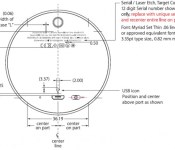
FCC filings discovered by electronics company Securifi (via TUAW) have revealed Apple’s plans for first-party iBeacon hardware to go along with the microlocation technology found in iOS. The transmitter is registered as the “Apple iBeacon” and carries a model number of A1573, which is in line with the company’s other products.
 According to the documents filed by Apple, the iBeacon was tested in collaboration with China-based Audix Technology from April 30 to May 13, 2014. The beacon tested has a diameter of 5.46” and has a highest working frequency of 2.4GHz, which is in line with modern Bluetooth standards.
Originally introduced at WWDC 2013, iBeacon technology enables iOS devices to communicate with transmitters through Bluetooth in order to deliver relevant information to apps and services when a user is nearby. Apple introduced a “Made for iPhone” iBeacon specification in February, signaling a more primary role for the technology in its devices and services.
So far, however, companies have used third-party transmitters, like the Estimote Beacon to work with the technology and iOS devices. Shopping app Shopkick and Macy’s partnered during the holiday season last year to integrate the technology into stores, while Major League Baseball and the National Basketball Association have used iBeacons to enhance live events.
Apple has also integrated iBeacons into its own retail stores to notify customers about picking up online orders and special upcoming events. Internationally, Virgin Atlantic integrated iBeacons into London’s Heathrow Airport to notify users of promotional deals and areas of interest.
While it is unknown as to whether Apple will actually launch iBeacon hardware or not, the product could integrate with the company’s other platforms and services. Apple’s iBeacon could be the company’s first product to integrate with its HomeKit initiative, which allows home automation devices and their apps to work with iOS.
It is likely that HomeKit integrated hardware would come further down the roadmap in Apple’s future product lineup, as that lineup is expected to include the iWatch, perhaps a 12-inch Retina MacBook Air and a next-generation Apple TV.

Apple Responds to Chinese State-Run Media Warning Against iOS Location Tracking [iOS Blog]
 Earlier this week, China’s state-run media broadcast labeled the iPhone a “national security concern” over Apple’s Location Services feature found in iOS 7, with the country’s researchers stating that the data could lead to accessing highly-sensitive data in China.
Today, Apple officially responded to the controversy on its Chinese website. The statement, which was posted in both Chinese and English, starts off by reiterating the company’s commitment to privacy and stating that its Location Services exist solely to help users for activities that require navigation:
Our customers want and expect their mobile devices to be able to quickly and reliably determine their current locations for specific activities such as shopping, travel, finding the nearest restaurant or calculating the amount of time it takes them to get to work. We do this at the device level. Apple does not track users’ locations – Apple has never done so and has no plans to ever do so.
Apple also states that it does not have access to the Frequent Locations data on any iPhone, noting that access to the information can be turned off and is only used to provide commuting information and automatic routing as requested by the user:
Frequent Locations are only stored on a customer’s iOS device, they are not backed up on iTunes or iCloud, and are encrypted. Apple does not obtain or know a user’s Frequent Locations and this feature can always be turned “Off” via our privacy settings.
Apple does not have access to Frequent Locations or the location cache on any user’s iPhone at any time. We encrypt the cache by the user’s passcode and it is protected from access by any app.
Apple concludes the statement by saying that it has “never worked with any government agency from any country” to create backdoor access in any of its products, and vows to never allow access to its servers. Last year, the company shared a sentiment in its “Commitment to Customer Privacy” letter which was issued after the discovery of the NSA’s secret intelligence program, PRISM.
China has become an increasingly important market for Apple, as the company has made moves over the past few years to improve its presence in the country. Last year, the company partnered with the region’s biggest carrier China Mobile and opened more retail stores throughout populated areas. CEO Tim Cook has also made a number of visits to China, meeting with Beijing’s mayor and the Chinese Vice Premier to discuss market growth.
Note: Due to the controversial nature of this topic, the discussion thread is located in our Politics, Religion, Social Issues forum. All forum members and site visitors are welcome to read and follow the thread, but posting is limited to forum members with at least 100 posts. 

Now (almost) anyone (with cable) can watch CNN the way they want to

Back in April CNNx launched, letting viewers jump through the news of the day and watch what they want, when they want. The only problem? Other than the fact that it’s restricted to CNN’s iPad app and web site, only subscribers to a few providers could actually access it. Now, CNN is rolling out the service nationwide, and as Multichannel News points out, Time Warner Cable as the only major provider that’s not yet set up for access. While it starts off with a live feed of the channel, you can skip through the story rundown and select anything from the past day, then just watch that or see related info. The plan is to also bring this to other set-top TV boxes soon, but there’s still no word on access for Android devices, iPhones, or other mobile platforms. There’s a demo video after the break so you can get a feel for it, but iPad-owning cable/satellite TV subscribers can just open the CNN app and try it out right now go to the website here.
Filed under: Home Entertainment, Tablets, Internet, HD, Apple
Source: CNNx, CNN app for iPad (App Store)
Apple May No Longer Be Required to Etch FCC Labels on iPhone [iOS Blog]
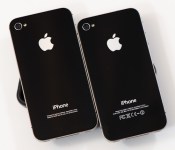
Currently, the FCC requires any device that wants its certification to have a nameplate or etched label that displays an ID and approval from the agency. Today, the FCC has loosened its rules (via MultiChannel) regarding labeling, allowing manufacturers to bypass etching FCC labels on its devices, like Apple’s iPhone.
 Verizon iPhone 4 without FCC label on left, iPhone 4 with FCC label on right.
Many consumer devices have very small surface areas for a label, or when etched on the surface, the labeling may cause damage or require very expensive techniques. In such instances, the rules permit the Commission to approve alternative means of displaying the required information.
The change comes shortly after Senators Deb Fischer (R-Neb.) and Jay Rockefeller (D-W.Va.) introduced the E-Label Act, which allows companies to meet the FCC’s label demands using digital stamps on the device rather than etching labels onto the hardware. The two Senators argue the change would allow manufacturers to save money, allowing them to pass the savings on to consumers.
“As manufacturers continue to produce groundbreaking technologies, it only makes sense that federal labeling requirements for these products are updated to further promote innovation and create new opportunities in the digital age,” Fischer said in a statement. “This bipartisan measure will provide relief for job creators, benefit consumers, and promote modern regulations that better suit a 21st century marketplace.”
The FCC’s solution is fairly similar to the one the Senators proposed, and would require companies like Apple to place the digital labels three menus deep within a phone’s device menu. The device’s user manual must include where to find the FCC labels, or the information must be on the manufacturer’s website.
It’s highly likely Apple takes advantage of either the FCC’s new rules or the E-Label Act, as the labels sit counter to Apple’s focus on clean, minimal design on its devices. However, it’s unclear when or how Apple would take advantage of the new rules.
Google Maps on iOS now plots search results, your appointments

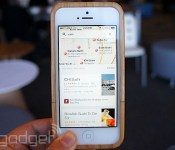
Slowly but surely, the iOS version of Google Maps is gaining parity with its Android equivalent. With the latest update, those who use Google’s mapping application on Apple’s mobile platform will be able to see search results along with their descriptions visually laid out on the map, as seen in the image above. You can toggle between the map view and just a regular list view as well. Additionally, Gmail users will find that appointments and reservations will show up on the map too, which is handy if you want to know how to get to that dinner meeting on time. Last but not least, there’s also an improved Explore view that you can use to figure out what’s nearby, just in case you’d like to follow up the meal with after-dinner drinks. So if you’re an iOS user who prefers Google’s own email and maps offerings over Apple’s own, then you should download this update right about now.
Via: 9to5 Mac
Source: App Store

Samsung Bashes iPad’s Screen, Lack of Multitasking in New Galaxy Tab S Ads
Last week, Samsung released an anti-iPhone ad calling iPhone users “wall huggers” in a promotion for its Galaxy S5 smartphone. Today the South Korean company is promoting its new Galaxy Tab S with two new anti-Apple advertisements, bashing the iPad’s lack of multitasking and its screen.
In the first ad, Samsung features a crying baby and a dad fighting over an iPad that’s unable to display two apps at once. The baby wants to watch a movie while the dad is trying to catch a sports game. A Galaxy Tab S, which can display multiple apps at once, is swapped for the iPad, and suddenly both dad and baby are happy.
“What’s going on? Ahhh, it looks like dad’s tablet can only do one thing at a time. What if it were a Samsung Galaxy Tab S? With the Galaxy Tab S, the whole family has something to smile about.”
The second advertisement pits the display of the iPad against the display of the Galaxy Tab S. In the spot, two friends are watching the same scary movie on an iPad and on a Samsung Galaxy Tab S. A scene depicting a dark figure against a black background is shown on both tablets, with the figure not appearing on the iPad’s screen.
What went wrong here? Ahhh, It’s not a Super AMOLED. What if it were a Samsung Galaxy Tab S? Compared to many LCDs, Super AMOLEDs give you 100 times higher contrast. Instead of 1000:1, you get 100,000:1 contrast. Conventional LCDs get their color using backlight but Super AMOLEDs turn off pixel by pixel, each emitting their own light. So you get all the fine details and varied shades of black that many LCDs can’t show.
First announced in June, Samsung’s newest tablet, the Galaxy Tab S features a high-resolution (2560 x 1600) Super AMOLED display. During its presentation, Samsung touted the tablet’s display quality, suggesting it had a more accurate color range, better contrast, and higher outdoor visibility than a typical LCD display. The Galaxy Tab S is also Samsung’s thinnest tablet to date, offering a fingerprint sensor, an 11 hour battery life, and Android’s multitasking features.
The iPad Air, in contrast, features a 2048 by 1536 Retina display with 3.1 million pixels. While it is unable to run two apps at once presently, split-screen multitasking is said to be in the works. Apple is also working on a new version of the iPad Air and the Retina iPad mini, both of which are expected to come equipped with Touch ID fingerprint sensors and an A8 processor.

Buyer’s Guide: Discounts on Retina MacBook Pro, iPad, Apple Accessories, and More [Mac Blog]
There are some good deals on Apple-related accessories this week, as well as some decent discounts on the Retina MacBook Pro and an iPad deal from Target that includes free gift cards.
Retina MacBook Pro
Like last week, several retailers are offering $100 to $150 off most Retina MacBook Pro models. The 13-inch Retina MacBook Pro with 4GB of RAM and 128 GB of storage is $1,199 at Amazon, Adorama, and B&H Photo. The 13-inch Retina MacBook Pro with 8GB of RAM and 256GB of storage is $1,399 at Amazon, Adorama, and B&H Photo. The lower-end 15-inch Retina MacBook Pro with 8GB of memory and 256GB of storage is $1,849.99 at Amazon, Adorama, and B&H Photo, while the higher-end model with 16GB of memory and 512GB of storage is $2,449 at Amazon, Adorama, and B&H Photo.
Buying from Adorama and B&H Photo gives the benefit of no sales tax in many states, as these two stores only charge tax in New York/New Jersey and New York, respectively.

iMac
There aren’t many deals on the iMac this week, but both Adorama and B&H Photo are offering the 21.5-inch iMac with 8GB of RAM and a 1TB hard drive for $1,349, a savings of $150 off the standard price.
MacBook Air
Apple’s 11.6-inch MacBook Air with 4GB of RAM and 256GB of storage is available for $999 from Adorama, a savings of $100. The 13-inch MacBook Air with 256GB of RAM can be purchased at $1,099.99, a $100 savings, from Adorama or B&H Photo.

iPads and iPhones
Target is currently offering a $100 Target gift card for customers who purchase an iPad Air or a Retina iPad mini (WiFi or WiFi + Cellular) in any capacity. Though Target is charging full price at $499 and $399, respectively, the gift card is a good deal for regular Target customers.
Target is also offering a $20 Target gift card with the purchase of a 16GB iPhone 5s or 5c. The iPhone 5c is available from Target for $30 and the iPhone 5s is $100. Target’s deals last through July 12.
Accessories
Jawbone’s Jambox speaker can be purchased via Groupon for $89, a discount of $21, while Meh.com is offering the JBL OnBeat Micro Speaker dock for $15. The Apple TV is available for $89 through Best Buy, a $10 discount.

Apps
This week marks the sixth anniversary of the App Store, and several developers are offering sales on their apps. Popular games like Threesand Monument Valley are available at low prices, so make sure to check out our anniversary post to get a look at all the deals.
Before making a purchase of a Mac or iOS device, make sure to consult our Buyer’s Guide to find out if it’s a good time to buy. For example, because the MacBook Air was updated in April, the Buyer’s Guide indicates that now is a good time to purchase.
MacRumors is an affiliate partner with some of these vendors.

Are we there yet? A century of the smartwatch in pictures

With two Google-powered smartwatches currently on sale, and the circular Moto 360 already causing a stir among design geeks, wearables are one step closer to securing a place on our wrists. And while many of us aren’t ready to strap on a Gear Live, G Watch or Pebble just yet, that doesn’t mean the smartwatch is a new concept. In fact, depending on your definition of “smart,” these gadgets have been fusing time-telling with extra functionality since the early 20th century. From wrist-borne spy cams to radio-controlled timepieces, here’s a look at this wearable’s evolution.
Filed under: Wearables, Mobile, Apple, Samsung, Microsoft, Google, LG

