


Buyer’s Guide: Discounts on MacBook Air, Mac Pro, Apple Accessories, and More [Mac Blog]
This Week’s Buyer’s Guide includes deals on the MacBook Air, the Mac Pro, the Retina MacBook Pro, and several different Apple accessories.
There aren’t many deals on the iMac, the iPad, the Retina iPad mini, or the 2014 Retina MacBook Pro this week, but make sure to check back next week for new discounts because prices tend to fluctuate on a week-to-week basis.
MacBook Air
A few sites are offering deals on the 2014 MacBook Air this week, dropping the price as much as $150. The 11.6-inch 1.4Ghz/4GB/128GB MacBook Air is available from B&H Photo and Adorama for $799, down from $899.
The 13-inch 1.4Ghz/4GB/128GB MacBook Air is available for $849 from Best Buy and Amazon, a discount of $150.

Mac Pro
Stock configurations of Apple’s Mac Pro desktop computer are available at slightly discounted prices from several retailers this week. The 6-core 3.5Ghz/16GB/256GB machine can be purchased for $3,739.99 from Best Buy, Amazon, and B&H Photo, while the 4-core 3.7Ghz/12GB/256GB machine for $2,839.99 from Best Buy, Amazon, and B&H Photo.
Retina MacBook Pro
The sole deal on the 2014 Retina MacBook Pro is for the 13-inch 2.6Ghz/8GB/256GB model, available for $1,379 from Adorama and B&H Photo.
There’s a solitary deal on the 2013 15-inch 2.0GHz/8GB/256GB Retina MacBook Pro, which is available for $1,599 from Amazon, Adorama, and B&H Photo, a discount of $400.

B&H and Adorama, as always, are a good choice for buyers who live outside of New York and New Jersey, as the sites only charge sales tax in those states.
Apple Accessories
The Apple Smart Cover for the iPad Air (pink) is available for $22 from DailySteals, a discount of $17. CrossOver 13, which lets users run Windows software on the Mac, is available at 50% for $30 from StackSocial. Case-Mate also has a site-wide sale going on, with up to 60% off most of its products with the promo code P85Z3N4.

Finally, Beats By Dre Tour In-Ear Headphones can be purchased from Groupon for $110, a discount of $40.
MacRumors is an affiliate partner with some of these vendors.
.CPlase_panel display:none;

BlackBerry Takes Advantage of iMessage Spam Reports to Tout BBM
BlackBerry is taking advantage of reports of iMessage’s vulnerability to spam messages to tout its BlackBerry Messenger app. In a blog post, the company highlights a report from earlier this week that said iMessage users see quite a bit of spam, with accounts run by spammers responsible for more than 30 percent of all spam messages on mobile devices.
BlackBerry suggests that iMessage users switch to BBM to avoid spam and lists five reasons why BBM is superior to iMessage. According to the company, BBM is safer primarily because it does not utilize a phone number or email address and it only accepts messages from contacts.

1) BBM is architected in a way that protects our 85 million users against spammers. iMessage works off of phone number or Apple ID. Anyone who has your number or Apple ID can send you messages whether you want them to or not. With BBM, users have a lot more control due to our “invite and accept” paradigm. In other words, both parties need to be mutually committed to being contacts in order to send and receive messages.
2) BBM gives you control. There’s no spam on BBM due to its self-policing system. Users are in control of their contact list and there is no way to send a message without being contacts. You can’t control someone showing up to your house, but you don’t have to open the door. With BBM someone can request to be added to your list, but you don’t have to accept their invite.
BlackBerry also uses its list to highlight BBM’s encryption that protects messages from “spying or hacking,” its ability to block contacts, and its cross-platform availability.
Despite all of BBM’s apparent perks, BlackBerry has had trouble convincing users to adopt the app due to competition from iMessage and other messaging apps like WhatsApp, Kik, WeChat, and more. In late 2013, BlackBerry users on Android, iPhone, and BlackBerry phones sent and received approximately 10 billion messages per day, while WhatsApp processed upwards 50 billion messages per day.
Listed as number 56 in the social networking section of the App Store, BBM is ranked far below competing messaging apps. BlackBerry itself has also been struggling in recent months as iOS and Android make gains in the enterprise market.
The initial report on iMessage spam pointed towards Apple’s deep integration of mobile and desktop as the reason for iMessage’s popularity with scammers. While the uptick in iMessage spam has been recent, Apple does have some measures in place to combat spammers. There’s rate-limiting on the iMessage network to stop users from sending hundreds of messages and there is a spam reporting protocol in place, but Apple will likely need adopt more aggressive measures in the future to limit spam messages due to the platform’s growing popularity with spammers.
.CPlase_panel display:none;
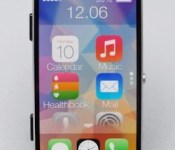
More Supply Chain Claims of Likely Early 2015 Launch for iWatch
 Earlier this week, KGI Securities analyst Ming-Chi Kuo released a report claiming Apple may not launch the iWatch until 2015 due to manufacturing difficulties associated with the new device. A follow-up report from Taiwan’s Economic Daily News (via G 4 Games) echoes this assertion with supply chain information hinting at an early 2015 debut for Apple’s wearable device.
Anonymous supply chain sources told Economic Daily News that Apple is requesting delivery of hardware components for the iWatch as it prepares to start assembly of the wristwatch device in September. Sources claim it will take Apple several months of manufacturing refinement before it has a final product that is ready for retail shelves.
Once it hits production, iWatch yield is rumored to be lower than first predicted, with one million watches rolling off factory lines each month. Because of the lengthy and limited production process, Apple may not be able to launch the iWatch fully in 2014. Instead, the company may decide to offer the iWatch in limited quantities at the end of this year or wait until 2015 to start selling the wearable device.
While Apple tends to unveil a product and release it shortly after the announcement, the company has utilized a protracted launch strategy with select new products. Apple introduced the original iPhone six months ahead of its retail availability and unveiled the first iPad two months before it went on sale.
Most recently, Apple used a similar strategy with its Mac Pro, unveiling the machine six months before it was made available for purchase in December 2013. When it finally went on sale, the Mac Pro was available in limited quantities for several months following its initial retail release.
(Image: iWatch concept by SET Solution)
.CPlase_panel display:none;

China Telecom iPhone 6 Ad Suggests Simplified Model Lineup for Different Carrier Technologies
According to a Sina News report (via ZDNet), China Telecom this week briefly announced plans to sell an unlocked version of the iPhone 6 in order to compete with rival carriers. The Sina report sources a Weibo post from China Telecom’s Shanghai office that was posted earlier this week and later deleted.
The move suggests Apple is planning to sell a version of the iPhone 6 that will support all wireless networks in the country, including dual 4G (TDD-LTE and FDD-LTE), WCDMA, CDMA2000, GSM, and CDMA1X. This opens up LTE to China Telecom subscribers and makes the country’s number three carrier more competitive with its bigger rivals China Unicom and China Mobile.
Apple currently sells three different models each of the iPhone 5s and 5c in China in order to accommodate the different technologies used by the country’s carriers. But with updated modem and antenna technology for the iPhone 6, Apple may be able to streamline its model lineup to more efficiently support the various carrier technologies.

As part of its advertisement, China Telecom used an iPhone 6 rendering from a Behance gallery posted early last month by Tomas Moyano and Nicolas Aichino. The renderings have been fairly popular around the web, including in our own stories, but differ from most recent leaks in some aspects such as omitting a protruding camera ring and showing rear shells featuring different colors at top and bottom.
Apple is expected to unveil the iPhone 6 at a press event to be held in early September. The handset may include larger 4.7-inch and 5.5-inch display options, a faster A8 processor, an improved iSight camera and a new Touch ID sensor. Sales of the 4.7-inch version are expected to begin at the end of September, with the 5.5-inch model launching either alongside or up to several months later than the smaller model.
.CPlase_panel display:none;

Apple Blocking ‘Secret’ in Brazilian App Store After Court Ruling [iOS Blog]
 Apple has started blocking downloads of anonymous communication app Secret [Direct Link] following a preliminary injunction that was granted recently by a Brazilian civil court judge (Via 9to5Mac). According to the injunction ruling shared by Gigaom earlier this week, Apple is required to remove the app from the Brazilian App Store and remotely delete the app from customers’ devices.
Local media noted claimed earlier today that Secret was still listed in the Brazilian App Store, but that Apple was preventing users from installing the app on their iOS devices. The app now appears to have been removed entirely from the the Brazilian store.
Apple reportedly has not started deleting the app from user’s devices per the injunction requirements, and it is unclear whether Apple plans to comply with that portion of the order or pursue the issue further. The injunction also applies to the Android version of Secret and a similar Windows Phone Secret client titled Cryptic, but Microsoft and Google are not yet complying with the injunction terms.
The injunction stems from a civil case filed by public prosecutor Marcelo Zenkner, who took action after receiving complaints about bullying on the anonymous social network. Secret allows users to post messages and comment while keeping their identity hidden. This anonymity provision violates Brazilian law, prompting the judge to issue the injunction earlier this week. Google, Apple and Microsoft have ten days to comply with the ruling or face daily fines of 20,000 reals ($8,890 USD).
.CPlase_panel display:none;

Apple blocks access to Secret in Brazil after anti-bullying ruling

A few days ago, a Brazilian judge ordered Apple and Google to pull Secret from the local app store and wipe it from the handsets of whose who had downloaded it. The same ruling covered Microsoft, who was ordered to do the same to Windows Phone clone Cryptic. So far, however, only Apple has begun to comply with the order, after suspending fresh downloads of the app to iOS accounts registered in Brazil. According to local news media, the company hasn’t started pulling the software from individual handsets, but that’s still more than Google or Microsoft have done. Both companies claim that they’ve not been directly notified of the widely-reported ruling, although it’s more likely that they’re waiting on a final decision from the courts before taking any action.
Filed under: Internet, Software, Mobile, Apple, Microsoft, Google
Via: GigaOM
Source: CenarioMT (Translated), DM.com (Translated)
.CPlase_panel display:none;
iPhone 6 Information Leak Sourced from Foxconn Details Dimensions of 4.7-Inch and 5.5-Inch Versions
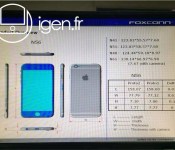
French Apple website IGen.fr (Google Translate) has shared a variety of new details about Apple’s upcoming iPhone 6, including dimensions for each model, info about the protruding camera ring on the rear of both devices, and more. The photos appear to be of internal information residing in a Foxconn factory, as the 5.5-inch iPhone 6 and 4.7-inch iPhone 6 carry code names of N56 and N61, respectively.
The information states that the final version of the 5.5-inch iPhone 6 will measure 158 mm long, 78 mm wide, and 7.1 mm thick (7.7 with the protruding camera), weighing 184.6 grams, or 6.5 ounces. Also spotted is information for a first prototype, which retained the same length and width but was 7.0 mm thick and weighed 168.5 grams, or 5.9 ounces.
 Supposed measurements of the 5.5-inch iPhone 6
Meanwhile, the 4.7-inch iPhone 6 is said to measure at 138 mm long, 66 mm wide, and 6.9 mm thick, as the weight of the device is not listed. For comparison, the iPhone 5s measures 123×58 and is 7.6 mm thick.
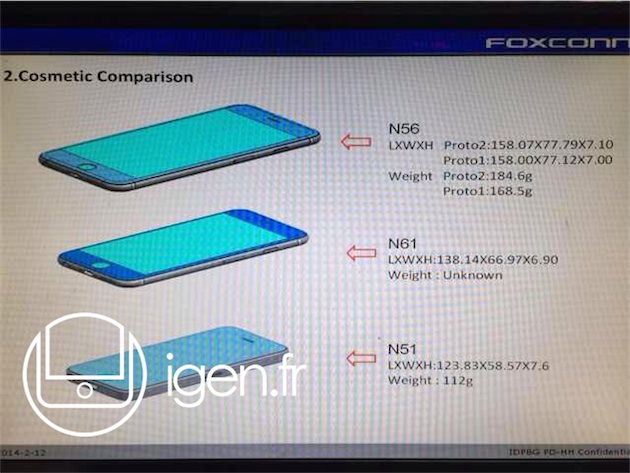 A comparison of both the 5.5-inch and 4.7-inch model, as well as the iPhone 5s
A source close to the production of the 5.5-inch version claims that it will feature a battery with a large capacity, possibly 2915 mAh. That number comes from a in line with a component leak spotted earlier this month. The source did not specify whether the larger device was equipped with a sapphire display, however Apple reportedly shipped 28 containers of displays to Foxconn from the United States. It is possible that those containers could have come from GT Advanced Technologies, which Apple partnered with to produce sapphire displays at a factory in Arizona. However, no additional evidence suggests that is the case.
 A schematic showing the protruding camera on each iPhone 6 and the iPhone 5s
Specifics around the protruding camera ring on both devices are also seen in the photos, as the 5.5-inch iPhone 6 will have an external camera ring that protrudes at 0.67-0.77 millimeters while the one 4.7-inch iPhone 6 will protrude at 0.77 mm. Both protruding camera rings appear to be similar to the one on the fifth-generation iPod touch, although it is unknown at this time what specific purpose they serve. The schematic of the protruding camera ring on the 5.5-inch iPhone 6 was spotted a few days ago, however that was originally interpreted to be for the 4.7-inch iPhone 6.
Finally, the source notes that the iPhone 6 features a well cut-out logo on its rear, which is said to be made from a very durable material and lines up with previous leaks. The device’s rear bands sighted in previous leaks are also said to be featured on the iPhone 6, and will act as refined antennas. Apple was also said to be working to feature a 2.5mm headphone jack on the iPhone 6, however the company scrapped it to avoid complaints about compatibility.
Certification tests for both models were said to take place last week, with mass production reportedly beginning this week. Apple is said to have ordered 40 million 4.7-inch units of the iPhone 6 for the rest of 2014, and is aiming for a 100 million devices by the end of this year. It was also stated that the launch 5.5-inch version may be delayed until a later time, although both are scheduled to be introduced at the same time.
Apple will reveal the iPhone 6 at a media event on Tuesday, September 9. In addition to a refined design as mentioned above, both models of the device will feature a faster A8 processor, an improved camera, and more.
.CPlase_panel display:none;
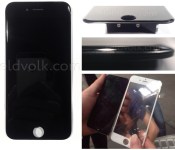
Apple Suppliers ‘Scrambling’ to Produce Enough iPhone 6 Displays After Issues With New Backlight
Apple’s supply chain is scrambling to get enough displays ready for the iPhone 6 ahead of its launch next month, reports Reuters.
 Front panel said to be from the 4.7-inch iPhone 6
The report notes that production issues were made prevalent when the backlight film for the device’s display panel had to be redesigned, halting production for two months:
Two supply chain sources said display panel production suffered a setback after the backlight that helps illuminate the screen had to be revised, putting screen assembly on hold for part of June and July. One said Apple, aiming for the thinnest phone possible, initially wanted to cut back to a single layer of backlight film, instead of the standard two layers, for the 4.7-inch screen, which went into mass production ahead of the 5.5-inch version.
After the backlight film component was revised, Apple reportedly rejected it and went back to add the second layer to the panel causing a delay. As it stands, production of the display has resumed as suppliers are attempting to work quickly to make up for lost time before the device’s launch.
Concerns over the iPhone 6′s backlight design surfaced last month from supply chain, which also suggested that Apple’s desire to use only one backlight film to minimize the size of the handset would cause production delays. Current generation iPhone displays are supplied by Minebea and use two layers in order to improve readability in these backlit displays.
In a single layer setup for the device’s display, one layer has to be of a very high quality to take the place of the standard second layer. To meet the demand for the part, Apple had allegedly gone to OMRON and Radian to add them as suppliers alongside Minebea, however the outcome of that effort is not known. Previous reports of production issues surrounding the iPhone 6 had pinpointed challenges with the device’s in-cell touch panel and metal casings.
Apple is expected to unveil the iPhone 6 at an event on September 9, with a launch for the 4.7-inch version likely come a week later. It is unclear if the 5.5-inch version will ship at the same time, as Apple is also said to be experiencing other production issues with the larger device. Both models of the iPhone 6 will likely feature a thinner, rounded chassis and incorporate a new A8 processor, a refined camera, and iOS 8.
.CPlase_panel display:none;

Apple Adding Samsung as RAM Supplier for iPhone 6 [iOS Blog]
Samsung will reportedly supply Apple with RAM for the iPhone 6, according to a report from Digitimes. Samsung’s return to Apple’s list of RAM suppliers for the iPhone comes after it was excluded from the list in 2013, with Apple electing to partner with SK Hynix and Elpida Memory for the iPhone 5s.

The logic board of the iPhone 5s featuring 1GB of RAM
Apple made a drastic move to begin expelling Samsung from its supplier list for a number of key components, including application processors, mobile RAM, NAND flash chips and batteries, starting 2013, the sources noted.
The report adds that Elpida and SK Hynix have become unsatisfied with Apple’s buying price for the components. With Elpida and SK Hynix reluctant to increase their shipments because of the dispute, Apple has once again added Samsung into its RAM supplier list to ensure a steady launch supply for the iPhone 6. Samsung had also previously supplied RAM to Apple for the iPhone 5 in 2012.
Apple has diversified its supply chain in recent years in an attempt to reduce its reliance on its rival Samsung, however the Korean company’s reputation for mass producing components with quality has made them a favorable choice. It was reported recently that Apple’s supply chain diversification has hit Samsung’s chip manufacturing business, as Samsung has been Apple’s only manufacturer of Apple A-series processors over the past few years.
The iPhone 6 will be unveiled at an event on September 9, and will likely be sold about a week or so later. It is also possible that the 4.7-inch version will launch ahead of the 5.5-inch version, as the latter is said to be experiencing production issues. In addition to a larger display, the iPhone 6 is expected to feature a thinner chassis, a faster A8 processor, an improved camera and iOS 8. While it is not known how much RAM the iPhone 6 will contain, some features in iOS 8 may require Apple to give the handset an adequate amount of RAM for smooth performance.
.CPlase_panel display:none;

GT Advanced Reportedly Producing Between 1.3 and 2.2 Million Sapphire Displays for 5.5-Inch iPhone 6 [iOS Blog]
Apple partner and sapphire glass manufacturer GT Advanced is estimated to produce anywhere from 1.35 to 2.25 million sapphire covers for the 5.5-inch iPhone 6 by the end of 2014, according to a report from Digitimes Research.

GTAT started sapphire production in August 2014 and expects revenue contributions from sapphire to begin in the fourth quarter, and Apple’s fourth down payment is due in October 2014, these conditions signal that GTAT’s sapphire production will not reach a large scale by the end of 2014, Digitimes Research indicated. However, GTAT is likely to ship sapphire at a large volume beginning the first quarter of 2015.
A yield of only 1.35 to 2.25 million sapphire glass covers for the 5.5-inch iPhone 6 would likely mean that Apple would delay the launch of the larger device until next year or release it in extremely limited quantities.
Such a small yield would also contrast earlier reports about the iPhone 6′s record-setting initial production run, as Apple was said to be preparing between 70 and 80 million 4.7-inch and 5.5-inch iPhone 6 units for this year. Reports of Apple’s production issues with the 5.5-inch iPhone 6′s display and metal casing may also suggested that the larger device will launch in 2015.
Analyst estimates of the use of sapphire in the iPhone 6 have varied widely, with some claiming that the material will only be limited to high-end versions of the iPhone 6, while others have stated that Apple will have more than enough supply for all models.
Previously, Digitimes Research claimed that GT Advanced would only be supplying 9% to 16% of iPhone 6 sapphire displays, or roughly 6.3 to 11.6 million cover units. Those numbers were discredited by analyst Matt Margolis, who discredited the repot due to a lack of any specific revenue disclosures from GT and unrealistically high estimated cost per display.
Apple is expected to unveil the iPhone 6 on September 9. It is most certain that the company will reveal the 4.7-inch version at its event, however it is unknown if the 5.5-inch version will also be revealed. Both models will likely feature a thinner profile, a faster A8 chip, an improved camera, and more.
.CPlase_panel display:none;

