


Schematics Allegedly Reveal M7 Successor Chip ‘Phosphorus’
Apple is unsurprisingly working on a new version of the M7 co-processor for the upcoming iPhone 6, claims GeekBar (Via G 4 Games) in a post on Weibo. In this latest report, a new set of schematics allegedly showcase this new co-processor chip, which is internally labeled “Phosphorus.”
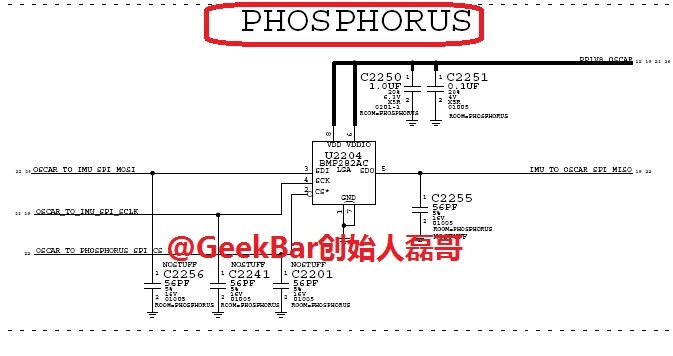
GeekBar claims “Phosphorus” will be the successor to the M7, collecting motion data as well as processing other health-related information handled by Apple’s new HealthKit API. This chip potentially is the power behind Apple’s new Health app for iOS 8, which will import data from the iPhone and other third-party devices in order to create an overview of the user’s health.
Apple introduced its new Health tracking app and its HealthKit API at WWDC in June. Besides encouraging developers to build health and fitness-related functionality into its device, Apple also may be talking to hospitals, health institutions and insurance companies in order to expand its HealthKit initiative beyond the user’s device. In one scenario, data from the Health app could be shared with a health insurance companies in order to lower a healthy subscriber’s monthly premium.
.CPlase_panel display:none;
TSMC Reportedly Ahead of Schedule With New 16nm Technology for Apple’s A9 Chip [iOS Blog]
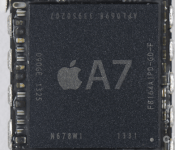
According to China’s Economic Daily News [Google Translate, via Digitimes], Apple’s reported current A-series chip partner Taiwan Semiconductor Manufacturing Company (TSMC) is ahead of schedule with its next-generation 16nm process for chip production. The Chinese-language report claims TSMC will begin 16nm volume production in Q1 2015, a full quarter earlier than its originally projected Q2 2015 start. This advancement may pave the way for TSMC to supply Apple with the future A9 processor that would be used in the late 2015 iPhone.
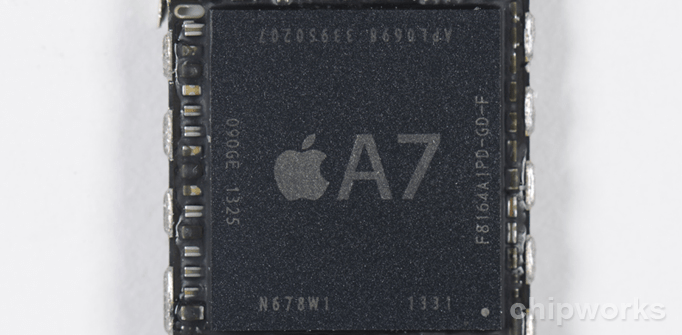
TSMC is reportedly installing this 16mm capability in its manufacturing plants with the potential for a monthly output of 50,000 wafers. This capability positions TSMC favorably against Samsung as the two companies vie to supply Apple with processors for both its current and future iPhone and iPad models.
Reports from last year suggested Samsung, GlobalFoundries and TSMC would share production of Apple’s A9 processor in 2015. Samsung is expected to handle the lion’s share of the production, providing up to 40% of Apple’s processor supply, although TSMC may be looking to alter that balance with its accelerated work. GlobalFoundries, TSMC and possibly even Intel may be used to complement Samsung’s production to provide the remaining chip inventory necessary to meet Apple’s demand.
.CPlase_panel display:none;

Schematics Allegedly Reveal M7 Successor Chip ‘Phosphorus’
Apple may be working on a new version of the M7 co-processor for the upcoming iPhone 6, claims GeekBar (Via G 4 Games) in a post on Weibo. In this latest report, a new set of schematics allegedly showcase this new co-processor chip, which internally is labeled “Phosphorus.”
GeekBar claims “Phosphorus” will be the successor the M7, collecting motion data as well as processing other health-related information handled by Apple’s new HealthKit API. This chip potentially is the power behind Apple’s new Health app, which will import data from the iPhone and other third-party devices in order to create an overview of the user’s health.
Apple introduced its new Health tracking app and its HealthKit API at WWDC in June. Besides encouraging developers to build health and fitness-related functionality into its device, Apple also may be talking to hospitals, health institutions and insurance companies in order to expand its HealthKit initiative beyond the user’s device. In one scenario, data from the Health app could be shared with a health insurance companies in order to lower a healthy subscriber’s monthly premium.
.CPlase_panel display:none;

App security flaw makes your iPhone call without asking

If you’re an iPhone user, you may want to be cautious about opening messages that contain phone numbers in the near future; they may cost you a lot of money. Developer Andrei Neculaesei notes that maliciously coded links in some apps will abuse the “tel” web handler (which covers dialing) to automatically make a phone call the moment you view a message. Potentially, an evildoer could force you to call an expensive toll number before you’ve had a chance to hang up. The exploit isn’t limited to any one app or developer, either. Facebook Messenger, Gmail and Google+ all fall prey to the attack, and it’s likely that other, less recognizable apps exhibit similar behavior. Apple’s Safari browser will ask you before starting a call, but FaceTime’s behavior lets you pull a similar (though not directly related) stunt.
In many cases, it’s the developers who are to blame. They’re supposed to put tighter controls on what happens when a number comes in, such as giving you a warning. However, Apple could theoretically mitigate the issue by requiring prompts for all phone links. You may not have to worry about a spam flood in practice, but let’s hope app writers act quickly — as Android users have already learned, “tel” exploits can cause a lot of grief if left unchecked.
Filed under: Cellphones, Internet, Mobile, Apple, Google, Facebook
Via: PCWorld
Source: Algorithm.dk
.CPlase_panel display:none;

Apple’s Reversible USB-Lightning Cable Unlikely for iPhone 6, but New Adapter Possible
Amid rumors of a new Lightning cable with a reversible USB connector and a redesigned power adapter from Apple, third-party vendor Moca.co is claiming that while the adapter may be ready for launch alongside the iPhone 6 next month, Apple is not yet ready to debut its new Lightning cable. Moca.co says that it is an MFi-certified vendor working with Apple’s primary Lightning cable provider and that Apple has not yet placed any orders for the new cable.
We are informed by the Official Appointed Manufacturer of Apple that the new Reversible USB Cable will not be released together with upcoming iPhone 6 and Apple has not placed any order with them yet. Apple fans will not be able to get the MFi version of this revolutionary cable from Apple this year but that is not the end of the story.
According to Moca.co, the manufacturing partner has sent samples of the Lightning cable with reversible USB connector to Apple for approval, but Apple has yet to move forward with manufacturing orders. Even once it does, it will reportedly be several months before the cables are ready.
The redesigned power adapter may, however, be ready to launch with the iPhone 6, as Moca.co tells MacRumors the design has been confirmed and mass production is already underway. According to the report, the new adapter supports up to 2A of current, twice that of the current adapter shipping with the iPhone. The new adapter will reportedly be able to power all iPhone, iPod, and iPad mini models, with the redesign likely driven by the higher power requirements of the larger iPhone 6 models.
Moca.co’s prototype adapter and cable based on Apple’s designs
Moca.co is planning to offer its own versions of the cable and adapter from its MFi-licensed manufacturing partners, and is currently taking pre-orders with plans of October delivery if it can obtain a sufficient number of pre-orders to initiate production.
.CPlase_panel display:none;
4.7-Inch and 5.5-Inch iPhone 6 to Carry 2x and 3x Retina Displays, Suggests Apple Journalist John Gruber
Throughout the past few months, a number of rumors have suggested many different resolutions for both the 4.7-inch and 5.5-inch iPhone 6, giving a variety of reasons as to how Apple will best optimize a larger screen size for both users and developers.
Prominent Apple journalist John Gruber has now given his in-depth take on the subject, stating that the 4.7-inch iPhone 6 will feature a resolution of 1334 x 750 with 326 pixels per inch, while the 5.5-inch iPhone 6 will have a resolution of 2208 x 1242 with 461 pixels per per inch.
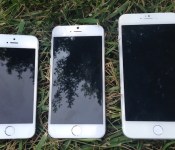
 4.7-inch and 5.5-inch iPhone 6 mockups compared to iPhone 5s
Gruber notes that keeping the current “2x” Retina resolution at 326 ppi on the 4.7-inch iPhone 6 would be consistent with Apple’s previous patterns on iOS devices:
At 4.7 inches, 1334 × 750 works perfectly as a new iPhone display, addressing problem #1, showing more content. With point dimensions of 667 × 375, this display would show 1.38 times more points than the iPhone 5. At 326 pixels-per-inch, everything on screen would remain exactly the same physical size. There would just be 38 percent more room for content.
Gruber also adds that moving to a “3x” Retina resolution at 461 ppi for the 5.5-inch iPhone 6 would display an even greater amount of content while being able to render the same Retina pixels on a larger scale:
Everything works at these dimensions for a 5.5-inch display. With an increase in area of 68 percent and a scaling factor of 1.06, this display would address both reasons why someone might want a very large iPhone: it would show a lot more content, and it would render everything on screen, point-for-point, a little bit bigger. And at 461 pixels-per-inch, everything would be amazingly sharp.
In both of those examples, existing apps would still be able to run at such resolutions, as optimizing current apps would be made easier considering the scaled nature of the displays.
The given 1334 x 750 resolution of the 4.7-inch iPhone 6 contrasts information and photos shared by luxury modified iPhone vendor Feld & Volk earlier this week, which showed the display of the 4.7-inch iPhone 6 under a microscope that was said to carry a resolution of 1704 x 960. That resolution has also been cited in previous rumors, but Gruber claims in his post that an iPhone 6 with a resolution of 1704 x 960 would only work well for 4.0-inch displays, as it would not show any additional content compared to the iPhone 5 when measured in touch points.
Gruber also comments on the possibility of both a 4.7-inch and a 5.5-inch iPhone 6 with a resolution of 1472 x 828. The claim states that such a resolution on the 4.7-inch device would render UI elements and text about 10 percent smaller, while such a resolution on the 5.5-inch device would equal out to be 307 pixels per inch, or only marginally better than Apple’s original definition of the Retina display as being at least 300 PPI.
The iPhone 6 is expected to be unveiled on Tuesday, September 9 at a media event. It is likely that the 4.7-inch version will go on sale about a week after the announcement, as the 5.5-inch may be held back due to production issues. In addition to a larger display, the iPhone 6 will likely feature a thinner design, a faster A8 processor, an improved camera, a more durable Touch ID sensor, and more.
.CPlase_panel display:none;
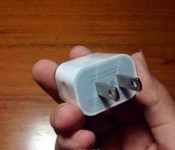
Image of Redesigned Apple USB Power Adapter Surfaces
A new image said to be of a redesigned Apple USB power adapter has been shared by a user on Weibo (Google Translate, via Gizmobic), hinting that Apple’s supposed new Lightning cable may be released alongside a new charger. The power adapter appears to be more rounded compared to Apple’s current offering, and also includes grooves on each side to improve comfort while holding and inserting the accessory.

While it is possible that the product in the image could be of a fake, the charger does have the signature “Designed by Apple in California” text along with other applicable information and logos. The user also shows another image of the new Lightning cable with its reversible USB connector, which has been spotted in a number of other photos and even a video throughout the past few weeks.
If both new products turn out to be real, it is possible that Apple could ship a new Lightning cable and new USB power adapter alongside this fall’s expected lineup of new iOS devices, possibly starting with the iPhone 6 next month.
.CPlase_panel display:none;

Apple offers battery replacements for some early iPhone 5 units

It’s hardly uncommon for smartphone batteries to lose some of their oomph over time, but Apple just might be able to help if your iPhone 5′s battery has been flakier than usual. The folks in Cupertino have figured out that some of the iPhone 5s sold between its launch in September 2012 and January 2013 have batteries that may “suddenly experience shorter battery life or need to be charged more frequently” and has kicked off a program to replace them free of charge. Mosey on over to Apple’s support page to see if your iPhone 5 is one of the affected units — if it is and you live in the United States or China, you can reach out and claim your replacement battery right now. What’s that you say? You’re one of those proactive types and already shelled out money for a replacement? Reach out anyway, because Apple may have a refund waiting for you. Alas, the rest of the world will have to wait just a little bit longer — Apple plans to launch the program in other countries on August 29th.
Via: 9to5mac
Source: Apple
.CPlase_panel display:none;
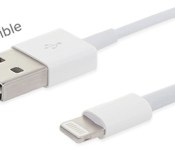
Third-Party Vendor Beats Apple to Market With Reversible Lightning USB Cables
Amid rumors that Apple is developing a Lightning cable with a reversible USB connector, third-party accessory vendor Truffol has begun selling a reversible USB Lightning cable on its website, beating Apple to the punch.
Priced at $9.99, the reversible cable advertised by Truffol is designed to be inserted into a USB port in either direction, a shift from a traditional USB cable that can only be inserted in one direction. While the cable is not Apple-approved and thus not Made for iPhone (MFi) certified, Truffol has told MacRumors that its cable works with both existing iOS devices and the upcoming iPhone 6. Purchasing third-party cables is not recommended by Apple, however, as they can cause damage to iOS devices.
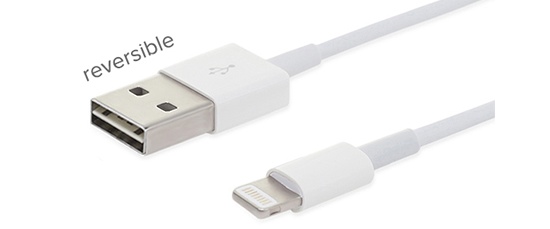
It is not clear whether these third-party reversible USB Lightning cables were already in development ahead of the rumors suggesting Apple was developing its own reversible solution or if they were designed in response to rumors, but their sudden availability may possibly hint at the existence of an Apple-branded reversible cable. Truffol told MacRumors that it believes the idea for the third-party reversible Lightning cables originated from “insider Apple sources.”
Rumors of an Apple-branded Lightning cable with a reversible USB connector first surfaced last week in the form of leaked images and videos, but Apple initially filed a patent application for the technology in January 2014, which became public in late July.
Video depicting alleged Apple Lightning cable with reversible USB connector
Apple may face some legal hurdles if it launches a reversible Lightning USB cable. A California company named UltraTek holds a patent for a reversible USB connector and already sells reversible USB cables through a number of different online retailers, but it is possible Apple has licensed the technology or developed a solution that is different enough not to infringe on UltraTek’s existing technology.
A second Apple patent filing that was published earlier this week suggests Apple has indeed improved on current reversible USB connector designs, as it details a cable with a flexible internal connector. Described as a flexible “tongue,” Apple’s design would allow a USB connector to flex to fit into any existing USB port regardless of insertion orientation. The flexible design may be superior to existing reversible USB designs because it allows for a thicker, sturdier middle “stalk” and a stronger connection with contacts.
It is possible that Apple’s rumored Lightning cable with a reversible USB connector might debut as soon as September, introduced alongside the iPhone 6 that’s expected to be unveiled at a September 9 media event.
.CPlase_panel display:none;
Apple Initiates iPhone 5 Battery Replacement Program
 Apple has begun an iPhone 5 Battery Replacement Program, suggesting that a small percentage of iPhone 5 units may have a faulty battery that results in a shorter battery life. iPhone 5 devices exhibiting battery issues were sold between September of 2012 and January of 2013 and could be eligible for a battery replacement.
Apple has determined that a very small percentage of iPhone 5 devices may suddenly experience shorter battery life or need to be charged more frequently. The affected iPhone 5 devices were sold between September 2012 and January 2013 and fall within a limited serial number range.
If your iPhone 5 is experiencing these symptoms and meets the eligibility requirements noted below, Apple will replace your iPhone 5 battery, free of charge.
Apple says the issue affects only a “limited serial number range” and iPhone 5 users can input their serial numbers on Apple’s support site to find out whether their phones need a battery replacement. Those who do have a faulty battery can get a replacement through an Apple Authorized Service Provider, an Apple Retail Store, or through Apple Technical support.
.CPlase_panel display:none;

