


Apple’s iPhone 6 and 6 Plus Quickly Dominate Japanese Smartphone Sales [iOS Blog]
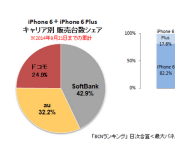
Apple’s new iPhone 6 and 6 Plus handsets are dominating the Japanese market in their first week of sales, reports Forbes, which cited weekly sales rankings provided by Japan’s BCN. iPhone sales were boosted by carrier Softbank, which edged out KDDI and NTT DoCoMo as the top wireless provider and accounted for 42.9 percent of weekly iPhone sales. According to the tracking, individual iPhone models took the top 18 spots in sales for the week.

The iPhone 6 was the most popular iPhone version, displacing competitors and the company’s own the iPhone 5s and 5c handsets, which previously topped the list for the month of August. According to BCN, the relative split between iPhone 6 and iPhone 6 Plus models was roughly 82 percent to 18 percent, with the smaller iPhone 6 seeing much greater sales than the larger model.
BCN tracks smartphones on a weekly and monthly basis, and in its latest weekly rankings the iPhone 6 took 8 of the top 10 spots with the iPhone 5s taking 5th and 8th place. The iPhone 6 Plus’ highest ranking was 11th and it has a fairly strong showing taking 5 of the next 7 spots.
Apple’s success compares to the month of August where the iPhone 5s took the 3rd and 4th positions and the 5c captured the 6th, 7th and 10th positions.
A similar dominance of the iPhone 6 was observed in US metrics with the iPhone 6 far outpacing the bigger iPhone 6 Plus. Much of this disparity may be the result of supply constraints affecting the availability of iPhone 6 Plus handsets, making it much harder for customers to find the models in retail stores and online.
Apple began selling the iPhone 6 and 6 Plus on September 19 and sold a record-breaking ten million handsets in the first weekend of sales. Demand for the handset remains high with minimum ship times of seven to ten days for most iPhone 6 models and three to four weeks for iPhone 6 Plus versions.
.CPlase_panel display:none;
Rumored 12.-9-Inch ‘iPad Pro’ May Include More Powerful A8X Processor
Apple’s 12.9-inch iPad Pro tablet is rumored to be landing as soon as early 2015, with the latest report from Taiwan’s TechNews (via G For Games) suggesting the tablet will feature an improved A8X processor. Similar to Apple’s previous A5X and A6X processors, the A8X would presumably be an graphics-enhanced version of Apple’s current A8 processor that debuted in the iPhone 6 and 6 Plus.

Apple shift away from using an “X” version of its base iOS device chip last year, opting to power the iPad Air and Retina iPad mini with the same A7 chip found in the iPhone 5s, albeit clocked slightly faster on the iPad Air. But with a higher-resolution “iPad Pro”, the graphics needs are likely high enough to require an enhanced main chip.
In its recent report, TechNews also reiterates its previous claim that Apple’s iPhone Air 2 will feature of RAM. This increased RAM would be a boost from the 1 GB present in both the current-generation iPad Air and the company’s new iPhone 6 and 6 Plus handsets. It also may serve to set the iPad Air 2 apart from the next Retina iPad mini, which is rumored to keep its current 1 GB RAM configuration.
While the iPad Pro may land next year, Apple’s iPad Air 2 is expected to be introduced sometime in the coming month. The new tablet may launch in time for the holiday shopping season with a redesign possibly including marginally a thinner body, redesigned speaker grille and other improvements such as Touch ID.
.CPlase_panel display:none;

Apple Reportedly Aware of iCloud Flaw Six Months Before Hacking of Celebrity Accounts
 Apple knew about an iCloud security flaw six months before it was utilized to hack celebrity accounts on the service, reports The Daily Dot. The company was notified of the exploit by independent security researcher Ibrahim Balic, who shared emails between himself and members of Apple’s product security team.
In an email from March 2014, Balic told Apple that he was able to bypass the security of any iCloud account by using a “brute-force” hacking method that was able to try over 20,000 password combinations. Balic recommended to Apple that it should implement a feature in iCloud that prevents log-ins after a set number of failed attempts, and even reported the exploit through Apple’s Bug Reporter. Balic was also the developer said to be behind the extended outage of Apple’s Dev Center last year.
In May 2014, Apple emailed Balic and questioned the validity of the exploit, stating that it “would take an extraordinarily long time” to find a valid authentication token to get into an iCloud account using the flaw. Balic states that Apple continued to ask him about the exploit and how it would be utilized.
On September 1, 2014, hackers breached the iCloud accounts of many well-known actresses, downloading and leaking private photos and videos. While it was not initially known what caused the breach, The Next Web linked to a Python script on Github that may have been used for the hacking. The script utilized a brute-force like method which allowed hackers to keep guessing passwords without being locked out.
Apple acknowledged later in the day that it was investigating the breach, ultimately leading to comments from CEO Tim Cook along with new security implementations. Those implementations included automatic emails when iCloud accounts are accessed via web browsers, automatic two-factor authentication for iCloud.com, and mandatory app-specific passwords for third-party apps accessing iCloud.
.CPlase_panel display:none;

‘Bash’ Security Flaw in OS X Allows for Malicious Attacks on Devices and Services
 Security researchers from Red Hat have uncovered a new exploit in the common “Bash” command shell found in OS X and Linux which can be used to deploy malicious code with minimal effort. Due to the ubiquity of the Bash shell, the exploit can affect a wide variety of different web-connected devices and properties, including unsecured websites, smart home appliances, servers, and more.
Security researcher Robert Graham noted on his blog that the Bash exploit is “as big as Heartbleed,” referring to the flaw discovered earlier this year in the popular OpenSSL software which secures connections between clients and servers:
Internet-of-things devices like video cameras are especially vulnerable because a lot of their software is built from web-enabled bash scripts. Thus, not only are they less likely to be patched, they are more likely to expose the vulnerability to the outside world.
Unlike Heartbleed, which only affected a specific version of OpenSSL, this bash bug has been around for a long, long time. That means there are lots of old devices on the network vulnerable to this bug. The number of systems needing to be patched, but which won’t be, is much larger than Heartbleed.
Heartbleed was said to have affected 66% of the Internet, although Apple announced in April that the exploit did not affect software or “key services.” Apple also released updates for the AirPort Extreme and Time Capsule to better secure both web devices against Heartbleed.
A topic discussing the Bash exploit on StackExchange also notes that Apple did not include a fix for the bug in its latest round of security updates that came alongside the release of OS X Mavericks 10.9.5 last week. It is possible however that Apple will release a fix for OS X in the near future to address the exploit, similar to what it has done for other security issues in the past.
.CPlase_panel display:none;
Apple Says iOS 8.0.2 Update is in the Works, Directs Users to Reinstall iOS 8
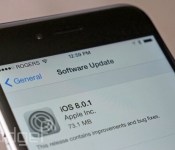
Earlier today, Apple released iOS 8.0.1, which ended up disabling cellular service and Touch ID on many iPhone 6 and 6 Plus devices. Apple said that it was investigating the issue this afternoon, and it has now released a support document confirming that an iOS 8.0.2 update is in the works with a fix.
In addition to announcing the upcoming update, the document also points users towards an interim fix involving reinstalling iOS 8 via iTunes.

The document offers the same advice Apple support representatives have been giving to customers since the issue first surfaced, directing users to download iOS 8 and reinstall it on their devices using iTunes. Apple’s specific steps are as follows:
Follow these steps to reinstall iOS 8.0.
1. Make sure that you’re using the latest version of iTunes.
2. Connect your iPhone to iTunes.
3. Back up your iPhone in iTunes on your Mac or PC. iCloud backups won’t restore to earlier versions, including iOS 8.0.
4. Download the file below that corresponds to your device:
– iPhone 6
– iPhone 6 Plus5. Select the file you just downloaded by doing one of these in iTunes:
– Mac: Press the Option key and click Check for Update.
– Windows: Press the Shift key and click Check for Update.6. Press Update to install iOS 8 on your iPhone.
The Health app won’t work in iOS 8 after these steps. It will be fixed in our upcoming iOS 8.0.2 software update.
Apple has pulled the iOS 8.0.1 over-the-air update, but the software was available to customers for approximately an hour and fifteen minutes, leaving many users with broken devices. According to the Apple, iOS 8.0.2 is already in the works with a fix and will be ready “in the next few days.”
iOS 8.0.1 originally fixed a significant HealthKit bug that popped up just ahead of the public release of iOS 8. Apple pulled all HealthKit enabled apps from the App Store due to the issue, and iOS 8.0.1 fixed the original bug, allowing the apps to be redistributed. The update also included fixes for third-party keyboards, Reachability, Photo Library, SMS/MMS messages, and more.
.CPlase_panel display:none;
Apple explains how to fix its busted iOS 8 update, new one coming soon

Went ahead and downloaded the newest, freshest version of iOS for that new iPhone 6? Then immediately regret doing so? Apple’s released a statement saying that users who have lost carrier service or Touch ID functionality should reinstall the initial version of iOS 8, until version 8.0.2 is ready to go. The company says this will take a few more days. We’ve got the full statement after the break.
“We have a workaround for iPhone 6 and iPhone 6 Plus users who lost cellular service and Touch ID functionality today after updating to iOS 8.0.1. Affected users can reinstall iOS 8 through iTunes, for more information visit http://support.apple.com/kb/HT6487. We apologize for the great inconvenience experienced by users, and are working around the clock to prepare iOS 8.0.2 with a fix for the issue, and will release it as soon as it is ready in the next few days.”
Filed under: Cellphones, Software, Mobile, Apple
.CPlase_panel display:none;

It’s just this easy to steal from the Apple Store (video)

Late last week, ex-NBA player Rex Chapman was picked up by Scottsdale, Arizona police on felony charges of theft and tracking in stolen property. According to the police, that’s because Chapman made off from the local Apple Store with over $14,000 worth of gear over several visits occurring in the last few months. As you can see in the raw security video footage of some nine visits released by the police today, he would browse around, pick up an item (headphones, although from the video we can’t tell if they’re Beats), pretend to check it out with Apple’s EasyPay app and put it in a white Apple sales bag. Finally, all he had to do was walk out before selling the goods at a pawnshop.
We’ve contacted Apple to find out if there are what specific policies are in place to stop this kind of thing from happening, but have not yet heard back. Apple employees reported the thefts back in August and recognized Chapman as a former player for the Phoenix Suns, and he was arrested Friday afternoon. He was released on $14,000 bond Saturday, and is due back in court Friday, but has been quiet on Twitter since the arrest.
Source: YouTube, AZCentral, AZFamily
.CPlase_panel display:none;

Apple Launches Yosemite ‘AirDrop Test Fest’ For AppleSeed Members [Mac Blog]
Apple has sent out invites to multiple AppleSeed testers to invite them to participate in a “AirDrop Test Fest” to fix any potential bugs in the file sharing service ahead of the launch of OS X Yosemite.

AppleSeed and the AirDrop engineering team would like you to join us for an AirDrop Test Fest. What’s a test fest? At Apple we often hold test fests when we want to focus our efforts on a new feature or enhanced function of OS X. Now we want to bring that experience to our seed participants. We would like you to help us test the new AirDrop in OS X Yosemite.
According to 9to5Mac, invited users will see a notice located in the Feedback Assistant app bundled with the public beta of Yosemite. Testers are given guidelines for testing the feature, including two Macs running Yosemite.
What do I need? To participate in the AirDrop Test Fest you will need at least two Macs from the following:
– 2012 Mac or later for new AirDrop
– Any Mac for Legacy AirDrop (old Mac to Mac only)
The Macs will need to be running the latest seeded build of OS X Yosemite. If you also want to test with your iPhone or iPad you will need device with a Lightning connector running iOS 7 or iOS 8.
Apple’s “AirDrop Test Fest” will last from today, September 24, until Sunday, September 28. Apple has set up a special discussion topic for the event, inviting testers to contribute observations and results, and the company will be providing a “special AirDrop survey” that guides users through usage scenarios the company would like to explore.
.CPlase_panel display:none;

Google Chairman Eric Schmidt: Competition Between Apple and Google is More Brutal Than Ever
Google executive chairman Eric Schmidt and former SVP of products, Jonathan Rosenberg, recently published a new book entitled “How Google Works, which explores topics like corporate culture, strategy, talent, innovation, dealing with disruption, and more. The duo have done an interview with Bloomberg to promote the title, with Schmidt commenting on the state of affairs between iOS and Google and Apple’s new larger-screened iPhones.
According to Schmidt, competition between Apple and Google is more brutal than ever before, with “enormous, enormous racing” going on between the two companies, which ultimately has “enormous benefits for consumers worldwide.”

In fact I would say that this brutal competition between Apple and Google over Android and iOS has enormous benefits for consumers worldwide. If you look at the innovation on the Apple side and on the Google side, that competition which I think is the defining fight of the computer industry, it benefits global at the billions of people level.
When questioned about how he feels driving past an Apple Store and seeing people lined up around the block to purchase an iPhone, Schmidt said “I’ll tell you what I think. Samsung had these products a year ago.” The interviewer further notes that nobody “had a huge party” and Schmidt reiterated that Samsung had larger phones first once again. “I think Samsung had the products a year ago. That’s what I think.”
Re/code has also published a short excerpt from “How Google Works,” where Schmidt writes about a meeting he had with former Apple CEO Steve Jobs in 2010. During the meeting, Jobs made it clear that he believed Android was based on Apple’s intellectual property, and Schmidt worried that a dispute was brewing.
The two had sat outside at the California-cuisine-oriented cafe, discussing Google’s growing mobile operating system, Android. Steve was convinced that the open-source operating system was built on intellectual property created by Apple. Eric responded that we hadn’t used Apple’s IP and had in fact built Android on our own. But his argument was to no avail. “They are going to fight us,” he thought.
The excerpt goes on to detail the friendship between Jobs and Schmidt and the release of the iPhone in 2007, which led to Schmidt stepping down from Apple’s board due to the similarities between iOS and Android. It also covers the differences between Apple’s closed system compared to Google’s open system, and why both methods work.
Apple’s control model works not just because of Steve Jobs’s excellence, but also because of how he organized the company. At Apple — just like Google — the leaders are product people with technical backgrounds. When you build a team of great, smart creatives, and put the world’s uber-smart creative in charge, then you have a good chance of being right most of the time. And when you are right most of the time, then a highly controlled model can yield tremendous innovation.
Schmidt and Rosenberg’s full 15 minute Bloomberg interview contains additional details on the relationship between Google and Apple and is well worth watching. Their new book, “How Google Works,” can be ordered on Amazon for $24.
.CPlase_panel display:none;

iPhone 6 Subjected to Bend Test, Proves More Durable Than iPhone 6 Plus
Apple’s iPhone 6 Plus has been receiving a huge amount of attention over the last day, following reports of users seeing significant bending after placing the phone in a pocket.
A video made yesterday demonstrated the just how far the iPhone 6 Plus is able to bend, and now the video’s creator, Lewis Hilsenteger of Unbox Therapy, has created a second video to test the iPhone 6 and several other Samsung devices.
Surprisingly, the smaller 4.7-inch iPhone 6 appears to be much less malleable than the larger iPhone 6 Plus. While the iPhone 6 Plus bent significantly near the volume buttons under the force inflicted by Hilsenteger, he is unable to do as much damage to the iPhone 6. Aside from a small dent, the phone remains intact. “This one is far more durable,” he says.
Based on his preliminary testing, Hilsenteger does not believe that iPhone 6 users will see the same issues that some iPhone 6 Plus users are seeing in regards to bending. As we noted yesterday, it’s unlikely that the force Hilsenteger used in the original video will be replicated inside of a pocket, but photos of bent iPhone 6 Plus devices have suggested that it does not take much force to cause a slight curvature in the device.
Bending issues are not limited to the iPhone 6 Plus, as bending has been seen in prior versions of the iPhone, including the iPhone 5 and 5s.
Apple has not commented on the iPhone 6 Plus bending incidents, but iPhone 6 Plus owners can likely prevent bending by removing the phone from their pockets before sitting or by placing the device in a rigid protective case.
.CPlase_panel display:none;

