


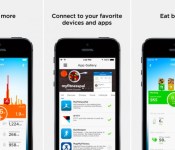
Jawbone Launches HealthKit-Enabled ‘Up’ App Featuring Personalized Fitness Advice [iOS Blog]
Jawbone has launched its new Up app for the iPhone, which utilizes Apple’s Health app and HealthKit to track and deliver advice based on a user’s diet and physical activity. Not to be confused with Jawbone’s other Up app, this newest app does not require the company’s fitness tracker and works with over a hundred apps and devices, including MyFitnessPal, Strava Running and Cycling, IFTTT, and more.

Information from meals logged throughout the day can be used to help generate nutritional advice, while data from workouts can be used to help set goals for the future. The Up app also allows users to log their sleep, which can be analyzed and used to provide advice on future sleep adjustments. All of the advice generated is powered by Jawbone’s Insight Engine, which works with both recorded data and data from the Internet to deliver information on a variety of fitness-related subjects.
The app also includes a number of social functions, including the ability to add friends to a “team” to compare and track fitness scores and goals. Users can also set their own goals within a team and receive notifications when progress is being made. Insights generated by the Up app can also be shared through email, message, Facebook, and Twitter.
Up by Jawbone is a free app for the iPhone and can be downloaded in the App Store. [Direct Link]
.CPlase_panel display:none;

iOS 8 Safari Supports Animated PNG Images [iOS Blog]
 With the release of iOS 8, Safari has gained the ability to display Animated PNGs (APNGs). Originally proposed in 2004 as a replacement to animated GIF images, APNGs offers more color and transparency support over GIFs.
The Animated Portable Network Graphics (APNG) file format is a non-standard extension to the Portable Network Graphics (PNG) specification. It allows for animated PNG files that work similarly to animated GIF files, while supporting 24-bit images and 8-bit transparency not available for GIFs. It also retains backward compatibility with non-animated PNG files.
The APNG specification, however, was rejected by the PNG group in 2007, so support for the format has been rather limited. In fact, the format has been declared dead due to the lack of official adoption. Firefox was the only major browser that provided standard support for APNG, until iOS 8.
The beach ball image in this article is animated when viewed in iOS 8 or Firefox.
Thanks Parasprite
.CPlase_panel display:none;
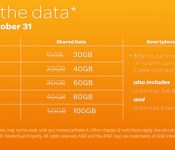
AT&T Doubling Data on Mobile Share Value Plans in Limited Time Promotion [iOS Blog]
AT&T today announced that it is launching a new limited-time promotion for its Mobile Share Value Plans, offering double the amount of data for new and existing customers with monthly data plans of 15GB or more.

Under the promotion, customers with monthly shared data plans of 15GB will now be receiving 30GB of data, while those on 20GB, 30GB, 40GB, and 50GB plans will see an increase to 40GB, 60GB, 80GB, and 100GB of data, respectively. In order to receive the promotion, new and existing customers must sign up by October 31.
The promotional pricing applies to new and existing customers who buy a phone under the AT&T Next early upgrade program, and also includes those who bring their own smartphone or purchase one at full price. In addition to data, the plans include unlimited talk, text, and international messaging.
The move follows an announcement from Sprint last month that offers 20GB of shared data plus an additional 2GB of data per line for $100 a month to new customers switching from other carriers. Additionally, Sprint is offering up to $350 (via Visa Prepaid Card) to cover early termination fees for users switching from other carriers.
.CPlase_panel display:none;
Supposed Internal Memo Suggests October 10 Launch for iPhone 6 in China [iOS Blog]
Apple may be looking to launch the iPhone 6 and iPhone 6 Plus in China on October 10, according to an internal Apple retail employee memo shared by Techweb (Google Translate). The memo also states that “prototype” iPhone 6 units will be put on store shelves starting October 7, allowing customers to experience both models before their launch three days later.

It was reported earlier this month that Apple received one out of the two regulatory licenses needed to sell the iPhone 6 in China. China’s Ministry of Industry and Information Technology (MIIT) is said to be performing the review, and would need to give Apple a critical regulatory license before the device goes on sale

Meanwhile, a report from Bloomberg states that the country’s largest carrier, China Mobile, would be taking steps to eliminate $2 billion in smartphone subsidies for customers. The move would double the total cost of handsets like the iPhone over two years, with the up-front cost of the device decreasing while service contracts increase
China has become a growing market for Apple throughout the past few years, as the company has opened a variety of new stores and pushed iPhone sales through China Mobile, China Unicom and China Telecom, which are country’s three biggest carriers. An October launch for the iPhone 6 in China would also be positive for Apple’s important holiday quarter, which usually sees the company pushing to increase its sales in all of its markets before the end of the year.
.CPlase_panel display:none;
Consumer Reports weighs in on iPhone 6 bending

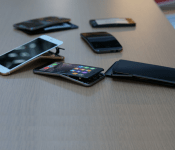
As much as Apple would like for this discussion to be over, controversy and conversation over whether the iPhone 6 / 6 Plus has a durability problem is continuing. Just as it tested out antenna reception for the iPhone 4, Consumer Reports has forced Apple’s newest mobile devices into its torture testing chambers, measuring them along with several other devices to see how much pressure they can really take. You can see the tests for yourself in a video embedded after the break, but according to CR, the larger iPhone 6 Plus is actually stronger than its counterpart, only deforming under 90 pounds of pressure, more than the 70 it took to bend the standard iPhone 6 and HTC One (M8). Meanwhile, Unbox Therapy gave a brand new iPhone 6 Plus another go in its less-scientific test, and bent it once again, while a Moto X withstood the challenge.
[Image credit: Consumer Reports]
The toughest phone in the test proved to be the Galaxy Note 3, which didn’t deform or suffer case separation until it hit 150 lbs of pressure. According to Consumer Reports, one of Apple’s tests uses a similar machine and method but only goes up to 55 lbs, about the pressure it says is needed to break three pencils. Ultimately, it gauged all of the phones capable of withstanding normal usage, but go ahead and press play if you need some more convincing.
Filed under: Cellphones, Mobile, Apple
Source: Consumer Reports, Unbox Therapy (YouTube)
.CPlase_panel display:none;
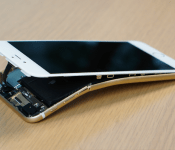
Consumer Reports: iPhone 6 and iPhone 6 Plus Not As Bendable As Believed
Just a day after Apple issued its first statement regarding the ongoing complaints that the iPhone 6 Plus bends in user pockets, Consumer Reports has released its test results for how “bendable” Apple’s new phones are. In summary, the results show that the new phones are far stronger than what some testimonies have suggested in the past few days.
brightcove.createExperiences();
To test the phones, Consumer Reports put them through the “three-point flexural test”, which has the phone supported at two ends and has pressure applied at a third point, alongside competitors like the HTC One (m8), Samsung Galaxy Note 3, LG G3 and iPhone 5.
Consumer Reports’ tests pushed the iPhone 6 and 6 Plus much further than [Apple’s test of 55 pounds of force]. We started light, applying 10 pounds of force for 30 seconds, then releasing the force. Then we upped the force in 10-pound increments, noted when the phones first started to deform (that’s what our engineers call it) and stopped the test for each phone when we saw the screen come loose from the case.
The results showed that the 6 Plus was actually stronger than the iPhone 6, starting to deform at 90 pounds of force and having its screen and case separate at 110 pounds of force. The iPhone 6 started to deform at 70 pounds of force and started coming apart at 100 pounds of force. The HTC One (m8) performed the worst in Consumer Reports’ test, deforming at 70 pounds of force and coming apart at 90 pounds of force.
 iPhone 6 Plus after Consumer Reports’ test
The LG G3 started to deform and come apart at 130 pounds of force while the iPhone 5 deformed at 130 pounds of force and came apart at 150 pounds of force. The Galaxy Note 3, on the other hand, deformed and came apart at 150 pounds of force. Consumer Reports notes that while other phones, like the iPhone 6 and HTC One, were still functioning after deforming and coming apart, the Note 3 stopped working right away.
Overall, the magazine notes that while none of the phones they tested were indestructible, all devices tested should hold up fine under everyday use
.CPlase_panel display:none;

What is Weirded? This is Weirded.

How does one introduce an original web series like #Weirded?
For one, it’s not tech news — at least, not in the way you’re used to seeing. So scrub that notion from your brain. It’s more like a constant channel change; like pressing the seek button on a car radio and catching tidbits of the noise filling the tech industry’s airwaves. It’s light, but biting in a way we hope’ll make you ask for “more, please!” It’ll skewer and shine a light on the more outrageous news and comments of the week. But it will always be in good fun (and in very bad taste). It’s a guilty pleasure; our tongue-in-cheek gift to you.
This week’s inaugural episode is pretty fruity: It’s nearly all about Apple, with some Blackberry crumble on the side. The full episode’s just after the break. Enjoy the feast!
[Image credit: Denelson83, Wikipedia]
Filed under: Cellphones, Apple, Blackberry
.CPlase_panel display:none;
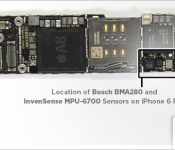
iPhone 6 and 6 Plus Equipped With Two Accelerometers for Power Management, Improved User Experience
Apple has opted to equip the iPhone 6 and 6 Plus with two separate accelerometers, as discovered in Chipworks’ comprehensive iPhone 6 and 6 Plus teardown. There’s a three-axis Bosch BMA280 accelerometer and what Chipworks believes is a MPU-6700 six-axis accelerometer from InvenSense.
According to Chipworks, Apple may have decided to incorporate two accelerometers into the iPhone 6 and 6 Plus to both minimize power consumption and “improve the overall user experience.”
The InvenSense accelerometer has a range of functions, allowing it to operate in several different modes, but it can draw more power than the Bosch accelerometer due to its higher sensitivity. The maximum sensitivity of the InvenSense is at 16684 LSB/g, much higher than the Bosch’s 4096.

The InvenSense device can operate as a six axis inertial sensor, or as either a three-axis gyroscope or a three-axis accelerometer. It is rated to consume 3.4 mA in the six-axis mode, 3.2 mA in the gyroscope mode and 450 µA in the accelerometer normal mode. By contrast, the Bosch device operates as a 3-axis accelerometer only and it consumes 130 µA of current in the accelerometer normal mode. Both devices offer two low power levels of operation for the accelerometer function. The InvenSense device actually consumes less current in its lowest power mode, with a 1 Hz update rate.
The main benefit of the InvenSense is full six-axis integration of the data by the on-chip digital motion processor (DMP). This will provide a direct benefit for gaming and other applications that need sophisticated inertial sensing capabilities. In addition the InvenSense provides significantly higher sensitivity than the Bosch device. The price however, is higher power consumption.
The Bosch accelerometer is able to operate at a lower power than the InvenSense and it has a “much faster” cold start up time, at 3ms compared to 30ms, allowing it to be used when complete six-axis integration is unnecessary. Chipworks speculates that it may be used for tasks where higher sensitivity is unneeded, perhaps for rotating the screen from landscape to portrait mode or for pedometer functionality.

According to Chipworks, the inclusion of two accelerometers in the iPhone 6 and 6 Plus is an example of Apple’s “elegant engineering.” A single InvenSense accelerometer would have enabled the device to work perfectly well, but the addition of the Bosch accelerometer allows for lower power consumption in the appropriate situations.
.CPlase_panel display:none;
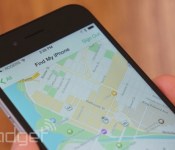
iOS 8’s WiFi location privacy isn’t as powerful as you might think

If you were hoping that iOS 8’s ability to hide your device ID from nearby WiFi networks would render you invisible to nosy hotspot operators, you’ll want to dial back your expectations a bit. AirTight Networks’ Bhupinder Misra has found that Apple’s hardware address randomization only kicks in under a very narrow set of circumstances. You not only have to put your device to sleep and turn off location services, you have to turn off cellular data as well — in short, your iPhone has to become a paperweight. Even then, the masking only appears to work with iOS devices using at least an A7 processor, like the iPhone 5s.
As such, it’s business as usual for institutions and stores that want to track your phone for the sake of stats and marketing. The only way to avoid giving out your hardware’s real ID is to… well, stop using your hardware. The risk of revealing anything truly personal is relatively slim, but you’re not going to be happy if you were hoping to go incognito around public WiFi access points. Not that companies would necessarily be deterred even if the location privacy feature was more useful. As AirTight’s Hemant Chaskar notes to The Verge, it’s possible for those monitoring WiFi data to toss out fake device info. Although they won’t get a complete view of the people wandering near their networks, they can still make use of whatever data is left.
Filed under: Cellphones, Tablets, Software, Mobile, Apple
Via: The Verge
Source: AirTight Networks Blog (1), (2)
.CPlase_panel display:none;

Apple Pay Roundup: Everything We Know, Coming in October
Apple Pay is Apple’s new mobile payments service, which it first debuted in September alongside the iPhone 6, the iPhone 6 Plus, and the Apple Watch. Apple Pay is expected to become widely available to consumers beginning in October, and ahead of its official release, we’ve gathered everything that’s currently known about the service into a roundup so users can get an idea of what to expect.
With Apple Pay, iPhone 6 and 6 Plus owners will be able to make payments for goods and services with their iPhones, both in stores and within participating apps, using the NFC chip built into the devices. While Apple Pay will initially be restricted to iPhone 6 and 6 Plus owners, iPhone 5, 5c, and 5s users will also be able to take advantage of the service if they purchase an Apple Watch after it is released.

Apple has described Apple Pay as the most secure payment solution available, as it uses Device Account Numbers rather than storing credit card numbers and keeps all payment information in a dedicated chip on the iPhone, called the Secure Element.
All payments are verified using Touch ID, which prevents someone who has stolen a device to make unauthorized purchases. Furthermore, if an iPhone 6 or 6 Plus is stolen, its ability to make payments can be disabled through Find My iPhone.
Apple has said that Apple Pay will be available beginning in October, enabled through an upcoming update to iOS 8.
The Apple Pay roundup, like all of our other roundups is accessible through a dedicated index page that shows a full list of all available roundups ordered by most recent update. The roundup is also accessible directly through the “Roundups” tab in the top navigation bar on all MacRumors pages.
.CPlase_panel display:none;


