



Apple CEO Tim Cook Earned $9.2M in Fiscal 2014, Doubling 2013 Compensation
 Apple CEO Tim Cook’s compensation for fiscal 2014 was $9.22 million, according to a newly released SEC filing. That breaks down to a salary of $1.7 million and non-equity incentive compensation of $6.7 million, double the $4.3M compensation he received in 2013.
Apple’s newest executive hire, Angela Ahrendts, received $73 million in cash and stock. That includes a $400,000 salary, a $500,000 bonus, and $70 million in stock. Ahrendts, who joined Apple in May of 2014, was previously making $37 million at Burberry, and her offer package included an RSU award with a value of $37 million to compensate her for her unvested Burberry awards along with an RSU award of $33 million as a new Apple hire.
As for other Apple executives, Eddy Cue and Jeff Williams made over $24 million in stock awards, salary, and non-equity incentive plan compensation. Peter Oppenheimer earned $4.5 million, and Luca Maestri, Apple’s new CFO, received $14 million.
Apple had a record year under the guidance of Tim Cook, generating $182.8 billion in sales with $38.5 billion in net income in fiscal 2014, a new high for the company. According to its October forecast Apple expects to see revenue between $63.5 and $66.5 billion for the first quarter of 2015.
Apple will announce its earnings for the first fiscal quarter of 2015 on Monday, January 27. MacRumors will provide live coverage of both the earnings release and the conference call.
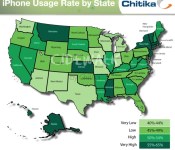
Apple’s iPhone is Most Popular in Alaska and Montana [iOS Blog]
A new study that measures iPhone usage rates by state suggests that Apple’s iPhone is most popular in states like Alaska, Montana, Vermont, New York, Kansas, and Mississippi. The study, conducted by Chitika Insights on December 25 through December 31, sampled “hundreds of millions” of U.S.-based iPhone ad impressions to determine the percentage of iPhone users in each state.
Each of the above listed states, along with many states in New England, saw between 55 and 65 percent of smartphone traffic coming from iPhones. Arizona, New Mexico, Texas, Washington, Iowa, Missouri, Wisconsin, Indiana, and Michigan saw the lowest amount of traffic coming from iPhones, at 40 to 44 percent. New Mexico was the state with the lowest iPhone usage.

According to Chitika, iPhone usage rates did not correlate to geography or raw population figures, but there was some relationship to both population density and education level. A higher median income was also associated with iPhone usage, but that could be a result of education level, as those two variables go hand in hand. In states with higher education levels and denser populations, iPhone usage tended to be higher.
In a similar study conducted in 2011, Montana was one of the few states where iPhone usage outpaced Android usage. In many states the iPhone is not dominant, but the two usage maps provide an interesting look at how iPhone adoption has grown by state over the past four years. Many states where BlackBerry dominated, for example, are now seeing high iPhone usage.
Chitika’s study is not the first to correlate iPhone usage with higher education and income levels. Several other studies have also suggested that iPhone owners are, on average, wealthier and higher educated than other smartphone owners.
‘Marco Polo’ App for Finding Misplaced iOS Devices Updated With Custom Responses and More [iOS Blog]
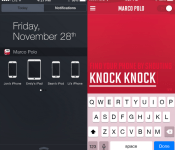
Developer Matt Wiechec today released a major update to his Marco Polo iOS app that helps users recover misplaced iPhones and iPads with the sound of their voice. The new update brings custom responses and a new Notification Center widget that allows users to find other iOS devices also running the app.
Addressing a different use case than Apple’s Find My iPhone service, Marco Polo is intended to allow users to easily find an iOS device located in close proximity to the user. The app’s core functionality requires the app to be running in the background, with the device’s microphone listening for the key passphrase, which is “Marco” by default. Once the user speaks the phrase, the app generates an audio response, with the default being “Polo”.
The new update lets Marco Polo users select phrases like “I’m Over Here” and “Who’s There?” over the simple “Polo” response, while also bringing a slew of new character voice options, like “Movie Guy” and “Wicked”. The widget, once installed in the Today section of the Notification Center and set to discoverable within the app, allows users to find other iOS devices with a simple tap.

Our largest update yet, ready for the new year. We’ve added great new features, new voices, custom responses, widgets, and improved the entire app experience!
– Custom Responses are here! Now your device can ring back more than just POLO!
– Choose from responses like “I’m Over Here”, “Who’s There?”, “iPhone Reporting”, and many others. Even enter your own phrase!
– New iOS 8 Nearby Widget; skip shouting and find other devices right from Notification Center
– Greatly improved voice recognition
– Added new voices like MOVIE GUY and WICKED, including supporter exclusives like ARNOLD, BUSH, KERMIT, SLY, and more
– The app is now Universal to support the iPad, and completely optimized for iOS 8 and the iPhone 6 and iPhone 6 Plus
Marco Polo even allows some customization to the phrase shouted to prompt the app’s response, meaning virtually any 12-letter word a user can think of could be used to discover a lost iPhone, an improvement over the original version of the app where some users complained that words with similar sounds to “Marco” such as “mark” would trigger a response.
Functionality in silent mode and while the device is sleeping, as well as a volume boost feature that makes sure the app’s voice is heard even if your phone is low, round out most of standard features that were available even before today’s 2.0 update.
The app has a decent voice recognition range, and recognizes almost any 12-letter word or phrase added as a passphrase. Slight drawbacks may hinder daily use of the app, however, including the need for the device’s microphone to always be active. This means that once you leave the app, the red “recording” microphone bar will be a permanent mainstay atop the iPhone screen. Using the Notification Center widget to discover other missing devices doesn’t require the microphone to be on, however.
Potential battery drain may also be a concern given the need to keep the device’s microphone active, although we did not see significant drops in battery status during limited testing.
Marco Polo can be downloaded for $0.99 from the App Store. [Direct Link]

‘The LEGO Movie Video Game’ for iOS Hits the App Store [iOS Blog]
Popular children’s film The LEGO Movie has been translated into an iOS app, which was released in the App Store today. The LEGO Movie Video Game, like other LEGO games, is a premium title that’s based on the movie, offering the same fun characters and plot line in a playable format.
In the game, players will take on the role of Emmet, an ordinary rule-abiding lego guy who has to take on the job of saving the world from an evil tyrant, with the help of the friends he meets on his journey.
The LEGO Movie Video Game features more than 90 characters from the movie, and there are 45 levels to play through across worlds like Cloud Cuckoo Land and Flatbush Gulch. There’s also an all new animation style.

KEY FEATURES:
– A delightful and surprising mix of over 90 characters as seen from the film, including Batman, Superman, the Green Ninja, Gandalf, Benny, and more.
-Journey through fantastical worlds like Flatbush Gulch, Cloud Cuckoo Land, and more in 45 exciting levels!-Smash bricks in a fascinating environment made of LEGO bricks.
-Collect and use LEGO instruction pages to build in a new way.
-Harness the awesome power of the Master Builders to virtually build extraordinary LEGO creations.
-Enjoy a brand new animation style as seen in the film that simulates the movement of actual LEGO toy sets.
Like other LEGO games, the new LEGO Movie game is quite large, requiring 2.2GB of space to download and 1.1GB of space to play after installation is complete. The game does have in-app purchases, but for a limited time, “Confetti” and “Bubble” Red Brick abilities are free to purchase to celebrate the game’s launch.
The LEGO Movie Video Game can be downloaded from the App Store for $4.99. [Direct Link]

BlackBerry CEO Says U.S. Government Should Force Apple to Expand iMessage to Other Platforms
BlackBerry CEO John Chen yesterday published a blog post adaptation of a letter in which he presses U.S. government officials to support not only net neutrality but also “application/content neutrality”. In Chen’s view, all apps and content should be available on all platforms, and he points specifically to Apple’s iMessage and Netflix’s streaming services as examples of discrimination against BlackBerry.

Unlike BlackBerry, which allows iPhone users to download and use our BBM service, Apple does not allow BlackBerry or Android users to download Apple’s iMessage messaging service. Netflix, which has forcefully advocated for carrier neutrality, has discriminated against BlackBerry customers by refusing to make its streaming movie service available to them.
Chen believes BlackBerry is a leader for content and application neutrality and pushes U.S. government officials to require these same neutral practices from the Canadian company’s competitors. “Neutrality must be mandated at the application and content layer if we truly want a free, open and non-discriminatory internet,” writes Chen.
Chen’s comments have unsurprisingly been met with ridicule by developers who don’t wish to be forced to create apps for platforms where they do not expect worthwhile returns, and many observers have suggested BlackBerry should focus its efforts on creating a compelling ecosystem that would attract users and apps organically.
Apple has historically been quiet on broader issues of net neutrality. The Cupertino company was noticeably absent from a list of more than 100 technology companies which signed a letter protesting a proposed change in FCC rules that would allow for Internet fast lanes for certain types of content. Speculation has suggested Apple’s absence may be related to its interest in securing priority access with Internet providers for media content delivered by the company.
Spotify for iOS Adding Streamlined ‘Touch Preview’ Controls After Record-Breaking 2014 [iOS Blog]
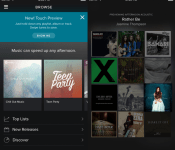
Spotify today announced an update to its iOS app that will bring more streamlined controls into its music browsing software, most notably allowing users to get a sneak preview of a song, album, or artist with a simple tap and hold on the screen.
The new feature, dubbed “Touch Preview”, is aiming to get Spotify users to find their preferred music faster and with less hassle. The update also brings a swipe-left gesture into the app — doing so on any song quickly saves it into Your Music for listening to later. The update to Spotify’s iOS app will be rolling out later today.

Spotify also announced last week that by the end of 2014, the service had accumulated 15 million subscribers and 60 million active users. Those number were up from 10 million subscribers and 40 million active users reported by the company in May 2014.
As users continues to shift to streaming services for their music consumption, Apple’s efforts in the subscription streaming market are rumored to be seeing a new focus with an upcoming revamp of the Beats Music service, and its integration into iTunes, sometime in 2015. Apple most recently acquired media analytics company Semetric, likely integrating some of that company’s Musicmetric tracking service into Beats and other aspects of iTunes.
Apple’s Time Machine, Cover Flow, and Safari for iOS Targeted in New Patent Infringement Lawsuit
Patent holding company TriDim Innovations this week filed a patent infringement lawsuit against Apple, accusing the companying of violating two 3D workspace patents the company owns. The lawsuit was filed in the U.S. District Court for the Northern District of California with a judge assignment still pending.
TriDim asserts in the suit that Apple is infringing on U.S. patents 5,838,326 and 5,847,709, both of which address document management in 3D workspaces. Specifically, Apple Time Machine, Cover Flow, and Safari for iOS 7 and 8 are claimed to be infringing on the patents.
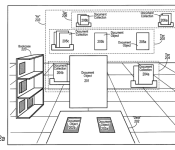
 One embodiment of the document display space disclosed in TriDim’s patents
Both of TriDim’s patents were originally filed in 1996 and awarded to Xerox in late 1998, although they have changed hands several times in recent years. Patent ’326 details a method of moving and manipulating document objects in a 3D workspace using touch-drop, flick and other gestures.
A computer controlled display system for displaying a three-dimensional document workspace is disclosed. One or more documents objects are present in the document workspace. The present invention provides for interaction with the collections, e.g. viewing, moving and storing, while balancing the necessary tradeoffs of rapid access, number of collections and associated documents, and available screen space.
TriDim is asking for unspecified monetary damages for Apple’s alleged infringement, along with interest and court costs.
https://www.scribd.com/embeds/253305528/content?start_page=1&view_mode=scroll&access_key=key-9WdfkBv5VHawdj4NjBpj&show_recommendations=true
TriDim’s lawsuit is not the first time Apple has been accused of patent infringement for its Time Machine and Cover Flow interfaces. In 2010, Apple was initially hit with a $625 million judgment in a case centered on a different set of patents owned by Mirror Worlds LLC. That verdict was ultimately overturned, however, and became final when the U.S. Supreme Court declined to hear the case.
Amazon Ends Wallet App Beta Program, but Still No Sign of Apple Pay Loyalty Rewards Program [iOS Blog]
Amazon today ended the beta for its Amazon Wallet app, approximately six months after the company launched it last summer. The company began sending emails last night to those signed up for the beta, announcing the company would be shutting it down and removing the Wallet app from Google Play and Amazon’s own Appstore (via CNET).
Unlike Apple’s new Apple Pay payments service that ties directly to credit and debit cards, Amazon Wallet focused on gift and loyalty cards that users could manage and store within the app for use in physical stores or online. Amazon did not confirm whether the Wallet app might be revived in the future, but did mention it was a learning experience for the company as a whole.

“We have learned a great deal from the introduction of the Wallet and will look for ways to apply these lessons in the future as we continue to innovate on behalf of our customers,” Amazon spokesman Tom Cook said in a statement.
The company has been far more than an online marketplace for a few years now, throwing its hat into the ring of everything from streaming devices to personal voice assistants. But it hasn’t been clear sailing either, especially with the Fire Phone, which debuted last summer. The phone received mediocre reviews and has seen a series of price drops in an attempt to sell more units.
Loyalty programs are currently one aspect missing from Apple Pay, but the company has been rumored to be planning a rewards-focused loyalty program for the service. Reports late last year hinted at a holiday launch date for the service, though the rumors failed to come true.
Apple’s loyalty program is rumored to see Apple partner with various companies, from retailers to major hotel chains, to provide customers who use Apple Pay at their locations with various rewards. Though Apple Pay is still a fairly new service, its continued growth amongst both customers and partners mean a rewards-style program could quickly prove valuable for consumers and help drive even more usage.
Apple Seeds OS X Yosemite 10.10.2 Build 14C106a to Developers [Mac Blog]
Apple today seeded a sixth beta of OS X Yosemite 10.10.2 to developers, just a week after seeding the fifth beta of OS X 10.10.2, and two months after seeding the first beta.
The new beta, build 14C106a, is available through the Software Update mechanism in the Mac App Store and through the Mac Dev Center.

As with previous betas, Apple asks developers to focus testing on Wi-Fi, Mail, Bluetooth, and VoiceOver. Many Yosemite users have had some ongoing problems with Wi-Fi since the new OS was first launched in October, and a November 10.10.1 update did not resolve all of the lingering issues.

Google Inks Deal With Sprint, T-Mobile to Become Wireless Carrier
Google has signed deals with Sprint and T-Mobile that will allow it to sell wireless service directly to consumers, reports The Wall Street Journal, adding to a report released by The Information earlier today. The publication’s sources suggest that Google’s entry into the wireless service industry may be part of an effort to persuade carriers to bolster speeds and cut down on pricing. Positioning itself as a wireless carrier is also part of Google’s larger effort to provide better Internet coverage across the United States.

Currently, there are four major carriers in the United States: T-Mobile, Sprint, AT&T, and Verizon, and while T-Mobile has made efforts to shake up the wireless industry with its Un-Carrier initiatives, wireless service in the United States remains much pricier than in other countries, with subscribers getting less data for more money.
Details on how Google will offer wireless service, its cost, or when it will launch are not known, but like the rollout of its Google Fiber broadband internet service, Google-branded wireless service could launch in a limited number of cities to begin with.
Sprint, of Overland Park, Kan., is the third-largest wireless carrier, while T-Mobile, of Bellevue, Wash., ranks fourth. Under separate agreements with each carrier, Google will resell service on the Sprint and T-Mobile networks, according to people familiar with the plans. Such wholesale agreements are common, essentially allowing sellers such as Google to pitch wireless service under their own brand names.
As it will operate as an MVNO, or mobile virtual network operator, Google will not need to build out the infrastructure for its own wireless network, instead providing T-Mobile or Sprint service that’s controlled by and sold through Google. Other well-known MVNO’s include Boost Mobile, FreedomPop, and Straight Talk.
In the past, there have been rumors and speculation suggesting that Apple too would take on the role of a mobile carrier, selling service directly to consumers, but Apple has not made any moves in that direction. In fact, in 2012, Apple CEO Tim Cook said that Apple did not need to own a carrier or provide its own wireless service, stating that the company would be better off focusing its efforts on making great devices than attempting to get into a market out of its area of expertise.

