


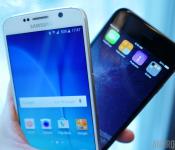
Today’s smartphone giants: looking back at 2014, where they may be headed in 2015

In terms of smartphone history, 2014 was a prolific year for smartphone OEMs. For Samsung, it saw a marked decline of sales and consumer apathy towards its Galaxy S product line, something the company hopes to reverse with the S6. For HTC, the Taiwanese company was finally able to breathe a sigh of relief as its finances went back to black, although how long that might last is questionable. For large Chinese manufacturers, the year saw huge gains in market share and earnings. For Apple however, 2014 was gloriously golden.
Gartner, the world’s largest IT research firm, has just published data on the 2014 curtain call, and the results might come as a surprise to some. Take a look at the first pair of tables:

Analysis will follow, but for now let’s just parse through the data:
With respect to Q4 2014, Apple found itself ahead of the competition. With just over a 20% of the global market share, it sold 74.8 million phones over the three month period. This is over 24 million phones more than it sold in the same period 2013, though interestingly enough the market share increase was only a little over 2.5% Q4 year-on-year. Note however, that Table 2 clearly shows despite the fantastic final quarter, Apple’s total sales in 2014 came to 191 million which, while a 40 million increase over Q3 2014, still puts it at only 15% of the global market share.
Despite the doom-and-gloom attitude that the press and even Samsung itself seem to have, the company was still the top spot in total 2014 sales at 307 million units, or roughly 25% of the market.
Samsung on the other hand, sold almost as many phones (about 73 million), yet dropped by almost 10 million from Q4 2013. Likewise, its market share contracted by a similar integer, almost 10%. Despite the doom-and-gloom attitude that the press and even Samsung itself seem to have, the company was still the top spot in total 2014 sales at 307 million units, or roughly 25% of the market. While it actually sold more phones in 2014, ironically the total annual market share percentage fell almost 6% from 2013.
Also worth mentioning are the Chinese OEMs, with Lenovo and Huawei both seeing nice growth, though neither as startling as that of Xiaomi, whose sales basically tripled when compared to those in Q3 2013.
One more chart to take a look at before getting down to details:

As you can see here, Android is unquestionably the world’s most dominant mobile OS player, with over 1 billion devices sold in 2014, and almost 81% of the market. Apple looks positively tiny by comparison at just 191 million, and about 15% of the market. Windows Phone became even less of a threat, despite its hardware actually selling more in 2014 than the year prior. Blackberry continued to decline with its annual sales dropping by over half, and its market share falling below 1%. For all the other OS platforms out there (Firefox OS, this means you), sales dropped along with market presence.
Now let’s take a more detailed look at each of the main players:

Oh how this was but a pipe dream at best prior to 2014.
Apple
Cupertino struck gold with its iPhone 6 and iPhone 6 Plus, as evident by it earning the world’s record for biggest quarterly profit ever among publicly traded companies. There is a certain degree of “told you so”, “jony come lately” disgust which Android enthusiasts might feel when faced with such news, if only for the fact that Ashton Kutcher’s inspiration was so fiercely opposed to larger sized smartphones. Sure enough, when CEO Tim Cook finally took matters into his own hands and broke the stay on larger device sizes, the sales soared. Having access to China’s seemingly infinite population certainly doesn’t help, either. The fact that Apple could do so well in Q4 2014 as compared to Q4 2013 is proof positive the size made all the difference.
The bizarre irony here is that, if Apple were to actually license its iOS to third party OEMs, while its market share would definitely increase, its sales probably would plummet. As the sole distributor of iOS devices, the company ensures that anyone in the ecosystem must play by its rules, all software must run on its hardware, and all consumers must buy its products.

Apple Watch: the device that could very well make or break Apple’s future plans.
Outlook for 2015
While the first quarter will inevitably see some continued benefits of the iPhone 6 and 6 Plus hardware, the real test for the first half of the year will be that of the market’s reaction to the newly announced Apple Watch: if it takes off then things are golden, yet if it sinks like a stone, then Apple is going to have far more than its pride to worry about, as investor confidence may very well plummet out of fear the entire platform is a waste of resources.
There is a very real possibility that Apple has peaked, especially now that it has released a phablet
Assuming history repeats itself, the iPhone 6s and 6s Plus will inevitable see some big sales as well given the annuals (or, in other words, people who upgrade each year out of love for Apple) or those whose 2-year contracts have lapsed. Will this surpass the sales of Q4 2014? That is highly unlikely unless the iPad Air 3 and Mini 4 are big sellers, or the rumored iPad Pro comes out and becomes a hit. There is a very real possibility that Apple has peaked, especially now that it has released a phablet: it was arguably the one thing users were up-in-arms about, and now that they have one, the need to upgrade the hardware each year may have diminishing utility value (assuming it had genuine value to begin with).
One potential profit point for Apple, however: If the company releases a third iPhone product line things could be almost assured to accelerate: a new device with a small screen. For all those who didn’t update to the 6/6 Plus because of their being too big, and all those who won’t this year either, a brand new top-tier-small-screen offering might go a long way, especially for all those who own an iPhone 5 or 5s and won’t be inclined to upgrade otherwise.

Samsung’s Galaxy S6 may have the fix (for the company’s smartphone sales slump).
Samsung
We’ve already discussed Samsung at length in the past few weeks and months, so in an effort to avoid rehash this will be succinct: Korea’s largest conglomerate had a really Debbie Downer in 2014 with its Galaxy S5 selling 40% less than anticipated. Even when the redesigned, metal-framed Galaxy Note 4 released in the fall, Apple’s phablet juggernaut was there to usurp sales; a bitterly distasteful situation for Samsung, given how it basically created the genre with the original Galaxy Note and did all the groundwork to legitimize the screen size. The company pledged it would fix things for the coming year, however.
Outlook for 2015
At the moment, the Galaxy S6 and S6 Edge seem to be the exact panacea Samsung needed to solve its fiscal fall-out. The press has been raving about the pair of redesigned, premium flagships, and barring some fan fury over the lack of MicroSD support and a removable battery, the public seems quite taken with them as well. The company is also taking a break from smartwatches for the time being, has yet to announce any tablets yet (by this time last year it had already unearthed no less than four), and has been quoted by saying it plans to focus on the core product lines for the time being.

There they are, Edge to Edge, and Edge to Edge. But wait, there are two more Edges not touching anything! Samsung’s Galaxy S6 Edge has two more curved sides than most other phones.
The ultimate success of the Galaxy S6 might be determined by the price point at which its set. Some have speculated that the S6 will occupy a lower price point so as to better compete in countries like China and India, where Chinese OEMs have stolen Samsung’s #1 spot. This would leave the Galaxy S6 Edge as the premium, expensive variant for those with extra cash to burn. Still, this hypothesis remains unlikely given that even when it comes to mid-range or budget hardware, Samsung doesn’t seem to interested in lowering prices to compete with its rivals (see the Galaxy A series for example).
The ultimate success of the Galaxy S6 might be determined by the price point at which its set.
As far as tablets go, while its expected the company will announce the Galaxy Tab S2 in the coming months, the rumored specs and hardware isn’t wildly different from the pair that released last year. On the contrary however, the 4:3 screen aspect ratio it’s said to ship with might be a huge turn off for Samsung supporters, or it might be just the ticket to properly displace the iPad in terms of sales dominance, especially if it does in fact, include an all-metal frame. Still, given the high price tag both will inevitably carry, it’s difficult to make heads or tails of this topic.

These two companies have already made quite a positive partnership it would seem.
Lenovo
Given that Motorola is now part of this Chinese giant (and indeed Gartner’s figures account for it as such), Lenovo had a fantastic Q4 last year. While its global market share might only have grown half-a-percent or so when compared with Q4 2013, sales-wise the bump was about 8 million units higher.
Outlook for 2015
Given that Motorola is getting major praise around the globe with its recent offerings, it’s likely that Lenovo will see increased growth this year, especially now that it can directly influence the decisions and products the formerly Google-owned entity puts out. The Moto X is a fine flagship with rich customization (something that irks one Ive) and the budget-friendly Moto G and Moto E are consistently getting good reviews for pairing affordability with good performance and relatively excellent hardware. These products will definitely help Lenovo in territories outside Asia given the extremely limited global availability of its own branded products such as the Vibe Z2 Pro.

Huawei has a very nice smartwatch coming soon.
Huawei and Xiaomi
Rather unsurprisingly, both companies had a fantastic year in 2014 with booming sales at the expense of Samsung in their home market of China, as well as neighboring India. Xiaomi in particular, has a unique business model that keeps costs low along with prices, and is definately the surprise success story of 2014 given its meteoric accomplishments. For a better look at them, and other Chinese OEMs as well, have a look at one more table from the Gartner report:


Xiaomi’s latest high-end offering, the Mi Note.
Outlook for 2015
Fantastic, to say the least. Huawei has just announced a fantastic new tablet and eye-catching smartwatch, not to mention updates to its other wearable offerings as well. Xiaomi has announced plans to broadly expand the availability of its products to outside markets, and even plans to open an accessory store in Europe and eventually in the US market. Both of these companies know how to make competitively priced hardware complete with their own unique approach to Android, and Asian customers couldn’t be happier. While Huawei is already relatively known in non-Asian territories (though perhaps for the wrong reasons), Xiaomi will need to work somewhat harder to establish itself in markets like North America and Europe.
Honorable Mentions:

The HTC One M8 next to the HTC One M9. The lack of…”distinguishing features” may-or-may not play into consumer purchasing decisions.
HTC
Interestingly enough HTC isn’t present on any of the three OEM-specific tables published by Gartner, a testament to just how far from grace the Taiwnese firm has fallen. The company had a rather diverse line of flagship products in 2014 that included consisted of the flagship Android HTC One M8 to the…Windows Phone 8 HTC One M8. Still, the Desire Eye was a flagship in all but name, and the various other offerings such as the Butterfly 2 and even the HTC Re periscope-inspired action camera showed the company is full of ideas.
Outlook for 2015
So far, HTC is off to a somewhat rough start given its decision to rehash last year’s twice-released HTC One M8 with updated internals and a different camera pair under the name HTC One M9. It has received a lot of criticism from fans and foes alike for this, but until the product hits stores nothing can be said in certain. The HTC Vive might prove to be a very promising piece of kit and at the very least comes as an unexpected development that had surprised many. The potential for a “true” flagship to hit this summer (after hype for the S6 has died down) is still a possibility, although sadly anything HTC releases this year may end up being largely ignored by all but its devoted fans. Still, the company has gone on record promising 2015 will be its best yet, so anything is possible.

Sony’s Xperia Z4 Tablet is thinner than ever.
Sony
Interestingly enough, when one examines the final Gartner table (Table 4), it would seem as if Sony had neither a good nor a bad 2014. On paper at least. The company had basically no growth or decline with respect to sales, though considering that most of its smartphones are sold in Japan, that might intrinsically be a bad thing. 2014 was a hard year indeed however, which saw the sale of its VAIO line to a third party entity as well as the continuation of its poor overall financial performance.
Outlook for 2015
Given the endless stream of bad news revolving around Sony, its finances, and its products, pessimism would seemingly go hand-in-hand. Still, the Xperia Z4 Tablet has received a lot of good press in the few days since its official announcement and many are convinced the upcoming Xperia Z4 smartphone will be “the one” to put Sony back on the path to success, especially since the Japanese conglomerate has seemingly gotten it straight that the single flagship product it has need not be updated every few months. Still, Sony has a lot of work cut out for it given the severe lack of presence its mobile division has in key territories like North America.
Wrap-Up
So there you have it. We took a look at the final sales data from 2014, made some sense of it, and then offered some thoughts on what the remaining 9+ months of 2015 may look like. Please feel free to weigh in on the figures and feature with your own thoughts, and let us know what you expect for 2015, or what you made of 2014’s report.
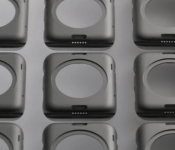
Apple Watch Diagnostic Port Spotted in Apple Promo Videos [iOS Blog]
Last week, we heard reports that a hidden “diagnostic port” was present on early Apple Watches currently in testing. The TechCrunch report indicated the port was being used for diagnostic purposes, and 9to5Mac claimed that the diagnostic port would not ship in the final version.
The port has a 6-dot brass contact array inside the groove for the ‘bottom’ strap connector slot. Several sources have confirmed its existence and placement to me. It is very similar to the connector for the Lightning connector in iPhones, as that connector currently only uses 6 of its 8 available pins. Apple recently began opening up the Lightning port for use by third parties. A source says that this port is currently for diagnostic purposes only — but that there is nothing preventing it from being a connection port for future accessories.
The port was spotted by our forum members in a number of the new Apple Watch promo videos that Apple released today.

Matthew Panzarino, the original author of the report, confirmed today that the port still exists, but he remains uncertain if it will ship in the final version:
Confirmed the ‘diagnostic port’ is still in the ᴡᴀᴛᴄʜ band channel. Don’t know if it will ship that way or not.
— Matthew Panzarino (@panzer) March 9, 2015
The Apple Watch will begin shipping in April with pre-orders starting on April 10th.
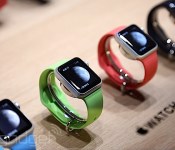
Apple Watch bands will cost between $49 and $449

An Apple Watch won’t do you a ton of good without a band to hold it to your wrist and Cupertino has plenty of options to choose from. Let’s start from the bottom: A 38mm sport band runs $49, and a 42mm one is the same price. It starts getting more expensive from there, though. The 38mm Milanese Loop (which looks an awful lot like chainmail if you ask me) is $149. Same goes for the 42mm large leather Loop. The smaller, 38mm Modern Buckle costs $249. The Link Bracelet will set you back the most, however, at $449 for a 42mm band (just over the price of two Pebble Time watches). Of course, none of them are available to ship at the moment despite how much you might want one — you’ll have to wait a few weeks for that.
Filed under: Cellphones, Wearables, Mobile, Apple
Via: MacRumors
Source: Apple
Apple Watch Hands-On: A First Look at Software, Apple Pay, Water Resistance, and More
We got several hands-on first impressions of the Apple Watch following its September debut, but at that time, finished versions of the Apple Watch with fully functional software were not available.
As of today, members of the press are getting their first look at Apple Watches running near-complete versions of Watch OS, and several sites have shared new tidbits and thoughts on the device, which we’ve rounded up below.
TechnoBuffalo‘s Jon Rettinger tested the aluminum Apple Watch Sport, Apple’s most affordable watch, giving a demo of the device’s software. A hard press on the screen brings up different watch faces, each of which can be customized, as Tim Cook described during today’s event.
In a second video, TechnoBuffalo takes a look at the design of the Apple Watch Sport, giving a close up of the backside of the watch and what it looks like on the wrist.
Mashable‘s Lance Ulanoff says all of the different Apple Watch versions “feel good to the touch” and that there’s not much difference in the display between the Apple Watch Sport with Ion-X glass and the Apple Watch with sapphire crystal. He also has good information on the fit, which is comfortable despite its protruding back.
Apple Watch is not curved to your wrist. In fact, the back bulges out over so slightly to make sure the sensors touch the wrist. This didn’t look like it would be comfortable, but it was — completely. I also got to try a number of different bands. I think the rubbery sports bands are fine, but not my favorite — they certainly make sense for the more active set. I like leather and metal options, most of which employ some sort of magnet to clasp and even adjust sizing.
TechCrunch‘s Darrell Etherington says that the Apple Watch system software is “expectedly intuitive.” The Digital Crown takes a bit of time to adjust to, but ultimately, it “makes as much sense” navigation wise as the iPod’s clickwheel. Touch input is “fast and responsive.”
The camera remote, which allows the Apple Watch to control the iPhone’s camera, is described as “especially clever” because it gives photographers a way to capture group shots and timed shots.
Re/code‘s Jason Del Rey has a detailed look at how Apple Pay will work on the Apple Watch. Apple Pay users will need an iPhone that links to the Apple Watch to share payment information from the iPhone. The Apple Watch does not store card or account information, using a placeholder code instead.
First, you need to own an iPhone — a 6, 6 Plus or a 5, 5C or 5S to use Apple Pay with the Apple Watch. Watch owners have to open the Apple Watch app on their iPhone, which Apple is installing on phones as part of an iOS software update. Once the Apple Watch app is open, you tap the Passbook and Apple Pay option in the app to add a credit or debit card to be used for in-store payments using the Apple Watch.
A passcode is required for setting up Apple Pay with the Apple Watch, and it has to be re-entered every time the watch is put back on after being removed to unlock Apple Pay. A payment is made by tapping the side of the Apple Watch twice and holding it near a payment terminal. According to Re/code, it does not look like users must have their iPhones with them to make payments with the Apple watch after linking.
Several small details on the Apple Watch have also been shared by Apple on its updated Apple Watch pages. The Apple Watch, for example, has a water resistance rating of IPX7 according to a footnote on the page, meaning its splash and water resistant but it is not waterproof. It can be worn during exercise, in the rain, and while washing your hands, but submerging it is not recommended.
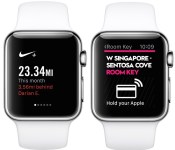
An Apple Watch apps page on Apple’s site shows off a range of apps that were demoed during the event and some that weren’t, giving a quick look at some of the things the Apple Watch will be able to do. With the SPG Hotel app, Starwood hotel visitors can use the Apple Watch to unlock their rooms, and with the American Airlines app, Apple Watch owners can get their boarding passes right on their wrists.

The Nike+ Running app displays distance, duration, and pace on the Apple Watch, while the Instagram app allows users to browse their feeds, like photos, and leave emoji comments. Shazam will identify songs, Dark Sky will let users know the chances of rain or snow, and the NYTimes Apple Watch app will offer headlines and breaking news.

iOS 8.2, released today, includes an Apple Watch companion app that has some information on Apple Watch setup. The Apple Watch will quickly connect to an iPhone using the camera. You just need to hold the Apple Watch up to the camera and align the watch display with the view finder. From there, the Apple Watch App Store is accessible, but it has yet to be populated with apps. It is not possible to delete the Apple Watch app from the iPhone in iOS 8.2.
 Image via iPhone Hacks
The Apple Watch will be available for pre-order beginning on April 10. Apple will also begin allowing customers to test the device in its retail stores on that date.

Apple Offering AppleCare+ With Accidental Damage Coverage on Apple Watch [iOS Blog]
 Apple Watch Sport and the stainless steel Apple Watch will be covered by a limited one-year warranty for hardware repairs and up to 90 days of complimentary support from Apple, the same coverage offered for the iPhone, iPad and many other products. Meanwhile, the more expensive 18-karat gold Apple Watch Edition will be backed by two years of hardware coverage and complimentary support.
AppleCare+ will also be available for all three Apple Watch models, providing extended warranty up to three years from the date of purchase, depending on the edition, and accidental damage coverage. The Apple Watch Sport and stainless steel Apple Watch are covered for up to two years from the original date of purchase under AppleCare+, while the high-end 18-karat gold Apple Watch Edition is covered for up to three years from the original date of purchase.
Apple will cover up to two incidents of accidental damage for an unspecified service fee, although the exact charge and the cost of AppleCare+ for Apple Watch overall is not provided. We have reached out to Apple for comment about pricing and will update this post if we hear back.
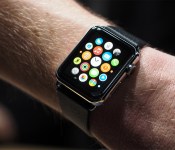
One month to launch: A closer look at Apple’s Watch

I was never a watch guy. Actually, let me rephrase — I was never a watch guy until I bought a Tissot online for giggles (and about $350). That day sort of changed the way I looked at these seemingly archaic wrist appliances. They become a statement about you. They can make you feel awesome. And, perhaps most importantly to Apple, they can stop being a thing you wear and become something you don’t want to take on your day without. With all that said, and given my general lack of expertise in horology, I did the only sensible thing I could. I strapped on the $12,000, yellow gold Apple Watch Edition in an incredibly dark room and took it for a spin.
A brief aside: Yes, $12,000. That’s how much Apple is asking for the 42mm Apple Watch Edition, and it’s a princely sum no matter how you slice it. We’ll get back to that a little later.
Despite the differences in materials, all three versions of the Apple Watch feel very similar once you’ve got ‘em strapped on. The 42mm versions are just a touch more substantial thanks to the slightly bigger chassis and battery (I’m told the difference in battery life is super small), but you’re not going to notice the difference. My go-to watch is a stainless steel Mondaine and the Watch felt dramatically heftier, only natural considering all the stuff that’s been crammed into it — it’s also got more weight to it than an ASUS ZenWatch, the Android Wear watch that Apple’s work most closely resembles. Don’t worry: You might not love the shape, but the Watch feels suitably expensive.

I was a little concerned about the digital crown at first, given how integral it is to actually using the watch — you’ll press it to view that constellation of apps, turn it to zoom in and out and double-tap it to bring up your watch face. It’ll sound minor, but there’s plenty of resistance to be felt as you start turning it, and that helps make the whole thing feel a little more measured and (dare I say) premium. You’ll be doing quite a lot of force touching as well, which works exactly the way it sounds — pressing down and holding lets you swap through the 10 available watch faces. Let’s be honest here: I’m not entirely sure what force touching brings to the table that a standard long press doesn’t. Apple just might be trying to save us all fractions of seconds of interaction so we can go back to our lives as quickly as possible, but I’m not convinced yet.

Moving on. Obviously, the software’s still not ready for public consumption — Apple staffers seemed to cycle through two demo Siri questions ad infinitum — but interacting with the Watch does seem more thoughtful and elegant than earlier reports might’ve suggested. What seems most immediately useful are the Glances, little applets that are invoked when you swipe up from the bottom of the screen. Need to check stocks? Toggle Bluetooth? You’ll be able to do that without having to dive into your app galaxy — just swipe up and take a gander. Meanwhile, smart approaches to third-party apps like WeChat and Uber only extend the value of a device that plenty of people would’ve kneejerk-bought anyway.
As I noted during our liveblog, Tim Cook made several attempts to frame the Watch not as a gadget, but as a companion. It’ll remind you “like a friend does.” It’s like having a “coach on your wrist.” I’ve admittedly only spent maybe 20 minutes with the Watch lashed to my wrist, and I spent that entire time waiting to be struck with a flash of inspiration along the lines of what Cook envisioned. “Oh,” I thought I’d say. “That’s why it’ll be worth buying one of these things.”
The epiphany I was half-hoping for never materialized… but that’s not to say it won’t. Apple’s Watch is ambitious in a way that few devices are, and its true value (which I suspect will come in the form of dev support) isn’t obvious to me just yet.
I’ll update this story with further impressions after I do a little more playing.
Filed under: Mobile
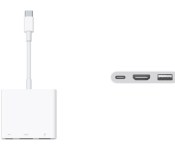
USB-C Digital AV Multiport Adapter for New MacBook Includes HDMI and USB 3.1 Connectors [Mac Blog]
Announced in conjunction with the new line of MacBooks revealed at today’s “Spring Forward” event in San Francisco, the USB-C Digital AV Multiport Adaptor will allow users a dock-like experience with included HDMI, USB 3.1, and USB-C inputs located on the device.

Mainly featured will be the ability to mirror a MacBook’s display onto an HDMI-connected screen. The adapter will allow users to play a wide range of video content, including movies and captured video, at up to 1080p HD.
This adapter allows you to mirror your MacBook display to your HDMI-enabled TV or display in up to 1080p HD. It also outputs video content like movies and captured video. Simply connect the adapter to the USB-C port on your MacBook and then to your TV or projector via an HDMI cable (sold separately).
Apple also noted that the other two inputs on the device, USB 3.1 and USB-C, will be able to be used simultaneously. Ultimately aimed at providing a bit more accessibility to the lone USB-C port located on the new MacBook line, the Multiport Adapter will allow users to mirror their display, charge an iPhone, and make sure their MacBook doesn’t run out of power at the same time.
A similar device, the USB-C VGA Multiport Adapter, will allow all the same features, but let users connect their MacBook to a VGA-enabled display, with all of the expected USB 3.1 and USB-C features as in the HDMI model.
Though currently unavailable, those interested will be able to pick up the Multiport Adapter from Apple’s online store for $79.00.
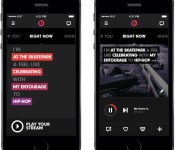
Apple Backs Down on $7.99 Price Point for New Music Service After Meeting Resistance From Record Labels
Amid all of the excitement over the 12-inch MacBook and new pricing details on the Apple Watch, Billboard has shared some new information on Apple’s rumored music service.
Initial rumors suggested Apple was hoping to undercut competing services like Spotify on price, offering its upcoming music service for $7.99, but according to Billboard, music labels are said to be highly resistant to pricing under the industry standard of $9.99.

Due to labels’ insistence on the $9.99 price point, Apple is said to have backed down from its aggressive $7.99 pricing goal, suggesting the service may cost subscribers $9.99 per month instead of $7.99 per month.
Negotiations for Apple’s upcoming subscription service are evidence labels are standing firm on pricing. Industry sources say Apple has backed down from its effort to lower monthly pricing for its subscription service to $7.99 from $9.99. Apple would have to absorb the loss if it sets a price lower than the standard $9.99.
Apple may not be able to offer a lower price point than competing services, but industry insiders that spoke to Billboard have suggested that Apple is talking to artists and labels about exclusives for key releases that will help it stand out from the competition.
Limited details are available on Apple’s new subscription music service, but it’s said to be a complete rebranding of the company’s existing Beats Music service. It is rumored to be directly integrated into iTunes and it will be platform agnostic — available on iOS and on Android, through a dedicated Android app Apple is building.
Recent rumors have suggested that Apple will launch its revamped streaming music service in June, during the company’s annual Worldwide Developers Conference.

Apple Posts Full Video of Today’s ‘Spring Forward’ Event, Plus Product Videos
Now that Apple’s “Spring Forward” media event has wrapped up, the company has posted a full video of the event on its website, which viewers can watch at their leisure.
During the event, Apple shared several product videos, which it has now uploaded to YouTube. There are dedicated videos on the new MacBook, each of the Apple Watch models, the new West Lake, China Apple Store, and more. A full list of videos is below.
– The New MacBook – Design
– The New MacBook – Reveal
– Apple Watch + Christy Turlington Burns
– Apple Watch – The Watch Reimagined
– Apple Watch Sport -Aluminum
– Apple Watch – Steel
– Apple Watch Edition – Gold
– ResearchKit – how iPhone is transforming medical research
– West Lake, China – Apple Store Opening
Along with the videos, you can also check out our full list of media event highlights below, featuring all of MacRumors event coverage.
– Live Coverage of Apple’s March 2015 ‘Spring Forward’ Event
– HBO and Apple Announce ‘HBO Now’ Exclusively for Apple TV, Apple Devices
– Apple Lowers Price of Apple TV to $69
– Apple Announces ‘ResearchKit’ Aimed at Medical Research
– Apple Announces 12-Inch Retina MacBook With Revamped Trackpad, Starting at $1,299
– MacBook Air and 13″ Retina MacBook Pro Updated to Improve Speed and Battery Life
– Apple to Release iOS 8.2 Today With Support for Upcoming Apple Watch
– Apple Watch Sport to cost $349 (38mm) and $399 (42mm)
– Stainless Steel Apple Watch Pricing: $549 to $1049 (38mm), $599 to $1099 (42mm)
– Gold Apple Watch Edition Costs Between $10,000 to $17,000, Available in Limited Quantities
– Apple Watch Launches April 24, Price Ranges From $349 to Over $10,000
– Apple Watch Bands Range in Price from $49 for the Sport Band to $449 for the Link Bracelet
– Apple Watch Battery Life: 18 Hours Mixed Usage, Up to 72 Hours on Power Reserve
– USB-C Digital AV Multiport Adapter for New MacBook Includes HDMI and USB 3.1 Connectors
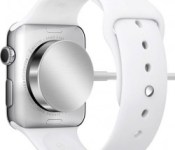
Apple Watch Battery Life: 18 Hours Mixed Usage, Up to 72 Hours on Power Reserve
 Apple has outlined specific information about Apple Watch battery life on its website, claiming that the wrist-worn device gets all-day battery life of 18 hours on a single charge based on mixed usage, and up to 72 hours in Power Reserve mode. The battery testing was conducted in March using a preproduction Apple Watch paired with an iPhone running preproduction software.
Apple claims that the Apple Watch has a battery life of up to 3 hours for talk time, 6.5 hours for audio playback over Bluetooth, up to 7 hours during a workout session with the heart rate sensor on and up to 48 hours for timekeeping. Apple Watch charging times are listed as about 1.5 hours from 0% to 80% and 2.5 hours from 0% to 100% using the included MagSafe inductive charger.
Apple’s claim of all-day battery life is based on using the Apple Watch for 90 time checks, 90 notifications, 45 minutes of app use, and a 30-minute workout with music playback via Bluetooth over the course of 18 hours. Apple used a 38mm Apple Watch for testing and claims that the 42mm will generally experience longer battery life. Additional magnetic chargers are available on Apple’s bands and accessories page, costing $29 for a 1-meter cable and $39 for a 2-meter cable.

