


Will the Galaxy S6 be able to compete with the iPhone 6?

The iPhone 6 took the world by storm when it was launched late last year. Collectively, the iPhone 6 and the 6 Plus took away a significant chunk of the Android device market share. And now with Samsung launching the Galaxy S6 and the Galaxy S6 Edge, industry sources have started to wonder whether the Korean manufacturer has done enough to stop the behemoth that is the iPhone 6.
The answer will not be clear until the 10th of April when the smartphone is expected to be available in 20 countries around the world including the U.S. Initial response for the smartphone has been very positive, so Samsung is certainly hopeful that this is the game changer it so desperately needs at this time. And we think Samsung is right in assuming that given the amount of changes we’ve seen on the Galaxy S6.
For the first time since the Galaxy S3, Samsung has taken bold decisions with the design of the handset. Taking this into account, it’s not really a surprise that the company spent more than ever on R&D. The Galaxy S6 packs an all metal design with a unibody enclosure, something we thought was limited to HTC and Apple devices.
The company has also made brave choices with regards to the processor, going with the home grown Exynos 7420 chip instead of the Snapdragon 810 which is expected to be used on all variants of the flagship. Of course, Samsung had its reasons to shy away from the Snapdragon 810, but it tells us that the company was not looking to sacrifice in terms of quality.
The list goes on and on really and Samsung has truly impressed everybody with the Galaxy S6, be it in terms of the camera or the cutting down of unnecessary TouchWiz bloatware. These factors tell us that the Galaxy S6 poses a serious threat to the Apple iPhone 6, although we feel the iPhone has already made significant damage to its Android rivals. The more important question that is upon Samsung is whether it will be able to continue on this path when the competition gets tougher later in the year with the likes of the LG G4 and the new breed of handsets break cover.
Do you think Samsung has done enough to make a comeback in the mobile industry? Sound off below.
Come comment on this article: Will the Galaxy S6 be able to compete with the iPhone 6?
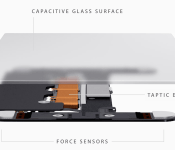
Apple’s ‘Force Touch’ Trackpad Fools Users Into Feeling Clicks Without Actually Moving
At its “Spring Forward” event on Monday, Apple announced a brand-new MacBook and updated 13-inch MacBook Pros with a fully redesigned trackpad called the Force Touch trackpad.
Like on the Apple Watch, Force Touch allows the device to distinguish between a light press and a deep press, opening up new methods for interaction. For example, while a light press could be a simple click, a deep press while browsing in Safari could bring up a Wikipedia entry in a pop-up window.

The Force Touch trackpad on the MacBook and new MacBook Pros achieves this through a total reinvention of the way the trackpad works. Apple ditched the “diving board” structure of older trackpads for a new design with four sensors, called Force Sensors.
These Force Sensors allow the user to click anywhere on the Force Touch trackpad. The “diving board” design on previous trackpads made it difficult to click toward the top of the trackpad, forcing users to move their fingers toward the bottom of the trackpad to click.
The Force Sensors are bundled together with the Taptic Engine, which is also featured in the upcoming Apple Watch. The Taptic Engine senses when a user clicks on the trackpad and issues haptic feedback to let a user know that their action was successful. As noted by TechCrunch’s Matthew Panzarino, this is because the trackpad itself doesn’t move. While the Force Touch trackpad sounds like it clicks and feels like it clicks, it doesn’t actually click.
There is a set of vibrating motors underneath that provides ‘force feedback’, also known as haptics in some applications. This feedback fools your finger into believing that you’ve pressed down on a hinged button, the way your current trackpad works. This feedback relies on phenomenon called lateral force fields (LFFs), which can cause humans to experience vibrations as haptic ‘textures’. This can give you the feel of a ‘clickable’ surface or even depth. The Force Touch feature of the new trackpad allows you to press ‘deeper’, giving you additional levels of tapping feedback. The effect is done so well that you actually feel like you’re pressing down deeper into a trackpad that still isn’t moving at all. It’s so good it’s eerie.
While the Force Touch trackpad was a main highlight of Apple’s introduction of the new MacBook, the updated 13-inch MacBook Pro is actually the first Mac to ship with the feature. iFixit has already performed a teardown of the new MacBook Pro to get a closer look at the workings of the Force Touch trackpad after removing the machine’s well-glued battery.
Read more 

Popular ‘Ulysses’ Writing App for Mac Expands to the iPad, Gets Major Update [iOS Blog]
Soulmen’s popular Markdown text editor designed for writers, Ulysses, has long been available on the Mac and is one of the more popular Mac-based writing apps due to its clean, text-focused distraction-free interface and it’s organizational system. As of today, Ulysses for Mac is getting a major update and it’s also expanding to the iPad.
For those of you unfamiliar with the app, Ulysses sets itself apart from other similar writing apps with a three-paned sidebar that lets users see all of their files in one place and its ability to organize files using groups and filters. Writing takes place on sheets, and files are stored locally on the Mac or in iCloud. Markdown text written in Ulysses can be exported in several different file formats, including PDF, ePub, and HTML.
The newest version of Ulysses for Mac includes a new name (dropping the former III) and a new icon — a butterfly. It’s been updated with a Yosemite-style redesign that includes an attachment bar, Favorites on the sidebar, and a new Dark Mode. Quick Export and Preview have been updated, adding TXT and ePub previews, plus export optimizations.
 Ulysses for Mac
The biggest change to Ulysses for Mac, aside from the redesign, is its integration with the new Ulysses app for iPad. The Mac app fully syncs with the iPad app via iCloud, making it easy to begin work on one device and pick up on another. Handoff support is also built in.

“Our ideal conception has always been to make Ulysses a universal tool that authors can use for any writing task, at any time and everywhere. Bringing it to iPad means a great leap forward towards turning this into reality”, explains Max Seelemann, head of development and co-founder of The Soulmen.
Ulysses for the iPad will be immediately familiar to anyone who has used Ulysses for Mac, as the interface and feature set are nearly identical. The iPad app uses a three-paned setup, and panes can be open or closed with swipes. A button row above the keyboard has been added to make it easier to format text, with access to special characters and shortcuts for creating headings, lists, paragraph blocks, and more. An info bar displays word count, sentences, characters, lines, and pages.
Ulysses for iPad supports filters much like the Mac version, and attachments like notes and images can be added. It also exports to all of the standard file formats the Mac app exports to, including Plain Text, HTML, ePub, PDF, and RTF. When an external keyboard is attached, Ulysses for iPad supports all standard shortcuts, and the look of the app can be customized with Themes, found in the Settings menu.
https://player.vimeo.com/video/119895209?byline=0&portrait=0
Both of the new apps are available for download today. Those who already own a copy of Ulysses for Mac can upgrade at no cost. The new Mac app is, however, exclusive to Yosemite — it won’t run on older versions of OS X.
Ulysses for iPad can be downloaded from the App Store for $19.99. [Direct Link]
Ulysses for Mac can be downloaded from the Mac App Store for $44.99. [Direct Link]

Pad and Quill Announces ‘Luxury Pocket’ Charging Stand for Apple Watch [iOS Blog]
Pad and Quill today announced a new line of accessories for the upcoming Apple Watch, including the “Luxury Pocket Stand” charging stand, a roll up pouch for portability and two travel kits.

The Luxury Pocket Stand is inspired by old pocket watch stands and is hand carved from a single piece of African mahogany or American cherry. The stand is also collapsible, allowing users to fold it up and take it with them on-the-go.
The Roll Up Kit is crafted with full grain American steer leather for packing on the fly and comes with a pouch to hold the charging magnet. There’s also the Luxury Travel Kit and Luxury Travel Pouch, both of which come with the Pocket Stand and space for chargers. The Travel Kit, however, features secondary sleeves to hold Apple Watch bands.
The Luxury Pocket Stand is available for the pre-order price of $69.99, but will raise to $79.99 when it’s released in May. Both the Luxury Travel Kit and Travel Pouch are available for pre-order priced at $119.99, while the Roll Up Kit is available for pre-order priced at $49.99. All four products ship in mid-May.
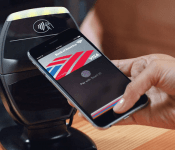
The fight for your wallet: A look at the mobile payment scene’s new big three

Apple, Samsung and Google are major forces in the smartphone industry and these three companies are about to advance their fight to a new emerging space: mobile payments. Not exactly a new concept, but these three tech titans are now competing to replace your wallet with one of their respective platforms.
At a glance Android Pay, Apple Pay and Samsung Pay might all look similar. They all use near field communication (NFC) tech in some shape or form and they each have the word “pay” in their name. However, when you really start to take a closer a look at what these three mobile payment platforms have to offer, you’ll notice that there are some noteworthy differences.
At a glance Android Pay, Apple Pay and Samsung Pay might all look similar.
Here’s an overview highlighting some of the details that we currently know about the mobile payment industry’s new big three.
Compatibility

Android Pay is more of a developer tool, instead of a standalone application like Samsung Pay and Apple Pay. Google’s follow up to Wallet is designed for OEMs and developers to mold as they see fit.
Meanwhile, Samsung’s and Apple’s solutions are proprietary and only work with in-house hardware. With support already announced for its upcoming Galaxy S6 and Galaxy S6 Edge smartphones, the South Korean tech firm is set to launch its new mobile payment setup later this summer. As for Apple, the California-based company’s Apple Pay is already available to iPhone 6 and iPhone 6 Plus users, with the outfit’s new smartwatch set to follow suit next month.
In addition to offering a flexible platform for developers and hardware producers, Google recently cozied up with three major wireless carriers. Out of the gate, this may help extend Android Pay’s reach further than its stifled predecessor.
Handling Transaction Data

Apple has been pretty straightforward about how Apple Pay works, clarifying that it will not store, share or track your purchase data. As for mobile payments newcomer Samsung, it’s still not completely clear how the company will manage transactions. So far the firm has revealed that Samsung Pay users will be able track transaction histories on their own devices. But that’s about it. Samsung will likely reveal more details as the company gets closer to the launch of its new service later this summer.
Android Pay will use temporary payment tokens for transactions opposed to transmitting a person’s permanent credit card details.
Like Samsung Pay and Apple Pay, Google’s platform will tokenize confidential user details such as credit and bank cards. Android Pay will use temporary payment tokens for transactions opposed to transmitting a person’s permanent credit card details. The idea here is to reduce the opportunities for would-be attackers looking to steal private financial information.
Additional Security Measures

One of the biggest concerns surrounding mobile payments (and standard credit card use) is security. The media is currently flooded with stories of merchant and creditor privacy breaches. This has caused quite an uproar among the very consumers that these three platforms are targeting. To help calm these concerns, measures such as tokenization have been taken, along with a few additional precautions.
Samsung Pay and Apple Pay require fingerprint scans in order to complete a transaction. This reduces the need for complicated passwords or PIN numbers that can potentially become compromised.
Samsung Pay and Apple Pay require fingerprint scans in order to complete a transaction. This reduces the need for complicated passwords or PIN numbers that can potentially become compromised.
Additionally, Apple’s payment setup leans on a dedicated chip unique to its hardware. Referred to as the “Secure Element,” this item is used to store a device’s identification number, user fingerprints and other secure data. This chip is believed to be somewhat comparable to an EMV card, and is completely segregated from its device’s iOS operating system.
Samsung Pay will tout a similar feature to Apple’s Secure Element, which will be provided by semiconductor manufacturer Infineon. Details about Samsung’s security silicon remain scarce, however the German-based chip maker says its hardware will offer device and transaction protection.
Unique Traits and Other Variables

Android Pay has the potential for deeper hardware integration by letting app developers and equipment manufacturers tinker with its API. Since it’s not tethered to a specific hardware platform, Mountain View’s emerging setup has a chance to be used across multiple hardware and software brands, depending on Google’s long-term strategy.
While Apple Pay has only been publicly available for a handful of months, it definitely shows a lot of promise. Dozens of financial institutions have already pledged support for the service and its online payment options are steadily increasing.
Although it’s the newest entrant in the great mobile payment race, Samsung Pay may have an ace up its sleeve. Thanks to its acquisition of LoopPay, the outfit has equipped its gear with tech capable of working with non-NFC magnetic card readers. This means the service will work with just about any legacy point-of-sale system.
This Guy’s Two Cents

It’s way too early to declare a winner here. Each of these mobile payment options have their pros and cons, but the biggest battle will be winning over casual consumers worried about security. Toss in factors like brand loyalty, third-party support and things become even more complicated. But I must say that I like Samsung’s inclusion of legacy payment terminals. This, along with the company’s history of releasing a high volume of devices might help put Samsung Pay in the hands of more consumers, once the service is up and running. However, it’s really hard to underestimate the folks in Cupertino and Mountain View.
Now that we’ve had a closer look at the mobile payment scene, we’d love to know your thoughts on the matter. Do you think mobile payments are the next big thing, or an impractical gimmick that will eventually fade away? Be sure to share your thoughts in the comments and let us know what you think.
// <![CDATA[
(function () ());
// ]]>

Apple Ceases Selling Jawbone UP, Nike Fuelband as Apple Watch Launch Approaches
With the Apple Watch set to launch in April, Apple has decided to stop selling many competing fitness products in its retail stores. Re/code checked several popular Apple Stores in San Francisco, Palo Alto, Los Angeles, and New York, and found that Apple had ceased carrying the Jawbone UP and the Nike+ Fuelband.
The two fitness bands are also unavailable through the company’s online store, and it appears the only remaining fitness band available for purchase is the MIO Alpha Heart Rate Monitor Watch. Apple is still selling non-wrist worn fitness tracking devices, like the Jawbone UP Move and the Wahoo TICKR X Heart Rate Monitor, both online and in stores.
 The Jawbone UP 24
Apple began removing wrist-worn fitness tracking devices from its stores back in November, when it stopped selling Fitbit’s line of activity tracking devices. Fitbit’s devices, along with the Jawbone UP and the Nike+ Fuelband all offer functionality that’s similar to what can be found in the Apple Watch, including the tracking of metrics like steps taken, distance traveled, calories burned, and stairs climbed.
According to Re/code, Apple told Mio founder Liz Dickinson that her company’s activity trackers would be removed from the Apple Store due to an effort to re-work branding, which may be at new retail chief Angela Ahrendts’ behest.
“They said they brought in a new executive in the marketing area who wanted to re-work branding for the stores, and to make the Apple brand more front and center and clean up and minimize the number of accessories,” Dickinson said.
The Apple Watch is set to be displayed in Apple’s retail stores beginning on April 10, in an effort to allow customers to try on and experience the watches ahead of their April 24 launch. Prices on the Apple Watch range from $349 to $17,000, and pre-orders will also begin on April 10.

Apple Again Said to Adopt Intel LTE Chips for iPhones in 2016
Some of Apple’s iPhones produced in 2016 will use wireless modem chips supplied by Intel rather than Qualcomm, reports VentureBeat. iPhones (presumably the iPhone 7) sold in emerging markets in Asia and Latin America will reportedly use an Intel 7360 LTE modem.

Intel has been gunning hard during the past year for a place in the iPhone and now appears to have succeeded, at least partly. The 7360 chip will ship inside a special version of the iPhone that will be marketed to emerging markets in Asia and Latin America, the sources said.
The 7360 LTE modem chip [PDF] from Intel features up to 450Mbps downlink and it supports 29 LTE bands. It will begin shipping out to manufacturers during the second half of 2015. Apple engineers have reportedly been traveling to Munich, Germany to collaborate with Intel engineers on the chip.
Though VentureBeat suggests the Intel chips might only be used in some iPhones in emerging markets, analyst Ben Bajarin believes that Apple would make the switch universal, rather than using separate chips in different versions of the phone.
Today’s report is the second time we’ve heard inklings of an Intel-Apple modem partnership. KGI Securities analyst Ming-Chi Kuo predicted Apple’s switch from Qualcomm to Intel for its baseband chips back in January. The shift from Qualcomm to Intel for even a portion of LTE chips will be a major loss for Qualcomm, as the company has supplied Apple with modem chips for many years now.
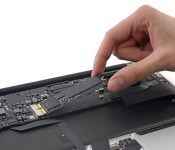
Teardown Reveals New 13-Inch MacBook Air SSD is Nearly Twice as Fast as SSD in New 11-Inch MacBook Air
Apple on Monday refreshed its MacBook Air lineup, adding Broadwell chips and Intel 6000 graphics. Both models received the same processor updates, but the 13-inch MacBook Air got an extra boost — new PCIe-based flash storage that Apple says is “up to two times faster” than the flash storage used in the previous generation MacBook Air. The 11-inch MacBook Air did not receive the same flash storage update.
iFixit decided to test Apple’s “two times faster” claim by comparing SSD speeds between a new 11-inch MacBook Air and a new 13-inch MacBook Air, with results that suggest the SSD in the 13-inch MacBook Air is indeed nearly twice as fast as the SSD in the MacBook Air.
Average write speeds for the 11-inch MacBook Air using Black Magic’s Disk Speed Test were 315MB/s, while average read speeds were 668MB/s. The 13-inch MacBook Air saw average write speeds of 629.9MB/s and average read speeds of 1285.4MB/s.

An iFixit teardown of the 13-inch MacBook Air conducted this morning suggests the notebook is using Samsung flash memory with a Samsung controller. A teardown of the 11-inch MacBook Air, which does not feature the faster flash storage, was equipped with SanDisk flash memory and a Marvell controller. In comparison to the Samsung flash storage used in the previous-generation 13-inch MacBook Air, iFixit said “it’s definitely an update.”
The new 13-inch MacBook Air is available from Apple’s online and retail stores with prices that start at $999. The higher-end $1,199 model can be configured with up to 512GB of flash storage.
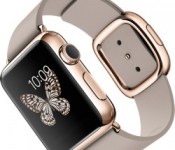
Apple Watch May Gain Additional Casing Material Options Later This Year
 KGI Securities analyst Ming-Chi Kuo, who has a good track record in providing information on yet-to-be released Apple products, today released a report predicting that up to three new casing options for the Apple Watch will launch sometime this fall.
Kuo points out that the Apple Watch’s sale momentum could stall entering the fourth quarter of the year, and thinks the release of new casing options for the device could reinvigorate it heading into the 2015 holiday shopping season.
Rumors stating that Apple was looking into a platinum casing for the Watch right before the “Spring Forward” event could point toward the option becoming available down the road.
Aside from current casing materials of aluminum, stainless steel and 18k gold, we believe 1-3 new versions of Apple Watch featuring new casing materials are likely to go into mass production in 4Q15. If this is the case, we think it could boost Apple Watch shipments momentum in 4Q15-1Q16.
Though impressed by the “outstanding designs” of the Apple Watch and new MacBook, Kuo sees the Watch underselling the market expectation of 20-30 million units in 2015 to about 15-20 million devices sold throughout the year. The analyst sees the Watch selling between 5-6 million units in the first half of the year, and the new MacBook about 450,000 units in that same time frame.
Kuo notes that as with many first-generation products, the Apple Watch will “focus on verifying whether the user behavior and business model are right”, with subsequent generations honing in and expanding on the device’s features and adding new ones, as well. As a result, he expects shipments to “grow significantly” in these second or third-generation Apple Watches in comparison to his predicted numbers for the first-generation model.

Google Announces New Chromebook Pixel With USB-C, $999 Price Tag
Google today launched an updated version of its Pixel Chromebook, which is equipped with USB-C, much like Apple’s new Retina MacBook. With USB-C, the Chromebook’s 12-hour battery can be fully recharged in approximately 90 minutes, and a 15 minute charge supplies two hours of power, according to Google.
The new Chromebook Pixel features an aluminum body, a 13-inch touchscreen with a resolution of 2560 x 1700 and an aspect ratio of 3:2, an Intel Core i5 Broadwell processor, 8GB of RAM, and 32GB of storage space.
Unlike the Retina MacBook, the Chromebook Pixel has multiple ports, including two USB-C ports, but it can’t compare to the Retina MacBook in size — the Pixel is more than a pound heavier at 3.3 pounds. It also outweighs the standard 13-inch MacBook Air.
Early reviews from sites like Re/code and Ars Technica have lauded the Chromebook Pixel for its design and its fast charging abilities, but the $999 price point is a major downside. The Pixel line is Google’s most expensive Chromebook, and at such a high price, the web-focused ChromeOS operating system seems overly limited. Other Chromebooks sell for as little as $250.
Along with the $999 Chromebook Pixel, Google also has a higher-end version, which it’s calling the Ludicrous Speed (LS) model. It has an Intel Core i7 Broadwell processor, 16GB of RAM, a 64GB solid state drive, and a $1,299 price tag.
The two new Chromebooks can be purchased from Google’s new online Google Store, which it just debuted today. The Google Store sells a range of Google-branded products, from smartphones and tablets to Chromebooks and Android Wear accessories.

