


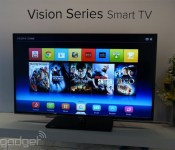
Android TV at CES 2014 highlighted by Chinese manufacturers Hisense and TCL

The project formerly known as Google TV has a limited presence on the CES show floor in 2014. While a number of companies are still working up Android-powered boxes and dongles, the largest TV manufacturers we saw on the floor promoting it were Hisense and TCL. Both are showing off skinned versions of Android TV with Google Play, which look different, but offer similar features like gesture and voice control. Hisense was also showing a new version of its Pulse add-on box, which sports some very Chromecast-like video sharing features. Announced in December, Pulse Pro will ship later this year with Android 4.2.2 and brings a new remote with an integrated microphone for voice control. Hisense’s Android TVs include its Ultra HD H9 and H8 line
While other manufacturers focus on their homegrown smart TV platforms, it appears Google is doing battle by opening up the services and apps it developed for Google TV to the companies interested in using Android. We’ll see if this looser approach helps its reach any, or if Google has any major surprises up its sleeve in 2014, like that Nexus TV box that has been rumored.
Filed under: Displays, Home Entertainment, HD
Source: Hisense

MediaTek’s wireless display solution beams video to TV, sets your mobile screen free (video)

While Miracast wireless display mode is now available on many Android devices, it is both loved and loathed — loved by those who want just wireless screen mirroring, and loathed by those who want to keep doing other things on the smaller screen. If you belong to the latter group, then MediaTek’s got your back. At CES, the Taiwanese chip designer showed off its solution that lets you beam video content to a Miracast-enabled display, without having to give up your mobile display for your other tasks — be it internet browsing, e-mailing or even gaming. See for yourself in our video after the break.
A company rep told us that in order to take advantage of this solution, app developers will need to use MediaTek’s upcoming API to enable this feature. There’s no word on when consumers will get to use this at home, but given that MediaTek’s shipped over 200 million smartphone processors last year, we’re pretty sure that developers will want a share of this piping hot pie.
Filed under: Cellphones, Displays, Tablets, Mobile

Samsung’s budget Galaxy Note 3 Neo reportedly caught on camera

Remember that talk of a lower-cost Galaxy Note 3? You may be looking at the phone right now. SamMobile claims to have photos of the rumored Galaxy Note 3 Neo (aka Lite), and they show what you’d expect — a slightly smaller, less advanced version of Samsung’s pen-toting flagship. The leak also includes benchmarks that back up rumors of an 8-megapixel camera, a 720p screen and a hexa-core processor with performance between that of the Galaxy S 4 and the full-size Note 3. There’s no guarantee that the photos or the specs reflect a shipping product, but there are murmurs of a possible Neo launch at Mobile World Congress in late February; we may not have to wait long to learn more.
Filed under: Cellphones, Mobile, Samsung
Source: SamMobile

Tesco says 400,000 people have already picked up a Hudl tablet with their groceries

UK supermarket Tesco appears to be on to a winner with its £119 Hudl tablet. After notching 35,000 sales in its first few days on sale, the chain says healthy Christmas demand helped it offload more than 400,000 units in the last three months of 2013. While the figure isn’t likely to have heavily impacted sales of Google or Amazon tablets, it’s a very healthy start for the Hudl, which aims to keep customers locked to the brand by offering grocery orders and movie downloads via its custom apps. With Tesco set to refresh its Hudl lineup later in 2014, its year-end sales undoubtedly prove customers like being able to pick up a low-cost tablet along with their bread and milk.
Source: Tesco News

Lumus turns its military-grade eyewear into a Google Glass competitor (video)

Lumus has long developed heads-up displays for the US military, but now it’s using a developer kit called the DK-40 to bring its HUD tech to wearables outside the battlefield. The contraption’s first stop was the CES show floor, so we couldn’t resist putting our fingerprints all over it. The key feature of the DK-40 is the “optical engine“, which eliminates the need for a thick piece of glass to house a substantially-sized prism. For the most part, the lens is transparent, but refracting light can occasionally catch the prisms and remind you (again) that it’s not run-of-the-mill eyewear. And as if one display wasn’t enough, the firm says it’s possible to add a second one for the left eye. Folks with eyesight issues can attach a pair of prescription lenses that rest on the nose grips, but the firm is also developing a version where the medically-prescribed glass will be bonded to the lenses.
While the general form is reminiscent of Google Glass, Lumus’ design does look more like a traditional set of spectacles. When it comes to tech specs, the device fits a 640 x 480 color display (as opposed to 640 x 360 on Glass), 5MP camera, gyroscope, accelerometer and a compass into a package that’s not much heaver than Google’s wearable. Though the plastic bulge that houses the camera and components is fairly large, the hardware keeps a pretty slick look overall, with a magnesium alloy and plastic build. Just like Glass, the gadget’s battery hangs over a user’s right ear.

As for software, Lumus’ wearable is barebones: it runs Android 4.1.2 with very little — if any — optimizations. There’s no touchpad on the gadget itself, but a companion Android app with a virtual mousepad and menu keys handle navigation. It’s certainly not the ideal way to cruise around a face-worn gadget, but it’s serviceable for a dev kit.
Lumus envisages its hardware will be used in everything from medical to industrial fields, and it also hopes to license the technology behind the lens display to gadget makers who could potentially target consumer applications. Ultimately, the DK-40 is a developer playground. The outfit behind the HUD isn’t disclosing its price, but interested programmers can ask the company directly and grab ahold of it this April.
Filed under: Wearables

Google update paves the way for more multiplayer games in the Play Store

Google’s latest update to Play Services should keep its mobile OS developers busy for a bit, particularly if they’re making games. Android’s SDK now has asynchronous multiplayer baked in, the kind of turn-based system that makes playing Words With Friends with distant pals possible. The update also features a developer preview of the new Google Drive API, better auto-complete options when sharing to Google+, and fixes the battery-draining bug that affected some Android 4.4 KitKat devices. Thrilling updates? Not quite, but it’s good to see Google investing in its budding games services.
Filed under: Gaming, Mobile, Google
Source: Android Developers Blog
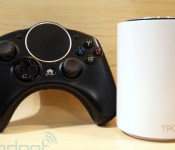
Huawei hops on the Android gaming bandwagon with Tron mini-console

The jury’s still out on Android gaming (exhibit A: OUYA), but that’s not stopping Huawei from taking a dive into that niche corner of the industry. Its Tegra 4-based Tron mini-console, announced here at CES 2014, pairs a cylindrical-shaped hub with a Bluetooth controller that hews quite closely to the Xbox 360 mold OUYA also went after. Before we get your hopes up though, take note that Tron’s for China only — at least, for now anyway. A Huawei rep did say that the company’s looking into further market expansion, but given its track record with smartphones in the US, we have a hard time believing Tron will see these shores anytime soon.
The Tron console itself runs a half-skinned version of Android JellyBean (version 4.2.3) that presents a clean menu overlay with feature tiles for access to games, Huawei’s store, video, application, settings and featured titles. That slick menu selection comes to a screeching halt, however, as soon as you attempt to select anything other than games, bringing you face-to-face with Android’s ugly underbelly — much like on the OUYA.
Storage-wise, the Tron will come in 16GB/32GB configurations, but that space can be expanded up to 64GB via a microSD slot at its base. There’s also support for Ethernet, USB 3.0, audio out, WiFi a/b/g/n/ac and 2GB RAM to aide the Tegra 4 chip inside. The Tron console, of which there are black and white versions, is housed in a glossy plastic shell (sorry, no flashing strips of neon light) with a large power button that nearly occupies its entire top. Overall, it’s an underwhelming design — something more than one Engadget editor referred to as “wastebin-like.” You can judge for yourself in the gallery below.
The Tron controller is an Xbox 360 controller by way of OUYA. So much so, that the button placement is nearly identical save for that giant, circular touchpad smack dab in the center. Users that pick up the controller will be greeted with four actions buttons (X, Y, A, B), four shoulder triggers, as well as buttons for home, mute, view and menu. There’s even a headphone jack just tucked beneath the front face. The controller is actually incredibly light, but that lightness comes across as a con rather than an asset. It just makes the whole thing feel cheap and disposable, an impression not helped by the materials used.
Gameplay was good, not great. There was a slight latency noticeable when effecting button presses, but nothing that seemed like it’d get in the way of the onscreen action. We weren’t able to get much clarity on the openness of the platform — a Huawei rep told us games would need to be optimized for Tron before appearing in the Store — but we assume side-loading Android games wouldn’t pose any problem. 4K playback is also supported on the console and was demoed from within the video submenu.
Huawei hasn’t locked down final pricing on the Tron just yet, but we’ve heard the Android mini-console should arrive with a sub-$150 price point. Again, it’s destined for China-only in Q2 of this year, but if you really need to get your hands on it, there’s always the option to import.
Gmail app updated to 4.7.2
Google is pushing out its latest update to Gmail with version 4.7.2. As many users have requested that automatic images show up, they have heard your plea! If you don’t want it, just simply go into settings and disable it!
The download is not pushing out just yet, but courtesy of Android Police, they have provided a link to the official APK here! Let us know if you’ve received it “officially” or any other changes you see as well!
Source: Android Police
The post Gmail app updated to 4.7.2 appeared first on AndroidGuys.

Snapchat responds to privacy scares by letting users unlink their phone number

Snapchat has just taken its first steps toward addressing the exploits that led to a leak of 4.6 million phone numbers late last year. Updates to its Android and iOS apps now let you opt out of linking your phone number to your username, preventing others from easily finding you. The company is also reducing the chances for abuse by requiring that you verify your phone number when using Find Friends. They’re not perfect remedies by any means — we’re sure that some would prefer that phone number use is opt-in rather than opt-out, for instance. Snapchat says it’s working on more improvements, though, so it’s at least aware that there’s more work to do before its users can truly feel at ease.
Filed under: Cellphones, Mobile
Source: Snapchat Blog, App Store, Google Play
WWE NETWORK launching in February, will have Android experience
WWE Network, the first-ever 24/7 streaming network, will launch live in the U.S. on Monday, February 24, featuring all 12 WWE live pay-per-view events – including WrestleMania – valued at more than $600 per year for $9.99 per month with a 6-month commitment. WWE Network will also include groundbreaking original programming, reality shows, documentaries, classic matches and more than 1,500 hours of video on demand at launch.
WWE Network will also be available through the WWE App on: Android devices such as Samsung GalaxySony PlayStation 3 and Sony PlayStation 4; and Xbox 360. Availability on additional devices, including Xbox One and select Smart TVs, will follow this summer.
So all of you WWE fans will be able to enjoy wrestling to your hearts content very soon! Get a sneak peak of WWE Network here!
Source: WWE
The post WWE NETWORK launching in February, will have Android experience appeared first on AndroidGuys.

