


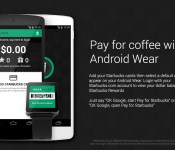
WearBucks (Pay for Starbucks) brings Rewards payments to your wrist [‘Watch’ This App]

If you’re like us then you’ve got a strong relationship with your coffee and Starbucks is your establishment of choice. Sometimes we’ll get our fix every few days, others it seems we’re there daily. One thing is for certain, however, we’ve been using our Rewards card to earn freebies. A few years back we graduated to…… Read more »
The post WearBucks (Pay for Starbucks) brings Rewards payments to your wrist ['Watch' This App] appeared first on AndroidGuys.
.CPlase_panel display:none;

WearBucks (Pay for Starbucks) brings Rewards payments to your wrist [‘Watch’ This App]

If you’re like us then you’ve got a strong relationship with your coffee and Starbucks is your establishment of choice. Sometimes we’ll get our fix every few days, others it seems we’re there daily. One thing is for certain, however, we’ve been using our Rewards card to earn freebies. A few years back we graduated to…… Read more »
The post WearBucks (Pay for Starbucks) brings Rewards payments to your wrist ['Watch' This App] appeared first on AndroidGuys.
.CPlase_panel display:none;

Skully’s Android-powered smart motorcycle helmet goes up for pre-order

If you take your motorbike rides seriously enough to want a smart heads-up display in your helmet, you can now do something about it. Skully has just launched a crowdfunding campaign for its Android-powered head protector, now named the AR-1; plunk down $1,399 and you should be one of the first to get the wearable when it ships in May 2015. That’s both a lot of money and a long time to wait, but Skully is betting that you’ll like the data you get while on the road. As promised, the helmet projects navigation, a rear camera view and riding info on your visor. Voice commands let you keep a grip on the handlebars, and smartphone pairing gets the headgear online. The price goes up to $1,499 if you wait until launch to make a purchase, so you may want to commit early if you’re determined to augment your two-wheeled adventures.
Filed under: Transportation, Wearables
Source: Skully
.CPlase_panel display:none;
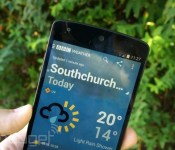
It’s official: Brits love weather apps

In days past, you couldn’t call yourself a true Brit unless you’d waited for the six o’clock news to end in order to catch the weather forecast for coming week. These days, however, more people than ever are pulling out their phone and launching an app. The BBC is keen to reinforce our obsession with unpredictable climates and mobile phones, announcing today that the BBC Weather iOS and Android apps have become its fastest-growing mobile properties, with over 8 million downloads since their launch just over a year ago. According to the Beeb, users love to whip out their mobiles first thing in the morning (7am being the most popular time), with Friday the most popular day, as people attempt to plan for the weekend ahead. In the near future, the BBC says it will add detailed weather warnings to the app, giving you an even firmer excuse for staying indoors with the cats.
Filed under: Cellphones, Internet, Software
Via: BBC Media Centre
.CPlase_panel display:none;

Xiaomi issues fix amid privacy scare over its cloud messaging service

Earlier this week, Finland’s F-Secure looked into claims that Xiaomi was secretly sending data from its MIUI-powered phones back to its servers, and it turned out to be true. Despite having not added any cloud accounts, F-Secure’s brand new Redmi 1s — Xiaomi’s budget smartphone — still beamed its carrier name, phone number, IMEI (the device identifier) plus numbers from the address book and text messages back to Beijing. Worse yet, the data was unencrypted, thus allowing F-Secure and potentially anyone to, well, get to know your Xiaomi phone very easily. Fortunately, today the Chinese company is issuing a patch to address this booboo.
According to Xiaomi VP and ex-Googler Hugo Barra, the aforementioned data link is part of MIUI’s cloud messaging service, which helps determine whether it can route your text messages over the Internet for free. Think Apple’s iMessage. Alas, Xiaomi had this is turned on by default and there’s no prompt about this for the user, which explains it all. With today’s ROM update, users of fresh or factory-restored Xiaomi devices will have to manually enable the cloud messaging function, meaning there should be no more stealthy connections back to Beijing. More importantly, the same update will also add encryption to the phone numbers sent to the servers, should users wish to keep using MIUI’s cloud messaging to avoid texting charges.
Kudos to Barra, his Google+ post goes to great lengths to explain what happened. It’s just as well since the latest findings have made his earlier post regarding privacy somewhat obsolete. Anyhow, the exec emphasized that his company doesn’t permanently store the data sent to its cloud messaging servers:
No phonebook contact details or social graph information (i.e. the mapping between contacts) is stored on Cloud Messaging servers, and message content (in encrypted form) is not kept for longer than necessary to ensure immediate delivery to the receiver.
Still, this raises the question: Shouldn’t the communication be encrypted in the first place, anyway? Sounds like someone deserves a big spanking at Xiaomi HQ this weekend, for both overlooking this issue and hindering the company’s global efforts. The last thing an expanding Chinese technology company needs is a privacy scare like this one, as the likes of Huawei and ZTE can attest to; though that’s not to say Western companies are entirely innocent, either.
[Image credit: Xiaomi]
Filed under: Cellphones, Mobile
Via: The Next Web
Source: Hugo Barra (Google+), F-Secure
.CPlase_panel display:none;

One of HTC’s first 64-bit phones is a budget model for Sprint

Qualcomm teased us with the prospect of powerful 64-bit smartphones arriving in late 2014 and early 2015, but it looks like you’ll have to dial back your expectations for the first wave of devices. New tipster @upleaks has posted details and photos of HTC’s A11, a starter smartphone in the Desire line that reportedly uses the more modest (if respectable) 1.4GHz Snapdragon 410 for its 64-bit processing. Other elements are modest, too; you’re looking at a 4.7-inch 854 x 480 screen, plain speakers (sorry, no BoomSound here) and both a 5-megapixel rear camera as well as a front 0.3-megapixel shooter. No great shakes, then, although hints of a Sprint launch suggest that you’ll see it in the US. There’s no word on when the A11 will ship, although it’s believed to run the existing Sense 6 interface on top of Android 4.4 KitKit — that suggests that HTC may deliver its first 64-bit phone well before its usual spring refresh.
Filed under: Cellphones, Mobile, HTC, Sprint
Via: GSMArena
Source: @upleaks (Twitter 1), (2), (3), (4)
.CPlase_panel display:none;

HTC A11 could be the first device from HTC with a 64-bit processor

A new device from HTC known as the A11 is the first device rumoured to come with a 64-bit processor, according to @upleaks on Twitter. The device is said to feature the new Qualcomm Snapdragon 410 MSM8916 chip, the same chip as seen in the HTC One Mini, so not exactly a powerhouse, but the… Read more »
The post HTC A11 could be the first device from HTC with a 64-bit processor appeared first on AndroidGuys.
.CPlase_panel display:none;

Pear alerts you that you’re about to leave your phone behind [‘Watch’ This App]

Today’s highlighted app isn’t extraordinarily rich in features or revolutionary, but it can be quite handy to have around. Called Pear it notifies the wearer that he or she is about to leave their beloved smartphone behind. You know the scenario where you get up from dinner and head home only to remember you left…… Read more »
The post Pear alerts you that you’re about to leave your phone behind ['Watch' This App] appeared first on AndroidGuys.
.CPlase_panel display:none;
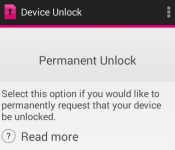
T-Mobile will now unlock select phones via an app

Now that phone unlockers have been given the governmental green light, T-Mobile’s trying to make the very process of unlocking less of a hassle… albeit very slowly. You see, the magenta-hued carrier has created a Device Unlock app that’ll let you either temporarily unshackle your phone for 30 days (perfect for those brief stints abroad) or do the deed permanently. Sound too good to be true? You may have a point. You’re still bound by T-Mobile’s eligibility requirements if you try to permanently unlock your device, for one, and the app only works with Samsung’s decidedly mid-range Galaxy Avant (on which the app comes preloaded) right now. The folks at Android Central couldn’t help but sideload the app onto a few other devices, but didn’t have much luck freeing any of them from T-Mobile’s tight grip. Here’s hoping this limited release is just a pilot program of sorts — we’ve reached out to T-Mobile to see if they’re willing to share any more.
Via: Android Central
Source: Google Play
.CPlase_panel display:none;
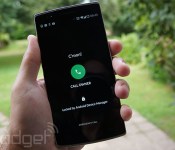
You can now add a callback number to your lost (and locked) Android phone

Look, there are some people out there who wouldn’t bother returning your lost phone, and the best you can do is try to appeal to their conscience. One way to do that is through Android Device Manager, which now has the capability to add a callback number on the phone’s lock screen that the finder can contact. You can now even write a message to the phone’s finder (or thief, if you’re unlucky) on the screen through the “lock” section of the app or web menu. The Device Manager, for those who’ve only just heard of it, is an app that lets you find lost devices remotely, or lets you lock them with a different pin than the one you typically use through its web interface. These features give the person who picks up your phone a really easy way to get in touch, so make sure to update the app, just in case you end up needing them.
Via: Phandroid
Source: Google Play
.CPlase_panel display:none;

