


Xiaomi render suggests the Mi Mix 3 will also feature a mechanical slider
Xiaomi’s upcoming Mi Mix 3 will also have a mechanical slider, but it could be very different from what we’ve already seen so far.

When Xiaomi unveiled the Mi Mix 2 last year, it mentioned that it experimented with different designs for hiding the front camera before settling on the current implementation — positioning it in the bottom bar. One of those designs included a notch much like the Essential Phone, and at the time Xiaomi said it would try something different this year.
We now have a better idea of that will look like thanks to a render posted by Xiaomi president Lin Bin on Chinese microblogging platform Weibo. According to the render, the upcoming Mi Mix 3 will sport a camera slider that’s similar to what we’ve seen on the Find X, with the front camera housing tucked behind the slider.
That said, there are a few key differences. Based on the render, it looks like Xiaomi is integrating the camera module into the chassis itself, with the display sliding down to reveal the camera array. It also looks like we’ll see a similar IR-based face unlock system like the Mi 8 and the POCO F1.
Bin’s post came on the heels of the Honor Magic 2 announcement, with Honor’s upcoming phone also offering a mechanical slider that hides the camera sensors. The Mi Mix 2 debuted last September, but the Mix 3 is slated for an unveil in the month of October.
iOS 12 Users Running Current Beta Plagued With Popup Prompting an Update
iPhone and iPad users who have installed the current iOS 12 beta are being plagued with a continual popup that suggests a new iOS update is available when it’s not.
Affected users are seeing the following message: “A new iOS update is now available. Please update from the iOS 12 beta.” The problem is users receiving this message are running the most recent version of iOS and there is no additional software to update to.
Beta testers have been seeing this popup since the latest beta was released on August 27, but over the course of the last day, the popups have become much more frequent.
Many users are now seeing the popup every time an iPhone or iPad running the beta is unlocked, and it is a popup that must be manually dismissed each and every time before an iOS device can be accessed.
Developer Guilherme Rambo has suggested that an error in the latest update causes the iOS beta to think that its expiration date is imminent, leading to the popup problem.
It looks like this method in Springboard does some date/time calculations to determine if the current build is about to expire, every time the cover sheet gets dismissed. For some reason, the latest builds of iOS 12 think they’re about to expire. (@davedelong :P) pic.twitter.com/HWe7C0NnIT
— Guilherme Rambo (@_inside) August 31, 2018
Complaints on Twitter and the MacRumors forums are picking up from users who are frustrated with having to continually dismiss the popup, and it’s not clear when a fix will be available.
Related Roundup: iOS 12
Discuss this article in our forums
LG’s SuitBot wearable exosuit will give workers the extra strength they need

LG may be best known to many readers as a top-tier Android smartphone maker, but the South Korean company has its fingers in plenty of other pies, too. One of those more surprising-but-exciting pies involves the creation of a new artificial intelligence-powered robot exosuits, set to be shown off at IFA 2018 in Berlin.
Called Cloi SuitBot, the lower body robotic exosuit is designed to enhance wearers’ leg movements to aid with activities such as warehouse workers lifting heavy objects. It was created in association with the startup SG Robotics.
“It is just one example of a wide range of revolutionary A.I. products designed to interact with users to dramatically elevate user convenience and create new opportunities to advance our robotics initiative into a next-gen growth engine,” Song Dae-hyun, president of LG’s Home Appliance and Air Solution Company, said in a statement.
Previous
Next
1 of 3


The use of artificial intelligence will help SuitBot to customize the experience it offers by learning individual wearer’s respective weaknesses and then giving them the literal leg-up they need to achieve their goal. It will also use this knowledge to optimize power consumption and conserve battery life where possible.
This isn’t the first time that we’ve covered assistive robots such as this. Here in 2018, everyone from Harvard University researchers to Ford employees to DARPA is seemingly either using or developing their own exosuits. While LG isn’t the first to market, its entrance as a major player in this field does demonstrate how much confidence there is that this type of smart equipment can be mass-market technology. According to LG, one thing that will help SuitBot stand out compared to its rivals is its ease of use. Specifically, it notes that its sandal-style shoes and easy adjustment features will make getting into and out of the suit easier.
Earlier this year, LG announced a related line of three new commercial robots at CES 2018. Eventually, the hope is that all of these Cloi devices will connect together into some kind of “smart working network” for use in a variety of industries.
As of yet, no price or launch date has been announced for SuitBot. We can’t imagine it’ll be cheap, though. Maybe it’s best to start saving now!
Editors’ Recommendations
- Bizarre stork robot uses a drone to compensate for its weak, twig-like legs
- Want an extra arm? A third thumb? Check out these awesome robotic appendages
- LG E8PUA series (OLED65E8PUA) review
- IFA 2018: 8K TV, AI everything, and more trends we expect to see
- Why learn to use gadgets when they can just learn to help us? Exactly, says LG
Sharp jumps back into the phone market with a trio of midrange devices
Sharp is heading back into the smartphone market. At IFA 2018, the company announced three new smartphones for the European market — the Sharp B10, Sharp Aquos C10, and Sharp Aquos D10.
The new phones cover a range of different price ranges, and while we don’t expect them to make a huge dent in the smartphone market, they could represent a renewed push from Sharp to build and develop smartphones.
Here’s a rundown of the new phones and what they have to offer.
Sharp Aquos D10
The Sharp Aquos D10 is the most powerful model here, and like other new smartphones, the device features an edge-to-edge display with a notch up top and a small chin at the bottom. The display on the device comes in at 5.99-inches with a resolution of 2,160 x 1,080, and Sharp says that it covers 91 percent of the front of the device — which is very good, and a higher screen-to-body ratio than most other phones on the market.
Under the hood, the specs suggest that this is truly a midrange phone. You’ll find a Qualcomm Snapdragon 630 processor, along with 4GB of RAM and 64GB of storage. Thankfully, if you want more storage, you’ll also find a MicroSD card slot, which allows the storage to be expanded by up to 128GB. Powering all of this is a 2,900mAh battery.
On the back of the phone, there’s a fingerprint sensor, and a dual rear-facing camera with one 12-megapixel sensor and one 13-megapixel sensor. The front-facing camera comes in at 16 megapixels.
Sharp Aquos C10
The Sharp Aquos C10 is largely the same phone as the Sharp Aquos D10, though it offers a slightly different design. Unlike the iPhone X-sized notch on the Aquos D10, the Aquos C10 features a small bubble notch for the front-facing camera, similar to that found on the Essential Phone. The display on this phone comes in at 5.5-inches with a resolution of 2,040 x 1,080, but there’s a much larger chin, leading to a screen-to-body ratio of 87.5 percent. That chin does serve a purpose here — the device has a fingerprint sensor on the front.
Under the hood, like the Aquos D10, the phone features a Qualcomm Snapdragon 630, 4GB of RAM, and 64GB of storage — with a MicroSD card slot to expand the storage by up to 128GB. There is, however, a slightly smaller battery in this device, coming in at 2,700mAh.
Like the D10, on the back of the phone you’ll find a dual-sensor camera, with the primary sensor coming in at 12 megapixels and the secondary sensor sitting at 8 megapixels. The front-facing camera is an 8-megapixel sensor.
Sharp B10
Last but not least is the Sharp B10, which is the lowest-end of the three phones. The device lacks an edge-to-edge design, and the 5.7-inch display comes in with a resolution of 1,440 x 720 pixels. On the back, you’ll find a fingerprint sensor and a horizontally aligned dual-sensor camera.
Under the hood, the phone features a MediaTek MTK6750T processor, coupled with 3GB of RAM and 32GB of storage. There’s also a MicroSD card slot here — and it supports up to 128GB of additional storage. The battery is a hefty 4,000mAh, which should help the phone last quite a while on a charge.
The camera on the phone is a dual-sensor, with the primary sensor coming in at 13 megapixels and the secondary sensor at 8 megapixels. The front-facing camera comes in at 13 megapixels.
Not much is known about the pricing and availability of these phones just yet, but we’ll update this story when we hear more.
Editors’ Recommendations
- Here is everything we know about the Asus ZenFone 5
- Here’s everything we know about the Motorola One Power
- The amazing $300 Pocophone F1 is so fast, it uses water inside to keep cool
- Samsung Galaxy Note 9 vs. OnePlus 6: Does more expensive mean better?
- The best smartphones of 2018
Intel’s new Whiskey Lake CPUs include fix for Meltdown, Amber Lake does not
Intel introduced new eighth-generation processors slated for laptops this week: Ultra-low power 15-watt “Whiskey Lake” U-series chips and extremely low power five-watt “Amber Lake” Y-series chips. After the launch, AnandTech asked Intel if these two processor families include hardware fixes for Meltdown and Spectre. The response was … rather loaded.
Meltdown and the two Spectre vulnerabilities are based on how processors “predict” the path of their current task, leaving sensitive data vulnerable in memory. Intel, hardware, and OS vendors began implementing fixes on a firmware and software level in early 2018. Intel also said that hardware mitigations would be introduced in new processors by the end of the year, hence the question.
For starters, the explanation will get somewhat technical. Although Intel releases “generations” of chips, they never rely on one single-generation design. Thus, each generation typically comprises of a refresh of a previous design, an entirely new design, and various design branches with different code names. All of this can get confusing so we’ll try to be clear as possible if you want to push forward.
First, Intel is gearing up to release 14nm processors based on its new “Cascade Lake” CPU design targeting servers and enthusiasts. A successor to Intel’s sixth-generation “Skylake-X” and “Skylake-SP” designs for those markets, these chips were originally slated to be the first to include hardware-based mitigations for Meltdown, Spectre, and Foreshadow. These chips will fall under Intel’s eighth-generation banner.
Meanwhile, Intel’s new Whiskey Lake chips released this week are based on the company’s original seventh-generation “Kaby Lake” design but uses the newer 14nm++ process node technology. As previously stated, these chips target laptops, requiring around 15 watts of power. Despite the seventh-generation foundation, Whiskey Lake CPUs also fall under the eighth-generation banner.
According to Intel, notebook-bound Whiskey Lake shares the same hardware fix for Meltdown as seen with server-bound Cascade Lake. These two families also share a hardware fix for the recently-disclosed L1 Terminal Fault issue, aka Foreshadow. But unlike Cascade Lake, Intel’s Whisky Lake design doesn’t include hardware fixes for Spectre Variant 2. All other issues are handled through firmware and OS fixes.
As for the new Amber Lake chips released this week, they’re based on Intel’s seventh-generation Kaby Lake design using 14nm+ process node technology. “Amber Lake” is similar to the “Kaby Lake Refresh” design introduced in the first wave of eighth-generation chips in August 2017. That said, all problems are handled through firmware and OS fixes, and do not contain hardware-based mitigations.
As a refresher, here are the three new Whiskey Lake processors:
i7-8565U
i5-8265U
i3-8145U
Cores:
4
4
2
Threads:
8
8
4
Base speed:
1.8GHz
1.6GHz
2.1GHz
Max speed:
4.6GHz
3.9GHz
3.9GHz
Cache:
8MB
6MB
4MB
Memory support:
LPDDR3 @ 2,133MHz
DDR4 @ 2,400MHz
LPDDR3 @ 2,133MHz
DDR4 @ 2,400MHz
LPDDR3 @ 2,133MHz
DDR4 @ 2,400MHz
Power:
15W
15W
15W
Now here are the three new Amber Lake chips:
i7-8500Y
i5-8200Y
m3-8100Y
Cores:
2
2
2
Threads:
4
4
4
Base speed:
1.5GHz
1.3GHz
1.1GHz
Max speed:
4.2GHz
3.9GHz
3.4GHz
Cache:
4MB
4MB
4MB
Memory support:
LPDDR3 @ 2,133MHz
DDR4 @ 2,400MHz
LPDDR3 @ 2,133MHz
DDR4 @ 2,400MHz
LPDDR3 @ 2,133MHz
DDR4 @ 2,400MHz
Power:
5W
5W
5W
Editors’ Recommendations
- Dell’s refresh of the XPS 13 2-in-1 series dips its toes into Intel’s Amber Lake
- Asus taps into Intel’s new ‘Whiskey Lake’ CPUs to power its latest ZenBooks
- Intel’s 10nm ‘Cannon Lake’ processors won’t arrive until the 2019 holiday season
- Intel serves up ‘Bean Canyon’ NUCs revved with ‘Coffee Lake’ CPUs
- Italian researchers discover what they believe is a lake under ice cap on Mars
Firefox mobilizes a three-pronged attack against ad-based tracking
Mozilla said that its popular Firefox browser will eventually block ad-based tracking by default. To get there, the company plans to roll out new features over the next several months, such as a new ad-blocking component that is already available in Firefox Nightly. If this component works as expected, it will go mainstream with the launch of Firefox 63.
But that’s just one-third of Mozilla’s assault on tracking. The company also injected Firefox Nightly with a component that will “strip” cookies and block third parties from storing tracking content on your PC. Mozilla will conduct a “shield study” with a limited number of beta participants and, if the tool performs well, it will be made generally available in Firefox 65.
“In the physical world, users wouldn’t expect hundreds of vendors to follow them from store to store, spying on the products they look at or purchase,” Mozilla says. “Users have the same expectations of privacy on the web, and yet in reality, they are tracked wherever they go. Most web browsers fail to help users get the level of privacy they expect and deserve.”
The first and final prong in Mozilla’s assault on ad-based tracking doesn’t have a planned, definitive release. Instead, the company said that future versions of Firefox will prevent “fingerprinting,” a means to lurk behind the scenes to identify web surfers by their device properties. The company also plans to block cryptocurrency mining scripts.
As Mozilla states, many websites will still require your information in return for their services, but with these components in place, sites must now ask for your information rather than take it by force. Mozilla’s angle is that it’s giving you a “voice,” which started with blocking pop-up ads in 2004.
Mozilla’s plan surfaces after the company introduced a new extension to control Facebook. Called Facebook Container, it essentially locks your identity in a virtual vault so that Facebook can’t track you across the internet through third-party cookies. Mozilla says this extension doesn’t interrupt the services you enjoy.
Mozilla also promotes an extension called Disconnect for Facebook. This tool blocks third-party requests sent to Facebook’s servers, but allows you to use Facebook without any problems. In other words, this extension prevents Facebook from tracking the websites you visit.
“Blocking pop-up ads in the original Firefox release was the right move in 2004, because it didn’t just make Firefox users happier, it gave the advertising platforms of the time a reason to care about their users’ experience,” Mozilla adds. “In 2018, we hope that our efforts to empower our users will have the same effect.”
If you want to see the two new ad-based tracking blocks in action, download the Firefox Nightly build here. After that, navigate to the Control Center menu located to the right of the address bar (the icon with three lines) to access a new “Content Blocking” section in the drop-down menu. It’s toggled on by default.
After clicking “Content Blocking,” you can block third-party cookies that track you across the web and more.
Editors’ Recommendations
- Firefox Quantum review
- The best web browsers
- Firefox’s new Monitor service will let you know if you’ve been hacked
- How to clear cookies
- How to block calls on an iPhone
This Sun Joe pressure washer is down to $140 at a variety of retailers
Make that sidewalk look like new!
The Sun Joe SPX4001 2030 PSI electric pressure washer is down to $139.99 on Amazon. This is $30 off what it normally goes for and a match for the lowest price we’ve ever seen. The last time it dropped this low was back in early July. You can also find this deal at Walmart and Home Depot.

The pressure washer has a 14.5-amp motor that generates up to 2030 PSI cleaning power. The wheels are designed for maximum maneuverability. It doesn’t always have to be at maximum power, either. Choose the low 1450 PSI option for easier jobs like dirt or grease. It has five quick-connect spray tips for a multitude of tasks. The hose reel stretches 20 feet. Users give it 4 stars based on 198 reviews.
See on Amazon
Philips Hue to Implement Support for Siri Shortcuts Later This Year
Philips is planning to introduce support for Apple’s Shortcuts feature in its Hue app in iOS 12, Philips announced today at the IFA electronics trade show in Berlin (via iCulture).
With the integration, Hue owners will be able to add lighting recipes to various Siri Shortcuts, such as shifting the lights in the dining room to a certain color with a Siri voice command like “Dinner Time,” as demoed by Philips.
Siri Shortcuts is a Siri feature designed to allow users to create multi-step shortcuts using first and third-party apps that can be activated by Siri voice command.
Shortcuts are deeply customizable, and third party apps like the Hue app are able to develop quick actions for Siri that can be incorporated into Shortcuts recipes. When Hue integration launches, Hue options will be available in the dedicated Shortcuts app.
The Hue shortcuts will be compatible with other shortcuts, so you can have a whole “Dinner Time” setup that not only changes the lights, but also does things like turn on music and text family members that the food is ready.
Siri is able to suggest frequently used Shortcuts right on the iPhone’s lock screen and Apple Watch, so if there are Hue-related lighting shortcuts that are often used, these options will be able to be implemented with a simple tap.
Right now, the Shortcuts app, which is what’s used to create these Siri Shortcuts, is available to developers in a beta capacity, but it will be released when iOS 12 is released. Sometime after that, Philips will presumably implement Shortcuts support.
Philips today also announced a new power feature that’s designed to allow Hue lights to retain their color and brightness settings after a power outage or after a lamp has been manually turned off, and the company is partnering with new lighting companies that include Makris, Kichler, Busch-Jaegar, Illumra, Koizumi, and John Lewis for its Friends of Hue program.
Discuss this article in our forums
Survey Suggests Customers are More Satisfied With CarPlay Than Android Auto
Customers who use Apple’s CarPlay feature report a higher satisfaction rate than those who are using Android Auto, according to data gathered by a new J.D. Power survey.
On a 1,000 point scale, Apple’s CarPlay earned a satisfaction score of 777, compared to Android Auto’s score of 748.
Though drivers appear to be more satisfied with CarPlay, Google still has an edge over Apple on navigation. Among owners who use their own navigation system, 56 percent choose Google Maps most often, while 16 percent use Waze most often.
Just 23 of respondents percent said that they prefer to use Apple Maps, and even iPhone owners were more likely to use Google Maps. These numbers could shift further in Google’s favor with the release of iOS 12, which will give CarPlay users the ability to use third-party mapping apps in lieu of Apple Maps.
Overall, according to J.D. Power, most consumers consider phone systems like CarPlay and Android Audio better than native systems installed in cars.
“Most consumers consider phone systems better for navigation and voice recognition–and they’re free. ‘Better and free’ are hard to compete with, so automakers will inevitably have to cede this territory and will be much better served by focusing on areas where they are the exclusive provider–like driver assistance and collision avoidance–and continue to hone those systems.”
In fact, 19 percent of new vehicle owners who have factory-installed navigation options don’t use it, and of those people, 70 percent use another device, which is “almost always” a smartphone.
While CarPlay was slow to roll out following its 2015 launch, it is now installed in hundreds of vehicles from nearly all prominent automobile manufacturers. Apple maintains a list of vehicles that include CarPlay support on its website.
CarPlay is also available as an aftermarket option in systems available from companies like Pioneer, Sony, Alpine, and Kenwood.
J.D. Power’s data was gathered from a survey of nearly 20,000 vehicle owners and lessees, and the full report contains additional detail about the highest-ranking vehicles from 2018.
Related Roundup: CarPlay
Discuss this article in our forums
Avido Wiba review: Wireless power, anywhere – but at a price

After raising over $40,000 back in July on IndieGoGo, the WiBa wireless power bank from Avido is finally ready to ship. The WiBa (presumably short for Wireless Bank) is a combination charging dock and external battery bank, both with Qi charging built in. We got our hands on the innovative device, and took it for a test-drive. The WiBa retails for $99, available for pre-order directly from Avido.
Hardware
The Avido WiBa is actually two products that function symbiotically as one. The first half of the product is a Qi-charging cradle, with built-in pins to charge the latter piece, which is a 5,000mAh power bank. Said power bank is a little larger than a 6″ phone, and a little thicker as well. It features a Type-C input port (which is all-but superfluous, as you’ll see), USB-A Quick Charge output port, and Qi Wireless Charging on its top face. Its bottom face also features contacts to charge the battery wirelessly – when Avido advertises the WiBa as a wireless charging solution, it means it.
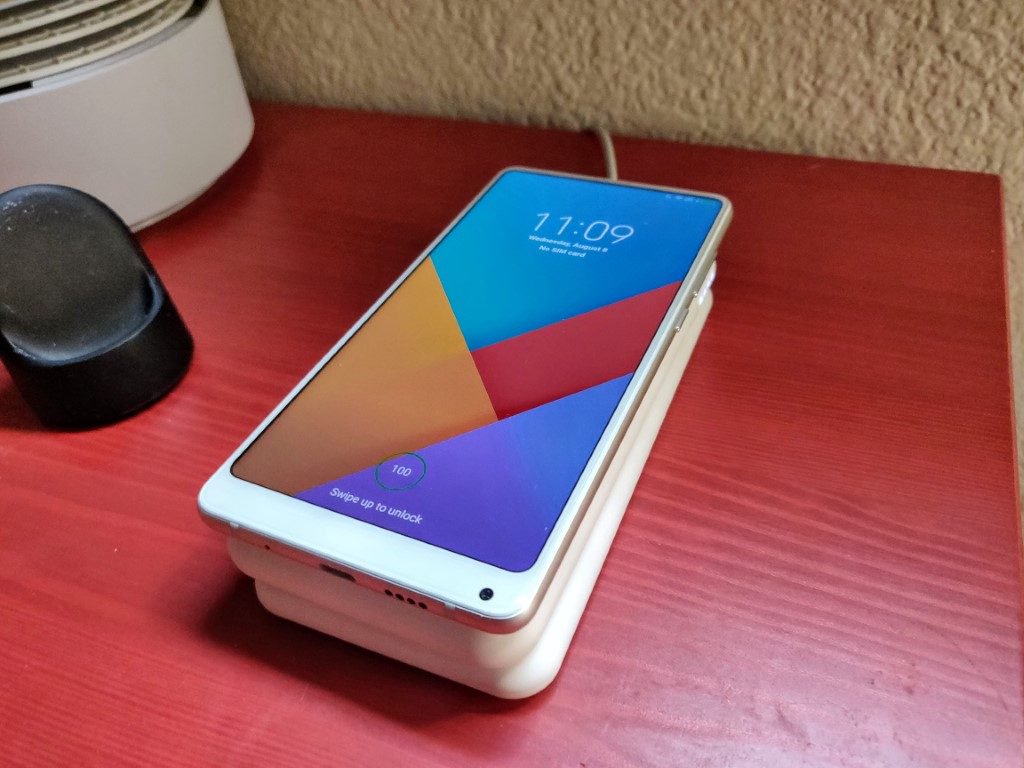
Aesthetically, the WiBa doesn’t try to do anything fancy. It’s made of a soft-touch bone-colored material, which unfortunately doesn’t quite fit in with the standard black of most smartphones these days. It does, however, fit rather perfectly with the white ceramic aesthetic of the Xiaomi Mi Mix 2S – eerily so.
Specs & Performance
Specification-wise, both the Power Bank and Charging Cradle feature standard Quick Charge speeds. The former can charge devices both wired (5V/2.1A) and wirelessly (5V/5W). The latter only charges devices wirelessly – at the fast-charge rated 9V/10W current. But it churns out enough power to charge both the power bank and your phone by stacking them atop one another, which is a great convenience. One cable to the cradle charges both your Qi-enabled phone and the WiBa power bank, and taking them off the cradle is a simple as picking them up. No wires, no cables. It’s pretty cool.

Value
At $99.99, the 5,000mAh Avido WiBa is no cheap buy. Most batteries of that capacity are $20 or less. Even if you include a fast-charging Qi Charger to the cart, you’re only looking at about $40. But the wireless technology in both the charger and battery shouldn’t be underestimated, nor should the convenience of being able to stack a battery and phone on top of the charger for utterly effortless charging.
At this price point, the Avido WiBa is, unfortunately, a rather niche purchase. But if it can sell enough of these to make the investment worthwhile, I have a feeling a WiBa 2.0 could change the way we think about charging. If you just can’t do without the ability to stack your battery and phone atop one-another to charge, the Avido WiBa is up for pre-order for $99 on Avido’s website.


