


Everything you need to know about the Pixel Slate
The Pixel family is about to welcome a new member on October 9: The Pixel Slate (also known under the code name “Nocturne”), a new Pixel tablet that uses Chrome OS and may provide a viable alternative to Chromebooks for many Google fans.
But what do we know about the Pixel Slate? Here’s everything we can say about the Slate’s specs, design, and important features. Check it out, and if you’re interested, remember to stop by Digital Trends on October 9 to get all the latest updates on Google’s new products.
A thin and simple design
There are two leaked renders of the Pixel Slate, and they show a very thin, display-focused tablet connected to a couple third-party keyboards. Compared to contemporary tablets, it has a surprisingly sturdy, beveled design that appears to include a USB-C connection. The bezels appear to have been cut back from where they were on the original Pixelbook.
Google source code has revealed that the “Nocturne” will have a 3,000 x 2,000 screen. That’s a pleasant 3:2 ratio, and a good resolution for a Pixel tablet, so this seems likely to persist to the final product. By comparison, the Surface Book 2’s 13.5-inch display has the same resolution.
Note that the Pixel Slate will include a camera and light sensor array as well, which the renders do not show. However, you can still get a good idea of what to expect.
Intel 8th-gen processor
PhoneArena has uncovered information that the Pixel Slate will ship with an Intel Core i7-8500Y processor. This is particularly remarkable because a lot of Chromebooks still use an ARM chipset. Google is making a statement by upgrading to an 8th-gen Amber Lake Intel processor for its tablet: It’s not quite competitive with today’s powerful notebooks, but you can also expect performance improvements for Chrome OS similar to what the original Pixelbook (which also uses Intel) offers.
Specifically, this chip offers 1.5GHz base speed with a max turbo option of 4.2 GHz, and is expected to come with up to 16GB of RAM. Based on what we know of Google’s Pixel ambitions, this wouldn’t be surprising, although many expect Google to offer more than one tier of Slate specs, which means lower RAM and perhaps even a less powerful chip could be an option. According to a recent leaked benchmark, some believe 8GB of RAM will be included in the base model.
Other Nocturne code indicates that the Pixel Slate will support NVMe solid state drives, so it’s likely the tablet will include an SSD. It’s also possible that Google will offer multiple versions of the Slate, some with eMMC SSDs and others with NVMe SSDs. NVMe is faster, but Google might want a lower-cost option as well.
Cross-platform support
Dan Baker/Digital Trends
Chrome OS now has Linux app supporter, Android Pie, and the Slate may also have the potential to run Windows 10 along with the Pixelbooks. That opens up a lot of possibilities for creative solutions and importing apps on demand from other platforms to finished a project.
Expect to hear a lot more about this at Google’s October 9 conference, including some long-awaited details on the ability to handle Windows 10.
Fingerprint sensor
A leaked animated image of the Pixel Slate in use indicates that the tablet will have a fingerprint sensor on the top of the display. Press the sensor, and you can unlock the computer: We know that Google has been wanting to include fingerprint sensors on Chromebooks, and the Slate is an excellent product to include fingerprint scan functionality. This isn’t a guarantee that the tablet will ship with biometrics, but it’s more likely than not.
In addition to the probable keyboards from the Slate renderings that were leaked, it’s also likely that Google is developing its own keyboard the tablet. Brandon Lall spotted a brief glance of Nocturne in a bug report that showed an interesting keyboard featuring oval keys. Maybe this was just a prototype, or perhaps Google really is bringing a round-keyed attachable keyboard to the market. It’s ambitious! It’s also a little weird. Does Google really think that the time has come for round keys on a tablet attachment, or was this just a prototype to be forgotten?
Since this is a tablet, Google’s Pixelbook Pen is also very likely to work with the Slate. There may well be more third-party accessories out there, but if any are waiting, we haven’t heard rumors about them quite yet.
Editors’ Recommendations
- Leaked Intel processor could help Google Pixel Slate dual-boot into Windows
- Google Pixel Slate — the first detachable Pixelbook 2-in-1
- Google’s Pixelbook 2 tablet could debut with fingerprint security
- Everything you need to know about the Pixelbook 2
- What to expect from the Google October event in New York City
LG V40 ThinQ vs. Samsung Galaxy Note 9: Can the V40 unseat the king?
Julian Chokkattu/Digital Trends
LG has taken the wraps off the LG V40 ThinQ, revealing a huge phone with a gorgeous 6.4-inch display, all the power you could want, and five camera lenses. But is it worth spending your money on, or should you invest in another top-level flagship instead? The Galaxy Note 9 is one of the best phones on the market right now, and also comes with a huge 6.4-inch screen, incredible power, and an amazing camera. Which one should you buy? We compared the two to find out.
Specs
LG V40 ThinQ
Samsung Galaxy Note 9
Size
158.7 x 75.7 x 7.7mm (6.25 x 2.98 x 0.30 inches)
161.9 x 76.4 x 8.8 mm (6.37 x 3 x 0.34 inches
Weight
169 grams (5.96 ounces)
201 grams (7.09 ounces)
Screen size
6.4-inch P-OLED display
6.4-inch Super AMOLED display
Screen resolution
3,120 x 1,440 pixels (537 pixels per inch)
2,960 x 1,440 pixels (516 pixels-per-inch)
Operating system
Android 8.1 Oreo
Android 8.1 Oreo
Storage space
64GB
128GB, 512GB
MicroSD card slot
Yes
Yes
Tap-to-pay services
Google Pay
Google Pay, Samsung Pay
Processor
Qualcomm Snapdragon 845
Qualcomm Snapdragon 845
RAM
6GB
6GB, 8GB
Camera
Triple lens 12MP (with OIS) and 16MP wide and 12MP telephoto rear, dual 8MP and 5MP wide front camera
Dual 12MP (with OIS) and 12MP (with OIS) rear, variable aperture, 8MP front
Video
2,160p at 60 frames per second, 1,080p at 240 fps
2,160p at 60 frames per second, 1,080p at 240 fps, 720p at 960 fps
Bluetooth version
Bluetooth 5.0
Bluetooth 5.0
Ports
3.5mm headphone jack, USB-C
3.5mm headphone jack, USB-C
Fingerprint sensor
Yes
Yes
Water resistance
IP68
IP68
Battery
3,300mAh
Fast charging (Qualcomm Quick Charge 3.0)
Qi wireless charging
4,000mAh
Fast charging (Qualcomm Quick Charge 2.0)
Qi wireless charging
App marketplace
Google Play Store
Google Play Store
Network support
T-Mobile, AT&T, Verizon, Sprint
T-Mobile, AT&T, Verizon, Sprint
Colors
Aurora Black, Moroccan Blue
Ocean Blue, Lavender Purple
Price
$900
$1,000
Buy from
LG
Samsung, Amazon
Review score
3.5 out of 5 stars
4 out of 5 stars
Performance, battery life, and charging
Julian Chokkattu/Digital Trends
Both of these phones are equipped with the Snapdragon 845, putting them among the most powerful mobile devices in the world. Both will provide smooth performance across a variety of apps, and will handle most mobile games extremely well. The Note 9 is technically more powerful, with the option for 2GB of extra RAM and a water-cooling system that keeps the processor from overheating, enabling it to perform at top level for longer.
The V40 packs a respectable 3,300mAh battery, while the Note 9 comes with a whopping 4,000mAh battery. Oddly though, there’s not a huge difference in battery life. We got a day’s use out of each of these phones, but the Note 9 could possibly go into a second day with light usage — not something we thought the V40 could manage. You’ll find wireless charging on both, as well as fast charging. However, the V40 refills faster than the Note 9, thanks to QuickCharge 3.0 support.
The LG V40 ThinQ charges faster than the Note 9, but that’s pretty much the only area where it’s superior. The Note 9 wins this fight with more power and a bigger battery.
Winner: Galaxy Note 9
Design and durability
It’s premium materials all-around here. The V40 and the Note 9 are both made from glass laid over aluminum frames. The Note 9’s design is a touch-up of the Note 8, while the LG V40 is a dead ringer for the V35 and V30. While that benefits the Note 9 — the Note 8 is still a beautiful looking phone — it’s something of a letdown for the V40, which struggles to draw your eyes the same way the Note 9 does. We said it was too subtle in our review, and in this contest, the Note 9 stands out more.
You’ll find IP68-rated water resistance in both phones. As both are covered in glass, you will want to invest in a case. We did notice that the lighter weight of the V40 made it feel less solid than the much heavier Note 9.
Both phones have excellent designs, and feel great in the hand — but the Note 9 earns the win with a design that’s just that bit more eye-catching.
Winner: Galaxy Note 9
Display
Julian Chokkattu/Digital Trends
While the notch will divide opinion, the V40’s 6.4-inch OLED screen looks great. It displays a 3,120 x 1,440-pixel resolution, and thanks to the OLED screen tech, blacks look deep and inky, while colors are beautifully vibrant. But LG’s up against a master here, and the Note 9’s AMOLED display is one of the best in the business. The Note’s 6.4-inch display runs a similar 2,960 x 1,440-pixel resolution, and also displays inky blacks and vibrant colors, but you’ll find the Note 9’s screen gets brighter, making it easier to see in bright sunlight.
The LG V40’s display is great, but the Note 9’s is better.
Winner: Galaxy Note 9
Camera
Julian Chokkattu/Digital Trends
The LG V40 ThinQ’s headline feature is undoubtedly its five camera lenses — three on the back, two on the front. The three on the back are comprised of a main 12-megapixel lens, a secondary 16-megapixel wide-angle lens, and a 12-megapixel telephoto lens. It’s an impressive lineup, reminiscent of the Huawei P20 Pro, and it adds a certain flexibility to your snaps. However, it’s not perfect, and quality is inconsistent across the lenses, with the primary 12-megapixel lens being superior to the other two. This can lead to a mismatch in quality when swapping between lenses. It’s also plagued by buggy software.
By contrast, the Note 9 only has two lenses on the back — a primary 12-megapixel lens teamed with a 12-megapixel telephoto lens. However, Samsung has spent a long time polishing this particular suite of cameras, and it shows in the smooth software and consistent quality across a variety of situations. The Galaxy S9’s variable aperture returns, and the Note 9 debuts an A.I.-powered Scene Optimizer. While both sport similar A.I. optimization, we definitely prefer the Note 9’s results.
Video-wise, you’ll be able to record at 4K at 60 fps on both, but there’s no Note 9-style super-slow-motion on the V40. Both are also capable of portrait modes, but we found the V40’s focusing to be extremely unreliable.
Both of these phones were marketed heavily on the strength of their cameras, so this category is of supreme importance. Despite the flexibility of the LG V40 ThinQ’s extra two lenses, it’s still let down by inconsistent quality and buggy software. The Note 9’s polished software and incredible low-light camera win here.
Winner: Galaxy Note 9
Software and updates
Julian Chokkattu/Digital Trends
Despite both phones coming with Android 8.1 Oreo, you’ll find Google’s OS hidden under custom skins. The Note 9 comes with the Samsung Experience UI, and it’s a fairly good UI, with plenty of customizable options. The included apps aren’t bad either, with Samsung Pay and Samsung Health being particularly notable. The V40 comes with LG’s UX skin, and it’s quite good, too, with customizable options and some useful features directly from LG. However, you might find a lot of carrier bloatware, depending on where you purchase your phone.
Unfortunately, neither phone comes with Android 9.0 Pie, which is a misstep for both. Both have Pie in the works, but we reckon LG will have the update out first, based purely on past performance. Both phones will get two years of Android updates, so you’ll get Android Q on both, too.
Though we prefer stock Android, both phones have good custom UIs. However, LG’s update record is generally better than Samsung’s, and helps it win this round.
Winner: LG V40 ThinQ
Special features
Julian Chokkattu/Digital Trends
The LG V40 ThinQ comes with some specials features that you’re likely to find beneficial. Top of the list is probably the Boombox Speaker, which uses the phone’s internal space as a sound chamber and boosts volume, but the A.I. key comes a close second, providing quick and easy access to the Google Assistant. It’s miles better than the Note 9’s Bixby key. That A.I. is integrated to a high level, including the camera optimization and easy access to Google Lens.
Bixby on the Note 9 still isn’t great, but the camera’s A.I. is definitely stronger than that on the V40. The Note 9 comes with an improved Samsung DeX mode — just plug in a cable and you’ve turned a simple monitor into a desktop PC. Then there’s the Note 9’s signature feature — the S Pen. This nifty little stylus allows you to quickly access a variety of features, scrawl on the sleeping screen, and capture gifs from videos. But that’s not all — it now comes with a low power Bluetooth connection so it can serve as a camera trigger, a presentation clicker, or a variety of other uses.
The V40 has some strong features, but the Note 9 is packed to the brim with extras.
Winner: Galaxy Note 9
Price
The LG V40 ThinQ will start from $900, and will be available from most U.S. carriers starting October 18. It’s currently available for pre-order. The Galaxy Note 9 is currently available for purchase, with prices starting from $1,000. It is also available from most U.S. carriers.
Overall winner: Galaxy Note 9
The LG V40 ThinQ is a great phone, but it’s up against one of the most polished phones Samsung’s ever released. It’s that level of polish that wins the Note 9 the crown here. The extra level of features and other tweaks really make the Note 9 stand out against a phone that’s otherwise its equal. The water-cooled processor, the gorgeous design, and the superbly made camera in particular stand out as strong reasons to pick the Note 9 over the V40.
With the prices being so similar, it’s hard to find a reason to recommend the V40. It’s a strong phone with plenty to love, but it simply can’t compete with the incredible Note 9 in so many areas.
Editors’ Recommendations
- LG V40 ThinQ: Everything you need to know
- LG V40 ThinQ Review
- LG G7 ThinQ review
- LG V40 ThinQ vs. LG G7 ThinQ: Which LG flagship is right for you?
- LG V40 ThinQ vs. V35 ThinQ vs. V30: Which of LG’s big phones is best for you?
SanDisk micro SD cards, cold brew coffee, and more are discounted today
Whether you’re looking for new tech gear or household items, we’ve got you covered.
There’s never a shortage of deals available, but sorting through all of them can be difficult at times. We’ve handpicked all the best tech, and everyday essentials discounts that you can take advantage of right now and brought them to one central location. From SanDisk’s 128GB micro SD card to Blooming Baby essentials, these are today’s best deals.
Tech Deals
View the rest of the deals
Everyday Essentials
If you want to know about the deals as soon as they are happening, you’ll want to follow Thrifter on Twitter, and sign up for the newsletter, because missing out on a great deal stinks!
Get caught up on the Google Pixel 3 before the October 9 event
Google’s 2018 flagships are almost here, and they could very well be the best phones of the year.

Google’s yearly Made by Google event is just days away, and while we can’t wait for Tuesday, we already have a pretty good idea of how the Google Pixel 3 and Pixel 3 XL look and some of the many, many features under that G-branded exterior. Whether you’re looking to catch up on a busy summer’s worth of leaks and rumor or you’re trying to decide if you need your credit card ready when pre-orders open, we’ve got you covered.
Everything we know so far about the Google Pixel 3
Sizes, screens, and specs
Google’s flagship phone comes in two sizes: the Google Pixel 3 and the Google Pixel 3 XL. While larger models tend to come with more cameras, more sensors, and more bells and whistles, far as we’ve been able to find, the Pixel 3 XL only seems to differ from the regular size Pixel 3 in three ways: a bigger, notched screen, a bigger battery, and a larger chassis to hold them.
Yes, notched: the Google Pixel 3 XL has a notch in the top of the front display that holds two front-facing cameras, light sensors, and the top speaker grill/ear piece. Said sensors are configured in a O__O face that has been mocked mercilessly by Android fans online.

The Google Pixel 3 sports a 5.5-inch 2160×1080 display and a 2,915 mAh battery, while the Pixel 3 XL sports a 6.3-inch 2960×1440 notched display and a 3,430 mAh battery. Other specs from the 3 XL evenly match the Pixel 3, including the Snapdragon 845 processor, 4GB RAM, dual 8MP front cameras, and front-facing stereo speakers.
Wireless at last

The Google Pixel and Pixel 2 lacked wireless charging, but that looks to be changing with the Google Pixel 3. Not only is the Pixel 3 reported to be packing Qi wireless charging capabilities, but Google may be launching a dedicated Pixel Stand with it.
The bottom of the Pixel Stand appears to have a grippy rubber base (similar to the Home Mini) that keeps it in place on a desk or table. A USB-C cable powers the accessory, and on the top is the wireless charging pad the Pixel 3 will rest on. Judging from the gif, it appears that Pixel 3 will probably go into a Smart Display-like mode once docked in the Pixel Stand to show your notifications, weather, traffic updates, and more.
Pre-orders, pricing, and pink
Pre-orders for the Google Pixel 3 will open immediately after the Made by Google event on October 9th, but an actual price for those pre-orders has yet to be confirmed. Last year’s Pixel 2 started at $649 and the Pixel 2 XL started at $849, so we wouldn’t be too surprised to see the Pixel 3 XL break into the $1000 phone club with the Samsung Galaxy Note 9 and the iPhone XS

When it comes to colors, black and white on the Pixel 3 are a given, but there’s some mystery surrounding the third (and maybe fourth) colors. Google’s been heavily teasing a mint option, but a render Android Headlines received from “a reliable source” shows a pink tone called “Sand” they say will be offered instead.
The latest Pixel 3 news
October 4, 2018 — Spigen lists Pixel 3 and 3 XL cases ahead of Tuesday’s event

Spigen is one of the biggest names when it comes to smartphone accessories, and just a few days before Google’s October 9 event, Spigen’s listed all of its Pixel 3 and 3 XL cases on its website.
Some of the cases are already available for purchase while others are still listed as coming soon, and in addition to giving you a jump start on your Pixel 3 accessory haul, this gives us yet another confirmation of the two phones’ design.
If you’re already planning on getting one of Google’s new phones, it might actually not be a bad idea to get your cases ordered now to make sure you’ve got them before your Pixel 3 arrives.
See at Spigen
October 4, 2018 — Here’s what the Pixel 3 looks like in its pink “Sand” color
The Pixel 3 and 3 XL will be here in just a few short days, and when they arrive, they’ll be available in a few different colors. Black and white are sure bets at this point, but there’s some mystery surrounding the third (and maybe fourth) colors. Google’s been heavily teasing a mint option, but now thanks to a new leak from Android Headlines, it would appear that a pink tone called “Sand” will be offered instead.
This render apparently comes from “a reliable source” who also provided Android Headlines with renders of the black and white models. However, there isn’t a mint color to be seen anywhere.
We actually haven’t seen any renders or hands-on photos of a mint Pixel 3, but if such a variant really doesn’t exist, it’s odd that Google would use mint tones in its promotion.
As such, this either means that Sand and mint will both be available at launch, one color will be available right away while the other is released at a later time, or Sand is the only other hue that’s joining black and white.
We really aren’t sure at this point, but thankfully we only have to wait until Tuesday to find out for sure.
October 3, 2018 — Pixel 3 pre-orders will open immediately after the October 9 event
Google’s October 9 event is getting closer and closer, and as part of a promotional email that the company began sending out today, we now have confirmation that preorders will “start immediately after the event.”
In addition to this, Google also has a few fun questions you can now ask the Google Assistant in preparation for the big day. Just ask “What’s this announcement about?”, “When are you making this announcement?”, or “How can I found out more about this announcement?”.
Lastly, the email also shows a large number 3 that transitions between black, white, and mint colors (likely the three colors that’ll be available at launch).
September 27, 2018 — Pixel 3 promo materials confirm Active Edge and other software features
The folks at MySmartPrice have been on a roll when in regards to Pixel 3 leaks as of late, and today, the site’s now shared a ton of promo images and an instructional video that confirm various software features the phone will have.


The video above shows users how to navigate and use the Pixel 3, and as expected, the Android Pie interface is pretty much identical to what we have on the Pixel 2 series right now. The gesture navigation is there, the notification panel is more rounded, and the revamped Do Not Disturb is present. Also confirmed in the video is the return of Active Edge (being able to squeeze the Pixel 3 to prompt Google Assistant).
As for the still promo images, the biggest takeaway from these is the one that shows the Pixel 3 retaining the Now Playing feature from the Pixel 2 that shows song info on your lock screen if it hears music playing in the background.
September 26, 2018 — This is Google’s Pixel Stand charging accessory for the Pixel 3
Last Friday, we got a look at a new accessory Google may launch alongside the Pixel 3 — the Pixel Stand. Now, instead of a promo image, we have a full device render to get a better idea of what it’ll look like in the real world.
The bottom of the Pixel Stand appears to have a grippy rubber base (similar to the Home Mini) that keeps it in place on a desk or table. A USB-C cable powers the accessory, and on the top is the wireless charging pad the Pixel 3 will rest on.
Like we saw last week, the Pixel 3 will probably go into a Smart Display-like mode once docked in the Pixel Stand to show your notifications, weather, traffic updates, and more.
Do you think you’ll be picking up a Pixel Stand?
September 25, 2018 — Pixel 3 wallpapers are now available to download
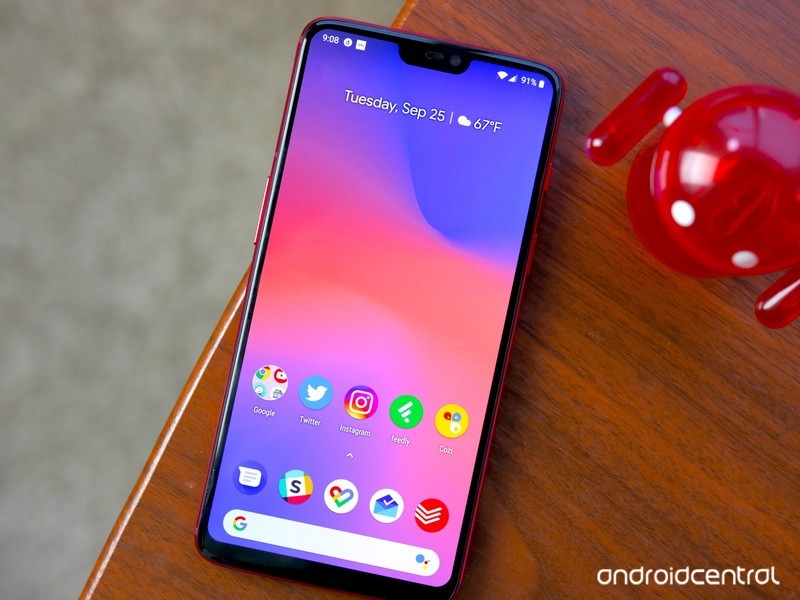
The Google Pixel 3 and 3 XL will be here in just two weeks, but if you can’t wait that long and want to make your current phone look a bit more like Google’s latest and greatest, you can now do just that.
The folks at MySmartPrice recently got their hands on 28 wallpapers that’ll ship with the Pixel 3 series next month, and just like last year, they look fantastic.
You’ll find a total of 28 wallpapers, including some new Live Wallpapers that Google introduced with the Pixel 2.
To get them, just tap the link below and install all of the individual wallpapers and APK file included in the Google Drive folder. So long as you’ve got a phone running Pie and have the Google Wallpapers app installed, you shouldn’t have any issue getting these on your device.
Download the wallpapers here
September 22, 2018 — Renders from Evan Blass show the Pixel 3 and 3 XL side by side
Since you guys keep asking… pic.twitter.com/DpRqzsyRem
— Evan Blass (@evleaks) September 21, 2018
’tis the season for Pixel render leaks, and this render from Evan Blass shows the Google Pixel 3 and Pixel 3 XL side by side with the screens off, showing off their size difference and their front camera/sensor layouts. These are consistent with the plethora of renders we’ve seen in recent months, with the O__O sitting smack dab in the Pixel 3 XL’s notch while the notchless Pixel 3 keeps its sensors to the left-hand side of the earpiece.
The Made by Google Event is slated for October 9th, where we will finally see the products in the flesh and see what they are or aren’t packing under those sizable screens.
September 18, 2018 — These are supposedly the Pixel 3’s official press renders

Although leaks for the Pixel 3 aren’t new at this point, the latest one from Nieuwe Mobile is the first time we’ve gotten an official press render for the 3 and 3 XL.
The renders show a lot of what we’ve already seen. The regular Pixel 3 is a fairly unoffensive device with relatively slim bezels on the top and bottom. The Pixel 3 XL, on the other hand, has a notch and chin at the top that’s been ridiculed to death.

The large “3” for the wallpaper is the same one present on the Google Store’s promo page, and if you look at the Google Search bar at the bottom, there’s an Assistant icon that we haven’t seen before.
There’s obviously no way to confirm whether or not these are legit renders, but as this point, it’s about as close as we’ll get until October 9.
September 17, 2018 — The Pixel 3’s fourth color might be pink
Following up on our previous entry from last week, there appears to be a fourth color for the Pixel 3 hidden on Google’s teaser page.
There’s a fourth color in the source code 🎨 #Pixel3 (@frontpagetech) pic.twitter.com/zutFwTRzKp
— Cas van Dinter (@CasVanDinter) September 16, 2018
Along with black, white, and mint that are visible to everyone, a quick look through the page’s source code reveals a fourth color referred to as “pink.” Google’s only ever launched three color variants for its Pixel phones at a time, so the fact that we could be getting four right from the get-go is pretty exciting.
However, a deeper look through the source code does reveals even more. Although we’re currently seeing black, white, mint, and the new pink color, there’s also mention of blue and green — suggesting that we might possibly get five total colors at launch time.
September 14, 2018 — Pixel 3 mint color teased in new promos from Google

With a little over three weeks to go before the big October 9 event, Google’s shared two new teasers to get people excited for the Pixel 3 and 3 XL.
The first of these appears to be live on all versions of the Google Store and is pretty basic. There’s a large 3 and some text next to it that reads “Stay tuned! Looks like you’ve already enrolled for updates from the Google Store. Be on the lookout for some news from us on Oct. 9.”


In addition to that, a Google page in Japan has a much fancier promo page that also potentially reveals a new color that we’ve yet to see in any of the leaks.
If you visit the page on your smartphone or tablet, you’ll see large text at the top that says “Coming Soon.” Below that is an outline of a phone with Google’s “G” logo at the bottom.
You can rotate your device side-to-side to move the outline of the phone on the page, and tapping on your screen cycles between a white, black, and mint background. These background colors also fill in the phone outlines, suggesting that these are all colors that’ll be available for the Pixel 3/3 XL. We’re already expecting white and black, but this is the first time we’ve ever seen a reference of a mint option.
September 6, 2018 — Google officially announces October 9 event for Pixel 3

Google has just sent out invites to the press for a hardware event in New York City, and just as rumored it will take place on October 9. The invite came in with a delightfully designed (and very swiftly swoopy) animated gif that honestly doesn’t give us any hints as to what we’ll be seeing. But there’s no reason why this wouldn’t be the launch event for the Google Pixel 3 and 3 XL.
The only question is whether we see more than the two phones. Last time around, Google had a blockbuster event that was ostensibly for the Pixel 2 and 2 XL, but also included the launch of the Google Home Max, Google Home Mini, Pixel Buds and Pixelbook. If Google pulls out all the stops once again, we could be in for a huge hardware launch event.
Last year’s event was in San Francisco (and on October 4), but it’s hard to read too much into a venue switch to NYC — it’s an easy place for press from all around the world to get to, and Google maintains a large presence in the city. Google will be streaming the event live, as well.
August 31, 2018 — Google Pixel 3 and 3 XL swing by the FCC
Before we head out for the week, let’s end our Friday on another Pixel 3 tidbit.
Today, FCC listings A4RG013A and A4RG013C from Google appeared — likely relating to the Pixel 3 and 3 XL, respectively. These numbers line up to last year’s phones where the Pixel 2 was G011A and the 2 XL was G011C.
Although no new information is revealed in these listings, it’s once again confirmed that Foxconn is the manufacturer rather than HTC or LG like we saw with the Pixel 2 series.
August 30, 2018 — Regular Pixel 3 appears in first hands-on photos, might not be a Verizon exclusive


Although the Pixel 3 XL has been leaked to death at this point, we still haven’t seen much on the regular Pixel 3 outside of device renders. However, thanks to a user over on Reddit, that’s now changing.
The photos confirm that the Pixel 3 will not have a notch and instead have slightly thicker bezels on the top and bottom compared to its XL sibling. The screen measures in at 5.5-inches, the resolution is 2160 x 1080, and there’s an aspect ratio of 18:9. The smaller battery also appears to be a 2,915 mAh unit.


Other specs from the 3 XL are carried over to the Pixel 3, including the Snapdragon 845 processor, 4GB RAM, dual 8MP front cameras, etc.
Also, in an update to the Reddit post, it’s said that the Pixel 3 in the above photos is part of a carrier testing program that isn’t Verizon. Contrary to reports we heard earlier this year, this suggests that Verizon’s exclusivity of the Pixel line may finally be over.
August 27, 2018 — Unboxing video shows off the Pixel 3 XL and its packaging, October 9 announcement date revealed
It’s pretty difficult to be surprised by a Pixel 3 leak anymore, but that certainly hasn’t stopped them from flowing in.
Most recently, a YouTube channel by the name of In DIGI uploaded a high-res 1080p Full HD unboxing video that shows the Pixel 3 XL being taken out of its packaging in one of the crispiest clips we’ve seen yet.
In addition to the Pixel 3 XL itself, the box is also home to the Pixel Bud-like wired earbuds that definitely appear to be included with the phone, #teampixel stickers, USB-C charging cable, USB-C to USB-A adapter, a USB-C to 3.5mm adapter, and AC wall adapter. The video gives us an up-close look at the front and back of the phone, as well as a few camera samples.
Lastly, we also got another hint as to when the Pixel 3 will officially be unveiled. In a Bloomberg article published by Mark Gurman this morning, it’s noted that:
Alphabet Inc.’s Google also plans to debut new Pixel phones on Oct. 9 at a media event in New York City, other people familiar with the plans said.
Google declined to comment on this news, but that lines up with earlier rumors and the press events for the company’s previous Pixel announcements for the past two years.
August 23, 2018 — Pixel 3 XL reported to have new Pixel Visual Core and a wide-angle selfie camera
We’ve known for quite some time that the Pixel 3 and 3 XL will have dual front-facing cameras, but up until now, it’s been a mystery as to what the second sensor will actually do. Thanks to a report from 9to5Google, we now have some more info as to what these sensors will be used for.
According to one source the site spoke with, the two cameras will allow for a new “Super Selfie” mode with another mention of there being an “improved Portrait Mode.” A leak from earlier today revealed new Portrait settings in the camera app, so that all lines up quite nicely.
As for the second sensor specifically, another source claims that this will act as a wide-angle lens so that users can fit more people in the frame in a single shot.
Details on the single rear camera are still pretty scarce, but 9to5 also mentions that one of their sources mentioned a “new Visual Core chip” and that Google is “doubling down on making a single camera powerful enough to not need a second camera.
August 23, 2018 — Another Pixel 3 XL leak highlights an updated camera app, included earbuds, and more
Kicking things off with a bang this morning, Russian website Mobile-Review recently published a “first look” at the Pixel 3 XL using a prototype model that was sent to it by “an anonymous well-wisher.” This hands-on is very similar to other ones we’ve seen already, but there are a couple new tidbits worth mentioning — specifically with the Pixel 3 XL’s camera app.
The UI shown here is a bit different from what we currently have on the Pixel 2. Rather than swiping open a hamburger menu to change shooting modes, the app now has them listed above the shutter button. Users can cycle through Panorama, Portrait, Camera, and Video. Tapping the More icon gives options for Google Lens, Slow Motion video, and Photo Sphere.


Portrait mode now allows you to choose between Natural and Soft face-retouching in addition to toggling it off altogether, a new “Google Lens suggestions” mode is featured, and the rear camera is confirmed to be 12.2MP while the front-facing camera is 8MP. For whatever reason, only one front-facing camera is mentioned in the app despite the Pixel 3 XL clearly having two.
As for the included earbuds, the instruction manual that comes with them indicates you’ll be able to use the in-line controls for controlling music, answering calls, and prompting the Google Assistant.
August 22, 2018 — Stolen Pixel 3 XL handsets are apparently being sold on the Ukranian black market
It’s not an uncommon practice for smartphones to be leaked ahead of their official release, but with the Pixel 3 XL, the quantity and quality of leaks we’ve been getting lately has been somewhat staggering. The first hands-on photos of the Pixel 3 XL were shared all the way back in June, and since then, it’s been a nonstop flood of leak after leak.
According to a new report from 9to5Google, a large portion of the leaks have been appearing thanks to a black market dealer over in Ukraine.
Essentially, this dealer somehow acquired multiple models of the phone and is shipping them from London at a price of $2,000 USD per phone. They’re said to be pre-release versions of the Pixel 3 XL, with it noted that “everything looks and works exactly the same” compared to the final versions that’ll be released in October.
We aren’t sure how many units this seller has or how they obtained them in the first place, but it’s further reported that people are still buying the phones and that more leaks are coming soon.
August 22, 2018 — Pixel 3 XL poses for more hands-on photos, Active Edge appears to be making a return

The Pixel 3 XL has reared its head in a number of hands-on photos at this point, but for the most part, they’ve been pretty low-quality and not the prettiest to look at. Thanks to user @wylsacom on Twitter and Rozetked, that’s no longer the case.
These photos don’t reveal a whole lot that we haven’t seen before, but they show off the Pixel 3 XL in a much more professional manner and, more importantly, a higher resolution.
The notch is as big as ever, the back is definitely all glass, and thanks to a shot of the settings page, it appears that Active Edge is returning so you can squeeze the sides to prompt Google Assistant.
August 22, 2018 — Leaked video confirms wireless charging on Pixel 3 XL; Camera samples shared on Instagram
Thanks to various hands-on photos, we’ve known for a while that the Pixel 3 and 3 XL will come with all-glass backs. However, up until now, it’s been a mystery as to whether or not wireless charging will make its way to the phones.
At least for the larger Pixel 3 XL, a video that was shared by user @khoroshev on Twitter confirms that this feature is, in fact, present.
pic.twitter.com/XtAtAeWreH
— Максим Хорошев (@khoroshev) August 22, 2018
The video above shows the Pixel 3 XL being placed onto a wireless charging pad, and when it makes a contact, a small animation appears on the screen to show the current battery percentage and to indicate that charging has begun. Google’s obviously yet to confirm the legitimacy of this video, but it sure does seem like wireless charging is a go for the Pixel 3 lineup.
Along with the video, that same person also took to Instagram to share a heap of photos that he supposedly captured with the Pixel 3 XL. Just like the Pixel 2 before it, the pictures showcase great dynamic range, excellent colors, and more. We don’t have access to the full-resolution files seeing as how these were uploaded to Instagram, but even so, it’s a great early look at what’s to come.
You can check out all of the photos here and here.
August 17, 2018 — Pixel 3 XL and its unforgiving notch pop up in Toronto

Surprise, surprise — another Pixel 3 XL leak!
A reader of the Canadian tech site MobileSyrup recently snapped the above photo while riding a streetcar in Toronto. As you can see, the phone shown in the picture appears to be none other than the Google Pixel 3 XL.
While Google’s yet to formally unveil the phone, the device lines up with everything else we’ve seen so far. It’s running Android P, has a chin below the display, and its large notch is impossible to miss.
This photo doesn’t reveal anything we didn’t already know about the phone, but the fact that Google’s got people using these out in the wild confirms that we’re not too far off from an official launch.
August 10, 2018 — Another hands-on video shows the Pixel 3 XL in use while also confirming some specs
The same person that shared those Pixel 3 XL photos and unboxing video from a couple days ago has returned with yet another video that reveals even more about the phone.
In this video, we can see the Pixel 3 XL actually being used. It’s running Android 9 Pie (no surprise there) and appears to have the same UI of the Pixel and Pixel 2 running the new software.
A couple benchmarks results are also shown during the video, and as such, a handful of specs have been confirmed. They include:
- 1440 x 2960 screen resolution
- Qualcomm Snapdragon 845 processor w/ Adreno 630 GPU
- 3,430 mAh battery
- 12.2MP rear camera
- 8.1MP front-facing camera (x3)
The most interesting of those specs are the front-facing cameras. Antutu lists three 8.1MP sensors up front, although in the video we can only see two. This could be nothing more than a glitch in the app, or Google could have implemented some sort of mystery camera up there. We really aren’t sure about that one.
August 8, 2018 — Pixel 3 XL appears in more hands-on photos and unboxing video


Previous renders and real-world pictures have already given us a clear look at the Pixel 3 XL’s design, and to help make that image as clear as humanly possible, SlashLeaks recently shared three additional hands-on photos and an unboxing video of the phone.
One of the photos shows the back of the white Pixel 3 XL while the other two showcase the front. We once again see that Google will be sticking with just one rear camera and a rear-mounted fingerprint sensor, and unfortunately, that notch hasn’t shrunk at all since the last time we saw it.
Moving over to the unboxing video, it’s apparent that Google’s using very similar packaging compared to the Pixel 2 and 2 XL. The box does contain a pair of wired USB-C earbuds in addition to the Pixel 3 XL, but seeing as how Google experimented with this idea for last year’s release, we aren’t entirely sure if the free buds will stick around for the final retail packaging.
August 6, 2018 — October 4 launch date leaked for the Pixel 3
While we’ve seen plenty of leaked renders and specs for the Pixel 3, talk about its release date has been fairly quiet. That is, up until now. As spotted by Brandon Lee from the YouTube channel This is Tech Today, the Pixel 3 is shown to be released on October 4 according to the website Famebit.
Famebit is a website that allows companies to connect with content creators and work out deals to create sponsored content for YouTube videos, Instagram posts, etc. An ad on the site was recently created by Google and asks for Canadian creators to switch to the Pixel 3 and then making a video talking about their experience.
In this listing, it’s stated that “The Pixel 3 phone is launching October 4, 2018.”
While there’s no way to confirm if this ad really was created by Google, that October 4 date is what we were previously expecting anyways. That’s the same day Google used to announce the Pixel and Pixel 2 before, so it makes sense that it’d keep the trend going this year.
July 30, 2018 — Clearly White Google Pixel 3 XL shows up in new leak

We just got our best look at the Google Pixel 3 XL courtesy of XDA. The images in question show off the Clearly White color option, and the live photos confirm a cutout at the front and a single rear camera. We can also make out a single speaker located below the display.
The XDA leak once again reaffirms the presence of a glass back on the Pixel 3 XL, with the finish alternating between glossy and matte. A glass back opens up the possibility for wireless charging, but for now there’s no further information as to whether the feature will make its way to the device.
July 28, 2018 — ‘Pixel Stand’ could be a wireless charger for the upcoming Pixels
A teardown of the Google app by the folks at XDA has served up interesting information. The code references something called a Pixel Stand, leading to suggestions that it will be a wireless charging dock for the upcoming Pixels.
According to XDA, the Pixel Stand will feature Assistant integration, and will be able to offer personalized suggestions and answer queries when the phone is docked.
June 27, 2018 — Pixel 3 and 3 XL renders show the phones from every possible angle

As if previous leaks of the Pixel 3 and 3 XL haven’t been revealing enough, MySmartPrice teamed up with OnLeaks to share a boatload of both photo and video renders of the two phones.
These renders confirm a lot of what we’ve previously seen, including things like an all-glass back for both phones, single rear cameras, and a notch on the larger Pixel 3 XL.


However, while earlier rumors suggested that only the 3 XL would have two front-facing cameras, these renders show that the regular Pixel 3 will have them, too.
The Pixel 3’s display is said to measure in at 5.4-inches with an 18:9 aspect ratio, whereas the Pixel 3 XL will have a 6.2-inch screen and 19:9 setup. As for the dimensions, we’re looking at 145.6 x 68.2 x 7.9mm for the Pixel 3 and 158 x 76.6 x 7.9mm for the 3 XL.
June 18, 2018 — Case render confirms Pixel 3 XL design

Ice Universe on Twitter has built up a reputation for being pretty accurate about leaks/rumors in the mobile space, and on June 18, they shared a case render that further confirms the Pixel 3 XL’s design.
Like we saw with the hands-on photos on June 7 and 8, the Pixel 3 XL will have a notch in its screen, dual front-facing cameras, stereo speakers, rear-mounted fingerprint sensor, and a single rear camera.
It’s peculiar that Google’s choosing to use two cameras on the front while keeping just one on the back, but based on how excellent the Pixel 2’s single rear camera is, I don’t expect this will be a downside at all.
June 8, 2018 — Pixel 3 XL shown off in six more hands-on pictures
Less than a day after those first two hands-on photos of the Pixel 3 XL surfaced, six more have appeared.


These additional photos showcase the Pixel 3 XL from every possible angle, and when XDA Developers reached out to their forum member that shared them, they were able to confirm that the phone has a full glass back. In other words, it’s possible this year’s Pixel line may finally adopt wireless charging.


The front and back photos are pretty similar compared to what we saw yesterday, but the other images showcase a reflective glass frame around the phone, volume rocker and power/lock button on the right side, and a USB-C port and SIM slot on the bottom.
Also, as 9to5Google pointed out, that mysterious logo on the back of the Pixel 3 XL was used previously with old Pixel 2 prototypes.
June 7, 2018 — Hands-on photos apparently showcase a Pixel 3 XL prototype


Out of the blue, XDA Senior Member meraz9000 shared two photos on the XDA Forums showing what’s supposed to be a prototype of the Pixel 3 XL. There’s obviously no way we can confirm whether or not this is the real deal, but it sure does line up with the display panels that were leaked last month.
The photos show the Pixel 3 XL from both the front and back, with the front reiterating the point that the 3 XL will more than likely have a notch in its screen. For what it’s worth, it does look like we’ll be getting two front-facing cameras and a chin at the bottom to retain stereo front-facing speakers.
Around back, this Pixel 3 XL prototype looks nearly identical to that of the Pixel 2 XL. The glass panel seems to be ever-so-slightly smaller, but that could just be the way the photo was taken.
In any case, what do you think about how the Pixel 3 XL is shaping up?
June 4, 2018 — Google’s apparently working on a mid-range Pixel phone
According to one tipster, Google’s in the process of developing a mid-range Pixel phone that’s codenamed “Bonito” and is powered by the Snapdragon 710 processor.
Rumors of a mid-range Pixel first popped up in April, but the old claim of it launching this July has since been replaced with a release scheduled for the first half of 2019.
That would suggest that Google may launch this new Pixel phone during I/O next year, but with so much discrepancy surrounding the release date, it’s entirely possible it’ll be announced alongside the Pixel 3 in October.
May 30, 2018 (part 2) — Verizon is said to be the exclusive carrier for the Pixel 3, again 😕
A report from Bloomberg recently surfaced confirming a few details about Google’s upcoming phones per a source that’s familiar with their production. According to the report:
- The Pixel 3 series will once again be exclusive to Verizon Wireless in the U.S.
- A notch will be present on the larger Pixel 3 XL
- Google will announce/launch the phones in October
- Foxconn will manufacture the Pixel 3/3 XL
- Stereo speakers will be present on both phones
- The Pixel 3 XL will have dual front-facing cameras
- “Both models will include upgraded, single-lens cameras on the back”
May 30, 2018 — LG will reportedly manufacture the Pixel 3 XL’s OLED display

Just a couple days after the Pixel 3 XL’s notched panel leaked, a report’s come out of Korea claiming that Google will once again use LG to manufacture and supply an OLED screen for the phone.
Furthermore, an official from LG Display that remains anonymous said, “We have maintained close ties with Google and the volume will not be much different from the previous one (the Pixel 2 XL).”
If this turns out to be true, one can only hope that LG’s improved the quality of its mobile panels since last year. The LG-made Pixel 2 XL display was the center of a lot of controversy for the phone’s first few weeks out in the wild, and Google really can’t afford to go through that again with gen-three.
What do you think about LG making the Pixel 3 XL’s display?
May 28, 2018 — The Pixel 3 goes 2:1 and the Pixel 3 XL gets a notch

Here’s an interesting leak that, while not necessarily all-telling, gives us an indication of where Google is taking the series in 2018. Specifically, the larger Pixel 3 XL looks to have a notch while the smaller Pixel 3, though moving to a 2:1 aspect ratio, will lack one. At the same time, we see some sensors that may indicate Google is adding either a second front camera to the phones or, more likely, some sort of dedicated biometric sensor for faster/more reliable face unlock.
The leak comes from Weibo (by way of Slashleaks) and reportedly shows two front glass panels for the new phones. Given that we’re almost in June, this would be the time for accessory makers to begin testing products for the final phone design. It’s also good to see Google maintaining dual front-facing speakers for the lineup.
What do you think of this latest leak?
May 10, 2018 — The Pixel 3 could be joined by second-gen Pixel Buds and a Pixel Watch
Google’s hardware events surround the Pixel phones with a heap of other product announcements, and this year, it’s reported that we’ll see a second-gen version of Pixel Buds and Google’s first Pixel-branded smartwatch.
Specifics on these gadgets are still up in the air, and as excited as I am to see how Google improves its wireless earbud game, I’m beyond ecstatic to see how the company’s first smartwatch turns out.
Wear OS is in an awkward stage right now, but a proper Pixel Watch and new silicon from Qualcomm could bring it back into the limelight. Assuming Google handles this right, the Apple Watch may soon be faced with some of its stiffest competition yet.
Google Pixel 2 and Pixel 2 XL
- Pixel 2 FAQ: Everything you need to know!
- Google Pixel 2 and 2 XL review: The new standard
- Google Pixel 2 specs
- Google Pixel 2 vs. Pixel 2 XL: What’s the difference?
- Join our Pixel 2 forums
Best Buy
Verizon
Google Store
Project Fi
Is Google’s next Chrome OS detachable the Google Pixel Slate?
Here’s everything you need to know about Google’s new Pixelbooks.

The Google Pixelbook is one helluva device. Its bezels might be big and the lack of a fingerprint sensor is a shame, but if you want a Chrome OS machine, it’s one of the very best you can get.
It’s no surprise that we’ll be getting a successor this year to accompany the Pixel 3, but according to everything we know, Google could be prepping to launch two Pixelbook 2 devices this year. What can we expect from this new hardware and when will we learn more?
Here’s everything we know about the Pixelbook 2 series!
The latest Pixelbook 2 News
October 6, 2018 — Detachable Chrome OS 2-in-1 leaks again as “Google Pixel Slate”

The October 9 Made by Google event is just days away, and while there’s little left to spoil about the new Google Pixel 3, there are other Google devices predicted for the event that still have some mystery to them. Rumors have swirled over a new Pixelbook or Pixel tablet, and with the latest leaks of the detachable Chrome OS tablet comes a new name: the Google Pixel Slate.
The images from MySmartPrice show the previously-seen detachable, well, detached from its keyboard base, as well as showing off an handsome blue Pixelbook Pen to match it. Whether this Nocturne-codenamed device is really the Pixelbook 2, Google Pixel Slate, or something else entirely, we won’t have to wait long to find out
September 19, 2018 – Detachable Pixelbook 2 shown off

Keyboard maker Brydge was rumored to be working with Google on a Chrome OS keyboard, and now that’s all but confirmed. About Chromebooks shared an image from the keyboard maker, showing off a keyboard that mostly resembles the standard Chrome OS layout. The leak also showed the tablet the keyboard was attached to, giving us a look at the fingerprint sensor and what looks like a far-field microphone setup.
While there’s nothing about this image that specifically has Google’s logo on the device, it’s worth noting there isn’t any logo on the front of the device. Companies like Asus, HP, Acer and other have a tendency to put their logo just below the display, which makes it more credible that this is a Google detachable.
September 12, 2018 — Pixelbook 2 appears in YouTube TV ad

One leaked ad showing the Pixelbook 2 not enough? Lucky for you, because a second one’s already popped up.
According to one Redditor, the above image appeared during a commercial for YouTube TV. Just like the device that we saw in the Chromebook ad a couple days ago, this shows a device that looks very similar to the current Pixelbook with much smaller bezels.
Adding more weight to the legitimacy of this leak, the same Redditor also shared a Motion Photo from his Pixel 2 that shows a couple seconds of the ad in action.
September 10, 2018 — Leaked ad shows 2nd-gen Pixelbook with much slimmer bezels

Atlas has been rumored for some time as a marginal upgrade over the 1st-gen Pixelbook, and thanks to an online ad that was recently discovered, we now have our first look at the machine.
The ad is pretty similar to other Chromebook advertisements Google’s been running, but the product shown in it is a device we haven’t seen before. The underside has a two-tone design that looks identical to the original Pixelbook, but as you can see for yourself, the bezels surrounding the screen are much smaller.
Lastly, the ad also reveals that the Pixelbook Pen will continue to work just fine with the new hardware.
September 8, 2018 — Video reportedly shows detachable Pixelbook 2
Like we previously talked about, this year should see Google releasing two Pixelbook 2 models — Atlas and Nocturne. Today, a short video clip apparently gives us our first look at the latter of those two devices.
The video’s pretty short and only shows a small portion of Nocturne, but it reveals some key details.
First of all, the buttons on the keyboard are circular instead of the traditional square design of last year’s Pixelbook. Few laptops have these circular buttons, so it’s interesting to see Google feature them on what’s likely its flagship Chrome OS device of 2018.
The bezels surrounding the display also appear to be much slimmer than the Pixelbook.
How do we know this is Nocturne and not Atlas? While we can’t confirm this with 100% certainty, the black pad that separates the keyboard from the screen sure does look like something you’d find on a Surface Pro — suggesting that the keyboard can detach from the main computer and reinforcing the belief that this is, in fact, Nocturne.
August 10, 2018 — Commit suggests two Pixelbook 2 models are coming this year
The Pixelbook is still one of the best Chromebooks you can buy, and later this year, Google may treat us to not just one, but two new machines to succeed it.
Thanks to some hard work from the folks at Chrome Unboxed, various commits hint at two new Chrome OS devices that Google is working on. Referred to as Atlas and Nocturne, these are believed to both be new entries in the Pixelbook 2 series.
What evidence backs this up? According to the commits that were found:
- Atlas and Nocturne share the same board.
- Features have been enabled for both Atlas and Nocturne in the same commit — something that doesn’t happen that often.
- “Krabbylake” is mentioned in the commit for Atlas and Nocturne (maybe a new version of Intel’s Kabylake processors?).
- Another codename “Whiskers” is referred to as a keyboard accessory for Nocturne, indicating it’ll be a detachable 2-in-1 device.
How many models are we expecting?
While one new Pixelbook would be a big enough treat from Google, a lot of signs are pointing towards us getting two Pixelbook 2 models — Atlas and Nocturne.
Atlas is expected to retain the same general design as the first Pixelbook with the exception of slimmer bezels around its display. On the other hand, Nocturne should feature a detachable design (a la Microsoft’s Surface Pro) that allows the main computer to detach from the keyboard so it’s easier to use as a tablet.
Various commits have provided ample evidence that Atlas and Nocturne are in fact two unique Chrome OS machines that Google is working on, giving customers more choice to find the Pixelbook that’s right for them.
How much will it cost?
Last year, pricing for the Pixelbook started at $999 and went up to $1649 depending on the configuration you chose.
It’s still unclear how much Google will charge for the Pixelbook 2 series, but we believe that the Nocturne detachable model will be the more expensive option while the Atlas machine that keeps the traditional laptop design will cost less.
In one leaked ad that shows a familiar Pixelbook body with slimmer bezels, the tagline under “You Chromebook” says “Convertible, flexible, affordable.”
“Affordable” could mean just about anything, but it suggests that the Atlas Pixelbook 2 could cost less than the original Pixelbook’s base $999 price tag.
When will the Pixelbook 2 be released?
Google’s confirmed that it’ll be holding an event in New York City on October 9, 2018.
While the Pixel 3 and 3 XL will likely be the main focus, this is also where we can expect to learn all about the company’s latest Chrome OS efforts with its new Pixelbook 2 hardware.
Chromebooks
- The best Chromebooks
- Chromebooks in education: Everything you need to know
- Should you buy a Chromebook?
- Chromebook Buyers Guide
- Google Pixelbook review
- Join our Chromebook forums
Make the most of your Ring Doorbell with these accessories!

The Ring Doorbell is a great way to make your home a bit smarter, since it pulls double duty as a security camera and intercom system, works with Alexa, and of course, functions as a doorbell. While the Ring Doorbell includes everything you need to get up and running out of the box, it never hurts to go beyond the basics. These are the best accessories to help you make the most of your Ring Doorbell.
Creative mounting
HOMONO Angle Mount

Every doorway is different, and you may need to get creative with how you mount your doorbell for it to be completely effective. This mount from HOMONO gives you up a 55-degree horizontal angle, so your camera pays attention to where it should.
$9 at Amazon
A simpler mount
OideaO 3x Adjustable Mount

This one works a bit differently than the previous mount, with the advantage being you can set it to a wider angle. You get three wedges: one 20-degree, one 30-degree, and one 40-degree, and you can stack these as you see fit to find the perfect angle for your doorway. The kit includes drywall anchors and screws, so you just need a drill and screwdriver to install this.
$12 at Amazon
Vertical mount
KIMILAR Angle Mount

If you need to change your vertical angle instead of your horizontal one, this kit if for you. Again, you get three wedges to angle your Ring Doorbell Pro, this time at 5-, 10-, or 15- degrees. And again, screws, drywall sockets, and even a little screwdriver are included so you can have the mount installed in no time.
$10 at Amazon
Better battery
Ring Rechargeable Battery Pack for Video Doorbell 2

The Ring Doorbell 2 works with standard AA batteries, but there are less wasteful power options available. This kit includes a rechargeable battery pack and a USB charging cable. The battery should last up to six months, though it takes seven hours to recharge.
$36 at Amazon
Unlimited power
Hotop Ring Doorbell Power Supply

If you don’t want to deal with batteries at all, a permanent power supply is for you. This one from Hotop works with all Ring Doorbell models, and the cable and plug are small enough to fit through a small hole in your wall. The cable is 1.8 meters long, so you shouldn’t have any issues reaching one of your outlets inside.
$16 at Amazon
Show up
Amazon Echo Show (2nd gen)

You can use the Echo Show to see who is outside your door, and the newest version is better than ever. The slimmer bezels and fabric back panel make the new Echo Show look miles better than the first one, and the big screen will make it super easy to see what’s going on outside your door. You can also talk to whoever is outside through the Echo Show, and hear them back.
$230 at Amazon
Speak easy
Amazon Echo Dot (3rd gen)

The all-new Echo Dot is great for a lot of things, but the key one here is that it lets you speak to and hear whoever is outside. It’s not as nice as being able to see footage like with the Echo Show, but this is also a good bit less expensive.
$50 at Amazon
Chime in
Ring Chime

The microphone on your doorbell doesn’t do any good if you can’t hear it throughout your home. The Ring Chime’s speaker plugs into any power outlet to let you hear whoever is trying to come inside. The Chime lacks a microphone, though, so you won’t be able to talk back.
$30 at Amazon
Extra reach
Ring Chime Pro

This does everything the Chime does but also serves as a Wi-Fi extender. Now, this doesn’t work as an extender for your smartphone or tablet, only for Ring devices, so you can hear alerts in that secluded back corner of your home.
$50 at Amazon
The Ring Doorbell is great on its own, but like with all smart home tech, it gets so much more capable once you add some accessories. Not all of these are mandatory (we personally like the Amazon Echo Show for its ability to let us see who’s at our door), so just mix and match accessories to find what works best for your home.
iFixit Indicates Third-Party 2018 MacBook Pro, iMac Pro Repairs Still Possible for Now
Earlier this week, MacRumors obtained an internal document from Apple stating that Macs with the Apple T2 chip, including the iMac Pro and 2018 MacBook Pro, must pass Apple diagnostics for certain repairs to be completed.
The document states:
For Macs with the Apple T2 chip, the repair process is not complete for certain parts replacements until the AST 2 System Configuration suite has been run. Failure to perform this step will result in an inoperative system and an incomplete repair.
• For notebooks: Display assembly, logic board, top case, and Touch ID board
• For desktops: Logic board and flash storage
Apple’s diagnostic software is limited to internal use by Genius Bars at Apple Stores, Apple Authorized Service Providers, and qualifying institutions, suggesting that independent repair shops without Apple certification would be unable to repair certain parts on the iMac Pro and 2018 MacBook Pro going forward.
Moreover, the document reignited a debate about planned obsolescence, as there were concerns that when Apple stops servicing the iMac Pro and 2018 MacBook Pro, repairs through alternative channels might not be possible.
The news was quickly opposed by “Right to Repair” activists who believe that Apple and other device manufacturers should be legally required to make replacement parts, repair guides, and tools available to the public. Apple has and continues to actively oppose “Right to Repair” legislation in the United States.
Those activists will be delighted to hear that, for whatever reason, what Apple said in its document isn’t actually the case right now.
After our report was published, the repair experts at iFixit swapped out the display and logic board on a 2018 MacBook Pro, and the notebook remained operational without being subjected to Apple’s diagnostic software.
 iFixit swapping out parts on 2018 MacBook Pro
iFixit is not an Apple Authorized Service Provider, so at this time, it appears that independent repair shops should remain able to repair the iMac Pro and 2018 MacBook Pro without issue. It’s unclear why Apple’s document suggests otherwise, but it’s possible the requirement could kick in at a later date.
iFixit:
So why is Apple doing this? It could simply be a mechanism for tracking parts used by their authorized network, to check quality or replacement rates. It’s possible that units with swapped parts may operate normally, but still report a failure in Apple diagnostic tests for having ‘unauthorized’ components installed—much like earlier units did on earlier versions of AST for third party HDD/SSD, RAM and batteries.
Apple did not respond to our request for comment.
Related Roundups: MacBook Pro, iMac ProTag: iFixitBuyer’s Guide: MacBook Pro (Buy Now), iMac Pro (Neutral)
Discuss this article in our forums
Do you need a 120Hz or 240Hz monitor?
If you’re looking for a new monitor, you may be bewildered by today’s options. The last five years have seen the average monitor’s feature list swell to include better panels, higher resolutions, and more inputs. But figuring out whether you actually need all of those features, especially if you’re not a gamer, can be rather difficult.
Alongside improved resolutions like 4K, one of the big selling points of many modern monitors is a high refresh rate. Often you’ll see displays marketed as having a 120Hz or 144Hz panel. This is among the most confusing traits for consumers, because the name doesn’t provide much explanation, and unlike most improvements, refresh rates don’t enhance color accuracy or resolution.
Is it better just because the numbers are higher? Do you need a 120Hz or 240Hz monitor?
If you just want to jump ahead and buy one now, here are some of our favorite high-end displays.
What does Hz actually mean?
Casual users often assume that “120Hz” has something do with performance because it seems similar to the way processor clock speeds are described. In fact, the term describes something a bit different; refresh rate.
Refresh rate is the number of times per second a display refreshes its image. Since movement is displayed by the difference between frames, the refresh rate effectively places a hard cap on the frame rate visible. That said, refresh rate is not the same as frame rate. Refresh rate is an attribute of the monitor, while frame rate is an attribute of the information being sent to it.
If you can run a game at 100 frames per second, you may see a tangible benefit from playing it on a monitor that can refresh that many times per second. But if you’re watching a movie at a classic 24 frames per second, a higher refresh rate monitor won’t make any difference.
Motion resolution
If your computer can play a game at a high enough frame rate to match a 120Hz or 240Hz monitor, you’ll see a noticeable change in the perceived sharpness of a moving image. Blurring occurs because of how the human brain processes the set of individual frames a monitor displays. The brain blurs together the series of frames to create a sensible moving picture, but some detail is lost along the way.
A higher refresh rate helps to decrease the blur by giving our brains more information to act on, in turn reducing perceived blur. However, unlike computer hardware, our brains aren’t all made to the same specification. Some people notice the difference between a 60Hz and 120Hz display immediately, while others can’t see what everyone is all worked up about. The difference between 120Hz and 240Hz is even more subtle.
Again, it is very much dependent on what you’re doing on your system. Gamers will notice sharper visuals during fast action, and moving a mouse can feel smoother compared to a more typical 60Hz display. Web browsing when fast scrolling down a page can look a little smoother too, but watching online videos and answering emails won’t see provide any real.
Screen tearing
Because refresh rates and frame rates are very different things, they can often mismatch. That’s when something called screen tearing can occur. It tends to happen when a computer’s video card is spitting out frames at a rate well beyond the refresh rate of the monitor connected to it. Because more frames are being rendered than the monitor can handle, half-frames are sometimes shown together on the screen, manifesting as an obvious split between two portions of it, neither of which appears to line up correctly with the other. It’s a distracting problem that even the least sensitive viewer will usually notice.
In games that aren’t particularly taxing, frame rates can often exceed 100 FPS. However, a 60Hz display only refreshes 60 times per second. This means gamers are not fully benefiting from the enhanced responsiveness of the higher frame rate, and may notice tearing as the display fails to keep up with the data fed to it. A 120Hz display refreshes twice as quickly as a 60Hz display, so it can display up to 120 frames per second, and a 240Hz display can handle up to 240 frames per second. This will eliminate tearing in most games.
Frame syncing technologies like V-Sync, Freesync, and G-Sync, also help prevent screen tearing, but they have their own drawbacks. V-Sync will cap performance. Freesync and G-Sync, meanwhile, require specific combinations of video card and monitor hardware.
Input response
Aurelien Meunier/FIFA/Getty Images
The refresh rate of a monitor has an impact on input lag. A 60Hz display, for example, will never have a visible input lag below 16.67ms, because that’s the amount of time which passes from one refresh to the next. A 120Hz display halves that time to 8.33ms, and a 240Hz display further reduces it to 4.16ms.
Decreasing lag by less than ten milliseconds may not seem important, and for many people, even gamers, it’s not. However, input lag can be worth eliminating for ultra-competitive gaming or for those who like games to feel as smooth as possible. This is, once again, an issue some people will notice more readily than others.
Do you need really need a 120Hz or 240Hz monitor?
In short, if you’re a gamer, we’d argue that you would see a greater, more obvious benefit from switching to a high-refresh rate monitor than you would in upgrading to 4K — as doing both can get inordinately expensive and taxing on your hardware. 120hz or 144Hz displays make for smoother, tear-free gaming with less input lag.
Still, if possible, try finding a 120Hz monitor in a store. Many have motion demos running to show off the feature. You might also refer to past experience; if you immediately notice stuttering or blur at the movie theater, or on your television, you’ll probably notice the difference. People who’ve never had a problem, however, may not see an improvement.
If you’re not a gamer, switching to a high refresh rate display is much less important. While the improvement in motion resolution is visible, its benefit is often hard to notice. Televisions, which also advertise 120Hz or 240Hz panels, further improve motion quality with image processors that change the input sent to them. Many can even add frames, effectively increasing the framerate of content. Monitors, however, usually have no processor; the input sent is what’s displayed. This minimizes the benefit of the panel when viewing video content. An improved refresh rate also does not guarantee the elimination of “ghosting,” an artifact common to LCD monitors which causes moving objects to leave one or more faint trails behind them.
Ultimately, consumers who don’t game will struggle to notice a difference. Spending money on improved image quality, rather than improved motion performance, is usually the better choice. There are many great IPS displays on the market which rely on 60Hz panels but are otherwise superior to most 120Hz monitors on the market.
Editors’ Recommendations
- What is G-Sync? If you’re a gaming fan, you’ll want to know
- Asus ROG Swift PG279Q review
- The best monitors of IFA 2018
- Acer targets gamers with new color-rich 4K Predator and Nitro monitors
- What is the ‘Soap Opera Effect’ in TV and how can you turn it off?
Save 50% on the TorGuard VPN and browse in peace… for life
Pay a little extra for privacy and security.
Use the code THRIFTERDEALS to take 50% off any of the Anonymous VPN services offered by TorGuard. This deal brings the price down to $4.99 for the monthly service or $29.99 for a year. Anonymous VPN is a subscription service, but you will continue to get the discounted price every time it renews until you end it. That’s pretty awesome because it means 50% off for life if you want.

TorGuard is a virtual private network. The internet at large is a really public space, and a lot of times that means your data is being passed around when you don’t even know about it. VPNs turn your internet experience into a private one so you can protect yourself and not worry about who is collecting or using your information. No matter which plan you choose, TorGuard services will include access to more than 3,000 servers in 50 countries, up to five simultaneous connections, perfect forward security, advertisement and malware blocking, protection against known leaks, support for all operating systems and devices, and more. You can even add on extras like protection from DDoS attacks.
Even if you aren’t generally worried about privacy, which you should be, there are a lot of general use reasons to subscribe to a VPN service. For example, if you play video games or stream online, you can use a VPN to protect your IP address from online trolls. Since VPNs can access servers in multiple countries, you can use them to view content that would not normally be available to you, like YouTube videos or European Netflix. It also keeps ads from targeting you based on your shopping habits and things like that, which can be very disconcerting.
You can try a month of the TorGuard VPN for as little as $5 with the THRIFTERDEALS promo code, and if you like it upgrade the service or keep it at the discounted price. For that low of a cost, it’s worth a shot.
See at TorGuard
The SanDisk Ultra 128GB micro SD card has dropped to $25
Store and save with this discounted micro SD card.

The SanDisk Ultra 128GB micro SD card is down to $25.49 on Amazon. This is the best price yet we’ve seen for a card that has been steadily dropping in price over the last couple of months. It was selling as high as $40 in April and has been dropping slowly since then.
This is a Class 10 SD card with transfer speeds up to 100 MB/s. It will resist shocks, extreme temperatures, water, and X-rays. The card is built for Android-based mobile devices like smartphones and tablets. It also comes with a 10-year limited warranty. Users give it 4.5 stars based on 6,559 reviews.
See at Amazon
 AIVAnet