


Huawei can make superb phones, but the Y7 Prime isn’t one of them
Previous
Next
1 of 13

Andy Boxall/Digital Trends

Andy Boxall/Digital Trends

Andy Boxall/Digital Trends

Andy Boxall/Digital Trends

Andy Boxall/Digital Trends

Andy Boxall/Digital Trends

Andy Boxall/Digital Trends

Andy Boxall/Digital Trends

Andy Boxall/Digital Trends

Andy Boxall/Digital Trends

Andy Boxall/Digital Trends

Andy Boxall/Digital Trends

Andy Boxall/Digital Trends
The Huawei P20 Pro is one of our favourite phones of 2018, and 2017’s Mate 10 Pro is no slouch either, plus we’re excited for the Mate 20 Pro and the potential of the Kirin 980 processor. Huawei knows how to make great flagship phones, but it also produces cheaper devices, which have helped catapult the brand’s market share to number one in China and number two globally.
What are they like? This is the Huawei Y7 Prime, one of its latest mid-range devices, and we’ve been giving it a try.
No notch
The Y7 Prime costs 170 British pounds, or about $220, which puts it in direct competition with the Moto G6, the Honor 8X, and the Nokia 6.1. Spend slightly more and the Nokia 7.1, the Xiaomi Mi A2, and the Sony Xperia XA2 come into view. That’s not just a bit of competition, that’s a brutal cage match between some real heavyweights. Given how we’re partial to Huawei’s best phones, we’d be crazy not to think the Y7 Prime can take them on. Can it?


Andy Boxall/Digital Trends
Let’s talk about the design, and start with the lack of a screen notch. This will split opinion. Many hate it on any phone that’s not Apple branded, but it has been widely adopted by Android manufacturers, and often accompanies a nearly bezel-less body making the phone appear more modern.
You’ll find one on the Honor 8X, the Xiaomi Mi A2, and the Nokia 7.1. The Y7 Prime has a chin, bezels, and worse, a black border around the display panel itself.
The Snapdragon 430 does not deliver the level or performance we’d like.
The Y7 Prime’s body is plastic, but cleverly disguised plastic with a shiny stainless steel-look chassis. The illusion only lasts until you pick the phone up, as the body has a warmth to it that doesn’t come with a metal body, and it’s also light at 155 grams.
It’s also rather ordinary looking, recalling Xiaomi’s designs from 2017 and earlier. After the beauty of the P20 Pro, and even mid-range Huawei phones like the 2016 Nova, it’s faceless.
Low-res screen, basic performance
The 6-inch screen isn’t high resolution either, with only 1,440 x 720 pixels on show. The Moto G6 has a 2,160 x 1,080 pixel screen. This means you can only watch videos up to 720p, when even YouTube content lacks detail and clarity, and photos lose out in the same way. Color and contrast are good though, and you don’t notice much difference when simply navigating Android.
 Andy Boxall/Digital Trends
Our review model came with Android 8.0, with a very old April 2018 Android security patch, and Huawei’s EMUI 8.0 user interface. All these are out of date, and not good news for future updates.
Huawei’s excellent “aperture” bokeh mode is present, and it’s the best part of the camera.
A Snapdragon 430 processor with 3GB of RAM is inside, which is unusual as we’re used to Huawei phones with the in-house Kirin chip. Scrolling and navigation isn’t that smooth, there is noticeable lag when opening apps, and even the shutter takes longer than we’d like to activate in the camera.
The Snapdragon 430 does not deliver the level or performance we’d like from a phone at this price, and is overshadowed by the devices with a 600-Series Snapdragon chip, like the Xiaomi Mi A2. We were also frustrated by the performance from the Moto G6, which has a Snapdragon 450 inside.
Camera disappoints
On the back is a dual-lens camera that takes pictures. We wish it did something more than that, but like the design, this feels like a camera from at least a year ago. When Honor — a sub-brand closely tied to Huawei — can put great cameras on phones that don’t cost much more than the Y7 Prime, it’s a disappointment.
Previous
Next
1 of 11

Sample photos from the Huawei Y7 Prime Andy Boxall/Digital Trends

Sample photos from the Huawei Y7 Prime Andy Boxall/Digital Trends

Sample photos from the Huawei Y7 Prime Andy Boxall/Digital Trends

Sample photos from the Huawei Y7 Prime Andy Boxall/Digital Trends

Sample photos from the Huawei Y7 Prime Andy Boxall/Digital Trends

Sample photos from the Huawei Y7 Prime Andy Boxall/Digital Trends

Sample photos from the Huawei Y7 Prime Andy Boxall/Digital Trends

Sample photos from the Huawei Y7 Prime Andy Boxall/Digital Trends

Sample photos from the Huawei Y7 Prime Andy Boxall/Digital Trends

Sample photos from the Huawei Y7 Prime Andy Boxall/Digital Trends

Sample photos from the Huawei Y7 Prime Andy Boxall/Digital Trends
The main f/2.2 aperture lens has 13 megapixels and the secondary lens has 2 megapixels. Taking outdoor photos in overcast conditions washed the sky out and obscured detail. Blue skies — when some appeared in London — didn’t pop, and challenging indoor shots were murky or blown out.
Huawei’s excellent “aperture” bokeh mode is present, and it’s the best part of the camera, picking out the edges of faces and objects effectively, even when being heavy handed with the post-shot editing.
We got at least a day-and-a-half of regular use, and could easily see this stretching to two days with minimum use.
The selfie camera does not have a bokeh mode, and takes only average photos which lack detail. However, even if the photo is good, looking at it on the low resolution screen isn’t inspiring.
The low-power processor and the low resolution screen do help battery life. The 3,000mAh battery may not sound very capacious, but we got at least a day-and-a-half of regular use, and could easily see this stretching to two days with minimum use. The fingerprint sensor on the back is also speedy, but no more so than any other phone at this price.
If we’re being tough on the Y7 Prime, it’s because not only do we know Huawei can make excellent phones, but also because there is a wealth of other devices for you to buy around this price. Stiff competition means mediocre phones get hammered, and the Y7 Prime is decidedly mediocre.
Editors’ Recommendations
- Here are the best Amazon Prime Day smartphone deals (updated)
- Xiaomi Mi A2/Mi A2 Lite: Everything you need to know
- The Huawei P20: Here’s everything you need to know
- Nokia 7.1 vs. Honor 8X vs. Moto G6: Budget phone battle royale
The GW100 are Grado’s first wireless Bluetooth headphones ever
New is always exciting.
Update: Grado’s new GW100 headphones are now available through Grado’s official retailer and available for pre-order at B&H. Get them for $249.
Grado Labs is not a company like Anker or SkullCandy. They don’t make thousands of products for every sound and every ear. Instead, Grado makes a few select headphones… hand makes them, in fact, in Brooklyn, NY… and what they do make is usually top of the line. “If it ain’t broke, don’t fix it” is the motto Grado has lived by since the 50s (you know, probably). That’s why it’s surprising to see Grado innovating with a new pair of wireless Bluetooth headphones called the GW100. Wireless headphones are the future, and even Grado can’t stay away.

The GW100 will still be made with Grado’s unique style, including the standard Grado audio drivers customized to this brand new housing and an open-air design. These will be open-back wireless headphones featuring Bluetooth 4.2 apt-X, a dynamic transducer, and 15 hours of battery life.
While Grado hasn’t announced a release date or a starting price yet, the GW100 product page links to Grado’s official online retailer, which suggests a price of $249. That’s a reasonable price compared to other Grado headphones like the $495 Reference Series or the $295 Prestige headphones.
See at Grado Labs
Apple’s Covent Garden Store in London to Reopen on October 26
Apple’s flagship Covent Garden store in London is set to reopen on Friday, October 26 following a three month renovation period, Apple announced today in its Apple Store app.
Covent Garden is set to reopen on the same day that the colorful new iPhone XR debuts, and to celebrate the store’s relaunch, Apple has designed a cheery reopening graphic.
The Covent Garden store closed on June 27 to be overhauled with the new store design first introduced at the Union Square location in San Francisco back in 2016.
Since Apple revamped its San Francisco Apple Store layout with the Genius Grove for getting help, The Avenue for shopping, a Forum for viewing presentations, and an area for Today at Apple classes, the company has been expanding the design to new and existing retail stores across the world.
Covent Garden is the latest store to be updated, and its unveiling follows the recent re-opening of Apple’s Palo Alto flagship store in California, which has been updated with a living wall of greenery, a large television screen at the back, redesigned accessory walls, new tables, and indoor trees, all signature features of the new store design.
When it opened back in 2010, Covent Garden was Apple’s largest retail location in the world, and it has always been one of the best-known Apple stores due to its unique interior with tall arched windows, stone columns and archways, and vaulted ceiling.
 Apple’s Covent Garden store in 2015
Given the store’s one-of-a-kind interior design, Apple is likely to keep much of the original look intact, but we won’t know the full extent of the changes until the October 26 unveiling.
Apple retail locations that debut on device launch days often open early, so while the Apple Store app doesn’t yet list a specific time when the doors will open at Covent Garden, customers should be able to get in right around 8:00 a.m. local time for iPhone XR purchases. Apple will provide additional information as the launch date approaches.
Related Roundup: Apple Stores
Discuss this article in our forums
Infinitode shows us how an endless game shoud be (Review)
Browse the games section of the Play Store for a moment and you will get a feeling that entries are comprised of endless games, Clash Royale clones, or a combination of both. Although there are for sure a lot of gems in the store, a lot feel like a quick cash grab rather than a well-executed game with fun mechanics. That is why, when I read about Infinitode, I thought that it was just another generic endless game designed with microtransactions in mind. Boy, I was wrong.
Developer: Prineside
Price: Free
Overview
Infinitode is a short way of saying Infinite Tower Defense. The best way of explaining this game is right there on the title. Infinitode combines the well-respected tower defense genre with a twist of never-ending action. Think of it as a Kingdom Rush that never ends. While in other tower defenses you have a set of waves you have to clear in order to finish a level, Infinitode just keeps generating waves forever until you die. Of course, there is much more than that.
Setup
 The game features a very long tutorial, in which almost every aspect of the game is explained thoroughly. I feel like a tutorial in which you actually get your hands dirty with the game would have been better than just reading all information at first, since you may forget some small details while reading. However, the information you get is all really valuable, so you don’t want to skip it. Also, if you feel like revisiting the tutorial, you can do so later.
Defending your base
In case you haven’t played a tower defense game before, it is very simple. Enemies spawn from a specific point and travel through a path that leads to your base. If your base is invaded or destroyed, then it is game over. To avoid this, you build towers that slow down and kill your enemies.
Infinitode does not deviate a single bit from this concept. You get enemies spawning from one block, and they walk through a path. There are several kinds of enemies with different attributes, such as flying ones, enemies that walk really fast, others that have a strong defense but are slow, some have a certain weakness, and similar. When killing them, you earn gold, which you use to build and upgrade towers.
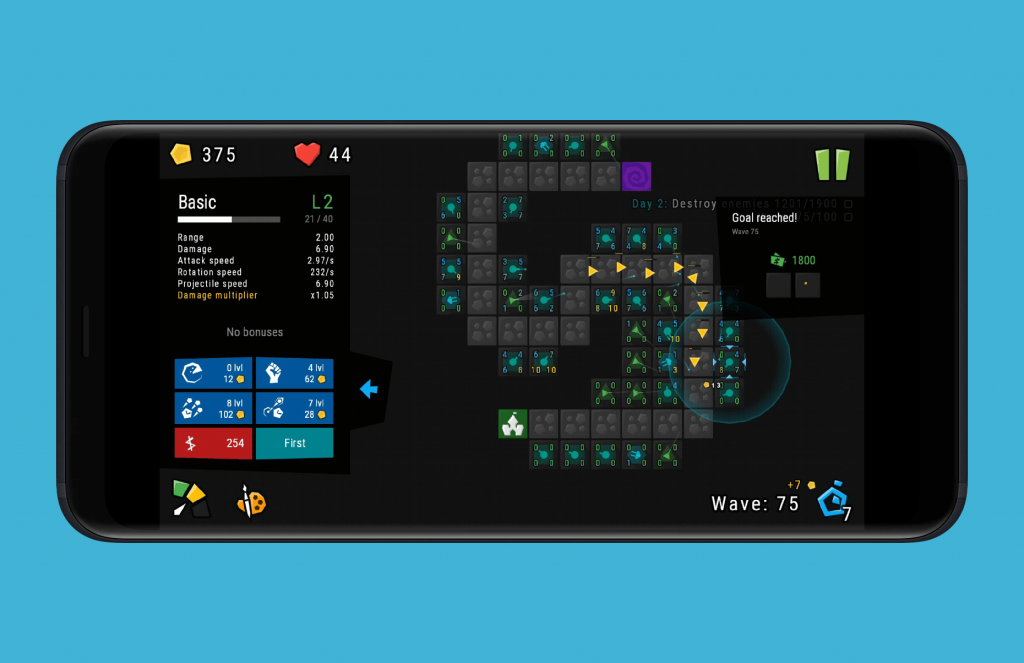
Just like your enemies, your weapons also have different attributes. You start with three: one that throws bombs quickly but doesn’t deal that much damage, a sniper that deals lots of damage but is slow, and one that targets only air units. However, you can get more afterwards. After building them, you can upgrade them in four different attributes: range, damage, attack speed, and rotation speed. The first three are self explanatory, but rotation speed is more uncommon. It deals with the speed at which your towers rotate after killing an enemy and targeting the next one.
Why Infinite?
As previously said, the biggest differentiating factor of Infinitode is the infinite part. The game keeps going until the HP of your base reaches zero. If that takes 200 waves to happen, then so be it. Knowing that this could get boring quickly, the developer added some tricks to make it better. For example, every now and then there are “boss waves,” which are waves that have a bunch of different types of enemies, making them particularly challenging. Also, there are daily goals, such as “kill 1900 enemies” or “clear 50 waves” that yield money.
When dying, even if you haven’t completed one of these goals, you also get money for your efforts. A game can easily last 20 minutes, so you better have some time to really invest in it. The progress can be saved mid-game though, so all is not lost in case you suddenly have a change of plans.
Money, progression tree and in-app purchases
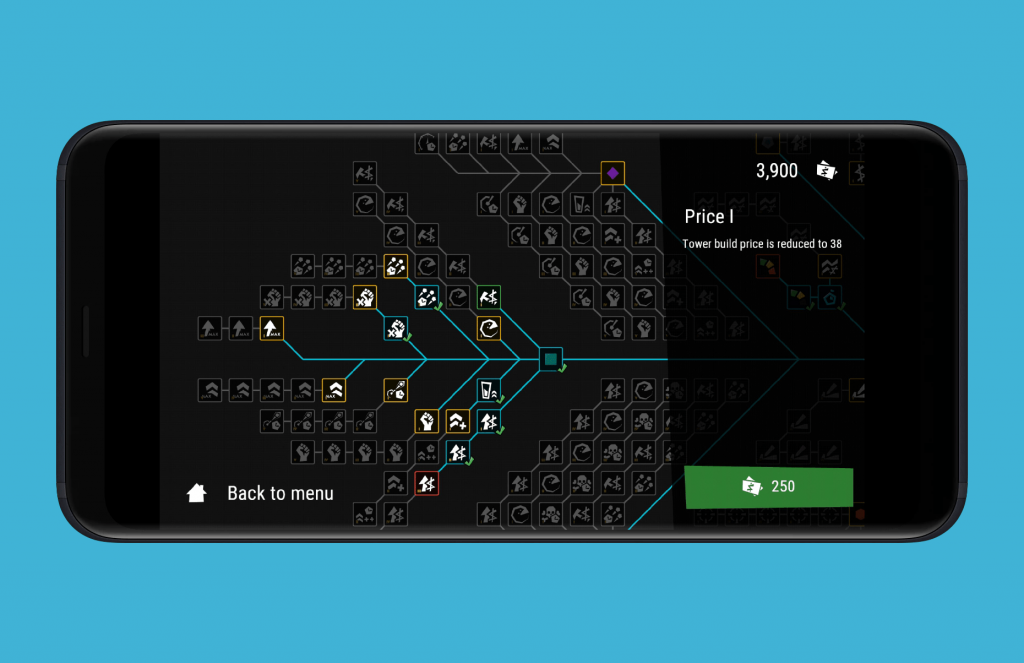
So, I mentioned that you could get more towers afterwards, and that clearing daily goals yield money. See the relation between them? If you go to the Upgrades option in the Main Menu, you get a HUGE progression tree, from which you can get new towers and make your game easier with the ones you already have. It is one of the biggest progression trees I have seen on a game. There are so many things to buy and upgrade that dramatically increase the replay value of this game.
In case you are lazy, you can also buy in-game money with off-game money (that is, your real money). There are only four different kinds of in app-purchases: three different amounts of money, and a double gain token that doubles the proceedings for each game you play. They are also price very competitively, so, since the game is free, you could easily buy one of these and actually get a decent amount of in-game currency while supporting the developers.
Maps and map creator
 The fact that you can buy in-game currency does not mean that this game instantly becomes easier. You still have only one map available to you at first, and, apart from money, you need experience to open the 17 remaining levels. If that is not enough of a number to you, there is a map creator in which you can create your own maps in any way you like. It is pretty robust and adds a lot to the game, in case you are really into that kind of thing.
Graphics and sound
While other tower defense games focus on really flashy graphics, with over-the-top explosions, detailed towers, and complicated enemies, Infinitode has really simple graphics. That doesn’t mean that they are bad, though. Graphics are more than adequate for the game, and the developers do a really good job in making each asset very descriptive.
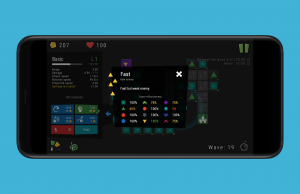
For example, the air enemy looks like helicopter blades seen from the top, the high-defense enemy is a red square, the icy enemy is a light blue ball, and the fast enemy is a yellow triangle. It’s not written anywhere that these colors and shapes are fast or heavy, but to me, they all make absolute sense.
Towers also follow the same philosophy. An air missile is light blue, a freezing tower is blue, a cannon tower is red, and a sniper has a triangle with a line at the top (kind of like a sniper looks when seen from above). In game, you can flip between showing the experience that your tower has, or the upgrades that you have done to it.
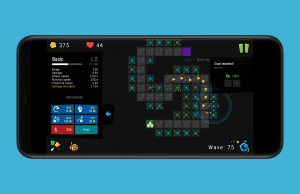
If there is one complain I have, is that sometimes the targets are very small to hit. I don’t have big hands, but I occasionally struggled with touching certain elements. You can zoom in and out of the battlefields, but menus and upgrade buttons are not zoomable, leaving a small target area to hit.
There is no music in-game, only sound effects. They get the job done without any bells and whistles. Almost everything you make has a sound effect, so at least you always have feedback on your actions, since visual feedback is not that prominent.
I did have some situations in which some sound effects didn’t play, especially when upgrading towers. However, most of the time they worked well enough.
Conclusion
Infinitode manages to add a lot of different elements into one game that works amazingly well. Solid tower defense gameplay, endless elements, huge progression tree, zero pesky ads or alerts to make you buy in-game currency, and sleek presentation make Infinitode a gem rarely seen on the Play Store. There’s enough content here to last your for hours, with all the different towers and maps you can unlock, and the upgrades you can buy afterwards. There are very few cons and a whole lot of pros in Infinitode, so make sure you give it a shot.
Download and install Infinitode from the Google Play Store.
Razer Phone 2 hands-on: A sharp upgrade
When it released in November 2017, the Razer Phone was unique. Aimed entirely at gamers, it offered an incredible 120Hz display capable of displaying silky smooth gameplay with lightning fast response times. Its “UltraMotion” effect has to be seen to be appreciated, but it really marked the Razer Phone out as something special. Of course, it also had all the latest specs packed inside for optimal performance and massive dual speakers.
UltraMotion is an effect that has to be seen to be appreciated
The Razer Phone received a lot of love, but it wasn’t quite perfect. The camera was capable of only average photography, which was too much of a compromise for even some die-hard gamers. The Android ecosystem also just wasn’t that set-up for gaming. Few games supported the maximum refresh rates, and there was just no need to go all-out in the specs department to play Candy Crush.

Fast forward to the end of 2018 and the Razer 2 looks set to rectify those mistakes and become the phone of every gamer’s dreams. It might look very similar from the front, but there are a lot of upgrades to be found if you look a little closer.
Beautiful screen and top specs
The amazing screen is back, with the same refresh rate and same 1,440 x 2,560 resolution. This time it’s also received a 50 percent increase in brightness, up to 645 nits. The SoC gets the expected bump up to the Snapdragon 845 with vapor chamber cooling for reduced thermal throttling and 8GB of RAM. The result is that the Razer Phone 2 can deliver 20-30 percent more horsepower than its predecessor – although I was a little surprised to learn it would only come with 64GB of storage. I also noticed the device getting a little warm during a session of PUBG.

The massive front-facing speakers are present and correct too, powered by Dolby Atmos — now reportedly crisper, louder, water sealed, and backed up with an improved vibration engine. There’s no headphone jack, but a USB-Type C dongle with a 24-bit DAC comes in the box for those offended by this omission, just like last time.

Also back is the 4,000mAh battery to allow for long gaming sessions. Software features like the Game Booster, which allows for tweaking performance on a per-game basis, and Razer Cortex, which makes it easier to find actually good games from the PlayStore, are also welcome. The phone runs on an almost stock version of Android 8.1.
Flagship features

Razer says it doesn’t just want to make a gaming phone, it wants to make a premium flagship device for gamers. To that end, we see many of the top end luxuries found on other flagships — we now get IP 67 water resistance, and thanks to a sexy glass back panel, wireless charging. That glass back gives the Razer Phone 2 a more attractive aesthetic from the rear (the front remains largely unchanged).
The Razer Chroma is another new aesthetic touch. It lets you change the color of the Razer logo while your phone is in use. You can pick any color you like (to match your outfit I guess?), as well as different modes such as cycling or breathing. The company’s wireless charging stand will also light up and automatically change color to match your device settings while in use.

Those who don’t care about battery draining can leave the effect on 24/7 if they so wish, but you can also turn it off entirely. I know it’s a gimmick, but I personally love it. I’d give my face RGB lighting if I could.
Camera performance – second time’s a charm?
If Razer truly wants to create a flagship though, its camera needs work. Thankfully, it seems the OEM has paid close attention in this area. The dual lens rear shooter combines a 12MP f1.75 wide-angle lens with a 12MP f/2.6 telephoto, which should allow for some great possibilities, as well as the now-compulsory depth effects. Around the front is an 8MP shooter, same as last time.

Unfortunately, the camera app wasn’t quite ready when I got to test the device. From what I saw, it seemed pretty capable. I managed to produce some pretty decent shots. It even has slow-mo and a host of other modes.

Closing thoughts
We’ll need to spend more time with the device to give a proper verdict on the camera — and of course the same goes for the performance over time. But on the face of it, this is a compelling proposition. For just $799 (779 pounds here in the UK and 849 euros elsewhere), you get flagship specs and performance in a water resistant, premium-feeling glass chassis with a one-of-a-kind screen, amazing speakers, and a host of gamer-centric features.
If Razer gets the camera right, this device might convince those who held off last time.

This may be the right time for a new Razer phone. Android gaming is increasingly popular, thanks in part to the success of PUBG and Fortnite and the example set by the Nintendo Switch. I’m personally enjoying streaming games to my device via Steam Link a lot these days.
With that popularity comes competition. Only time will tell whether the Razer Phone 2 has the chops to take on offerings from Honor and ROG.

What do you think of the Razer Phone 2? Let us know in the comments down below and be sure to subscribe so you don’t miss the full review coming soon.
More Razer 2 coverage
- Razer Phone 2 announced: More style, more power
- Razer Phone 2 specs: Familiar, but better in all the ways that matter
- Razer Phone 2 vs Razer Phone: Specs comparison
- The Razer Raiju Mobile lets you play Android games with actual buttons
Gaming laptops with Nvidia’s flagship RTX cards could arrive by CES 2019
Riley Young/Digital Trends
If you’re waiting for Nvidia to make its flagship GeForce RTX 2080 series graphics card available on laptops, you may not have to wait much longer. While it was previously rumored that Nvidia may launch the card as early as November, a new report suggests that mobile RTX graphics won’t launch until early 2019. Nvidia may announce the mobile graphics cards around the same time as the Consumer Electronics Show (CES). Hopefully, this means that we’ll see gaming laptop manufacturers showcase their designs at CES in January following Nvidia’s announcement.
“Our source has just informed us that the entire RTX mobility lineup will be released around CES along with the 2080 Max-Q following a bit later,” Wccftech reported.
In addition to the RTX 2080 Mobility and RTX 2080 Max-Q Mobility cards, a leaked document obtained by the publication suggests that Nvidia could also offer the RTX 2070, RTX 2070 Max-Q Mobility, RTX 2060 Ti Mobility, RTX 2060 Mobility, RTX 2050 Ti Mobility, and RTX 2050 Mobility configurations as part of its laptop graphics lineup. Currently, it appears that only the RTX 2080 and RTX 2070 Mobility cards will get also come with a Max-Q.
It’s also reported that Nvidia is working with its laptop partners to “standardize laptop thickness for its mobility lineups.” Hopefully, this will result in gaming laptops that aren’t unwieldy in the future. According to Wccftech, Nvidia has provided recommendations for minimum laptop thickness — referred to as Z height — for each RTX Mobility configuration. Documentation published by the outlet reveals that a few Max-Q designs for upcoming RTX-equipped laptops to come in at under 20mm thick.
Previously, it was reported that Nvidia was working with laptop manufacturers to maintain the same Z height with the RTX cards as on devices with the older GTX cards. If Nvidia can achieve this, then we shouldn’t see any increase in dimensions once RTX Mobility gaming systems are announced. An industry insider revealed to Wccftech that RTX laptops will maintain a similar design language as last year’s GTX systems. “We will put the 2080-Max Q into the current thin 15 and the 17 with Nvidia’s help,” the source said. “I don’t think the weight will increase significantly on this new card. Our ID/design will be pretty much the same as what you saw.”
Hopefully, by that time, we’ll see more ray tracing titles launch to take advantage of the capabilities of the RTX chips. But with CES being just a few months away, we’ll find out soon enough what Nvidia’s plans for mobile RTX gaming will be.
Editors’ Recommendations
- Nvidia GeForce RTX 2080 Mobile sighting hints at more powerful gaming laptops
- Nvidia’s GeForce RTX 2060 might launch next year without ray tracing
- Nvidia GeForce RTX 2070 joins the ray tracing future on October 17 for $499
- Nvidia vs. AMD
- Nvidia teases new GeForce RTX 2080 launch at Gamescom next week
Google’s Pixel Slate could land in stores in time for Black Friday
Julian Chokkattu/Digital Trends
Google took the wraps off of its vision for the future of Chrome OS earlier this week at an event in New York City, unveiling the Pixel Slate. Google revealed that Pixel Slate would start at $599 and will ship later this year, but it did not disclose specific details about the availability of the newest member in the Pixel family. Now, thanks to a Best Buy listing, we learn that the Pixel Slate could ship by November 22.
Chrome Unboxxed published a screenshot captured by Kevin Tofel that the tablet will launch on November 22. Best Buy has since removed the “Release Date” on its page — the listing only suggests that the Pixel Slate will be “Coming Soon.”
The date suggests that Google may be eyeing the busy holiday shopping season with the availability of the Pixel Slate. In the United States, the Thanksgiving holiday falls on November 22, with most retailers targeting holiday shoppers with Black Friday sales the day following. This means that the Pixel Slate will arrive just in time for holiday shoppers eager to find a present, but given that it is still a new device, it may not arrive with any discounts.
While not a direct successor to the current Google Pixelbook, the Pixel Slate also can be converted between tablet and laptop modes — Google opted for a detachable keyboard folio rather than a 360-degree hinge this year — and supports touch and pen input. While the tablet starts at $599, depending on what you choose for the processor and storage, the price could quickly climb up to $1,599 for the top configuration. Best Buy offers the 64GB with an Intel Core m3 processor for $799, a 128GB configuration with an Intel Core i5 for $999, and a 256GB model with an Intel Core i7 processor alongside 8GB RAM for $1,599. It’s unclear if the $1,599 model’s memory configuration is an error on Best Buy’s part — Google’s online store lists the Pixel Slate with 16GB of RAM for the same price.
Though the Pixel Slate could be used as a stand-alone tablet, users looking to pick up the tablet for productivity work may want to add another $199 to their budget for the keyboard folio. The Pixelbook Pen, which is available in a color-matched midnight blue hue this year, is available for $99. Be sure to read our hands-on impressions of the Pixel Slate before you buy.
Editors’ Recommendations
- Everything you need to know about the Pixel Slate
- Google Pixel Slate vs. Google Pixelbook
- Leaked Intel processor could help Google Pixel Slate dual-boot into Windows
- Pixel 3, Home Hub, and Pixel Slate — our first look at all Google’s new devices
- Google takes on iPad Pro and Surface Pro with its new Pixel Slate
Biologists create a mutant fly with 140-million-year-old genes
In what totally sounds like a mash-up of two of Jeff Goldblum’s best movies, The Fly and Jurassic Park, scientists at New York University and the University of Chicago have created mutant fruit flies carrying reconstructed genes from 140 million years ago. The goal? To shed some light on the process of evolution and how it has changed the development of fruit flies over millions of years.
The work, described in the journal eLife, was achieved using cutting-edge gene insertion techniques to replace a particular modern day protein with ancestral proteins in a living fly. The purpose was to test whether it could create functions which had long since been absent. The scientists discovered that two mutations millions of years ago altered the function of a developmental gene, which regulates development of the fruit fly’s head. This chance mutation has since become an indispensable aspect of modern fruit flies. Fly embryos without the modern day Bicoid protein die very early since they form tail structures at both ends of their body, rather than forming a head.
“Ancestral changes in protein sequences are thought to be responsible for the evolution of diverse animal forms, but finding which historical changes were most critical has eluded scientists until very recently,” Stephen Small, an NYU biologist, told Digital Trends. “The ancestral protein’s function was to bind to a specific set of DNA sequences, and turn on a set of target genes based on that sequence. By comparing the ancestral protein sequence with its modern day descendants, the research team identified two specific amino acid changes that allowed the modern day protein to bind to a completely different set of DNA sequences, compared to the ancestral protein. [The work] further showed that these changes allowed the [modern] protein to activate a novel set of target genes in the developing embryo and acquire a central role in the embryogenesis of a subset of insect species.”
The two amino acid changes identified by the researchers endow the ancestral protein with some of Bicoid’s modern day activities. However, there are still questions to be answered. Specifically, the researchers want to know which changes occurred to evolve a fully functional Bicoid protein. “We are currently extending our studies to identify all the sequences changes that led to the evolution of the modern day protein,” Small said.
No, we’re not going to see 140-million-year-old flies buzzing around any time soon. But between this work and Harvard University’s work to bring back the woolly mammoth through cloning, this is sure an exciting time in our history. Better yet, make that pre-history!
Editors’ Recommendations
- CRISPR halts fatal genetic disease in dogs, could soon do the same in humans
- CRISPR 101: A crash course on the gene editing tool that’s changing the world
- Here’s who won the 2018 Nobel Prizes in Science and why
- From picking to pollinating, agribots are pushing farming into the future
- Gene editing can reverse balding and wrinkling in mice — and maybe humans, too
The best Pixel 3 XL cases to keep your notch in one piece
Julian Chokkattu/Digital Trends
The release of Google’s new Pixels always heralds a new age for great Android phones, and this year’s launch of the Pixel 3 range has been no different. The Pixel 3 XL — the larger of the two announced — is a great example of the biggest trends in smartphones right now, with a notched screen, incredibly powerful hardware, and a luxurious glass back.
But while the Pixel 3 XL’s traditional two-tone style and bezel-less design is beautiful, it’s still made from glass — and glass is easy to shatter, which could ruin your phone’s good looks. If you’re worried about the longevity of your phone, protection is a great idea. Here are the best Pixel 3 XL cases to keep your phone safe from drops, bumps, and scratches.
VRS Design Crystal Chrome Series ($24)
You don’t have to hide your Pixel 3 XL away just because you want to protect it. The Pixel 3 XL’s design can be divisive, but those who love it will want to show it off — and that’s where a clear case comes in extra handy. VRS’s Crystal Chrome case is made from a combination of a TPU bumper and a hard polycarbonate (PC) backplate that allows your phone to be seen, while still providing flexible but tough protection. The case has raised edges, so your phone doesn’t rest directly on surfaces, and air cushions on each corner ensure great drop protection. It’s certainly on the more expensive side for a clear case, but it offers great protection for your $900 phone.
Buy it now from:
VRS Designs
Tech21 Evo Check ($45)
What if you like clear cases, but want to add some extra style to your phone, as well as protecting it? That’s some weirdly specific requirements you’ve got there, but thankfully the Evo Check case from Tech21 covers most of those bases. It’s made from a flexible material called FlexShock, which Tech21 claims is able to absorb shock from drops of up to 12 feet. We don’t recommend you test that, but it provides some good peace of mind regardless. It’s attractive too, adorned with a series of checks that provide a cool style to your Pixel 3 XL’s two-tone design. It’s expensive, but if you’re serious about your protection it’s a good buy.
Buy it now from:
Tech21
Spigen Neo Hybrid ($35)
What sort of case round-up would this be without Spigen? Spigen is extremely well known for making quality protective cases at good prices, and the Neo Hybrid case is one of its longest lasting lines. It’s a dual layer case, using flexible and absorbent TPU and hard PC in a complementary fashion that makes the most of each material’s strengths, and reduces weaknesses. The soft TPU material also helps to increase grip on the case, and it has raised edges to protect your display. The case certainly has a unique look too, with a herringbone pattern and two-tone style that’s reminiscent of the Pixel 3 XL’s own. A great case for style and protection.
Buy it now from:
Spigen Amazon
Moment Photo Case ($30)
Love to take photos on your Pixel 3 XL? You should — Google’s put together an amazing camera yet again, despite using just one camera lens. Why not add protection to your phone and some extras for your beloved photography? Moment’s case is made from absorbent TPU that doesn’t add much bulk, comes with an attachment point for a lanyard, and adds a ton of extra grip to your phone — but the real draw here is the optional photo lenses you can attach. These include wide-angle, telephoto, macro, and more, and lenses are easily attached directly onto the case. The lenses are expensive, but worth it if you love the idea.
Buy it now from:
Moment
Kerf Wooden Case ($79)
We’re all used to cases made from leather and plastic, but what about wood? Wood isn’t the best protective material in the world for absorbing drop impact, and can sometimes break — but it’s attractive and protects extremely well against more direct threats. Kerf’s wooden cases are one of the few premium wood cases around, and they’re extremely beautiful. You have the choice of multiple types of wood for your case, and there’s an inner lining of suede to hold your phone safely. It doesn’t block wireless charging, and surprisingly Kerf claims it’s also compatible with the Pixel’s Active Edge feature. It’s certainly expensive, but great if you love the wood aesthetic.
Buy it now from:
Kerfcase
Obliq K3 Wallet Case ($35)
Wallet cases have a style all their own, and this wallet case from Obliq is no different. It’s crafted from synthetic leather and uses an inner core of hard PC to hold your phone in place. The leather cover folds behind the phone while in use, and covers your phone’s display to keep it safe while it’s in your bag or pocket. There are card slots galore on this case too, with three internal card pockets being joined by a single exterior card pocket that’s perfect for your ID or tickets you need at a moment’s notice. Thanks to the combination of full coverage of leather and the hard PC inner, this case is protective and not too expensive for a wallet case.
Buy it now from:
Obliq Amazon
Speck Presidio Grip ($45)
Another name with a great protective pedigree, Speck has brought one of its most popular lines back for the Pixel 3 XL. The Presidio Grip case is one of Speck’s most recognizable cases, and it’s a great choice if you’re looking to get some solid protection for your phone with minimal fuss. It uses two layers of protection, which Speck boasts provides drop protection of up to 10 feet. It has raised bezels to avoid your phone being laid directly down on surfaces, and a series of distinctive lines adorning the back of the case provide additional grip to your device. It’s on the expensive side for a case, but it’s worth it to get Speck’s level of quality.
Buy it now from:
Speck
Nomad Rugged Leather Case ($45)
Leather is a wonderful material for style and protection. Nomad’s rugged leather case is made from U.S. Horween leather molded onto a combination of TPU and hard PC, which means it should be able to cope with a wide variety of hazards and still look great. The leather will continue to mature as the case ages, and the unique grain means you’ll always end up with an accessory like no-one else’s. Nomad claims the multiple layers are proof against drops of up to 6 feet, and despite all that protection, it still comes in a fairly thin package, not adding too much bulk to your Pixel 3 XL. $45 isn’t too much for genuine leather either, making this a great choice if you want the style points that only leather can bring.
Buy it now from:
Nomad
UAG Monarch Series ($60)
If protection is the most important thing to you, then there aren’t many cases more protective than UAG’s Monarch series. It has five layers of construction, including a layer of top grain leather and a metal alloy, making it supremely effective at protecting against a huge variety of threats. UAG claims that this case has not only passed military standards for drop and shock protection, but exceeded the standards by twice the required amount. It’s not a subtle case though — especially if you choose the red color — but if you don’t mind a case that looks rugged, then the UAG Monarch series case will provide excellent all-round protection.
Buy it now from:
UAG
Otterbox Symmetry Series ($50)
Protection doesn’t have to look rugged, and that’s an ethos Otterbox has always followed with its Symmetry cases. The Otterbox Symmetry case is slim for a protective case, but still meets the standards of Otterbox’s Certified Drop+ Protection tests. It’s easy to apply and remove, thanks to a one-piece construction. It works with the Pixel 3 XL’s Active Edge feature, and it also comes with a raised bezel to protect your phone’s display. It’s certainly on the expensive side, but if you’re looking for a protective case that has something of a more subtle style to it, then you can’t beat Otterbox’s slim and stylish protection.
Buy it now from:
Otterbox
Editors’ Recommendations
- The best Pixel XL cases and covers
- The best Google Pixel 2 XL cases and covers
- Best Pixel 3 cases and covers
- The best iPhone 8 cases and covers
- The best iPhone XS Max cases and covers
Patent filing shows Microsoft’s evolving efforts on foldable Andromeda device
Early prototypes of Microsoft’s secretive but highly anticipated Project Andromeda computer project revealed a device with two screens that can fold on a center hinge, similar to a book. However, rather than utilizing two separate displays, Microsoft’s latest take at a new computing form factor utilizes a single flexible display, according to a newly published patent application.
Microsoft created a new hinge design to allow the flexible panel to fold and unfold without being damaged. The hinge is also designed to prevent crimping and to support the display when the device is opened like a book. Otherwise, the display area near the hinge may feel mushy when users are utilizing the touchscreen. In this case, the role of the hinge is to provide support in order to deliver a similar tactile feel throughout the display, no matter where the user is touching the touchscreen.
“The hinge assembly can provide several features that facilitate the use of a single flexible display,” Microsoft said in the patent application that it filed with the United States Patent and Trademark Office (USPTO) and published on October 11. “First, the hinge assembly can change lengths during rotation of the first and second portion to reduce stresses imparted on the flexible display. Second, the hinge assembly can maintain a minimum bend radius for the flexible display during rotation to protect the flexible display from damage (e.g., crimping). Third, the hinge assembly can support the flexible display when the first and second portions are rotated to a 180-degree “flat” orientation so that user interaction with the flexible display over the hinge assembly is the same or similar to interactions with other areas of the flexible display (e.g., similar tactile feel).”
Unlike the original Andromeda concepts, the single flexible screen design means that the screen will not be able to rotate 360 degrees. This means that you can’t close the hinge in a way so that the screens would face outwards.
Various materials could be utilized in the hinge assemblies, including metals, plastics, foams, polymers, and composites. And Microsoft claims that this hinge could be used in a number of devices, including “notebook computers, smart phones, wearable smart devices, tablets, and/or other types of existing, developing, and/or yet to be developed devices.”
Microsoft is no stranger to innovative hinge designs. When the Surface RT and Surface Pro were introduced, those devices became the first on the market to support a kickstand with a hinge located in the middle of the device. The Surface Book introduced the fulcrum hinge that helped to balance the screen, and the Surface Studio came with a zero-gravity hinge that makes it easy to adjust the display so that users can enjoy a comfortable viewing position. Given this history, this new innovative hinge assembly would definitely find a natural home in the Surface family. Even though Microsoft has put the brakes on Project Andromeda for the time being, our hope is that Microsoft will be able to deliver on its Andromeda concept and bring a foldable Surface Phone with this new hinge.
Editors’ Recommendations
- Microsoft’s latest patent application hints to ‘page flipping’ on Andromeda
- Best Samsung Galaxy S9 cases
- Essential PH-1 Phone: Everything you need to know
- Samsung’s 34-foot Onyx LED TV looks to change movie theaters forever
- The Razer Phone 2: Everything you need to know
 AIVAnet