


Biologists have found a protein that could make space farming possible
An off-Earth colony seems pretty promising with the rate climate change is going. But that’s easier said than done. Building a viable colony anywhere outside of Earth’s atmosphere will pose engineering and logistical challenges unlike anything we have experienced. Not only will we need to transport those space pilgrims, but we’ll also need to shelter and feed them. That last point may pose the most difficult challenge. As Mark Watney made clear in The Martian, farming in space isn’t as easy as it is on Earth.
Now, researchers at the University of Zurich have shown how space farming may be possible. By engineering plants to excrete excess amounts of a certain hormone, they demonstrated that crops can thrive despite challenging space conditions, such as low-nutrient soil and microgravity.
“Food … production is and probably will be a big challenge in the next decades on this planet, because of increasing world population, decreasing arable land, and limited fertilizer resources,” Lorenzo Borghi, a biologist at the University of Zurich who worked on the research, told Digital Trends. “If we start colonizing other planets or employing humans in long space missions, local food … production in laboratory conditions or alien soils will be as challenging, as alien soils are very likely far poorer in nutrients compared to our agricultural lands.”
There are ways around that, Borghi pointed out, such as shipping soil and fertilizer to space. However, transport comes at a significant economic and ecological cost.
Instead, Borghi and his colleagues propose that a plant hormone may be able to boost crop production by encouraging a symbiotic relationship between plant roots and fungi in the soil. Called mycorrhiza, this relationship provides plants with more resources, such as water, nitrogen, and phosphate. The plant hormone, strigolactone, triggers this symbiotic relationship.
“We engineered plants that can exude high amounts of strigolactone to the soil and thus obtain high levels of mycorrhization,” Borghi said. “We tested these plants in microgravity and found that they can obtain high levels of mycorrhization and high biomass production even in microgravity.” That is, higher levels of the plant hormone may counteract the negative effects of microgravity and poor soil on crop propagation. “Therefore we suggest that it will be important to choose crop varieties with high strigolactone exudation for future space farming on alien soils.”
To simulate space farming conditions, Borghi and his team grew petunias — which are in the same family as tomatoes, potatoes, and eggplants — in low gravity. But before we pack astronaut backpacks full of engineered plants, the researchers will want to test their plants in real space conditions, either on a space station of an alien world.
A paper detailing the research was published this month in the journal Nature Microgravity.
Editors’ Recommendations
- Leafy greens are grown by machines at new, automated Silicon Valley farm
- Attention, space gardeners: Simulated Martian soil now on sale for $20 a kilo
- ‘Crop-dusting’ drones drop biodegradable sensors instead of pesticides
- The BrambleBee robot promises to help honeybees pollinate flowers
- 15 epic sci-fi novels you should read before they become blockbuster films
Kyocera’s KY-O1L is small enough to fit alongside your business card
While most of us are perfectly happy with our smartphones, some prefer something a little more compact and pocketable. For those people, Japanese company Kyocera has come up with a device that it’s billing as the “thinnest smartphone in the world.” It’s called the KY-O1L, and it’s built specifically to fit inside a business card holder. For that, the phone has been given the nickname of the “card phone.”
The phone itself comes in at 5.3mm thick and weighs a measly 47g, making it also one of the lightest devices around. On top of that, it boasts LTE connectivity and a 2.8-inch monochrome epaper display. Powering it all is a 380mAh battery, which should be more than enough for a phone with an epaper display.
Of course, there is some debate about whether or not this is really the thinnest phone out there. As The Verge notes, the 2016 Moto Z came in at only 5.2mm — though that excludes the camera bump. Before that, there was the Oppo R5, which came in at a tiny 4.9mm thick. That said, none of those phones offer the same adorable basic-ness as the KY-O1L.
Whether it is truly the thinnest phone or just one of them, it’s still an interesting device. The user interface offers everything a basic phone needs, though there is no app marketplace and as such, this is perhaps only a good choice for those that need something to make calls and text people, with the occasional news reading online. There’s also no camera so don’t expect to get any shots with this device.
The Kyocera KY-O1L comes at 32,000 yen, which equates to around $300. It’s also only available in Japan so don’t expect to get your hands on the phone anytime soon if you don’t live there. Even in Japan, it’s only available on the country’s NTT Docomo carrier.
Smaller phones may be a growing trend. Just recently Palm took the wraps off of a new smartphone that’s specifically aimed at reducing people’s addiction to their phones. It syncs to your primary phone, so you’ll get all your notifications and calls.
Editors’ Recommendations
- The best rugged smartphones of 2018
- Samsung Galaxy X: Everything we know so far
- The best Galaxy S8 Plus cases and covers
- Essential PH-1 Phone: Everything you need to know
- Pixel 3 and Pixel 3 XL: 5 features we love, 5 features we don’t
Vertu Aster P seemingly announced out of nowhere for $5,000
You can step all the way up to $14,146 for a gold-plated model.
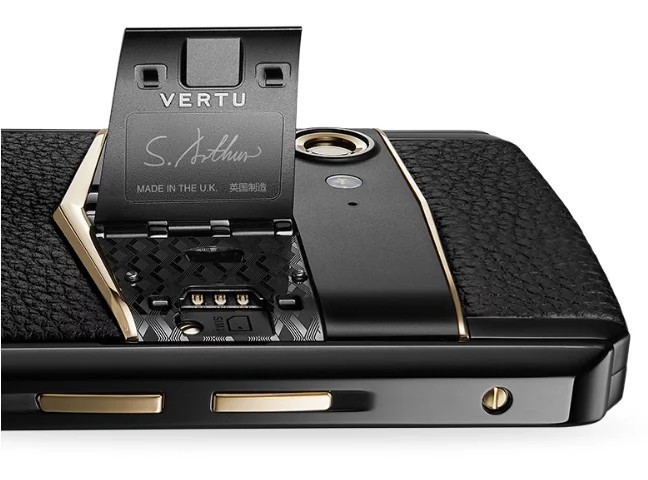
There’s a lot of discussion right now about more and more smartphones creeping towards the $1000 price point, but one company that’s been soaring well beyond that is Vertu. Vertu’s released a number of multi-thousand dollar Android phones in the past, and now the company’s returning with the $5,000 Aster P.
While luxury phones from Vertu aren’t anything new, this is the first new phone from the company since it reportedly closed up shop in July 2017 and cut around 200 employees.
So, what kind of phone are we getting with the Vertu Aster P? More or less what we’ve come to expect from past Vertu phones. The phone is handmade in England and features a titanium frame and display that’s covered by a measly 133-carat sapphire crystal glass panel. You can outfit the back with a variety of materials, including the likes of crocodile and lizard leather.
Also similar to other Vertu phones is the red ruby button that contacts your own personal concierge. Pop open the winged-panel on the back and you’ll find the SIM card slot and a signature of the person that actually crafted your phone.
You’d expect such a luxury phone to come with top-notch specs, but that’s not the case. The AMOLED display measures in at just 4.9-inches, the Snapdragon 660 and 6GB of RAM power everything, and there’s 128GB of onboard storage. You’ll also find a 12MP rear camera and 20MP selfie camera.
The Vertu Aster P is only being sold in China and has a cool starting price of just $5,167. If you want to splurge for the model that’s outfitted with gold, you’ll see a modest increase to $14,146.
Vertu Constellation Review: The Billionaire’s Phone
Echo Dot owners can get three months of SiriusXM streaming radio for free
Alexa’s always ready to play your favorite stations.

SiriusXM is teaming up with Amazon to offer three months of streaming radio for free to Echo Dot owners. New customers who sign up for a SiriusXM All Access or SiriusXM Premier subscription will receive one of the smart speakers featuring Amazon Alexa for free, which is a $50 savings. Plus it’s the latest (third-gen) version of the device. Furthermore, SiriusXM is offering 60% off six-month All Access subscriptions right now.
If you’re already a SiriusXM Select listener, upgrading to one of the tiers above will also score you a free Echo Dot. Once it’s arrived at your home, not only will you be able to listen to your favorite SiriusXM channels, but you’ll also gain access to tons of Alexa Skills, check the weather, and use it to control connected smart home devices like Philips Hue lights.
The Echo Dot was just recently upgraded for its third generation, too. You can find out more about its latest enhancements by reading through our review of the device.
See at Amazon
See at SiriusXM
Not all endless games are shallow: Alto’s Odyssey proves it (Review)
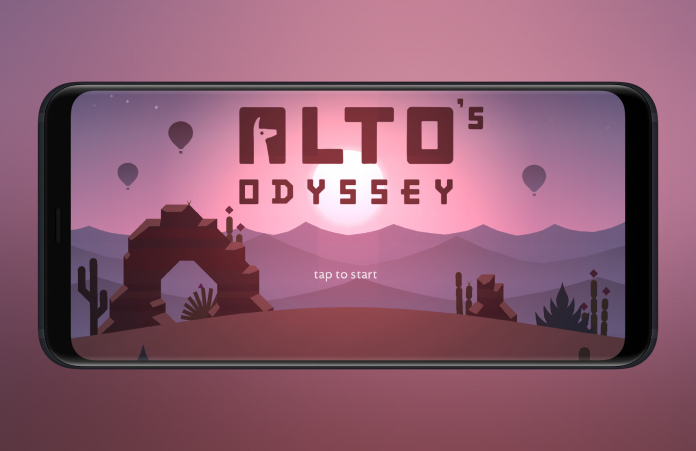
I am not really a fan of the endless genre. For me, they are all designed in a way that spending on microtransactions is the main goal of it, rather than having entertaining gameplay with great design. That’s why when I approached Alto’s Odyssey, I was a bit skeptical. Fortunately, all of my fears weren’t realized, and I ended up enjoying this game much more than I imagined, and I couldn’t put it down for a while.
Developer: Noodlecake Studios Inc
Price: Free
Overview
While the franchise has been around since 2015 (you might have heard about Alto’s Adventure), Alto’s Odyssey was just launched in July for Android devices. Its premise is pretty simple: you control Alto, a sandboarder with superb stamina, across a beautiful, atmospheric desert. There are several structures in the world that you can grind on, such as ropes, balloons (like the one Team Rocket had, just not Meowth-shaped), and more.
Acceleration is done for you automatically, but you can make your character jump by tapping on the screen. Holding it will let you flip your character in order to make backflips. If you do something wrong, like hitting a rock, falling off a cliff, or landing a flip in the wrong way, Alto will not be able to sandboard anymore, which means game over for you.
Tutorial
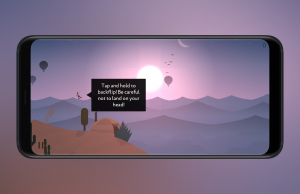 In order to familiarize yourself with the controls, Alto’s Odyssey offers a nice tutorial. Apart from the basic controls, it also explains stuff like jumps, backflips, and coins. In case you die on the tutorial, Alto will just revive and you will be able to try again. Later in the game, when you get a nicer sandboard, you will get a tutorial again for learning about tricks on walls. It is all pretty easy, although there is no mention of items you can collect throughout the game apart from coins, which are a common thing in games anyways.
Gameplay
In case you have missed it before, Alto’s Odyssey is an endless runner. This means that the game ends when you die. Not before, not after. Recognizing that this kind of game can get boring very fast, Noodlecake Studios has added a vast amount of different components to keep you entertained.
At the most basic level, you have items that you collect during your trips to the desert. These include super coins (a coin that gives you more coins), pots (which normally house even more coins), magnets (which attract nearby coins to you), and flowers (which let you smash rocks). Although nice to have, these don’t have any meaningful impact on the gameplay and, on their own, provide almost no value.
Also, there is the currency component. It is fairly common for games to have some sort of currency that you collect in order to buy enhancements, new items, or progress in some sort of way. Alto’s Odyssey lets you collect coins that are scattered through the world. You can exchange for a handful of items, but they are not essential. This means that they do not hinder your progress, as we have seen in an increasing amount of games in the Play Store.
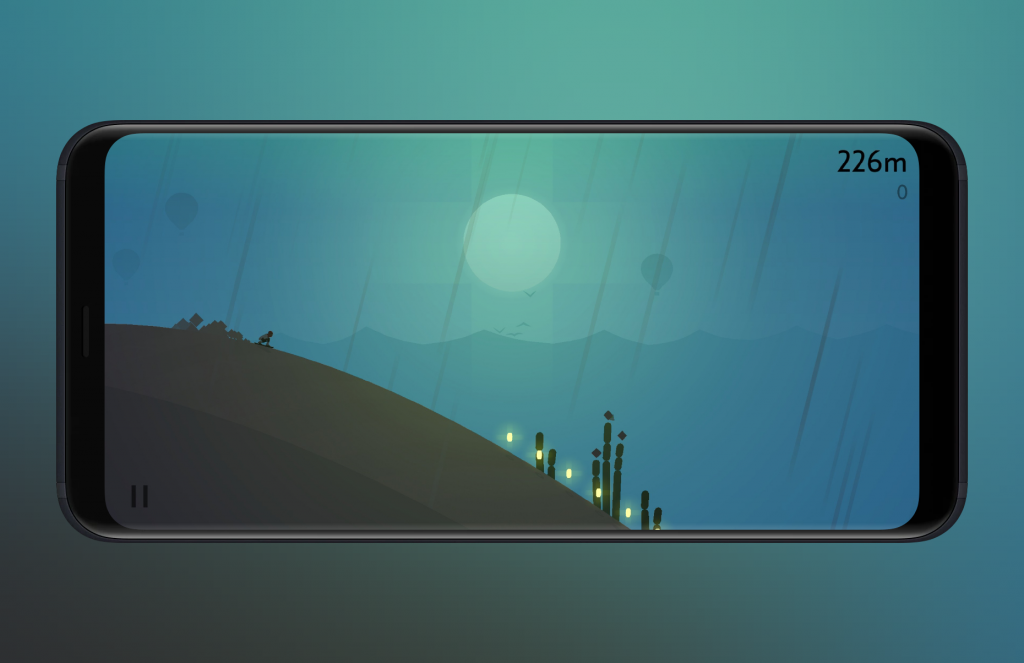
There are upgrades that let you prolong the effects of magnets and flowers, but you can also buy a radio (which, once bought, gives you “something useful” when you encounter it while sandboarding), a compass (to travel to other biomes), and a wingsuit (to do additional tricks). If you feel like coins are hard to come by, then you can also buy a coin doubler with real cash. You can also pay to remove ads, or get coins outright.
Objectives
As you may have figured, this is not enough to hold a game these days. It may have worked on the days where Temple Run was popular, but we have thankfully grown as a mobile gamer generation. Alto’s Odyssey introduces objectives, which, in my opinion, work in a superb way to increase the enjoyment out of the game. You get three at first, and, when you complete them, you get to the next level and get three new objectives, and so on.
These objectives can vary both in the required action, and in their difficulty. For example, some are very easy, such as “collect a super coin.” Others require you do to a double backflip, which is not as easy as it sounds. Some require you to hover over globes, to jump over them, to travel a certain amount of meters, and everything in between. It is very entertaining to complete these objectives, since it brings some kind of purpose apart from the “travel as far as you can” that endless games normally have.

As a plus, getting to a certain number of levels will grant you a new character to choose from. These characters have different strengths or are able to do different things. For example, there is one that travels faster than others, while other can double jump. This is the kind of progression that is so commonly missing from other games, so it’s nice to see Alto’s Odyssey providing it.
There are a total of 180 objectives to complete, which gives you plenty of stuff to complete and increases its replay value significantly.
Biomes
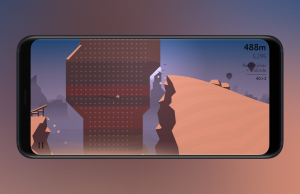 Even though they are referred to as “levels,” the game itself only changes when you reach a new biome. According to the Merriam-Webster dictionary, a biome is “a major ecological community type.” In this game, a biome is kind of that too, because the environment changes a bit from biome to biome. You start on a plain desert that has few stuff in it, but you can go to ruins, canyons, and temples.
While every world is randomly-generated, this variation in the environments that you find makes the game a lot less monotonous. Also, as previously said, when you reach a certain level, you can purchase a snowboard that lets you slide through walls and jump from one wall to the other, which brings a whole new dimension to the game. This makes it less dependent on sandboarding through the desert only, increasing its fun factor.
Graphics and Sound
There’s no way of talking about Alto’s Odyssey without its graphics. This is, by far, the greatest “feature” of the game. They are not striving for realism, but rather for simplicity and creating an atmosphere. There are time variations, so you will play in every condition from dawn until dusk. The background with the rising sun while the foreground has shadows all over is breathtaking, and really does a lot to set an atmosphere of relaxation and calmness.
All special effects are smooth and details, while not prominent, add a lot to the philosophy. Most of the elements in the game are simple without feeling unpolished. For example, in order to identify walls that can be jumped at, the game adds small dots that do not disturb the design style. Balloons have just enough details to figure that it is a balloon, but nothing more. Flags from ropes are just colored squares, but once you board through them, they fall gracefully to the ground. Nothing tries to be realistic, but everything does its best to immerse you into the experience.

Of course, this could not be done without audio that properly sets the tone. Sound effects and music all work together to complement the atmosphere set by the graphics. Normally, I find that audio in games is just there, either adding just a little bit to the gameplay or not making it worse. This game, however, is one of the few in which the graphics and the sound work together in a superb way towards a common goal.
Zen Mode
If all you want is to relax and sandboard without feeling anxious about objectives and unlocking characters, there is a Zen Mode. Here, Alto cannot die, although you can still screw up, but tapping on the screen will fix that. Also, the game recommends you to play with headphones because the music is incredibly relaxing. This mode highlights the work made by the team in order to portray this game as a relaxing, breathtaking adventure.
Conclusion
Alto’s Odyssey gets elements from the endless genre, but slaps a lot of different mechanics on top to make an enjoyable game. Objectives, new characters, and additional mechanics make this game stray away from the usual get-highest-score-possible business. Even if you are not fully convinced by this, the graphics at least are worth a look. Such an atmospheric game, in which the graphics and the sound blend together to create an astonishing experience, is something that is not commonly seen on the Play Store. Give it a go, you might end up as hooked as I was.
Download and install Alto’s Odyssey from the Google Play Store.
Scientists created a condom that self-lubricates during sex. You’re welcome
In the future, condoms will lubricate themselves — and you’ve got Bill and Melinda Gates to thank for it. Well, them and some smart chemists from Boston University. As part of a brief put out by the Bill & Melinda Gates Foundation for ideas to encourage condom use, Boston University chemist Mark Grinstaff and colleagues set about trying to come up with a way to make condoms more comfortable to wear.
While most commercially available condoms use a silicone oil coating as a lubricant, this doesn’t necessarily hang around for the whole, err, session. Instead, Grinstaff and associates have created a special coating which responds to bodily fluids by becoming more slippery than Mark Zuckerberg at a privacy summit.
“The idea is to develop an improved condom whereby the condom itself has a slippery surface, thus added lubricants like silicone oil are not needed,” Grinstaff told Digital Trends. “We have coated the condom with a polymer which holds onto water molecules, and thus a thin layer of water resides on the surface of the condom to provide lubricity.”
The researchers tested the friction that resulted when rubbing the polymer-coated latex over a surface resembling skin for around 15 minutes. After this time, the polymer-coated latex generated approximately half the friction compared with standard latex which had been lubricated with water. Non-treated latex with a commercially available lubricant performed better at first, but after the 15-minute test period was still not as effective as the newly developed polymer-coated latex. The new material additionally scored well when people were asked to rate its slipperiness. A massive 85 percent of test participants described it as more slippery than the non-treated latex with added lubricant.
“The next steps include manufacturing the condom under [good manufacturing practices] and conducting a marketing study with couples,” Grinstaff said. “One of the authors on the paper, Dr. Stacy Chin, has started a company, [Hydroglyde Coatings], to develop a self-lubricating condom. In fact, she has a new formulation that performs even better.”
The paper describing the work, “Friction-lowering capabilities and human subject preferences for a hydrophilic surface coating on latex substrates,” was recently published in the journal Royal Society Open Science.
Editors’ Recommendations
- NASA’s invention of the year award goes to … space lube?
- How to clean a cast-iron skillet and prevent rust
- How to season a cast-iron skillet
- Engineered sand could remove nasty toxins to produce drinkable water
- Regular Wi-Fi can accurately detect bombs, chemicals, and weapons in bags
Handy Google Pixel 3 tips and tricks
The Google Pixel 3 and Pixel 3 XL are phones with hidden depths. In this guide, we’ve got step-by-step instructions for you here to help you customize your new phones, dig into the best shortcuts, and uncover the most exciting features.
We’ll run through some features exclusive to the Pixel line, and some that will work on any Android 9.0 Pie phone. Before we dive in, Pixel 3 XL owners might want to look at how to hide the notch. Without further ado, here are our top Pixel 3 tips.
How to customize your home screen
Tap and hold on any open area of your home screen and you’ll get a pop-up menu that lets you select Widgets and Wallpapers – we recommend the Living Universe section in Wallpapers, where Google offers some fantastic animated wallpapers. Some of the other categories offer a Daily wallpaper option that changes your wallpaper every day.
You’ll also find Home settings in here, where you can decide if you want Notification dots, whether new app icons should be added to the Home screen, set At A Glance info like calendar events to stay at the top of the screen, and more.
How to choose quick settings toggles
Pull down the notification shade with two fingers and tap the wee pencil icon at the bottom right to edit the quick settings toggles that appear. You can simply tap and drag icons to add or remove them and select your preferred spot.
How to use Night Light
Because blue light can make it harder to fall asleep, most phone manufacturers now offer a blue light filter that can be scheduled to kick in near bedtime. On your Pixel 3, go into Settings > Display > Night Light and tap Schedule, where you can choose to have it turn on precisely when you want or automatically align with the sunset and sunrise in your area.
You can also set this as a part of your Wind Down bedtime routine in Settings > Digital Wellbeing.
How to free up storage space
With 64GB of storage in the base model and no room for a Micro SD card, you might find that you run out of space on your Pixel 3 or 3 XL. Apart from uninstalling apps you don’t need, you should also go to Settings > Storage and tap Free up space.
Another way to free up space is to back up photos and video to Google Photos, where you can back up everything in its original quality for free. Once everything is backed up, tap on the small hamburger menu at the top left in Google Photos and then tap Settings > Free up device storage.
How to have Google Assistant screen your calls
If a call comes in that you suspect may be spam — or you just don’t want to take it — tap Screen call and Google Assistant will answer for you, saying, “Hi, the person you’re calling is using a screening service from Google, and will get a copy of this conversation. Go ahead and say your name, and why you’re calling.”
You’ll see what they say transcribed in real time on your Pixel 3 screen and you can choose whether to answer, send a quick reply, or report as spam.
How to use split screen
To use split screen, simply swipe up from the bottom of the screen to open the multitasking view showing your recent apps and tap the app icon at the top of one of the apps you want open. Then select Split screen and choose the second app you want open. You can drag the bar in the middle to resize, then simply drag it all the way to the top or bottom when you’re done to go full screen with one of the apps.
How to configure Ambient Display
We definitely recommend turning Ambient Display on, so that you can see new notifications and other information on your Pixel 3’s screen even when it’s locked, but you should configure it. Since battery life isn’t the best, we wouldn’t recommend leaving it on all the time. Go to Settings > Display > Advanced > Ambient Display and make sure that the Always on mode is off, but New notifications is on. We also turned on Double-tap to check phone and Lift to check phone, but you might feel one of those options is enough.
How to quick launch the camera
Simon Hill/Digital Trends
You can simply double tap the power button to quickly launch the camera app at any time, even when your Pixel 3 is locked. It’s a handy shortcut when you want to capture a spontaneous moment and speed is important. You can toggle this feature on and off in Settings > System > Gestures > Jump to camera.
How to use volume keys for camera gestures
You can use your Pixel 3’s volume keys to snap photos or zoom in if you configure them. Open the camera app and swipe over to More > Settings, then tap Gestures and choose your preference.
You can also set what double tapping on the screen in the camera app should do here: Zoom in or switch cameras.
How to quickly switch to front-facing camera one-handed
Sometimes you’ll negotiate into the perfect group selfie position and realize that the main camera is on instead of the front-facing camera. Don’t worry, just twist your wrist twice and it should switch to the front-facing camera. This should be on by default, but you can find the option in Settings > System > Gestures > Flip camera.
If you haven’t already, you might want to check out key settings you need to change on your brand-new Google Pixel 3 or Pixel 3 XL.
Editors’ Recommendations
- Key settings you need to change on your brand-new Google Pixel 3 or 3 XL phone
- Pixel 3 XL vs. Pixel 2 XL vs. Pixel XL: Which XL is best for you?
- The best Google Pixel tips and tricks
- Pixel 3 XL vs. iPhone XS Max: Which plus-sized flagship reigns supreme?
- Google Pixel 3 and Pixel 3 XL: Everything you need to know
You’re so vein: Palm-based biometric system could help confirm your identity
Face ID. Fingerprint scanners. Voice recognition. When it comes to biometrics, there a whole lot of means for checking a person’s identity in a way that’s far more personalized than a four-digit security code or password. Now a nonprofit group called the IOTA Foundation is working with biometrics company Iampass to introduce a system that lets users verify their identity using the veins in their palm print. As it turns out, these vein patterns are just as unique as the other biometric markers that drive technologies like fingerprint or retina scanners.
“More so than any other biometric technology, palm vein authentication is highly accurate, hygienic, and designed specifically to curb impersonation, counterfeiting, and other illegal actions that may be used to access important information and secure areas,” Dominik Schiener, co-founder and co-chair of the IOTA Foundation, told Digital Trends. “[That’s especially true] since the palm veins are unable to be seen by the naked eye, and therefore much harder to replicate. Compared to fingerprints, the pattern of your palm veins are also nearly impossible to destroy, allowing people who had accidents to still access a secure system, as the unique palm vein has not changed.”
The innovative palm-reading system uses image recognition and optical technology to non-invasively scan users’ palms as a way of ensuring they are who they say they are.
Iampass is currently investigating several potential applications for its vein-based biometric system. This includes replacing access cards in secure buildings, providing access logs at data centers, and various use-cases within the automotive industry. In the case of the IOTA Foundation, it’s using palm prints as an access point to something it calls the IOTA Tangle, a next-generation distributed ledger technology that works on a principle that’s similar to blockchain.
No, palm readers are unlikely to replace Face ID on your next smartphone, but that’s not really the point. Tools like this offer additional levels of security, which can be added onto existing systems to make them even more secure. Successfully passed the facial recognition test? Next, you can check your vein print marries up to records.
This isn’t the first time we’ve covered unorthodox biometric security technologies. Other alternative body-based security systems include reading people’s “heart print,” their ear shape, and even the unique parameters of their posterior. Before long, their won’t be too many parts of the human body that can’t double up as a pass code of sorts!
Editors’ Recommendations
- Google’s Pixelbook 2 tablet could debut with fingerprint security
- For Columbus, a city is only smart if the public is behind it
- Replaced by robots: 10 jobs that could be hit hard by the A.I. revolution
- What to expect from Google’s October 9 event in New York City
- This robot arm could soon recharge your electric car, no driver effort required
A ThinkPad tablet with a foldable screen could be in Lenovo’s future
Lenovo could debut its new vision for a dual-screen tablet computer by as early as late next year. The company is no stranger to experimenting with innovative form factors, having recently announced that it replaced the traditional keyboard with a secondary screen on one of its new Yoga models. However, with this new dual-screen tablet, like the recently unveiled Microsoft patent for Project Andromeda, could also forgo using two displays in favor of a single, foldable panel.
“LG Display will work with Lenovo, the world’s largest PC maker, to develop a foldable tablet that folds the screen,” a translation of South Korean publication ET Times reads. “The tablet will be equipped with a 13-inch foldable panel. 13 inch is the screen size that can be seen on a tablet or notebook now.”
If accurate, Lenovo’s folding screen PC could measure just eight or nine inches when folded, making it more compact for travel. With a 13-inch 4:3 panel, the screen could measure about nine inches. A 16:9 aspect ratio would mean that the screen could be reduced to just eight inches when folded.
Citing an industry insider, the publication reported that LG Display had entered into a non-disclosure agreement with Lenovo to supply the 13-inch foldable panel by the second half of next year.
A foldable screen would allow phones, tablets, and laptops to dramatically increase the viewable screen area while still maintaining a compact form factor when the display is folded down for travel. Another benefit, according to LG Display, is that by being able to fold the screen, the display will be better protected, adding to a device’s durability.
The downside is that these devices will come with a premium, at least initially. Microsoft is said to have placed its Project Andromeda concept on hold in order to find the right market and use cases for such a device. If early speculation is accurate, Project Andromeda could eventually launch under Microsoft’s Surface umbrella as the Surface Phone.
In addition to Lenovo, a number of other technology companies in the computer and smartphone spaces are also racing to launch devices with foldable screens. Samsung and Huawei have each made their ambition to launching a foldable smartphone in the near future no secret. Most recently, at the Computex trade show, Intel and its partners showed a number of dual-screen PC concepts, but those devices utilize two distinct screen panels rather than a single display that can fold.
In addition to Lenovo, ET Times also reported that LG Display is also working on foldable screens for other partners, including Dell and LG Electronics.
Editors’ Recommendations
- Huawei is working on a 5G foldable phone, the Mate 20 X may be its template
- Andromeda — a pocketable Surface PC — remains a dream for Microsoft’s Panos Panay
- Lenovo IdeaPad 530S review
- Dell Ultrasharp U3818DW review
- Samsung Galaxy S10: Here’s everything we know
Consider an extended warranty plan if you buy a Surface Pro 6
Dan Baker/Digital Trends
If you’re looking at picking up Microsoft’s new Surface Pro 6 this year, you may want to also consider adding an extended warranty or accidental damage coverage in case something goes wrong. Repair site iFixit gave the Surface Pro 6 a repairability score of just 1 out of 10, meaning that it would be difficult for most home users to repair on their own.
Like many of the Surface Pro 6’s predecessors, this year’s tablet earned a low repairability score because of Microsoft’s excessive use of glue to secure the tablet and its component in place, making it difficult to remove the display assembly and battery.
“All repairs require first removing the display assembly — which is stubbornly glued in place, expensive, and prone to shattering,” iFixit noted in its report. “Complex construction makes all disassembly and reassembly tedious in comparison to other tablets.”
Microsoft offers a standard limited-warranty policy on its hardware in the United States, which includes a one-year warranty for defects and malfunctions along with 90 days of technical support for preinstalled software. In addition to the standard warranty, cautious Surface Pro 6 owners can also purchase optional extended warranties. Microsoft sells its own protection plan, called Microsoft Complete, that extends the coverage to two years for $149. Microsoft Complete also adds coverage for accidental damage, including liquid damage and cracked screens, though a deductible would apply if the damage is deemed to be caused by the user and not due to manufacturing defects.
If you bought your Surface Pro 6 without a warranty package, Microsoft advises that you have up to 45 days from the date of purchase to add a protection plan. Customers can either visit the Microsoft online or retail store. Because of the difficulty in disassembling and repairing Surface products, customers have reported in the past that Microsoft would exchange a defective product for a refurbished or new item through its warranty program.
Some retailers may also offer their own extended warranty protection. Best Buy, for example, offers its Geek Squad protection plans. Like Microsoft Complete, Geek Squad protection plans also include accidental damage coverage. Best Buy’s service range from $120 for a one-year plan to $260 to extend the coverage to three years.
Aside from repairability issue, consumers should also be mindful of the storage configuration when purchasing their Surface Pro 6. Unlike older Surface Pro models, iFixit noted that the storage module on the Surface Pro 6 is not removable, so you won’t be able to upgrade the solid-state drive to a larger capacity drive if your needs change down the road — even if you’re able to disassemble and reassemble the tablet on your own.
Editors’ Recommendations
- Don’t wait to buy that new iPhone battery — prices are going up
- Google launches mail-in Repair Center for damaged Pixel phones
- Surface Go has one of the lowest manual repair scores on the planet
- The best laptop brands of 2018
- Surface Pro 6 review
 AIVAnet