


Kaspersky Lab Says Report Claiming China Hacked Apple’s Former Server Supplier is Likely ‘Untrue’
Russia-based cybersecurity company Kaspersky Lab today said that while “hardware supply chain attacks are a reality,” evidence suggests Bloomberg Businessweek’s report about Chinese intelligence tampering with server motherboards manufactured by Apple’s former supplier Supermicro is “untrue.”
Apple data center
Kaspersky Lab said the report “should be taken with a grain of salt” in its 14-page analysis of the alleged attack, obtained by MacRumors:
The stories published by Bloomberg in October 2018 had a significant impact. For Supermicro, it meant a 40% stock valuation loss. For businesses owning Supermicro hardware, this can be translated into a lot of frustration, wasted time, and resources. Considering the strong denials from Apple and Amazon, the history of inaccurate articles published by Bloomberg, including but not limited to the usage of Heartbleed by U.S. intelligence prior to the public disclosure, as well as other facts from these stories, we believe they should be taken with a grain of salt.
Kaspersky Lab added that the language in both Apple and Amazon statements denying the Bloomberg Businessweek report are “pretty strong” and “leaves little to no chance of retractions or denials at a later time.” The firm added that the statements are regulated by the SEC in the United States.
The key part of Apple’s statement was as follows:
On this we can be very clear: Apple has never found malicious chips, “hardware manipulations” or vulnerabilities purposely planted in any server. Apple never had any contact with the FBI or any other agency about such an incident. We are not aware of any investigation by the FBI, nor are our contacts in law enforcement.
In a press release, Apple later said it is not under any kind of gag order or other confidentiality obligations.
Referring to Apple’s mid-2016 detection of malware-infected firmware in specific Supermicro servers that were used internally only, Kaspersky Lab said it believes it is “quite possible that the Bloomberg journalists misunderstood the incident and included it in the hardware supply chain attack story.”
The analysis said hardware-based attacks like the one alleged in the Bloomberg Businessweek report are sophisticated, difficult to implement, and expensive. “For instance, even if a server board is compromised during manufacturing, it is complicated to ensure that it finds its way to a certain target.”
The accuracy of Bloomberg Businessweek’s report has been questioned by not only Kaspersky Lab, but the Department of Homeland Security, the U.K.’s National Cyber Security Centre, and NSA senior advisor Rob Joyce.
Moreover, Apple’s recently retired general counsel Bruce Sewell said he called the FBI’s then-general counsel James Baker last year after being told by Bloomberg of an open investigation into Supermicro, and was told that nobody at the federal law enforcement agency knew what the story was about.
Apple’s aggressive campaign to deny the report extends to unnamed senior executives within the company. Supermicro and Amazon, also named in the report, have likewise issued strongly-worded denials of the report.
Bloomberg Businessweek continues to stand by its reporting, and has since followed up with a second story that claims a major U.S. telecommunications company discovered manipulated hardware from Supermicro in its network and removed it in August, citing a security expert working for the telecom company.
The original report, citing 17 unnamed sources, claimed that Chinese spies planted tiny chips the size of a pencil tip on server motherboards manufactured by Supermicro at its Chinese factories. The servers were then sold to companies such as Apple and Amazon for use in their respective data centers.
An unnamed government official cited in the report said China’s goal was “long-term access to high-value corporate secrets and sensitive government networks,” but no customer data is known to have been stolen.
The report claimed that Apple discovered the suspicious chips on the motherboards around May 2015, after detecting odd network activity and firmware problems. Two senior Apple insiders were cited as saying the company reported the incident to the FBI, but kept details about what it had detected tightly held.
Apple dropped Supermicro as a supplier in 2016, after the incident with the malware-infected firmware updates.
We’ve covered Bloomberg Businessweek’s report in extensive detail over the past week, with all of our coverage available in our “The Big Hack” archive. At this point, it remains a stalemate between Apple and Bloomberg.
Kaspersky Lab itself has faced controversy, with several reports over the last year claiming its software was compromised by Russian intelligence. Nevertheless, Motherboard said the firm “continues to have a good reputation in the industry,” particularly as it relates to its ability to discover malware.
Note: Due to the political nature of the discussion regarding this topic, the discussion thread is located in our Politics, Religion, Social Issues forum. All forum members and site visitors are welcome to read and follow the thread, but posting is limited to forum members with at least 100 posts.
Tags: China, The Big Hack
Discuss this article in our forums
Nintendo’s New Dragalia Lost Game Earned $16 Million in Two Weeks
In the two weeks following the launch of Dragalia Lost, Nintendo’s newest title, the game has earned $16 million in revenue from the iOS App Store and Google Play, according to estimates from app analytics site Sensor Tower.
$13.5 million of the $16 million in revenue has come from Japan and the United States, with the game now ranking third when it comes to revenue earned by Nintendo mobile titles.
During the first two weeks of availability, Fire Emblem Heroes earned $34 million, Super Mario Run earned $15.6 million, and Animal Crossing earned $9.8 million.
Dragalia Lost, unsurprisingly, is performing best in Japan. 69 percent of total revenue has come from Japan, while 16 percent has come from the United States. The remaining 15 percent has come from Hong Kong, Taiwan, and Macau.
Dragalia Lost is the 19th most popular iOS app in Japan at the current time, and the number 512th most popular app in Japan. In terms of revenue, it is ranked number 10 in Japan and number 62 in the United States.
Nintendo released Dragalia Lost two weeks ago on Thursday, September 27. The game is an original swipe-based action RPG developed in partnership with Cygames.
Dragalia Lost tasks players with conquering their enemies using powerful attacks and special skills, with players able to control characters who can transform into dragons to unleash their power on enemies.
In addition to battling monsters, players will also need to develop a holy citadel for dragon training. Limited time multiplayer raid battles are available for up to three players online, and an internet connection is required to play.
Like most of Nintendo’s recent titles, Dragalia Lost is free to play and supported through in-app purchases.
Dragalia Lost can be downloaded from the App Store for free. [Direct Link]
Tag: Nintendo
Discuss this article in our forums
Luminar (re)touches the sky with a simple A.I.-powered slider
Great photo, but not so great sky? There’s now artificial intelligence for that. On Thursday, October 11, Skylum Luminar unveiled A.I. Sky Enhancer, a tool designed to add detail and drama to the sky while leaving the rest of the image untouched. The tool will roll out in a free update to Luminar 2018 on November 1, followed by a new library tool in December.
Skylum says that the A.I. Sky Enhancer adds depth, detail, and definition to the sky without introducing artifacts. The company says the tool leaves the remainder of the image untouched, and adds that the tool even works to retouch the sky in gaps inside trees, bridges and other objects.
While existing tools across different photo editors can use a mix of graduated filters and brush tools to apply changes to only the sky, the A.I. Sky Enhance uses a simple slider, skipping the process of actually selecting the sky. Skylum says the tool can help save time compared to manually selecting and adjusting the sky in an image.
Previous
Next
1 of 2

Before Jim Nix / Skylum

After Jim Nix / Skylum
The tool joins other A.I.-powered tools like the Accent A.I. and Foliage Enhancer in Luminar 2018. A result of the Skylum A.I. Lab, software engineers created the tool by feeding hundreds of thousands of images to the computer and differentiating between good edits and bad ones.
“We are extremely proud of the tremendous solutions our AI Lab has developed to help photographers quickly correct images,” said Alex Tsepko, CEO of Skylum Software. “Boring skies can minimize the impact of even the most beautiful scenes, but AI Sky Enhancer restores the drama and beauty of the sky using a simple slider as opposed to complex selections and masking processes. This frees up time that can now be spent artistically developing their personal vision using other creative tools available in Luminar.”
The update continues Skylum’s focus on A.I. technology in photo editing, including machine-learning tools inside Aurora HDR and the consumer photo software that edits for users with A.I, Photolemur 3.
The A.I. Sky Enhance update rolls out on November 1 as a free update for current users. Skylum says the previously teased update adding a digital asset management library will arrive in December.
Editors’ Recommendations
- PaintShop Pro 2019 is more well-rounded with 360 compatibility, speed boost
- Honor Play review
- With Premiere Elements’ new A.I. editor, you may finally finish that video project
- Photography News of the Week: Fujifilm creates A.I. for use in designing albums
- How to take pictures of the Perseid meteor shower and the stars
Why Intel and Nvidia controversies prove you should always wait for benchmarks
Biased benchmarks are nothing new, but that doesn’t make them any less misleading.
The last couple of months have been exciting times for those looking to upgrade their PCs. SSD prices have continued to fall and both Nvidia and Intel have showcased new hardware that is more powerful than anything they’ve ever released before, especially when it comes to games. But in both the debut of the Turing-powered RTX 2000 graphics cards from Nvidia and the reveal of Intel’s 9000-series CPUs, we’ve been fed benchmark information that exaggerates the advantages of the new hardware.
Just over a month since Nvidia’s controversial claims about the performance of its RTX-series of graphics cards, the PC hardware community is once again facing problems with misleading results from tests of pre-release hardware. As we sit mired in the controversy over the paid-for test results of Intel’s Core i9-9900K CPU, it’s more important than ever to remember that waiting for third-party benchmarks is a must when it comes to making an informed purchase of new components.
After spending most of its Gamescom reveal of the RTX cards talking about a feature that wasn’t even available at launch, Nvidia suggested that its cards were several times faster than previous generations using a brand new metric: RTX OPS. It responded to criticism about a lack of traditional gaming numbers with another skewed table of results which again heavily favored its new hardware.
Nvidia’s own comparison results were skewed by a focus on DLSS.
When we finally got our hands on the cards we found them to be very capable and certainly more powerful than their predecessors, but not quite like what Nvidia claimed. Indeed Pascal hardware remains competitive on both price and performance even today, when the RTX 2080 and 2080 Ti cards are very much available for those who want them.
Intel’s new CPU lineup was similarly marred by iffy benchmark results. In its keynote presentation, Intel showed off results published by a company that it paid to test its new chips. The flagship of the consumer range, the 9900K with its eight cores and 5GHz clock speed, was shown to dominate both the 8700K from the last-generation of Intel chips and the top-tier AMD consumer CPU, the 2700X. But there were discrepancies in the results and the test conditions that achieved them.
Principle Technologies, the company that performed the testing, has since admitted that it made a mistake using inferior cooling on the AMD CPUs it benchmarked and that it erroneously used a setting in the Ryzen Master overclocking software that disabled half the cores on the Ryzen 2700X. Media and consumers have also highlighted a number of other concerns with the benchmarking methodology, and Principled Technologies has responded by pledging to redo the tests with those concerns in mind.
Intel is standing by the results, claiming that they are “consistent with what we have seen in our labs,” but because of the NDA that prevents other independent media from reporting on the results, there’s no way to refute such claims until the chips are on sale.
Misleading results like those generated by both Nvidia and Intel lead to headlines and help push pre-orders of hardware that are entirely unproven in real-world settings in the rigs of real gamers. You could argue that it’s putting new hardware’s best foot forward, but equally so, it could be seen as deliberately misleading. Don’t forget: Companies like Intel and Nvidia will always want to push people to buy the next generation of hardware, even when the previous generation might still be the better option for some people.
That’s exactly why pre-ordering hardware is such a bad idea. You don’t really know what you’re buying. Always wait for the benchmarks, as otherwise all you’re doing is rewarding companies for great media spin, not great hardware.
Editors’ Recommendations
- We tested Nvidia’s RTX 2080 and 2080 Ti. Are they a worthy upgrade?
- Nvidia’s GeForce RTX 20 Series starts at $500 and features real-time ray tracing
- Testing company says benchmarks that favored Intel over AMD were a mistake
- Leaked benchmark shows the RTX 2080 outperforming the GTX 1080 Ti
- 3DMark’s new Night Raid benchmark gives integrated graphics their own test
New ‘parkour’ video shows Boston Dynamics robot training to overthrow humanity
Do you remember the time, a few years back, when Boston Dynamics’ Atlas robot took a pratfall on stage during a public demo, after tripping over a stage light? Such embarrassing relics of a bygone age are a world away from the kind of dazzling feats that everyone’s favorite humanoid robot is capable of in 2018. Like a mid-life crisis dedicated to getting rid of the dad bod, Atlas has hit the gym with a vengeance — and now it’s apparently doing all kinds of crazy stunts. First there was the picture perfect backflip. Now, in its latest YouTube video, Boston Dynamics’ Atlas robot pulls off some frankly astonishing parkour stunts.
Parkour, for those unfamiliar, is a training discipline which grew out of military obstacle course training. The goal is to move rapidly through complex environments, usually urban cityscapes, using the scenery in unusual and innovative ways. Remember that jaw-dropping scene from the start of Casino Royale? That, basically. But now with 100 percent more robot.
“Atlas does parkour,” the video description reads. “The control software uses the whole body including legs, arms and torso, to marshal the energy and strength for jumping over the log and leaping up the steps without breaking its pace … Atlas uses computer vision to locate itself with respect to visible markers on the approach to hit the terrain accurately.”
Considering that, not all that long ago, robots struggled to move in a straight line down a corridor, seeing one leap effortlessly between steps with a height of 40 cm is pretty darn incredible. While this is just one demo showcase, the technology exhibited here could also be enormously useful in the real world, where the ability to see environments in terms of how they can help with locomotion (for instance, a wall that could also be a platform) would make robots such as this useful in a range of scenarios. Imagine being rescued from a disaster zone by a robot doing parkour stunts. Heck, it could even be worth it for that alone!
For more on the development of the Atlas robot from its 2013 through today, check out our timeline article here.
Editors’ Recommendations
- Born to hug: 6 of the weirdest, most outlandish robots humanity has ever created
- Bizarre stork robot uses a drone to compensate for its weak, twig-like legs
- Look out construction workers; Japan’s new robot might steal your job one day
- Strawberry-picking robots could replace human workers in the field
- Spirit animals: 9 revolutionary robots inspired by real-world creatures
Score 2 Amazon Fire HD 8 tablets and custom cases for under $100
There are a lot tablets on the market today from brands like Apple, Samsung, and Microsoft. If you’re thinking about getting one for yourself, there are some factors to consider such as user interface, how it will sync with your other devices, and hardware specs. However, if you’re concerned with the cost of a device, especially if you already have a laptop and smartphone, then an Amazon Fire Tablet is a great option.
For a limited time you can purchase two Amazon Fire HD 8 tablets for only $100 at QVC’s website. Amazon normally sells them for $80 each, so this is a sweet $60 discount. The tablets are being sold as a bundle along with two custom case vouchers.
When you receive your Amazon Fire HD 8 tablets, QVC’s packing slip will direct you to Caseable.com where you can create your custom case using your voucher. Cases add an extra cost when purchasing tablets so that’s an extra $30 saving for each tablet. If you’re new to QVC, they also offer a $5 discount on your first purchase with the promo code: FIVE4U. The promo code brings down the cost to $95, not including tax. These tablets also come with free shipping as an added bonus.
One of the biggest changes between the Amazon Fire HD 8 from its previous version is its new hands-free Alexa feature and “Show Mode,” where the tablet takes voice commands similar to Amazon Echo. Unlike the 7th-generation tablet, the Amazon Fire HD 8 just needs to be connected to Wi-Fi to access Alexa. Even when the screen is off, you can still call for Alexa to check the weather, update your calendar, play music or request real-time score updates of your favorite team. Alexa eliminates the extra swiping, making it much easier to navigate. If you’re already an Alexa user or an Amazon Prime member, this tablet has added benefits that you won’t get from its competitors. If you’re still not sure if the Amazon Fire HD 8 tablet is for you, we covered it here.
Amazon’s tablet are known for being durable, and with this hardy plastic shell, it’s definitely designed to last. If you need a tablet for your long commute or if you have a commuter friend who loves to read, reviewers are especially loving the larger screen and clearer pages for reading.
As the holiday season looms ever nearer, this tablet is the perfect gift idea for someone special, and this dual purchase will even let you cross two people off your list early. If you have a young person in mind, children can watch their favorite shows and you can rest assured that it won’t break easily. You can also keep the other tablet for yourself, of course, and cozy up this fall while streaming the latest movies.
Get ahead of the Black Friday and Cyber Monday craze by taking advantage of this huge deal and keep checking up with Digital Trends for more cool gift ideas.
Buy Now
Looking for more great deals? Find iPad deals, Amazon coupons, and more from our curated deals page, or follow us on our Deals Twitter for daily savings.
We strive to help our readers find the best deals on quality products and services, and choose what we cover carefully and independently. If you find a better price for a product listed here, or want to suggest one of your own, email us at dealsteam@digitaltrends.com.Digital Trends may earn commission on products purchased through our links, which supports the work we do for our readers.
Huawei can make superb phones, but the Y7 Prime isn’t one of them
Previous
Next
1 of 13

Andy Boxall/Digital Trends

Andy Boxall/Digital Trends

Andy Boxall/Digital Trends

Andy Boxall/Digital Trends

Andy Boxall/Digital Trends

Andy Boxall/Digital Trends

Andy Boxall/Digital Trends

Andy Boxall/Digital Trends

Andy Boxall/Digital Trends

Andy Boxall/Digital Trends

Andy Boxall/Digital Trends

Andy Boxall/Digital Trends

Andy Boxall/Digital Trends
The Huawei P20 Pro is one of our favourite phones of 2018, and 2017’s Mate 10 Pro is no slouch either, plus we’re excited for the Mate 20 Pro and the potential of the Kirin 980 processor. Huawei knows how to make great flagship phones, but it also produces cheaper devices, which have helped catapult the brand’s market share to number one in China and number two globally.
What are they like? This is the Huawei Y7 Prime, one of its latest mid-range devices, and we’ve been giving it a try.
No notch
The Y7 Prime costs 170 British pounds, or about $220, which puts it in direct competition with the Moto G6, the Honor 8X, and the Nokia 6.1. Spend slightly more and the Nokia 7.1, the Xiaomi Mi A2, and the Sony Xperia XA2 come into view. That’s not just a bit of competition, that’s a brutal cage match between some real heavyweights. Given how we’re partial to Huawei’s best phones, we’d be crazy not to think the Y7 Prime can take them on. Can it?


Andy Boxall/Digital Trends
Let’s talk about the design, and start with the lack of a screen notch. This will split opinion. Many hate it on any phone that’s not Apple branded, but it has been widely adopted by Android manufacturers, and often accompanies a nearly bezel-less body making the phone appear more modern.
You’ll find one on the Honor 8X, the Xiaomi Mi A2, and the Nokia 7.1. The Y7 Prime has a chin, bezels, and worse, a black border around the display panel itself.
The Snapdragon 430 does not deliver the level or performance we’d like.
The Y7 Prime’s body is plastic, but cleverly disguised plastic with a shiny stainless steel-look chassis. The illusion only lasts until you pick the phone up, as the body has a warmth to it that doesn’t come with a metal body, and it’s also light at 155 grams.
It’s also rather ordinary looking, recalling Xiaomi’s designs from 2017 and earlier. After the beauty of the P20 Pro, and even mid-range Huawei phones like the 2016 Nova, it’s faceless.
Low-res screen, basic performance
The 6-inch screen isn’t high resolution either, with only 1,440 x 720 pixels on show. The Moto G6 has a 2,160 x 1,080 pixel screen. This means you can only watch videos up to 720p, when even YouTube content lacks detail and clarity, and photos lose out in the same way. Color and contrast are good though, and you don’t notice much difference when simply navigating Android.
 Andy Boxall/Digital Trends
Our review model came with Android 8.0, with a very old April 2018 Android security patch, and Huawei’s EMUI 8.0 user interface. All these are out of date, and not good news for future updates.
Huawei’s excellent “aperture” bokeh mode is present, and it’s the best part of the camera.
A Snapdragon 430 processor with 3GB of RAM is inside, which is unusual as we’re used to Huawei phones with the in-house Kirin chip. Scrolling and navigation isn’t that smooth, there is noticeable lag when opening apps, and even the shutter takes longer than we’d like to activate in the camera.
The Snapdragon 430 does not deliver the level or performance we’d like from a phone at this price, and is overshadowed by the devices with a 600-Series Snapdragon chip, like the Xiaomi Mi A2. We were also frustrated by the performance from the Moto G6, which has a Snapdragon 450 inside.
Camera disappoints
On the back is a dual-lens camera that takes pictures. We wish it did something more than that, but like the design, this feels like a camera from at least a year ago. When Honor — a sub-brand closely tied to Huawei — can put great cameras on phones that don’t cost much more than the Y7 Prime, it’s a disappointment.
Previous
Next
1 of 11

Sample photos from the Huawei Y7 Prime Andy Boxall/Digital Trends

Sample photos from the Huawei Y7 Prime Andy Boxall/Digital Trends

Sample photos from the Huawei Y7 Prime Andy Boxall/Digital Trends

Sample photos from the Huawei Y7 Prime Andy Boxall/Digital Trends

Sample photos from the Huawei Y7 Prime Andy Boxall/Digital Trends

Sample photos from the Huawei Y7 Prime Andy Boxall/Digital Trends

Sample photos from the Huawei Y7 Prime Andy Boxall/Digital Trends

Sample photos from the Huawei Y7 Prime Andy Boxall/Digital Trends

Sample photos from the Huawei Y7 Prime Andy Boxall/Digital Trends

Sample photos from the Huawei Y7 Prime Andy Boxall/Digital Trends

Sample photos from the Huawei Y7 Prime Andy Boxall/Digital Trends
The main f/2.2 aperture lens has 13 megapixels and the secondary lens has 2 megapixels. Taking outdoor photos in overcast conditions washed the sky out and obscured detail. Blue skies — when some appeared in London — didn’t pop, and challenging indoor shots were murky or blown out.
Huawei’s excellent “aperture” bokeh mode is present, and it’s the best part of the camera, picking out the edges of faces and objects effectively, even when being heavy handed with the post-shot editing.
We got at least a day-and-a-half of regular use, and could easily see this stretching to two days with minimum use.
The selfie camera does not have a bokeh mode, and takes only average photos which lack detail. However, even if the photo is good, looking at it on the low resolution screen isn’t inspiring.
The low-power processor and the low resolution screen do help battery life. The 3,000mAh battery may not sound very capacious, but we got at least a day-and-a-half of regular use, and could easily see this stretching to two days with minimum use. The fingerprint sensor on the back is also speedy, but no more so than any other phone at this price.
If we’re being tough on the Y7 Prime, it’s because not only do we know Huawei can make excellent phones, but also because there is a wealth of other devices for you to buy around this price. Stiff competition means mediocre phones get hammered, and the Y7 Prime is decidedly mediocre.
Editors’ Recommendations
- Here are the best Amazon Prime Day smartphone deals (updated)
- Xiaomi Mi A2/Mi A2 Lite: Everything you need to know
- The Huawei P20: Here’s everything you need to know
- Nokia 7.1 vs. Honor 8X vs. Moto G6: Budget phone battle royale
The GW100 are Grado’s first wireless Bluetooth headphones ever
New is always exciting.
Update: Grado’s new GW100 headphones are now available through Grado’s official retailer and available for pre-order at B&H. Get them for $249.
Grado Labs is not a company like Anker or SkullCandy. They don’t make thousands of products for every sound and every ear. Instead, Grado makes a few select headphones… hand makes them, in fact, in Brooklyn, NY… and what they do make is usually top of the line. “If it ain’t broke, don’t fix it” is the motto Grado has lived by since the 50s (you know, probably). That’s why it’s surprising to see Grado innovating with a new pair of wireless Bluetooth headphones called the GW100. Wireless headphones are the future, and even Grado can’t stay away.

The GW100 will still be made with Grado’s unique style, including the standard Grado audio drivers customized to this brand new housing and an open-air design. These will be open-back wireless headphones featuring Bluetooth 4.2 apt-X, a dynamic transducer, and 15 hours of battery life.
While Grado hasn’t announced a release date or a starting price yet, the GW100 product page links to Grado’s official online retailer, which suggests a price of $249. That’s a reasonable price compared to other Grado headphones like the $495 Reference Series or the $295 Prestige headphones.
See at Grado Labs
Apple’s Covent Garden Store in London to Reopen on October 26
Apple’s flagship Covent Garden store in London is set to reopen on Friday, October 26 following a three month renovation period, Apple announced today in its Apple Store app.
Covent Garden is set to reopen on the same day that the colorful new iPhone XR debuts, and to celebrate the store’s relaunch, Apple has designed a cheery reopening graphic.
The Covent Garden store closed on June 27 to be overhauled with the new store design first introduced at the Union Square location in San Francisco back in 2016.
Since Apple revamped its San Francisco Apple Store layout with the Genius Grove for getting help, The Avenue for shopping, a Forum for viewing presentations, and an area for Today at Apple classes, the company has been expanding the design to new and existing retail stores across the world.
Covent Garden is the latest store to be updated, and its unveiling follows the recent re-opening of Apple’s Palo Alto flagship store in California, which has been updated with a living wall of greenery, a large television screen at the back, redesigned accessory walls, new tables, and indoor trees, all signature features of the new store design.
When it opened back in 2010, Covent Garden was Apple’s largest retail location in the world, and it has always been one of the best-known Apple stores due to its unique interior with tall arched windows, stone columns and archways, and vaulted ceiling.
 Apple’s Covent Garden store in 2015
Given the store’s one-of-a-kind interior design, Apple is likely to keep much of the original look intact, but we won’t know the full extent of the changes until the October 26 unveiling.
Apple retail locations that debut on device launch days often open early, so while the Apple Store app doesn’t yet list a specific time when the doors will open at Covent Garden, customers should be able to get in right around 8:00 a.m. local time for iPhone XR purchases. Apple will provide additional information as the launch date approaches.
Related Roundup: Apple Stores
Discuss this article in our forums
Infinitode shows us how an endless game shoud be (Review)
Browse the games section of the Play Store for a moment and you will get a feeling that entries are comprised of endless games, Clash Royale clones, or a combination of both. Although there are for sure a lot of gems in the store, a lot feel like a quick cash grab rather than a well-executed game with fun mechanics. That is why, when I read about Infinitode, I thought that it was just another generic endless game designed with microtransactions in mind. Boy, I was wrong.
Developer: Prineside
Price: Free
Overview
Infinitode is a short way of saying Infinite Tower Defense. The best way of explaining this game is right there on the title. Infinitode combines the well-respected tower defense genre with a twist of never-ending action. Think of it as a Kingdom Rush that never ends. While in other tower defenses you have a set of waves you have to clear in order to finish a level, Infinitode just keeps generating waves forever until you die. Of course, there is much more than that.
Setup
 The game features a very long tutorial, in which almost every aspect of the game is explained thoroughly. I feel like a tutorial in which you actually get your hands dirty with the game would have been better than just reading all information at first, since you may forget some small details while reading. However, the information you get is all really valuable, so you don’t want to skip it. Also, if you feel like revisiting the tutorial, you can do so later.
Defending your base
In case you haven’t played a tower defense game before, it is very simple. Enemies spawn from a specific point and travel through a path that leads to your base. If your base is invaded or destroyed, then it is game over. To avoid this, you build towers that slow down and kill your enemies.
Infinitode does not deviate a single bit from this concept. You get enemies spawning from one block, and they walk through a path. There are several kinds of enemies with different attributes, such as flying ones, enemies that walk really fast, others that have a strong defense but are slow, some have a certain weakness, and similar. When killing them, you earn gold, which you use to build and upgrade towers.
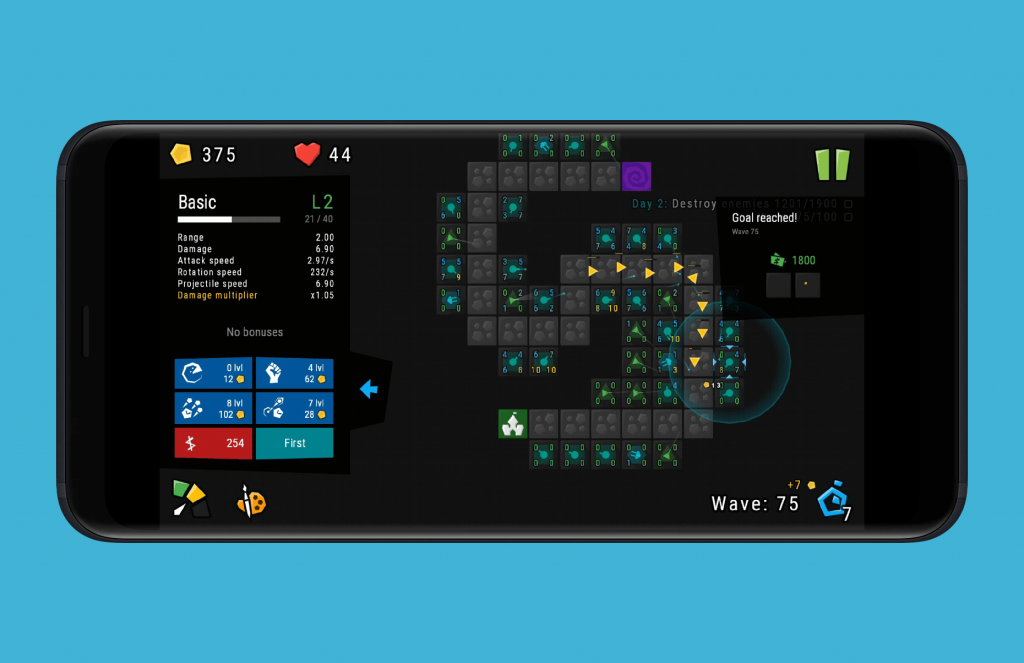
Just like your enemies, your weapons also have different attributes. You start with three: one that throws bombs quickly but doesn’t deal that much damage, a sniper that deals lots of damage but is slow, and one that targets only air units. However, you can get more afterwards. After building them, you can upgrade them in four different attributes: range, damage, attack speed, and rotation speed. The first three are self explanatory, but rotation speed is more uncommon. It deals with the speed at which your towers rotate after killing an enemy and targeting the next one.
Why Infinite?
As previously said, the biggest differentiating factor of Infinitode is the infinite part. The game keeps going until the HP of your base reaches zero. If that takes 200 waves to happen, then so be it. Knowing that this could get boring quickly, the developer added some tricks to make it better. For example, every now and then there are “boss waves,” which are waves that have a bunch of different types of enemies, making them particularly challenging. Also, there are daily goals, such as “kill 1900 enemies” or “clear 50 waves” that yield money.
When dying, even if you haven’t completed one of these goals, you also get money for your efforts. A game can easily last 20 minutes, so you better have some time to really invest in it. The progress can be saved mid-game though, so all is not lost in case you suddenly have a change of plans.
Money, progression tree and in-app purchases
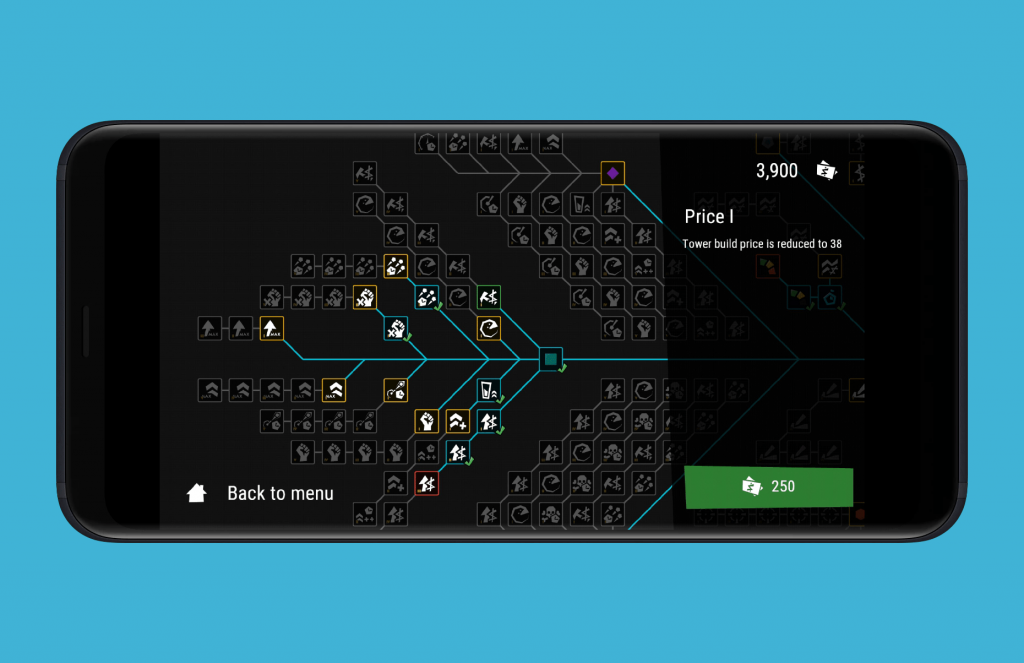
So, I mentioned that you could get more towers afterwards, and that clearing daily goals yield money. See the relation between them? If you go to the Upgrades option in the Main Menu, you get a HUGE progression tree, from which you can get new towers and make your game easier with the ones you already have. It is one of the biggest progression trees I have seen on a game. There are so many things to buy and upgrade that dramatically increase the replay value of this game.
In case you are lazy, you can also buy in-game money with off-game money (that is, your real money). There are only four different kinds of in app-purchases: three different amounts of money, and a double gain token that doubles the proceedings for each game you play. They are also price very competitively, so, since the game is free, you could easily buy one of these and actually get a decent amount of in-game currency while supporting the developers.
Maps and map creator
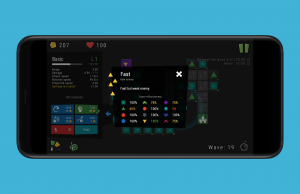 The fact that you can buy in-game currency does not mean that this game instantly becomes easier. You still have only one map available to you at first, and, apart from money, you need experience to open the 17 remaining levels. If that is not enough of a number to you, there is a map creator in which you can create your own maps in any way you like. It is pretty robust and adds a lot to the game, in case you are really into that kind of thing.
Graphics and sound
While other tower defense games focus on really flashy graphics, with over-the-top explosions, detailed towers, and complicated enemies, Infinitode has really simple graphics. That doesn’t mean that they are bad, though. Graphics are more than adequate for the game, and the developers do a really good job in making each asset very descriptive.
For example, the air enemy looks like helicopter blades seen from the top, the high-defense enemy is a red square, the icy enemy is a light blue ball, and the fast enemy is a yellow triangle. It’s not written anywhere that these colors and shapes are fast or heavy, but to me, they all make absolute sense.
Towers also follow the same philosophy. An air missile is light blue, a freezing tower is blue, a cannon tower is red, and a sniper has a triangle with a line at the top (kind of like a sniper looks when seen from above). In game, you can flip between showing the experience that your tower has, or the upgrades that you have done to it.
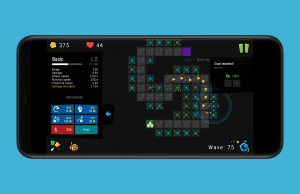
If there is one complain I have, is that sometimes the targets are very small to hit. I don’t have big hands, but I occasionally struggled with touching certain elements. You can zoom in and out of the battlefields, but menus and upgrade buttons are not zoomable, leaving a small target area to hit.
There is no music in-game, only sound effects. They get the job done without any bells and whistles. Almost everything you make has a sound effect, so at least you always have feedback on your actions, since visual feedback is not that prominent.
I did have some situations in which some sound effects didn’t play, especially when upgrading towers. However, most of the time they worked well enough.
Conclusion
Infinitode manages to add a lot of different elements into one game that works amazingly well. Solid tower defense gameplay, endless elements, huge progression tree, zero pesky ads or alerts to make you buy in-game currency, and sleek presentation make Infinitode a gem rarely seen on the Play Store. There’s enough content here to last your for hours, with all the different towers and maps you can unlock, and the upgrades you can buy afterwards. There are very few cons and a whole lot of pros in Infinitode, so make sure you give it a shot.
Download and install Infinitode from the Google Play Store.
 AIVAnet