


Beats 1’s Zane Lowe Says Streaming Music Goes Beyond Apple: ‘There is No League With One Team’
In a new interview today with The Los Angeles Times, Beats 1 host Zane Lowe discussed a few topics related to Apple Music’s daily streaming radio show, including the company’s rivals. Without directly referencing Spotify, Lowe explained the need for competition among streaming music platforms.
“This is a controversial statement: I don’t ever want us to be the only streaming service on the block,” Lowe says. “There is no league with one team. Sometimes you win, sometimes you don’t. But you’re still in the game. Not to sound too holistic but I’m glad I’m in the game.”
Still, when Spotify was brought up during the interview — comparing Apple Music’s 40 million paid subscribers to Spotify’s 83 million paid subscribers — Lowe said he doesn’t look to Spotify when thinking about Beats 1. “We’re the only voice in streaming,” he mentioned, referring to the streaming radio show. “That’s not cockiness. It’s fact.”
Beats 1 is a 24/7 streaming radio channel comprised of a collection of radio shows hosted by different DJs throughout the day, including Julie Adenuga, Ebro Darden, and Lowe. Guest and celebrity hosts also include Elton John, Charli XCX, Pharrell, and St. Vincent. Shows range from artist interviews, listing current popular tracks on Apple Music, and more.
In response to Beats 1’s success on Apple Music, Spotify and YouTube are now believed to be looking into beefing up their radio-style programming as well.
Other services, however, are starting to mirror the Beats 1 mode of radio-style programming. In June, Spotify announced the hiring of Dawn Ostroff as its new chief content officer. Formerly of Conde Nast Entertainment and the CW network, she’ll oversee production of shows, radio stations, podcasts and episodic programming. YouTube Music’s Lyor Cohen has also indicated a desire to move into Beats 1-style programming.
Despite the apparent influence of Beats 1 in the market, The Los Angeles Times questioned Lowe directly regarding specific listener counts for the service’s shows. Lowe dodged answering and stated that Beats 1 streams in “more than 100 countries,” and doubled down on the service’s ability to sell listeners new artists and ultimately convert them into paid Apple Music subscribers (anyone can listen to Beats 1 in the Apple Music app, but paid Apple Music subscribers get access to on-demand stations and shows).
Last year, head of content Larry Jackson said, “Beats 1 is the biggest radio station in the world.” Is it? Lowe sidesteps because to him the question is premature. He recalls advice given to him by Jimmy Iovine[…]
“Jimmy said to me at the beginning: be the thing that moves the needle.” For Lowe, that meant getting cozy with artists. Before when Lowe encouraged fans to buy artists’ records, whether or not they did wouldn’t affect his livelihood. “This directly affects my business. By that very nature we are in business together.”
In regards to Jimmy Iovine, the former Apple Music head this month transitioned to a “consulting role” for the company’s streaming music service. According to people familiar with the matter, this means that Iovine has stepped back from daily involvement with Apple Music so that he can spend more time with his family, while also support Apple Music and Apple senior vice president Eddy Cue “as needed.” The transition from Beats’ “edgy culture” to Apple’s focus on “appealing to the masses” reportedly proved to be a challenge for Iovine.
Beats 1 launched alongside Apple Music on June 30, 2015, kicking off with a day full of tracks that preceded an interview Lowe hosted with Eminem, the debut of St. Vincent’s “Mixtape Delivery Service”, and more. A few months after launch, Beats 1 eventually began saving replays of recent shows so subscribers could revisit an episode they missed at any time.
During the two-year anniversary of Beats 1 in 2017, Lowe said that he’s “never been more excited about where Beats 1 is at this moment, and this is just the beginning.”
Tags: Zane Lowe, Apple Music, Beats 1
Discuss this article in our forums
Google Planning to Launch Echo Show-Like Smart Speaker With Touch Screen Later This Year
Google entered the smart speaker market in 2016 with the introduction of Google Home, allowing users to speak to Google Assistant and control various smart home products, listen to music, get the news, and more. Eventually, Google added the Home Mini and Home Max to the lineup, introducing products that were direct competitors to the Amazon Echo Dot and Apple HomePod, respectively.
Looking forward, the next Google Home will be a smart speaker equipped with a touch display that should arrive in time for the holiday shopping season, according to sources speaking to Nikkei Asian Review. This means that the new device “is likely to be similar to the Amazon Echo Show,” which includes a display so users can do things like watch videos, view photos, and hold video calls.
The Lenovo Smart Display with Google Assistant (left) and Amazon Echo Show (right)
Google’s plan for the upcoming device is described as “aggressive”:
“Google targets to ship some 3 million units for the first batch of the new model of smart speaker that comes with a screen,” an industry source said. “It’s an aggressive plan.”
Earlier in 2018, Google announced a new “Smart Display” platform with partners like Lenovo, JBL, and Sony. Through these partnerships, the Google Assistant can be placed in devices not directly built by Google, like the Lenovo Smart Display and upcoming JBL Link View and ThinQ View. The new product described in today’s report would represent Google’s own first-party entry into this market.
Google and Amazon butted heads following the launch of the Echo Show last year, when Google removed YouTube from any Amazon Echo device with a screen. Google said that Amazon was violating its terms of service, but in December 2017 a YouTube spokesperson explained that the removal was due to Amazon not carrying certain Google products. This grants the upcoming speaker-equipped Google Home a potential edge in the market as Nikkei points out that playing and browsing YouTube will likely be a major selling point.
For Apple, the company is sticking to smart speakers without full displays. Although the HomePod does include a small screen that provides a visual indicator for Siri and volume buttons, no information regarding the currently playing song or album selection is available. Currently, the main rumor for the next iteration of HomePod is that Apple is working on a low-cost version of the speaker.
Google typically holds a hardware event in October, so we should hear more about the upcoming Google Home speaker with a touch screen — if it exists — around that time.
Tags: Google, Google Assistant, Google Home
Discuss this article in our forums
Apple Says No Personal Data Was Compromised in Australian Teenager Hacking Incident
In a statement, Apple has confirmed that no personal data was compromised by a 16-year-old student from Melbourne, Australia who admitted to hacking into Apple’s internal servers on multiple occasions over one year.
The Guardian:
At Apple, we vigilantly protect our networks and have dedicated teams of information security professionals that work to detect and respond to threats.
In this case, our teams discovered the unauthorized access, contained it, and reported the incident to law enforcement. We regard the data security of our users as one of our greatest responsibilities and want to assure our customers that at no point during this incident was their personal data compromised.
Australian publication The Age reported that the teen downloaded some 90GB of confidential files, and accessed customer accounts, storing information in a folder on his computer named “hacky hack hack.” It’s unclear exactly what he downloaded during the series of network intrusions.
The student, who cannot be publicly named due to his age and notoriety in the hacking community, reportedly pleaded guilty to his actions in an Australian Children’s Court this week, with sentencing deferred until next month. His lawyer later told police that the teen “dreamed of” working for Apple.
The teen reportedly had a method of accessing Apple’s servers that “worked flawlessly” on multiple occasions—until he was caught.
The international investigation began when Apple detected the unauthorized access, contained it, and alerted the FBI. The allegations were passed on to the Australian Federal Police, which executed a search warrant on the teen’s home last year, and found the software that had enabled the hacking on his laptop.
Tag: Apple security
Discuss this article in our forums
Prince’s Estate Launches 23 of His Albums and New Anthology on Apple Music and Other Streaming Services
Sony Legacy announced over the summer that it had obtained the rights to release the “bulk” of Prince’s back catalog, namely the albums he debuted after he left Warner Bros. in the mid-nineties. Today, The Prince Estate digitally released 23 total Prince albums that first launched between 1995 and 2010 onto “all major streaming services,” including Apple Music and Spotify.
As Variety points out, today’s launch marks the first time that many of these albums will be available for listeners to stream and download. Along with the individual albums, The Prince Estate released a new album called “Anthology: 1995-2010,” which curates a collection of 37 songs from this period in Prince’s career.
The 23 Prince albums now available on Apple Music include:
- The Gold Experience (1995) (“The Most Beautiful Girl in the World” greyed out, partial album streaming only; album unavailable for download)
- Chaos and Disorder (1996)
- Emancipation (1996)
- Crystal Ball (1998)
- The Truth (1998)
- Rave Un2 The Joy Fantastic (1999)
- Rave In2 The Joy Fantastic (2001)
- The Rainbow Children (2001)
- One Nite Alone… (2002)
- One Nite Alone…Live! (2002)
- One Nite Alone…Live – The Aftershow: It Ain’t Over (Up Late with Prince & The NPG) (2002)
- Xpectation (2003)
- N.E.W.S. (2003)
- C-Note (2004)
- Musicology (2004)
- The Chocolate Invasion (Trax from the NPG Music Club: Volume 1) (2004)
- The Slaughterhouse (Trax from the NPG Music Club: Volume 2) (2004)
- 3121 (2006)
- Planet Earth (2007)
- Indigo Nights (2008)
- LOtUSFLOW3R (2009)
- MPLSoUND (2009)
- 20Ten (2010)
To find the albums and anthology, visit the Browse tab on Apple Music and swipe through the carousel until Prince’s “Featured Artist” spotlight card appears. In this section, subscribers can also pre-add the upcoming Prince album “Piano & a Microphone 1983,” which will be a compilation of previously unreleased home recordings for tracks like “Purple Rain,” “17 Days,” and “International Lover.” The album launches September 21.
Before today, many of Prince’s classic albums were already available to stream on Apple Music, so now that his later work is on streaming services, fans have the chance to listen to most of the albums from the late singer’s lifelong career.
There are still numerous Prince albums missing from streaming services, but a deal struck between Sony Legacy and The Prince Estate should see these missing albums appear to stream in the future. Unfortunately, it won’t be until 2021 at the earliest, at which time Sony Legacy’s distribution rights will expand to include 12 of Prince’s non-soundtrack albums from 1978-1996.
Prince passed away in April 2016, and prior to that time he had pulled all of his music from every streaming service except Tidal in the summer of 2015.
Tag: Apple Music
Discuss this article in our forums
Watch as a ‘lifeguard drone’ rescues a swimmer struggling at sea
An increasing number of lifeguard organizations around the world are turning to drone technology to help speed up rescue efforts for when swimmers get into difficulties.
Australia, Germany, and Iran are three such countries that have rescue drones ready to take to the skies in an emergency. And it’s not just their speed in carrying flotation devices to struggling swimmers that makes them so useful. Their onboard cameras also enable the drone pilot to survey the scene and relay important information to lifeguards who are on their way to help.
The latest demonstration of just how effective drones can be for ocean rescues came this week in the sea off Sagunto, about 15 miles north of Valencia, Spain.
When a lifeguard spotted bathers caught in an undertow about 70 meters from the shore, the Auxdron Lifeguard Drone was quickly deployed to help out, sUASnews reported.
Initially receiving guidance from a lifeguard in an observation tower, drone pilot Diego Torres flew the quadcopter toward the distressed swimmers.
“I had a general location but with the help of the lifeguard giving me instructions and the video feed from the drone, we were on top of them within the minute,” Torres told sUASnews.
A quick assessment via the livestream revealed that one woman in the group was having particular difficulties in the water, with the other swimmers trying to support her in the choppy surf. Torres responded by releasing one of the drone’s two life vests, lowering it on a tether to within reach of the swimmers. When it touches the water, the vest disconnects from the tether and automatically inflates before being used to help the woman.
A short while later, lifeguards arrive on a Jet Ski to take the woman back to shore. The drone, which was built by Spanish startup GeneralDrones, stays hovering in the air, relaying information about the condition of the remaining swimmers back to lifeguards as the rescue effort continues.
Speedy rescue
Lifeguards in New South Wales, Australia, are also using drone technology to help in rescue efforts. Its specially designed quadcopter hit the headlines earlier this year when it played a central role in the rescue of two struggling swimmers. The drone reached the pair and dropped a flotation device in just 70 seconds — several minutes before a human lifeguard would have been able to get there.
In 2017, the New South Wales government announced it would invest more than $300,000 in drone-rescue technology as part of a trial for coastal areas in the Australian state.
Editors’ Recommendations
- Some folks still think it’s a good idea to fly drones over wildfires
- Drones are helping efforts to free whales from dangerous marine debris
- Did a drone help a notorious French gangster escape from prison?
- Parrot Anafi drone review
- Check out these wacky designs from Boeing’s $2 million passenger drone contest
Is your PC safe? Foreshadow is the security flaw Intel should have predicted
(in)Secure is a weekly column that dives into the rapidly escalating topic of cybersecurity.
If you thought Spectre and Meltdown were going to be the only industry-shaking security flaws to affect nearly every computer, think again. Intel recently revealed three new issues related to its Core and Xeon processors, dubbed collectively as “Foreshadow” by the researchers who discovered the exploits.
Unfortunately for Intel and all of us, Foreshadow doesn’t exactly inspire confidence in the computers we rely on every day. Here’s everything you need to know about the new security flaw.
Meet Foreshadow
Like with Spectre and Meltdown, Foreshadow was first discovered by multiple independent teams outside Intel, in this case as a collaboration between researchers from a few universities.
But the origin story is not where the similarities to the previous security flaws stop. The vulnerabilities revealed in Foreshadow are similar to Meltdown and Spectre in that they take advantage of flaws in the way processors temporarily store data in memory.
In an interview with the BBC, one of the researchers behind the discovery described the attack as targeting a “lock box within Intel’s processors,” which could then leak out any kind of data you wanted.
Intel discovered two other related problems, which researchers have named “Foreshadow-NG” (aka next generation).
The “lock box” Wenisch is referring to is known as the Software Guard Extensions (Intel SGX), and this attack method only works on Intel processors with the special feature. Intel SGX is essentially a set of instructions built into Intel’s chips that enable developers to create private caches, aka enclaves, in memory, for applications such as secure web browsing and digital rights management for streaming video.
This alone was already a dangerous vulnerability waiting to be exploited — but unfortunately, it was only the first of three methods of attack. Upon further investigation, Intel discovered two other related problems, which researchers have named “Foreshadow-NG” (aka next generation).
Foreshadow, the Next Generation
These two vulnerabilities are still based on a processor core’s L1 cache, which is where an individual core of the processor stores the information it will need next. But these newly-discovered issues affect memory uses other than just Intel’s SGX technology.
The first vulnerability in the Foreshadow-NG group can grab data from memory used by the core of an operating system, aka the kernel. This core has access to all data stored in memory, including every app and program installed on the machine. The good news here is that a hacker must have access to your PC and use a malicious program to actually steal that data.
This vulnerability also enables access to data used by the System Management Mode (SMM) installed in all modern processors. This mode is used by the PC’s firmware to control the hardware, manage power, and so on. Again, to steal this data, a hacker must have access to your PC with guest privileges to run malicious software.
Foreshadow affects second- to eighth-gen Intel Core processors, X-Series, and Xeon processors.
The second Foreshadow-NG vulnerability can be used to attack virtual machines. These aren’t real PCs, but rather software-emulated PCs running in memory on a datacenter server. Virtual machines are typically managed by a hypervisor so that data doesn’t leak between these virtual PC instances.
But according to the researchers, a malicious virtual machine could break through those boundaries. “A malicious virtual machine running inside the cloud can potentially read data belonging to other virtual machines as well as data belonging to the cloud’s hypervisor,” the researchers claim.
Who’s affected by Foreshadow?
The original Foreshadow vulnerability, specifically pertains only to SGX-enabled Intel processors. These include all sixth- and seventh-generation Core processors but exclude Atom processors that support SGX. Processors manufactured by AMD are not affected, nor are chips based on ARM’s processor core design (Tegra, Snapdragon, Enyos, etc.).
The Foreshadow security flaw affects nearly every modern computer with an Intel processor.
Foreshadow-NG is a different story. As of now, chips based on ARM’s architecture and x86-based CPUs from AMD are still under investigation. Processors produced by Intel that fall prey to Foreshadow-NG can be found here in a very long list. It essentially covers second- to eighth-generation Intel Core processors, X-Series chips for the X99 and X299 platforms, Xeon processors spanning from the 32400 Series to the Xeon Processor Scalable Family, and so on.
“We are not aware of reports that any of these methods have been used in real-world exploits …”
Intel was quick to report that microcode updates were already issued earlier this year to protect customers against possible attacks. These updates built a foundation for the current mitigations introduced on Tuesday by operating system providers, hypervisor software developers and the open source community.
Changes will also be made on a hardware level in Intel’s next-generation “Cascade Lake” Xeon Scalable processors and “client processors” launching by the end of 2018.
“We are not aware of reports that any of these methods have been used in real-world exploits, but this further underscores the need for everyone to adhere to security best practices,” Intel says. “This includes keeping systems up-to-date and taking steps to prevent malware.”
Editors’ Recommendations
- New Spectre-like bug could mean more performance-degrading patches
- You’ll want to perk up when it comes to the new ‘Lazy State’ Intel CPU bug
- New Spectre attack lets hackers steal data without having to run local code on PCs
- Google Chrome now consumes more memory due to a new Spectre fix
- BMW racing to patch 14 security vulnerabilities found in its cars
How to send and request money using Google Pay
Bob still owe you for pizza last night? Send him this article.

If you’ve got an Android phone, Google Pay is the go-to app for all things mobile payments. You can use it to pay for things at stores that accept NFC, store your boarding passes and event tickets, house your gift cards, and send money to friends/family.
There are a number of apps that allow you to send and receive money from your contacts, but the way this feature is integrated right into the Google Pay app with everything else it has to offer creates a really great all-in-one solution.
With that said, here’s what you need to know about sending and receiving money with Google Pay.
- How to send/request money in the Google Pay app
- How to send/request money via Google Pay in Android Messages
- How to send/request money via Google Pay through the Google Assistant
How to send/request money in the Google Pay app
Whether you need to send your roomate money for groceries, request cash from your friend for last night’s dinner, or whatever else, sending money with Google Pay is simple.
Open the Google Pay app.
Tap Send on the bottom navigation bar.
Tap the blue Send or request button.


Find the contact you’re looking for.
Enter the amount you want to send/request.
Tap Add Note if you want to leave an optional message about what the money’s for.
Once you’re done, tap Request or Send at the bottom to finish up.


How to send/request money via Google Pay in Android Messages
Sending or requesting money in the actual Google Pay is simple enough, but Google’s got a few tricks up its sleeves to make the process even easier.
If you’re texting someone and you realize you need to get some money sent their way, you don’t have to leave the conversation, open Google Pay, send the money, and then tell your friend that you’ve sent it. Instead, you can do all of this directly within your conversation.
Open Android Messages and tap on the conversation thread you want.
Tap the circular + icon near the bottom left.
Scroll down until you see the Google Pay icons.
Tap Send or Receive depending on what you want to do.
Type in the amount
Tap Attach Money / Attach Request.


How to send/request money via Google Pay through the Google Assistant
You can also send/request money using Google Pay without having to open any apps thanks to the Google Assistant! It can be used for both actions just by asking, but for this demonstration, I’ll be asking for $20 from Kennedy.
Say, “Hey Google, request $20 from Kennedy.”
Confirm that you’ve got the right contact, email address, etc.
Say what the money is for.
Tap Yes or say “Yes” to confirm the transaction.


Time to get paid!
With all that said, that’s all you need to know about sending and requesting money with Google Pay.
What’s your favorite way to send money? Have additional questions? Sound off in the comments below!
Download: Google Pay (free)
UK Deal: Start your smart home with Echo Dot + Philips Hue bundles from £80
Alexa + Hue is a match made in heaven.
Amazon UK has reduced the price of the Echo Dot + Philips Hue Starter Kit bundles today, meaning you can get started with your smart home for as little as £79.99 right now.

The kits come with the Echo Dot in black or white, plus the Philips Hue Bridge and a set of bulbs to get you going on your smart lighting journey.
Your light fixture fittings will dictate which set is right for you. Primarily using Edison bulbs? Well, you can choose from the £79.99 White kit that includes 2 dimmable White bulbs — saving you £13 — or the Colour kit that includes 3 bulbs and also throws in the wireless Dimmer Switch for £174.99. This bundle saves you over £35 off the price of buying the items separately.
If you’re rocking Bayonet fittings, you’ll want to pick up the bundle that includes the B22 Philips Hue White and Colour bulbs plus the wireless Dimmer Switch for £174.99.
Of course, if you have multiple different light fittings around your home, you can always pick up additional Philips Hue bulbs down the line and they’ll link up just fine with the Bridge and can then also be controlled by your Echo Dot.
And if you’re already up and running with Hue lights, you can add just the Echo Dot to your smart home system for just £34.99 right now, giving you all that Alexa’s voice control has to offer.
For more UK deals coverage, be sure to keep an eye on Thrifter UK, sign up for the UK newsletter and follow the team on Twitter.
See at Amazon UK
‘Entry-Level’ 13-inch MacBook, Redesigned iPad Pros With Faster 18W USB-C Charger Coming in September, But no New iPad Mini
Apple will launch its much-rumored “entry-level” MacBook in September, according to a report by DigiTimes outlining Apple’s upcoming product launches. The website says the new MacBook will be priced at $1200, according to industry sources, and will be powered by 14-nanometer Kaby Lake CPU architecture, following delays to Intel’s 10-nm rollout.
Earlier this year, DigiTimes said that Apple will release the first MacBook Air with a Retina display in the second half of 2018, and claimed that it will be a 13-inch model in a separate report. It also recently said Quanta will assemble new “inexpensive notebooks” for Apple in the fourth quarter. However, the idea of a $1200 MacBook Air leaves the question of a sub-$1000 MacBook offering wide open.
TrendForce believes Apple will release a new MacBook Air in September or October, while both Apple analyst Ming-Chi Kuo and Bloomberg reporter Mark Gurman expect Apple to release a new entry-level notebook later this year. Whether that’s a MacBook or a MacBook Air remains unclear, but Gurman expects at least one of them to have a $999 starting price.
Today’s DigiTimes report also claims Apple will use the September event to announce the “launch schedule” for its wireless AirPower charger, costing in the region of $160-$190. Apple previewed its multi-device AirPower charging mat at its iPhone X event last September, and confirmed that it will be released at some point in 2018, but it has yet to reveal how much it will cost. An earlier rumor citing “industry insiders” has suggested a price point of around $149.
Apple is expected to announce two new iPad Pro models this September measuring in at 11 and 12.9-inches, featuring slimmer bezels and a TrueDepth camera with support for Face ID. DigiTimes claims the two redesigned iPad Pros will sit alongside Apple’s 9.7-inch iPad and iPad mini 4 to complete its tablet lineup, but notably the report also claims Apple has “no further plan” for the iPad mini 4.
Elsewhere in today’s round-up, DigiTimes claims Apple’s next-generation iPad Pro models will come with a newly designed 18-watt USB-C power adapter for faster charging. Apple is rumored to be including the more powerful charger with its new trio of iPhones coming this year, but this is the first time we’ve heard that it could also feature as part of Apple’s iPad lineup. The adapter would presumably connect to the iPads with a Lightning to USB-C cable, also included in the box.
Apple’s iPads have traditionally come with 10–12W adapters, so including the 18W USB-C power adapter would make sense as it would allow for faster charging without requiring users to purchase separate charging accessories at additional cost. Apple’s current iPad Pro models already support fast charging using one of Apple’s USB-C charge adapters paired with a Lightning cable. With this setup, a 2017 iPad Pro can be charged in half the time.
Lastly, today’s DigiTimes report reiterates previous rumors surrounding Apple’s new 2018 iPhone lineup, which is expected to include two OLED models measuring in at 5.8 and 6.5 inches, and a 6.1-inch lower-cost LCD model. All three will feature Face ID and edge-to-edge displays.
Related Roundups: MacBook Air, iPad mini 4 (2015), 2018 iPhonesTags: digitimes.com, AirPowerBuyer’s Guide: MacBook Air (Don’t Buy), iPad Mini (Don’t Buy)
Discuss this article in our forums
How to Output Your Mac’s Audio to Two Pairs of Headphones at the Same Time
Next time you’re on a flight with someone and you both want to watch a video on your Mac without disturbing other passengers, try this convenient solution for sharing your Mac’s audio among two pairs of headphones.
The method described below should work regardless of whether you’re using one wired pair and one wireless pair of headphones, two pairs of Bluetooth headphones (i.e. two sets of AirPods), or even several pairs.
How to Output Mac Audio to Two Audio Devices
Make sure that the headphones you want to use together are paired with your Mac over Bluetooth and/or connected via the headphone jack.
Launch the Audio MIDI Setup app, located in Applications/Utilities.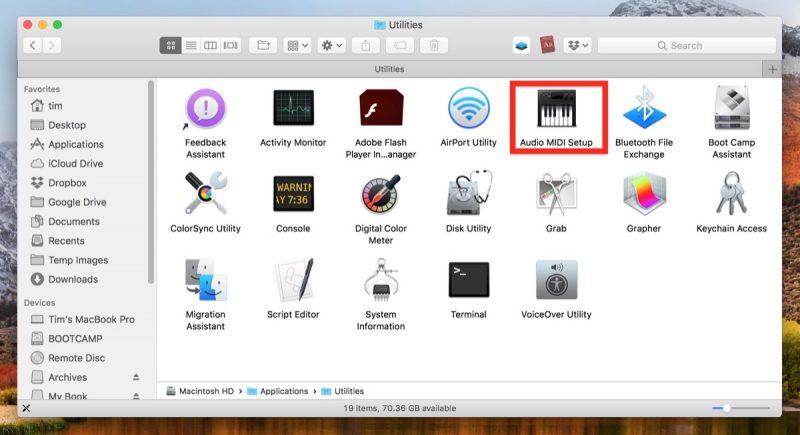
Click the plus (+) button at the lower left of the Audio Devices window and select Create Multi-Output Device.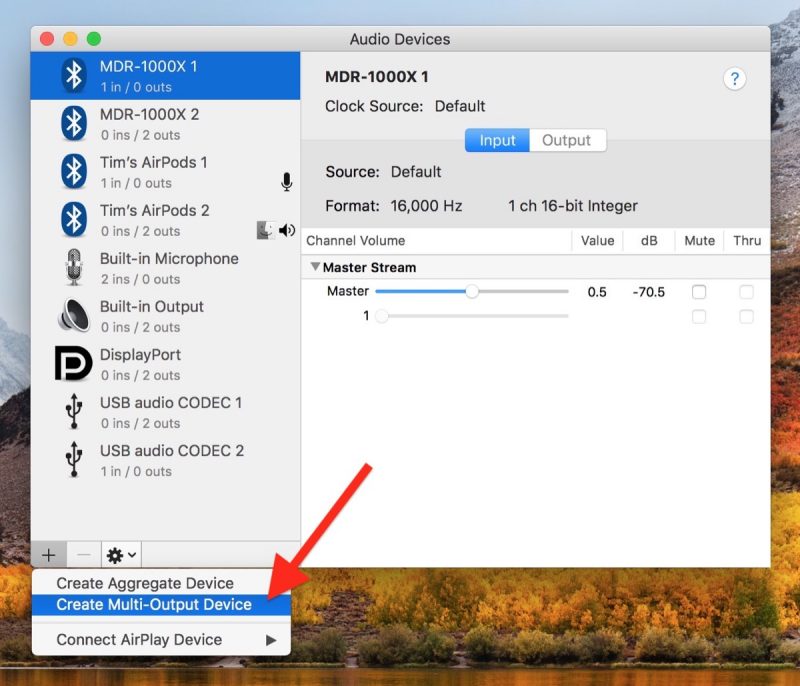
Right-click (or Ctrl-click) the Multi-Output Device in the list that you just created, and select Use This Device For Sound Output. (You can also opt to Play Alerts and Sound Effects Through This Device from the same menu.)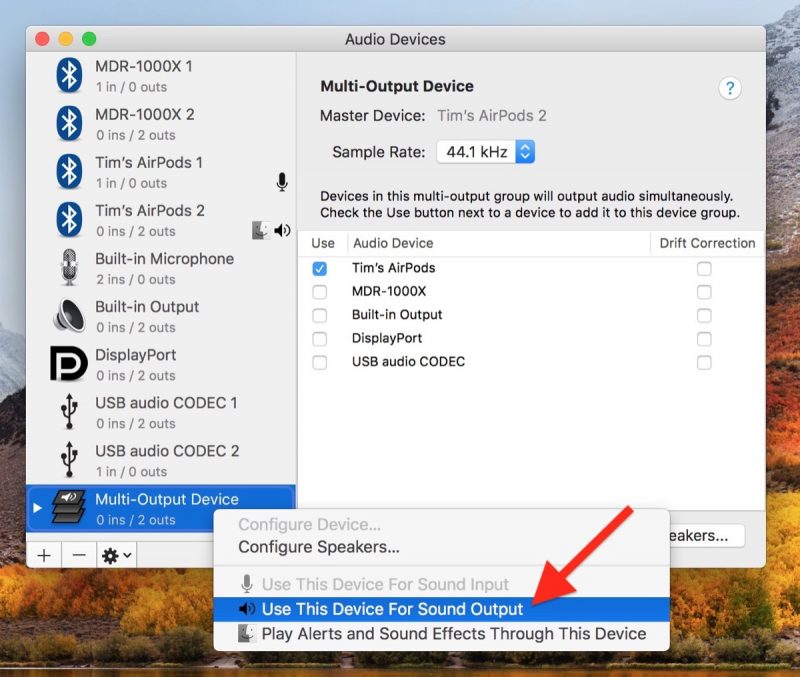
Tick the sets of headphones that you want to use in the Audio Device list. (If one is a wired pair, tick Built-in Output.)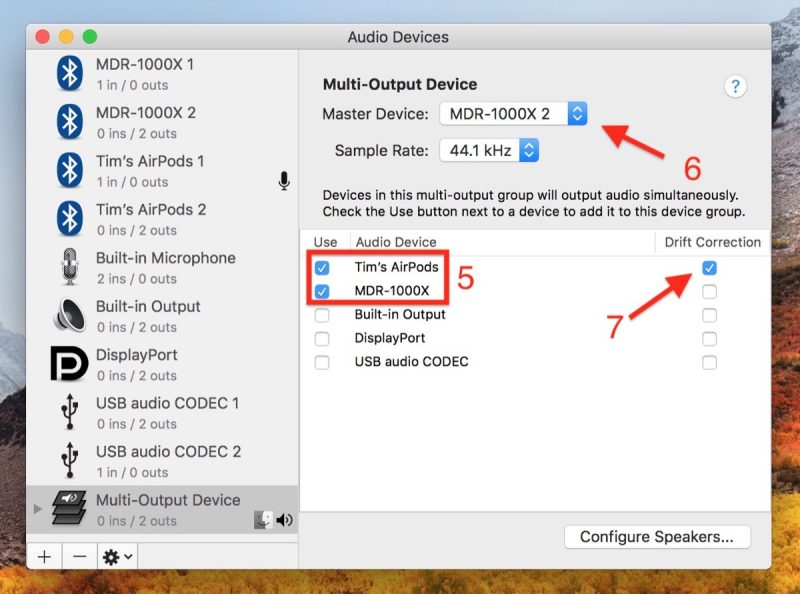
Select a Master Device in the drop-down menu.
Tick Drift Correction for the slave device in the Audio Device list.
Launch System Preferences (select -> System Preferences… from the menu bar) and open the Sound pane.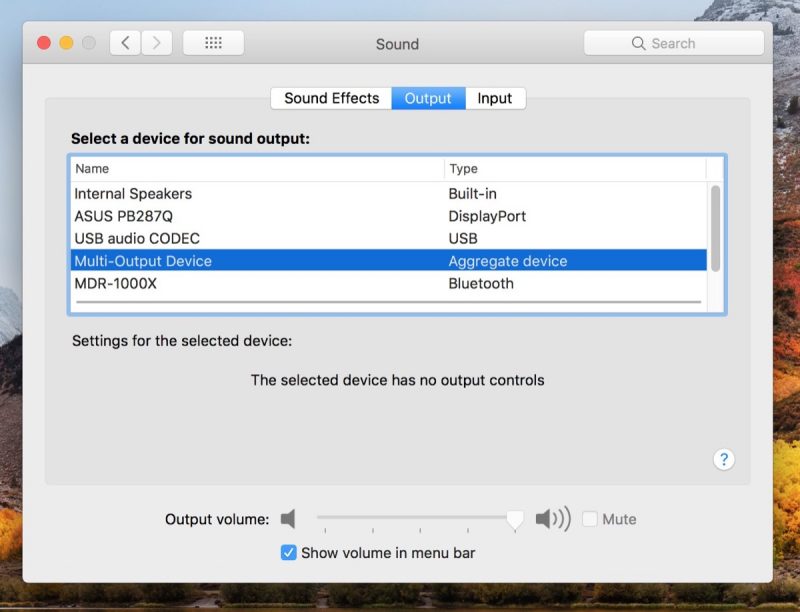
Click the Output tab and choose the Multi-Output Device or “Aggregate device” in the list, and you should be good to go.
Discuss this article in our forums
 AIVAnet