


Tesla: Model 3 production could hit 5,000 per week in two months
One of the major stories about Tesla’s car business has been its struggle to build sufficient quantities of its Model 3 electric car. In a just-released earnings report the company said that prior to its most recent shutdown, it had managed to build over 2,000 cars per week for three weeks in a row for the first time, and anticipates it will manage 5,000 per week in two months.
Following comments from Elon Musk that over-reliance on robots slowed production, the earnings report expanded on that angle. In certain production areas like “portions of the battery module line, part of the material flow system, and two steps of general assembly” it has “temporarily” dialed back automation in favor of semi-automated or manual processes. If it can hit its production goals, Tesla also claims that it can be profitable in Q3 and Q4 of this year.
Developing…
Source: Tesla Q1 2018 Earnings (PDF)
Facebook: AI will protect you
Artificial intelligence is a key part of everything Facebook does, from chat bots in Messenger to powering the personalized recommendations you get on apps like Instagram. But, as great as the technology is to create new and deeper experiences for users, Facebook says the most important role of AI is to keep its community safe. Today at F8, the company’s Chief Technology Officer, Mike Schroepfer, highlighted how valuable the tech has become to combating abuse on its platform, including hate speech, bullying and terrorist content. Schroepfer pointed to stats Facebook revealed last month, which showed that its AI tools removed almost 2 million pieces of terrorist propaganda, with 99 percent of those being spotted before a human even reported them.
Shroepfer said that, even though these are promising numbers, Facebook knows there’s still plenty of work to be done and it needs to keep evolving the technology — especially because the bad actors promoting this type of content keep getting smarter themselves. One of the ways Facebook plans to do this, Shroepfer said, is by investing heavily in artificial intelligence research and find ways to make it work at a large scale without much (if any) human supervision. This is all part of Facebook’s plan to write a security “playbook” that other tech companies can follow, and one that the company says it can’t create alone. That’s why, aside from its in-house team, it’s working with outside academics and research scientists to develop the best possible AI systems.

Facebook’s Chief Technology Officer, Mike Schroepfe, at F8.
Isabel Kloumann, a research scientist at Facebook, said that one of the biggest challenges with AI is training it to be unbiased. Because the technology is so new, it’s hard to test it for fairness and ensure that it incorporates a diverse set of voices in its decisions. As in, how can AI tell the difference between an unpopular opinion that may show up on a Facebook or Instagram post and a comment that’s intended to spread hate? Vision, language and reasoning, said Shroepfer, are the three most important factors in training an AI system that’s going to be efficient and accurate in taking down all the abusive content that shows up across Facebook’s platforms. Basically, it seems, you have to make it think like a human — but an unbiased one.
“Compared to a few years ago, this is great progress.” Shroepfer said. “But it’s clear we still have a lot of work to do.” And that Facebook does, because online abuse isn’t going anywhere, and there’s bound to be some hate speech, bullying comments or terrorist propaganda that slips through the cracks. After all, Mark Zuckerberg himself said that it’s easier for artificial intelligence to detect nipples than hate speech. So, when that does happen and AI fails to do its job, Facebook will need to rely on the 20,000 humans it’s hiring to review content to make sure that they act quick to take down whatever the tech wasn’t smart enough to catch.
Maybe AI will be perfect one day, but it’s not there just yet.
Click here to catch up on the latest news from F8 2018!
Spotify touts 75 million subscribers in first quarterly earnings report
Spotify made its New York Stock Exchange debut last month, and today the streaming service announced its first earning report as a public company. As part of its pre-filing paperwork, we already knew the company had amassed 170 million monthly users, but as of now Spotify touts 75 million paid subscribers. That’s up from 71 million earlier this year. For comparison, Apple Music recently hit the 40-million mark, though recent reports indicate Apple may catch Spotify by the end of the year.
Despite a growing subscriber base, one that Spotify says could hit 96 million by year’s end, the company is still spending more than it’s taking in. For Q1 2018, Spotify’s operating loss was down from Q4 2017 (€41 million down from €87 million). The company explains that number would’ve been even less, but it missed on revenue for the quarter which lead to a higher gross margin than expected. Spotify says the reason for this is “primarily related to changes in rights holder liabilities booked in the quarter.”
Even as it continues to work on closing that gap, the challenge will likely get tougher. The music industry is so reliant on streaming now that when it comes time to renew licensing deals, the stakes will likely be higher (and pricier) for both sides. Of course, a business model where the rights to the content aren’t owned by the company isn’t exactly the most solid investment, so Spotify will need to prove it’s worth the risk.
Spotify’s recently announced revamp for free users added more personalization to the ad-supported tier. While that may not go far in terms of converting free listeners to paid ones, the company is banking on things like new markets, partnerships and things like its bundle offer with Hulu to help lure even more paying customers.
We’ll update this post with any additional information from the company’s earnings call later today.
Source: Spotify
Apple Officially Orders ‘Are You Sleeping’ Drama Series Starring Octavia Spencer
Apple has given a series order for 10 episodes of “Are You Sleeping,” a drama series that will star Octavia Spencer, who is known for her work in movies that include “Hidden Figures,” “The Help,” “Gifted,” and “The Shape of Water.”
News of Apple’s work on “Are You Sleeping” first surfaced in January, but now Variety says the company has decided to move forward with production on the show.
Image of Octavia Spencer via Variety
“Are You Sleeping” is based on a novel by Kathleen Barber, which has been described as a psychological thriller. The book focuses on a podcast that reopens a murder case, similar to the popular “Serial” podcast that led to a new trial for Adnan Syed, in jail for allegedly murdering a former girlfriend. Sarah Koenig, who created and produced “Serial,” will consult on “Are You Sleeping.”
The novel the TV show is based on explores how the reopening of the murder case impacts the victim’s daughter and disrupts her life, and it’s likely the TV show will follow a similar plot.
“Are You Sleeping” was written by Nichelle Tramble Spellman, and the series will be produced by Reese Witherspoon’s Hello Sunshine and Chernin Entertainment/Endeavor Content.
Apple is also working with Reese Witherspoon’s production company on an as of yet untitled “morning show drama” that takes a look into the cutthroat would of morning TV.
Apple now has more than a dozen television shows in the works, with a full list of what’s on the horizon available in the original content section of our Apple TV roundup.
It’s not yet known when the first of Apple’s TV shows will debut nor how they’ll be distributed, but rumors have suggested we could see the first fruits of Apple’s efforts in 2019.
Related Roundup: Apple TVBuyer’s Guide: Apple TV (Neutral)
Discuss this article in our forums
Anti-Surveillance Coalition That Includes Apple Condemns Proposals for Device Backdoors
The Reform Government Surveillance coalition, which includes several major tech companies who have teamed up to lobby for surveillance law reform, this week released a statement condemning recent proposals for backdoor access into electronic devices and reaffirming a commitment to strong encryption.
The coalition is made up of multiple tech companies who have taken a strong stance against weakening encryption, including Apple, Google, Microsoft, Dropbox, Snap, Evernote, LinkedIn, Oath (owned by Verizon) and Facebook.
Reform Government Surveillance recently announced a new core principle on encryption that will guide our advocacy efforts, and we continue to believe that strong encryption helps protect the security and privacy of individuals and companies around the world. We have consistently raised concerns about proposals that would undermine encryption of devices and services by requiring so-called “exceptional access” for law enforcement. Recent reports have described new proposals to engineer vulnerabilities into devices and services – but they appear to suffer from the same technical and design concerns that security researchers have identified for years. Weakening the security and privacy that encryption helps provide is not the answer.
As ZDNet points out, the statement comes following a WIRED article profiling Microsoft chief technical Ray Ozzie and his suggestion for a solution called “Clear” that would supposedly provide law enforcement with access to encrypted data with less security risk.
Ozzie’s proposal uses a public key and a private key (housed and protected by a company like Apple) that are used to encrypt and decrypt a PIN generated on the device. No one is meant to be able to decode and use the PIN to unlock the device aside from the vendor, using the aforementioned private key.
So, say the FBI needs the contents of an iPhone. First the Feds have to actually get the device and the proper court authorization to access the information it contains–Ozzie’s system does not allow the authorities to remotely snatch information. With the phone in its possession, they could then access, through the lock screen, the encrypted PIN and send it to Apple.
Armed with that information, Apple would send highly trusted employees into the vault where they could use the private key to unlock the PIN. Apple could then send that no-longer-secret PIN back to the government, who can use it to unlock the device.
Ozzie demonstrated his “Clear” solution to representatives from tech companies that included Apple, Google and Facebook, according to WIRED, but unsurprisingly, none of them had “any interest whatsoever” in voluntarily implementing that kind of access into their devices and services.
The coalition Apple is a part of in April published a core principle pledging to ensure device security through strong encryption and calling on governments to avoid taking actions that would require companies to “create any security vulnerabilities in their produces and services.”
Strong encryption of devices and services protects the sensitive data of our users – including individuals, corporations, and governments. Strong encryption also promotes free expression and the free flow of information around the world. Requiring technology companies to engineer vulnerabilities into their products and services would undermine the security and privacy of our users, as well as the world’s information technology infrastructure. Governments should avoid any action that would require companies to create any security vulnerabilities in their products and services.
The renewed activity from the Reform Government Surveillance group follows reports that have suggested law enforcement officials are quietly revisiting proposals that would require tech companies to add backdoor access into electronic devices for use by law enforcement officials.
FBI and DOJ officials have been meeting with security researchers with the aim of developing approaches that would offer “extraordinary access” to encrypted devices like the iPhone, with DOJ officials reportedly “convinced” there is a way to create a backdoor without weakening a device’s defense against hacking.
Apple software engineering chief Craig Federighi recently said that this kind of backdoor access would “inject new and dangerous weaknesses into product security.”
“Weakening security makes no sense when you consider that customers rely on our products to keep their personal information safe, run their businesses or even manage vital infrastructure like power grids and transportation systems,” Federighi said.
Apple vehemently opposes backdoor solutions like the one Ozzie proposed because they have the potential to weaken device encryption and provide new ways for bad actors to access device data.
Apple’s strong stance against weakened device protections for the sake of law enforcement access was highlighted in the 2016 Apple vs. FBI conflict that saw Apple refuse to create a backdoor access solution to allow the FBI to crack the iPhone 5c owned by San Bernardino shooter Syed Farook.
 GrayKey iPhone unlocking box via MalwareBytes
Without device backdoors, law enforcement officials have still found ways to crack devices like iPhones through other means. At the current time, for example, agencies like the FBI and DOJ have access to an iPhone unlocking box called GrayKey, which is capable of unlocking Apple’s most recent iPhones running modern versions of iOS.
Note: Due to the political nature of the discussion regarding this topic, the discussion thread is located in our Politics, Religion, Social Issues forum. All forum members and site visitors are welcome to read and follow the thread, but posting is limited to forum members with at least 100 posts.
Tags: privacy, Encryption, Apple-FBI
Discuss this article in our forums
NeoPen M1/N2 review – expensive and niche, but effective

Hand-written notes are a chore. I grew up in an era where we still wrote everything on paper, with laptops, tablets, and phones all being cost-prohibitive to bring into the classroom. I’d have killed for a device that would automatically digitize and transcribe my notes, when I was in school. Instead, I’d spend hours manually transcribing my notes at home into the Family Dell. With a gadget like the NeoPen, all that time could’ve been saved. That was a decade and more ago, though. In a world where smartphones, tablets, and laptops follow us literally everywhere, is there a place for a digital, transcribing pen? Read on, dear Android Guys.

Build & Design
NeoLAB clearly did its best to design a smart pen that still feels like a normal ballpoint. And in that, it certainly succeeded; the fiberglass body of the M1 feels no different than any other run-of-the-mill ballpoint pen. And while that may be great for some, I prefer to have a pen that feels like an instrument, rather than a piece of plastic. The N2, however, is an all-aluminum body with real heft that scratches that premium itch.
The M1 comes in five colors: Black, Navy, Grey, Red, or Yellow. All feature rather “loud” secondary accents; red, yellow, neon, white, and brown, respectively. If I had my way, my NeoPen would’ve been matte black aluminum, with no accent colors – fortunately, the N2 delivers on that with either aluminum or black styling.

While the body and design of the M1 are nothing to write home about, it’s very light (17.4g) and durable thanks to its fiberglass construction. Both the M1 and N2 use standard D1 refills, making them cheap and easy to keep filled. Interestingly, the LEDs on the back end of the pens are multicolored, rather than your run of the mill red-green LED. The result is some nifty status indicators and patterns that play for various occasions. It’s a cute touch.
Battery Life
At 280mAh, the internal batteries on NeoLab’s NeoPens are pretty small. As such, they charge quickly (just 90 minutes for a full charge using the MicroUSB port on the back of the pen), but support 6 hours of continuous use or 125 days of standby power. The pen powers on when you remove the cap, and likewise powers off when you re-cap it. Additionally, the pen goes into standby mode when it hasn’t been used for ten seconds – it comes out of standby automatically when you start writing again.
Overall, it should withstand all but the most extreme writing marathons – and even if you manage to kill it, you can just plug it in with any MicroUSB you have laying around. One thing I’d love to see in the next generation of NeoPens is an inductive charger on the side of the pen, similar to a smartwatch – maybe even Qi support. I think that would be pretty cool.
Ncode Tech
 Each page of a NeoLAB notebook is microprinted with Ncode.
The technology that backs the NeoPen is rather impressive. It’s really two or three pieces of technology that work in perfect sync to deliver on its output. There’s a built-in scanner under the barrel of the pen that scans what you’re writing, as you’re writing it. In addition to scanning your writing, it also reads a micro-printed coding on the NeoLAB notebooks and paper that detects which notebook you’re in, which page of that notebook, and which line on that page. It’s all very, very cool. Unfortunately, this means you can’t use any other kind of paper with the NeoPen if you want it to work properly, but – as we’ll talk about below – there are other options to use your NeoPen.
Writing with a NeoPen
- Transcription is surprisingly accurate. It gets fooled a little by repetitive or corrective strokes.
- I’m thoroughly impressed with both the NeoPen and its companion app – it works better than I ever expected, and I can see myself using it to transcribe the hundreds of words I scribble on a daily basis.
- The companion app allows you to select and edit writing, allowing you to change
colors, add outlines, or highlight text as you please. - It also lets you share your pages in a variety of formats, including bitmap, vector,
and text. - I found myself trusting the Neo Pen more and more, writing more quickly and less carefully, and the M1 warmed to the task.
- Scratching words of leaves them out of the transcription and the app knows what bullets and hyphens are. It doesn’t, however, detect broken up words on two lines.
- While transcription is impressive, the NeoNotes app does not give you the option to backup your transcriptions automatically – only by sharing the pages individually to Google Drive, via .txt format. For the NeoPen to truly be a tool to digitize handwritten notes, stories, calendars, etc, it needs to be able to seamlessly transfer that information to a format that’s easily manipulated by the user.
- While this problem is minimized when using the M1 with a Windows computer – allowing you to copy and paste with impunity – it’s harder when you’re trying to migrate notes and such to a Mac, which does not have a NeoNotes App.
But How Does it Work?
You tell me. The above section was written entirely with the NeoPen M1, exactly as-is – all I did was copy, paste, and format. As you can see, it works pretty well, detecting bullets, hyphens, and non-standard English words.
I’d say 90% of my experience with the M1 has been pleasant. It’s accurate and precise, and its transcriptions are fairly accurate as long as your handwriting isn’t awful. That other 10% was a defective review unit that produced some rather odd results. The replacement unit that NeoLAB sent me, though, works perfectly with no trouble.
By and large, though, that shouldn’t be a problem. In the week I tested the M1, that was the only hiccup I encountered; every other occasion handled like a dream. The pen reliably recreates the notes you write on paper, digitally, and then has the ability to transcribe them.

Transcription
Unfortunately, the transcription is a bit limited right now. The app creates a digital version of your handwritten notes, but it has very limited formatting, sharing and no backup support whatsoever. This can all be fixed via software update of the NeoNotes app, and I hope the functionality is added. Being able to transcribe notes is great, but unless you can actually do something with those notes, it becomes less useful.
What I’d like to see is the ability to backup our notes via Google Drive, in multiple formats; Raster, Vector, Text, and PDF. You can currently share your notes in these formats, why not back them up that way? I reached out to NeoLAB for any comment or insight – I’ll let you know if we hear back from them.Try not to let these samples dissuade you from giving the NeoPen M1 a try. It’s not 100% reliable, but it’s close enough to it that it’s an asset to those that prefer to handwrite notes. For instance, at my day job I don’t have the luxury of using a computer, but I have plenty of downtime to write. As such, the ability to digitize my notes automatically – and transcribe them – is invaluable. It saves time retyping my notes, instead allowing me to simply copy, paste and edit.
UPDATE: Looks like automatic transcription format and upload are planned features, but not on the roadmap for 2018. Shame.
Accessories
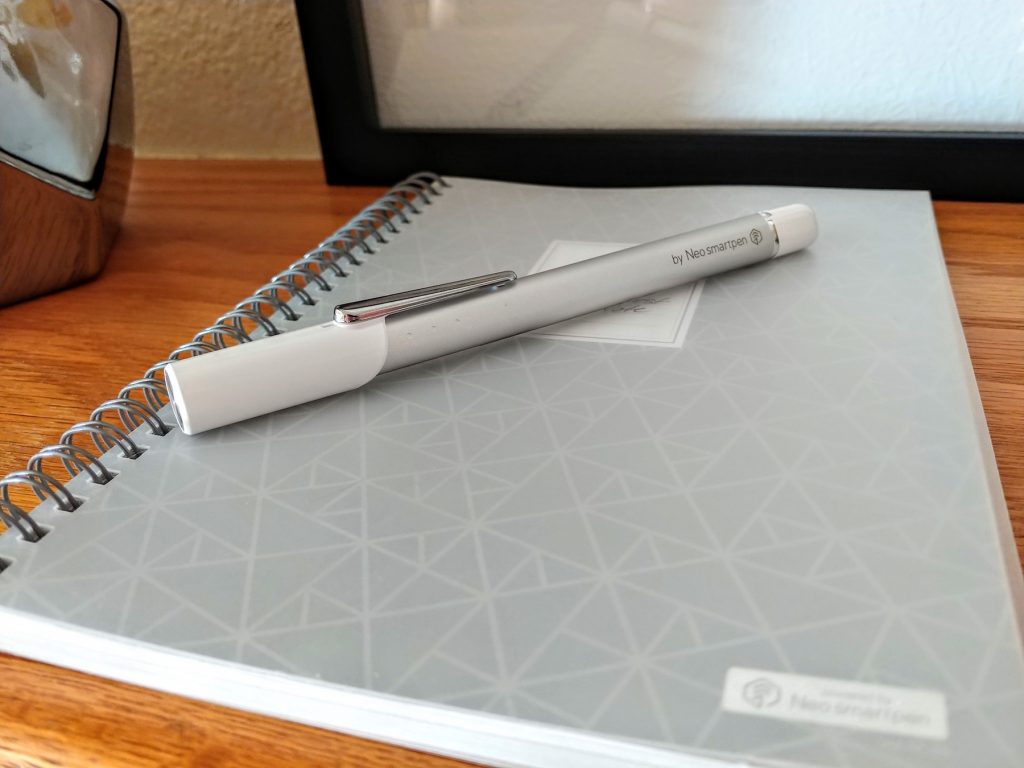
NeoLAB has a great selection of notebooks and folios compatible with the M1, including Moleskine – a personal favorite for notebooks. They have college ruled, standard, memo, pocket, planners, and professional – which features a faux leather cover and half-ruled, half-blank pages.
Additionally, NeoLAB designed printable PDFs in various styles to print your own Ncoded pages. There are a lot of formats, including Plain, Grid, Dot, Landscape, Manuscript, Checklist, Cornell, Meeting Minutes, Log Sheet, Letter, A5, and A5 string. Very clever.
While this won’t help you create your own Ncoded Code & Quill notebook (for example) it is nice to know that it’s not a requirement to buy proprietary notebooks in order to use the Neo Pen.
Value
If you hand-write notes frequently, the ability to transcribe them seamlessly and automatically is well worth the $130 (plus notebooks) cost of entry. If you don’t write much by hand, you may find this price tag to be too high. I fall into that former group, so you bet I’ll be using it – and probably investing in one of those fancy leather folios.
With the exception of the error I had earlier, the NeoPens performed admirably. In fact, every word of this review was written with the pen, and then formatted manually. I’d say it cut my writing time in half or so, when compared to manually transcribing.
Where to Buy
NeoPen M1: Amazon (Prime) – $129 | NeoLAB – $103 (on sale as of this writing)
NeoPen N2: Amazon (Prime) – $159 | NeoLAB – $169
Apple neglects Macs on second-quarter earnings call, again
Apple had its second-quarter earnings call today, and while it was mostly good news for stockholders, it wasn’t as good for Mac customers. For the second time in a row, the entire Mac lineup got the cold shoulder from Tim Cook and company when discussing revenue and plans for the future.
It’s worth mentioning these earnings calls are typically just updates for stockholders — the CEO walks everyone through quarterly earnings, profit margins, market share and all that. We usually get a few small glimpses at what’s coming up in the next quarter, when the CEO — in this case Tim Cook — mentions upcoming plans, or answers a particularly pointed question from a well-heeled stockholder.
However, with WWDC just around the corner and rumors that we might see a new MacBook Air, we expected we might hear a little something about Mac revenue, plans for the future, that kind of thing. Instead, there were only a few offhand comments about the Mac.
“The market for us is more than iPhone,” Tim Cook began, in response to a question about Apple’s plans for expanding in China. “Mac gained share there as well. Watch is getting some traction there. Services is doing extremely well. Several catalysts. I’m very pleased with the results that we were able to show during the quarter.”
It’s disappointing for Mac and MacBook users but it’s not much of a surprise. Despite making efforts to connect with its professional audience, with the upcoming Mac Pro and the new iMac Pro, Apple continues to pull away from its computer division. Hardware updates are infrequent, woefully outdated products like the MacBook Air continue to be sold at full-price, despite featuring outdated and under-powered hardware for the price.
Even the MacBook Air’s product page remains unchanged, still featuring language that describes components that have long-since become the standard in essentially every major laptop.
“MacBook Air is powered by fifth-generation Intel Core i5 and i7 processors. This ultra-efficient architecture was designed to use less power and still deliver high performance,” the MacBook Air’s product page reads and will continue to read since the rumored MacBook Air refresh got pushed back again.
Nobody expected Tim Cook to get on the Q2 earnings call and announce a slate of new MacBooks, but even a small amount of recognition would’ve gone a long way toward assuaging the fears of Mac users who might be looking at upgrading or switching platforms entirely. Instead, Mac users were neglected again, and it’s starting to seem like that’s not going to change. But hey, Apple sold a lot of AirPods.
Editors’ Recommendations
- Apple plans a radically redesigned Mac Pro for 2019
- Tim Cook says people don’t want iOS and MacOS to merge. What do you say?
- Apple is reportedly planning to abandon Intel hardware by 2020
- Apple aficionado, huh? Here are the 20 best Mac games
- Windows 10 vs. MacOS vs. Chrome OS
Have you always dreamed of having a personal robot? Misty II ready for pre-order
It’s been nearly a year since Sphero, the company known best for making lovable Star Wars droids into connected toys, announced that it would be spinning off a new startup, Misty Robotics, that’s dedicated to bringing robot assistants to smart homes. And now, we’re getting our first chance to bring one of these bots into our homes.
Misty recently showed off the Misty II, a slightly more advanced version of the original Misty robot the company debuted at CES in January 2018. Crowdfunding pre-orders are officially open for what’s being called the “personal robot you’ve been waiting for,” and prices begin at $1,499.
As per Misty’s new landing page for the bot, the Misty II is “professional grade, hardware-extensible, and purpose built as a development platform.” Meant for developers of both the amateur and professional variety, the Misty II promises to be “easy to make powerful,” but is DIY enough to keep robotics fans interested.
At six pounds and just over a foot tall (14 inches, to be exact), the Misty II is a relatively small robot, and meant for either the home or the office. It comes complete with a number of features that can help it safely navigate these scenarios, including a 3D Occipital sensor for mapping, a 4K Sony camera for facial and object recognition, and eight sensors to help avoid obstacles.
But what Misty II actually does for its owners is completely up to them. Depending on how the robot is programmed, it could serve as a security guard, tasked with investigating strange noises or opening the door; or as an extra pair of hands for mom and dad, checking in on children to ensure they’ve completed their chores. But ultimately, Misty wants its customers to dream up applications for the Misty II that the company itself can’t even conceive of. After all, the company’s goal is to put a robot in every home, which means that its robots will have to be able to execute a wide range of tasks.
To program Misty II, users can leverage a block-based programming interface Misty developed itself, as well as JavaScript APIs to create new skills or integrations with third-party services like Amazon Alexa or Google Assistant. Misty II is also able to run on TensorFlow, Caffe, and Windows ML and has two Qualcomm SnapDragon processors running Windows IoT Core and Android 7 operating systems.
Editors’ Recommendations
- Having problems with your Xbox One? We have some possible solutions
- Walmart says that store employees have embraced new robots
- Keep an eye on what you have in the oven with the CombiSteam Pro
- With this browser, ads can’t steal your attention — they have to pay you for it
- Help us, our sides have split: The best 2018 April Fools Day gags
Samsung partners with Oath to pre-load 4 Verizon apps on Galaxy S9 series
The S9/S9+ will now come with Yahoo Newsroom, Sports, Finance, and Go90.
Oath, Verizon Wireless’s digital media subsidiary, is partnering with Samsung to pre-load four of the company’s apps onto all Galaxy S9 and S9+ smartphones.

With this deal, Samsung’s Galaxy S9 series will now come pre-installed with Yahoo Newsroom, Yahoo Sports, Yahoo Finance, and Go90 (Verizon’s video streaming service). Along with the apps themselves, Oath content will also be presented to users via Bixby Home.
In addition to placing the content of these apps in more users’ hands, this will also allow Oath to get people where it counts – advertisements. According to Reuters –
The agreement will also allow advertisers to place ‘native ads’, or advertisement that blend in with the content where they appear, within Oath’s apps as well as Samsung’s Galaxy app.
Commenting on this, Oath CEO Tim Armstrong said, “This gets ads one step closer to being direct to consumer. You can’t be more direct than being on the mobile phone home screen and app environment.”
Although this is a big win for Oath, I can’t imagine too many consumers will be pleased to see more bloatware on their $700+ phone.
If you own a Galaxy S9/S9+, how do you feel about this partnership?
Samsung Galaxy S9 and S9+
- Galaxy S9 and S9+: Everything you need to know!
- Galaxy S9 review: A great phone for the masses
- Complete Galaxy S9 and S9+ specs
- Galaxy S9 vs. Galaxy S8: Should you upgrade?
- Join our Galaxy S9 forums
Verizon
AT&T
T-Mobile
Sprint

Never forget another password with a subscription to Dashlane!
Keeping all your online accounts secure is so crucial these days — but then with so many different accounts to keep track of, it can be hard to keep things straight while avoiding one password to use for all accounts (never do this).
If improving the security of your accounts is one of your goal for 2018, you should consider checking out a top-rated password manager such as Dashlane Password Manager.

Built with patented security architecture, Dashlane is available across all platforms and browsers and makes it a breeze to log into all your favorite websites and apps. Dashlane will remember all your passwords and autofill them when it’s time to log in, and also allows you to generate a brand new strong and unique password with a single click. And since Dashlane does all the remembering and auto-filling, you don’t have to remember a dozen different cryptic passwords.
Right now, first-time users can save 50% off a yearly subscription to Dashlane, which are available in one-year ($19.98), three-year ($59.94), and five-year terms ($99.90). With a Dashlane subscription, you’ll be able to manage and secure 500 different accounts at one time, which gives you the peace of mind to focus on the things you want to do without getting bogged down trying to remember your own password. You’ll want to act now, as this deal is only here for a limited time!
For a limited time, use coupon code DASHLANE10 and get an additional 10% off!
See at Android Central Digital Offers
 AIVAnet