


The best heating pad
By Kevin Purdy
This post was done in partnership with Wirecutter. When readers choose to buy Wirecutter’s independently chosen editorial picks, it may earn affiliate commissions that support its work. Read the full article here.
After sorting through hundreds of reviews for dozens of look-alike models, interviewing a doctor, a safety expert, and a journalist obsessed with back pain, and then testing seven top contenders, we recommend Pure Enrichment’s Pure Relief XL King Size Heating Pad for people who want rapid, reliable heat—dry or moist. It warms up quickly and has twice as many granular heat settings as other pads we researched and tested. Its controller has a backlit display and is easier to grasp and operate, and its power cord is easier to pop out when you need to wash the pad’s cover. Its two-hour auto shut-off function can be disabled too, and testers preferred the overall feel of this pad to all others we assessed.
Who this is for
People use electric heating pads to relieve muscle pain associated with menstrual cramps, arthritis, injuries, and other ailments. Heat increases blood flow where applied, helping to dilate blood vessels, improving circulation. The increased blood flow to a treated area can help soothe muscular cramping, spasms, aches, and soreness. However, frequent use or use on a new injury can cause problems. You should consult a doctor before treating yourself with cold or heat.
How we picked and tested

They’re very similar in looks, size, and price, but small differences between heating pads can add up to a significantly better experience. Photo: Michael Hession
In conducting expert interviews, reading hundreds of reviews, and talking to people who regularly use heating pads, we determined our criteria for picking out electric heating pads worth testing. (For this guide, we did not consider microwavable pads or hot-water-bottle-type devices.) We considered top-rated, UL-certified or ETL-certified heating pads that offered the following features:
- Three or more heat levels
- Quick heat-up
- Dry and moist heat options
- Easy machine washing of the covering
- An automatic shut-off timer
- An intuitive controller (one you could operate in the dark) with a long power cord
These criteria left us with seven models to test. We assessed each heating pad as follows:
- Applying each pad to gauge its overall feel and ease of use, and any noise it made when adjusted
- Evaluating the heat-up speed, heat dispersion, and average temperatures of each pad at given heat settings
- Testing the auto-off functions of each pad
- Washing and drying each pad cover
- Folding and storing each pad
- Monitoring each pad using a thermal-imaging camera as they heated up
Our pick: Pure Enrichment Pure Relief XL King Size Heating Pad

Photo: Michael Hession
The Pure Relief XL King Size Heating Pad was the consensus-favorite pad among our testers and offers features not found in similarly priced heating pads. The smooth and plush sides of the cover made it our testers’ overall favorite cover, and while it made a bit more crinkling noise when bending than some others, it was reasonably quiet. The Pure Relief’s six levels of heating (between 105 and 140 degrees Fahrenheit) fell within the same general range as other pads’ minimum and maximum levels, but offered the smallest gaps between temperatures. This addresses a common complaint among our panel of heating pad owners that “medium is too low, but high is too hot,” and makes it easier to find the right temperature and adjust it than pads with a narrower range of options and larger jumps between settings.
The Pure Relief’s controller is simple to use: You turn the heat up or down, turn the auto-off timer on or off, and turn the pad on or off. Other pads require you to cycle through settings (such as off/low/medium/high), a design that makes it more likely you’ll accidentally leave the pad on or have to click multiple times to simply go down one level. The Pure Relief’s LCD screen has big numbers and backlighting, a change from the tiny red lights and lettering on most controllers. Its cord stays firmly plugged into the pad and will not come loose, unlike with some pads we tested. Its cover dried faster than those of most other pads after washing, it comes with a storage bag, and it is warrantied for five years—though we will be watching this model for long-term reliability.
Runner-up: Sunbeam King Size XpressHeat

Photo: Michael Hession
If the Pure Relief pad is unavailable or becomes more expensive than Sunbeam’s King Size XpressHeat heating pad, we recommend the latter model. It is nearly the same pad: The XpressHeat has six heating settings, a very similar texture on both sides, a controller with a backlit LCD screen, and an identical button layout to the Pure Relief, plus the same warranty coverage. (The Pure Relief is likely a less-expensive “clone” of the more-established Sunbeam pad.) We like the clip-in cord plug on the Pure Relief better than the plugs on models that make you apply significant force to separate the pad from its cord, or those that come loose too easily. We also found the rounded controller easier to hold in our hand than the square-edged models of other pads. The Pure Relief’s carrying tote, while nothing special, at least provides a properly sized means of storage. One tester thought the XpressHeat was notably louder when crunched or folded than the Pure Relief. Sunbeam claims this pad heats up “three times faster” than other models, but that isn’t something we noticed in testing.
This guide may have been updated by Wirecutter. To see the current recommendation, please go here.
Note from Wirecutter: When readers choose to buy our independently chosen editorial picks, we may earn affiliate commissions that support our work.
Sony’s SXSW experiences draw out your sweat and feels
I wasn’t expecting to break a sweat when I visited Sony’s Wow Studio here at SXSW, despite the sweltering 90-degree weather. The tech giant is showing off about a dozen interactive demos at an air-conditioned warehouse here in Austin, and the event sounded like it would be really chill. But Sony wanted to make its visitors feel connected to its technology, and what better way to engage than through physical exertion?
Although the company has been attending SXSW since the show’s music festival days, this is only Sony’s second time bringing a warehouse full of quirky mini adventures to SXSW, and it’s expanded a bit beyond last year’s VR-heavy affair. Walking into the Wow Studio this year, you’re confronted with robots, photobooths and dark little rooms hiding mysterious demos with names like “Ghostly Whisper” and “Acoustic Vessel ‘Odyssey’.” You can stop to play with adorable new Aibos (that now understand English) if you wish, but the fun lies beyond the foyer.
Some of them have obvious sports themes. Things like “VR Soccer” and “A(i)r Hockey” showed off creative implementations of existing tech. For example, the soccer demo had me firing penalty kicks at a menacing goalkeeper character from the popular Captain Tsubasa manga series. This would probably have been more meaningful for a fan of the franchise, but for me it was simply amusing.

I was more impressed by the Air Hockey demo. Using a pair of Sony’s high-speed vision sensors, the system is able to track the puck and paddles on the table, and not only project colors onto each projectile, but also create virtual pucks. These come at you in later stages of the game, creating more challenging rounds.
Each paddle also housed vibration engines that buzzed when you touched a virtual puck, making the impact feel more realistic. There was barely any lag between the haptic feedback and me making contact with one of these faux pucks. At the height of drama during the game, things got so crazy that I had a hard time differentiating between the physical puck and the digital ones.
What’s intriguing about this particular demo is that the sensors are actually being used in self-driving cars to study moving objects at speeds of up to 1,000 frames per second. But instead of explaining how all of that works in a boring slideshow, Sony encouraged its engineers to come up with creative ways to engage the SXSW audience.

Shigeki Mori, head of brand strategy at Sony Japan, told Engadget that the mandate for employees when pitching SXSW concepts was to “please make it very experential.” The goal was to make people “feel something about the output,” and for the experiences to feel like “magic.” Mori believes that encouraging creative ideas and engaging with the SXSW audience is a “great way to get input,” which could eventually translate into something the company could use in the future.
Few of the projects shown at the Wow Studio will ever actually be launched as products for consumers, but they do show off creative implementations of existing tech. At “Interactive CUBE,” for example, Kinects, cameras and vibrating motors combined to facilitate games that let you use your body as a controller. In the “Rolling Rover” mini game, I had to swing my arms wildly to get the giant ball to move forward, and step side to side to make it go right or left. Nothing groundbreaking, but like any festival activation worth its salt, Interactive CUBE was extremely selfie- and photo-friendly (after you wipe off the sweat).

Being a horror buff, I was most excited to check out “Ghostly Whisper” — an installation borne from a collaboration between Sony and Universal Parks & Resorts. Billed as a “conceptual haunted experience,” this simulated series of paranormal incidents uses Sony’s Sonic Surf VR tech to play atmospheric sound, as well as send noises that seem to be coming from specific directions.
I was pleased with the quality of the tech setup — the eerie music and sudden flickers of sound were indeed realistic and felt like they came from where they were meant to. I only wish the experience had been more engaging, or that the plot moved along faster. Thanks to the long-drawn-out theatrics served by the tired-looking man in search of his daughter’s spirit, I almost felt relieved when things started to shake and lights began to flicker. Before long, the otherworldly noises gave way to an unsatisfying resolution, and I was left wanting (so much) more. The chills I expected to feel never showed up, unfortunately.

My disappointment at “Ghostly Whisper” was made up for at “Hero Generator,” which used Sony’s “Free-Viewpoint Visual Technology” to capture 360-degree footage of attendees to plop them in a superhero movie trailer. After being directed by a company rep, I made the appropriate faces and jumping actions while the room’s 16 cameras recorded. I still haven’t received my own superhero trailer just yet, as reps said it could take days to receive the file via the Sony Events app, but I’m excited to see how it turned out.
Ultimately, Sony has the right idea for tech demos at a show like SXSW. Focus less on explaining the tech or convincing people why you’re here — just wow your audience with magical experiences. On the whole, even if the components used at the Wow Studio weren’t necessarily the latest or most effective, I was still convinced that the stuff Sony is working on could be put to good use.
Catch up on the latest news from SXSW 2018 right here.
Twitter and Fox Sports have high hopes for their World Cup live show
With the 2018 FIFA World Cup in Russia just around the corner, right holders to the event are starting to share more details about their coverage plans. And, to no surprise to anyone, social media will play a major role in that. Fox Sports, FIFA’s English-language broadcast partner in the US, is going all out on Twitter this year with a partnership that includes a daily, 30-minute live show from Russia and bringing near-live highlights to the platform. Twitter, which has around 330 million active users, has been ramping up its sports efforts in recent years, and it plans to use the upcoming World Cup to showcase the power (and potential) of its platform. Just yesterday, the company announced a three-year deal with Major League Soccer to stream 24 games per season.
Fox Sports says that the show created alongside Twitter, called FIFA World Cup Now, will have 27 episodes — all of which are going to be streamed from a studio on Moscow’s Red Square. It’ll feature match previews, recaps, guest appearances from the likes of US football legend Landon Donovan and, of course, reactions from the world of Twitter. The network also plans to produce original content on the ground in Russia. Most importantly, perhaps, the partnership will let Twitter users watch highlights for each game almost in real time. Fox Sports says it can deliver cut-downs of notable moments, like goals scored, to the site in about two minutes. That’s impressive considering that, during the 2014 World Cup, it used to take ESPN 15 minutes to deliver highlights to the internet.
In addition to that, Twitter is also getting access to videos featuring player and coaches interviews, as well as pre- and post-match press conferences. It’s worth noting that Fox Sports’ daily live show and the other content it’s making for Twitter will only be available for users in the US, as the network only holds the rights to the 2018 World Cup here.

The show will stream live to Twitter from Red Square in Moscow, Russia.
“When you think of something as seminal as the World Cup,” said Kay Madati, Twitter’s vice president and global head of content partnerships, “it just presents this opportunity to marry the conversation that’s happening around the sport, and amplify it on our platform.” He said that, through efforts like the 2018 World Cup live show, Twitter is able to connect fans to the sport in a new, creative way — especially those who won’t be attending the event in Russia. Madati said that during the 2014 World Cup, which took place in Brazil, there were nearly 700 million tweets about it, noting that to this day the Brazil-Germany semifinal match is still the most-tweeted event in Twitter’s history. “I’m hoping to see that we break some of the records that we set before,” he said.
Madati pointed to these type of partnerships as being core to Twitter’s business strategy. The company also teamed up with People TV recently on an Oscars show, and it now also has a live NFL news and analysis program. Not surprisingly, Twitter isn’t the only one ramping up its video efforts, other industry giants like Facebook and Amazon are investing billions of dollars in the space.
But regardless of the competition, Madati believes Twitter continues to be the best place for interactive commentary, as it lets people have conversations with one another around something they love (or hate) in real time. “For us,” he said, “I think that we present a unique value proposition for users, and our business partners to actually extend reach, engagement and visibility, and fandom around sports or any other kind of activity in general.”
Catch up on the latest news from SXSW 2018 right here.
From the Editor’s Desk: Entertainment in the Smartphone Age
I want my phone to do everything, but that doesn’t mean I only want to use my phone.

There isn’t much your average phone can’t do these days. From communication to entertainment, research to shopping, it has never been easier for my phone to be my only computer. This week alone I have used my phone to write an article while on the exercise bike, finish Stargate Origins while waiting for my daughter to finish gymnastics practice, and do all of next week’s grocery shopping during a meeting I probably should have been paying closer
attention to (Sorry Phil). Being able to do all of these things is awesome, but Netflix reminded me this week that access does not mean utilization when it revealed a vast majority of people prefer the TV to the phone when watching.
When I want to disappear into a game for a while, I usually pick up my controller instead of my phone.
Granted, just because you’re watching Netflix on your television doesn’t mean your phone isn’t involved. The sheer volume of Chromecast sticks in the wild suggests more than a few of us are still using our phone in some capacity when watching TV these days, to say nothing of folks who surf Twitter while binging. That’s kind of the point though, it’s nice to have access to Netflix on my phone if I really want it, but having access doesn’t mean I’m going to use only that.
The same is true of gaming. Mobile games have improved a great deal over the last couple of years, leading to major console titles like Tomb Raider and Fortnite heading to the smaller screen. But when I want to disappear into a game for a while, I usually pick up my PlayStation 4 controller instead of my phone. Sony has seen the writing on the wall here, which is why things like PlayLink encourage you to use your phone as a controller for the console. Like the Jackbox games before it, PlayLink is all about meeting you where you are. It gives the people who are perfectly happy with playing on just their phones a reason to interact with a PlayStation 4. And it works, those games are ridiculously fun.

All of this makes me think about Razer and Samsung. The Razer Phone laptop dock and the Samsung Dex Pad are efforts to make it possible to use your phone to do more, but it’s unlikely either are going to fully replace my trusty desktop. Not just because I’m a big VR nerd, either. I like having my phone as an accessory to my PC in much the same way people like having their phones as an accessory to watching TV. As silly as it seems, I can use the small screen to give me a break from the bigger screen. Maybe it’s to clear my head for a moment and focus my thoughts, but that physical disconnect from one action to the next is more helpful to me than opening a tab on my PC.
Some other thoughts to close out your week:
- Andrew and Alex did an incredible job on the Galaxy S9+ review and video. It’s so cool to see them push themselves to deliver something even better each time.
- So far no sign of any gesture-based navigation in Android P, but tons of great new things are on the way.
- I’m not sure I buy into the OMG Pixel 3 will have a notch but it wouldn’t exactly surprise me.
- Quick reminder that Apple did not invent the notch, nor are these other manufacturers copying Apple. Phone life cycles are a lot longer than that, these phones were deep into the concept phase long before Apple made any announcements.
- We’re going to keep talking about PlayStation 4 stuff. We just are. This team is doing a great job so far, and those who have offered a warm welcome to the new information are deeply appreciated on this side of the screen.
That’s it for now — almost time to do it all again next week!
-Russell
Best Micro-USB Cables in 2018

Wherein we help you pick a great Micro-USB cable.
I understand. USB-C is the new hotness. But for all your legacy devices (and to charge tons of peripherals still), a good Micro-USB cable can go a long way. These are the best of the best around.
- EZOPower Micro-USB cable
- ReTrak Premier Series Retractable Micro-USB cable
- Anker 10-foot Nylon Braided Micro-USB cable
- Anker PowerLine Micro-USB cable
- iXCC Micro-USB cable
- Rampow braided nylon Micro-USB cable
- Ailkin 6-foot braided nylon Micro-USB cable
- iSeekerKit 1-foot Micro-USB cable
EZOPower Micro-USB cable

If you need a longer yet inexpensive Micro-USB cable, the EZOPower Micro-USB cable works very well.
It’s six feet long, so you have plenty of length to play with, whether you’re charging your phone in your car or at home. With charging speeds of 2.1A, you’ll top up your battery in no time at all.
Additionally, with its data transfer rate of 480Mbps, you can sync music or other files from your computer to your phone in seconds. Grab it in white, green, or orange, starting around $5.
See at Amazon
ReTrak Premier Series Retractable Micro-USB cable

If you’re tired of dealing with messy cables while traveling, the ReTrak Retractable Micro-USB cable may be the one for you.
Available in black in addition to seven bright colors, this Micro-USB cable retracts neatly into a small case — forget about wasting time winding and unwinding cables — a light tug pulls the cable into its casing. When expanded, this Micro-USB cable reaches a length of 3.2 feet in total.
Also, it has a transfer speed of 480Mbps, so you can sync music, pictures, or anything else from your computer to your phone in no time at all. Pricing starts around $8.
See at Amazon
Anker 10-foot Nylon Braided Micro-USB cable

Anker’s 10-foot Nylon Braided Micro-USB cable is a good choice if you have limited power outlets in a large room and you need the reach.
Constructed of braided nylon, this cable is strong, durable, and resists tangling. Anker claims that this cable has a lifespan of more than 4,000 bends, and customer reviews seem to back this up. Its gold-plated connectors aid in resisting corrosion as well.
Another benefit of this cable is that it gives you a 480Mbps data transfer speed, as well as fast charging.
If you want a durable, extra-long Micro-USB cable that’s fast, the Anker 10-foot Nylon Braided Micro-USB cable is the one for you. And it’s only $8.
See at Amazon
Anker PowerLine Micro-USB cable

The Anker PowerLine Micro-USB cable is rated highly by consumers, as well as The Wirecutter, because it is very durable and performs its job well. It’s also rather inexpensive at only $5.
Made of Kevlar — the same stuff that bulletproof vests are made from — this cable isn’t going to fray or otherwise break down any time soon. In fact, Anker boasts that it has a 10,000 bend lifespan, which customer reviews appear to confirm.
Additionally, its heavier-gauge wires are able to charge your device fast.
If you’re looking for an inexpensive Micro-USB cable that will last for years without fraying and coming apart at the ends, the Anker PowerLine Micro-USB cable might be your best choice.
See at Amazon
iXCC Micro-USB cable

iXCC’s Micro-USB cable is the best-selling one on Amazon, with 75% of its 10,461 reviews being 5-star. It comes in 3, 6, and 10 feet, and you can get a 3-pack with all 3 sizes, so you have a cable for all occasions. iXCC claims a lifespan of over 20 thousand bends, and it has a reinforced boot so that you have added strength where it matters most.
If you’re concerned with value and want some durable, reliable Micro-USB cables, then check out a three-pack from iXCC for around $12. Single cables start around $5.
See at Amazon
Rampow braided nylon Micro-USB cable

If you’re looking for a durable option, then braided nylon is the best way to go. It holds up better to bending than rubber cables, and Rampow’s cables feature stainless steel connectors. Braided nylon cables also resist tangling better than other cables, so toss a Rampow cable in your bag as is and don’t worry about pulling out a rat’s nest.
The best part of Rampow’s Micro-USB cable is Rampow’s unconditional lifetime warranty. If anything at all goes wrong with your cable (aside from you cutting it up with scissors), give Rampow a shout and it’ll replace it for you. Comes in space gray or red starting at $8.
See at Amazon
Ailkin 6-foot braided nylon Micro-USB cable

Braided nylon is a fantastic solution to the tangled cable problem, and Ailkin’s 6-foot cables are the perfect option for anyone who’s looking for major bang for their buck. You get a five-pack of colorful cables for only $12 on Amazon. They come in blue, pink, silver, orange, and green, making this one the perfect option for a family — everyone gets their own color!
There’s also a pack that subs in purple and red instead of pink and orange if you prefer.
See at Amazon
iSeekerKit 1-foot Micro-USB cable

If you’re at your desk, on your laptop, or somewhere you really don’t need 6 feet of cable, then check out iSeekerKit’s three-pack of 1-foot cables. They’re wrapped in braided nylon and come in eight colors to suit your style. Each three-pack is only about $8 and makes for a perfect travel cable. If you’re someone who likes to carry around a phone and a battery bank, this is also a great option to help cut down on long cords in your pockets.
See at Amazon
And you?
We’ve laid out our picks for best Micro-USB cables, but how about you? Which Micro-USB cables are you using and why are they awesome? Let us know in the comments below.
Updated March 2018: Updated pricing and added Ailkin’s colorful five-pack for anyone looking for big-time value, as well as iSeekerKit’s three-pack of 1-foot cables.
After Math: When it all comes crashing
It’s turning out to be a great week for falling objects. China’s first space station is set to reenter the Earth’s atmosphere, IBM’s 50-qubit processor record was felled by Google’s latest invention, the FBI and Geek Squad’s cozy narc relationship has been revealed and the White House has decided it wants to be able to shoot civilian drones out of the skies. Numbers, because how else will you gauge how fast you’re falling?

Twice: Since being launched in September of 2011, China’s Tiangong-1 space station has only hosted a pair of crewed missions. There won’t be a third because that big ole’ hunk of space metal will come crashing down into the Earth’s atmosphere sometime between now and the middle of April. Thanks a lot, gravity.

“Months”: That’s how long the Trump administration has reportedly been working on plans to allow federal agencies to track and shoot down civilian drones. And like most of the policies set forth by this administration, the drone ruling could be implemented tomorrow, next week, four months from now or not at all, depending exclusively on the whims of the President. Because that’s how good governance is supposed to work.

10 years: That’s how long the FBI has been using Geek Squad to surreptitiously spy on computers brought in for repair, the EFF has discovered. The Feds leveraged the repair center in its fight against child porn, at least that’s the story they’re sticking with.

Extremely: That’s how screwed Fyre Festival founder Billy McFarland is. His company forged documents and lied to investors to raise $26 million while leaving festival goers to fend for themselves on an uninhabited Bahaman island. McFarland is facing 40 years in the clink for his role in the scam (aka a pair of wire fraud counts).

$954 million: That’s how much the FCC plans to spend to rebuild Puerto Rico’s devastated telecom system. Can’t wait to see how badly the administration bungles this task given the bang-up job they did restoring the island’s water and power.

22: That’s how many more qubits Google manages to wrangle in its fancy new Bristlecone quantum chip than former record holder IBM is able to. This should help make the new few years of AI research very interesting.

25kHz and 180Hz: Those are the ultrasonic frequencies that Cuban spies might have used in order to eavesdrop on (and potentially deafen) US and Canadian Embassy workers last year, according to a study from the University of Michigan. However, the study is not conclusive and doesn’t alternative causes, so internet conspiracy theorists, do your thing.
‘The Future of Secrets’ is a digital confession booth
“I feel like I can justify the worst things I’ve done.”
“My initial connection to the majority of my partners is based on superficial sexism.”
“I once bumped someone’s phone when it was charging and it feel off a table and cracked and I just walked away.”
The experience of reading anonymous confessions is both intimate and detached. Being confronted with people’s real-life emotional baggage reveals quiet but deeply human moments, yet divorced from the person who said them there’s no human to project the resulting empathy on.
I read the divulgences above at The Future of Secrets. At the heart of this SXSW installation is a solitary laptop that asks “Do you have a secret?” You type your confession, hit enter, and it heads into a database of thousands. Seconds later, a receipt printer hums and pushes out someone else’s revelation — a reward. Meanwhile, your disclosure will be repurposed according to an opaque algorithm.
Across the room, steady robotic voices read the messages over headphones, sometimes in faint whispers, giving the sense that you’re privy to a confession. On one wall, projections of secrets pop into view then fade away, mimicking a restless mind of fleeting thoughts, some banal, some disturbing. On another wall runs an infinite scroll of the code which converts written secrets into audio. To the layperson, it appears that your thoughts are being processed and crunched but you don’t know how. A second receipt printer convulses apparently at random, spitting out secrets onto neat rectangles of thin, disposable, paper. I contributed my disclosure knowing it could appear minutes later in this room, or in several months, perhaps in in the next city the installation travels to.
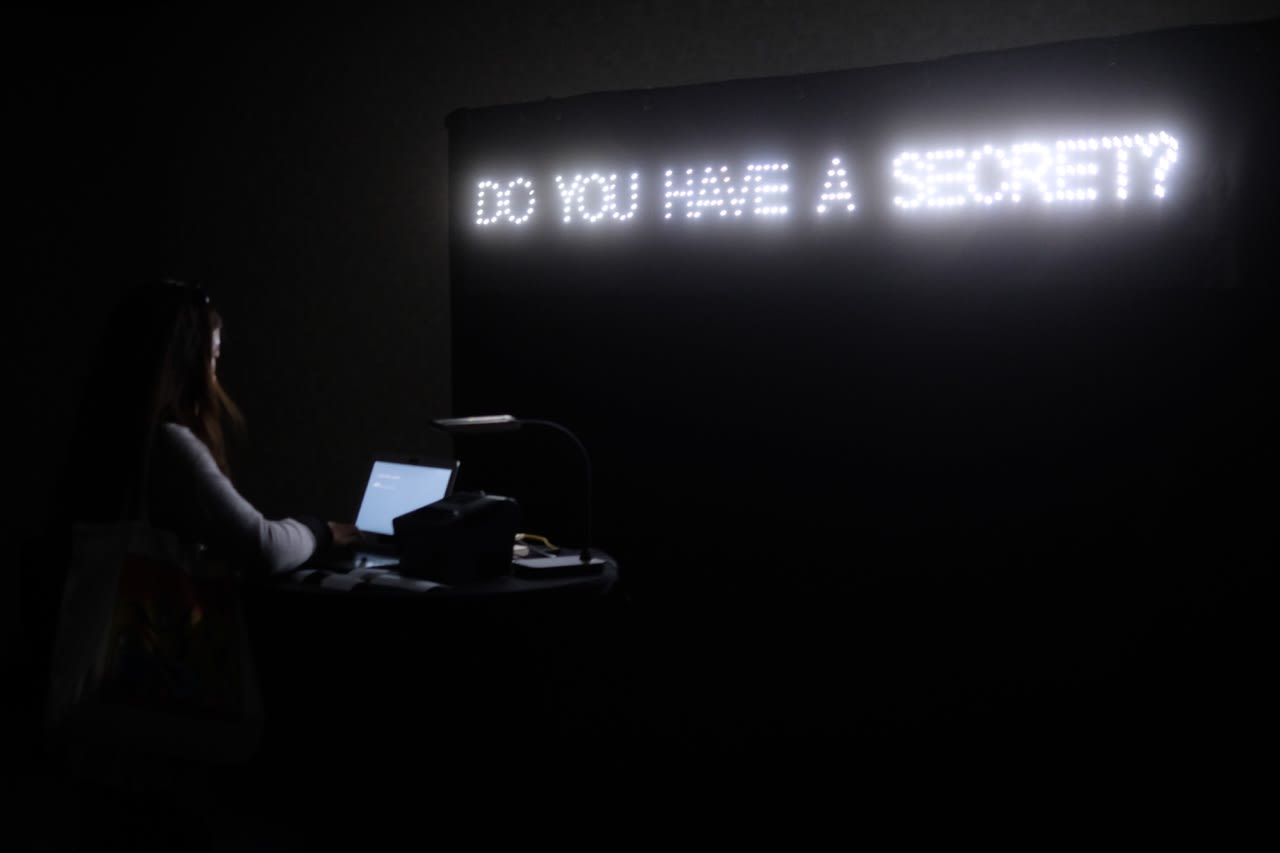
For the three creators — Sarah Newman, Rachel Kalmar and Jessica Yurkofksy from Harvard University’s metaLAB and the Berkman Klein Center for Internet & Society — the project stems from an interest in what will happen to our immortalized digital communications in the far future. This is the eighth time that a variation on this project has exhibited, while drawing on and growing the database of secrets, whether in Boston, Berlin or Rome.
It reflects what we do on social media all the time: give up secrets without knowing where they’ll end up, and receive the details of others’ lives as compensation for providing our own.
But it also differs from the way Google, Facebook, Amazon or the myriad apps we sign up for harvest our data. Online, we tap out mundane messages or buy household supplies and companies infer our secrets; here we are asked explicitly to admit to our thoughts. The Future of Secrets is also strictly anonymous: There are no cameras in the room or ways to trace a secret back to its teller. During SXSW, secrets can also be submitted online; Newman told me the website tracks nothing but the confession and its time of submission).
This strict decoupling of the confession from confessor is liberating, and draws attention to the fact that we can’t usually feel so safe in our disclosures online — there’s always a sneaking suspicion our data could be used for nefarious purposes, justified by a sentence buried deep in the terms and conditions. Like the mid-2000s postcard project PostSecret, this installation shows the value of anonymous secrets. Unlike with apps that have tried to replicate the experience such as Whisper, we can write without a creeping feeling of being tracked.
The result is a kind of catharsis. People confess that they find Bernie Sanders sexy, fear tiny doll houses or have a picture of Conan O’Brien in their retainer. Plenty admit to infidelity, sexual expression or childhood shame. While these may feel like a burden to the individual, displayed alongside dozens of others’ secrets they almost seem commonplace. People send dispatches from their darkest core and realize they’re practically trivial.

“It’s so rare that you have the opportunity to share something which really is not connected back to you,” said Kalmar. “I don’t post things on social media which I don’t want to be public and permanent because they’re connected to my persona… I wish I could say something like ‘It’s Friday night, I’d like to hang out with other people, does anybody want to have dinner?’ But I’ll never let myself post that.”
Exposure to all these authentic insecurities has a humanizing effect. You don’t know who said what, but you become conscious that a stranger — any stranger — can have their own issues and quirks.
“I actually think that one of the hopes of the piece is making people feel more compassionate and also more humble,” said Newman. “That said, it’s embedded with a certain critique of the way we rely on technology… I think there is a darker side that it’s important to be aware of.”
The tension between ominousness and sentimentality is what makes The Future of Secrets compelling. You can’t forget the sketchiness of data privacy issues when you see people’s revelations embedded in code. And you can’t remain purely cynical when bombarded with sentimental regrets or absurdities.
At SXSW, where the go-getters in arts, entertainment and technology are pitching their wares, “activating” their brands and networking with relentless optimism, it’s refreshing to step into a dark, silent room for a moment and reflect on the experiences we may have in common that are rarely shared out loud.
Catch up on the latest news from SXSW 2018 right here.
Images: Engadget
NASA wants to change the way we think about the habitable zone
“There are great possibilities in expanding the habitable zone beyond our traditional blinders on that vision where it’s Earth or nothing.”
That’s Dr. Cynthia Phillips, a planetary geologist at NASA’s Jet Propulsion Laboratory. She’s currently working on a mission to study Europa, one of Jupiter’s icy moons with a subsurface ocean. Jupiter — and, by association, Europa — is well outside of the “habitable zone,” the gauge astronomers have used for years to determine whether a planet can sustain liquid water, a major precursor for life. But in Phillips’ view, being outside of this zone doesn’t automatically mean the moon or planet is devoid of life.
At SXSW, Phillips and a panel of NASA scientists discussed how they’re approaching the search for alien life within our own solar system and beyond — and, as it turns out, they’re not necessarily looking for another Earth.
“Our solar system is just one example, but there’s this huge diversity of systems out there that look nothing like the Earth,” Phillips said. “We haven’t found any planets that are like Earth yet, and of course it’s hard to find Earths because they’re relatively small.”
One of the most exciting discoveries in recent years was the TRAPPIST-1 system — a group of seven Earth-sized planets circling a red dwarf star 40 light years away. Hopes of finding life on these planets were dashed in July 2017 after two studies from the Harvard-Smithsonian Center for Astrophysics concluded the red dwarf was likely too dim and cool to support Earth-like ecosystems. The habitable zone, in this case, was much closer to the star than Earth is to the Sun, increasing the amount of UV radiation on these planets to an unlivable level.
At least, unlivable by Earth standards. In December, a study published on arXiV.org proposed the idea that the “habitable zone” was too narrow a search criteria when looking for alien life. Researchers were as likely, if not more, to find life on frozen planets with subsurface oceans, according to the study’s authors. That life, of course, may not look much like the organisms on Earth.

At SXSW, Dr. Tiffany Kataria expanded on this idea. Not only should scientists be looking at the surface of frigid planets, she argued, but at the mysteries below. Tidal heating is key here — this process heats up the interior of a planet or moon via the friction that gathers as it orbits a sun or planet. For example, Io, one of Saturn’s moon’s, has hundreds of volcanoes produced by tidal heating. It’s possible that this orbital process could produce liquid water, a precursor of life, under the surface of Io and other frigid moons or planets.
“We really need to revise what that construct looks like,” Kataria said. “We’ve said the habitable zone is classically defined by this rigid [ruleset], but if we look at our own Earth, there are many different conditions that contribute to life, and life can persist in absence of some of those criteria.”
Her fellow panelist, Dr. Morgan L. Cable, agreed. “And that’s still just considering life as we know it,” she said. “There are plenty of other things that are liquids that could potentially host some sort of unique biochemistry.” Things like liquid methane, liquid ammonia or liquid carbon dioxide, for example — these liquids wouldn’t necessarily be able to sustain Earth-like life, but that doesn’t mean they’re devoid of new organisms.
“The world is wide open, the universe is wide open, in terms of where we might look,” Cable said.
After the panel, Phillips emphasized the idea that humans can’t let their own Earth-based experiences skew the scientific possibilities. The habitable zone isn’t a hard-and-fast rule for finding life; it’s simply a known, provable foundation. What’s more interesting, perhaps, are the unproven, as-yet-unobserved criteria for sustaining life outside Earth.
“The sheer diversity of worlds out there means we can’t be biased,” she said. “We can’t just look at, OK, here’s the Earth, here’s what the Earth looks like, we’re looking for exactly this. We have to be much more creative.”
Catch up on the latest news from SXSW 2018 right here.
Study shows Android enjoys more brand loyalty than iOS
Apple fans are a loyal lot. Some might even say they are too loyal, as some parts of the Apple fandom have earned a reputation for cult-like loyalty to the company. A new study by Consumer Intelligence Research Partners, however, shows that Android fans are more loyal to their choice of phone OS than are users of iOS. Tech Crunch reported on the study, which shows that Android-brand loyalty has been rising since 2016, and is currently the highest in the history of the OS.
Currently, Android enjoys a loyalty rate of 91 percent, compared to the 86 percent held by iOS. In order to measure brand loyalty, CIRP looked at the percentage of consumers who stayed with their previous OS after upgrading their phones.
With only two mobile operating systems at this point, it appears users now pick one, learn it, invest in apps and storage, and stick with it,” CIRP’s Mike Levin told Tech Crunch. “Now, Apple and Google need to figure out how to sell products and services to these loyal customer bases.”
This may explain why both Google and Apple are heavily investing in services such as apps, music, and storage. In fact, despite seeing lower brand loyalty, Apple saw record revenues from services last November. This would indicate that the company is doing a good job of earning money from its existing customer base.
As for why Android has a stronger brand loyalty, that may be due simply to the broad range of Android devices on the market. Whereas Apple only offers a handful of premium products, Android devices ran the gamut of disposable $50 phones all the way up to high-priced flagships such as the Pixel or Galaxy S line of smartphones. Even those users who want to stay within a specific price range have a wealth of options to chose from. They can transfer their app purchases and storage content from phone to phone, whether that be a $900 flagship, or a $40 phone running Marshmallow.
One other thing worth noting is that even though Android enjoys slightly higher loyalty, there are still more Android users switching to iOS than vice-versa, simply due to how large the Android market is.
“We know Android has a larger base of users than iOS, and because of that larger base, the absolute number of users that switch to iOS from Android is as large or larger than the absolute number of users that switch to Android from iOS,” Levin told Tech Crunch. “Looking at absolute number of users in this way tends to support claims that iOS gains more former Android users,
than Android does former iOS users.”
Editors’ Recommendations
- How to install Windows 10 on a Mac
- Kuo: Apple’s culty iPhone SE is not getting any big changes
- Apple AR glasses: News and rumors about ‘Project Mirrorshades’
- Five companies, other than Shazam, that Apple should acquire
- Here’s everything you need to know about the 2018 Ram 1500 pickup
NASA plans to use nukes to save the Earth from a killer asteroid
Although there’s a very small chance it could happen, a large asteroid impacting the Earth would be a worldwide catastrophe. Government scientists have developed a plan for such an eventuality — blow it up (or deflect its trajectory) with a nuclear weapon.
According to BuzzFeed News, a joint venture between NASA, the National Nuclear Security Administration, and weapons labs from the Energy Department has resulted in designs for a spacecraft capable of saving the planet. Dubbed HAMMER (Hypervelocity Asteroid Mitigation Mission for Emergency Response), the 8.8-ton craft would be able to alter the orbit of an incoming asteroid, either by crashing into a small one or detonating a nuclear device on a large one.
“Smart people are taking this seriously and thinking carefully about what might be done,” MIT impact expert Richard Binzel told the website. “These are reasonable ideas — well thought out.”
As outlined in the science journal Acta Astronautica, the more time we have to prepare for such an eventuality, the more likely the chance of success: “To use a kinetic impactor for successful deflection of an NEO [near-Earth object], it is essential to minimize the reaction time and maximize the time available for the impulse delivered to the NEO by the kinetic impactor to integrate forward in time to the eventual deflection of the NEO away from Earth impact.”
Scientists are using an asteroid named Bennu for a case study. According to calculations, there is a 1 in 2,700 chance it will strike the Earth in 2135 — on September 21, to be precise. Launched in 2016, the OSIRIS-REx spacecraft is currently on its way there. Later this year, it will scoop up a sample from the surface of Bennu in a “touch-and-go” maneuver before it returns to Earth.
Bennu is about one-third of a mile wide and weighs 174 billion pounds. If it struck the Earth, it would trigger a 1.13-gigaton blast, more than 20 times larger than the biggest hydrogen bomb ever tested. It was chosen for the impact scenario mainly because it’s been studied exhaustively as part of the OSIRIS-Rex mission.
“If the asteroid is small enough, and we detect it early enough, we can do it with the impactor,” physicist David Dearborn told BuzzFeed. “The impactor is not as flexible as the nuclear option when we really want to change the speed of the body in a hurry.”
It’s difficult to map the exact trajectory of these giant rocks hurtling through space, as they are subject to various gravitational forces and buffeted by solar winds. Strapping nuclear weapons to giant rockets and launching them on a collision course is hardly a sure thing, so the sooner scientists can identify possible threats, the better.
Detection of potentially dangerous NEOs needs to remain one of NASA’s priorities, said Bizel. “Time is the most important factor,” he added. “If you have more time, this problem gets much easier.”
Editors’ Recommendations
- A.I. is ready to advise us on how to best protect Earth from deadly asteroids
- NASA just tested the tiny nuclear reactor it could use for a Martian colony
- NASA releases first images of Jupiter’s bizarre geometric storms
- Konami says ‘Metal Gear Solid V’ nuclear event was triggered by mistake
- An amateur astronomer just discovered a long-lost NASA zombie satellite
 AIVAnet