


These are the 10 best Alexa skills for India
Amazon has thoroughly customized the Alexa experience for the Indian market.

Amazon launched the Echo family in India at the end of last year, introducing the subcontinent to Alexa. The virtual assistant made its debut three years ago on the first-gen Echo and over the years Amazon has steadily added more features to Alexa, making it one of the most robust options available in this space.
Amazon took its time in bringing the Echo family to India as the retailer was customizing Alexa for the local audience. That includes a wide range of skills that leverage Indian services — including Zomato and Ola — and working around limitations like e-commerce purchases. In India, all e-commerce transactions require a secondary layer of authentication, usually in the form of an OTP delivered to a user’s phone number.
The mandate means Amazon’s one-click order isn’t available in India, and so the retailer had to introduce a digital wallet — dubbed Amazon Pay — to work around the limitation. There are a lot of such instances where Amazon took the time and effort to customize Alexa for the Indian market, and the end result is that the assistant offers a ton of features out of the gate.
If you’re just getting started with your Echo or are looking to know more about what Alexa can do, read on.
Book an Uber/Ola

Booking a cab with Alexa is about as straightforward as it gets. You’ll need to link your Uber or Ola account with Alexa, and then the virtual assistant will be able to request a ride on your behalf. You can link your accounts by going into the skills section, finding the Uber or Ola skill, and signing into your account.
As with everything else, you’ll get an OTP on your phone number to confirm the linking of the two accounts, but it’s a one-time process. After you link your account, you’ll be able to book a cab by just saying, “Alexa, book an Uber.”
You can request a ride from any of your saved Uber addresses, or Alexa can pull in your home address from Amazon as well. Alexa will list out the closest ride option by default (for me, that tends to be UberGO), but if you’re looking for UberX or UberSUV, you can ask the virtual assistant to list other cab options available.
Once you confirm the ride, Alexa will tell you how far away your taxi is, and give you a fare estimate to your destination.
Control smart home products
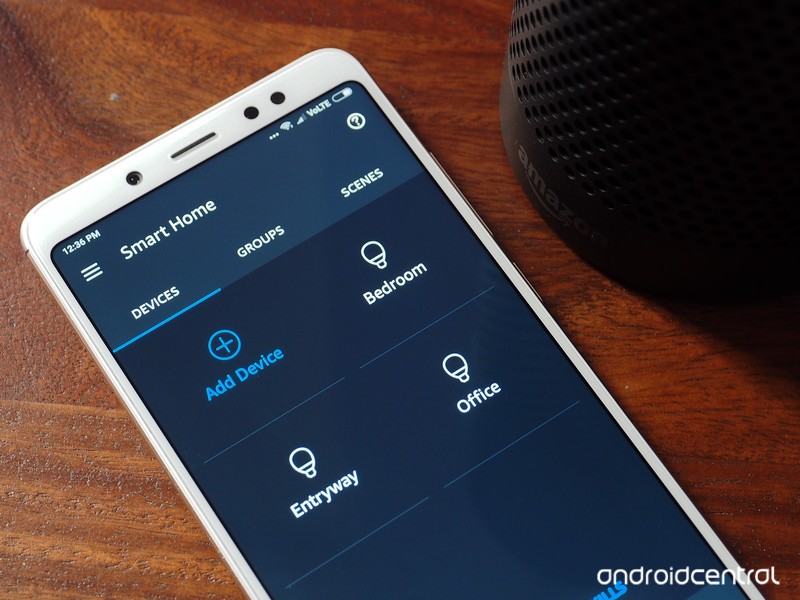
The larger Echo Plus has ZigBee built into the chassis, which essentially eliminates the need for a dedicated hub for your smart lights or door locks. The integrated hub makes it easier to connect devices to the Echo Plus, and because Alexa made its global debut over four years ago, there’s a laundry list of manufacturers offering support for the platform.
If you’re looking to get started with the smart home segment and are interested in a virtual assistant to control the lights or connected appliances, Alexa is the way to go. With Google Home not yet available in the country, it’s also the only option available to Indian customers. That said, having used both the Echo Plus and a Google Home side-by-side, the former does a better job of finding and connecting to smart home gear.
Alexa has a lot of localized skills for the Indian market, so in addition to Hue, you can add bulbs from Syska, Yeelight, Oakter, and more. Chances are if you have a smart home product, there’s an Alexa skill for it.
Syska, Hue, LIFX, Oakter,
Buy things from Amazon

One of the coolest things you can do with your Echo is purchase items from Amazon. All you have to do is say something along the lines of, “Alexa, order hand sanitizer,” and Alexa will look through your order history to see if you’ve ordered hand sanitizer in the past.
If it finds an item with a matching description, it will suggest that particular product and give you details on pricing. If there isn’t a product available from your order history, Alexa will read out the top two links for that product query on Amazon, followed up with, “Would you like to buy it?”. All you need to do is say yes for the order to go through.
Alexa will also mention the estimated delivery date once the order is successfully placed. The balance will be automatically deducted from your Amazon Pay account, and to prevent misuse, there’s also the option of adding a four-digit passcode that you’ll have to furnish Alexa before confirming an order.
You’ll be able to view the order confirmation details in the Alexa app, and Amazon will send an email with all the relevant information. Buying things from Alexa is about as easy as it gets, and as I use Amazon for most of my ecommerce purchases, it is one of the features I use the most.
Get food from Zomato
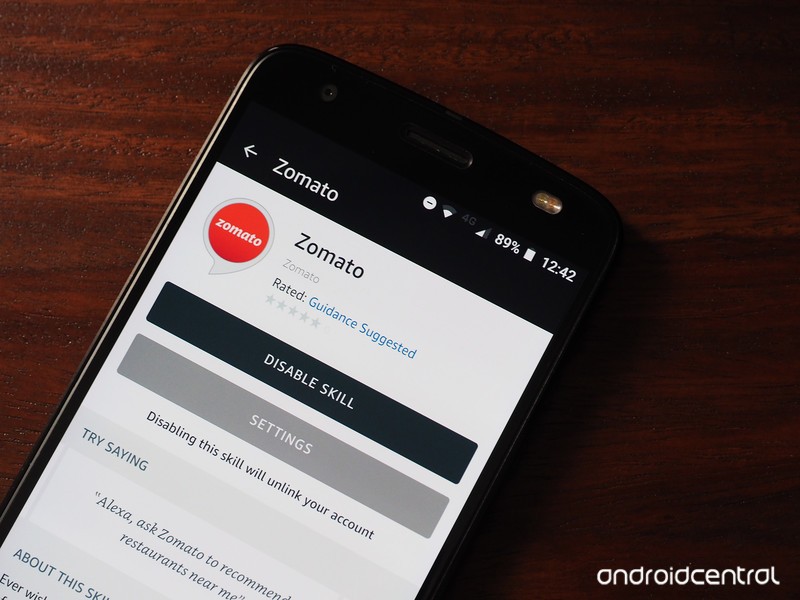
The Zomato skill allows Alexa to suggest restaurant recommendations and order food to your house. If you’re looking to dine out, all you need to do is say, “Alexa, find restaurants nearby” and the assistant will serve up suggestions based on your location.
Alexa will also ask you what kind of cuisine you’re interested in, so if you’re in the mood for some Mexican food, you can ask the assistant to look for Mexican restaurants in your city. For dining in, you can just say, “Alexa order food from Zomato” and it will look through your order history and suggest restaurants.
Get score updates

India is crazy about cricket, and Alexa is a great resource for tracking the latest score. Just say, “Alexa, what’s the score?” and you’ll get a rundown of football, cricket, and any other sports scores. If you’re looking for scores from a particular match, just include the match name and you’ll get a thorough breakdown.
You’ll also get detailed statistics in the Alexa app. So if you’re looking to catch up on cricket scores or see if Arsenal won a match lately, all you have to do is ask Alexa.
Hear the flash briefing

Alexa plugs into a lot of news sources, so if you’re looking to start the day with the latest headlines, you can just ask, “Alexa, what’s in the news?” and you’ll get a briefing with what’s going on in the world.
As with most things to do with Alexa in India, the flash briefing feature lists a lot of local news sources, so you should be able to find the publication you read in the skills list.
Play songs from Prime Music

Prime Music isn’t officially live in India just yet, but it is available to Echo owners in preview form. The service has a vast catalog of songs available,, ranging from classic rock to heavy metal, reggaeton, electronica, pop music, and a staggering amount of regional songs.
Amazon has tied up with a majority of local labels, including the likes of Sony Music, Saregama, Times Music, Tips Music, Zee Music, Venus Music, and Warner Music Group, so if you’re interested in listening to regional songs, Prime Music is one of the best options available in the market today.
Amazon also recently inked a deal with T-Series, India’s largest music label, to make its catalog of over 150,000 songs available on Prime Music.
Alexa automatically selects Prime Music as the default music services; in the unlikely scenario where it can’t find a song on Prime Music, it switches to Saavn.
Ask it to tell jokes

When it comes to jokes, Alexa is just as good as Google Home at delivering the most cringe-inducing one-liners. Like everything else to do with Alexa for the Indian market, Amazon has tailored the jokes for the local audience, so get ready for a lot of Bollywood-themes quips.
Play games

If you’re feeling bored, you can play a game with Alexa. Just ask, “Alexa, let’s play a game” and the assistant will respond with a lengthy list of games. Alternatively, you can enable skills in the Alexa app if you’re looking for a particular game. There’s enough content to keep you entertained for hours.
I’m partial to trivia-based games, and Alexa offers a wide variety of skills in this area.
Call your family and friends

Alexa’s latest feature is the ability to call and text family and friends that also own an Echo device. Essentially, all Alexa-to-Alexa calls and texts are free, and there’s a feature that lets you “drop in” on another Echo device. You can restrict the feature to members within your household (and you should).
Your turn
Got an Alexa skill that you use a lot? Let me know in the comments below.
New Audi tech will let you ditch your toll road tag
Audi is about to make life easier for people that deal with toll roads on a daily basis. Instead of using an ugly stick-on tag or box for passing through and paying tolls, Audi will make it a built-in feature on some of its cars. It’s called the Integrated Toll Module (ITM), and it uses a transponder conveniently tucked away behind the rear view mirror. You’ll be able to pull that old tag off your car and reclaim windshield space. Plus, you’ll never forget to bring it with you, since it never leaves the car.
The new technology will be compatible with nearly every toll road in the country, regardless of the company or government operating it. The company that developed it with Audi, Gentex, specifically says it will work with 97.8 percent of toll booths in the U.S. Audi also says it will be compatible with some systems in Canada and Mexico, too. And for regions that have toll roads with carpool requirements, there is a setting for it accessible in the car’s infotainment system.
The ITM won’t be available until late 2018. It will only be available on select vehicles as well. The company didn’t say which cars will feature it, but the press photo Audi sent out shows an A8 interior, so we suspect that’ll be one of the models included. Pricing for the feature also has yet to be announced.
Related Video:

Watch Netflix’s first trailer for hip-hop biopic ‘Roxanne, Roxanne’
Roxanne, Roxanne, the Lolita “Roxanne Shanté” Gooden biopic that premiered at Sundance last year, is making its way to Netflix on March 23rd — and you can watch its first official trailer below the fold. Shanté rose to prominence as one of the most fearsome battle rappers in Queens, New York back in the 80s when she was just 14 years old. The biopic has some big names attached to it, including Oscar-winner Mahershala Ali (Moonlight, Luke Cage). Chanté Adams, the new actress who plays Roxanne, held her own though and won Sundance’s Special Jury Award for Breakthrough Performance.
Shanté’s journey began when she wrote a track in response to rap trio U.T.F.O.’s Roxanne, Roxanne about a girl who wouldn’t respond to their advances. In addition to showing how Shanté became a feared battle rapper in Queens, the Netflix original also explores the difficulties she faced to support her family.
Check out the trailer below:
Source: Netflix
Apple’s AirPower Wireless Charging Mat Could Be Available to Buy Next Month
Apple will begin selling its AirPower wireless charging mat next month, according to Japanese website Mac Otakara. The publication has spoken to “reliable sources” who have apparently confirmed a claim made earlier in February by The Apple Post that the wireless accessory will go on sale in Apple retail stores sometime in March, although the specific date still remains unclear.
Announced by Apple in September, AirPower is an oval-shaped white charging mat featuring Qi-compatible networking technology that will allow it to charge multiple devices at once. Along with an iPhone 8, iPhone 8 Plus, or iPhone X, and the Apple Watch Series 3, the AirPower charges AirPods thanks to a new wireless charging AirPods case that’s also set to be released sometime soon.
According to the original rumor, Apple intends to make the AirPower mat available to purchase concurrently at Best Buy and other Authorized Apple Resellers alongside its own retail stores. The Apple Post also claimed that in addition, Apple retail stores will stock the updated AirPods wireless charging case on the same day, although Mac Otakara’s own sources make no mention of this.
Mac Otakara has connections to the Asian supply chain and Asian accessory manufacturers, making it a typically trusted source for Apple product rumors. That said, the publication does not have a perfect record and has shared inaccurate info on occasion, so it’s best not to take the latest report as fact until backed up by other sources.
Right now our best guess is that Apple’s AirPower wireless charging mat will cost around $199 in the United States, based on a price listing for the accessory that appeared on a Polish website in November.
Tags: AirPods, AirPower
Discuss this article in our forums
14 major milestones along the brief history of 3D printing
3D printing is one of the most revolutionary technologies of the 21st century. Giving everyone from engineers and doctors to DIY enthusiasts and small business owners the ability to transform virtual ideas into physical objects, it promises to change life as we know it.
If you don’t know your laser sintering from your Shapeways or your bioprinting from your RepRaps, read on. These are the milestones we’ve passed so far on the road to making 3D printing a reality!
The earliest breakthroughs
1800s: 3D printing doesn’t officially get started until the late twentieth century, but some of the ideas behind it date back a little bit further.
In 1859, a French “photosculptor” named François Willème demonstrates the world’s first “3D scanning” technology by using 24 cameras to simultaneously photograph subjects from different angles.
A few years later, in 1892, inventor Joseph E. Blanther is awarded a patent for a method of creating 3D topographical maps using a layering method — similar in concept to today’s 3D printers.
Both hint at the promise of 3D printing to come!
The real birth of 3D printing
1980: The first attempts at modern 3D printing are carried out at a time when most of us are still marvelling at owning our first regular printers.
The first patent relating to the technology is filed in May 1980 by Dr. Hideo Kodama of Nagoya Municipal Industrial Research Institute, describing a photopolymer rapid prototyping system. Kodama’s idea involves using vat of photopolymer material, exposed to UV light, in order to harden a part. Unfortunately, he never commercializes it.
The arrival of stereolithography apparatus (SLA)
1986: Chuck Hull invents stereolithography apparatus (SLA). This 3D printing technique refers to a method of printing objects layer by layer using a process in which lasers selectively cause chains of molecules to link together, forming polymers.
Hull goes on to go-found 3D Systems Corporation, which introduces the world’s first commercial 3D printing system, the SLA-1.
The world of selective laser sintering (SLS)
1987: Carl Deckard at University of Texas pioneers an alternative method of 3D printing, which turns loose powder into a solid, instead of Chuck Hall’s liquid resin process. Deckard’s approach to 3D printing involves using a laser to bind the powder together as a solid. His first machine is called “Betsy.”
It takes until 2006 until the first SLS printers are commercially viable, thereby opening up new opportunities in manufacturing.
Fused deposition modeling (FDM) is born
1989: S. Scott Crump, along with his wife and fellow inventor Lisa Crump, invents and patents a new additive manufacturing method called Fused Deposition Modeling. This technique involves melting a polymer filament and depositing it onto a substrate, layer by layer, to create a 3D object.
The idea for this new technology came to Crump a year earlier, in 1988, when he attempted to create a toy frog for his daughter using a hot glue gun loaded wit ha mixture of polyethylene and candle wax. After struggling to do it manually, he envisioned a way to automate the process and build the shape by creating a series of thin layers stacked on top of each other.
Crump later goes on to co-found Stratasys, which remains one of the most prominent additive manufacturing companies in the world today.
The birth of medical 3D bioprinting
1999: The use of 3D printed organs in surgery becomes a real thing when a lab-grown urinary bladder is successfully transplanted into a patient, using technology developed by the Wake Forest Institute for Regenerative Medicine.
The artificial bladder is created by taking a CT scan of the patient’s bladder and then printing a biodegradable scaffold using the information. Cells grown using a tissue sample from the patient’s bladder are then layered onto the scaffold, before it is transplanted.
The RepRap revolution
2004: Adrian Bowyer, a senior lecturer in mechanical engineering at the U.K.’s University of Bath founds the RepRap project, an open-source project which aims to build a 3D printer that can print most of its own components.
The idea is that this will democratize 3D printing, by expanding to technology to people all around the world — since friends will be able to print 3D printers for their friends.
The design of the first RepRap 3D printer, named “Darwin,” is released a few years later in March 2007. Other versions, including “Mendel,” “Prusa Mendel” and “Huxley,” follow in the years to come. The initial RepRap printers are named after famous evolutionary biologists, since the project is all about replication and evolution.
Printing on demand
2008: Shapeways, a 3D printing service, is launched in the Netherlands. A bit like RepRap, Shapeways makes 3D printing available to a wider audience.
Rather than giving people their own 3D printers, however, Shapeways lets users submit their own 3D files, which the company then 3D prints and ships back.
Shapeways rapidly expands to a factory in Queens, New York, and raises substantial venture funding. It also becomes a marketplace for 3D printed objects, which the company will then print on demand. Shapeways makes 3D printing accessible to a non-tech crowd, including artists, architects and other creative individuals.
3D printed prosthetics
2008: The first usable 3D printed prosthetic leg is created and used. It is printed “as is” without requiring additional later assembly. Today, a number of 3D printed prostheses have been created and used around the world.
Here comes Kickstarter
2009: Kickstarter launches. While not directly related to 3D printing, the crowdfunding website becomes a launchpad and money-raising platform for a large number of 3D printers.
While some of them crash and burn, others go on to establish themselves as major players in the industry.
To date, the most funded Kickstarter 3D printer project is 2014’s Micro, a consumer 3D printer supporting PLA or ABS materials, along with its own proprietary and standard filament spools. Asking for $50,000, its creators instead raise a massive $3,401,361.
The arrival of Makerbot
2009: Following the expiration of a key patent on FDM technology, Makerbot launches and helps bring 3D printing technology into the mainstream.
Building on the success of the RepRap dream, Makerbot makes open-source D.I.Y. kits for people who want to build their own 3D printers or 3D printed products. It has since sold over 100,000 such kits.
The company also creates online file library Thingiverse, allowing users to submit and download 3D printable files. Thingiverse becomes the largest online 3D printing community and file repository. Makerbot is acquired by the company Stratasys in 2013 for around $400 million.
3D printing cars and planes
2011: Anyone thinking that 3D printing is only about creating small objects gets a wakeup call when engineers at the U.K.’s University of Southampton design and 3D print the world’s first unmanned 3D-printed aircraft. The total cost comes in at under $7,000.
Not to be outdone, Kor Ecologic shows off Urbee, a prototype car with a 3D printed body at the TEDxWinnipeg conference in Canada.
Obama loves 3D printing
2013: You know that a technology has become mainstream when the President of the United States mentions it!
In his 2013 State of the Union address, Obama praises 3D printing as having, “the potential to revolutionize the way we make almost everything.” The same year, The Big Bang Theory features an episode involving additive manufacturing. 3D printing is no longer exclusively about early adopters.
The modern era
2018: Whether it’s 3D printed houses, the possibility of 3D printing in space, or breakthroughs in 3D bioprinting and prosthetics, 3D printing is reaching its biggest audience yet — with more printers available than ever. Long may it continue!
Editors’ Recommendations
- Formlabs aims to usher in the era of ‘mass customization’ with new 3D printers
- Best emerging tech product of 2017
- The best 3D printers you can buy (or build) in 2018
- Awesome tech you can’t buy yet: Heated coats, folding ebikes, and more
- A 3D-printed single sidewall gives Capita’s Spring Break snowboards an edge
Xiaomi Redmi Note 5: Everything you need to know
The Redmi Note 5 has plenty to offer if you’re looking for a capable budget phone that doesn’t break the bank.

Xiaomi unveiled the Redmi Note 5 earlier this month, bringing the 18:9 form factor to the budget segment. The phone is powered by the Snapdragon 625 — like last year’s Redmi Note 4 — but Xiaomi is positioning the improvements to the display and camera as the main differentiator for this year’s offering.
Then there’s the pricing. The Redmi series’ meteoric rise was mainly due to aggressive pricing by Xiaomi, and the brand outdid itself this year. The base variant of the Redmi Note 4 with 3GB of RAM and 32GB of storage is available for just ₹9,999, which is less than what the Redmi Note 4 launched at last year.
So while the internal hardware may not be all that different, there’s a lot to get excited about with the Redmi Note 4. Here’s what you need to know about Xiaomi’s latest budget phone.
It has an 18:9 display

The most visible change in the Redmi Note 5 from its predecessor is the 18:9 panel at the front. Xiaomi kickstarted the bezel-less movement with the first-gen Mi Mix back in 2016, and with the Redmi Note 5 the 18:9 form factor is making its way to the budget segment.
That said, the Redmi Note 5 has considerably larger bezels than the Mi Mix 2, but overall the effect is not unlike the Pixel 2 XL. The 5.99-inch display offers a resolution of 2160×1080, and the LCD panel is one of the best in this segment.
Xiaomi has carved out a niche for itself in the budget category by offering vibrant displays for some time now, and thankfully that hasn’t changed with the Redmi Note 5.
The 12MP camera is from the Mi A1

Xiaomi started reusing components across its devices last year, and the result is that the 12MP camera on the Redmi Note 5 is the same as the primary sensor on last year’s Mi A1. That’s actually a good thing as the Mi A1 has one of the best cameras in the budget segment.
The camera on the Redmi Note 5 has 1.25um pixels and an ƒ/2.2 lens, and does a great job of taking photos in daylight conditions. Images tend to suffer in low-light conditions though, but it is considerably better than the Redmi Note 4. The front 5MP camera is the same as last year’s phone, and comes with Beautify 3.0.
Still powered by the Snapdragon 625

The internal hardware is one area where the Redmi Note 5 is unchanged from its predecessor. The phone features a 4000mAh battery — slightly less than the 4100mAh battery in last year’s model — but you still get two days’ worth of usage from a full charge.
Under the hood, there’s a Snapdragon 625. Xiaomi clearly stated last year that it was a fan of Qualcomm’s mid-range chipset, and to that effect we’ve seen the Snapdragon 625 powering a variety of Xiaomi phones over the last 12 months. A year on, Xiaomi is confident enough in the capabilities of the Snapdragon 625 to retain it in the Redmi Note 5.
The phone is sold in two variants in India, down from the three models that launched with the Redmi Note 4. The base version now offers 3GB of RAM and 32GB of storage, and the second variant comes with 4GB of RAM and 64GB of storage.
It’s now on sale in India

Both variants of the Redmi Note 5 are now up for sale in India. As mentioned earlier, the 3GB variant is up for grabs for just ₹9,999, and the 4GB version is available for ₹11,999. You can purchase the device on Flipkart as well as Xiaomi’s own portal, and the phone will be sold at Mi Home stores across the country.
It’s usually hard to get a hold of Xiaomi’s phones at launch due to the sheer demand, and the brand isn’t making things any easier for customers by continuing to rely on the flash sale model. That said, you should be able to get your hands on the Redmi Note 5 at more retail locations thanks to Xiaomi’s recent push into the offline market.
See at Flipkart
Read our extensive review

Need more on the Redmi Note 5? I reviewed the phone after using it for over a month, so be sure to take a look at my review. In broad strokes, you’re getting a phone with a decent 18:9 screen, much-improved camera, and two-day battery life.
Oh, and MIUI 9 is pretty great. It’s a shame that Xiaomi wasn’t able to roll out Oreo with the device, but on its own, MIUI 9 makes a great case if you’re a power user.
Xiaomi Redmi Note 5 review: The best just got better
Check out the Pro variant

Sure, the Redmi Note 5 introduces key upgrades in the display and camera segments, but a lot of the attention will undoubtedly go to the Redmi Note 5 Pro, and for good reason. The phone is absolutely incredible, featuring an all-new dual camera setup at the back, front 20MP camera, and the Snapdragon 636 mobile platform under the hood.
The Redmi Note 5 Pro starts off at ₹13,999, ₹4,000 more than the base variant of the Redmi Note 5. If you’re on a tight budget and are looking to purchase a phone for under ₹10,000, then the Redmi Note 5 is going to serve you well. If you can stretch your budget, then you’ll love what’s on offer with the Redmi Note 5 Pro.
Xiaomi Redmi Note 5 Pro review: King of the hill
Any questions?
Looking to pick up the Redmi Note 5 but aren’t fully ready to commit just yet? Hit me up with your questions down below, and be sure to take a look at our forums.
Paul Ryan moves to replace election security official
The White House and House Speaker Paul Ryan are looking to replace a federal official who’s been working to protect election systems from possible Russian cyber attacks. According to Reuters, Matthew Masterson, who holds a seat picked by the House Speaker and formally nominated by the president, won’t be re-appointed as a commissioner for the US Election Assistance Commission. Masterson made cybersecurity his priority when he became the commission’s chairman in February 2017 in response to what happened during the 2016 Presidential Elections.
On its website, the EAC says it “accredits testing laboratories and certifies voting systems,” among other responsibilities. When Masterson wrote an opinion piece for The Hill, he said the EAC would support and empower state and local governments to purchase “new and innovative election” machines. He also said that his office will “keep turning to state and local election officials to listen and respond” to election cybersecurity issues.
The US intelligence community believes Russian authorities launched a cyber attack on US election infrastructure on top of hacking the DNC and Hillary Clinton herself before and during the 2016 elections. In addition, the voting machines the country has been using for the past decade are already obsolete and vulnerable to infiltration. At least a couple of states are already planning to replace them with more secure models, though in Pennsylvania’s case, it doesn’t have the budget to do so.
It’s unclear why the Speaker isn’t nominating Masterson for a second four-year term. Ryan’s spokesperson AshLee Strong only told Reuters: “The appointment expired in December and we are going in a different direction for our nomination. We nominate people for a variety of positions and generally speaking choose our own folks.”
Privacy advocates are already worried about the impact of Masterson’s removal from the EAC, since it could mean that the meaningful security changes he’s been fighting for won’t see the light of day before the midterm elections take place in November. Especially since intelligence agencies believe that Russia will try to attack again. Center for Democracy & Technology chief technologist Joseph Lorenzo Hall told Politico: “This is insanity. [Masterson] is extremely capable and has been a champion of more secure and better elections the entire time he’s been on the EAC.” Colorado election chief Judd Choate echoed that sentiment, telling Reuters that “It is pretty remarkable that in this environment, given the importance of this issue, that the speaker would choose this moment to not reappoint the person doing the most work in this area.”
While Strong didn’t explain why Ryan won’t be re-appointing Masterson, it’s worth noting that a Republican-led House panel passed a bill last year to terminate the EAC. Masterson has been fighting to keep the agency alive. As for who’ll replace him in the role of chairman, Politico reporter Eric Geller says it could be Republican appointee Christy McCormick, who’s not entirely convinced that election security is an urgent issue.
Masterson has made cybersecurity a major focus of his chairmanship, which began last February (he had been a commissioner since 2014). Unclear why the White House and Speaker Ryan want to replace him. https://t.co/slar706QkC
— Eric Geller (@ericgeller) February 22, 2018
Source: Reuters
‘A Normal Lost Phone’ arrives on Nintendo Switch March 1st
A Normal Lost Phone is the kind of indie game that seizes a tricky niche (mobile gaming) and leans into the form factor for a unique experience — a Gone Home or Life Is Strange that takes place entirely within a mock phone interface. The game will lose that skeuomorphic novelty when it arrives on Nintendo Switch on March 1st, but will be able to reach players on a console increasingly known for indie titles.
Like other character-driven games, A Normal Lost Phone is best explored without spoilers. But some critics felt the central conceit — picking up a stranger’s phone, poking around their texts and photos and then sending personal information to other characters — presented ethical challenges.
The game aims to deliver a unique LGBTQ narrative, and the team received developmental input from members of that community. But it was criticized for forcing the player to expose details about its queer central character without their permission, a serious breach of privacy during a deeply personal process.
But if you want to explore “A relatable story that helps build empathy with the characters, which allows difficult topics to be explored,” as the game is described, it will arrive in the Nintendo eShop on March 1st.
Source: Nintendo
Asus ZenBook 13 vs. Dell XPS 13
Matt Smith/Digital Trends
Although you can find many great budget laptops out there today, the sweet spot in laptop pricing and hardware, as far as we’re concerned, is just north of $1,000. There are some truly stellar entries in that ballpark, including our favorite for the past few years, the Dell XPS 13. But there are always pretenders gunning for that throne and Asus has a new potential competitor that has us intrigued.
In this head to head, we’ll pit the Asus ZenBook 13 UX331UN vs. Dell XPS 13, to see which comes out on top in all of the most important categories.
To see how the new Dell XPS 13 measures up against the larger Dell XPS 15 2-in-1, check out our comparison between the two.
Specifications
Asus Zenbook 13 UX331UN
Dell XPS 13
Dimensions
12.2 x 8.5 x 0.55 inches
11.9 x 7.8 x 0.46 inches (0.3 at thinnest)
Weight
2.47 pounds
2.67 pounds
Processor
8th Generation Intel Core i5, i7
8th Generation Intel Core i5, i7
RAM
8GB or 16GB
4GB, 8GB or 16GB
Graphics
Intel HD 620 or Nvidia MX150 with 2GB GDDR5
Intel HD 620
Display
13.3-inch wide-wide angle (touch optional)
13.3-inch InfinityEdge
Resolution
1080P or 4K
1080P or 4K
Storage
128GB, 256GB, 512GB, 1TB SSD (PCIe optional)
256GB, 512GB, 1TB SSD (PCIe optional)
Networking
802.11ac, Bluetooth 4.2
802.11ac, Bluetooth 4.2
Ports
USB-C, 2 x USB-A, HDMI, headset, microSD
USB-C, 2 x Thunderbolt 3, Headset, microSD
Webcam
VGA webcam
720P webcam
Operating System
Windows 10
Windows 10
Battery
50 watt-hours
52 watt-hours
Price
$1,000+
$1,000+
Availability
Now
Now
Review
Full review: 7/10
Hands-on
Design
Asus’ laptops have never been the most striking. Even its recent entries haven’t done much to change that, though it does appear to have taken some measures to improve the aesthetics of its new ZenBook 13 to bring it more in line with its pricing. With some subtle tweaks to the angling, a reduction in bezel size and a new, matt finish to the dark blue paint job, it certainly looks better than previous entries in this range.
The Dell XPS, on the other hand, is arguably one of the best looking laptops available today. Its latest refresh is slightly flatter and looks far more modern than its predecessors. It’s soft-touch, carbon fiber interior is still lovely to look at and feels great. Its bezels are thinner than ever too, practically making it an edge-to-edge display, which is more than can be said for the new Zenbook, despite its new slimmer design.
Both laptops are trim elsewhere too, although the XPS 13 just pips the ZenBook 13 there too, coming in a few fractions of an inch shorter and thinner. The ZenBook does manage to undercut the competition on weight though, shedding 0.2 of a pound compared to the Dell design. That weight loss may come at the expense of frame stability, as we noticed some flex in the display during our hands-on.
Elsewhere in the designs, the ZenBook 13 has a little more port flexibility with the inclusion of two USB-A ports, as well as an HDMI output that supports up to HDMI 1.4. There’s no Thunderbolt 3 support though and the webcam is only VGA, compared to the 720P version that the XPS 13 sports.
Although both designs have their perks, the overall look and feel of the XPS 13 is hard to beat, even if the ZenBook’s legacy ports give it a little more connectivity flexibility.
Winner: XPS 13
Hardware
Although the configuration options for both the Asus ZenBook 13 and Dell XPS 13 are similar, there are some notable differences that are worth considering. Both systems offer eighth-generation Intel Core i5 and i7 CPUs (8250U and 8550U respectively) and up to 16GB of RAM, though the base version of the XPS 13 comes with 4GB. The ZenBook starts with 8GB.
Storage options are a little more varied with the UX331UN, starting at 128GB of M.2 solid state storage (SSD), but both systems offer up to 1TB, with an optional PCIe drive.
The biggest difference between the two is in the graphics department. Where the Dell XPS 13 offers no additional graphics support beyond the on board Intel HD 620 chip included with the processor, Asus offers an Nvidia MX150 with 2GB of GDDR5. That’s not a particularly powerful graphics chip, typically comparable to a desktop GTX 1030, but it’s significantly more powerful than Intel HD graphics — even if it’s throttled a bit.
All things considered, both systems should perform comparably in typical Windows tasks, but with the additional oomph of a dedicated graphics processor, even a slightly limited one, the ZenBook 13 should be the more powerful system with 3D applications and gaming.
Winner: ZenBook 13
Display
The XPS 13 offers two resolution options for laptop displays: A standard 1080P, full-HD panel and a much more detailed, 4K choice, which gives both laptops native support for the latest consumer media source. Whichever resolution you opt for though, both come in the 13.3-inch form factor and have fantastic color accuracy — it’s some of the best we’ve ever seen on a display outside of a MacBook Pro.
The ZenBook 13, on the other hand, only offers a 1080p display — and it didn’t fare quite as well in our testing. It loses to the XPS 13 in pretty much every category, ranging from contrast ratio to color accuracy.
Winner: XPS 13
Mark Coppock/Digital Trends
Portability
Portable laptops need to be compact, lightweight and have plenty of battery life and both the XPS 13 and ZenBook 13 have all those in spades. The physical dimensions are a bit of a toss up, as though the ZenBook is the slightly lighter notebook, it’s not by enough of a margin that general usage will make it too noticeable. Likewise, the XPS 13, although smaller, is not so much so that it’s going to make an enormous difference to your day.
The kicker is likely to come in terms of battery life. Although there are only a few watt-hour difference between the batteries that both laptops employ, claimed battery life is a little different. Asus claims that the Zenbook 13 can offer up to 14-hours battery life. While that’s stellar, it’s not as much as Dell’s claimed 19-hours. Whether neither top the Surface Book 2, the XPS 13 wins out over over the ZenBook 13, giving it the overall edge in portability.
Winner: XPS 13
Price and availability
Arguably the most important category, nothing else matters if a product is too expensive or hard to find. This is where the Asus laptop could really give Dell a run for its money, as both systems start out at $1,000. The ZenBook has a substantially more attractive configuration at that price point. For your money you get a Core i5-8250U CPU, 8GB of RAM, 256GB of storage, and the distinctive MX150 graphics chip. The XPS 13 in comparison, has the same CPU, but just 4GB of RAM, 128GB of storage, and just onboard Intel HD 620 graphics.
You only need to bump up your budget by $150 to get the same sort of hardware — sans the MX150 graphics chip — with the XPS 13, but it’s still the more expensive option. The 2017 Dell XPS 13 is an alternative, as it can be purchased for as little as $800, but that does come with older hardware.
With all that in mind, at the time of writing, the above configuration of the ZenBook 13 UX331UN is the only one available. Even still, you get a better deal with the ZenBook 13, especially if you want to be able to play games on the side.
Winner: ZenBook 13
Close, but no cigar
It’s rare that a laptop can come close to toppling our long-running mid-range laptop champion and the ZenBook 13 UX331UN made a valiant effort. With a discrete graphics chip nestled inside its newly trim design, decent battery life, and display options, it came closer than most to becoming our new favorite. The GPU is certainly a distinguishing factor, but without the
However, the overall package just isn’t quite enough to sway us. Although the XPS 13 appears to be the more expensive offering right now, its wider array of (buyable) hardware options, its better-designed chassis and weight distribution, its new look and feel, and stellar battery life, mean it’s not leaving its cozy spot in our hearts just yet.
Overall winner: Dell XPS 13
Editors’ Recommendations
- Asus ZenBook 13 UX331 billed as the ‘thinnest laptop with discrete graphics’
- Dell XPS 13 vs. Asus ZenBook 13: Two thin and light 13-inch notebooks face off
- Dell XPS 13 vs. Dell XPS 15 2-in-1
- The best Dell XPS 13 cases, sleeves, and bags for every occasion
- Asus ZenBook 13 (2018) review
Asus ZenBook 13 vs. HP Spectre 13
Mark Coppock/Digital Trends
One of the more striking developments in PCs has been the continued evolution of the Windows 10 thin-and-light notebook. Once dubbed “Ultrabooks,” these machines started out as a response to both the Apple MacBook Air and the modern smartphone and tablet — and they’ve gotten increasingly excellent over time. While 2-in-1s have gained some attention lately, manufacturers are still pumping out great notebooks that are easy on the back and slide easily into a backpack.
One of the most striking recent examples is the HP Spectre 13, a very thin and light notebook that’s notable for its exceedingly good looks. But Asus has a trick up its sleeve with its latest ZenBook 13 — a discrete GPU that pumps up the graphics performance. We put together an Asus ZenBook 13 UX331UN vs HP Spectre 13 cage-match to see if elegant design can trump pure performance.
Asus ZenBook 13
HP Spectre 13
Dimensions
12.2 x 8.5 x 0.55 (in)
12.03 x 8.83 x 0.41 in
Weight
Starts at 2.47 pounds
2.45 pounds
Keyboard
Full-size backlit keyboard
Full-size backlit keyboard
Processor
Eighth-generation Intel Core i5
Up to eighth-generation Intel Core i7
RAM
8GB RAM
Up to 16GB
Graphics
Intel UHD 620
Nvidia GeForce MX150
Intel UHD 620
Display
13.5-inch IPS Display
13.3-inch IPS display
Resolution
Full HD (1,920 x 1,080 or 160 PPI)
Full HD (1,920 x 1,080 or 160 PPI)
4K UHD (3,840 x 2,160 or 331 PPI)
Storage
256GB SATA SSD
Up to 1TBGB PCIe SSD
Networking
802.11ac, Bluetooth 4.1
802.11ac, Bluetooth 4.1
Connectivity
2 x USB-A 3.0, 1 x USB-C 3.1, 1 x HDMI, microSD card reader, 3.5mm combo jack
2 x USB-C with Thunderbolt 3, 1 x USB-C 3.1, 3.5mm combo jack
Windows Hello
Fingerprint reader
Infrared facial recognition
Fingerprint scanner
Operating System
Windows 10
Windows 10
Battery
50 watt-hour
43.7 watt-hour
Price
$1,000
$1,080+
Availability
Coming soon
Now
Review
Full review: 7/10
Full review: 8/10
Design
With the latest HP Spectre 13, the company took an already sleek, modern notebook and turned up the aesthetics while shaving off some millimeters. The result is a very thin (0.41 inches) and light (2.45 pounds) machine with tiny bezels and a svelte chassis, and a design that’s incredibly striking. It’s available in two colors, the previously available Ash Silver (really dark gray) and Chrome Luxe scheme and the new Ceramic White and Pale Gold, and both are simply lovely.
The ZenBook 13 follows along with its other ZenBook siblings, adopting a similar Royal Blue color and iconic concentric circle pattern on the lid. This time, though, Asus utilized a special nano-imprinting lithography (NIL) technique to lay on a special ultraviolet coating that’s cured to a hard, glass-like finish over the anodized metal surface. The result is an attractive notebook that’s still relatively conservative. It’s a bit thicker than the HP at 0.55 inches, but it’s almost identically weighted at 2.47 pounds.
Where the two machines are somewhat similar is in their build quality. They’re both nicely made, and they’re both a bit bendy in the lid. The HP, however, manages to remain more rigid in the keyboard deck thanks to the carbon fiber bottom complete the otherwise all-aluminum chassis. The all-aluminum ZenBook 13, on the other hand has far more keyboard flex and the bottom can also be depressed with relatively light pressure.
That makes the HP Spectre 13 not only the more rigid notebook but also the more handsome. It wins this round handily.
Winner: HP Spectre 13
Performance
Both the HP Spectre 13 and the ZenBook 13 utilize the quad-core eighth-generation Intel Core processor, with Asus choosing the Core i5-7250U and HP going with the Core i7-8550U. Regarding CPU performance, therefore, the Spectre 13 has the edge, but it’s not terribly significantly. Both machines are powerful productivity notebooks that can tackle both typical and more demanding tasks.
The ZenBook 13, however, has the distinction of being the “world’s thinnest notebook with discrete graphics,” as Asus puts it. Yes, the notebook has more than just the usual Intel UHD graphics you’ll find in such a thin and light machine — it also squeezes in an Nvidia GeForce MX150 GPU. While that’s a distinctly entry-level graphics chip, it’s significantly faster than integrated graphics and can run some modern titles on low graphics settings.
At the same time, HP opted for a much faster PCIe solid-state drive (SSD) for the Spectre 13, whic his significantly faster than the SATA SSD that’s in the ZenBook 13. That means opening and saving files will be faster on the Specre 13.
Overall, the ZenBook 13 is going to be able to act as a more performant gaming system, and it’s also going to be able to more quickly churn through creative tasks that can utilize the GPU, such as photo and video editing. It’s the clear performance winner.
Winner: Asus ZenBook 13 UX331UN
Keyboard, Mouse, and Pen
Sometimes, an incredibly thin notebook like the HP Spectre 13 compromises on the keyboard, suffering from short travel and a typing-on-a-block-of-wood effect (MacBook, we’re looking at you). That’s not the case with the Spectre 13, though — the keyboard has 1.3mm of key travel that feels like more, and a light and precise bottoming action that provides plenty of snap. The touchpad is large and fits the display’s dimensions, but it’s not a Microsoft Precision version and so isn’t quite as responsive.
The ZenBook 13’s keyboard has a similiar 1.4mm of key travel, but it feels like less. It’s saved somewhat by a firm bottoming action that avoids a mushy feel and allows for some accuracy. It’s a good keyboard, but not as comfortable as the Spectre 13. The touchpad, though, is both larger and, as it supports the Microsoft Precision protocol, more precise.
Both notebooks have touch displays, but only the ZenBook 13 supports an active pen. Whether that’s a huge advantage depends on whether you like writing on an upright notebook display. In terms of Windows 10 Hello password-less login goes, the Spectre 13 supports both infrared facial scanning and a responsive fingerprint scanner, while the ZenBook 13 relies on your fingerprint alone.
We do like a good keyboard, and here the Spectre 13 is a standout — it really does have a nice keyboard for such an incredibly thin notebook. The ZenBook 13’s touchpad is better, but not nearly as much so, giving the HP the win.
Winner: HP Spectre 13
Mark Coppock/Digital Trends
Connectivity
The HP Spectre 13 has every port you could want, as long as it’s USB-C. Yes, that’s right: if you want to plug in any kind of legacy device, you’ll need a dongle. However, two of the ports support Thunderbolt 3, and so you have tremendous options for connecting external displays, superfast accessories, and external GPUs. That’s a real plus.
The Asus ZenBook 13 is far more legacy-friendly. It has two USB-A 3.0 ports and a full-size HDMI port to go with a single USB-C connection that does not support Thunderbolt 3. And so in a sense, Asus took the opposite approach to HP in terms of legacy versus future peripheral support.
Both notebooks support 2×2 MU-MIMO 802.11ac W-Fi and Bluetooth support, of course, while only the ZenBook 13 has a microSD card reader. In the end, we’re challenged to award a winner here. We like Thunderbolt 3, and we like lots of ports with legacy support. Neither notebook has both, though, and so we’re going to take the easy way out and assign this one a tie.
Winner: Tie
Display
Both the Spectre 13 and the ZenBook 13 have 13.3-inch Full HD displays, and so they’re equally sharp. Both are also relatively closely matched in terms of color gamut, color accuracy, and gamma (how light or dark the display is compared to source material). The only material differences between the two according to our colorimeter are brightness, where the ZenBook 13 slightly wins out, and contrast, where the Spectre 13 is a little bit better.
In real-life use, you’d have a difficult time picking out which display belongs to with notebook. They’re both average for the premium notebook space, but that’s actually a good thing given how great displays have become over the last several years. However, here’s the kicker: HP offers a 4K UHD display option for the Spectre 13, meaning that if you’re a pixel peeper and you want extremely sharp text and graphics, then HP has you covered. Asus, unfortunately, only offers the ZenBook 13 with a Full HD display, to its detriment. That’s worth a win for HP in our book.
Winner: HP Spectre 13
Portability and Battery Life
As mentioned in the design section, the Spectre 13 and the ZenBook 13 are almost exactly the same weight. However, the HP is significantly thinner, and it has very small bezels and so its chassis is also slightly smaller. Neither notebook takes up too much space in a backpack, but the Spectre 13 just takes up less.
But that’s only half the battle. The other half is how long each notebook can last away from a charger. That’s determined by a few factors, including battery capacity, and here the ZenBook 13 wins out with 50 watt-hours of capacity versus the Spectre 13’s 43.7 watt-hours.
In testing, the Asus’s larger battery generally wins out. At least, that was the case on our most aggressive web benchmark test where the ZenBook 13 lasted an hour longer and in our web browsing test where it lasted for three hours longer. The Spectre 13 was able to last for a half hour longer when looping our test video.
In the end, we think that battery life trumps a design that’s only thinner and slightly smaller in overall dimensions. The ZenBook 13 is going to keep you working longer, and that’s well worth a real win for Asus.
Winner: Asus ZenBook 13 UX331UN
Availability and Price
HP has a variety of configurations avaialble for the Spectre 13, ranging from a Core i5-8250U, 8GB of RAM, and a 256GB PCIe SSD for $1,300 (currently $1,080 on sale) up to a Core i7-8550U, 16GB of RAM, a 1TB PCIe SSD, and an upgrade to 4K UHD (3,840 x 2,160) display for $2,210 (currently $1,900 on sale). That’s firmly in premium notebook territory.
The ZenBook 13 only has one configuration at the moment, however. That’s a Core i5-8250U, 8GB of RAM, and a 256GB SATA SSD for $1,000. That, too, is premium notebook territory — though with a discrete GPU, that’s not such a bad deal.
We’re disappointed with the lack of options that Asus is providing with the ZenBook 13. Having options for 16GB of RAM and a larger SSD, not to mention a 4K display, would let users take much better advantage of that discrete GPU. While ZenBook 13’s retail price is lower than the Specre 13’s entry-level price, HP often has sales that bring the prices much closer together.
We like options, and we like the ability to flesh out a more powerful notebook. Therefore, HP gets the win for giving us what we want.
Winner: HP Spectre 13
The ZenBook 13’s power overcomes the Spectre 13’s better design
Mark Coppock/Digital Trends
This was a tough one. The HP Spectre 13 is a gorgeous notebook that performs very well and has an excellent keyboard. It’s also highly configurable, up to all of the RAM, storage space, and display sharpness that you could want in such a machine.
The ZenBook 13 has better battery life and it also sports a useful discrete GPU that makes it the more powerful notebook overall. It’s also well designed and very thin and light, even if it slightly falls behind the HP in this regard.
We’re not happy with being unable to choose a ZenBook 13 with just 8GB of RAM and a 256GB SSD. But nevertheless, we have to give some kudos for Asus for packing in more power at such a low price point — so we’re giving it the slightest of wins in this shootout.
Editors’ Recommendations
- Asus ZenBook 13 vs. Dell XPS 13
- HP Spectre 13 (2017) review
- Dell XPS 13 vs. MacBook Pro 13
- Dell XPS 13 vs. Asus ZenBook 13: Two thin and light 13-inch notebooks face off
- Asus ZenBook 13 (2018) review
 AIVAnet