


Sony will sell its wireless ‘open-ear’ buds in the US
There was a time when it wasn’t clear if Sony’s Xperia Ear Open Style Concept buds would even become a real product, let alone reach the US, but they’re most definitely real — and a US launch is relatively close. Sony has announced that the finished product, the Xperia Ear Duo, will go on sale in the US this May for $280 with both black and gold designs. That’s a while to wait, but Sony is betting that the unique ‘open-ear’ listening experience will reel you in.
You’ve seen all-wireless earbuds before, but the Xperia Ear Duo uses its processing power to meld your music with the outside world in a comparatively seamless way. You can listen to your favorite tunes at the gym without completely isolating yourself from workout buddies, for example. This style isn’t for everyone — many people buy earbuds precisely to shut out external sounds. If you can’t bear to be cut off from society, though, this might provide the aural experience you’re looking for.
Catch up on the latest news from MWC 2018 right here.
Source: Sony
Lenovo’s Yoga 730 is a cheaper 2-in-1 with Alexa support
Mobile World Congress, for obvious reasons, isn’t really known for its laptop announcements. Lenovo is bucking that trend today, however, with three mid-range convertibles sporting the Yoga name. The most exciting is the Yoga 730, a sleek 2-in-1 that sits below the company’s flagship Thinkpad X1 line and the popular Yoga 920. It will be available in 13- and 15-inch variations, sporting similar designs but slightly different upgrade options. They’ll be joined by the Flex 14 (which will be marketed as the Yoga 530 outside of North America) a cheaper alternative with a near-identical form factor.
First, the Yoga 730. We’re yet to be told the base specs, but we know they’ll go up to an eighth-generation Intel Core i7 processor and 16GB of RAM. The smaller version will offer up to 512GB of SSD storage while its larger sibling ramps up to a beefy 1TB. On the 13-inch laptop, you’ll be stuck with integrated graphics (boo) but the 15-inch model can be specced up to a gaming-friendly Nvidia GTX 1050. Both come with built-in JBL speakers and the option of a 1080p or 4K touchscreen — perfect for mindless finger doodles and artsy brushstrokes with Lenovo’s optional Active Pen 2 stylus.
It’s a Yoga, so of course you can flip the screen over and use it like a tablet. I still think it’s weird to hold a laptop with the keyboard pressed into your palm, but hey, the option is there if you really dig the ‘clipboard’ form factor. Both are relatively light — the 13-inch model weighs two and a half pounds, while the 15-inch version comes in at 1.89kg. The display bezels are also fairly slim and I like that the webcam is placed up top, rather than the lower left-hand corner (where you’re stuck with an up-the-nose shot).
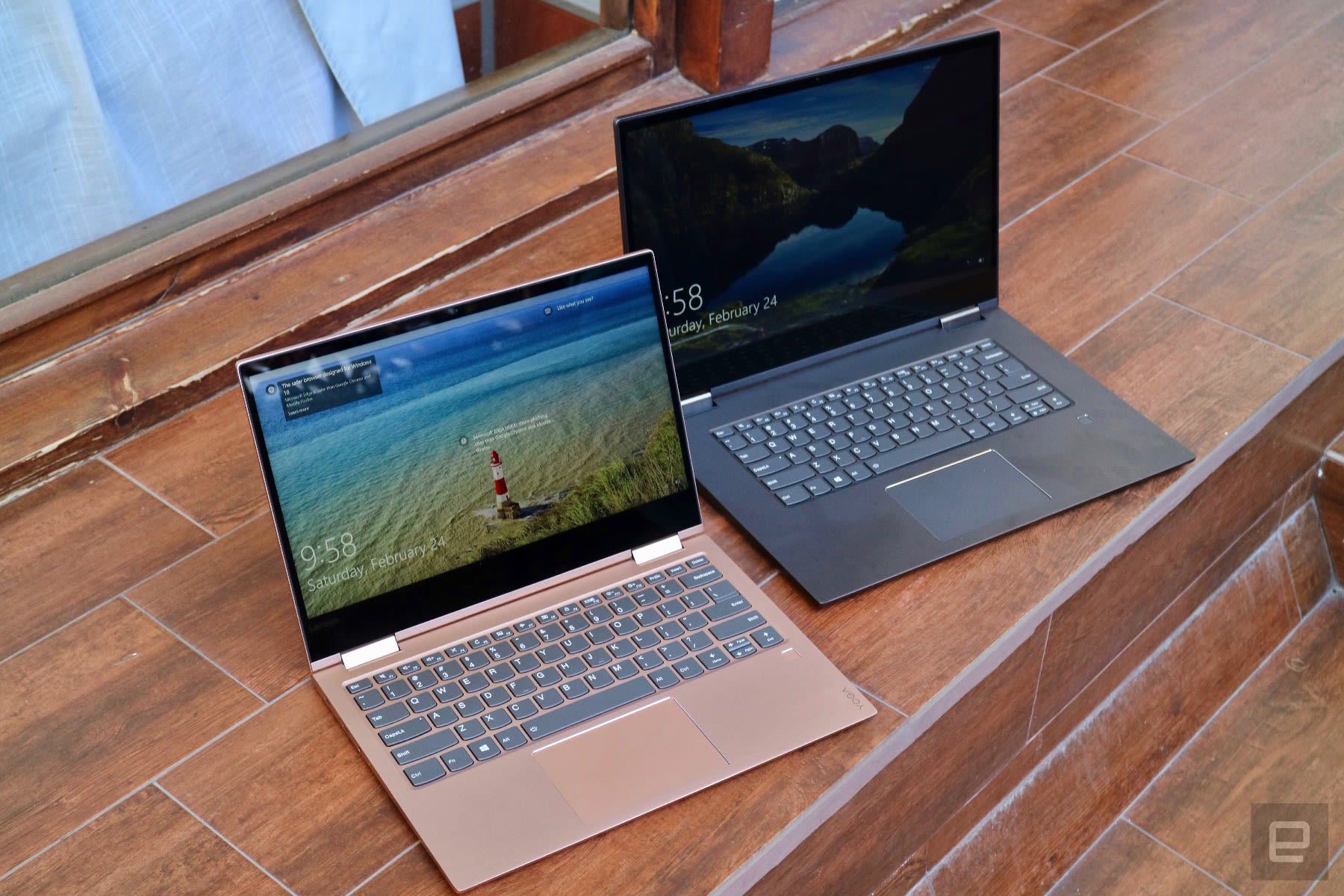
Like the Thinkpad X1 range, the Yoga 730 will support both Cortana and Amazon’s Alexa assistant. AI-hopping isn’t ideal, but until the smart speaker wars shake out it makes sense for Lenovo to offer multiple options (the company is also backing the Google Assistant with its Smart Display.) Both the 13-inch and 15-inch models will come with far-field microphones that can pick up your voice from across the room. So in theory, you could ask Cortana for your schedule and then book a time-appropriate Uber through Alexa. Or search for an article and order a pizza while you read.
The 13-inch and 15-inch Yoga 730 will start at $880 and $900 respectively. They cost considerably more than the $600 Flex 14, which will ship with an Intel Core i3 processor and a 1080p touchscreen. You can upgrade to an eighth-generation Intel Core i7 processor, a 512GB SSD, 16GB of DDR RAM and an Nvidia GeForce MX130 graphics card, but these will cost you extra. At first blush, Lenovo’s new laptops seem like decent if predictable performers for people with a sub-$1,000 budget. They all look the part and the Alexa support is nice for people who own a bunch of Echo speakers and compatible smart home appliances. Part of me misses the watchband-inspired hinge found on the Yoga 920, but hey — you can’t have it all.
Catch up on the latest news from MWC 2018 right here.
‘Papers, Please’ official short film recreates the game’s bleak tone
The official Papers, Please short film has been a long time in coming, but it’s finally here… and if you’re a fan of the game’s grim Soviet Bloc atmosphere, you’re in for a treat. The 11-minute production includes plenty of nods to the title’s nerve-wracking customs checks, such as the dread you feel when you’re not quite sure you should have let someone through. It also touches on the game’s underlying theme — how do you maintain some shred of humanity in a job that’s frequently heartless? Be sure to turn subtitles on, by the way, as the dialogue is appropriately Russian.
Nikita Ordynskiy and Lilya Tkach produced the movie alongside developer Lucas Pope.
Short films for popular games are nothing new, but it’s rare that they’re officially sanctioned and tout the direct involvement of the game’s creator. The Papers, Please short suggests these collaborations should happen more often — it captures the essence of the game while making the experience feel almost too real.
Source: Nikita Ordynskiy (YouTube)
Snapdragon 845-powered Xiaomi Mi Mix 2S set for a release on Mar. 27
Xiaomi’s first Snapdragon 845-powered phone will usher in a host of new features.

Back at the launch of the Snapdragon 845, Xiaomi CEO Lei Jun said that the Chinese manufacturer will be one of the first to release a device powered by Qualcomm’s latest platform. And while it was assumed that the phone would make its debut at Mobile World Congress, it doesn’t look like that will be the case. According to a recent tweet by Xiaomi global spokesperson Donovan Sung, Xiaomi’s first Snapdragon 845 phone will be the Mi Mix 2S, which will be released on March 27:
Mi MIX 2S will use the next generation flagship processor Snapdragon 845. Launching on March 27th! ❤️ pic.twitter.com/XoOdmmcDO2
— Donovan Sung (@donovansung) February 25, 2018
Sung’s tweet also had a reference to the upcoming phone’s AnTuTu score, which at 273,741 is significantly higher than the 206,783 managed by the standard Mi Mix 2 last year. Xiaomi has relied on AnTuTu scores to highlight the performance of its devices for some time now, and while synthetic benchmarks aren’t an indicator for real-world performance, Xiaomi’s fans swear by them.
The Mi Mix 2S won’t be the first phone to launch with the Snapdragon 845 — that distinction goes to the Galaxy S9 and S9+ — but it could be the first to do so in Asian markets, where Samsung sells the Exynos variant instead. It’s interesting that Xiaomi is rolling out a refreshed variant of the Mi Mix 2 and not the Mi 7 next month. Traditionally, the flagship Mi series was the first to feature the latest Qualcomm hardware, but with the phone rumored to usher in a complete visual overhaul, Xiaomi is likely pushing back the launch a few months.
The Mi Mix 2S could be the first Xiaomi phone with an in-display fingerprint sensor.
As for the device itself, the Mi Mix 2S is rumored to feature ultra-thin bezels, much like the first-gen Mi Mix and the Mi Mix 2. That said, we could be seeing a subtle change in the design up front, with the phone offering the camera module in the top right corner. The position of the camera sensor on the bottom bar was a major drawback on the Mi Mix and Mix 2 as the angle wasn’t ideal for taking selfies, and it looks like Xiaomi is set to rectify the issue with the Mi Mix 2S.
Furthermore, the Mi Mix 2S is rumored to feature an in-display fingerprint sensor, as well as a dual rear camera configuration with two 12MP sensors. It’s no secret that camera quality is a key priority for Xiaomi this year — as we’ve seen on the Redmi Note 5 Pro — and it looks like the Mi Mix 2S will continue that trend.
With the launch slated for March 27, we should know more about the Mi Mix 2S in the coming weeks. With the Mi Mix 2 garnering a lot of attention in India, it’s possible the Mi Mix 2S will also make its way to the subcontinent, as well as other Asian markets. What are you looking forward to seeing from the Mi Mix 2S?
Best Buy will offer a $100 discount on Galaxy S9/S9+ pre-orders on Mar. 2
You’ll be able to save $100 off the cost of the Galaxy S9/S9+, provided you’re interested in picking up carrier-branded versions.

The Galaxy S9 and S9+ are iterative updates over last year’s flagships, but they do come with all-new cameras with adjustable apertures and a more sensible location for the fingerprint sensor. The Galaxy S9+ also has 6GB of RAM, 2GB more than last year.
Both phones will make their debut in the U.S. on March 16, with pre-orders set to kick off from this Friday, March 2. If you’re interested in Samsung’s latest flagships, Best Buy is rolling out a $100 discount on Galaxy S9 and S9+ pre-orders for those picking up the devices on March 2.
The deal is valid for one day only, and the caveat here is that the discount isn’t available on the unlocked variant or for Sprint Flex Lease customers — you’ll have to pick up a carrier-branded version of either device. The $100 discount will be automatically applied if you’re paying full price upfront, and if you’re going the instalment route, the discount will be reflected in the form of bill credits.
The unlocked model of the Galaxy S9 and S9+ is also the most affordable at $719.99 and $839.99 respectively, and T-Mobile is matching those prices. Unfortunately, you won’t be able to pick up T-Mobile variants of either device at Best Buy, but the $100 pre-order discount makes other carrier options that much more enticing.
For instance, AT&T’s variant of the Galaxy S9 goes down to $690 with the $100 discount, and you’ll be able to pick up the Galaxy S9+ for $815.
- Where to buy the Galaxy S9: Best deals for your new phone
- Samsung Galaxy S9 and S9+ hands-on preview: The biggest gets better
Best Buy is also offering up to $350 when you trade in a Galaxy S8, Galaxy S8+, or the Galaxy S8 Active, as well as the iPhone X, iPhone 8, or the iPhone 8 Plus. Those looking to upgrade from the LG V30/V30+, Pixel 2/2 XL, Galaxy S7, S7 edge, or the Galaxy S7 Active will receive a $300 credit.
Customers making the switch from the Galaxy S6 series, the Note 5, first-gen Pixels, LG G6 or the V20 will get a $150 trade-in credit. The trade-in offer is available in-store only, and you’ll receive the credit in the form of a Best Buy gift card.
Interested in taking up Best Buy on its offer? You’ll be able to receive the $100 pre-order discount on the Galaxy S9 and S9+ on March 2.
See at Best Buy
Samsung Galaxy S9 and S9+
- Hands-on with the Samsung Galaxy S9 and S9+
- Galaxy S9 and S9+: Everything you need to know!
- Complete Galaxy S9 and S9+ specs
- Galaxy S9 vs. iPhone X: Metal and glass sandwiches
- Galaxy S9 vs. Google Pixel 2: Which should you buy?
- Join our Galaxy S9 forums
You can now pay ₹2,000 to pre-book the Galaxy S9/S9+ in India
Samsung kicks off pre-bookings of the Galaxy S9 and S9+ in India before revealing the price.

Samsung unveiled the Galaxy S9 and S9+ yesterday at Mobile World Congress, with both phones set to go on sale in the U.S. starting March 16. The company hasn’t detailed availability or pricing information for the Indian market, but customers interested in getting their hands on Samsung’s latest can pre-book the Galaxy S9 and S9+ by paying a ₹2,000 advance.
The pre-booking page gives us a first look at the color options that will be sold in the country at launch. Both the Galaxy S9 and S9+ will be available in Midnight Black, Lilac Purple, and Coral Blue color variants, but if you’re interested in the 256GB storage variant, you’ll have to go with the Midnight Black option. Both the Lilac Purple and Coral Blue are limited to the 64GB storage model.
Both phones are powered by Qualcomm’s latest Snapdragon 845 platform in the U.S., but Samsung sells the Exynos-powered variants in India, and the country should be one of the first markets to feature the Exynos 9810. And unlike previous years, there are marked differences between the Galaxy S9 and the larger S9+. The latter comes with 6GB of RAM (the standard S9 gets 4GB), and has a secondary camera sensor with a telephoto lens.
Samsung Galaxy S9 vs. Galaxy S9+: Which should you buy?
Talking about the camera, Samsung has introduced an all-new module with adjustable aperture, with both phones featuring the new sensor. If you’ve settled in on a particular variant of the Galaxy S9 or S9+, you can now hit up Samsung’s store to pre-book the phone.
Here’s how it works: you’ll need to head to Samsung India’s store, select the variant you’re interested in and the color option, and hit the Pre-book Now button. You’ll have to sign into your Samsung account and furnish your phone number as well as the delivery address, and pay ₹2,000 during checkout.
After paying the amount, you’ll receive a coupon code that you can be adjusted against the final bill when you’re picking up the device. Essentially, you’re paying the amount to be one of the first to receive the Galaxy S9 in India. The pre-booking offer is also available from select Samsung stores across the country.
Samsung is expected to detail Indian availability and pricing sometime next week, but if you’ve dialed in on a particular variant of the Galaxy S9 or S9+, head to Samsung India’s store from the link below to pre-book your device.
See at Samsung India
Xiaomi Mi Robot 2 vacuum review: A worthy upgrade
Xiaomi is back with another robot vacuum cleaner, and it’s bigger and better than before.

The Mi Robot is one of Xiaomi’s best ecosystem products, and with the second-generation model, there are a few upgrades on offer.
If you haven’t heard of the Mi Robot, a quick refresher: under the Mi Ecosystem label, Xiaomi partners with Chinese hardware vendors to release lifestyle and smart home products, and the robot vacuum cleaner falls under this category.
The robot is manufactured by Roborock, one of Xiaomi’s hardware partners, and while the first-gen model featured the Mijia label (a Xiaomi sub-brand that caters to the smart home segment), the Mi Robot 2 comes with Roborock branding. The goal is to give more prominence to the ecosystem partners, and aside from the label change, there aren’t any differences in build quality or features. If anything, the Mi Robot 2 feels more robust.
Xiaomi Mi Robot 2 Design and operation

The Mi Robot 2 shares the same design aesthetic as the first-gen model — there are a lot of white elements interlaced with grey — but there are a few changes in the layout. The biggest change is that it now has a mop function, allowing the robot to perform a dry and wet clean in one go.
There’s a manual in English this time around, giving you a breakdown of all the vacuum’s features, and the default language is also English out of the box, so you don’t have to rely on Google Translate to decipher what the vacuum is saying.
The front houses the water tank and mop, and the brushes for the dry clean are located at the back. There are two speakers up front, and the dust collection tray, as well as Wi-Fi reset buttons, are in the same location as before. The dry clean option is unchanged from the first-gen Mi Robot — there’s a rotating brush on the right side that siphons particles into the path of the robot, and there’s a circular brush underneath the vacuum that does a great job of sucking in dirt.
Like before, there are two wheels on either side, and a smaller balancing wheel at the back that sits in between the charging pins. The robot now has a 2cm obstacle clearance, so it manages to go over rugs and other indents on the floor without any issues. And talking about charging, the charger base is significantly smaller than last time. And because there’s a mop feature, you get a pad that prevents the vacuum from streaking wooden floors when it’s charging.
As the front section houses a mop, the vacuum goes back-to-front when cleaning, allowing it to do a dry clean and follow it up with the mop. It still follows a grid-based cleaning system, dividing a particular room into zones and going back and forth to cover the entire space.
The Mi Robot 2 features an even more powerful motor and a better routing algorithm.
The first-gen model had a 1800Pa motor, and the Mi Robot 2 comes with an even more powerful 2000Pa motor. There’s also a carpet mode in which it will increase suction if it recognizes a carpet. The default cleaning mode is set to Balanced, but this can be changed to Quiet, Turbo, or Max by heading into the robot’s settings on the Mi Home app. You can also select a spot cleaning mode by hitting the button on the unit or from Mi Home, and the vacuum will start cleaning that particular zone.
All you need to do to start the cleaning process is press the power button at the top, and the robot kicks into action. The Mi Robot 2 has a total of 12 sensors that allow it to create a virtual map of your house, and the vacuum starts off by identifying the boundaries. There’s a laser edge sensor that lets the robot maintain proximity (10mm) to a wall, and the 2mm rubber bumper ensures the vacuum doesn’t get damaged when it does manage to hit something.
The routing algorithm has gotten much better from the first-gen model, thanks to a new laser distance sensor. The vacuum has a 5200mAh battery that’s good for about 45 minutes of cleaning time, and if it runs out of charge midway, it automatically returns to the charging dock to recharge. It picks up from where it left off once it’s fully charged.
Xiaomi Mi Robot 2 Monitoring and usage statistics

You don’t necessarily need to use the Mi Home app to monitor the Mi Robot 2. You can start the cleaning by hitting the power button, and the robot does the rest by itself. But if you want to take a look at the vacuum’s cleaning route in real-time or get a detailed view of the cleaning statistics and remaining charge level, then Mi Home comes in handy.
You can easily connect the Mi Robot 2 to Mi Home after downloading the app. The vacuum has built-in Wi-Fi, and it’s fairly straightforward to hook it up to Mi Home. Just install the app and log in with a Mi account, and you should see the Mi Robot 2 shortly after the app loads. You can then connect the robot to your home’s Wi-Fi network (it works over 2.4GHz), and once it’s paired with Mi Home, you can access its full list of features.
From within the Mi Home app, you’ll be able to view the virtual map that the vacuum “sees,” and take a look at the cleaning area and the time it took the robot to clean a particular room. A cool new feature is the ability to put a marker anywhere in the house and direct the robot to clean that spot.

Mi Home lets you set a Do Not Disturb schedule for the robot, which essentially shuts down the vacuum for that predetermined time. There’s also the ability to change the volume level, install new language packs, set automated cleaning schedules, view the cleaning history, and get details on maintenance. The main filter and brush are washable, so you won’t have to change them anytime soon. The filter is usually good for about 150 hours of cleaning time, and the brushes need to be changed after 300 hours.
You can also change the cleaning mode from within Mi Home. If you’re changing the cleaning mode from the default to either Turbo or Max, note that the robot will make significantly more noise. Particularly in Max mode, it feels like there’s a whirlwind in your house.
Xiaomi Mi Robot 2 Bottom line

Overall, the Mi Robot 2 is a significant upgrade over the first-gen model. The new laser sensor does a better job of routing, and the wet clean option makes it an all-round vacuum.
Honestly, the sheer number of features available with the Mi Robot 2 make it one of the best products in this space. The vacuum is available for $540, and while that’s $200 more than the first-gen model, the enhancements justify the cost. If you’re interested in picking it up, use coupon code NEWXMVCM at checkout to get the cost down to $539.
See at GearBest
Vivo’s APEX has an insane 98% screen-to-body ratio and retractable front camera
Vivo is showcasing the future of smartphone authentication with its latest concept phone.

Earlier this year, Vivo rolled out the first phone with an in-display fingerprint sensor in the X20 Plus UD. At Mobile World Congress, the company is showing off the APEX concept phone, which has a screen-to-body ratio in excess of 98%, a half-screen in-display fingerprint sensor, and a retractable front camera.
The X20 Plus featured a fingerprint sensor near the bottom of the display, but the APEX takes that idea even further by allowing the entire bottom half of the screen to read your fingerprint. The larger surface area makes it easier to authenticate, and while the quoted 0.7ms time isn’t as quick as traditional fingerprint sensors, the ability to just place your finger on your phone’s screen and unlock it is demonstrably cool.
The APEX has miniscule 1.8mm bezels on three sides of the device — the smallest in the industry, according to the company — with the bottom bar at 4.3mm. Vivo says microchips mounted directly to the flexible circuit board allowed the company to trim down the bezels even further, with the device featuring an OLED panel.
The bezel-less design also sees the traditional front camera make way for the “8MP Elevating Front Camera.” The camera module is hidden in the chassis, and pops up when you need to take a selfie. It takes just 0.8 seconds to “rise” up from the chassis, and retracts after use. And as there’s no room for a standard earpiece, Vivo is rolling out Screen SoundCasting Technology, which makes the screen vibrate to produce sound.
This isn’t the first time we’ve seen the tech — Sony’s 2017 OLED 4K HDR TV has an “Acoustic Surface” that emits sound from the screen — but Vivo is the first to do so on a phone. Vivo has also retained the 3.5mm jack and included a DAC along with three amplifiers in the device.
As for an eventual launch, Vivo SVP Alex Feng said that the company is exploring possibilities:
APEX is an iteration of our constant pursuit of setting new industry standards and to deliver the ultimate mobile experience. From breakthroughs in audio, photography to In-Display Fingerprint Scanning Technology, Vivo has remained committed to realizing our vision for future smartphones.
What we showcase in this concept phone is only a fraction of our innovation pipeline. We will continue to explore all possibilities to bring the best possible experiences to our consumers.
The APEX in its current form is unlikely to be a retail product, but the phone is a proving ground for upcoming biometric authentication technologies. It’s possible we’ll see the half-screen in-display fingerprint sensor make its way into a phone in the coming years; and as for the retractable camera, I’d sure love to see one in a consumer phone at some point.
What do you guys make of the APEX?
Tesla’s electric trucks may be more cost-effective than expected
When Tesla unveiled its Semi electric truck, it made audacious claims about the big rig’s value — namely, that companies would recoup the cost of the vehicle in 2 years thanks to the savings on fuel. As it turns out, that might have been conservative. DHL exec Jim Monkmeyer told Reuters in an interview that he expects the shipping company to reach that point in a year and a half, saving tens of thousands of dollars per year. The absence of fuel is only part of the equation, he noted. As EV motors are much less complex than the big diesel engines that power conventional trucks, the Semi shouldn’t need as much maintenance.
Appropriately, Tesla’s Elon Musk has hinted that the Semi’s performance might see an upgrade. He’s “feeling optimistic” that Tesla can outdo the specs from the November 2017 debut without hiking the price. We’d take that with a grain of salt when Musk’s companies tend to set overly ambitious goals, but it’s not an idle claim when the first deliveries are slated to start in 2019.
DHL’s hopes depend on the Semi living up to initial expectations, of course, and there’s a lot that could go wrong. It’s no mean feat to produce an EV that large with a range of 300 to 500 miles (the battery will be gigantic), and a lot of Tesla’s math is predicated on the assumption that diesel prices remain the same. If there are unforeseen technical hurdles or diesel becomes cheap, the Semi’s value may go down the tubes. However, it’s not often that customers suggest a vehicle maker is underselling its product — while caution is definitely warranted, this bodes well for the future of electric trucks.
Via: Electrek
Source: Reuters, Elon Musk (Twitter)
Canon launches the EOS M50, its first 4K mirrorless camera
Canon has responded to criticism of the lack of 4K in all but it’s high-end DSLRs by launching the EOS M50, its first mirrorless M-series camera with Ultra HD 4K video. Packing a new DIGIC 8 processor, the 24.1megapixel, APS-C model can shoot 3,840 x 2,160 video at 24 fps, or 1080p video at 60 fps. At $780 (body only) Canon says the M50 is now its “entry-level” M-series camera. Since it’s the only one with 4K, that presents an awkward dilemma for potential buyers of the top-end EOS M5 and M6 models.
If the M50 has become Canon’s new entry-level mirrorless, then it’s a good sign that Canon is getting set to revamp the rest of the lineup. It strongly resembles the high-end, DSLR-like M5, rather than the smaller M10 and M100 models. It has an OLED optical viewfinder with touch and drag autofocus, Canon’s vaunted Dual-Pixel phase-detection AF, a vari-angle, flippable touchscreen ideal for vloggers, 120fps slow-motion video (at 720p), a new silent-shooting mode and WiFi, Bluetooth and NFC connectivity.
The ISO range is 100-25,600, expandable to 51,200 max, depending on the mode. Burst shooting runs at 10fps, or 7.4fps with continuous autofocus, letting you capture a maximum of 47 images in the latter mode. Video shooters get an external 3.5mm microphone input and HDMI output while shooting, and there’s also micro-USB port (but no high-speed USB Type C, unfortunately).
The EOS M50 looks like a very solid entry-level mirrorless camera, but does beg that question as to why someone would now buy the more expensive M5 model. In response, Canon appears to have dropped the prices of all its mirrorless cameras, lowering the M5 from $980 to $930, and dropping the the M6 by $100 from $780 to $680.
As mentioned, the M50 will cost $780 for the body only (in black of white) or $900 with the EF-M 15-45mm f/3.5-6.3 IS STM kit lens. You can also grab it with both the EF-M 15-45mm f/3.5-6.3 IS STM and EF-M 55-200mm f/4.5-6.3 IS STM lenses for $1,250. It arrives in April of 2018.
 AIVAnet