


YouTube TV snags rights to local Los Angeles FC soccer broadcasts
You can certainly watch sports on cord-cutting TV services, but major sports exclusives? Not until now. YouTube TV has reached a deal that makes it the official live TV and video partner for Major League Soccer’s brand new team, the Los Angeles Football Club. The streaming service will be the only place for Angelenos to watch all locally televised English-language LAFC games, and it’ll also carry all nationally broadcast games on ESPN, Fox and FS1. The deal will be impossible to ignore regardless of how you watch — players will have YouTube TV’s logo “prominently” plastered on their jerseys.
You won’t have to pay more than YouTube TV’s $35 base monthly rate to watch.
This certainly isn’t the biggest team deal in TV land, and it remains to be seen how many people will tune in. MLS doesn’t attract nearly as many viewers as other sports leagues in the US, even on conventional TV — how many people are going to add or switch to YouTube TV just to catch local games? Still, it’s a groundbreaking moment. To date, American teams and leagues have made a beeline toward traditional TV when they want local exclusives. While YouTube TV is far from a household name in the US, it’s now big enough that a team is willing to take a chance on the service.
Via: Variety
Source: MLS
NVIDIA proves the cloud can replace a high-end gaming rig
A year ago, NVIDIA’s GeForce Now game-streaming service let me play The Witcher 3, a notoriously demanding PC-only title, on a MacBook Air. This year, NVIDIA finally unveiled the Windows version of the service, and it was even more impressive. I was able to play Rainbow Six: Siege and PlayerUnknown’s Battlegrounds on underpowered PCs that sell for $200 to $300. If NVIDIA’s Mac demo was a revelation, playing high-end PC games on discount hardware felt like a miracle. Now, after testing the GeForce Now beta release on PCs for a week, I’m even more intrigued by the possibilities of game streaming.
To put it simply, the service lets you remotely tap into the power of an expensive gaming rig from any computer. It runs on remote servers powered by NVIDIA’s GTX 1080Ti GPUs. While the company isn’t divulging further specifications, you can bet they’re also stuffed with more than enough RAM and CPU horsepower. (NVIDIA claimed they were the equivalent of a $1,500 gaming PC a year ago.) When you launch GeForce Now, you’re actually watching a video streaming to your PC. But since there’s very little latency between what you’re seeing and your keyboard and mouse inputs, it feels as if the games are running right on your computer.
You don’t need a very powerful PC to run the GeForce Now client. At the minimum, NVIDIA recommends using a 3.1GHz Core i3 processor and 4GB RAM, along with either Intel HD 2000, GeForce 600 series or Radeon HD 3000 graphics. Those are all specs you’ll find in PCs four to six years old. But of course, solid internet access is a must. You’ll need speeds of at least 25Mbps, but NVIDIA advises a 50Mbps connection for the best experience. You’ll also have to make sure your computer has a reliable link to your router — which means you’ll either need to use an Ethernet cable or a 5GHz Wi-Fi network.
At the moment, GeForce Now on Macs and PCs only lets you play games you already own on Steam, Blizzard’s Battle.net or Ubisoft’s Uplay. Anything you don’t own can be purchased through the streaming platform. That’s a major difference from GeForce Now on NVIDIA’s Shield tablet and set-top box, which includes a handful of titles as part of its $7.99 monthly fee as well as games for purchase. Both versions of the service support popular titles like Overwatch, Call of Duty WWII and The Witcher 3, but you’ll probably have to wait a bit for them to work with lesser-known games. NVIDIA isn’t specifying what it takes to make a game compatible with the service, but I’d wager it has to test them out to make sure nothing breaks in the streaming process.
Setting up GeForce Now is as easy as downloading and installing the client and choosing a title to play. Then you just need to provide your login information for whichever service hosts the game. If you’re launching a Steam title, you’ll end up seeing the service’s familiar Windows interface, where you can either buy the game or download it to your library. One big downside with GeForce Now is that you’ll have to install games every time you want to play them, since you’re thrown onto a different server whenever you log in. It’s not a huge problem, though, since the remote machines are plugged into a fat network pipe and offer unlimited storage. PUBG, which weighs in at 12GB, installed in around four minutes while The Witcher 3 (31.7GB) took more than 10 minutes.
Devindra Hardawar/AOL
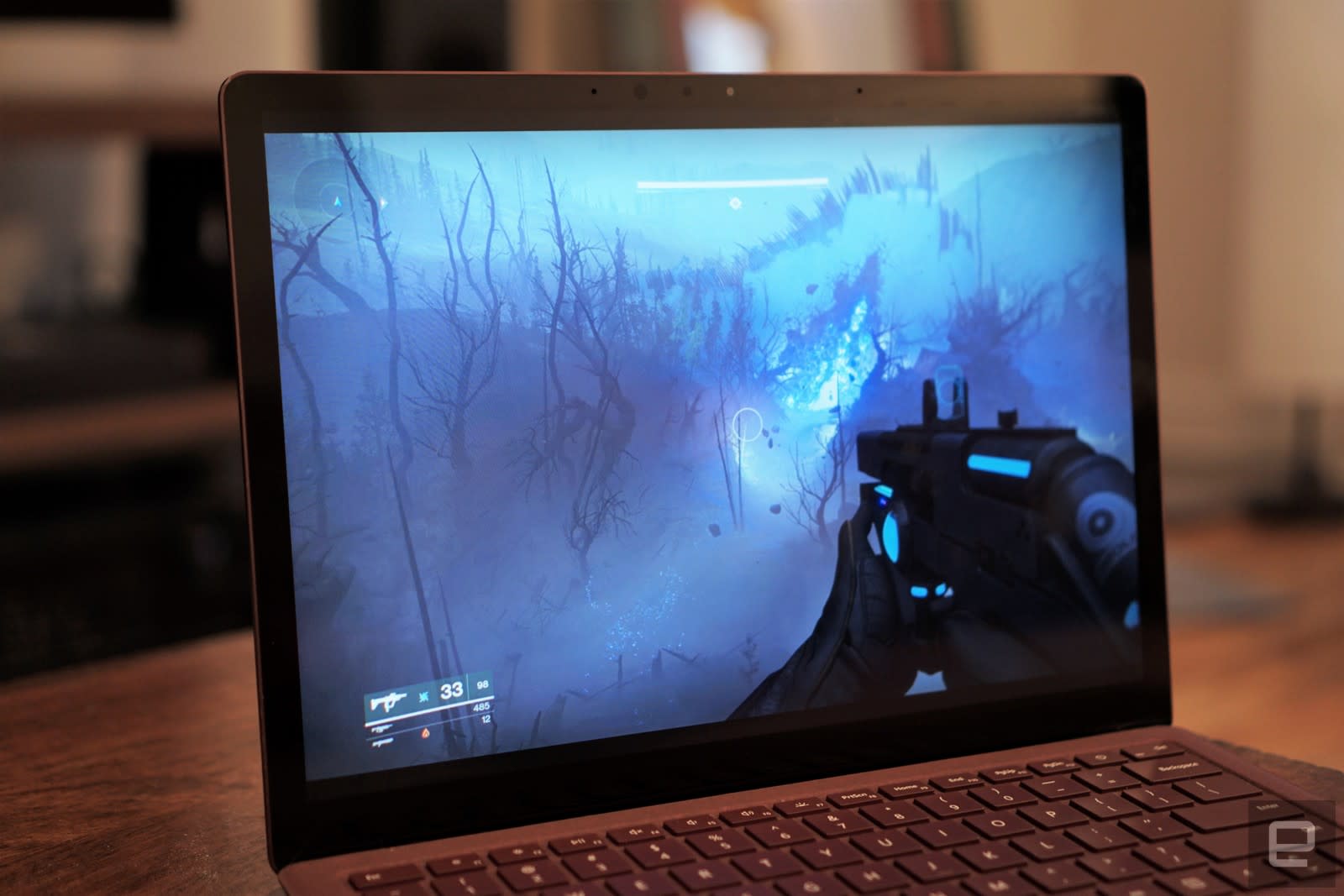
On the Surface Laptop — a great ultrabook marred only by its weak integrated graphics — running over our office’s WiFi, PUBG felt almost as smooth as it does on my dedicated gaming rig. It ran at a steady 60 frames per second, even though I cranked the graphics settings to Ultra and the resolution to 2,560 x 1,400. After a few minutes of running around the game’s apocalyptic European town and taking out other players, I almost forgot I was playing something that was running on a server hundreds of miles away.
The game’s excellent audio design also survived: I had no trouble pinpointing people sneaking around a house while wearing headphones, and the bomb strikes in “Red Zones” still rattled my skull. Mostly, though, I was surprised that I didn’t feel any lag while I was using the Surface Laptop’s keyboard and a Logitech wireless G903 gaming mouse. Moving the camera around and aiming my weapons felt incredibly responsive, and I was surprised that I was able to outgun some players in some heated shootouts.

That lack of latency was even more impressive with Overwatch, an even faster-paced game. Characters like Tracer and Genji, both of whom would be tough to play with any noticeable lag, felt as nimble as they do on my desktop. I didn’t even have trouble landing shots with snipers like Hanzo and Ana. I was simply able to enjoy playing the game as I normally do. And even more so than with PUBG, I was impressed by how well GeForce Now handled Overwatch’s vibrant and colorful graphics. Gorgeous maps like Ilios and Dorado appeared as detailed as ever, and the same goes for the game’s imaginative character models and costumes.
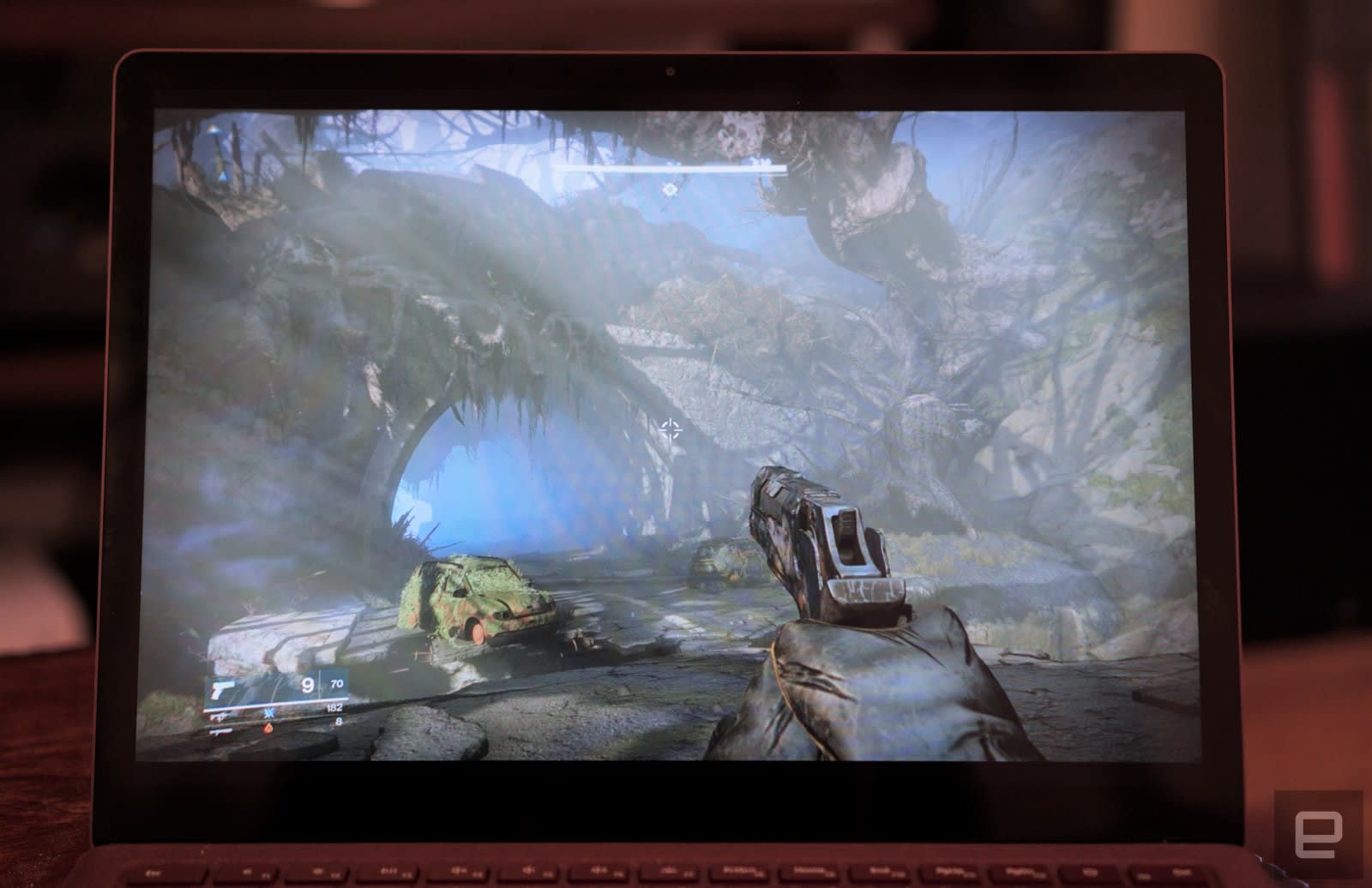
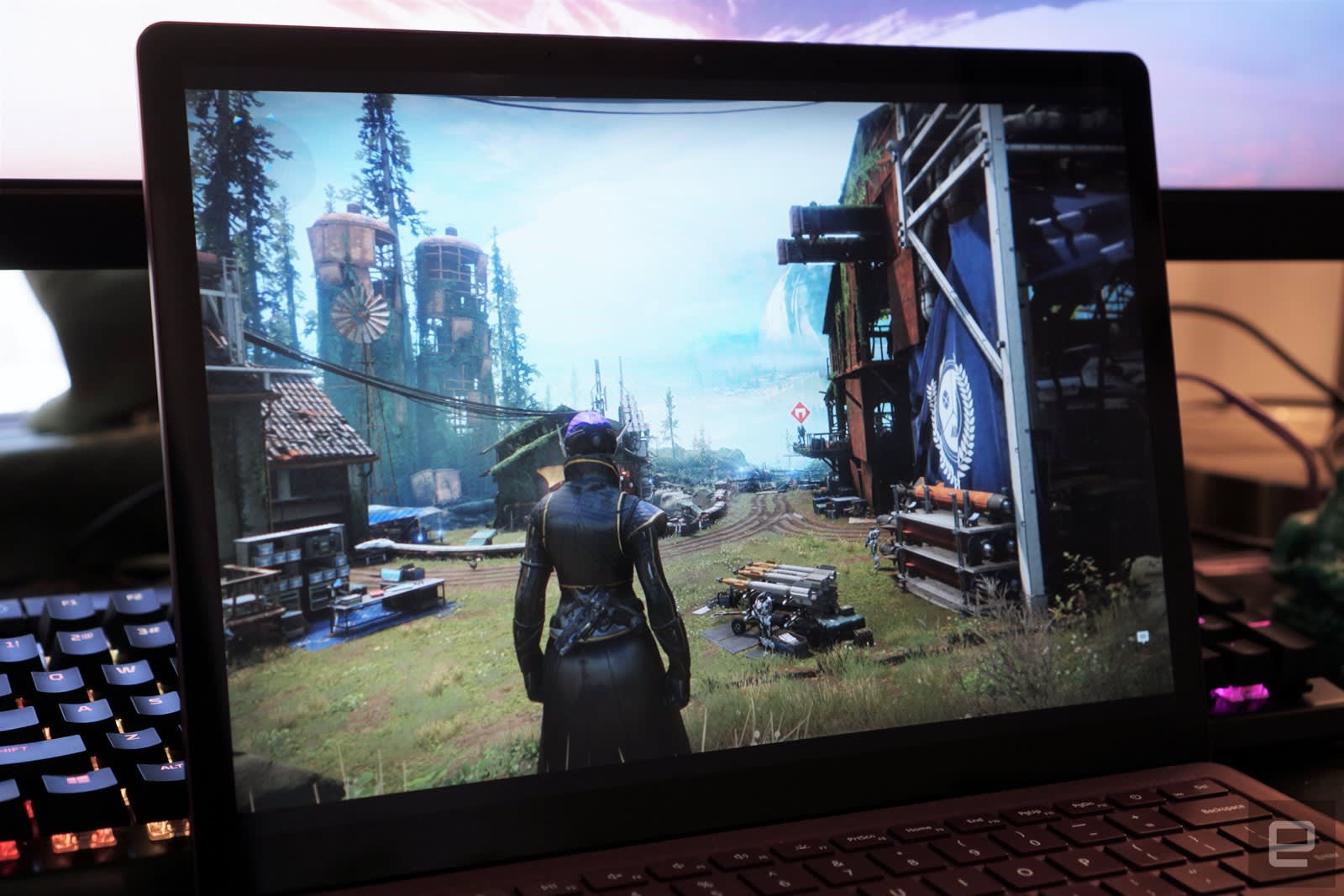
GeForce Now easily handled graphically intensive titles like Destiny 2 and The Witcher 3, which felt even more impressive to play on the Surface Laptop. Both games managed to run at 60 FPS at a 2,560 x 1,400 resolution (the service supports up to 2,560 x 1,600), with all of their graphics settings turned all the way up. Even though Destiny 2 isn’t exactly a fast-paced shooter, it still benefited from the service’s low latency, which helped me mow down waves of enemies without much trouble. And with the Witcher 3, I was impressed that its graphically rich world didn’t lose any fidelity while being streamed. Perhaps because these games are particularly demanding, I occasionally experienced connection hiccups while playing them. They only lasted a few seconds, but if I were fighting against tough bosses, they could have easily led to my doom.
Those disruptions also made it clear that your experience with GeForce Now will depend largely on your internet connection. I had a mostly trouble-free experience in our office and at home, where I have 100 Mbps cable service. But if you don’t have a steady 25 Mbps connection, Ethernet access or strong wireless reception, you’ll likely see more gameplay-disrupting issues. I wasn’t able to run any games at Starbucks locations around NYC, and based on my terrible experiences with hotel WiFi, I’d wager you’d have trouble using GeForce Now while traveling too. (The service is only supported in the US and Europe at the moment.)
Devindra Hardawar/AOL
The big problem with GeForce Now? We don’t know what the service will look like once it leaves beta. You can request access now, and if you’re lucky enough to get in, you can test the service for free. NVIDIA isn’t giving us a time frame for an official release or how much it’ll eventually cost. Based on what we typically see with streaming services, I’d also expect GeForce Now’s smooth performance to take a hit once it’s open to the hordes of frag-happy gamers.
For now, though, it’s a glimpse at the true future of gaming — a world where we don’t have to worry if our video cards are fast enough or if we have enough hard drive space for a massive open-world game. Well, as long as you have an internet connection fast enough to handle all of that gaming goodness.
GoPro’s Plus service will replace your busted camera
GoPro has amped up its Plus subscription in a big way. The offering, which was mostly a back-up service for your photos and videos, now comes with device replacement for the same price. GoPro says if you break your camera, it’ll replace it for you with no questions asked — so long as you only go in twice per 12 months of subscription. If you break your GoPro a third time within a year, you’re on your own… and you probably need to think of a way to keep your camera safer when you go on your wild adventures.
While device replacement is definitely Plus’ biggest new feature, GoPro has also tossed in a couple more perks. In the past, auto-backup for photos and videos to the Plus cloud service was only possible from a GoPro camera or a computer, but soon you’ll be able to upload your stuff directly from a mobile device. If you have an iPhone, you’ll be able to take advantage of the feature as soon as February 20th, but you’ll have to wait till spring if you’re an Android user. You now also get unlimited photo storage and 35 hours of video storage (around 250GB) with a subscription, whereas you were previously limited to 250GB of cloud backup overall.
GoPro is likely hoping that these features can make the service look more enticing, so it can boost that revenue stream. Although the company finally became profitable again last quarter, its struggles aren’t over: it recently had to cut 300 jobs after it quit making drones and exited the market entirely. Whatever GoPro’s reason is, the addition of device replacement could make Plus look a lot more appealing, especially to veritable daredevils. Even better? The service still costs $5 a month, and you’re covered by device replacement even if you’re just trying it out for free for 30 days.
Twitter now says 1.4 million users interacted with Russian spam accounts
Midway through January, Twitter posted a public statement on their blog confirming that over 677,000 users had followed, liked or retweeted messages from Russian-backed spam accounts. The social network reached out to inform everyone who had. But today, Twitter updated their count to 1.4 million users who had interacted with these accounts leading up to the 2016 election.
In a company blog post, Twitter said the increased number included interactions they hadn’t previously considered: That 1.4 million encompasses users who retweeted, quoted, replied to, mentioned, or liked those accounts or content produced by them during the 2016 election. (It also includes those who opted out of email notifications and weren’t included in Twitter’s initial wave of outreach emails.) The social network pointed out that this tally still doesn’t include every user ever who was exposed to messages from the Russian-backed accounts — for example, those who saw their tweets but didn’t otherwise interact.
But it’s worth pointing out that Twitter didn’t expand its pool of spam producers — it’s still only considering content from the 3,814 accounts linked to the Russia-backed Internet Research Agency (IRA) that it had previously suspended. The social network will reach out to those in the revised 1.4 million total who it hadn’t already emailed.
But as Ars Technica reporter Cyrus Farivar noted in a tweet, the social network duly informed him that he’d interacted with a Russian-backed account…but didn’t identify which one, nor any details about the interaction. Which calls into question how useful these outreach efforts really are for informing users so they can avoid such accounts in the future.
.@twitter just told me that I followed/replied/mentioned/retweeted a Russian bot account. But which one was it?
It’s not saying.
What exactly am I supposed to do with this email? pic.twitter.com/C2saIFZXqU
— Cyrus Farivar (@cfarivar) January 31, 2018
Source: Twitter blog
We spend less time on Facebook, but it still makes loads of money
The past few weeks haven’t been easy for Facebook. After announcing an overhaul to its News Feed earlier this month, one that places emphasis on people’s interactions over content from brands, the company has been taking heat for its new approach. Not only because Facebook is leaving publishers who relied on its platform behind, but it also isn’t offering the best solution to fix its fake news problem. A blunt two-question “trusted” news survey simply won’t cut it. CEO and founder Mark Zuckerberg said that, with these changes, he expects users’ time on the site to go down, but he believes keeping people happy will be better for Facebook’s bottom line in the long run.
And well, today during its Q4 2017 earnings report, Facebook revealed that even though users are indeed spending less time on its site, it is making more money than ever. The company raked in a record revenue total of $12.97 billion last quarter, a 47 percent year-over-year increase. It’s also a notable jump compared to the $10.3 billion from Q3 2017. In a statement about the latest results, Zuckerberg said “2017 was a strong year for Facebook, but it was also a hard one.” He added that, in 2018, the focus won’t just be to ensure Facebook is fun to use, but also “good for people’s well-being and for society.”
Zuckerberg said Facebook is already doing that by “encouraging meaningful connections between people rather than passive consumption of content,” referring to the recent News Feed tweaks. “Already last quarter, we made changes to show fewer viral videos to make sure people’s time is well spent,” he said. “In total, we made changes that reduced time spent on Facebook by roughly 50 million hours every day.” That’s a huge chunk of user engagement down the drain, which will likely be a cause for concern for investors.
Still, Zuckerberg doesn’t seem to be too worried about the drop in numbers, noting that by “focusing on meaningful connections, our community and business will be stronger over the long term.” That’s something he keeps emphasizing as Facebook seems to be dealing with an identity crisis, which may have come as a result of the Russian debacle from 2016 and 2017.
Last year, Facebook pledged to sacrifice profit for better security, as a result of growing concerns of how Russian-sponsored trolls and bots used its platform to interfere in American politics. Zuckerberg said back then that, even though Facebook’s community was continuing to grow (with more than 2 billion users), none of that matter if it couldn’t protect them. “We’re serious about preventing abuse on our platforms,” he said. “We’re investing so much in security that it will impact our profitability. Protecting our community is more important than maximizing our profits.”
Developing…
Trump reportedly seeks massive budget cuts to clean energy research
The Trump administration has made it very clear that it is pro fossil fuels and has little interest in pushing programs the promote renewable energy. Now, the Washington Post reports that the president’s proposed 2019 budget slashes funds for Energy Department programs focused on energy efficiency. While the proposal is just a jumping off point, the fact that it seeks to cut such funding by 72 percent underscores where the administration’s interests lie and in which direction its policies will continue to go.
The draft budget documents viewed by Washington Post staff showed that the president is looking to cut the Energy Department’s Office of Energy Efficiency and Renewable Energy (EERE) budget to $575.5 million, down from the current $2.04 billion level. Included in the budget cuts are funds for programs researching fuel efficient vehicles, bioenergy technologies, solar energy technology and electric car technologies. Additionally, the draft budget proposal seeks to cut jobs, dropping staff levels from 680 down to 450. One EERE employee told the Washington Post, “It shows that we’ve made no inroads in terms of convincing the administration of our value, and if anything, our value based on these numbers has dropped.”
Since taking office, Donald Trump has rolled back Obama-era climate policies, withdrawn the US from the Paris climate change agreement, removed climate change from the US national security strategy and instituted tariffs on imported solar panels. He has also continuously referred to mythical “clean coal” saying earlier this year that he would “end the war on coal and have clean coal, really clean coal.” All of this is done despite overwhelming evidence and widespread agreement among the scientific community that climate change is happening and is almost certainly caused by humans.
According to the Washington Post’s sources, the Energy Department had requested less extreme spending cuts, but the Office of Management and Budget pushed for the more substantial ones found in the draft proposal. However, the proposal could still be changed before being released in February and Congress could restore some or all of the slashed funding later on.
In a statement sent to the Washington Post, the White House said, “We don’t comment on any leaked or pre-decisional documents prior to the release of the official budget.”
Via: Washington Post
Microsoft’s cloud business just keeps growing
If there’s one major takeaway from Microsoft’s earnings reports over the last few years, it’s this: The cloud is everything for Microsoft. And, based on the company’s financials for the second quarter of 2018, its success in the cloud doesn’t appear to be slowing down anytime soon. Microsoft reported a 12 percent revenue jump for the period, reaching $28.9 billion up from $25.8 billion a year ago. And mostly, that growth was driven by the company’s investments in cloud services.
The “Productivity and Business Processes” group, which includes Office 365 and its cloud apps, saw its revenues increase by 25 percent. Azure revenue jumped by 98 percent, leading to a 15 percent increase for Microsoft’s “Intelligent Cloud” group. That more than makes up for the relative stagnant 2 percent growth in the “Personal Computing” segment, which includes Windows, Xbox, Bing and Surface. It’s particularly surprising that Surface revenues only increased by 1 percent, given the 12 percent increase we saw last quarter. I’d expect more of a jump for the holidays, especially now that the Surface Laptop and Pro are on the market.
The quarter wasn’t entirely rosey for Microsoft, though. The company posted a $6.3 billion loss, which it attributes to a $13.8 billion charge for the Tax Cuts and Jobs Act (TCJA). That figure also doesn’t reflect the full accounting for that bill, which Microsoft is still in the process of calculating. Without the TCJA charge, Microsoft would have seen a profit of $7.5 billion for the quarter.
Apple Selling New ‘UNDEFEATED’ Beats Pill+ and BeatsX Earphones
Apple’s Beats By Dre brand has teamed up with UNDEFEATED for a new series of products featuring a tiger camouflage design in shades of green, white, and black.
The collaboration includes a new set of UNDEFEATED BeatsX Earphones and a new Beats Pill+ speaker, both of which come in a unique colorway and are available to purchase from Apple’s online store.
The BeatsX Earphones, available for $179.95, are black and green with a matching tiger camo carrying case.

The Beats Pill+ Speaker, available for $199, uses the same camo pattern for the speaker mesh, with a black middle section for the control buttons that features prominent UNDEFEATED branding. It ships with an olive green carrying case, an accessory not normally included with a Beats Pill+ speaker.

Apple’s Beats by Dre website says the collaboration between the two companies is designed for “the ones dedicated to staying ahead of the game.”
Back the underdog. Push boundaries. Take a stand. That’s what Beats and UNDEFEATED both believe in, which is why we joined forces for a third time with this must-have collection. Designed for the ones dedicated to staying ahead of the game, this latest collaboration is inspired by UNDEFEATED’s unmistakable tiger camouflage and fearless attitude.
Beats by Dre and UNDEFEATED previously teamed up in 2013 to offer limited edition Beats By Dre headphones in the olive green shade UNDEFEATED is known for.
Apple’s Beats brand regularly teams up with designers, celebrities, and other companies to create special edition products. Back in July, for example, Apple collaborated with French fashion label Balmain to create special edition Powerbeats and Beats Studio Wireless Headphones in a safari color with metallic gold accents.
Tag: Beats by Dre
Discuss this article in our forums
Exclusive Deals: $328 Off Sound Forge Pro Mac 3 and Extended RAVPower 4-Day Sale
A new MacRumors exclusive Sound Forge Pro Mac 3 offer is launching today, allowing our readers to get Magix’s advanced audio waveform editing software for $229, a $328 discount on the traditional price of $557. The exclusive sale lasts from today, January 31 through February 28, 2018.
Note: MacRumors is an affiliate partner with these vendors. When you click a link and make a purchase, we may receive a small payment, which helps us keep the site running.
Sound Forge Pro Mac 3 is an advanced audio waveform editing suite that has been optimized and designed for macOS, offering users multi-channel recording and editing, mastering for music and dialogue clips, and support for high-resolution audio recording at 24 bits with sampling rates as high as 192kHz. The suite’s full features are extensive — also including customizable window layouts, file conversion automation, and the iZotope’s RX Elements and Ozone Elements tools — so make sure to head over to Magix’s website for more details if you’re interested.
Another exclusive deal for MacRumors readers is debuting tomorrow, February 1, for a collection of RAVPower portable and desktop chargers. Today, most of the accessories are available at a discount of up to 30 percent off in Amazon’s Gold Box Deal of the Day, but MacRumors readers will be able to gain access to these sale prices for an extended period of time thanks to a series of promo codes.

This means that beginning Thursday, February 1 and running through Saturday, February 3 you’ll be able to enter the below promo codes on Amazon and nab the same RAVPower accessories at today’s discount prices. So if you are interested in purchasing one of the sale items today, remember that you won’t need a promo code. Also note that a few of the accessories have an on-page coupon you can click to get an extra 10 percent off your purchase.
Check out all of the chargers on sale below (the first two are not discounted as part of the Gold Box deal today):
-
RAVPower 20000 mAh Portable Charger (Black) – $25.89 with promo code 4CA29JTI, down from $36.99
-
RAVPower 20000 mAh Portable Charger (White) – $27.29 with promo code 39NWGPJW, down from $38.99
-
RAVPower 40W 4-Port Desktop Charger (Black) – $15.39 with promo code QCHAR40W, down from $21.99
-
RAVPower 40W 4-Port Desktop Charger (White) – $15.39 with promo code QCHAR40W, down from $21.99
-
RAVPower 15000 mAh solar power bank – $21.99 with promo code 796DPW9M, down from $29.99
There are a few other notable sales happening today only, including B&H Photo’s $1,200 discount on the late 2016 15-inch MacBook Pro with Touch Bar (2.9 GHz, 16GB RAM, 1TB SSD) in Silver for $2,299.00, down from $3,499.00. At Best Buy, you can purchase the 64GB Apple TV (fourth generation) for $169.99, down from $199.99 (also at Walmart). JBL is offering a notable limited-time sale as well on its Charge 2+ speakers in recertified/factory refurbished condition for $59.95, down from $149.95.

Head over to our full Deals Roundup for even more of the latest discounts and sales going on this week.
Related Roundup: Apple Deals
Discuss this article in our forums
AppleCare+ for Mac Now Available in Australia and New Zealand
AppleCare+ for Mac, previously limited to the United States and Japan, is available to purchase in Australia and New Zealand starting today.
AppleCare+ extends a Mac’s in-warranty hardware coverage to up to three years from its original purchase date, and adds up to two incidents of accidental damage coverage, each subject to a service fee of AU$149 or NZ$169 for screen or external enclosure damage, or AU$429 or NZ$499 for any other damage.
AppleCare+ for Mac also includes 24/7 priority access to software support by chat or phone. It replaces the AppleCare Protection Plan for Mac, which was essentially the same as AppleCare+, but didn’t include accidental damage coverage like Apple has long offered for devices such as the iPhone and iPad.
The plan itself also has an upfront cost, which varies based on the type of Mac:
Australia
- Mac mini: $119
- iMac and iMac Pro: $199
- 12-inch MacBook: $299
- MacBook Air: $299
- Mac Pro: $299
- 13-inch MacBook Pro: $329
- 15-inch MacBook Pro: $449
New Zealand
- Mac mini: $149
- iMac and iMac Pro: $249
- 12-inch MacBook: $349
- MacBook Air: $349
- Mac Pro: $349
- 13-inch MacBook Pro: $379
- 15-inch MacBook Pro: $539
AppleCare+ for Mac benefits are in addition to any legal rights provided by consumer law in Australia and New Zealand.
Apple offers warranty coverage on most Mac parts for up to 24 months after its limited one-year warranty period, under consumer law in each country, according to an internal document distributed to Apple Stores and Apple Authorized Service Providers and obtained by MacRumors last month.
AppleCare+ can be purchased alongside a new Mac on Apple’s website in Australia and New Zealand, at Apple retail stores in Australia, and at select Apple Authorized Resellers or Service Providers. It can also be added within 60 days of a Mac’s purchase date, pending an inspection or diagnostic test.
Customers with a Mac purchased between December 1, 2017 and January 30, 2018 must contact Apple Support to purchase AppleCare+ for Mac, according to an internal memo distributed by Apple today and obtained by MacRumors.
Tags: Australia, New Zealand, AppleCare
Discuss this article in our forums

