


Peel for the Pixel 2 is a case for people who hate cases

If you’re looking for a simple case that truly doesn’t take away from the phone’s design, this is it.
Admission: I’m not a case guy. That partially comes with having used too many phones over the years. But it also has to do with the fact that phones are so damn big these days, and most cases just make them bigger.
Most cases. That’s not Peel, though.
No. This is the sort of case you put on a phone if you want to protect the finish but not worry so much about breakage. It’s a plastic case, just 0.35mm thick. While it’ll vary a little by phone (they have cases for the Galaxy S7 and Galaxy S8, along with the Pixel 2 and original Pixel line), I’ve found that extra little bit of thickness actually can make the phone feel a little bit better in the hand. Sort of like how some phones feel too thin naked by fit just right with clothes. (Stick with me here.) That was true of my original Pixel, and it’s true of my Pixel 2 XL.
 The matte finish also means things aren’t quite as slippery as they might otherwise be. And the case is semi-transparent, so you can still see the G of the Google Logo poking through. (Pro tip: Don’t bother trying to go all “panda” here. It just doesn’t work. If you’ve got a black Pixel, get a black case. White on white.)
The cutouts are all in the right places, of course. And even just this little bit of extra thickness means the phone doesn’t rock anymore (the Pixel 2 XL doesn’t do this nearly as bad as, say, the iPhone X, but it’s still a thing) when it’s laying flat on a table.
And it doesn’t really change the overall look and feel of the phone. The Pixel 2 XL is still the Pixel 2 XL, just as the designers intended. It doesn’t take away from what few curves this phone has.
That’s the good stuff. The bad? You’re definitely going to get dust and crumbs and stuff up under the edges. While the case isn’t going anywhere, it’s also not exactly hermetically sealed. You’ll want to remove the phone every now and then and hose things off.
That’s a small price to pay, though. Really, it’s just simple. Simple design, simple protection.
See at Peel
YouTube promises better communication and stronger policies in 2018
Last year was a rough one for YouTube, and it plans on fixing a lot in 2018.
Whether you’re a creator or just an occasional viewer, you probably heard a thing or two about YouTube having a rough 2017. Between multiple Ad-apocalypses, the whole Logan Paul debacle, and stricter partnership requirements for smaller channels, there was no shortage of events and controversial decisions that made last year one of YouTube’s roughest.

CEO Susan Wojcicki recently took to the YouTube Creator Blog to share her top five priorities for the site for 2018, and while it remains to be seen how these words will be turned into actions, it sounds like YouTube is on the right path.
Starting first with the elephant in the room, it’s said that YouTube is working on new policies to better handle bad behavior from the site’s biggest names.
Wojcicki says:
We’re also currently developing policies that would lead to consequences if a creator does something egregious that causes significant harm to our community as a whole. While these instances are rare, they can damage the reputation and revenue of your fellow creators, so we want to make sure we have policies in place that allow us to respond appropriately.
On a similar note, Wojcicki also reiterates the fact that YouTube will be increasing its number of human employees to 10,000 for manually reviewing content, in addition to further improving its machine learning system that’s had a tendency to demonize videos and entire channels that weren’t actually deserving of it.
More humans for (hopefully) less unnecessary demonitizations.
Improvements here are important and need to happen, but in an effort to help creators continue to make money even without advertisements, YouTube Red will expand to additional markets alongside “a revamped YouTube Music experience.”
Communication has also been a weak point for YouTube, but changes are coming here, too. YouTube will supposedly start making better use of its @YTCreators and @TeamYouTube Twitter accounts to be more engaged and active with community questions/concerns, and emails will be sent out for any major news or updates.
Lastly, YouTube will also use 2018 as a year to invest more in its educational content. More specifically –
That includes working with our educational creators to bring more of their content to the platform as well as expert organizations like Goodwill to provide and feature even more high-quality job skills videos on YouTube.
No matter if you’re a creator or viewer, what are your thoughts on this update? Do you think these changes are enough, or is there more you think that needs to be addressed? Sound off in the comments below.
Some YouTube ads forced users’ computers to mine cryptocurrency
What if Android P is designed for Chromebooks?

Android P could be another Honeycomb, but in a good way.
Sometimes playing “what if?” can be fun, especially when there’s a reasoning to whatever thing you’ve put together inside your head. I’ve had this half-crazy idea that Android P could be a release designed for big screen devices like convertibles, tablets, and Chromebooks. And as off-the-wall as that sounds, it wouldn’t be the first time.
Android doesn’t need a redesign, it needs tobe fixed for tablets and other big-screen devices.
Android Nougat saw a sizable change in features and design, but it’s become obvious that Google is happy with the behavior and layout of Android’s core interface. It’s a good base layer, too. Companies like Samsung are free to alter the interface (within limits) and still have access to Google’s services and cloud platform as a native Android device, but the design still works if an OEM decides not to change things up. That changes when you put Android on something with a bigger display.
The Pixelbook makes it clear that Chromebooks are now a mobile device akin to a tablet, Android will be a significant part of the interface and app platform going forward, and that Google saw they needed to provide the halo device for developers big and small to use if things are to get better on a big screen. Google as a services company only wants you on the internet and your eyeballs on their products, but Google as a mobile company has their own vision of how the future will be when it comes to the devices we use and how we will use them.
This is what Fuchsia OS looks like on the Pixelbook
There is no longer any doubt that Google plans to do something with a new mobile operating system. That doesn’t mean Android is going anywhere; Android isn’t really the operating system as much as it is the application layer. There are a lot of people, myself included, who think Google plans to replace the core system that runs Android as we know it with something new that’s easier to develop for and easier for hardware vendors to implement. Fuchsia isn’t going to replace Android or Chrome, nor is it going to unify them. It’s going to be the engine that powers them.
Say hello to my little blue friend

Set your wayback machines for 2011 and witness the, um, masterpiece that was Android Honeycomb on the Motorola Xoom.
OK, so Honeycomb was a mess and nobody ever wants to hear me say its name again. But what Honeycomb was is important here — a version of Android that was designed to help put the existing features onto a big screen in a better way. We may not have wanted a Honeycomb, but Android needed a Honeycomb. And now it needs another one.
That part of “Android” that may change with Fuchsia is the part that works the best, so there is plenty of work to do.
The low level “stuff”, whether that means Chrome for Chromebooks and convertibles or Android proper for tablets and televisions, just works. In fact, it just works so well that the next big thing we expect to see from Fuschia has some big shoes to fill here. It’s the interface and feature set that sucks on a big screen. We need some new APIs and tools that will let developers take advantage of all that real estate and some incentive for them to do it. Android P could be part of it, just like Android Honeycomb was.
It’s all not as crazy as it sounds, and now I really hope it plays out this way.
Chromebooks
- The best Chromebooks
- Should you buy a Chromebook?
- Google Play is coming to Chromebooks
- Acer Chromebook 14 review
- Join our Chromebook forums
Sprint plans to raise prices and roll out 5G next year
It’s become a fairly close race to provide mobile 5G service, with Verizon, AT&T and T-Mobile all announcing plans to roll out the faster network tech within the next couple of years. Sprint already has plans to launch its own 5G network in 2019, which it confirmed today during an earnings call, as reported by VentureBeat.
According to FierceWireless, Sprint CEO Marcelo Claure noted during the call that his company is working with Qualcomm to launch the first “truly mobile” 5G network in the US by the first half of 2019. This moves Sprint’s original plans up a bit. In comparison, AT&T plans to launch 5G service in 12 cities this year, while Verizon has plans to do so in the second half of 2018. T-Mobile doesn’t plan to roll its own 5G service out until 2020. VentureBeat also reports that Sprint will have to increase prices to $70 or $80 for unlimited 5G data, which would bring it more in line with its competitors.
Via: VentureBeat
Source: Sprint
DJI Mavic Air review: Aerial photography’s next small thing
When DJI revealed the Mavic Pro in late 2016, it ended up being a turning point for the company. DJI was already the dominant name in consumer drones thanks to the Phantom series, but the Mavic Pro was cheaper, smaller and downright meaner looking. The combination of price, features and cool-factor made it an instant success. Then there was the Spark, which was smaller, but less powerful and lacked some of the basic features that a budding aerial photographer wants. Enter the Mavic Air, a quadcopter that slots between the Mavic Pro and Spark on DJI’s roster.
When I first saw the size of the Mavic Air, I assumed it would have less features than the Mavic Pro. And in some ways that’s true. The Air is rated for 21 minutes of battery life, while the standard Pro tops out at 27. Also, that smaller size means it’s probably more prone to being blown around by mother nature. But for the most part, some important parts, the Mavic Air matches or bests the Mavic Pro — and that’s a good thing (unless you just bought a Mavic Pro, I guess).
Unpacking the Mavic Air reinforces how small it is. The packaging for the Phantom 4, for example, is about the size of typical carry-on luggage. The Mavic Air’s box looks more like something premium headphones come in. DJI suggested the folded Mavic Air is about the size of a large phone (if you ignore its height). This isn’t a helpful comparison, although some dimensions do sorta match that of my Pixel 2 XL. The two-inch height means the Mavic Air is actually about the size of a bag of coffee (but that’s still pretty darn small).

Beyond its size, the next thing I noticed is how cool it looks. The Mavic line ushered in a much-needed facelift for DJI drones. The Phantom series always looked a little… “smurfy,” but the Mavic Pro looks modern and aggressive. The Mavic Air has softer lines like a sports car, and the two-tone color scheme gives it a contemporary aesthetic that shows DJI’s design chops are coming of age.
I’ve flown plenty of DJI drones, so I was confident enough to get the Mavic Air flying right away. One thing that hasn’t really changed is the first-time setup. Once your batteries and controller are charged, you need to download/install/sign up for DJI’s Go app. Then you need to squeeze your phone into the grip at the bottom of the controller (after installing the appropriate USB adapter) and go through a quick walkthrough of the app. Once you’re set, just unfold the Mavic Air’s arms and you’re good to go.
I launched the Mavic Air in our cavernous (and mostly empty) office; I was instantly bombarded with beeps coming from the controller. Thanks to the Mavic Air’s multiple sensors, it detects objects in front, behind and beneath it. Engadget’s office has several timber pillars, and the sensors immediately detected them (even though it was already keeping a safe distance from them). Straight away, I was reminded how tight DJI’s drones fly. Take your hands off the sticks, and the Mavic Air just stays where it is, without any drifting. Point it somewhere, apply the throttle and it effortlessly glides in that direction.

While DJI’s drones have enough sensors to make flying indoors safer, it’s the great outdoors where they shine. I took the Mavic Air up to a drone-friendly park on the East Bay overlooking San Francisco to put it through its paces in its natural environment.
When I used to fly a Phantom, there was always an amount of self-consciousness. This (relatively) big white thing that alerted the world to its existence with a shrill warning noise, and then sounded like a chainsaw when you started it up. There’s none of this with the Mavic Air. Just unfold, set it down and get it up. It’s much quieter in the air than DJI’s bigger drones and doesn’t draw too much attention to itself (though people did stop and admire it as they passed).
The range on the Mavic Air is advertised as 4km (about 2.4 miles) which is double that of the Spark, with the Mavic Pro coming in at 7km (about 4.3 miles). A few times I flew the Mavic Air as far away as I safely could (well within range) and experienced some glitches with the video feed. Only at first, though; it always seemed to clear up after that. There was also one occasion where the drone lost contact with the controller and started to fly home, but it soon connected again, putting me back in control. And even that happened only once.
Good flight performance is table stakes for DJI drones, but that’s all for naught if the camera doesn’t work well. I shot in several different settings (cloudy, well lit, indoors) and I have to say that the camera impresses. Videos look sharp across various resolutions (I mostly used 4K and FHD). Photos look equally good, with great dynamic range and bright popping colors (the right side of saturated).

For me, it’s the camera that’s possibly most important. After all, DJI has the drone part down to a tee at this point. The Spark’s HD camera is good, but it’s hampered by more basic stabilization technology and a smaller selection of resolution settings. But for the Mavic Air and Pro it’s almost neck and neck as far as features go. The Mavic Air has HDR, higher bitrates (100Mbps versus 60Mpbs) and more slo-mo options. But the Mavic Pro has a cinematic mode and, in my opinion, better color representation. DJI really does like to make decisions hard for us.
From what I’ve seen from both drones in the same environments, the Mavic Air might have more features, but the image quality on the Mavic Pro is slightly better. Regardless, the video and photos you get out of the Mavic Air are generally fantastic, and the smoothness of the gimbal is perfect, which is kinda crazy considering its small size.

I’ve talked a lot about DJI’s other drones so far, and there’s a good reason for that. Normally we expect the more expensive model to be the better one. No one told DJI, it seems. The problem (benefit?) seems to be that DJI develops new tech and software at a fast clip. It sometimes releases a souped-up version of an existing drone, but there’s obviously a point where it makes sense to make a new model.
With rear obstacle avoidance, 8GB of built-in storage and a more clever camera, the Mavic Air is that model. All the new sensors make for better 3D vision in the drone, and that requires more processing grunt — something even the older Mavic might not be capable of. The result is a smaller, cheaper drone that might best its higher-end stablemate on the features that matter to you.

Unusually, then, potential buyers of both the Spark and the Mavic Pro might be tempted by the Mavic Air. At around $400, the Spark is about half the price of the Mavic Air. But (and I think it’s a fair-sized but) the camera upgrade is significant, you get 33 percent longer flight times, more auto shot modes and more safety sensors. Plus the Mavic Air folds down, which arguably makes it more portable, too. That all adds up to a solid upgrade that might make the price hike more palatable.
If I were eyeing up a $999 Mavic Pro, on the other hand, the decision for me would be easier. The $200 saving comes with very few compromises for casual users who want a reliable, capable flying camera with superior obstacle avoidance and the convenience of built-in storage. There will be people for whom the superior image/filming modes will really matter. Or want something more robust. But I’ll come out and say it, that for a lot of you Mavic Air is everything you need.
YouTube will address ‘egregious’ acts by creators in new policies
The massive backlash to Logan Paul’s Aokigahara forest video pushed YouTube to make a few changes in how it handles the content it hosts. The company took some specific actions against Paul himself, putting his original projects on hold and pulling his Preferred status, but it has also begun to tweak its policies and regulations overall. Now, in a blog post, YouTube CEO Susan Wojcicki says there are more changes to come. “We’re also currently developing policies that would lead to consequences if a creator does something egregious that causes significant harm to our community as a whole,” she wrote. “While these instances are rare, they can damage the reputation and revenue of your fellow creators, so we want to make sure we have policies in place that allow us to respond appropriately.”
Already, YouTube has said it will begin to manually vet videos before they can be added to its top tier Preferred ad program. It has also changed its creator partnership requirements, with creators now having to accrue 4,000 hours of watchtime over the last 12 months and 1,000 subscribers before they can make money from their content. Additionally, Google is working to build up its content review team to 10,000 people. Along with new consequences for creators, Wojcicki said that throughout the year YouTube will focus on being more transparent, providing new ways for creators to make money, giving viewers more ways to engage with video content and investing in learning and education.
It’s good that YouTube is taking more responsibility over what is published on its platform, but while Logan Paul is the latest creator to step over the line, he’s certainly not the first. Let’s not forget Pewdiepie and the numerous awful things he’s said online. The point is, Paul isn’t a singular circumstance, there’s been a pattern building for years, and YouTube should’ve taken a more active role long before Paul was able to post that wildly disrespectful video. It will be interesting to see what sorts of consequences YouTube lays out for creators going forward.
“As YouTube grows, I want to remain focused on our mission to give everyone a voice and show them the world,” said Wojcicki. “It’s my commitment in 2018 to ensure we do this responsibly, with greater openness, smarter policies, more engaging products, more revenue for creators, and a higher emphasis on learning and education.”
Via: Polygon
Source: YouTube
This shameless iPhone X clone costs just $160
What? A company has made a phone that borrows heavily from Apple’s design? (And LG, Samsung while we’re here.) At least the notch is real this time. Oukitel’s U18 is up for preorder, priced at $160, making it the cheapest iPhone X that… isn’t an iPhone X at all. But, you could get six of them for the price of a real one.
The hardware design is all over the place: look at that Samsung chin, or the LG-inspired button on the back. Meaning, for some reason, Oukitel’s brought together all the things that I hate. However, it is backed it up with a 4,000mAh battery, at least. (It’s the same company that debuted that insane 10,000mAH smartphone a way back.)
There’s also curved glass wrapped across the wide 21:9 dimension 5.8-inch screen, but the rest of the spec sheet is a mixture of average and fancy. There’s a MediaTek 1.5GHz octocore processor, 16-megapixel dual-camera setup and, despite the curves and notch, it’s only got a 1512 x 720 resolution screen, but again — it’s $160. Well, for the first 999 buyers, this week. It’ll then go up a… notch to $180 for everyone else.
Source: Oukitel
YouTube labels news videos that have received government funding
YouTube has been making efforts to improve its transparency, which is why anyone viewing news broadcasts on the platform may notice a change starting today. If a news video has received any public funding or government support, YouTube will show a notice below the video. This only applies to videos that are uploaded by news organizations.

The feature starts rolling out today for US users only, and YouTube cautions that there may be bumps in the road to its implementation: “We don’t expect it to be perfect,” the release said. Eventually, the company plans to expand this feature. In the meantime, users can use the “send feedback” option to flag imperfect implementation.
As the landscape between online news and ads becomes more muddled, increasing transparency is an important step to take. Both Twitter and Facebook have put regulations into place that require people who run political ads to disclose who is behind them. It’s good that YouTube is taking action as well.
Source: YouTube
BMW’s C evolution squeezes EV technology into a scooter
While new companies like Zero and Gogoro are establishing themselves as first-rate two-wheeled vehicle builders, the Hondas and Yamahas of the world have taken a more cautious approach to the market. BMW, on the other hand, launched its own electric scooter way back in 2014. Sadly it was only available in Europe — until now. It’s finally in the US, and I took it for a spin in America’s parking lot (i.e., Los Angeles).
The $13,750 BMW C evolution isn’t what the average American thinks of when the word “scooter” is mentioned. Instead of a tiny 50cc bike, the electric maxi-scooter is a 606-pound beast that should comfortably seat two (I didn’t have any friends willing to ride with me) and at first glance could be mistaken for a motorcycle. But don’t let the large footprint fool you: It’s a quick commuting machine that’s as comfortable on the freeway as it is on surface streets.
If you’re a regular scooter rider or even someone who rides a typical motorcycle (aka not a huge Harley or Gold Wing), it takes a few miles to get used to the weight of the bike. It can be intimidating, but after you get into the groove, the electric scooter offers a smooth ride. That’s probably because it’s tough to bounce around that much mass. Whatever the reason, combined with the bike’s snappy, fluid acceleration and electric-motor whir, navigating Los Angeles on the C evolution felt civil.
It helped that the bike has a 99-mile range rating, which, during my tests, were nearly dead-on — as long as I didn’t spend too much time on the freeway. Not bad, considering I regularly switched from the bike’s energy-efficient Eco Pro mode to the high-powered Dynamic mode, which gives you all the power and regenerative braking.
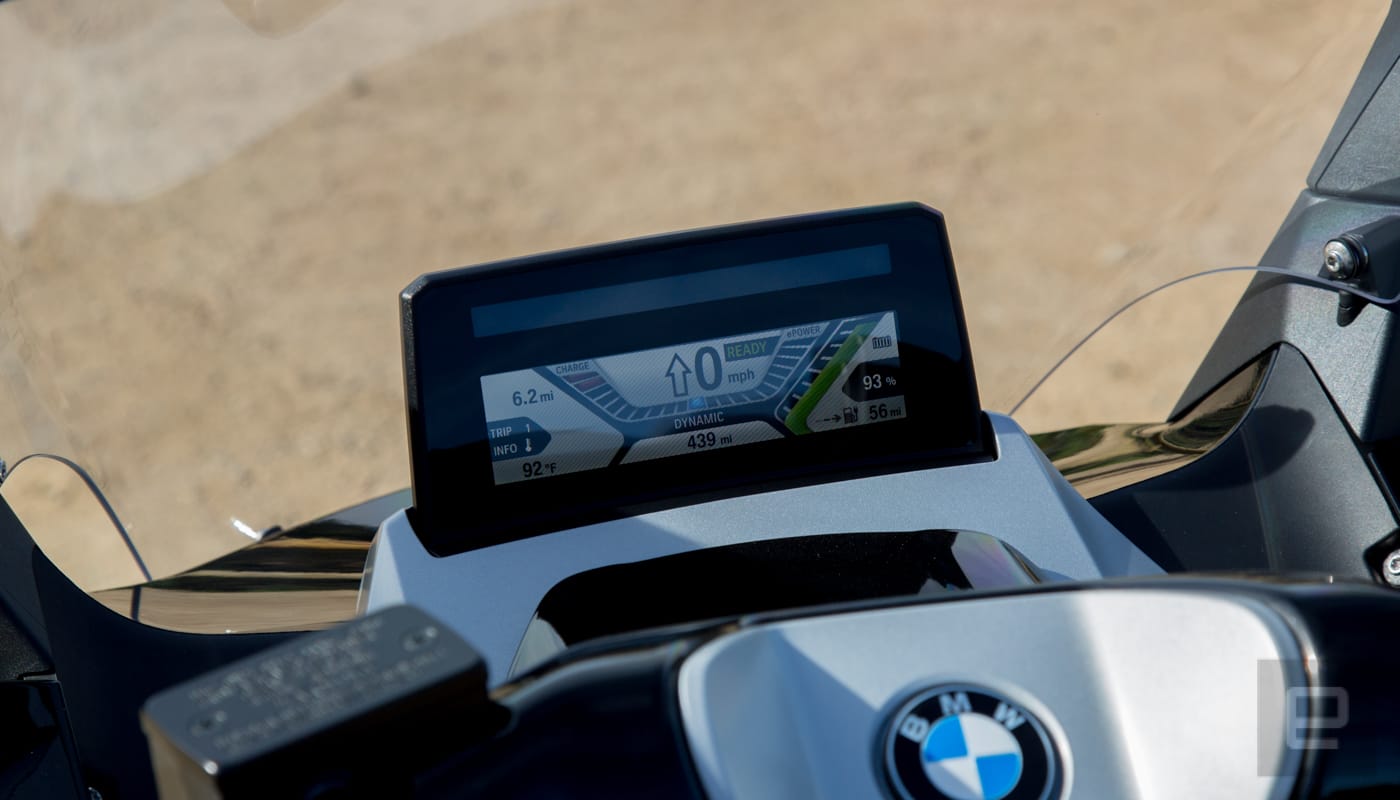
Typically I use the energy-efficient mode on a car or bike for testing, then forego it after a few hours in the name of speed. On the C evolution, the Eco Pro mode was more than adequate to handle nearly all riding situations. I only switched to Dynamic mode to power up a hill on Interstate 405 and blast away from traffic lights (thanks to a 48-horsepower motor that pushes 53 pounds of torque).
There are two other modes available: Road gives you all the power with a little regenerative braking while Sail removes all regenerative braking. I stuck with Eco Pro and Dynamic modes for 95 percent of my rides, since they offered the best combination of riding and regenerative energy creation.
Regardless of how you ride, there is the usual electric-vehicle caveat that if you spend any time at high speeds on the freeway, you’re going to burn through your charge. During an 11-mile jaunt on the highway at a steady 65MPH, I drained 20 percent of the battery. That’s something to consider if you’re interested in any EV for a daily commute that involves a lot of time on the freeway.
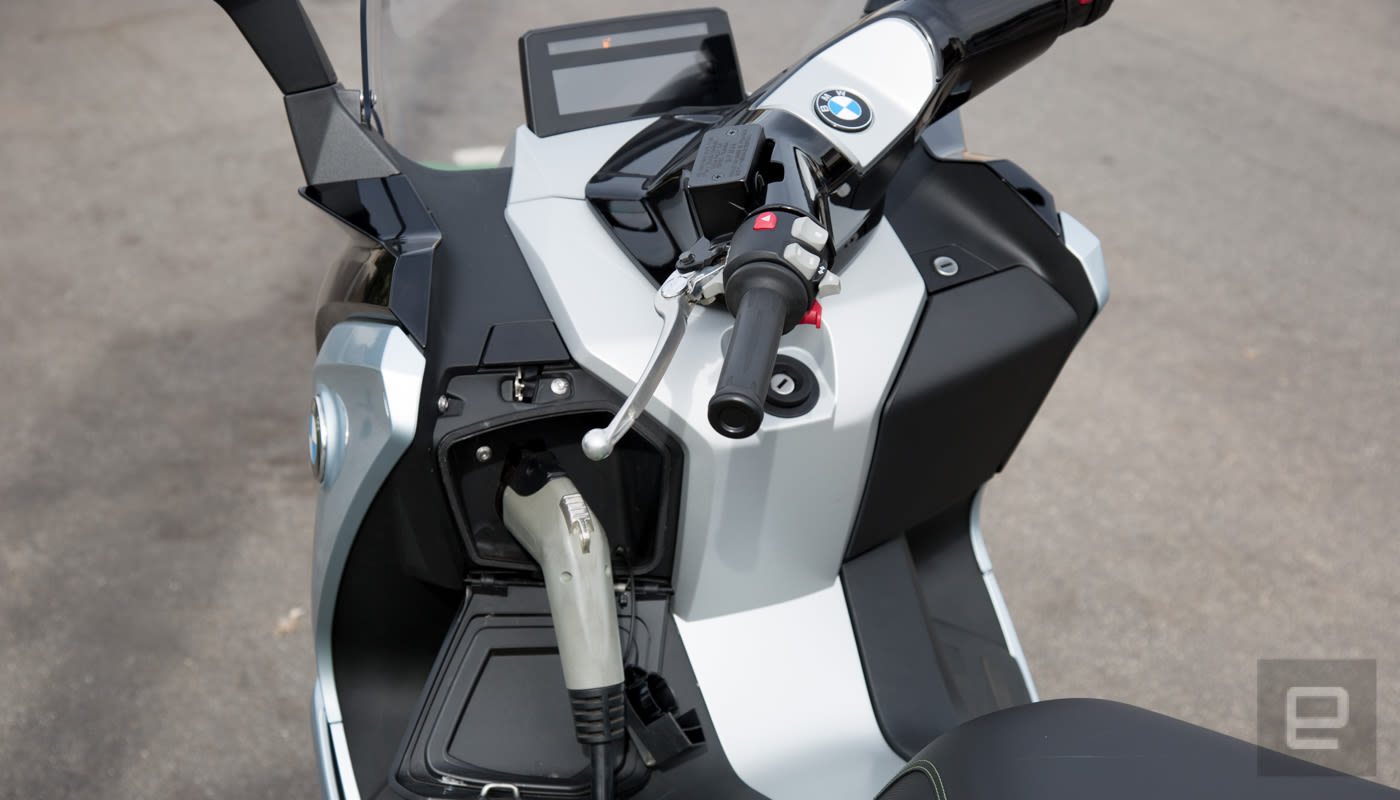
Recharging the bike after flying down the highway via the level 2 port took about 4 to 4.5 hours. It can also be charged with the 110-volt outlet you have at home, but expect it to take about twice as long. In a city like Los Angeles where malls, Whole Foods Markets and other businesses have chargers in their parking lot, pushing past the century mark during a single day wasn’t a problem — that is, if you’re cool shopping or eating while you charge. That might not be so healthy for the bank account.
That’s the rub with electric motorcycles and scooters. Unlike their four-wheeled counterparts, it’s tough to see a financial incentive. The gas-powered BMW counterparts to the C evolution both get 51 miles per gallon, so the monthly outlay of cash isn’t that high to begin with. There are the maintenance cost savings, but with a price tag that’s about $3,000 more than comparable with BMW gas-powered scooters, it’s tough to see the financial upside of the C evolution.
That said, as I rode through LA and saw a constant brown haze on the horizon, both over land and water, it was a reminder that petrol-powered vehicles contribute to that smog. In the grand scheme of things, it’s important to see the C evolution and other EVs as vehicles that will reduce that brown sky. Sure, on a spreadsheet buying one doesn’t add up, but when you take into account the impact vehicles have on our air, if you can afford to go EV and it fits into your lifestyle, it’s almost a no-brainer.
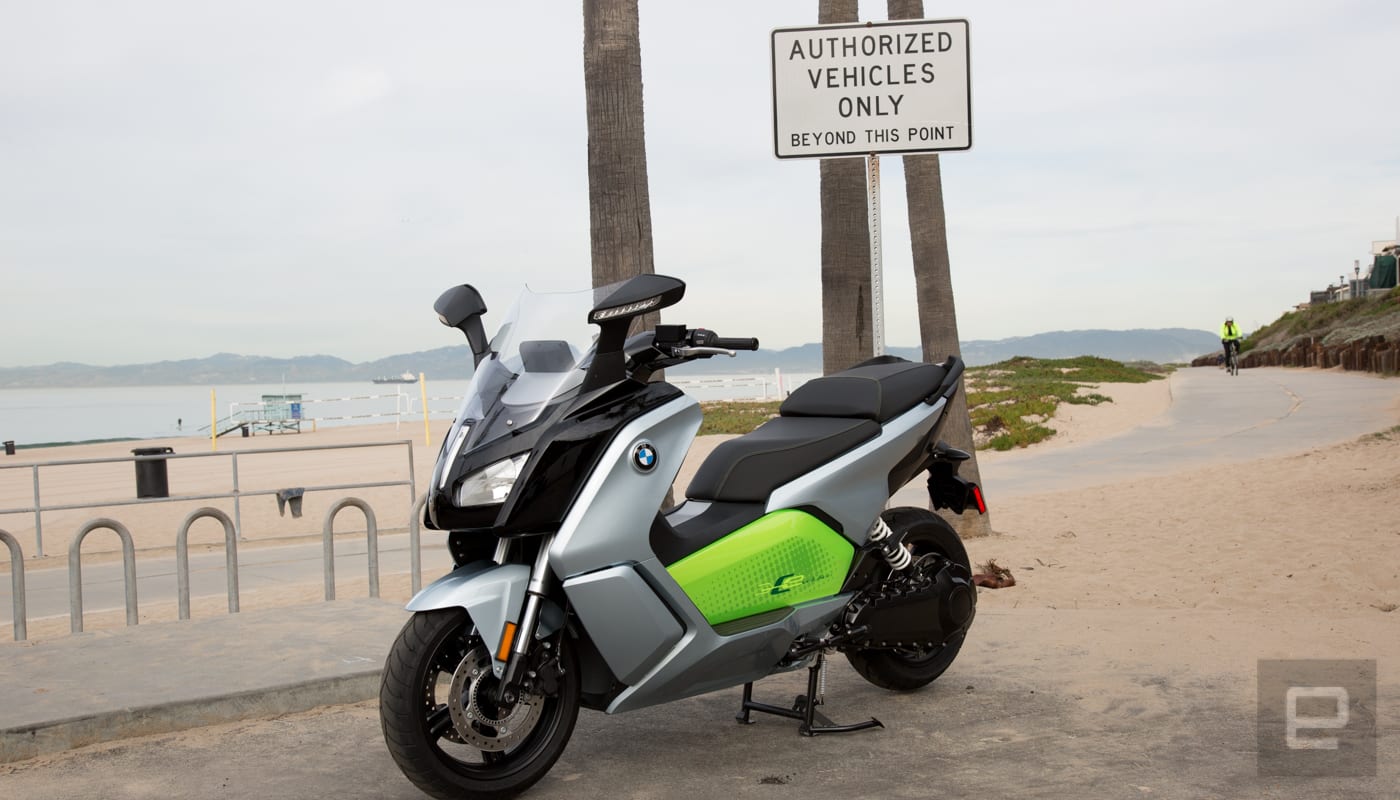
It also helps that the C evolution is a blast to ride, thanks to electric motor torque. Plus, the BMW electric scooter that’s purchased today might encourage the automaker to put electric motorcycles on the market tomorrow. Scooters make sense as EVs, but an electric motorcycle — especially one for BMW — well, those would be just too much fun to pass up.
Microsoft offers cheaper Surface laptops with lower specs
Microsoft wants to make it easier to buy into the Surface family. The company has begun offering a lower specced Laptop running Windows 10 S — Microsoft’s take on Chrome OS — and an Intel Core m3 processor in the US. It’ll set you back $799 versus the standard model’s $999 asking price, and is only available in the platinum colorway, as spotted by Windows Central. As for storage and memory, you’ll get 128GB and 4GB, respectively. If you’re thinking that sounds an awful lot like the $799 Surface Pro tablet, you aren’t wrong. But, that won’t get you a keyboard cover, which The Verge points out is a $130 add-on.
In related news, Microsoft has also debuted a new variation of the Surface Book 2 with less storage and a lower price. An entry-level model with 128GB of storage and a 13.5-inch screen, 8GB of RAM and an Intel Core i5 processor costs $1,199. For those keeping track at home, that’s $300 cheaper than the previous lowest-cost model, but the discount comes at a price: half the internal storage.
Other prices have dropped as well. A Surface Laptop with an i5 processor, 8GB of RAM and 256GB of storage is $200 cheaper now, in what seems like a temporary sale rather than a permanent price cut.
The pair of these “new” devices likely aren’t going to make any waves with power users, but they represent Microsoft’s next steps for the Surface line. Specifically, hitting mass adoption. The lower-priced Surface Laptop is perfect for people who just need a computer for email and word processing tasks, while the Surface Book 2 could sway potential MacBook Air and MacBook customers toward Windows.
The company recently posted 2 percent growth in its “Personal Computing” segment, and more moves like this could help drive sales and increase that relatively stagnant number.
Via: Windows Central
Source: Microsoft

