


‘Alto’s Odyssey’ Launching on iOS and tvOS February 22
iOS game developer Snowman today announced that “Alto’s Odyssey” will launch on the iOS and tvOS App Stores on Thursday, February 22. With the confirmation of a release date, Apple today shared a new card on the iOS App Store noting the launch, along with snippets of an interview with the game’s developers (via TouchArcade). The game was originally set to debut in the summer of 2017 but got delayed because “it takes longer to build things right.”
Alto’s Odyssey is a sequel to the original 2015 game “Alto’s Adventure,” and will introduce a few new pieces of gameplay into the endless runner formula from the first game, like wall jumping, balloon bouncing, and more. Characters can be unlocked and each will have their own abilities, and players will be able to relax a bit with a “Zen Mode” that removes all coins, power ups, and scores to focus on exploration.
“We want to make sure both games feel connected,” says Harry Nesbitt, lead artist and programmer for the eight-person Team Alto. “They’re part of the same world, so they need to feel like they’re painted with the same brush. But we also want to celebrate the new desert environment and explore everything it has to offer.”
Instead of a snowy location, Alto’s Odyssey takes place in a desert and players will control Alto through the franchise’s “one-touch trick system” to chain combos and complete level goals. The sequel also has a Photo Mode, where players can pause the game and take pictures of their trips through the desert to share online with friends and family.
Alto’s Odyssey is a universal iOS app, and supports the iPhone, iPad, and Apple TV, syncing progress across all devices. The game is up for pre-order today [Direct Link] ahead of its February 22 launch date, priced at $4.99 “with no ads or in-app purchases.”
Tag: Alto’s Odyssey
Discuss this article in our forums
Microsoft makes it easier to preview Windows apps
If you’re looking to get a peek at what cool features are coming to Windows apps in the future, then you pretty much need to run an Insider build. But Microsoft realizes that some folks don’t want to run beta software on their machine, which is why it’s developing a way to test apps inside retail versions of the OS. Right now, a handful of Windows 10 apps have been opened up to let users see what’s coming down the pipeline, regardless of their Insider status.
This won’t “radically change WIP as we know it”. This is just us trying to make it easier for those who want to test app updates on both Insider builds or retail. More to come. https://t.co/f4gvixos6h
— Brandon LeBlanc (@brandonleblanc) February 11, 2018
The program was picked up by Thurrott.com, and currently enables would-be testers to preview Windows Camera, Microsoft Photos, Alarm, and a handful of other apps. Microsoft isn’t saying too much about how this will work in future, although Microsoft’s Brandon LeBlanc did confirm the program’s existence. In a tweet, LeBlanc wrote “This is us just trying to make it easier for those who want to test app updates on both Insider builds or retail.” Hopefully, in the not-too-distant future, we can all put our two cents in and make these apps the best they can be.
Via: Windows Central
Source: Thurrott
Hasbro’s new AR helmet puts you inside Iron Man’s armor
Children love to role play, whether it’s pretending to cook in a toy kitchen or swinging plastic swords at each other in the backyard. But lately, more than just about anything else, kids want to be superheroes. To help, toy companies like Hasbro sell costumes, weapons and other props so kids can live out their Captain America and Iron Man fantasies.
But a plastic shield will only take you so far: It can’t give you super strength or speed, and you certainly can’t throw it at bad guys and have it return to your hands afterward. But Iron Man’s a little different, since so much of his power is tied up in the suit. His armor enables him to fly, blast enemies and view the world through its informative heads-up display. The latter element is what Hasbro’s new Hero Vision Iron Man AR helmet aims to imitate, using a phone to display its own custom HUD so kids can feel like they’re really wearing the armored Avenger’s suit.
Disappointingly, the AR app isn’t an overlay that feeds you information about the world around you, a la Tony Stark’s J.A.R.V.I.S. (or F.R.I.D.A.Y. in the later films). Instead, it’s a basic action game, based partially on the upcoming Infinity War movie and developed with input from Marvel Studios. The main villain is Thanos, who pops out of a portal to growl and gesticulate menacingly before sending waves and waves of generic drones to attack you. You aim by looking at the enemies, locking on to your target and raise your hand to fire.
It’d be a fairly generic shooter if it were just a phone game; the magic is unlocked when you’re fully kitted out in Iron Man’s helmet and gauntlet. The helmet is a standard plastic costume piece on the outside, but inside it has a slot for your device and a fully adjustable eyepiece that should accommodate most children’s faces. Adults can wear the helmet too, but the eyepiece will be a bit snug. I was forced to remove my glasses when I put it on.
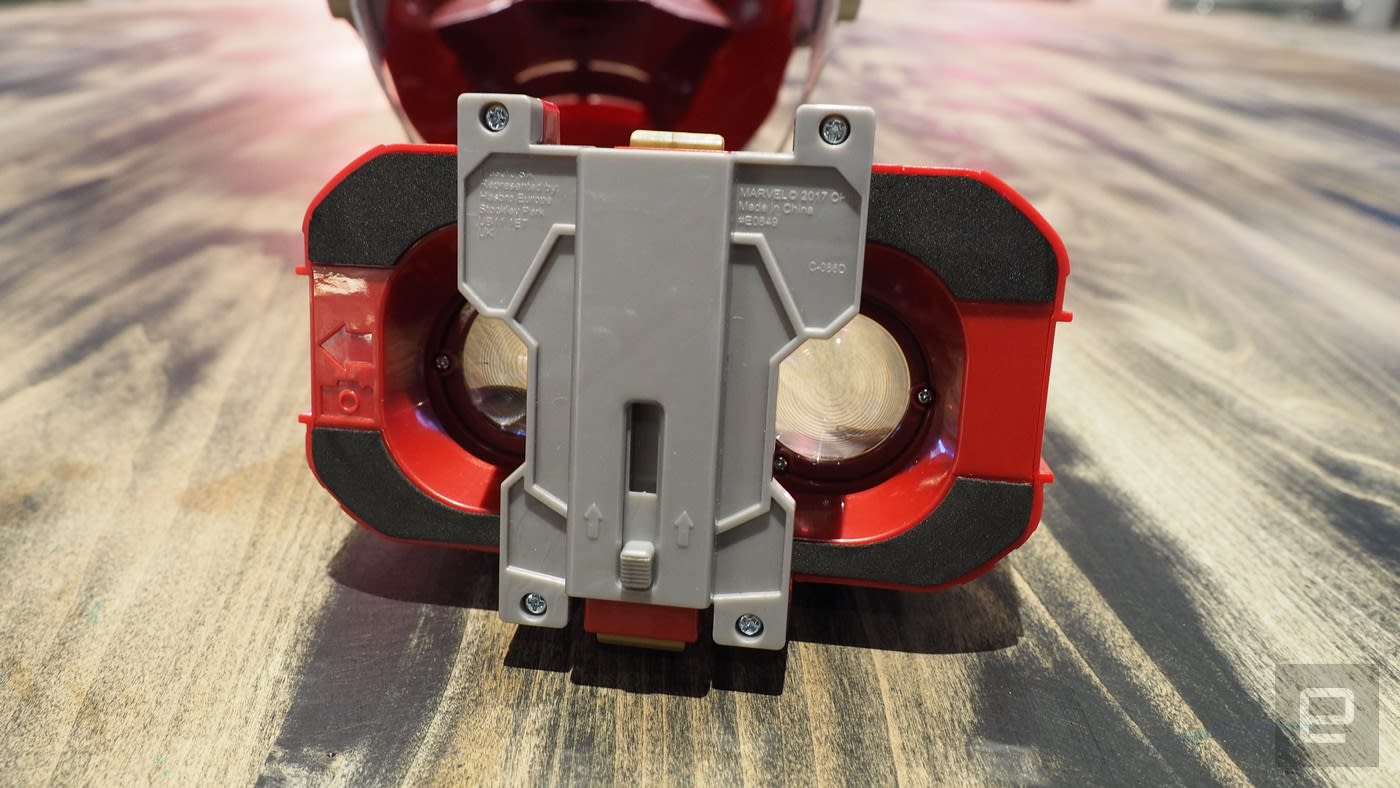
There are no headphones inside the helmet, which relies entirely on your handset for sound. It’s fairly low-tech in general: The front of the visor doesn’t glow in any way and in fact, you can see the phone through the eye holes. It’s a bit of a let down visually, but it’s a necessary evil so the phone’s camera can see your surroundings. The helmet does an excellent job of blocking out light: I was completely blind when the phone wasn’t actually on. However, the phone and goggles can also be removed from the helmet so the kids can just pretend to be Iron Man the old-fashioned way, sans game.
There’s a small red gauntlet with markings on it that allows the app to track your hand movements. It also has pegs to place “Infinity Stones” on, which function as power-ups in the game.
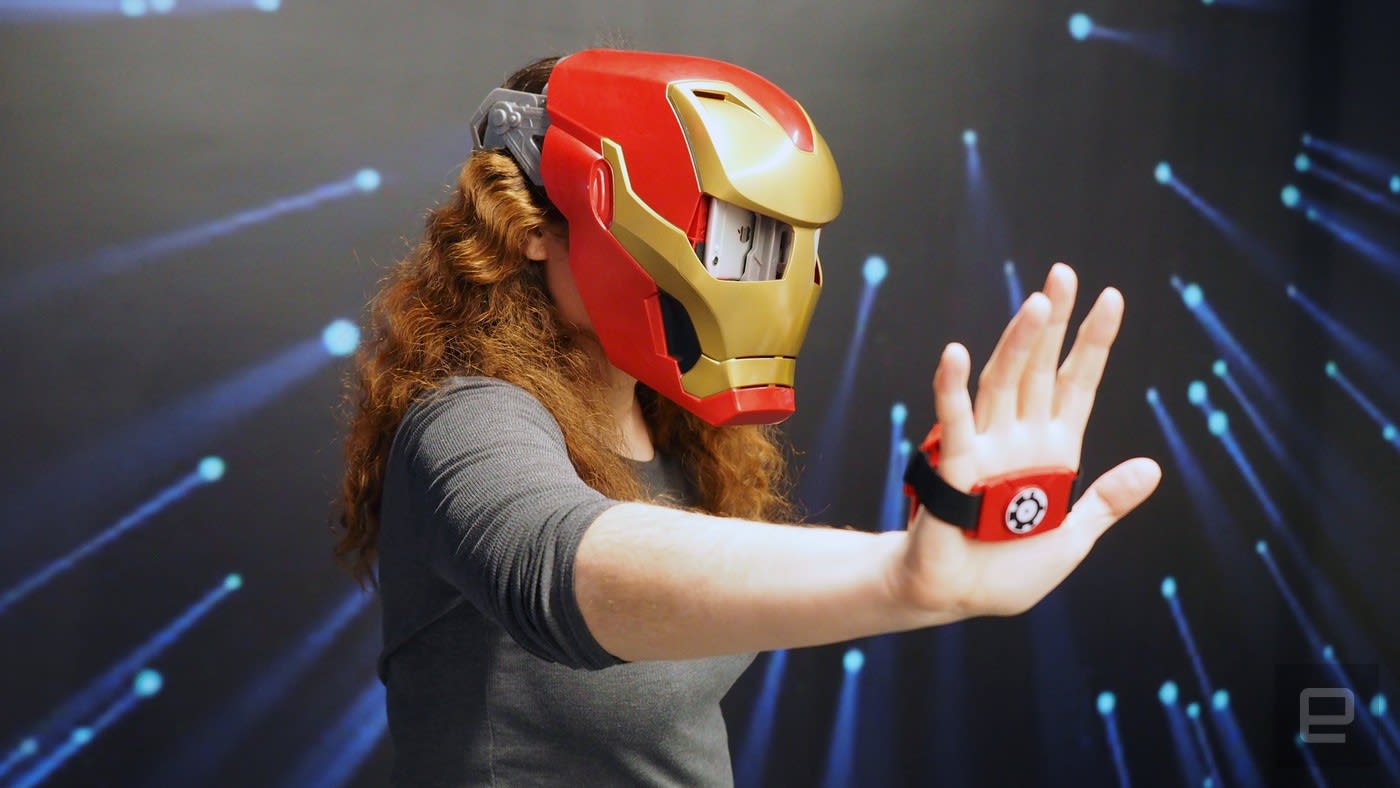
I put the helmet on sans glasses, and tried my hand at a few rounds of fighting Thanos’ minions and protecting an unnamed city. The first few levels were a little dull and served as a tutorial, but eventually it started to get a little frantic. I was turning in every direction to take out enemies before they hit me, putting up my hand to block incoming fire and listening to the cacophony of sound effects and voices reverberating in the helmet.
The conference room I was playing in at the time wasn’t terribly exciting, but I could see a backyard making for a more interesting backdrop. There’s also a freeplay mode planned, which would allow a kid run around with the HUD on, firing at their friends and pets but not having to worry about refilling ammo or taking down galactic villains.
Each round doles out in-game currency that allows you to purchase better weapons and armor, but there’s no real-world cash involved, so parents won’t have to give out their credit card info here. The game is completely self-contained and doesn’t rely on an internet connection. Everything’s stored on the device, so Hasbro doesn’t need to collect kids’ personal data and the game stays COPPA-compliant. Instead, the function of traditional in-app purchases have been replaced by the physical Infinity Stone toys, which Hasbro plans to make and sell more of later this year. As for the main set, it’ll be released this spring for $50, and includes the helmet, gauntlet and one Infinity Stone, just in time for kids to act out their favorite scenes from the new Marvel movie.
Android P might support ‘notched’ displays
It sounds like Google is taking inspiration from the iPhone X display’s notch for the next version of Android. The idea is for Android Pistachio Ice Cream (the software version’s internal name, according to Bloomberg) is to win potential iPhone customers over by offering a similar look to its OS. While some like Samsung have outright mocked the cut-out, other manufacturers like Essential (above) have embraced it. This move makes it sound like Google expects more of the latter than the former, which means you can likely expect to find more phones with all manner of sensors tucked into the space in the future. Chinese OEM Huawei is rumored to join the notched-display party as well.
What else can we expect from Android P? More Google Assistant in more places — potentially in the the home screen search bar — along with better battery life and apparently even support for foldable displays and multiple screens. Bloomberg’s sources are mum on any other details, but we’re closer to Google’s annual I/O conference, typically held each May, than we are away from it so more details (and rumors) likely aren’t far off. We’ve reached out to Google for more information and will update this post should it arrive.
Source: Bloomberg
HomePod Teardown Reveals Hidden 14-Pin Connector, 16GB Storage, and Very Low Repairability
iFixit has completed an exhaustive teardown of the HomePod and found that, while the speaker appears to have a simple design on the outside, it will likely be extremely difficult for customers to complete do-it-yourself repairs.
HomePod’s mesh has a drawstring
The teardown experts, who admit there might be a better way to open the HomePod that they’ve yet to learn, were forced to use a variety of tools to gain access to the internal components, including a heat gun, a guitar pick, a knife, and after all else failed, even a hacksaw and an ultrasonic cutter.
Underneath the rubber foot, iFixit found a hidden 14-pin connector that they speculate is probably used to test or program HomePods on pogo pins during assembly in Taiwan. Given the port sits below a layer of strong adhesive, it’s unclear if it will be used for any other purpose, such as diagnostic testing.
 HomePod’s hidden 14-pin port
Digging further, the team found the HomePod has an Apple A8 chip, as advertised, likely paired with 1GB of RAM layered underneath. There’s also a 16GB flash storage chip from Toshiba, although users can’t store songs on the speaker directly, as music must be streamed from Apple Music or an AirPlay source.
HomePod also has a two-part power supply, composed of an inner block handling the AC/DC conversion, and an outer ring distributing power to all eight of the speakers. The seven tweeters each have a conductive screw post.

In the end, the teardown concludes that the HomePod is very durable, but extremely difficult to open. This might explain why Apple is charging $279 to replace the HomePod entirely if it is damaged, unless only the power cable is damaged, in which case Apple charges a more reasonable $29 fee to have it repaired.

There’s also AppleCare+ for HomePod, which adds up to two incidents of accidental damage coverage, each subject to a service fee of $39 in the United States, plus the upfront cost of the plan. But even then, it still appears that Apple is simply replacing damaged HomePods outright beyond power cable repairs.
Related Roundup: HomePodTags: iFixit, teardownBuyer’s Guide: HomePod (Buy Now)
Discuss this article in our forums
Google ‘Embracing’ Notch Design in 2018 Android Update, Preparing for New Wave of iPhone X Clones
Google’s upcoming software update for its Android smartphone operating system will “embrace” an iPhone X notch-like design, according to people familiar with the company’s plans speaking to Bloomberg.
With the software, referred to as Android P, Google is readying a “new generation” of Android smartphones that will be “mimicking” the iPhone X’s front-facing camera cutout design.
Just like iPhone X, this cutout is believed to be where Android smartphone makers will be placing cameras and other sensors to help Android phones compete with Apple devices in the high-end market.
While Google controls the Android software, many other companies manufacture Android devices and have the ability to tweak the software as they see fit. Because of this, Bloomberg pointed out that “not all Android phones will have notches.”
In total, Google’s plan for Android P — shortened from Pistachio Ice Cream — is to convince more iOS users to switch sides by “improving the look of the software.”
While Android dominates the middle and low-end of the global smartphone market, Apple controls much of the high-end with users who spend more on apps and other services. Embracing the notch may help change that. The design will mean more new Android phones with cutouts at the top of their screens to fit cameras and other sensors. That will likely support new features, helping Android device makers keep up with similar Apple technology.
[…]building notch capabilities into Android suggests Google expects the iPhone X look to catch on more broadly.
Otherwise, Android P will reportedly focus heavily on Google Assistant and improving its abilities. Tighter software integration with the AI assistant will allow developers to integrate it inside of their apps, and Google is considering adding the assistant into the search bar on the Android home screen, but “neither of these changes are finalized for introduction this year.” Android P is said to also introduce improved battery life on smartphones and support new designs, including “multiple screens and foldable displays.”
Following the launch of the iPhone X, clones of the device began appearing around the world, including in China with the LEAGOO S9 smartphone and its notch-inspired design. Many users have disliked Apple’s notch design, and Android smartphone maker Samsung played into that criticism by making fun of the notch in a Samsung Galaxy ad posted on the weekend of the iPhone X launch.

While Android P is said to be a “dramatic” overhaul amid support for notch designs on a growing number of Android smartphones, Apple’s own iOS update in 2018 is believed to be focused more on stability. In January, it was reported that Apple has chosen to delay new software features until 2019 — like a home screen refresh, Mail improvements, CarPlay updates, and more — and instead focus on addressing performance and quality issues this year.
Related Roundup: iPhone XTags: Google, AndroidBuyer’s Guide: iPhone X (Buy Now)
Discuss this article in our forums
Apple Joins Group Investment in OLED Microdisplay Company eMagin Amid Ongoing AR/VR Efforts
Apple has joined a group of companies investing in OLED microdisplay maker eMagin, believed to be part of Apple’s overall virtual and augmented reality hardware strategy. LG, Valve, Immerex, and Stillwater Holdings have all joined in on the investment with Apple, which is said to be worth up to a total of $10.6 million (via TechCrunch).
eMagin confirmed the investment, stating that it will use the money for “working capital and general corporate purposes.” The company created “a new kind of display” to use in VR headsets that allows for sharper images, which it believes will help fuel the “next generation” of AR and VR devices.
eMagin’s technology is notable in that it has created a new kind of display that can be used in VR headsets, which provides a sharper image by using a denser layout of lines (versus the pixels commonly used in existing products). This helps reduces the so-called “screen door” effect on the display and makes what you see up close through the headset much sharper.
“We believe that our direct patterning technology is a key differentiator for enabling next generation AR/VR hardware for the consumer and enterprise segments because of the brightness and the pixel density afforded by the technology,” the company notes.
For Apple, the last few years have seen a ramp up in the hiring of talent and acquisitions of companies that all revolve around its AR/VR efforts. Since 2015, Apple has purchased several companies in this area, but some acquisitions date back even further. A few of these AR/VR acquisitions made by Apple include companies like Metaio, Faceshift, Emotient, Flyby Media, RealFace, and VRvana.
Apple has already put the technology behind Faceshift to use with Animoji in iPhone X, but outside of software the company’s plans for a hardware product in the AR/VR space remain unclear. Right now, plans for a pair of “smart glasses” or VR headset are believed to be in prototype stages, so if they do ever launch it will still be a few years down the road. More recently, a report suggested that Apple is ramping up development on an AR headset running a new operating system called “rOS.”
Apple CEO Tim Cook has said that any AR/VR hardware from Apple is a few years away because “the technology itself doesn’t exist to do that in a quality way.” At the time, Cook said that one of the biggest challenges for building such an AR headset today would be the display technology required to make it work, suggesting the new eMagin investment could be helping Apple in this area. One of the last major reports regarding Apple’s interest in AR hardware was the company’s meeting with potential AR glasses suppliers, said to have happened at CES last month.
Tags: Apple VR Project, augmented reality, eMagin
Discuss this article in our forums
Buying a used phone? Beware of this common scam no one wants to talk about
Maybe your phone is scratched up, the battery won’t hold a charge anymore, or you’re just plain sick of it. Whatever the reason, you start to shop around for a new phone, but all your budget will allow is a bland, mid-range device. So you hop online to see what kind of bargain you can pick up second hand. Someone is selling last year’s flagship iPhone or Samsung Galaxy, barely used, at a drastically lower price. You pounce and secure yourself a shiny new smartphone at a steal.
The phone arrives in a couple of days, as described, and you pat yourself on the back for your bargain-hunting skills. But you can’t activate it. Or maybe you use it for a month or so, and then it gets blocked. Upon further investigation, you realize your new phone has been reported lost or stolen. The seller won’t respond to your messages. To make matters worse, no one wants to help you – not your carrier, not the website you bought on, not even the police.
The used phone scam is frighteningly simple.
We’re sorry to say, you’ve fallen victim to a horrifyingly common used phone scam. A quick Google search reveals countless threads on forums across the world going back years, where victims appeal for help because they bought a phone that turned out to be blacklisted and unusable. Read through them and you’ll see the vast majority don’t have a happy ending. The victim typically has to eat the loss, with no prospect of getting their money back.
The used phone scam is particularly pernicious, because it doesn’t rely on a victim’s gullibility, and it’s not as well-known as something like the white van speaker scam. Everything appears to be perfectly legitimate right up to the point your new phone gets blocked. If it has happened to you, sadly there’s nothing we can do to help you, but read on if you want to learn more about the scam and how to avoid it in future.
How it works
The used phone scam is frighteningly simple. Perpetrators range from criminal gangs to insurance scammers to the morally dubious down on their luck. In some cases, the phone you’ve bought will actually be stolen. The thieves who snatched $370,000 worth of new iPhone X handsets, for example, likely tried to sell them as quickly as possible, before the phones were blocked.
Sometimes the scammer will be selling a new phone they legitimately got, probably as a contract upgrade, but then claim for it on insurance. That way they can sell the phone for cash and double their money when they claim it has been lost or stolen.
Justin Sullivan/Getty Images
Another possible scenario is the seller got the handset legitimately as a contract upgrade or as part of a new contract, sold the handset to you, and then defaulted on the monthly payments. They got the cash from you, for a phone they didn’t yet own, and then stopped paying for it, leaving you with a blocked device.
The phone can be reported lost or stolen within a few days or it could be three months later. The result is the same – you end up with a blocked phone.
The nightmare part of this scenario for victims of the scam is that there’s no way for you to get the phone unblocked. Only the person who reported the phone lost or stolen can get it unblocked, and even then, it usually takes a few days, weeks, or even months.
How to avoid the used phone scam
There’s a lot of conflicting advice out there about best practices for selling and buying smartphones, so it can be a real minefield. While you can take steps to reduce your risks, it’s difficult to ensure you’re completely protected when you buy a phone from a private individual you don’t know.
“Before you buy a phone, you want to get as much information as possible,” David Dillard, managing director at Recipero (part of the Callcredit Information Group), told Digital Trends. “Do more homework upfront, and don’t take unnecessary risks.”
“Before you buy a phone, you want to get as much information as possible”
Recipero runs a service called CheckMEND where you can pay $1 to find out about the history of a phone. This is currently the most comprehensive service around to check on a phone’s history. It will tell you if a phone has been blacklisted or blocked with a carrier, but it also draws on data from law enforcement, the insurance industry, various retailers, and other sources.
“We aggregate multiple data sets and let the consumer make their own decision,” Dillard said.
You can find out if a phone has been reported lost or stolen for free using the Cellular Telecommunications and Internet Association (CTIA) stolen phone checker, but it relies on the Groupe Spéciale Mobile Association (GSMA) for data, which comes from participating operators worldwide. It doesn’t factor in some of the sources CheckMEND can access.
“There’s a danger of false positives,” Dillard said. “You could use the CTIA phone checker and find it’s green, then the phone gets reported stolen three days later, and now you have a blacklisted phone that’s stolen property.”
CheckMEND is used to support the police and help provide accurate information to help convict criminals. Read the latest news story on how CheckMEND helped convict a mobile phone fraudster. https://t.co/FmFpKuf49Q
— CheckMEND (@CheckMEND) January 23, 2018
CheckMEND also tracks things like inventory in transit and enterprise devices out on lease. If thieves steal from an existing inventory, there’s a delay between the device being stolen, people noticing that it’s gone, and then reporting it stolen. That delay is often long enough to sell a device. Or if someone sells you a device that has outstanding finance on it, you can’t tell that from the CTIA blacklist check.
But for all its sophistication, sadly, the CheckMEND system isn’t a cast iron guarantee of safety either.
The trouble with IMEI numbers
Every phone has a unique International Mobile Equipment Identity (IMEI) number. It’s easy to check your IMEI number. When you report a phone lost or stolen, the IMEI number is blacklisted, so cell service is blocked on that device.
To run a CTIA stolen phone check, or get a CheckMEND report, you need to have the IMEI number of the device. The idea is that a prospective buyer can ask the seller for the IMEI number and then run a check on it, allowing them to buy with confidence. But then criminals started using IMEI numbers to clone phones and run new kinds of scams.
“If you buy second-hand from a retailer, make sure they have a good return policy.”
It used to be quite common to post IMEI numbers on sales listings. But if you look online today, in countless forums, you’ll see people asking if it’s okay to post an IMEI number, usually followed by numerous comments warning about the risk of cloning. It all sounds a bit paranoid.
“I heard about the paranoia, so I did a test,” says Dillard. “I placed a phone up for sale in an online marketplace, published the IMEI in the listing, and within 72 hours it was used in a commission fraud.”
A wireless employee took the IMEI and activated the device for the commission money and it took David approximately three months to have it restored once it was blacklisted.
“Never publish your IMEI on the web,” he said. “If you’re going through a trusted network and the buyer calls or messages privately and wants to check the IMEI; that’s probably okay; use your intuition. But never put it on the web, like in an eBay or Craigslist listing.”
Genevieve Poblano/Digital Trends
Another scam that’s proving very tough to combat is “credit muling”. A criminal persuades someone to activate multiple lines with a carrier and take several phones. They pay the “mule” a tempting sum for their time and trouble and tell them to cancel the contracts in a month. Meanwhile the criminal sells the phones, all with clean IMEIs, through eBay, Craigslist or wherever and makes a tidy profit.
When the mule tries to cancel the contract, they find out that they can’t without returning the phones or paying a hefty cancellation fee and they’re on the hook for the full amount. The buyer only finds out 45 to 60 days later when the payment is defaulted, and their new phone gets blocked.
In this kind of scenario, even if you got a CheckMEND report beforehand, you’re still going to be out of pocket with little recourse. You have a certified report that the phone wasn’t stolen when you took ownership, so you’ve done your due diligence, but it’s not going to be much use unless the cops subsequently catch the criminal, and that’s a lot easier said than done.
While some sellers, perhaps understandably, won’t share IMEI numbers, you can always ask them to get a CheckMEND report to prove the device they’re selling is legitimate.
What else can you do?
“You’ve got to know who you’re buying from, so you have recourse if something goes wrong” Dillard said. “If you buy second-hand from a retailer, make sure they have a good return policy.”
Most places offer a 30-day returns policy. With PayPal, you have 45 days to dispute. We recommend making purchases with a credit card, as you can dispute charges if the phone ends up being blocked. If you buy in cash from a stranger you met through Craigslist, then there’s really nothing much you can do. It’s a gamble.
GameStop, Gazelle, and Sprint all use the CheckMEND system, so at the time of purchase, you can be sure that the phone you’re buying isn’t blocked. However, as we’ve discussed, that’s no guarantee it won’t be blocked down the line.
The top three carriers in the U.S., AT&T, Verizon, and T-Mobile all rely upon the GSMA system. We contacted all three, but they either didn’t reply or declined to be interviewed for this piece. We also reached out to the CTIA, as well as Gazelle and Swappa, but have yet to hear back.
It appears this is a major problem, and no one wants to be held accountable. An industry-wide effort to pool resources and share data on phone status in real time would undoubtedly reduce the risk for the phone-buying public. It’s something CheckMEND is trying to work towards, but unless everyone buys in, it’s never going to give people purchasing used phones 100 percent confidence, and the scams will continue.
Editors’ Recommendations
- How to check your IMEI number on an iPhone, Android, or other phone
- How to find a lost phone, whether it’s Android, iPhone, or any other kind
- The best used cars you can buy for under $15,000
- Need a new ride? Here are the best used car sites on the web
- Looking for online privacy and security? Here are the best VPNs for Android
Latest Xiaomi teaser suggests the Mi TV is finally coming to India
Xiaomi may finally launch the Mi TV in India.
Xiaomi is all set to launch the Redmi Note 5 in India on February 14, and it now looks like the manufacturer may unveil its TV in the country as well. If a new teaser shared by Xiaomi on Twitter is any indication, the Mi TV will make its way outside of China for the first time.
Mi fans! Is it a bird? Is it a plane? #WhatIsThatSomething wonderful is about to happen this Valentine’s Day. Stay tuned!Register now for the live stream – https://t.co/l4bdUpyerC pic.twitter.com/99ODzuVHML
— Mi India (@XiaomiIndia) February 12, 2018
The Mi TV 4 made its debut early last year, and is available in 49-, 55-, and 65-inch variants in China. Coming in at just 4.9mm, the Mi TV 4 is one of the sleekest around. There’s also the Mi TV 4A series, which is available in 43-,49-, 50-, 55-, and 65-inch versions.

The Mi TV 4 features a 4K panel along with HDR10, and comes with Xiaomi’s PatchWall UI, which relies on AI to serve up recommendations based on your viewing preferences. Like the rest of Xiaomi’s products, the Mi TV 4 offers great vale for money, with the 49-inch version starting out at just $500.
It’ll be interesting to see which TV Xiaomi brings to India, and at what price point. I’ll be on the ground in New Delhi in a few days’ time to bring you all the details from the event, so stay tuned.
In the meantime, what do you guys think is a decent price for the TV? Let me know in the comments below.
On Valentine’s Day, remember that Google doesn’t care if your significant other uses an iPhone
Personal interactions shouldn’t be limited by smartphone platforms.
Ahead of Valentine’s Day, a few of us here at Android Central were thinking about how we keep our digital lives in sync with our significant others and family members. We all have different apps and services for shared files, photos, notes, calendars and to-do lists — but one thing we kept coming back to was that using Google apps and services is a great way to keep your digital lives in sync, even when you have an Android and your significant other uses an iPhone.
When it comes to these critical parts of our daily lives, Apple’s apps and services just aren’t an option unless both of you are using iPhones. That’s rather upsetting, isn’t it?

When I look at how my girlfriend and I keep things in sync, I realize it’s all about Google. Part of that is, of course, because I write about Android and Google for a living and therefore have more exposure to it. But beyond that, when I think about it, it’s actually just the best way to keep everything together and portable between platforms.

We’re still using Hangouts between Android phones, iPhones, PCs and Macs for our daily communications. (And hey, if you don’t need the computer side of it you can even download Allo for iOS). We have a shared shopping list in Google Keep for our weekly groceries. Google Photos lets us have shared albums, and automatically identifies and shares pictures of one another. We can both use the Google Home app to configure our Google Home speakers to work with our individual accounts.
There are more general features like email and calendars that can be handled with third-party services well across devices, and of course there are other shopping list apps and chat apps — I’m not trying to claim that Google is the only way to do this. But what’s clear is that Apple decidedly is not an option. Anything that’s designed to keep two people synced up across an Android and an iPhone just can’t come from Apple itself. By design.
Being able to interact together on Google’s services is far more appealing than being alone on Apple’s.
Now obviously there are countless versions of this story. Apple doesn’t make it easy (or in many cases, possible at all) to use its services on other platforms, cutting down opportunities for staying in sync. But in this particularly love-filled time of the year, it becomes extra apparent that Apple only really cares about creating meaningful interactions between people when they both use iPhones and Apple’s services. And that’s rather upsetting. It’s a time when Google’s “Be together. Not the same.” campaign has a particularly strong meaning.
I appreciate Apple’s design. I use a MacBook Pro every single day. I even like some of Apple’s services. But I don’t get to use them, even if I wanted to, because (aside from Apple Music) they just don’t work with my Android phone. This has a knock-on effect: not only do I not get to experience Apple’s cloud services, neither does my girlfriend — because using Apple’s apps and services would mean not being able to share with me. And no matter how nice and elegant it may be over there, being able to interact together on Google’s services is far more appealing than being alone on Apple’s.
Google Pixel 2 and Pixel 2 XL
- Pixel 2 FAQ: Everything you need to know!
- Google Pixel 2 and 2 XL review: The new standard
- Google Pixel 2 specs
- Google Pixel 2 vs. Pixel 2 XL: What’s the difference?
- Join our Pixel 2 forums
Best Buy
Verizon
Google Store
Project Fi
 AIVAnet