


Moss for PlayStation VR: Tips, Tricks, and Cheats!
If you’ve gotten stuck quite a few times while playing Moss, here are a few tips and tricks on how to beat the game.

Everyone knows by now that Moss is a cute game that follows around Quill as she adventures through her town to save her uncle.
Every action you do in the headset has an effect on the world, so you have to use that power to help Quill out. However, there may be some parts that cause you a bit of headache and can be difficult, so here are a few tips and tricks to get through those sticky situations.
See at Amazon
Take in the story

Moss is all about the story telling as well as the puzzles. You start off the game inside a library, staring at a book with no name, but you will quickly learn about the story behind the town of Moss and all it’s been through, as well as the backstory to our hero, Quill.
As you would with a regular video game, listen to the story behind the puzzles and take in the scenery. If you’ve been paying attention, some parts of scenery will tie in the backstory of our hero and his town. The story is very important to the game and it will really suck you in, so keep your ears open.
Don’t forget the scrolls

In every chapter there are hidden scrolls to be found, and once you get enough a secret will be unlocked. You can notice all the pieces adding up on the side when you go back to the book mode of the story. They’ll continue to create a design on the right hand side until you have all of the scrolls
Make sure to check every level over, even areas you wouldn’t think to check, because the scrolls may be lurking there. There are a few out in plain sight, but even more are hidden in the shadows of the world. If there’s a random ledge or a hidden corner, take a peek there to make sure you didn’t miss anything.
Keep moving

The biggest mistake you can make is taking the levels too slow. This game is about timing in some of the puzzles, and you’ll have to know when to jump even if you seem to be holding an object. There are some leisurely obstacles in this game, but for the most part, you’ll want to be on your toes.

You’ll also have to tackle some enemies as well, as you would in a regular RPG. Some of these enemies will be quicker than you, so you’ll have to master the art of evading before they get to you.
As you’ll see in the game, X and square are going to be your best friends. Quill is not a particularly sturdy champion, especially in the early parts of the game, so you’re going to have to be constantly moving in combat to survive.
Keep your eyes peeled

Some levels seem a bit tricky, but there are less than obvious signs to show you where to go. Whether it’s a subtle white ledge for you to jump on or a metal object that you can push and pull, there are little ways that help you make your way through the levels.
Although in some levels it may seem like these subtle hints are a bit overhaul on some levels, they will be a saving grace on your harder levels. This will be helpful as the levels get tougher and more strenuous when you get further in the game.
See at Amazon
PlayStation 4

- PS4 vs. PS4 Slim vs. PS4 Pro: Which should you buy?
- PlayStation VR Review
- Playing PS4 games through your phone is awesome
Amazon
You can finally sign up for PlayStation Vue on your phone
Local channels are also available wherever you go.
PlayStation Vue is one of my personal favorite live TV streaming services to-date, but one thing that’s remained a constant annoyance since its debut almost three years ago is the sign-up process. Up until now, PlayStation Vue has required you to have a TV in order to create and register your account. Thankfully, that restriction is being eliminated.

In an interview with Engadget, PlayStation Vue head Dwayne Benefield said the change was being made because “more and more people start these cord-cutting services on mobile” (true) and that “It also gives us opportunities with segments like college students, who might not have a TV in the first place.”
It’s worth noting that you’ll be limited to just three simultaneous streams if you sign up on your phone or laptop, but as soon as you connect a TV to your account, you’ll be bumped up to the regular five streams.
Along with this, PlayStation Vue is also letting its subscribers watch regional sports and other local channels no matter what city you travel to. Thanks to this, you’ll be able to stay on top of local news, weather, sports, and more even when on vacation or traveling for work.
PlayStation Vue costs $39.99/month, but you can pay as much as $74.99/month as you add more channels – including HBO, Showtime, and EPIX.
See at PlayStation Vue
Amazon has purchased smart doorbell maker Ring for over $1 billion
Similar to Zappos and Twitch, Ring will retain its own branding.
Ring is a fairly big name in the smart home gadget space, and it’s most well-known for its doorbells and security lights. One of its biggest competitors is the Google-owned Nest, and according to a report from Reuters, Ring’s just been purchased by Amazon for over $1 billion.

Similar to Amazon’s acquisitions of Audible, Twitch, and Zappos, Ring will continue to operate as it currently does and retain its own branding while integrating Amazon tie-ins as the company sees fit.
Commenting on this, a Ring spokesperson said:
Ring is committed to our mission to reduce crime in neighborhoods by providing effective yet affordable home security tools to our neighbors that make a positive impact on our homes, our communities, and the world. We’ll be able to achieve even more by partnering with an inventive, customer-centric company like Amazon. We look forward to being a part of the Amazon team as we work toward our vision for safer neighborhoods.
Both the Ring Floodlight and the Ring Doorbell Pro have received high praise from Mobile Nation’s own Modern Dad, and it’s likely Amazon will use this acquisition to create new features for Ring and Echo users.
On the other side of the octagon, Nest is expected to take on Ring with the Nest Hello this March, and now that the company is merged with Google’s hardware team, there’s a good chance we’ll see exciting things come out of that partnership even later in the year.
Things in the smart home space are quickly heating up, and now that we’re here, I’ve got to ask you – Team Amazon/Ring or Team Google/Nest?
Amazon buys smart doorbell and camera maker Blink
F1’s streaming service will be ready for April’s Grand Prix
Formula 1 racing is getting in on the streaming game. F1 TV launched today at Mobile World Congress, and the new functionality will be up and running in time for April’s opening grand prix in Melbourne, Australia. F1 TV will deliver racing fans commercial-free streams, which include access to onboard cameras for all 20 drivers in competition. From there you can arrange the camera feeds on your device however you like. There will also be a premium tier that grants access to exclusive camera feeds “not available on any other platform with the capability of multi-level personalization,” according to Formula 1.
The governing body says that all of the practices, qualifying and races will be live-streamed, in addition to press conferences and pre-and-post race interviews. For now, it’ll only be available on desktop and web browsers, with TV apps for Amazon, Android and iOS to come in the future. Subscriptions will run between $8 and $12, with Reuters reporting there will be an option for a $100 annual subscription.
Here’s what the F1 TV service will look like #F1 pic.twitter.com/ZXFm3yWCCr
— Luke Smith (@LukeSmithF1) February 27, 2018
It’s part of an overhaul for the entire F1 broadcast package, not just streaming. Motorsport says traditional TV broadcasts will feature lower camera angles and revised graphics packages. The latter is an attempt to make it easier for folks to grasp what’s happening during a grand prix race, while the former should deliver a more accurate sense of speed for viewers. There’s a video preview at the source link, but if you’re impatient, check out the tweet above for an idea of how it’ll all look.
Catch up on the latest news from MWC 2018 right here.
Nokia and Vodafone will bring 4G to the Moon
German new-space firm PTScientists has been planning a mission to the Moon for many years now. It has partnered with Audi to produce and deliver two XPrize-winning quattro rovers to the Moon that will explore both the lunar surface and carefully return to the Apollo 17 landing site in 2019. Now the team has partnered with Vodafone and Nokia to create a Moon-based communications network using 4G LTE to bring high-def video of the moon to those of us here on Earth.
Vodafone’s base station will communicate with the rovers as they gather images and video of the various lunar sights. The 4G network will use the 1800 MHz frequency band to send HD video to the Autonomous Landing and Navigation Module (ALINA), which will then connect to PTScientists in Berlin. Nokia is making space-grade networking gear that will weigh less than one kilogram in total.
4G is more energy efficient than analog radio, and will allow a larger amount of data to be transferred between the rovers and the ALINA station. “We are very pleased to have been selected by Vodafone to be their technology partner,” said Nokia’s Marcus Weldon. “This important mission is supporting, among other things, the development of new space-grade technologies for future data networking, processing and storage, and will help advance the communications infrastructure required for academics, industry and educational institutions in conducting lunar research. These aims have potentially wide-ranging implications for many stakeholders and humanity as a whole, and we look forward to working closely with Vodafone and the other partners in the coming months, prior to the launch in 2019.”
ASUS’ ZenFone 5 stretches the limits of the term ‘AI’
As expected, ASUS officially revealed its new ZenFone 5 in Barcelona today, and if you don’t mind I’m going to skip my usual meandering intro. The company talked up a handful of AI features in its latest midrange smartphone, but I think ASUS is throwing around the word “AI” haphazardly. More on that later though: Let’s get the usual hands-on stuff out of the way first.
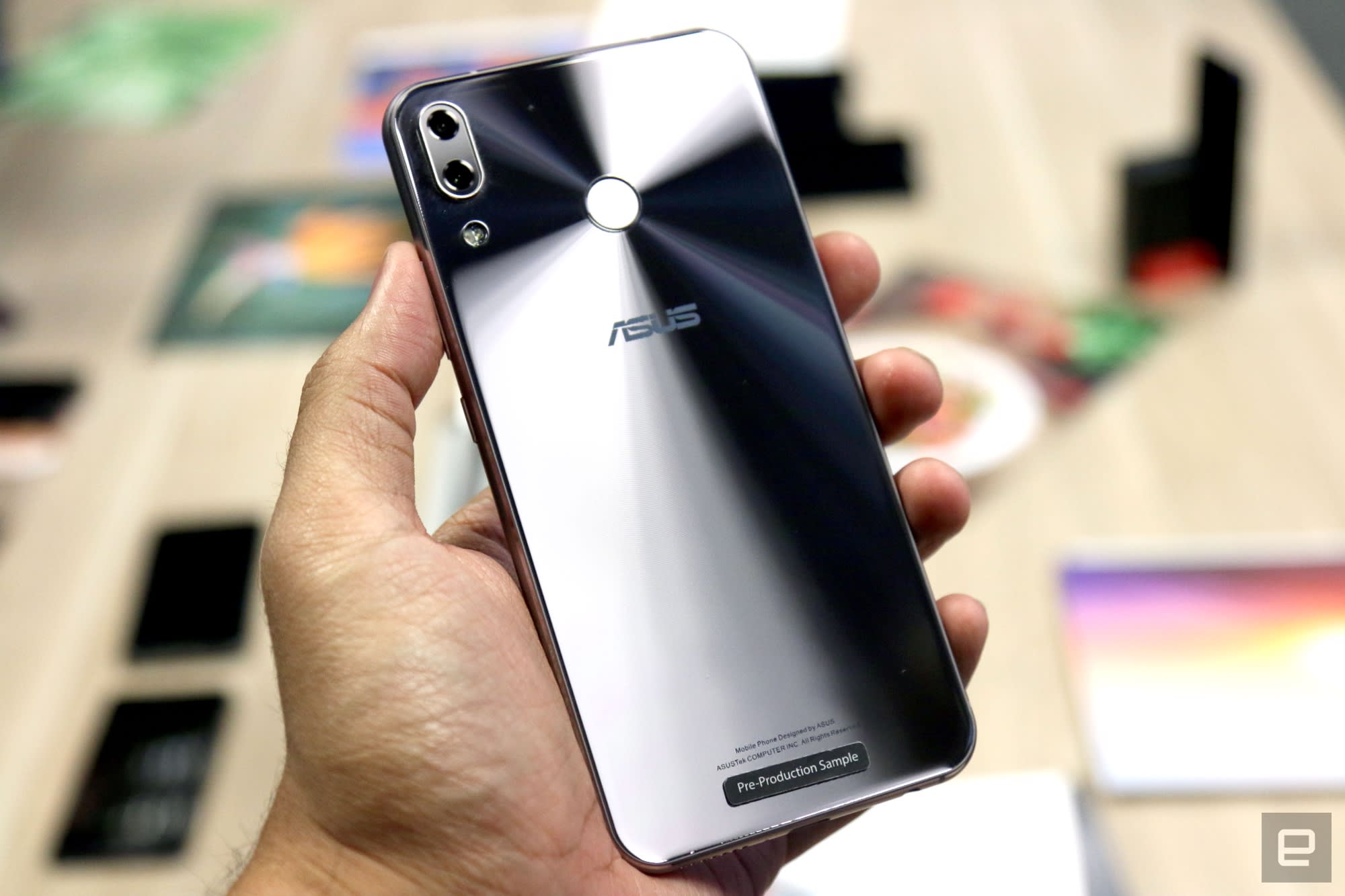
Yes, with its notched 6.2-inch screen and its vertically mounted dual camera, the ZenFone 5 looks quite a bit like an iPhone. (Just, you know, bigger and with a striking finish on its rear.) The 19:( screen is particularly nice (and that’s not a typo): Colors appear much brighter and punchier than I had hoped, and it’s longer than the standard 18:9 displays so videos played at full resolution aren’t obscured by the notch. All told, generally a pleasure to gaze at, as long as you’re not looking for a super high-resolution panel.
Inside, you’ll find one of Qualcomm’s Snapdragon 636 chipsets with either 3GB of RAM and 32GB of storage or 4GB RAM and 64GB storage. While it isn’t the fastest machine I’ve tried at MWC, navigating was mostly painless — I’m willing to chalk up the handful of performance issues I encountered to our phone’s non-final hardware. If the truly complete ZenFone 5 runs as smoothly as this one did most of the time, people searching for a midrange phone would do well to keep this thing in mind. And while I couldn’t offload any of the sample images I took, the 12-megapixel main sensor seemed to capture sufficiently detailed images with respectable dynamic range. It has an f/1.8 aperture too, which should help out a lot in low light (which I didn’t get to test) — too bad the 120-degree, secondary wide-angle camera was mostly just OK.

Chris Velazco/Engadget
ASUS hasn’t told us how much the ZenFone 5 will cost, but everything about it screams above-average midrange. There’s nothing wrong with that, but the way ASUS describes some of its features rubs me the wrong way. When the company introduced us to the ZenFone, a spokesperson proudly talked about its “10 AI features.” The problem is, ASUS is playing pretty hard and fast with the way it defines artificial intelligence. This is nothing new: While AI has become more accessible and more relevant, it has become clear that there isn’t one true definition of artificial intelligence.
ASUS has staked its position inside that gray area. Some of those AI features it spoke about to us didn’t seem to rely on AI as we know it at all, and I’m concerned that ASUS is overselling things by banking on the general confusion that comes with talking about artificial intelligence. The company’s position is that the definition of AI has shifted in recent years toward one that involves some level of machine learning. In applying the AI label to many of the ZenFone 5’s features, ASUS is simply sticking with an older, broader definition and hoping the average consumer won’t notice (or care about) the difference.
Consider the ZenFone 5’s ability to change its screen’s color temperature in different situations. The same feature is called Truetone on Apple’s most recent iPhones, and ASUS concedes there’s no machine learning going on. Ditto for another feature that keeps the phone’s screen on and unlocked while you’re looking at it. If that sounds familiar, it’s because Samsung Galaxy S phones have been doing that since the GS3. Again, the company was clear: No machine learning involved here either.
Meanwhile, a feature called Power Boost automatically manages the ZenFone 5’s performance and provides an extra dose of oomph in certain intense situations. We’ve seen similar features in action in devices like Huawei’s Mate 10 Pro, which leaned on an algorithm that was trained to help the phone understand how to best tweak performance over time. In the ZenFone 5, ASUS conceded that the Power Boost feature didn’t rely on machine learning. Actually, ASUS wouldn’t confirm how the feature worked at all, aside from saying that it isn’t maintaining a white list of apps that are allowed to push the processor harder than others. Well, what is it then?
Chris Velazco/Engadget
To be clear, I’m not saying these features aren’t helpful. The ones that actually worked in the preproduction sample we tested actually held up well — the screen never turned off while my eyes were on it, and Power Boost did seem to work for certain applications. What’s really odd is that ASUS actually built some features into the ZenFone 5 that rely on machine learning to improve performance over time. Consider the camera. After taking photos for between one and three weeks, the ZenFone will start to offer edited versions you might like.
If you find them pleasing, you can accept those changes, and that feedback will help shape the way the camera processes images in the future. If you don’t like them, you can dismiss them and never worry about them again. Also in the camera is an intelligent-scene mode that interprets what’s in the frame and fires up the correct scene mode. Since we were inside an office on a chilly Barcelona afternoon, there weren’t many sweeping vistas to test this feature with. The phone quickly launched its sunset, food and flower modes when pointed at printed pictures of, well, sunsets, food and flowers. Squeezing this kind of functionality into a midrange smartphone is good news for consumers, and for that, at least, ASUS deserves credit.
Ultimately, whether or not these are actually AI-powered features is a philosophical question. As long as these features work — and my current sense is that they do — most people probably won’t care about the distinction. Even so, I got the impression that ASUS wanted a nice, round number of buzz-inducing AI features it could tout at its very first smartphone launch at Mobile World Congress and applied the AI label too liberally. I don’t think that ASUS is necessarily pulling a fast one, but I do think it’s being at least a little disingenuous.
Catch up on the latest news from MWC 2018 right here.
Surprise! A bad mobile port of ‘Chrono Trigger’ is on Steam
Last year, Nintendo one-upped its NES Classic retro console with the SNES Classic, a powerful and value-packed trip back to the best of 90s gaming. But among all the gems bundled into the box, one was notably missing: Chrono Trigger. Out of nowhere, that exclusion was given a chance for redemption when the game appeared on Steam today. Unfortunately, a flood of negative reviews pointed out the truth: This new PC version appears to be straight-up ported from the 2011 mobile version.
We’ve gotten our hands on the PC iteration and it does appear to carry over much from the iOS port, with poor sound, almost no graphical options, an odd system font and the mobile touch interface with minimal accommodations for gamepad and keyboard control. It’s certainly disappointing: Developers often overhaul 16-bit games when porting them to PC, especially to account for advances in displays. PC players have been able to emulate Chrono Trigger near perfectly using programs like Higan, but fans would still jump at the chance to give SquareEnix money for a definitive version of the treasured game.
First released on the SNES in 1995, Chrono Trigger is a gorgeous sprite-animated RPG made by a ‘Dream Team’ of 90s designers: Final Fantasy creator Hironobu Sakaguchi, Dragon Quest creator Yuji Horii, and famed Dragon Ball artist Akira Toriyama. The game has become a critically-acclaimed favorite, which undoubtedly fueled outrage at this lazy PC port. At least this latest version includes additional content featured in the 2008 Nintendo DS port. But if you really want to do Chrono Trigger justice, you might have a better time buying an older edition instead of getting your hopes up for a quality experience on PC.
Source: Chrono Trigger | Steam
Dear HMD, the world is finally ready for the Nokia Communicator
The phone that stole the show at last year’s MWC wasn’t an Android, didn’t have a Samsung badge on it, could barely connect to the internet and didn’t have a touchscreen. The relaunched Nokia 3310 traded on one key thing: nostalgia. But it was enough for it to grab most of the headlines, and even see a re-rerelease later that year with souped up “3G” data speeds. That wasn’t it though, just a month ago, we finally got the 4G version we presume some people were asking for.
This year, Nokia (or, rather, brand-owner HMD) is at it again, reviving the iconic “Banana phone.” But, one day into the show proper, and the chatter about it had faded. I think new-Nokia missed a trick. Instead of rehashing iconic feature phones, it should revive one of Nokia’s most prescient franchises: the Communicator.
While the 3310 is iconic, it’s a 16 years old “dumb” phone, which means that it’s not really all that much use to today’s tech-savvy crowd. Even with a color screen, a camera (unheard of back then) and a few other tweaks, it was always going to be something for users with simple needs. Don’t get me wrong, there are situations where phones like this can flourish. Younger/older users might enjoy the simplicity, for one. But these aren’t the people raving about retro revivals.

The Communicator series (my favorite is either the 9110i or the E90), is ripe for a 2018 remake. If you never saw one of these beasts, they were extra chunky phones (back when phones were already chunky), that flipped open to reveal a second, full-length display and a QWERTY keyboard, almost like a mini laptop. The Communicator screamed “I do business” and came with all manner of apps for the suit on the go. This was the defining “smart” phone of its day (if you’re asking me that is).
The Communicator line started early, around 1996. Showing that, even then, Nokia knew the future was email and internet on your phone. There were several iterations that grew smaller and smarter until the name fizzled out around 2007. Nokia experimented with similar products, like the innovative, but ultimately lacking N800 internet tablet. And the 2011 E7 borrowed much of the Communicator’s DNA with a slide out keyboard (but lost the executive charm of its forbearers).

The E90 Communicator was the last hurrah of the franchise, but by then the iPhone had just arrived, Android was around the corner, and apps that didn’t need a degree to configure were about to consign it to the history books. Nokia was then destined to wander into to sunset hand-in-hand with Microsoft (and Windows Phone). And here we are.
You’d think that a clamshell phone with a physical keyboard would be redundant in 2018, but BlackBerry fans still pine for physical keys, and when Planet Computers showed off its — Psion reboot — Gemini PDA/Android hybrid at CES this year, the Engadget crew was polarized (I’m team Gemini, obviously). Anecdotally, a writer sat next to me at MWC as I type this is pecking out missives on an old Huawei phone and a fold-out Bluetooth keyboard, I’m pretty sure she’d love a modern Communicator too.
New Nokia has the ability to make a decent Android phone, if the latest Scirocco is anything to go by, so a higher-spec, more capable Android Communicator isn’t beyond the company’s abilities. It might feel niche, but the combination of nostalgia and actual functionality would be intoxicating enough to reach new and nostalgic buyers alike. What’s more, the average user wasn’t ready for what the Communicator offered back then. Buyers today, however, expect and rely on the very features — email, browsing and productivity — that ultimately made phones like the E90 too exotic back then.
Images: Shritwod / Public Domain (Three phones); Nokia-e90.jpg / Wikimedia Commons (Nokia E90)
‘Transparent’ creator Jill Soloway heads new Amazon book imprint
Jill Soloway, creator of the Emmy- and Golden Globe-winning show Transparent, is heading another Amazon project. The company announced today that Soloway will be the editor-at-large of a new Amazon Publishing imprint, Topple Books, which will feature a diverse slate of writers working in narrative nonfiction and fiction. “We live in a complicated, messy world where every day we have to proactively re-center our own experiences by challenging privilege. With Topple Books we’re looking for those undeniably compelling essential voices so often not heard,” Soloway said in a statement. “I can’t think of a more perfect collaborator than Amazon Publishing to make our dream of a revolutionary publishing imprint come true.”
Topple is also the name of Soloway’s production company, which, along with Transparent, produced I Love Dick for Amazon and currently has eight TV shows and four films in development with the company. Transparent is scheduled to return for a fifth season, though it will be doing so without Jeffrey Tambor who was removed from the show following multiple allegations of sexual harassment. I Love Dick was cancelled last month after just one season.
Soloway, while more well-known for their TV and film writing, directing and producing, has also published two works — a novella titled “Jodi K.” and a collection of essays titled Tiny Ladies in Shiny Pants: Based on a True Story. Topple Books is one of 15 Amazon Publishing imprints and it will publish, women of color, gender non-conforming, lesbian, bisexual, transgender and queer writers.
Source: Amazon
ASUS’s Zenfone 5Z flagship looks the same as its mid-range cousin
ASUS’s Zenfone 5 just made its first official appearance at MWC, and aside from overenthusiastic claims about its AI prowess, it’s still a solid little machine. It isn’t a flagship-level powerhouse though, which is why ASUS cooked the ZenFone 5Z — it uses the exact same body as the more affordable Zenfone 5 but holds within it a Snapdragon 845 and up to 8GB of RAM.
Because it looks identical to the 5, ASUS didn’t actually bother bringing any 5Zs to its press conference. I We can’t really elaborate on any differences in performance as a result, but ASUS’s rationale for keeping the design the same makes sense. As explained to us, ASUS is used to fitting different spec configurations into the same chassis from its main business as a PC maker. Fair enough, though we still would’ve liked to test one out.
The press conference also revealed that, in response to Apple and Samsung, ASUS kitted the Zenfone 5 and 5Z out what it calls Zenimoji. As you’d expect, it too transposes your facial expressions onto virtual avatars like a funny bear and the company’s cutesy owl mascot, Zenny. Just what we needed! While we still don’t know what the bog-standard Zenfone 5 will cost when it launches in April, the Zenfone 5Z just might be the best value you’ll find on a Snapdragon 845 machine. Starting this June, our friends in Europe will be able to pick up the 5Z for €479, which works out to just a hair under $600 in US dollars. You can expect the official US price to be a little higher than that, but we’ll share that detail with you soon as we hear about it.
Catch up on the latest news from MWC 2018 right here.
 AIVAnet