


Nokia 8 Sirocco Hands-on Review
Research Center:
Nokia 8 Sirocco
Ever since HMD started producing smartphones with the Nokia brand name, its designs have more or less been utilitarian. A tough protective metal frame around a single aluminum unibody, with a fairly straightforward rear and front design. Well, the company thinks it’s ready to change things up with its first luxury smartphone, the Nokia 8 Sirocco.
If you recall the Sirocco name, it’s from when Nokia used to differentiate some of its special edition feature phones, like the Nokia 8800 Sirocco. Well, the Nokia 8 Sirocco certainly is something special. Let’s take a closer look.
Razor-thin edges
The Nokia 8 Sirocco is wrapped in Gorilla Glass 5, with a stainless steel frame in between. Stainless steel is tougher than aluminum, which is used in most phones, and it also makes the phone look and feel a tad more luxurious.
The first thing you’ll notice, however, is how compact the Sirocco feels. The minimized edges around the screen really do make the 5.5-inch form factor feel small. Better yet, the phone is thin at 7.5mm, but the edges curve into the stainless steel frame, with the thinnest point being just 2mm.
Julian Chokkattu/Digital Trends
It’s quite an experience holding the Nokia 8 Sirocco, because it feels futuristic, and the edges are razor thin. It’s just plain cool to hold and stare at. The sides of the phone do feel a little too sharp, but we’ll have to use the phone a little longer to decide if it’s detrimental to the smartphone experience. What we certainly didn’t like were the buttons — they’re flush against the right edge of the Sirocco, so not only is it difficult to quickly locate them, but they’re tough to press without making sure you exert a certain amount of pressure.
The software is slick, simple, and fast, and the promise of updates is always good to hear from any Android manufacturer.
The rear side of the phone is a little too glossy because of the glass, and it attracts plenty of fingerprints, but that’s a problem with most flagship smartphones these days. There’s a dual-camera system on the top, a fingerprint sensor below it, as well as the Nokia and Android One logos below. We’re hoping the certification labels aren’t going to sit at the very bottom, because it sort of clutters the look of the device.
There’s a USB-Type C charging port on the bottom, and HMD thinks it’s also time to get rid of the headphone jack, sadly.
Overall, we love the look of the phone. It feels compact and comfortable to grip in the hand, and we like how the curved edges don’t blend as much into the frame as the Galaxy S9, which sometimes interrupts usability. We’ll certainly have to use it for a longer period of time to see if the razor-sharp edges continue to bother us.
High-end specs
The Nokia 8 Sirocco mostly has the flagship specifications you’d expect — except for the processor. It uses Qualcomm’s Snapdragon 835 chip, which was the flagship processor of choice for many smartphones last year. 2018 is the year of the Snapdragon 845, so it’s a little odd that HMD’s flagship phone doesn’t have the latest processor on board.
Julian Chokkattu/Digital Trends
In terms of actual performance, though, you won’t see a problem with the 835 at all. Apps opened quickly, and moving through the operating system felt fast. There’s 6GB of RAM on board, which is more than enough, as well as 128GB of internal storage. There’s no MicroSD card slot, which may be disappointing for some, but again, 128GB is plenty for the average person.
The P-OLED 2560 x 1440 pixel resolution on the 5.5-inch screen looks vibrant, colorful, and incredibly sharp — perfect for viewing movies and videos.
The glass back allows for Qi wireless charging, and a 3,260mAh battery should keep the phone going strong for about a full day. The phone is also IP67 water-resistant, which means it should still survive submersion up to a meter underwater for 30 minutes.
The camera system is also surprisingly fast to react. There’s a 12-megapixel camera accompanying a 13-megapixel telephoto lens on the rear — with Zeiss optics — which adds a 2x optical zoom feature, to shoot subjects that are further away, as well as a bokeh portrait mode. We saw virtually no shutter lag, though there was a little blur in the low-light environment we were shooting in.
It’s the “bothie” feature that caught our eye. Debuting last year on the Nokia 8, it lets you take photos or videos with the 5-megapixel front camera and the rear camera at the same time, perfect for trying to capture reaction and action at the same time. It worked incredibly well with an easy-to-use interface, offering high-quality photos at the touch of a button.
The new Pro Mode is a nice addition as well. Swipe up from the shutter icon and you can get access to manual controls for the camera. It’s well-laid out and easy to slide the toggles to get the settings you want. This feature will be available on all Nokia phones with Zeiss optics.
Nokia 8 Sirocco Compared To
Sony Xperia XZ2
Cat S41
Nokia Lumia 820
Sony Ericsson C902
Motorola MOTORIZR Z3
Jitterbug Dial
Samsung SCH-u620
LG VX9400
Sony Ericsson K790a
Nokia N93
Blackberry 8700c
Blackberry 8700g
Nokia N90
Palm Treo 650
Motorola RAZR V3c
Android One
But perhaps best of all, the Nokia 8 Sirocco runs Android One. That doesn’t just mean you get stock Android with no bloatware apps — you also get access to fast security and Android version updates.
The software is slick, simple, and fast, and the promise of updates is always good to hear from any Android manufacturer.
Price and availability
The Nokia 8 Sirocco will cost a whopping 750 euros (about $922). You can certainly get equal or better specifications for the price, such as with the Galaxy S9, but it may be worth the cost. We’re quite happy with the design, the camera is promising and has quite a few must-have features, and you’re guaranteed immediate updates.
The Sirocco will be available in April 2018, but there’s no word of a U.S. release.
This is the moment a portable charger caught fire in a plane’s overhead bin
Exploding batteries are back in the news after one of the devices went up in flames on a passenger plane in China on Sunday.
While extremely alarming for those on board the China Southern Airlines aircraft, the jet was fortunately still on the ground when the incident took place, with passengers taking their seats prior to the plane’s departure.
A video (below) of the incident shows an object burning in an overhead bin. A flight attendant can be seen squirting water at the flames before throwing the entire bottle at the fire, apparently extinguishing it in the process. But with smoke continuing to billow from the bin, a passenger then grabs another bottle of liquid to pour onto the ruined power bank.
The airline said in a statement picked up by Channel News Asia that passengers were boarding flight CZ3539 when they spotted the flames coming from the portable charger. The make of the device hasn’t yet been revealed.
The fire was fully extinguished and no one suffered any serious injuries, the airline confirmed. Passengers were quickly evacuated and flew later on Sunday on a replacement aircraft.
Police questioned the owner of the power bank and learned that the device had not been in use when it started burning.
Power bank fire on board China Southern CZ3539, Feb 25 2018. pic.twitter.com/cby6E62qRv
— ChinaAviationReview (@ChinaAvReview) February 25, 2018
Lithium-ion batteries, whether built into devices like smartphones or as standalone power banks, are well known to be a fire risk, especially if they’re faulty, badly made, or have incurred damage during their daily use.
The most famous incident of recent times involved Samsung’s Galaxy Note 7, which was shipped in 2016 with faulty batteries that led to numerous reports of overheating and fires. The issue was so serious that the U.S. Department of Transportation banned the device from being taken onto American planes.
Shortly before the ban was announced in October 2016, the U.S. Consumer Product Safety Commission warned that the Note 7’s battery could “overheat and catch fire, posing a serious fire and burn hazard to consumers.”
Hoverboards also hit the headlines in 2015 after a spate of incidents which saw the personal transporter suddenly catch fire. They, too, were banned from passenger aircraft.
Airlines around the world now have strict rules in place preventing passengers from placing spare, uninstalled lithium-ion batteries in their checked baggage. Power banks are considered as spare and so can only be taken on as carry-on luggage.
While reports of such fires are thankfully rare when you consider how many lithium-ion batteries are in use today, Sunday’s incident shows just how fierce such a fire can be, with quick action needed to prevent the situation from spiraling out of control. You certainly wouldn’t want it to happen at 36,000 feet.
Editors’ Recommendations
- Cool camping gadgets for every outdoor adventure
- Swiss Apple Store evacuated after an iPhone battery begins emitting smoke
- The five longest flights in the world make New York to London feel like a hop
- Airline smart luggage ban will be a real headache for travelers
- Windows 10 Timeline hands-on
The MediaTek Helio P60 could help make midrange smartphones a whole lot smarter
MediaTek wants to make midrange phones a little more powerful. The company announced at MWC 2018 the new MediaTek Helio P60 chipset, which is aimed at offering many of the specs that you would expect in a flagship chip, but in a more affordable chipset aimed specifically at midrange devices.
Perhaps most interesting is the fact that the chip is among the first midrange chips to feature a so-called “big.LITTLE” architecture. In other words, it features eight cores — four more powerful ARM A73 cores, and four ARM A53 cores. What that means is that the more powerful cores can handle more intensive tasks, leaving things like background tasks to the less powerful cores. That ultimately will result in a much more efficient chipset.
How much more efficient? Well, MediaTek claims the Helio P60 offers a 70 percent CPU and GPU performance boost over its predecessors, the Helio P23 and Helio P30. The chipset is also more power efficient — and MediaTek claims it will deliver up to 25 percent power savings for some power-intensive applications, and a 12 percent power saving overall.
The chipset also boasts other high-end features, like MediaTek’s NeuroPilot and CorePilot 4.0 technology. NeuroPilot is basically aimed to enable artificial intelligence features like facial recognition, object recognition, and so on. It’s also compatible with Google’s Android Neural Network, supports TensorFlow, and so on — meaning developers can make use of NeuroPilot to create A.I. systems.
The new chipset also places a pretty heavy emphasis on photography. The Helio P60 supports dual rear-facing cameras of up to 20 megapixels plus 16 megapixels — or a single lens of up to a hefty 32 megapixels.
When it comes to communications, the Helio P60 offers 802.11ac Wi-Fi, an FM radio, and Bluetooth 4.2. It’s a little strange that the chipset doesn’t offer Bluetooth 5.0, though according to MediaTek the reason is that the release schedule of Bluetooth 5.0 and the development schedule of the Helio P60 just didn’t line up.
Of course, the MediaTek Helio P60 isn’t MediaTek’s flagship chipset — that title falls to the MediaTek Helio X30. So what’s the difference between the two? Well, while the Helio X30 has the same eight cores as the P60, but it has a higher clock speed, and as such it will be able to process a little quicker. The Helio P60 also may not offer the wide array of communications technology on offer from the Helio X30.
Still, the fact remains that the Helio P60 looks to be a pretty excellent midrange offering and should help give midrange phones some more premium-tier features, especially when it comes to artificial intelligence.
Editors’ Recommendations
- Honor View 10 vs. OnePlus 5T: Which midranger reigns supreme?
- Sony Xperia XA2 vs. HTC U11 Life: Can Sony rule the midrange market?
- Try these Honor View 10 tips and tricks to get more from your phone
- Monoprice Monolith K-BĀS review
- Meet the Qualcomm Snapdragon 845, the power behind next-gen phones
Sony Xperia XZ2 preview: Slimmer bezels, wider appeal
The right direction. The wrong carrier strategy.
I have a confession: I really like Sony phones. More accurately, I like the idea of Sony phones — the ones that, over the years, have debuted to passionate pleas by reviewers to improve camera quality and get rid of dem bezels.
The Xperia XZ1, which debuted during IFA last year, didn’t get rid of the bezels, but it did give the former — the camera quality — a fighting chance. At the same time, the brand seemed stuck in stasis in the U.S. as consumers waited for Sony’s self-proclaimed biometric reemergence, bringing the fingerprint sensor, a table stakes feature, back Stateside.
With the Xperia XZ2, Sony’s done exactly that, while simultaneously redesigning its flagship lineup. The phone adopts a so-called “Ambient Flow” design language, extending the 5.7-inch LCD screen to the now-common 18:9 aspect ratio that we saw debut last year with the LG G6. A glass back allows for wireless charging, which is convenient, and the Snapdragon 845 inside ensures that at least from a performance perspective the phone is in line with other 2018 flagships.


The Xperia XZ2 (left) compared to the Xperia XZ1 (right). You can see how different they look from the front.
What’s impressive about the Xperia XZ2 is how modern it feels compared to Sony’s previous phones; this isn’t merely an Xperia XZ1 with less pronounced bezels. The fingerprint sensor has been moved from the side to the back (though there is still, thankfully, a camera shutter button on the side below a dedicated power button), and the phone, at a hefty 198 grams, holds a 3180mAh battery that’s 17% larger than its predecessor. At 11.1 millimeters thick, the Xperia XZ2 is not a small phone.
Sony Xperia XZ2 & XZ2 Compact specs
So Sony did a lot to bring its flagship phone into the 21st century, but to say that the XZ2 is “bezel-less,” or akin in any way to the achievements of the Galaxy S9, Essential Phone, iPhone X, and LG V30, is a misnomer. There is still a sizeable chin below the elongated screen, and even up top the earpiece, front-facing camera, and proximity sensor combo have plenty of extra room. While the screen certainly takes up more of the phone’s overall facade than any previous Sony phone, the phone itself is considerably bigger than any “regular” Xperia flagship — the dimensions are closer to the XZ Premium than the XZ or XZ1 (or XZS. My goodness, Sony releases a lot of phones).


All of this is to say the Xperia XZ2 does a lot of things well, but doesn’t diverge too much from the fundamentals that Sony has espoused for years: content creation and media consumption. To that end, the phone puts even greater emphasis than before on taking great photos with the 19MP sensor and f/2.0 lens, which is identical to the previous generation and still not optically stabilized.
This is very much a Sony phone, even though it tries to do away with so much of what made them so problematic in previous years.
There is some gratification in this upgrade, though, owed more to Qualcomm’s help than anything Sony itself did: the XZ2 is the first Xperia phone to plug directly into Qualcomm’s Image Signal Processor, which means a couple of things. First, the processing should be considerably better than the proprietary method Sony used on previous devices; and it allows for 4K HDR video capture, which is heralded along by the Snapdragon 845 platform.
It’s safe to say Sony’s phone camera output has been of questionable quality in recent years. The company has struggled to keep up with the industry’s biggest names like Samsung, Google, and Huawei, despite manufacturing the sensors that go into nearly every phone out there. While I didn’t get to do side-by-side comparisons in my short time with the XZ2, Sony assured me that lessons have been heeded and users can expect a significantly better camera experience this time around, despite the lack of hardware changes.

The faster Snapdragon 845 also helps Sony achieve another milestone: 960fps slo-mo video capture at 1080p resolution. The Xperia XZ1 and XZ Premium could capture 0.6 seconds of slow motion at 720p; their successor can do 0.3 seconds at 1080p, which works out to about three seconds of usable video. That’s still longer, and at a higher resolution, than the Snapdragon 845-toting Galaxy S9.
Sony has also brought its 3D Creator tool— the cool but not particularly useful feature that allowed users to build three-dimensional models of themselves or objects in their vicinity — to the front-facing camera, so you can 3D alone. I tried this on admittedly early software — the phone doesn’t come out until late Spring — but the process was inordinately difficult, and I couldn’t complete it. What’s potentially more interesting is that these creations can be posted, or will be postable soon, natively to Facebook, allowing you to scare your friends with creepily realistic CGI versions of yourself while dodging fake news. Fun!

Here’s admittedly the most interesting part of the entire Xperia XZ2 experience — at least based on my limited time with the phone. Sony calls it a “Dynamic Vibration System,” but I call it the coolest haptics ever. It’s an optional setting that implements a vibration motor that’s more than twice the size than that of a normal smartphone, and while it’s not quite as accurate as the one in the LG V30 or iPhone X, it’s tremendously powerful.
Sony demoed the Spider-Man: Homecoming trailer (remember, Sony still owns the rights to Spider-Man even if Homecoming is part of the MCU) and it felt like a party in my hands. It’s probably not something I want enabled for every song or movie I watch, but if it translates into improved haptics throughout the OS, you can call me a happy camper.


To that end, audio continues to be among Sony’s top priorities, although the Xperia XZ2 does away with the headphone jack in favor of a USB-C port and an in-box dongle.
Unlike the LG V30, the Xperia XZ2 is an audio-focused device that does away with the headphone jack.
Perhaps as justification (but not really, let’s be honest), the phone’s front-facing stereo speakers are 1.5 times more powerful than the previous generation’s, and there’s still support on-board for myriad audio-related acronyms, including LDAC (wireless audio codec), aptX HD (wireless audio codec), DSEE HX (upsampling compressed audio), and more.
In other words, audio’s going to sound really good out of the XZ2, but don’t expect to easily use wired headphones with it. Sony justified the removal by pointing to the significant increase in battery life, but I’m still of the opinion that an audio-focused phone should have a headphone jack. Call me old-fashioned.


If you’re interested in something smaller and (most likely) cheaper, the Xperia XZ2 Compact could be your phone. It’s got a 5-inch LCD display, up from 4.6 inches on the XZ1 Compact — once again, thank the 18:9 aspect ratio and reduced bezels — but the diminutive phone loses the wireless charging of its larger counterpart (along with its attractive rear glass) and the Dynamic Vibration System. It feels considerably less premium than the XZ2, too — the plastic feels cheap compared to previous Compacts — but it’s, like, 90% the way there, which is more than enough for most people. If you’re interested in the Xperia XZ2 Compact, it’s probably because you’ve bought a member of the Xperia Compact series before.

I was one of the few people who bought the Xperia Z3 Compact when it debuted in 2014 — that green was my favorite color — and these Xperia XZ2 variants come close to recreating my favorite hues. But this time around, the XZ2 Compact feels somewhat of a throwaway, a legacy device for people who refuse to move into the now. That doesn’t preclude me from wanting it, but it’s clear Sony is spending considerably more engineering effort on its flagship, and that’s likely to continue into future generations.

On the software side, both phones run Android 8.0 Oreo with a very slight Sony skin. While the company hasn’t gone as far as Nokia in dedicating itself to Google’s way of Android, Sony’s is among the closest to “stock” you’ll find on a phone today.
So what’s the takeaway here? After seeing the iterative nature of the Galaxy S9, the Xperia XZ2 should be very exciting, but in a lot of ways, it feels like Sony catching up to the present. The XZ2 is a fine smartphone, a capable handset that I hope outputs better photos and videos than its predecessors. But even if it does, and by a wide margin, the phone will still be held back by limited U.S. distribution and branding that doesn’t quite make it into the mainstream.
For those who know, Sony makes great smartphones. This time around, let’s hope the company behind PlayStation and Spider-Man do a better job making that obvious.
The Xperia XZ2 and XZ2 Compact will be available in late spring. Pricing and specific market availability will be shared in the coming weeks, so stay tuned.
Sony Xperia XZ2 & XZ2 Compact specs
The numbers behind the phones you may want to buy.

Sony knows how to tell a specs story, but it often lacks a compelling narrative for why someone would want to buy the phone in the first place. The Xperia XZ2 and XZ2 Compact don’t change the narrative too much, but they’re considerably better looking than any Xperia product before them — and having a usable fingerprint sensor can’t hurt, either.
| Operating System | Android 8.0 Oreo | Android 8.0 Oreo |
| Display | 5.7-inch LCD, 1920x1080Gorilla Glass 5 18:9 aspect ratio | 5-inch LCD, 1920x1080Gorilla Glass 5 18:9 |
| Processor | Snapdragon 845 64-bitAdreno 630 | Snapdragon 845 64-bitAdreno 630 |
| Expandable | microSD up to 400GB | microSD up to 400GB |
| RAM | 4GB | 4GB |
| Rear Camera | 19MP Exmor RS, hybrid AF960 fps FHD slow-mo, 4K HDR video | 19MP Exmor RS, hybrid AF960 fps slow-mo, 4K HDR video |
| Front Camera | 5MP f/2.2 23mm wide-angle | 5MP f/2.2 23mm super wide-angle |
| Connectivity | Wi-Fi 802.11ac, Bluetooth 4.2, NFC, USB 3.1, GPS | Wi-Fi 802.11ac, Bluetooth 4.2, NFC, USB 3.1, GPS |
| Battery | 3180mAh | 2870mAh |
| Charging | USB-CQuick Charge 3.0Qnovo Adaptive Charging Qi wireless charging | USB-CQuick Charge 3.0Qnovo Adaptive Charging |
| Sound | Stereo S-Force front speakers | Stereo S-Force front speakers |
| Water resistance | IP68 | IP68 |
| Security | Rear fingerprint sensor | Rear fingerprint sensor |
| Dimensions | 153 x 72 x 11.1mm | 135 x 65 x 12.1mm |
| Weight | 198 g | 168 g |
| Network | 1.2Gbps (Cat18 LTE) | 800Mbps (Cat15 LTE) |
| Colors | Liquid Black, Liquid Silver, Deep Green, Ash Pink | White Silver, Black, Moss Green, Coral Pink |
The Xperia XZ2 is Sony’s fastest, strangest flagship phone yet
Sony has longed to find lasting success in the smartphone market, but none of the devices it released in the past few years have done the job. It’s clearly time for a change, and Sony knows that — that’s why the new Xperia XZ2 and XZ2 Compact are notable steps away from the company’s smartphone norm.
They’re fast, fascinating and pretty (to me, anyway), and it seems obvious that Sony wanted to strike a balance in these devices between immersive media consumption and powerful content creation. After a little bit of hands-on time with the XZ2 and its little sibling, I don’t think Sony hasn’t gotten everything right, but at least these things are pleasantly strange.

The basics
The XZ2 is one of many smartphones we’ll see this year that use Qualcomm’s Snapdragon 845 chipset, paired here with 4GB of RAM and 64GB of internal storage. (Most versions of this phone will take microSD cards as large as 400GB, but some will use a dual SIM setup instead.) In our limited time together, the XZ2 felt as fast as the Galaxy S9 when launching apps and frantically multitasking, and it’s nice to see that Sony’s custom interface doesn’t bog things down noticeably. Curiously, Sony says its implementation of Qualcomm’s X20 modem features more RF antennas to help it reach peak download speeds as high as 1.2Gbps.
The XZ2 also runs Android 8.0 Oreo, and you’ll take in all of those software flourishes on a 5.7-inch Full HD+ HDR display. Sony hasn’t confirmed why it didn’t use a higher resolution screen, but considering its 3180mAh battery, concern over power consumption is a safe bet. That screen also has one fascinating new trick we haven’t had much chance to test yet. Thanks to Sony’s XReality engine, the XZ2 will up-convert standard SDR videos into HDR on the fly, a trick that’s been a part of televisions for a few years now already. Given how nice the screen is to look at under normal circumstances, consider us cautiously optimistic about how well this actually works.
Look and feel
If you’ve picked up a Sony phone in the past few years, there’s a very good chance it looked and felt like many of the devices that came before it. That’s because Sony has been using the same aesthetic — “OmniBalance,” they call it — since the launch of the Xperia Z more than five years ago. Well, no more. For its new flagships, Sony has embraced a curvier, arguably more organic approach you can also spot hints of in the company’s PlayStation 4 controller and, erm, its robot dog Aibo.
As far as I’m concerned, it’s a big improvement over Sony’s older, flatter design. The curved Gorilla Glass 5 back helps it sit nicely in the palm of your hand, and the company’s decision to use a taller, narrower 18:9 display makes the XZ2’s 5.7-inch screen feel very manageable. Make no mistake, though. Sony might’ve gone with an 18:9 display, but it hasn’t gone as far as companies like Samsung in trimming the bezels around that screen, and I’m sure not everyone will find the look anything to write home about. If nothing else, you’ll find some small, helpful changes here. The rear-mounted fingerprint sensor sits low on the phone’s back, which made it a little easier for me to access without having to stretch for it. And at long last, Sony aligned the camera near the phone’s center rather than off in a corner, so you’re less likely to accidentally dangle a finger in front of it when trying to shoot stills.

Chris Velazco/Engadget
The camera
Impressive Sony-made camera sensors are almost impossible to avoid when smartphone shopping, but Sony seems to be playing it safe with the XZ2. Much like its predecessor, the XZ2 packs a 19MP Motion Eye sensor around back, and yes, there’s still only one of them. It’ll be a little while before you can nab a Sony phone with a dual camera, but the company has suggested we’ll hear a little more about those plans shortly. We’ll be waiting. In the meantime, though, the results I squeezed out of the XZ2’s camera were mostly impressive: lots of bright colors and sharp detail appeared, even with non-final software and drab New York weather throwing a wrench into things.
The actual sensor Sony used might not have changed, but it has picked up a few new tricks. Smartphone videographers can now shoot 960FPS, super-slow-motion video in full HD (up from 720p), and since there’s a Snapdragon 845 tucked away inside, the XZ2 can capture 4K HDR video as well.

Meanwhile, a more modest 5-megapixel camera sits above the screen, but it captures more than standard selfies. The original Xperia XZ came with a 3D creator mode that let you “scan” objects with the phone’s main camera to build 3D models for sharing on Facebook or printing. Sure, it was gimmicky; it was also a classic case of Sony being weird for reasons that are never really clear. In any case, the feature had one notable shortcoming: it was fine for scanning objects in front of you, but less than ideal for scanning your own head. Sony has finally fixed that tragic oversight — those scans can now be created using the front-facing camera, and while the process can be awkward (I was prompted to remove my glasses and do everything blind), the results can be surprisingly impressive. These 3D scans also get bonus points for being slightly less creepy than the Galaxy S9’s AR emoji.

Chris Velazco/Engadget
Rumbling audio
Sony paid a lot of attention to the XZ2’s audio performance, too. Mostly, the work paid off: the phone supports high-resolution audio, and a set of S Force stereo speakers pump up the jams with more power than I expected. (All told, the XZ2 is 20 percent louder than its immediate forebear.) So far, so good, right? Well, things get strange pretty quickly.
As some leaks suggested, the XZ2 has a significantly larger haptic actuator inside of it. On the most basic level, that means you’re more likely to notice the vibration of a notification rolling in. Sony took things a bit further by whipping up an algorithm to turn that actuator into a sort of video-gamey rumble feature. The idea is that an algorithm processes the audio data of whatever’s playing and vibrates the phone when appropriate. If you’re playing a game like Angry Birds, the effect can be mildly cool — I felt some haptic jolts as I pulled a bird back in its slingshot, released it and watched it crash into a tower of pigs. Listening to music and feeling the phone rumble in time with the beat, however, was occasionally neat but mostly just odd. At least in its current form, this feature isn’t particularly helpful or fun, but I’ll reserve final judgment until I get to test a retail-ready model.

Chris Velazco/Engadget
What about the Compact?
As mentioned, the XZ2 has a diminutive sibling: the XZ2 Compact. It packs just about every feature that makes the XZ2 so capable and squeezes them into a smaller, curvaceous polycarbonate frame that feels fantastic to hold onto. There are a few notable absences, like wireless charging and that weirdo haptic rumble features. Sony obviously had to go with a smaller screen, too — in this case, a 5-inch Full HD+ HDR panel.
Overall, my eyes couldn’t make out much difference in quality between this screen and the XZ’s bigger one, but there’s a caveat here: smaller 18:9 panels like this one mean keyboards can feel especially cramped. Most of my test texts came out looking like garbage because my chubby thumbs weren’t used to this layout. Beyond that though, it shares every major feature with its big brother, and it’s awfully nice to know I could get full flagship power in a package this small. My biggest concern right now is just how well the Compact’s 2870mAh battery will stand up to the needs of a Snapdragon 845, but we’ll have to wait and see how that turns out. Those kinds of trade-offs are unavoidable for smaller phones, but here’s hoping the final experience is worth it.
Catch up on the latest news from MWC 2018 right here.
Sony will sell its wireless ‘open-ear’ buds in the US
There was a time when it wasn’t clear if Sony’s Xperia Ear Open Style Concept buds would even become a real product, let alone reach the US, but they’re most definitely real — and a US launch is relatively close. Sony has announced that the finished product, the Xperia Ear Duo, will go on sale in the US this May for $280 with both black and gold designs. That’s a while to wait, but Sony is betting that the unique ‘open-ear’ listening experience will reel you in.
You’ve seen all-wireless earbuds before, but the Xperia Ear Duo uses its processing power to meld your music with the outside world in a comparatively seamless way. You can listen to your favorite tunes at the gym without completely isolating yourself from workout buddies, for example. This style isn’t for everyone — many people buy earbuds precisely to shut out external sounds. If you can’t bear to be cut off from society, though, this might provide the aural experience you’re looking for.
Catch up on the latest news from MWC 2018 right here.
Source: Sony
Lenovo’s Yoga 730 is a cheaper 2-in-1 with Alexa support
Mobile World Congress, for obvious reasons, isn’t really known for its laptop announcements. Lenovo is bucking that trend today, however, with three mid-range convertibles sporting the Yoga name. The most exciting is the Yoga 730, a sleek 2-in-1 that sits below the company’s flagship Thinkpad X1 line and the popular Yoga 920. It will be available in 13- and 15-inch variations, sporting similar designs but slightly different upgrade options. They’ll be joined by the Flex 14 (which will be marketed as the Yoga 530 outside of North America) a cheaper alternative with a near-identical form factor.
First, the Yoga 730. We’re yet to be told the base specs, but we know they’ll go up to an eighth-generation Intel Core i7 processor and 16GB of RAM. The smaller version will offer up to 512GB of SSD storage while its larger sibling ramps up to a beefy 1TB. On the 13-inch laptop, you’ll be stuck with integrated graphics (boo) but the 15-inch model can be specced up to a gaming-friendly Nvidia GTX 1050. Both come with built-in JBL speakers and the option of a 1080p or 4K touchscreen — perfect for mindless finger doodles and artsy brushstrokes with Lenovo’s optional Active Pen 2 stylus.
It’s a Yoga, so of course you can flip the screen over and use it like a tablet. I still think it’s weird to hold a laptop with the keyboard pressed into your palm, but hey, the option is there if you really dig the ‘clipboard’ form factor. Both are relatively light — the 13-inch model weighs two and a half pounds, while the 15-inch version comes in at 1.89kg. The display bezels are also fairly slim and I like that the webcam is placed up top, rather than the lower left-hand corner (where you’re stuck with an up-the-nose shot).
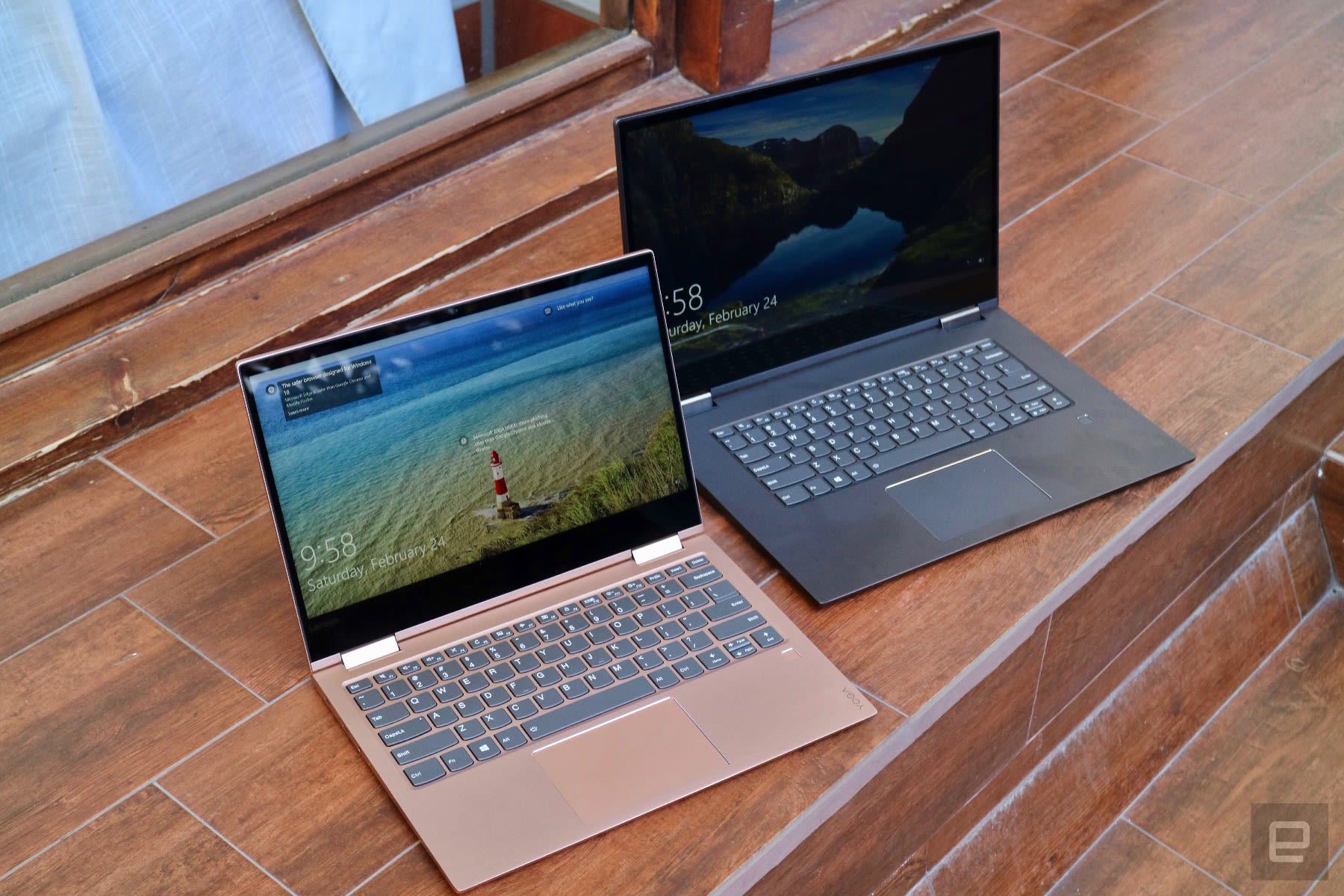
Like the Thinkpad X1 range, the Yoga 730 will support both Cortana and Amazon’s Alexa assistant. AI-hopping isn’t ideal, but until the smart speaker wars shake out it makes sense for Lenovo to offer multiple options (the company is also backing the Google Assistant with its Smart Display.) Both the 13-inch and 15-inch models will come with far-field microphones that can pick up your voice from across the room. So in theory, you could ask Cortana for your schedule and then book a time-appropriate Uber through Alexa. Or search for an article and order a pizza while you read.
The 13-inch and 15-inch Yoga 730 will start at $880 and $900 respectively. They cost considerably more than the $600 Flex 14, which will ship with an Intel Core i3 processor and a 1080p touchscreen. You can upgrade to an eighth-generation Intel Core i7 processor, a 512GB SSD, 16GB of DDR RAM and an Nvidia GeForce MX130 graphics card, but these will cost you extra. At first blush, Lenovo’s new laptops seem like decent if predictable performers for people with a sub-$1,000 budget. They all look the part and the Alexa support is nice for people who own a bunch of Echo speakers and compatible smart home appliances. Part of me misses the watchband-inspired hinge found on the Yoga 920, but hey — you can’t have it all.
Catch up on the latest news from MWC 2018 right here.
‘Papers, Please’ official short film recreates the game’s bleak tone
The official Papers, Please short film has been a long time in coming, but it’s finally here… and if you’re a fan of the game’s grim Soviet Bloc atmosphere, you’re in for a treat. The 11-minute production includes plenty of nods to the title’s nerve-wracking customs checks, such as the dread you feel when you’re not quite sure you should have let someone through. It also touches on the game’s underlying theme — how do you maintain some shred of humanity in a job that’s frequently heartless? Be sure to turn subtitles on, by the way, as the dialogue is appropriately Russian.
Nikita Ordynskiy and Lilya Tkach produced the movie alongside developer Lucas Pope.
Short films for popular games are nothing new, but it’s rare that they’re officially sanctioned and tout the direct involvement of the game’s creator. The Papers, Please short suggests these collaborations should happen more often — it captures the essence of the game while making the experience feel almost too real.
Source: Nikita Ordynskiy (YouTube)
Snapdragon 845-powered Xiaomi Mi Mix 2S set for a release on Mar. 27
Xiaomi’s first Snapdragon 845-powered phone will usher in a host of new features.

Back at the launch of the Snapdragon 845, Xiaomi CEO Lei Jun said that the Chinese manufacturer will be one of the first to release a device powered by Qualcomm’s latest platform. And while it was assumed that the phone would make its debut at Mobile World Congress, it doesn’t look like that will be the case. According to a recent tweet by Xiaomi global spokesperson Donovan Sung, Xiaomi’s first Snapdragon 845 phone will be the Mi Mix 2S, which will be released on March 27:
Mi MIX 2S will use the next generation flagship processor Snapdragon 845. Launching on March 27th! ❤️ pic.twitter.com/XoOdmmcDO2
— Donovan Sung (@donovansung) February 25, 2018
Sung’s tweet also had a reference to the upcoming phone’s AnTuTu score, which at 273,741 is significantly higher than the 206,783 managed by the standard Mi Mix 2 last year. Xiaomi has relied on AnTuTu scores to highlight the performance of its devices for some time now, and while synthetic benchmarks aren’t an indicator for real-world performance, Xiaomi’s fans swear by them.
The Mi Mix 2S won’t be the first phone to launch with the Snapdragon 845 — that distinction goes to the Galaxy S9 and S9+ — but it could be the first to do so in Asian markets, where Samsung sells the Exynos variant instead. It’s interesting that Xiaomi is rolling out a refreshed variant of the Mi Mix 2 and not the Mi 7 next month. Traditionally, the flagship Mi series was the first to feature the latest Qualcomm hardware, but with the phone rumored to usher in a complete visual overhaul, Xiaomi is likely pushing back the launch a few months.
The Mi Mix 2S could be the first Xiaomi phone with an in-display fingerprint sensor.
As for the device itself, the Mi Mix 2S is rumored to feature ultra-thin bezels, much like the first-gen Mi Mix and the Mi Mix 2. That said, we could be seeing a subtle change in the design up front, with the phone offering the camera module in the top right corner. The position of the camera sensor on the bottom bar was a major drawback on the Mi Mix and Mix 2 as the angle wasn’t ideal for taking selfies, and it looks like Xiaomi is set to rectify the issue with the Mi Mix 2S.
Furthermore, the Mi Mix 2S is rumored to feature an in-display fingerprint sensor, as well as a dual rear camera configuration with two 12MP sensors. It’s no secret that camera quality is a key priority for Xiaomi this year — as we’ve seen on the Redmi Note 5 Pro — and it looks like the Mi Mix 2S will continue that trend.
With the launch slated for March 27, we should know more about the Mi Mix 2S in the coming weeks. With the Mi Mix 2 garnering a lot of attention in India, it’s possible the Mi Mix 2S will also make its way to the subcontinent, as well as other Asian markets. What are you looking forward to seeing from the Mi Mix 2S?
 AIVAnet