


Plex adds DVR scheduling to its Apple TV app
Halfway through 2017, Plex started offering live TV and DVR features for users willing to cough up $5 a month. They still needed a tuner of their own, to avoid any Aereo-like shenanigans, but it was still great for cord-cutters. Now, Plex is adding more features to the Apple TV app for its DVR system, enabling users to schedule recordings and view closed captions.
With warmer weather (hopefully) just around the corner, don’t miss out on your favorite shows while you’re frolicking outside. Along with watching #LiveTV, now you can also schedule recordings and use closed captioning on your Apple TV. #DVR https://t.co/SUNaGFr7oC pic.twitter.com/OjotROFpq1
— Plex (@plex) February 23, 2018
The selection of channels is, perhaps obviously, limited to the ones that your OTA antenna can pick up in your local area. But that should stretch as far as ABC, NBC, CBS, Fox, the CW and plenty of others, plus the ability to sync your shows for offline viewing. Earlier this month, Plex also pushed out timeshifting for the Xbox One and the Plex Web App, as well as closed captions for Roku players.
Source: Plex
Qualcomm’s simulated 5G tests show a 20x increase in download speeds over 4G
Qualcomm’s simulation tests in Frankfurt and San Francisco highlight 5G’s real-world potential.

Qualcomm is touting up its advances in the field of 5G, announcing last week that its upcoming 5G-enabled chipset will be built on Samsung’s 7nm node. At Mobile World Congress, Qualcomm is demonstrating the real-world potential of 5G by sharing findings of extensive network simulations it has conducted over the past several months.
Qualcomm conducted two simulations, one in Frankfurt and the other in San Francisco, leveraging existing cell sites in both locations. The Frankfurt simulation modeled a Non-Standalone (NSA) 5G NR network “operating on 100 MHz of 3.5GHz spectrum, with an underlying Gigabit LTE network operating across 5 LTE spectrum bands.” The California test, meanwhile, modeled a hypothetical NSA 5G NR network “operating in 800 MHz of 28 GHz mmWave spectrum, with an underlying Gigabit LTE network operating across 4 licensed LTE spectrum bands plus License Assisted Access (LAA) bands.”
Qualcomm is quoting heady increases in download speeds from the simulated test in Frankfurt, recording a massive 900% uptick over 4G, 12x increase in speeds for the “10th percentile” user, and a median streaming quality of 8K. Average download latency was also significantly reduced, from 116ms to 17ms:
- Browsing download speeds increasing from 56 Mbps for the median 4G user to more than 490 Mbps for the median 5G user, a gain of approximately 900 percent
- Approximately 7x faster responsiveness, with median browsing download latency reduced from 116ms to 17ms
- File download speeds of 100 Mbps for the 10th percentile 5G user, meaning that 90 percent of 5G users have download speeds of more than 100 Mbps. This is compared to 8 Mbps for the 10th percentile LTE user.
.- Median streaming video quality increasing from 2K/30 FPS/8-bit color for LTE users to 8K/120 FPS/10-bit color and beyond for 5G users.
The test in San Francisco yielded even better results, with Qualcomm noting a median download speed of a staggering 1.4Gbps, an uptick of 2000% from 4G. The rest of the statistics followed in the same vein:
- Browsing download speeds increasing from 71 Mbps for the median 4G user to 1.4 Gbps for the median 5G user in mmWave coverage, a gain of approximately 2000 percent
- Approximately 23x faster responsiveness, with median browsing download latency reduced from 115ms to 4.9ms
- File download speeds of more than 186 Mbps for 90 percent of 5G users, compared to 10 Mbps for LTE, a 1,826 percent gain. The median 5G file download speed was 442 Mbps.
- Median streaming video quality increasing from 2K/30 FPS/8-bit color for LTE users to 8K/120 FPS/10-bit color and beyond for 5G users.
With the simulated tests, Qualcomm is showing just how fast 5G is in real-world usage scenarios. Thus far, we’ve only seen metrics from controlled tests in labs, so the real-world simulations give us an early look at the 5G’s potential.
Qualcomm is working with 18 global operators to conduct 5G trials, and the vendor noted that over 20 leading device makers are turning to the Snapdragon X50 5G modem for their devices. With median download speeds surging over 1,000% from 4G, Qualcomm is envisaging a “whole host of new services and experiences” beyond browsing, downloading, and streaming.
The first wave of consumer products with Qualcomm’s 5G modem will be making their debut in the first half of 2019. Until then, we’ll have to make do with the X24 modem, which tops out at just 2Gbps.
How to declutter your phone with Google Files Go
Files Go is an elegant solution to a long-standing problem on Android.

Managing internal storage has always been a problem on Android, particularly on devices with limited storage. For instance, a phone with 16GB of storage has just over 10GB of usable space at best, with the rest of the storage taken up by the operating system itself. That doesn’t leave a whole lot of room for your apps, music, photos, videos, and games, and while there’s no shortage of cleaning and optimizations apps on the Play Store, most of them tend to be nothing more than conduits for malware.
Thankfully, Google is finally addressing the issue with Files Go, a storage management utility that’s designed for the Android Go platform. Android Go is a lightweight operating system that’s tailored for devices with 512MB to 1GB of RAM and 8GB of storage. The OS takes up less than half the install size as the full-fledged version of Android, and the bundled apps have also gone on a diet and take up a fraction of their usual space.
Even then, users will be left with around 5GB of storage, and this is where Files Go comes in handy. The app intelligently monitors the apps you use and files that have been downloaded to your device, and offers recommendations on content that can be deleted. It also has a nifty feature that automatically clears the cache, and Google built filters to target specific WhatsApp image forwards, which tend to clutter up a device over time.
Although Files Go has been designed to serve Android Go devices, the app itself is available to download for all devices on the Play Store. It comes in at just 4.4MB, and is a must-have if you’re using a phone with limited storage.
How to install Google Files Go
Open the Play Store from the app drawer or the home screen.
Search for Files Go.
Hit the Install button on the Files Go card.

How to get started with Google Files Go
After installing Files Go, you’ll need to give it usage access so it can monitor your app usage and offer suggestions for apps you can delete. Here’s how to get started with Files Go:
Open Files Go from the app drawer or home screen.
Hit the Continue button.
Give Files Go access to photos, media, and files by hitting the Allow button.

In the Find unused apps card, tap the Get started button.
Hit the Go to settings button.
Tap Files Go in the Apps with usage access screen.

Toggle the button next to Permit usage access.
Go back to the app to see cleanup suggestions. In the Temporary app files card, hit the Free up button to clear unused files.
Select the button next to All items and hit Clear.

One of Files Go’s strengths is its ability to find unused apps to free up space. Now that we’ve given the app access to monitor your phone usage, you’ll see periodic recommendations when it finds apps that you haven’t used in a long time. You’ll also get notifications to clear unused files or excessively large media content when you’re running low on storage.
Overall, Files Go is one of the most robust storage management apps available on the Play Store, and the fact that it’s made by Google means you don’t have to worry about dealing with malicious ads. In addition to clearing your cache, Files Go also has a straightforward file transfer service that works offline. If you’ve been using SHAREIt and are ready to make the switch to another service, you should give Files Go a try.
Download Files Go (free)
Nokia 7 Plus hands-on: A Pixel 2 XL for the frugal set

It may not be flashy, but this is a great phone.
Nokia’s new 8 Sirocco may be stealing the show, but it’s the lineup of less expensive phones that will be selling in big numbers. Anchoring the core mid-range spot in its lineup is the new Nokia 7 Plus, a €399 phone that doesn’t have the flair of higher-end phones but represents what Nokia is really good at right now.
And after spending some time with it here at MWC 2018, it really feels like it’s aimed at being a Google Pixel 2 XL for the frugal among us.
This is efficient, clean design with just a touch of style — Nokia, in a nutshell. The solid metal frame makes the phone sturdy, and the ceramic-like multi-coat paint job has just a subtle bit of texture to give you ample grip. Nokia says the thick paint let it have larger antennas because it could completely cover them with the textured finish in the end. The metal is polished up nicely with a great contrasting gold color, popping off of the white or black back.
I really wonder how much Nokia targeted the Pixel 2 XL here.
The texture is not unlike the Pixel 2 XL’s, and that’s a good thing. Similarly, the Nokia 7 Plus isn’t attempting to be super-thin or sleek, it’s just realistically sized and designed. It has a 6-inch 18:9 display with nicely curved glass over top and rounded corners on the display panel. The overall dimensions and weight are nearly the same as the Pixel 2 XL. The rear fingerprint sensor is easy to reach, right below the dual camera setup — which I unfortunately didn’t have enough time to test thoroughly, but you hope with a 12MP f/1.75 combo and Zeiss optics it’d at least hit the mark for the price point.
The phone looks great in both colors, though you’ll need to have a bit of a sense of style to really acclimate to that shiny metal. But aside from that, it feels really good as well. Large, weighty, solid. Function over form in many places.
The Nokia 7 Plus has a super-clean Android One take on Oreo, which should be plenty fast on this Snapdragon 660 processor and 4GB of RAM. The display is just 1080p as well, and with a big 3800mAh battery I wouldn’t be surprised if the battery life was fantastic.
Looking at everything the Nokia 7 Plus offers, it all makes you wonder how much it really targeted the Pixel 2 XL’s experience, if at all. Between the design similarities, overall shape and size, and software experience, this feels like a budget version of Google’s flagship — and based on who I’ve seen get excited about Nokia’s recent phones, that’s a great strategy.
Will you be upgrading to the Samsung Galaxy S9?
You know you want it.
After months of leaks and rumors, Samsung finally took the stage in Barcelona yesterday to officially unveil the all-new Galaxy S9 and Galaxy S9+. These are Samsung’s top two phones until the Note 9 makes its debut in the second half of the year, and each one packs a ton of features and upgrades over 2017’s Galaxy S8 series.

A lot of our forum members recently started talking about the Galaxy S9/S9+ and whether they’d be upgrading to them from their current phone, and this is what they had to say.
Ramon Castillo1
02-25-2018 01:29 PM“
Hell yeah. Much improvement to the camera that exceeds the Note 8 and much faster chip. However, most likely the Note 9 will focus on the screen (more resolution and dolby vision?) and fingerprint sensor under the screen. Samsung seems to focus on things on each line and they chose camera focus for the S9 line.
Reply
Philipmom
02-25-2018 04:30 PM“
I’m going to wait and see what’s happening with the note 9 and X then pick between the two. If the X is a folding phone I might pass since that really new tech can be sorta glitchy.
Reply
areyes163
02-25-2018 05:24 PM“
I’ll wait it out for the note 9 the note 9 will get everything the s9 has and added features. Plus I do use the s pen a lot so I’ll wait. It will be hard because I love new phones. We will see if I have the strength to wait it out lol.
Reply
Scott8881
02-25-2018 09:41 PM“
Low light camera on the S9+ is going to be so much better than my V30, and I’m finding it is such an important feature… my S7 Edge took better pics in low light than V30. Not even using the quad dac, so yes, I’m upgrading, can’t wait!
Reply
Now, we’d like to hear from you – Are you upgrading to the Galaxy S9?
Join the conversation in the forums
Samsung Galaxy S9 and S9+
- Hands-on with the Samsung Galaxy S9 and S9+
- Galaxy S9 and S9+: Everything you need to know!
- Complete Galaxy S9 and S9+ specs
- Galaxy S9 vs. iPhone X: Metal and glass sandwiches
- Galaxy S9 vs. Google Pixel 2: Which should you buy?
- Join our Galaxy S9 forums
Canon’s AI flash moves by itself to make portraits more flattering
Camera flashes aren’t normally the sexiest products, but Canon has made its Speedlite 470EX-AI a lot more interesting by using artificial intelligence. As photographers know, you’re better off bouncing a flash off a wall or ceiling to best flatter subjects, rather than pointing it directly at them. Figuring all that out can be a pain, however, which is where Canon’s “AI Bounce” tech comes in. By calculating the distance between the camera, ceiling and subject, it lets beginning photographers “utilize the ideal lighting and natural brightness of the room,” Canon explains.
The flash will adjust itself automatically, even if you move the camera, thanks to built-in motors at the base and hinge, and sensors in the front corner (as shown above). When you double-tap on the shutter release, the flash first points at the subject and the ceiling to calculate distances. It then sets itself to the ideal angle for the perfect bounce light on your subject. You do have to stick to that camera position, however, or the whole dance starts over again.
It can also operate semi-automatically, letting more experienced photographers store flash positions in memory, then recall them when needed. It includes an optical receiver, but lacks a radio transmitter if you need remote studio operations.
Lately, Canon has been accused of being stuck in the past with its camera tech compared to rivals like Sony and Fujitsu. However, this new flash features some pretty cool tech, and the new entry-level M50 is also a good sign for the future of its mirrorless lineup. The 470EX-AI arrives in April 2018 for $400, or £500 in the UK.
The Morning After: This is the Samsung Galaxy S9
Welcome back! We kicked off MWC 2018 in Barcelona, in style, with the launch of Samsung’s Galaxy S9 — and the S9 Plus. That’s not all: There’s a ridiculous Huawei laptop with a hidden webcam and Nokia’s latest smartphone range as it continues to reinvent itself. You’ll be able to find all things MWC right here.
The new flagship is a big bundle of small changes.
Samsung Galaxy S9 and S9+ hands-on: The devil is in the details

Getting to know the Galaxy S9 is like unwrapping a present you think you’ve already opened. On the surface, it looks familiar, but once you peel back the layers, you’ll notice the contents are new. That’s not to say the changes between the Galaxy S9 and the Galaxy S8 are insignificant. There’s a ton of them, and you’ll have to look carefully to spot them all, but when considered as a package, this update feels more incremental than monumental. We test it out.
The flagship gets a full redesign and some hardware improvements, too.
The Nokia 8 Sirocco edition is 95-percent glass

HMD brought a Nokia phone for all tastes to this year’s MWC. Just as some people might want a retro feature phone or an entry-level smartphone, others want the best money can buy. HMD’s latest offering to these flagship fiends is the Nokia 8 Sirocco, which is pitched as a special edition of the Nokia 8 that launched last summer. Make no mistake, this isn’t merely the same phone in a new funky color. It sports a completely overhauled design consisting almost entirely of glass.
“Mr. Wizard, get me the hell out of here.”
The Nokia 8110 Reloaded is HMD’s latest retro feature phone

HMD Global undeniably stole MWC in 2017 with, of all things, a new feature phone. Flexing its newly-acquired license to the Nokia brand, the company put on a marketing masterclass by announcing a re-release of the iconic Nokia 3310. This year, if it ain’t broke, don’t fix it. Here’s the Nokia 8110 Reloaded, AKA the reinvented banana-phone.
It’s a symptom of the VFX industry’s problems.‘Black Panther’ is amazing. Why are its CG models so terrible?

Black Panther is a refreshing answer to the increasingly stale world of superhero cinema. But its use of CG models to replace humans during action sequences leaves an awful lot to be desired. You’d think in the year 2018, following the recent glut of comic-book films, visual effects (VFX) studios would have perfected the art of creating realistic CG humans. Instead, we appear to have peaked at Avatar in 2010. What gives?
The company’s classy take on the MacBook has a weird home for your webcam.Huawei’s MateBook X Pro crams a pop-up webcam into the keyboard

When Huawei unveiled its first true laptop barely a year ago, it was a slightly more useful MacBook lookalike. Borrowed looks aside, it offered some minor changes that alleviated common grievances, including the MacBook’s solo USB-C port and its barely-there key travel. At MWC, Huawei introduced the new MateBook X Pro, and the company has decided to put the webcam somewhere it’s never been before: hidden inside your keyboard.
But wait, there’s more…
- This case turns your iPhone into a modular device
- LG’s V30S ThinQ is the AI-fueled phone the V30 should’ve been
- Nokia’s new affordable smartphones prioritize design
- Nearly half of 2017’s cryptocurrencies have already failed
The Morning After is a new daily newsletter from Engadget designed to help you fight off FOMO. Who knows what you’ll miss if you don’t Subscribe.
Craving even more? Like us on Facebook or Follow us on Twitter.
Have a suggestion on how we can improve The Morning After? Send us a note.
Jolla’s alternative Sailfish OS is coming to more phones
It’s been a long time since we’ve covered Jolla on Engadget, and with good reason — the company has had a tumultuous time of late. The Jolla Phone — the first hardware running its alternative Sailfish OS platform — failed to take off and its tablet was cancelled after heavy layoffs in 2015. Somehow, though, the company survived. And today at MWC, it’s announcing that Sailfish OS will soon be compatible with a bunch of new devices including the Sony Xperia A2, the upcoming Gemini PDA, and a tablet by Russian brand Inoi. In addition, it will support feature phones later this year.
Jolla is calling the expansion Sailfish 3. To mark the low-key launch, it’s teasing a new version of the OS that’s 30 percent faster and compatible with the latest Android. It will also have “full cloud integration,” including bookmarks, notes and photo syncing, a new multitasking interface and a fresh “Light” theme. In the past, it’s been possible to buy and flash a version of the mobile OS called ‘Sailfish X’ onto the Xperia X. This do-it-yourself approach will continue with Sailfish 3 and the latest wave of compatible devices (at the time of writing, the OS costs 50 euros.)

These devices, of course, represent a slither of the overall Android market. That’s why the company is expanding Sailfish OS to feature phones, which are still popular in emerging markets. It will offer some “core” native apps alongside a special app store and compatibility with a selection of Android apps. Unlike the normal Sailfish experience, which requires you to swipe from the edges of the display to navigate, the feature phone version will support non-touch phones with numerical keyboards and directional control pads. The company will face tough competition, though, from Android One and low-cost phone manufacturers like HMD Global.
“We are very proud to be moving to the third generation in our OS development,” Sami Pienimäki, CEO of Jolla said, “and believe it will provide a great upgrade for all our B2G, B2B, and community customers.” It’s clear, though, that Jolla’s niche status won’t be changing anytime soon. Until it can reboot its own hardware efforts, or support devices with mainstream appeal, Sailfish OS will remain a curiosity and nothing more. We can’t help but root for this strange, beleaguered operating system though — especially when so many ‘alternative’ platforms (R.I.P. Firefox OS, Windows Mobile and Ubuntu Touch) have fallen by the wayside.
Catch up on the latest news from MWC 2018 right here.
Source: Jolla (Press Release)
Vivo’s all-screen concept phone hides a pop-up selfie cam
When I think of funky, ambitious smartphones, I don’t usually think of the name Vivo. That began to change after seeing a phone with an in-display fingerprint sensor — the world’s first, actually — a month ago at CES. Now, after playing with the company’s APEX FullView concept phone, it’s clear that Vivo is more clever than we’ve given it credit for.
With the screen off, the APEX looks like an unremarkable black slab. There’s an iPhone X-like dual camera on its back, a headphone jack on its bottom and little else of note otherwise. Then you turn the thing on, and everything gets pleasantly weird. Like the Essential phone before it, the APEX has barely-there bezels around its flexible OLED display with only a hint of extra space beneath the panel.
And when I say barely there, I mean it: they’re 1.8mm around the top and sides, and 4.3mm at the bottom. The company says the phone’s screen to body ratio would reach an astonishing 98 percent if that bottom bezel was as slim as the others. That would be an odd data point to just toss out there if Vivo never planned to do it, but a spokesperson wouldn’t confirm my suspicions. Still, as close to a full-screen phone as I’ve seen, and that’s worth appreciating even if the initial thrill of bezel-less designs has kind of worn off.
Naturally, Vivo’s design means compromises had to be made. To completely excise space around the top of the display, the company had to ditch the traditional earpiece and selfie camera design. Fortunately, the fixes are clever as hell. An exciter wedged beneath the display effectively turns the whole thing into the earpiece (and one you can hear without your ear pressed to the screen, no less). There’s still a single down-firing speaker for traditional speakerphone calls, but the canned demo call Vivo ran me through was remarkably crisp. It sounded a little space-y too if I’m honest, though I couldn’t tell whether that was because of the phone or the room I was sitting in.

Engadget
And here’s the crazy bit: when you launch the camera and try to take a selfie, an 8-megapixel camera pod rises from the top of the phone to oblige. Vivo says it only takes 0.8 seconds for the camera to lock into place, and while I didn’t have my stopwatch on my to check, the process was much quicker than I would’ve expected. Call me a downer, but the odds of any major smartphone maker adopting this approach for the long term is basically nil. After all, it makes selfies feel ever-so-slightly less spontaneous, and the motor to drive the camera up and out of the phone’s body seems like an unneeded point of potential failure. Still, seeing the camera in action was cool as hell.
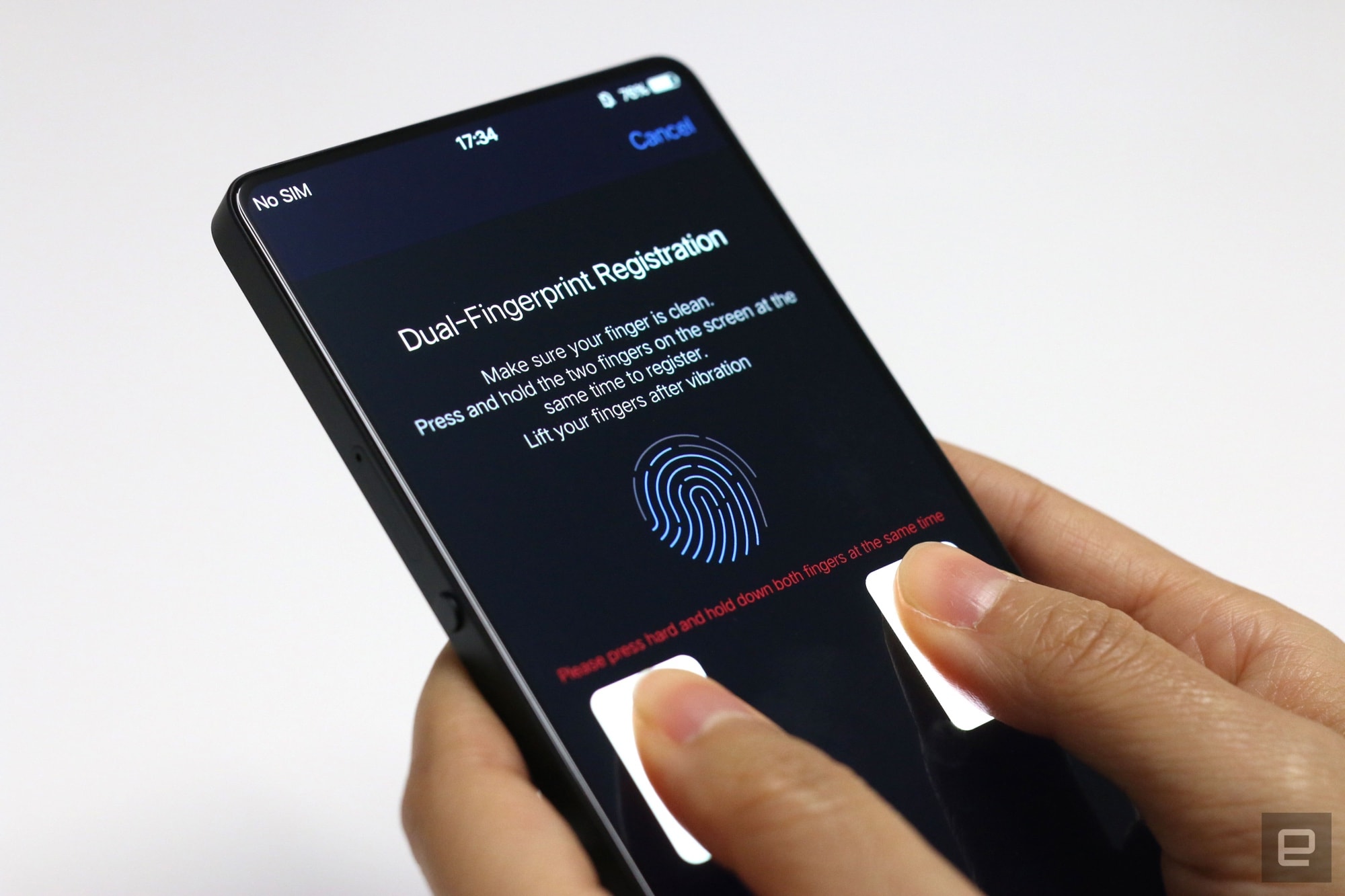
I alluded to the fact that Vivo’s X20 Plus UD was the first phone in the world to feature an in-display fingerprint sensor, and the company is already keen on outdoing itself. While the X20 Plus had a single spot on the screen where you could lay your finger down to unlock, the APEX concept has a field that takes up roughly a quarter of the phone’s screen. Once you’ve enrolled your fingers, you can lay them down anywhere within that field to unlock the phone. It’s all thanks to an ultrasound sensor beneath the screen that can read fingerprints over a much wider area. (Ironically, Synaptics — the company that made the in-display sensor Vivo used the first time — doesn’t think very highly of ultrasound biometrics.)
Chris Velazco/Engadget
On a basic level, this means you wouldn’t have to hunt for a sweet spot with your finger to unlock it. I’ll take it. If you’re doubly concerned about security though, that extra space also means you could set the phone to require two simultaneous fingerprints to unlock it. The spokesperson showing me the phone mentioned a married couple both authenticating a document on the phone as a potential use case, but since Vivo hasn’t had many conversations about the technology with possible partners, I wouldn’t count on seeing that anytime soon. Oh, and there’s another rub, too: at this point, the phone doesn’t seem particularly great at identifying fingerprints. It often took multiple tries to unlock the phone with a finger in the sweet zone, even though it’s supposed to work no matter which way your finger is oriented.
That the APEX doesn’t really work the way it’s supposed to is no surprise. There’s no guarantee that Vivo will even work on this concept after it leaves MWC, let alone produce it in mass quantities. If the APEX ultimately remains a technically neat lark, I’m OK with that — for the industry to move forward, people have to be out there, doing the weird stuff and seeing what works. For now, I’m glad that at least some of those people work at Vivo.
Catch up on the latest news from MWC 2018 right here.
Sony Xperia XZ2 and XZ2 Compact hands-on
Announced today in the MWC madness, Sony decided to pull a new phone out of its pocket that it thinks will help it compete with the top dogs on the market.
The Xperia XZ2 and XZ2 Compact are a departure from Sony’s traditional squared-off design. Gone are the days of sharp edges and huge bezels, replaced with what Sony calls Ambient Flow. Sony says this is based around the concept of water, molding to the vessel that cradles it.

This has some pitfalls. The body is definitely pretty thick at 11.1 mm. That would be easier to stomach if the battery was significantly larger, but at just 3180 mAh, it’s hard to see why Sony had to inflate it to this level. There is a USB Type-C port at the bottom (and no headphone jack) though, so you can fast charge this device if you need to quickly top it off.
Read more: Sony Xperia XZ2 and XZ2 Compact officially announced | Top 5 Xperia XZ2 features
Sony moved the fingerprint reader to the back of the device under the camera. Usually we’d be happy with this, but Lanh and I found it just a bit too low. Phones like the Pixel 2 find your finger already resting on the sensor as you pick up the device, but the Xperia XZ2 design led to our fingers landing closer to the camera, like what happened with more recent Samsung devices. Sony showed us a slide which explained the placement, but it still could have been better.

See also:
Samsung Galaxy Note 8 review: Do bigger things, at a bigger price
This review is brought to you by MNML Case, an ultra-thin Note 8 case that showcases the beauty of your new phone and fits like a glove!
After the disaster of last’s year Galaxy Note 7, …
The XZ2 may not be stuffed with the highest density power pack, but it is dense with features. As a basic rundown, the XZ2 has super slow motion 960 fps people in 1080p, surround sound speakers, high end audio, wireless charging, and IP65/68 water and dust resistance. It can also force HDR on pretty much any streaming content through upscaling, though it is certified by Netflix, Amazon Prime Video, and YouTube to play actual HDR content.

To make your experience even more realistic, Sony redesigned their vibration motors to be much more accurate, and even wrote software to make them work with any video, game, or music file. This works a little like the “HD Rumble” feature in the Nintendo Switch, though Sony preferred to compare it to Playstation 4 DualShock controllers.
Sony isn’t messing around with specs either. The XZ2 is rocking a Snapdragon 845 SoC which Qualcomm says should need a 30 percent-less power across the board. This is paired with 4 GB of RAM and 64 GB of UFS storage, which can be expanded by using its Micro SD card slot. This is a Dual-SIM/SD card slot as well, so you could always throw another SIM card in there instead.

This all powers an 18:9 5.7-inch FHD+ display, but you wouldn’t necessarily notice that based on the body. The phone feels like an older design, probably due to its relative chunkiness. Still, the screen looks really great, especially since all video content is converted to HDR using an upscaling algorithm.
See also:
Sony Xperia XZ1 Compact review: small but powerful
Buy now from Amazon
While most smartphone OEMs are creating standard and plus or XL sized versions of their smartphones, Sony believes there’s still a market for a small, compact flagship that doesn’t skimp out on …
The XZ2 Compact is essentially the same device, with the same battery capacity, SoC, and RAM. The only thing missing from this model are the specialized haptics and wireless charging. The larger version also uses Gorilla Glass 5 on the front and back, while the Compact model sports a plastic back. If these features are important you’ll be more interested in the larger model. If not, the smaller sibling is worth a serious look.

The Sony XZ2 and XZ2 compact are slated to ship in late Spring, and will come to the U.S. unlocked. The Canadian version will come through a partnership with Bell, taking advantage of their Gigabit LTE network.
Price is still to be announced, but we’re assuming it will probably fall in line with other Sony flagships over the years. Competition will be tough in 2018, but for those that want to get as many features as possible in one device, this phone looks promising.

You can get the Xperia XZ2 in Liquid Black, Liquid Silver, Ash Black, and Ash Pink.
What do you think of the new Sony XZ2 and XZ2 Compact?
 AIVAnet