


No, postcards won’t solve our Russian interference problem
We just learned all the ways Russian propaganda agents fooled American social media companies, thanks to the recent indictments of Russian nationals by Team Mueller.
After years of these companies forcing us to adhere to their contrived “community safety” policies and made-up rules to police our identities (which they swore was for our own good), their failures are rather spectacular.
Russia’s low-rent spies — I mean trolls — leveraged every hypocrisy (like “real names” policies), weakness (tolerance of hate groups, impersonation, false information) and flouting of laws (political advertising disclosures) inherent in America’s biggest social media companies to do the unimaginable: divide and conquer US democracy.
If you missed it, the Internet Research Agency indictment outlined an operation that ran hundreds (if not tens of thousands) of fake accounts, impersonated the GOP and civil rights groups, stole identities from actual US citizens to set up bank accounts, PayPal accounts and driver’s licenses, and more.

Finding identities to steal was easy. Fooling social media companies desperate to make ad revenue at any cost was even easier.
Some of the reporting that’s come out of it is stellar. I’m thinking of CNNMoney’s superb foray into the fray, interviewing American citizens who, through Facebook pages and social media contacts, inadvertently did work for Russian operatives. Sometimes paid work.
Catching Florine Gruen Goldfarb, who runs the Team Trump Broward County Facebook page, CNN recorded the exact moment her disbelief dug in its heels and insisted that, despite the evidence, no, this couldn’t be true. For those who study belief systems and cults, and how their beliefs double down as a coping mechanism when shown clear evidence that their beliefs are false, it was an exquisite example.
Anyway, as usual, techies and tech companies came out of the woodwork with overly specific solutions.
Facebook looked at its burning forest and focused on one tree: the ads. In all of its (alleged) wisdom and leadership about preventing harm, the company told the press it would, like, totally send people postcards in the mail “to verify the identities and locations of anyone hoping to buy ads related to federal-level candidates.”
It’s an unusually weak response, and odd in light of an eight-piece Twitter thread from Facebook’s vice president for ads, Rob Goldman, insisting that the Russian ads were not meant to sway the election. Which actually, according to the very indictment he cited, was incorrect. Goldman, an executive steering leadership at one of the world’s most valuable advertising and influence properties, was one step past the disbelief of Florine Gruen Goldfarb and well into the vindication phase of denial, seeing evidence that absolved him and his company of responsibility — when there was no such evidence.
Others freaked out about the whole “on the internet no one knows you’re a dog” quandary we’ve been in for decades, and trotted out some oldies but goodies from the “real names” myth and legend files. Some suggested that “real names” or some kind of Internet ID would help.
Digital ID would help. With Digital ID, issued by states to residents, we could require big social to accept Digital ID and software could be written that performs digital signatures on each post, with non-repudiation as a result.
Alas, techies are libertarians so it festers
— Jeff Wilson (@jeffwilsontech) February 18, 2018
We’ve been down the “real names” road before. The policy disproportionately affects — with malice — pretty much everyone but straight white cis dudes. LGBTQ people are exposed to harm by outing, the policy is used to target people of color, and we learned from a National Network to End Domestic Violence (NNEDV) report that the policy puts at least 23 million women (domestic violence victims, comprising 1 in 4 women) directly in the path of violence. As for deterring abuse, empirical evidence has shown that “real names” doesn’t work.
Online ID, “real” or “authentic names” is a cheap fix, one that really isn’t a fix at all. It’s just another forest-for-the-trees moment. A way to cling to the belief that we can somehow automate this Russian problem and solve it with tech.
At any rate, when you’re sending postcards to shore up your failed “real names” policy — or carving up which parts of a federal indictment you’re going to respond to selectively — these are clearly times for desperate measures.
(Incidentally, Facebook’s “real names” policy is now illegal in Germany. You know, the country that wants to do everything it can to not repeat the whole Nazi thing.)
Of course, all of this sure would be easier to figure out if America’s social media companies were transparent or straightforward with us about what’s really going on behind their virtual closed doors. We’ve been here before, too. Like with Facebook sabotaging its own efforts to combat “fake news” on the platform by refusing to share information with the very people it asked to help with the problem.
Maybe — for a start — social media companies like Facebook could follow US laws (like around political advertising). They could take a page from Medium and boot alt-right trolls, and actually purge those bot accounts. They could stop giving space to Sandy Hook hoax pages and their peddlers, stop letting death threats and racist abuse run rampant, and stop enabling neo-Nazis by protecting Holocaust denial as free speech — if only because millions died and we kind of decided that one a long time ago.
So much of this, if not all of it, has revolved around each company’s unwillingness to admit that any of this is happening at every stage. Every day, a denial. A PR dodge. Clinging to the futile belief that none of these are real problems doing actual harm to real people; they’re just PR problems. The only bad people are the ones who don’t follow our rules.
Because we’re seasoned internet cynics, we “know” it’s because the companies are playing a shell game with our lives, using their own truths, data and greed.
But perhaps for these companies, and their leaders, engineers and various teams, some truths are just too much to bear.

We need only look into the faces of men who won’t stop taking millions from the NRA to know what that looks like.
Images: gorodenkoff via Getty Images (Hackers); POOL New / Reuters (Marco Rubio)
YouTube reportedly plans to spend ‘hundreds of millions’ on Red originals
While Facebook and Netflix are (reportedly) spending billions on new programming, YouTube is said to be holding its investments at current levels. Google’s video wing is only spending “a few hundred million” on original shows for Red this year according to Bloomberg’s sources. Other details are scant, but unlike the competition, YouTube also has a live TV service that’s expanding in reach. Google could just be taking a “wait and see” approach to its investments this year. There’s also the chance that the reticence to invest stems from recent black eyes. Its biggest stars have been in the headlines pretty frequently lately and not for flattering reasons.
YouTube put a hold on Logan Paul’s projects for Red in January after shooting video in Japan’s “suicide forest,” as one example. And last year the company did similar to PewDiePie over the top-grossing star’s videos featuring anti-Semitic messages. Even if it isn’t scaling back investments, YouTube may want to consider being more selective with its funds given recent events.
Source: Bloomberg
The best smart speakers for music fans
If you’re a music fan, the first wave of smart speakers was probably a disappointment. While Alexa and Google Assistant have definitively proven they have a place in the home, the first Echo and Google Home devices were unimpressive when it came to actually playing music. They did the job in a pinch, and being able to command Spotify with your voice is a killer feature, but many longed for better-quality audio.
Fortunately, that call has been answered. In the past six months, Sonos, Google and Apple have all released music-first speakers with voice assistants built in. There’s no doubt that the Google Home Max, Alexa-powered Sonos One and Apple HomePod all sound far better than just about any other voice-powered speakers out there. If you value audio quality above all else (and have about $400 to spend), what’s the right smart speaker for you? Let’s break it down.
How we tested
For the purposes of this story, we compared a single HomePod ($350), two Sonos One speakers ($350 total) paired in stereo and a single Google Home Max ($399). While the prices are in the same range, you’ll get different speaker components with each set. Each Sonos One includes a single tweeter and one mid-woofer to cover both mid-range frequencies and bass. The Home Max answers with two tweeters and two large 4.5-inch woofers. The HomePod has perhaps the most unusual arrangement: seven total tweeters (each with its own amplifier), along with a single woofer that points straight up.
To compare the speakers, we set them up in the same room, made sure each was running the most current version of its software and, in the case of the Sonos One, ran the TruePlay tuning software, which adjusts audio quality for the room and placement of the speakers. The HomePod and Home Max both tune themselves automatically; there’s no way to control that part of the audio equation. In all cases, we left EQ settings on default. Finally, we used an Apple Music subscription for the HomePod and Sonos One, while Google Play Music provided audio to the Home Max. Song choices trended toward modern rock, indie and pop, although we sampled songs from every decade since the 1960s.
Lastly, although I did most of the listening, a number of other Engadget editors lent their ears and feedback to this review.
Audio quality
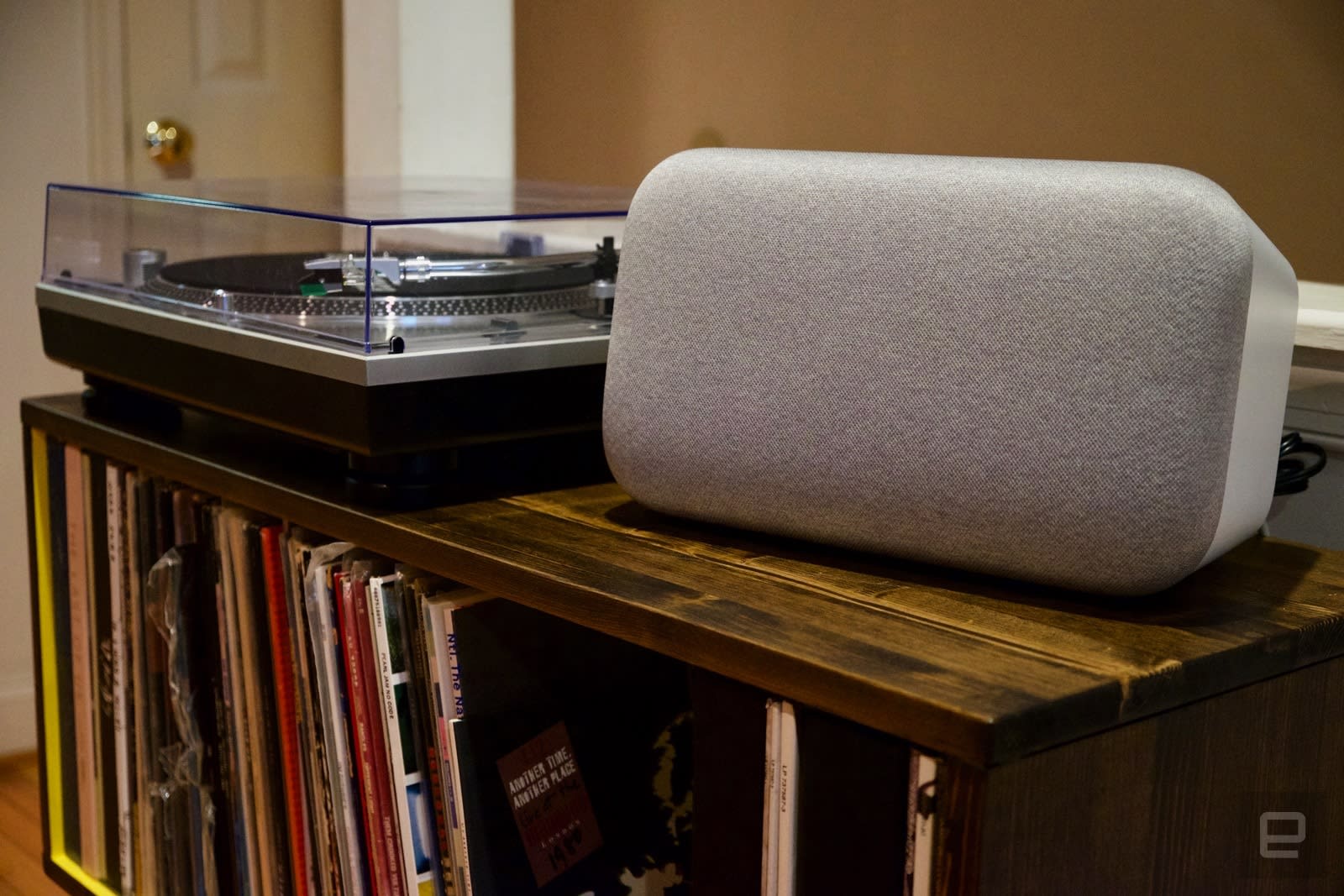
There wasn’t a clear, unequivocal winner among the three speakers tested; rather, each speaker showed its prowess in different situations. Chris Ip, our features editor, did a comparison listen between all three speakers and preferred the HomePod’s rendition of Beyoncé’s “Countdown.” Specifically, Ip is a fan of prominent bass, and the HomePod’s woofer elevated it over the Sonos One. The Home Max also provides strong bass, but it didn’t reproduce mids and highs with the same precision.
That was the story across the board with the Home Max. Its strengths come from two places: bass and volume. At louder volumes (think 75 percent or higher), it sounds better than a pair of Sonos One speakers; the lack of bass means the One ends up sounding shriller than the Home Max when you crank it up. But both the HomePod and Sonos One offered better overall clarity across the range of songs we tested. The bass doesn’t feel as well regulated on the Home Max; while the HomePod does a great job of adjusting bass levels to match the room and the speaker’s overall volume level, the Max’s overall sonic picture is muddier and less distinct than the competition.
As mentioned, the Sonos One is the speaker most lacking in bass here; pairing two of them together helps a bit, but it just doesn’t reproduce the physical, table-rattling, chest-thumping sounds you can coax from the Home Max and HomePod. However, spending $350 on a pair of Sonos One speakers opens up a number of audio experiences that just aren’t possible with the other speakers we looked at. By virtue of being two separate speakers you can place anywhere you want, the pair of Ones naturally did a far better job of reproducing a wide stereo soundstage. The Home Max and Home Pod do a better job of this than they should, but it’s still not the same as having true stereo separation. And if you’re more interested in multi-room audio, two One speakers will give you that option for a lot less money than getting multiple Home Maxes or HomePods (which don’t even have stereo pairing or multi-room audio capabilities yet, though Apple says its speaker will this year).

There wasn’t a definitive winner between the paired Sonos One speakers and the HomePod. When listening to Metallica’s “Master of Puppets,” I preferred how the HomePod added a nice low end to the frantically chugging guitars; the One felt like it lacked the power needed to make the song hit home, particularly at higher volumes. But Sonos did a great job at reproducing the psychedelic soundscape of Pink Floyd’s “Shine On You Crazy Diamond.” For plenty of other songs, it was truly difficult to pick a winner. Executive editor Dana Wollman did a blind test and couldn’t decide which speaker did a better job playing back John Coltrane’s version of “My Favorite Things,” while senior editor Kris Naudus was similarly torn picking between the HomePod and Sonos when listening to “Cherry Tulips” by Headlights.
Along with senior editor Chris Velazco (who wrote our HomePod review), I spent hours bouncing songs back and forth between the speakers — everything from the swirling trip of Beck’s “Colors” and the continually shifting soundscape of the Radiohead classic “Paranoid Android” to Carly Rae Jepsen’s over-the-top hit “Cut to the Feeling” and the electronic glitches of “Such Great Heights” by the Postal Service. Throughout our listening, we were never able to fully write off either the HomePod or the Sonos One.
Ultimately, though, I give a slight edge to the HomePod — it has significantly better bass reproduction, but I wouldn’t describe it as an overly bass-heavy speaker. It just makes it a lot easier to hear every aspect of the song the way it was intended to be heard, bass included. The Sonos One does a lot with lesser specs, and pairing the speakers up in stereo makes for a truly great listening experience. But to my ears, the HomePod more often had the edge.
Everything else

If music were our only focus, we’d be done — but even if sound quality is your foremost concern, there are still other things to consider before making a decision. Specifically, each comes with a voice assistant that can be used to control audio playback, but Siri, the Google Assistant and Alexa can do much more than that. Additionally, each speaker supports different music services in different ways, so that’s another thing to take into account.
Plenty has been said about Siri’s limitations as a personal assistant on the HomePod. Ditto for the device’s reliance on Apple Music. But I think Siri holds its own in a number of situations, specifically finding music. Telling it to just play some music brings up a station populated primarily with music in your library, ensuring you start off with tunes you’ll recognize and enjoy. Siri does a good job of fielding queries like “Play me some rock music from the ’70s,” “Play popular songs from the last decade” or something as simple as “Play me new music I’ll like.”
Initially, the Google Assistant did a horrible job of answering the same questions on the Home Max using Google Play Music. When I asked it to play rock music from the ’60s, it played a compilation album called Rock and Roll Instrumentals: 50’s–60’s that was populated with terrible covers of songs from that period. Eventually, I figured out that I could ask it to play Google’s custom radio stations — just saying something like “Play a station featuring songs from the ’80s” would do the trick. Most users aren’t going to realize that, initially.
Combined, Alexa and Spotify did a solid job answering such requests by pulling up playlists from the service’s massive collection. But Siri still gets the edge with music commands; it add songs to playlists or your library as a whole, and you can tell it that you “like” whatever song is playing to improve Apple Music’s recommendations. Neither the Google Assistant nor Alexa was able to add songs to specific playlists or my music library for either service, though you can tell Google to add a thumbs-up or thumbs-down rating to songs while using Play Music. It’s possible Amazon Music is better supported through Alexa, but far more people are likely to use Alexa and the Sonos One with Spotify.
Siri’s advantage dwindled once we moved on to other tasks. Overall, the Google Assistant was best at answering general knowledge queries, and it also does a better job of recognizing context in follow-up questions. For example, I can ask who the starting quarterback for the New England Patriots is and then ask where “he” went to college, and it’ll know I’m still talking about Tom Brady. Siri and Alexa could also answer these questions, but they didn’t have as much context awareness.

Setting alarms, adding reminders and checking the weather all worked equally well, but Siri falls down when setting timers, because you can set only one at a time. Siri also can’t add things to a calendar, even though it can do so on iOS devices. Both the Google Assistant and Alexa support calendars, but Alexa ultimately wins because it supports multiple Google calendars (including Google’s own G Suite) as well as Microsoft Outlook and Apple iCloud. Strangely enough, Siri is the only assistant that can take notes; it adds them to the Mac/iOS notes app.
Google wins when it comes to using the Home Max as a speakerphone; you can initiate calls with anyone in your Google address book just by asking. The HomePod can take only calls that you start on an iPhone, while Alexa on the Sonos One can’t handle calls or messages at all; those features are restricted to Amazon’s own hardware for now. Google can’t send text messages either, but Siri can. Of course, all of these Siri features are limited to one account, and anyone with access to the speaker can send messages or have the speaker read your texts back to them. Apple really needs to implement some better security features around that, and quickly.
All three assistants work with a pretty huge range of smart home devices. If you’re thinking of using these devices to control lights, thermostats and more, just do the research first and make sure they’re supported by Alexa, Google Assistant or Apple’s HomeKit. But at this point, just about all the major players work across all three platforms.

Ultimately, Siri’s issues weren’t entirely a deal-breaker for me; I don’t have any smart home devices yet, and I don’t use voice assistants for much beyond basic interactions. But it’s hard to ignore Google and Amazon’s lead here. And if you can’t choose which virtual servant you prefer, Sonos has promised it’ll add support for Google Assistant on the One. Right now, Alexa is the only option, but if you prefer Google you’ll be able to just switch over. Additionally, the One will work with AirPlay 2 when Apple releases it. So while you can’t currently control Apple Music on the Sonos One with your voice, AirPlay 2 should enable owners to talk to Siri on an iPhone to play music over the One.
While the Sonos/Alexa combo supports only a handful of music services with voice control, Sonos’ own controller app lets you use virtually any music service you can think of. With the Home Max, you’re limited to a small set of services with voice control; after that, you can send music via Google’s Cast technology through supported apps, or just use Bluetooth or a 3.5mm audio cable. Finally, the HomePod works with Apple Music or iTunes purchases almost exclusively, as we’ve all heard. However, in all cases, you can use basic voice commands to get some additional functionality out of services that aren’t supported by these speakers.
You can AirPlay songs from Spotify and other services to the HomePod, and then use voice commands to skip tracks, play, pause and change volume. With the Sonos One, you can start playing songs from any service using the controller app on your phone or computer, and then use Alexa voice commands to play, pause, adjust the volume or skip tracks in the queue. And the Home Max offers the same commands when you’re casting audio from other apps.
Wrap-up

There’s a lot to like about all of these speakers, even Apple’s locked-in HomePod. For most potential buyers, any of these will likely be a huge upgrade over using your laptop, pack-in headphones or a battery-powered Bluetooth speaker to listen to tunes. Of the three options we tested, a pair of Sonos One speakers is the best choice for most people. Despite a relative lack of bass, the One consistently reproduces songs clearly, and having two speakers makes for a much better stereo experience. I personally prefer the Google Assistant, but Alexa is a strong voice option. And besides, the One will support Google before long anyway.
That said, if you’re a fan of bass, both the HomePod and the Home Max are worth considering. If you’re deep in the Google ecosystem and use Google’s own services for music, the Home Max won’t disappoint. And the millions of people paying for Apple Music will appreciate the HomePod’s excellent fidelity and Siri’s general smarts when it comes to finding music, even if Siri isn’t as good an assistant as Google and Alexa.
But for the millions of Spotify users who want to talk to their speakers and get excellent audio quality, the Sonos One delivers. It sounds great now, and Sonos promises to keep improving it over time. Whether that’s more music services or the forthcoming Google Assistant support, buyers should feel confident the speaker will actually get better over time. And they’re a great first piece in a bigger, multi-room audio setup as well. A pair of Sonos Ones should delight all but the most die-hard Apple or Google fans — and even those people would probably find a lot to like with these speakers.
HTC confirms layoffs as it combines VR and smartphone divisions
It’s been an interesting few months for HTC. Google bought the team responsible for Pixel phones last year for $1.1 billion. The president of HTC’s smartphone operations just resigned, claiming a “personal career plan” for the move. Now, the remaining US workforce is facing layoffs. As first reported by Digital Trends this week, HTC has confirmed that it will combine its smartphone and VR divisions, resulting in employee reductions.
Digital Trends‘ sources report that between a few dozen to around 100 employees have been let go. The company told Engadget that it was still very committed to the smartphone business. “We have recently brought our smartphone and VR businesses under common leadership in each region,” a company spokes person said. “Today we announced a restructure in North America for the HTC Smartphone business that will centralize the reporting structure within the region. In doing so, there have been some employee reductions to align the businesses and empower the teams to share more resources.”
Via: The Verge, Digital Trends
1Password now lets you see if your password has been leaked
If you have a 1Password membership, you can now check to see if your passwords have been compromised by data breaches and leaked on the internet. It’s just a proof of concept feature for now, but 1Password says that in future releases, it will be added to Watchtower within 1Password apps. The feature is an integration of Troy Hunt’s Pwned Passwords service that includes over 500 million leaked passwords.
To use the proof of concept feature now, sign into your account on 1Password.com and click Open Vault. Click on an item in the vault, then Shift-Control-Option-C or Shift+Ctrl+Alt+C depending on your operating system. That unlocks the proof of concept and allows you to click the “Check Password” button next to your password. You can see in the video below what happens next. If your password matches one in Pwned Passwords, 1Password will let you know. If it doesn’t, 1Password will tell that you’re all good. We want to note that if your password matches one in the database, it doesn’t necessarily mean it was part of a data breach. Someone else could’ve been using your same password, but in either case, you should change it.
The good thing about this feature is that it doesn’t compromise the password you’re checking on by sending it out to Pwned Passwords or to 1Password. When checking a password, 1Password hashes it and sends only part of that hash to Pwned Passwords. Any password hashes with the same first few characters as yours are sent to 1Password and are then compared to your full hash locally.
You can read more about Pwned Passwords here.
Source: AgileBits
Dropbox’s IPO filing reveals 500M users but a $1 billion deficit
In a move reminiscent of Snap’s IPO journey, Bloomberg sources claimed last month that Dropbox had quietly filed to become a public company. Suspicious hires last year had tipped their hand, and we waited to see what would happen for a company valued over $10 billion a few years ago. Today, Dropbox’s IPO filing surfaced, and while we still don’t know what day its stock will hit the market, their documentation pulls back a bit of the veil on the company’s situation as it gears up to go public.
BREAKING: Dropbox files for IPO. https://t.co/jn8limUSe7
— CNBC Now (@CNBCnow) February 23, 2018
Per the filing itself, Dropbox has over 500 million registered users but only 11 million of those are paying subscribers. Some might sign up multiple times for multiple accounts, so the number of unique users is certainly lower. Ultimately, the company admits in the document, “a majority of our registered users may never convert to a paid subscription to our platform.”
Converting existing users to the paid tier is at the top of the company’s list, but the filing admits that their revenue growth rate has declined and could keep slowing. The filing noted the company ended 2017 with a $1 billion deficit, though its rate of net losses had decreased from nearly $326 million in 2015 to almost $112 million in 2017. As the filing summarizes: “We have a history of net losses, we anticipate increasing expenses in the future, and we may not be able to achieve or maintain profitability.”
While any IPO points out risk factors and worst-case scenarios to hedge expectations, it’s interesting that the company is going public but not necessarily in a position of financial success. And hopefully for Dropbox, it won’t follow Snap’s example, which had an IPO a year ago that was speculated to value the company $25 billion, but suffered a downslide of low earnings it’s only now recovering from.
Via: CNBC
Source: SEC
Apple’s AirPower wireless charging mat could launch in March
Apple may be close to launching another one of the numerous products it teased last year. Sources talking to both MacOtakara and the Apple Post have claimed that the company’s AirPower wireless charging mat should ship sometime in late March, about half a year after its September premiere. This would reportedly include the wireless charging case for AirPods, too. You might have to buy the case directly from Apple if you’re upgrading an existing pair of earbuds, but multiple stores would sell a version of the AirPods with the wireless charging case included.
It’s not clear why Apple needed the extra time to ready the AirPower mat, but it might have something to do with the Apple Watch. Although at least a few Qi chargers will top up an Apple Watch, the wristwear wasn’t really designed for it — according to MacOtakara, the AirPower Mat has to use a “special wave” to detect the watch. Combine that with the mat’s signature (though not completely unique) multi-device charging and it’s decidedly more complex than a typical Qi pad.
These are rumors, so you won’t want to plan your shopping trips around them. It makes sense that Apple would want to deliver AirPower before the end of its current fiscal quarter, though. And let’s face it, 6 months is a long time to wait for a wireless charging mat — it’s hard to imagine people being patient for much longer.
Via: VentureBeat
Source: MacOtakara
YouTube finally notices Infowars is peddling dangerous conspiracies
Earlier this week, YouTube took down a video from one of Infowars’ channels. It was one of many videos out there claiming that students of Marjory Stoneman Douglas High School are not in fact students and school shooting survivors, but are instead paid “crisis actors.” The video, which was titled “David Hogg Can’t Remember His lines In TV Interview,” was removed by YouTube from the Alex Jones Channel on Wednesday and the platform said it violated its policies against harassment. CNN now reports that this qualifies as one strike against the Infowars channel and if it gets two more within a three-month period, the channel will be terminated.
YouTube’s policies on harassment and cyberbullying say, “In cases where harassment crosses the line into a malicious attack, it can be reported and the content will be removed.” And a YouTube spokesperson told CNN, “Last summer we updated the application of our harassment policy to include hoax videos that target the victims of these tragedies. Any video flagged to us that violates this policy is reviewed and then removed.”
When you violate YouTube’s Community Guidelines, the offending content is taken down and you’re issued a strike. YouTube considers its first strike a warning and nothing much happens apart from an explanatory email and your video being taken down. However, a second strike within three months will get creators a two-week suspension from posting new content whereas a third leads to termination of the account.
YouTube had to remove a separate David Hogg-focused conspiracy theory video earlier this week. It became the number one trending video before it was taken down.
Infowars and Alex Jones, who runs the site, often push wild, dangerous and offensive conspiracy theories including PizzaGate and claims that the Sandy Hook Elementary School shooting was fake. It may seem surprising that Infowars has only one strike against it currently, but maybe that won’t be the case for long. CNN says it asked YouTube about three other Infowars videos that also push conspiracies like its David Hogg video did. A YouTube spokesperson said that the policy team would be reviewing them.
Via: CNN
MacRumors Giveaway: Win a Seaboard Block From ROLI
For this week’s giveaway, we’ve teamed up with ROLI to offer MacRumors readers a chance to win a Seaboard Block, a portable keyboard for creating music using touch and shape.
ROLI, for those unfamiliar with the brand, makes a fun series of “Blocks” that are used for creating music and are suitable for both beginners and professionals.
Designed to replace a traditional keyboard, the Seaboard Block has a soft, pressure sensitive surface so you can make music in a unique, tactile way using taps, swipes, and other gestures.
ROLI says its Seaboard Block supports five dimensions of touch (strike, glide, slide, press, and lift) and offers a 24 keywave, two octave playing surface. It is wireless and small enough to be portable, so you can take it anywhere you go and make music wherever you are.

The Seaboard Block, priced at $299, can be used on its own, or it can be paired with the other ROLI Blocks like the Lightpad Block M, the Live Block, and the Loop Block. ROLI sells a Songmaker Kit that includes the Seaboard Block, the Lightpad M, and the Loop Block, all of which pair well together.

ROLI includes a suite of music making software for desktop and mobile devices with all of its products, and the Seaboard Block includes more than 200 free sounds for you to work with, along with options to purchase soundpacks from artists like Steve Aoki and RZA. With the Noise app for iOS, for example, you can start playing and experimenting with sound as soon as you download it and connect the Seaboard Block.
The Seaboard Block is designed for musicians of all skill levels, and for beginners, ROLI this week announced a new “Start Making It” initiative to inspire music creators in 2018. As part of this effort, ROLI is sharing advice from seasoned music makers along with tutorials, guides, and more through the ROLI Learning Hub.

Through April 12, ROLI is also including a free one-month subscription to Melodics with all Seaboard Block purchases, with Melodics offering a range of keyboard and finger drumming lessons.
We’ve teamed up with ROLI to give one MacRumors reader a free Seaboard Block. To enter to win, use the Rafflecopter widget below and enter an email address. Email addresses will be used solely for contact purposes to reach winners and send prizes. You can earn additional entries by subscribing to our weekly newsletter, subscribing to our YouTube channel, following us on Twitter, or visiting the MacRumors Facebook page.
Due to the complexities of international laws regarding giveaways, only U.S. residents who are 18 years or older and Canadian residents (excluding Quebec) who have reached the age of majority in their province or territory are eligible to enter. To offer feedback or get more information on the giveaway restrictions, please refer to our Site Feedback section, as that is where discussion of the rules will be redirected.
a Rafflecopter giveawayThe contest will run from today (February 23) at 11:00 a.m. Pacific Time through 11:00 a.m. Pacific Time on March 2. The winner will be chosen randomly on March 2 and will be contacted by email. The winner will have 48 hours to respond and provide a shipping address before a new winner is chosen.
Tag: giveaway
Discuss this article in our forums
Deals: T-Mobile Launches iPhone/Apple Watch S3 Offer, Belkin Debuts Weekend Sale, and More
T-Mobile’s iPhone and Apple Watch offers, announced on Wednesday, have now launched on the carrier’s website today. The iPhone deal nets you a $200 rebate when purchasing the iPhone X, 8, 8 Plus, 7, or 7 Plus on an Equipment Installment Plan, received through a prepaid MasterCard card that you’ll get in the mail about eight weeks after the order date. Check out our original blog post for more information, and head to T-Mobile’s store to browse the available iPhones under the sale.
T-Mobile also shared new information on its Apple Watch deal, which lets you purchase one Apple Watch Series 3 device on an Equipment Installment Plan, with an Apple DIGITS plan on the same line, and get another one for 50 percent off (up to $215). The Apple Watch rebate amount isn’t received through a MasterCard like the iPhone offer, but instead via 24 monthly bill credits, which typically begin on your second bill cycle.
Note: MacRumors is an affiliate partner with some of these vendors. When you click a link and make a purchase, we may receive a small payment, which helps us keep the site running.
The company said that it’s requiring new devices to use its Apple DIGITS wearable plan “specifically because it’s the right plan for Apple Watch Series 3,” which lets your phone number work on any compatible LTE-enabled smartwatch. The company listed a few of the Apple Watch Series 3 models you can get with the offer, along with the monthly costs and full prices, which you can see below. Head to T-Mobile’s Q&A page for more information.
Apple Watch S3 38mm ALM: $0 down and $16.67/mo. x 24, full price $399.99.
Apple Watch S3 38mm SS: $167.99 down and $18/mo. x 24, full price $599.99.
Apple Watch S3 Nike+ 38mm ALM: $0 down and $16.67/mo. x 24, full price $399.99.
Apple Watch S3 42mm ALM: $0 down and $17.92/mo. x 24, full price $429.99.
Apple Watch S3 42mm SS : $217.99 down and $18/mo. x 24, full price $649.99.
Apple Watch S3 Nike+ 42mm ALM: $0 down and $17.92/mo. x 24, full price $429.99.
There are a few other notable discounts going on today and heading into the weekend, including a new sitewide sale over at Belkin. The accessory maker today debuted a trio of savings that will let you save $10 on orders of $50 and over, $25 on orders of $100 and over, and $50 on orders of $150 and over, with no promotional code required.
There are a handful of exclusions in the sale, including Belkin’s Boost Up Qi Charger for iPhone, a few USB/Thunderbolt docks, a USB car charger, the QODE Ultime Lite Keyboard Case for iPad, and all Belkin routers, Wemo and NetCam products. Otherwise, compatible products will see the discount applied automatically upon checkout, and you have until Sunday, February 25 at 11:59 p.m. PT to place your order.
Costco members can also get a pair of AirPods for $139.99 today, down from their regular price of $159.99. The members only sale includes free shipping and is expected to last for a limited time only.

At Amazon, you can save up to 40 percent on iXpand’s flash drive with combination Lightning connector and USB 3.0, allowing you to easily transfer data from an iPhone/iPad to a Mac or other computer. A collection of iOttie’s iPhone compatible car mounts have also been marked down at Amazon, with the savings — up to 47 percent off — lasting until Monday, February 26.
Lastly, as part of its Daily Deals today Best Buy has select models of the 12-inch MacBook refresh from last year marked down by $250. There are two models on sale in all colors: Intel Core M3, 8GB RAM, 256GB Flash Storage for $1,049.99, down from $1,299.99; and Intel Core i5, 8GB RAM, 512GB Flash Storage for $1,349.99, down from $1,599.99. That’s some of the best prices for these models online, with retailers like B&H Photo pricing the same MacBooks at $1,219.99 and $1,519.99, respectively.
Head over to our Deals Roundup for even more sales info, including DirecTV Now’s ongoing offer for the 32GB Apple TV 4K.
Related Roundup: Apple Deals
Discuss this article in our forums
 AIVAnet