


MWC 2018: What to expect from the world’s biggest phone show
Team Engadget is en route to Barcelona for Mobile World Congress, and while the show officially starts on Monday, you’ll start to see some of this year’s key news and announcements as soon as this weekend. We don’t want you going into things blind, though, so here’s a primer on what to expect from the world’s biggest and best phone-makers once MWC 2018 gets off the ground.

Samsung
Unlike last year when it trotted out a pair of new tablets, Samsung is actually bringing smartphones to Barcelona this year. We’ll get our first official look at the Galaxy S9 and S9 Plus at a press conference before the show even starts, but countless leaks have told us almost everything we need to know. Barring a few minor differences, we know they basically look just like last year’s models, and they’re sure to pack Snapdragon 845 chipset when they debut in the United States.
We also know that the big draw this year is the camera, even if the S9 and S9 Plus handle them a little differently. The former has one main camera around back while the latter — like the Galaxy Note 8 — uses a dual camera setup instead. No matter which route you take, you’ll still get to use the camera’s variable, mechanical aperture. Unlike other phones with fixed apertures, the S9’s shutter dilates and contracts (like in a traditional camera) to control the amount of light that hits the sensor. Let’s say you’re shooting with a wide aperture, like the f/1.6 suggested by leaks: that allows for a shallow depth of field for sweet bokeh-filled shots and improved low light performance. Then you could switch to the f/2.4 aperture to make sure your landscapes come out looking just right.
The improvements don’t end there. We’ve also heard that the S9 will feature a super-slow-motion video mode and some kind of 3D emoji to rival Apple’s own Animoji. Throw in some stereo speakers — a first for Samsung — and we’re ultimately left with an impressive (if iterative) update. Now just we need to know how much these things will cost and when we can get them.

Chris Velazco/Engadget
LG
After some missteps and false starts, last year’s G6 was proof that LG’s smartphones are far from irrelevant. Too bad we’re not getting at G7 at MWC this year. LG seems to enjoy spoiling its own surprises, so it confirmed we’d see an updated version of last year’s V30 that’ll probably be called the V30S. From what we’ve heard, it’s mostly the same V30 we reviewed last year, just fleshed out with new AI features to make the cameras a little more capable. (Personally, I hope LG also used better screens for this updated model.)
LG’s Vision AI is supposed to help the V30 and future devices scan QR codes, perform image searches and provide shopping links for things the camera sees. If this sounds familiar, well, it should — this sound conceptually familiar to the Bixby Vision feature Samsung baked into its S8s and Note 8s. Given the V30’s impressive photographic chops, it’s no surprise the Vision AI should help when taking photos. Vision AI was also trained on over 100 million images to help it better understand what it sees, and as a result, the camera can switch to a shooting mode appropriate for what’s in front of it.
This updated V30 will also get a slew of new voice commands for Google Assistant, marking the first time a smartphone maker has cooked up custom Assistant commands. Not only will the new V30 know to fire up food mode when you’re snapping photos of your lunch — you’ll be able to ask it to snap the photo, too. Here’s hoping we get some clarity on LG’s upcoming flagship phone (code-named Julie) as well, but that probably won’t happen for at least a few more months.

Sony
Sony has managed to avoid major MWC leaks so far, but it recently teased fans with a short video that suggests at least one curvy new Sony phone is coming to Spain. That seems like a clear sign that Sony is moving away from its long-running OmniBalance design language, and frankly, good riddance. Sony phones have mostly looked like the same ol’ slabs for years, and enough is enough.
Unfortunately, we don’t have much detail on what this curvaceous new phone has going for it. Rumors of a so-called XZ Pro have been making the rounds for a while, though. If true, it’ll be a new flagship-class device with a 5.7-inch, 4K OLED display and one of Qualcomm’s fresh-off-the-line Snapdragon 845s. It might also be the first Sony phone on the market with a dual camera, and if that’s the case, we’re looking forward to seeing how Sony’s implementation differs from all the others. We might also get to see an updated version of the company’s Xperia Ear, if only because Sony has a solid track record of turning its wacky concepts into real products.

BlackBerry Mobile
It’s been a long strange ride for BlackBerry fans, but 2018 should be a good year for the brand’s diehard fans. Back at CES, execs told us to expect at least two smartphones with physical QWERTY keyboards this year, and with any luck, we’ll get our first look at the show. If rumors hold true, one of those devices might be a spiritual, sliding successor to 2015’s BlackBerry Priv with a curved screen, and we’d expect the other to be some sort of BlackBerry KeyONE follow-up. Other details are scarce at the moment, but we have seen some new codenames being thrown around lately — BlackBerry Uni sounds pretty… awful, but we wouldn’t mind spending some time with a BlackBerry Athena or Luna.

Alcatel
Don’t forget about TCL’s other smartphone brand, either. The company showed us a few of its redesigned phones at CES, but they were far from finished at the time — we expect these new 1, 3 and 5 series phones to be ready to launch very soon. They’re meant to be inexpensive machines, so there hasn’t been too much hype surrounding them, but they’re proof that you’ll be able to get phones with 18:9 screens without making your wallet groan.

Lenovo & Motorola
We go to MWC expecting to spend all our time with smartphones, but Lenovo always seems to have some Windows machines to show off; you’d do well to expect a notebook announcement before the week is over. The big question is whether Lenovo will show off new, always-connected PCs — you know, the ones powered by Qualcomm’s Snapdragon chipsets — or just the usual Intel-powered fare. We’re tentatively leaning towards “no” since the Miix 630 is still so new, but hey — we can hope right?
Meanwhile, Lenovo’s Motorola brand has been awfully quiet in the run-up to the show. That just might be because it had to deal with the mother of all leaks earlier this year. You can expect big updates for its G, X, and Z-series devices this year — we’re just not sure about when, or if they’ll all be announced at MWC. Last year, Moto showed off new Moto Gs, so news of some follow-ups seems like a safe bet. But what’s actually new?
Well, the Moto G series is expected to get dual cameras across the board and a glossy redesign to make it look more like the existing Moto X4. The updated X series, meanwhile, should pack a 5.9-inch, 18:9 screen with an iPhone X-style notch that hides a pair of front-facing cameras. And the Z series? Well, it should still play nice with existing Moto Mods, but leaked images suggest the new Z phones will have 6-inch, curved displays. Here’s hoping we hear about some new Moto Mods, especially that long-rumored 5G radio Mod. With 5G network trials slated for later this year, we’ll need news sooner than later.
Nokia

Evan Blass/Twitter
Let’s face it: Nokia won MWC last year with its 3310 revival. Too bad we haven’t heard of any new dumbphone sequels lined up for this year’s show. We are, however, expecting to see a handful of (what else?) new Nokia Android phones. Leaked photos point to the existence of a Nokia 1 running Android Go, which all but guarantees it’s a low-cost model that should see lots of play in developing markets. (For those not keeping track, Android Go is a special configuration of Android Oreo designed to run on devices with less than 1GB of RAM.)
Also seemingly on deck is the Nokia 7+, an update to last year’s Nokia 7 with barely-there bezels running around a 6-inch screen. Expect mid-range performance out of this thing, though we’re cautiously optimistic about the ZEISS-tuned dual camera system around the back. Know what really has us excited, though? The Nokia 7+ has appeared in both gray and white, but both versions have some punchy orange highlights.
Huawei

Sorry, Huawei fans: You shouldn’t expect much in the way of phones. We know the company is going to show off its new P-series smartphone in March, and as with the Galaxy S9 and S9 Plus, the camera might be the biggest reason to invest in those devices. Huawei’s invite strongly hinted at a three-lens setup, but we’ll have to wait a little longer for the juicy details. At MWC, we’ll probably just see one of Huawei’s new MediaPad tablets given the timing. Since Huawei has used MWC to show off its Windows machines in the past, you shouldn’t discount the possibility of another Huawei PC breaking cover either. Really though, we’re hoping the company shares more about its struggles with the US government.

ASUS
They might not be tremendously popular in the US, but ASUS’s ZenFones have steadily gotten better over the years. Based on a handful of leaks, we’d expect to hear about at least two new devices at the show. The standard ZenFone 5 should sport a rear-mounted fingerprint sensor and another extra-tall screen with an iPhone X-like notch. More importantly, it packs flagship levels of power thanks to its Snapdragon 845 chipset and 6GB of RAM. There’s no firm word on price at the moment, but if it winds up being steep, there should also be a ZenFone 5 Lite lurking on the show floor somewhere. Very little about the device is known right now, but we ARE pretty sure it packs four cameras — two on the back and two above the display.
Oh, and everyone else
Covering MWC is a huge undertaking, and there are a lot of other companies on our radar that are worth paying attention to. It feels a little weird sticking HTC down here, but the truth is the company hasn’t put much effort into MWC in recent years. We’d be surprised to see anything more than just some new Vive demos on the show floor. On the other hand, ZTE will likely show off its Blade V9, with its 5.7-inch, 18:9 display and a Snapdragon 450 processor. And Vivo, a Chinese phone maker you probably haven’t heard of, will spend some more time showing off devices a fingerprint sensor built into their displays.
There’s obviously going to be a lot of news coming out of Barcelona next week, and even with all this information, there’s bound to be a few surprises. Be sure to stick around to get the full scoop on everything once MWC is officially underway.
Businesses tap Google’s RCS for more useful text messages
Google has supported Rich Communication Services (RCS) for a while now, hoping to bring features like group chat, high-res photo sharing and read receipts to all Android users. The company made a big push to expand RCS support on Android last year, and carriers have been slowly adopting the standard and preloading Android Messages to the standard app load out. Now, Google says that it’s convinced 43 carriers and device makers to add native support for the messaging protocol.
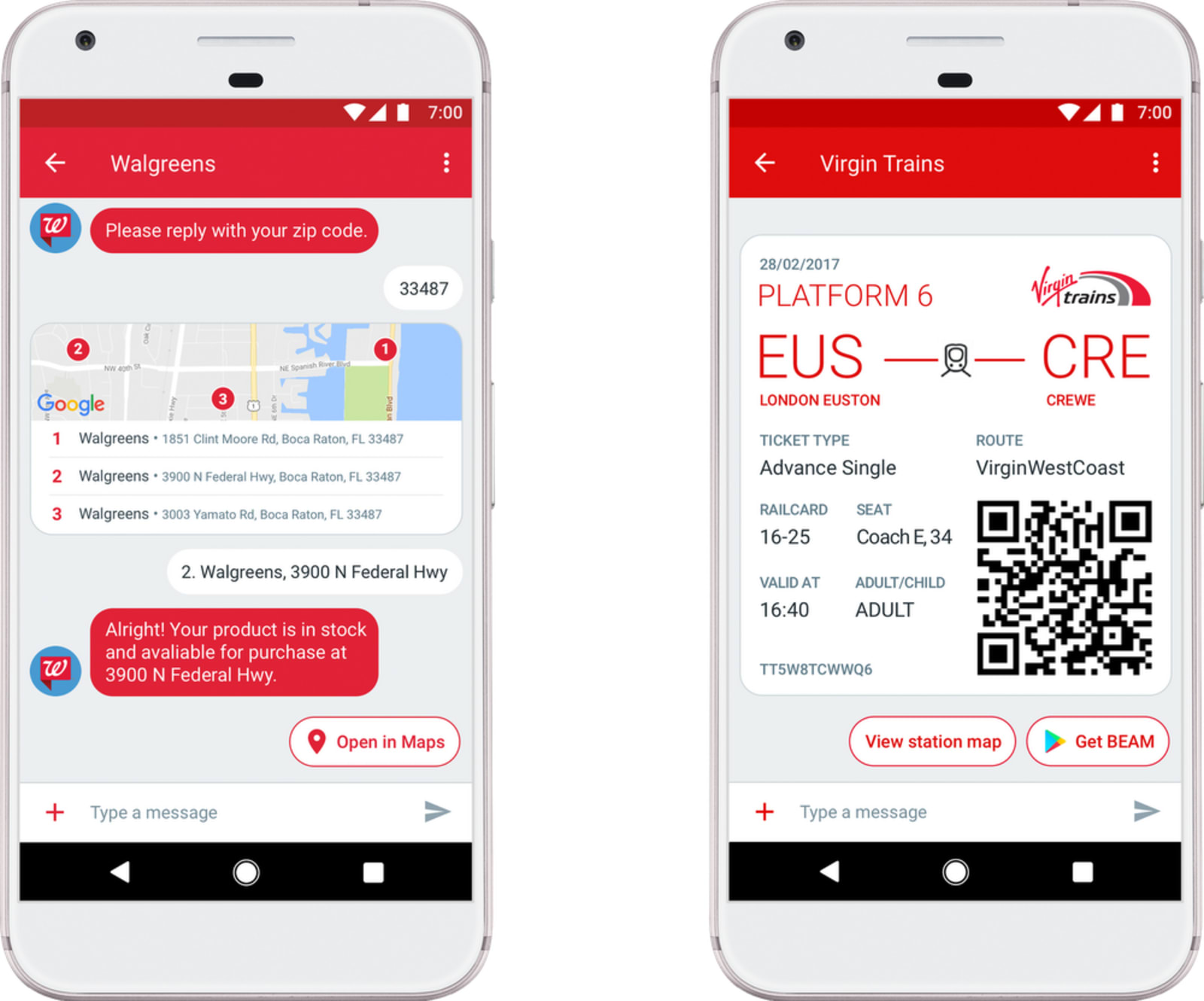
The widespread adoption of RCS will likely help Google compete with Apple’s iMessage, which has had similar features for a long time. As TechCrunch notes, Google is now pushing the business uses of RCS, which enables companies to send messages with things like boarding passes, financial fraud alerts and package notifications. The RCS standard can also allow suggested response buttons, like “Open in Maps” to find a nearby Walgreens or “View station map” from Virgin Trains.
Google is partnering with Sprint, 1-800 Contacts, 1-800 Flowers.com, Booking.com, SnapTravel and Subway to bring RCS messaging to their customers, as well as with messaging companies like Smooch and Twilio. Google has also connected with Telcel in Mexico to do the same with various companies and services there, including DHL Mexico, Secretaria de Salud and Airmovil.
Via: TechCrunch
Source: Google
UPS is adding to its fleet of electric delivery trucks
UPS announced today that it will soon deploy 50 electric delivery trucks designed by Workhorse Group Inc. that will cost about the same as traditional, conventionally fueled trucks. They’ll have a between-charge range of around 100 miles, will be zero-emission and the first vehicles will be tested in a handful of cities this year. “Electric vehicle technology is rapidly improving with battery, charging and smart grid advances that allow us to specify our delivery vehicles to eliminate emissions, noise and dependence on diesel and gasoline,” Carlton Rose, UPS’ president of global fleet maintenance and engineering, said in a statement. “With our scale and real-world duty cycles, these new electric trucks will be a quantum leap forward for the purpose-built UPS delivery fleet. The all electric trucks will deliver by day and re-charge overnight.”
The first batch of trucks will be tested in Atlanta, Dallas and Los Angeles and based on their performance, the vehicle design will be tweaked ahead of a larger deployment sometime in 2019. “This innovation is the result of Workhorse working closely with UPS over the last four years, refining our electric vehicles with hard fought lessons from millions of road miles and thousands of packages delivered,” Workhorse CEO Steve Burns said in a statement. UPS has previously worked with Workhorse on a delivery truck equipped with drones that can take over the last delivery step.
UPS has a number of environmental goals it’s aiming to hit in the near future, including a 12 percent reduction of its greenhouse gas emissions within the next seven years. While the company has around 108,000 package cars, vans, tractors and motorcycles on the road, it has over 9,000 alternative fuel vehicles currently in use. Last year, UPS reserved 125 of Tesla’s electric semis and began converting 1,500 of its New York-based diesel trucks to all-electric systems.
UPS says it has around 35,000 trucks in its fleet that are comparable to the Workhorse-designed vehicles, meaning a good chunk of its fleet could in theory be replaced by the all-electric trucks. By 2020, it aims for a quarter of its newly purchased vehicles to be advanced technology or run on alternative fuel.
Source: UPS
‘Alto’s Odyssey’ took three years to make, and that’s all right
It’s been three years since Snowman, a tiny independent studio based in Toronto, launched Alto’s Adventure on iOS devices. Back then, Snowman was three people — Ryan Cash, Harry Nesbitt and Jordan Rosenberg — and Alto’s Adventure was their first real game. They didn’t know what to expect when they published it in the App Store for $2.99 in Feb. 2015, but the team hoped for the best.
That launch changed everything.
Alto’s Adventure was a huge success. Players devoured the serene, soothing experience set on the slopes of a snowy mountain range — it was an endless-runner snowboarding and llama-herding game, and its only mechanic involved tapping the screen to jump. Though gameplay was simple, the atmosphere and art told a larger story about comfort, risk and the warmth of home. Apple users ate it up, and the next year, Android players got a taste as well.

It’s been three years since Alto’s Adventure debuted on mobile devices, which means it’s been about three years since players have been asking Snowman about a sequel. This week, they got their wish as Alto’s Odyssey landed in the App Store for $4.99.
“The big elephant in the room is, this game’s taking quite a long time to release since the first one came out,” producer Eli Cymet said. “And that’s because we really wanted to pursue a feeling that was more natural to us.”
The Snowman team has flourished since 2015, and the studio now acts as a quasi-publisher for other independent developers, collaborating on projects like Where Cards Fall with Los Angeles studio The Game Band. Cymet joined Team Alto (the group within Snowman that’s dedicated to this particular franchise) after the launch of Alto’s Adventure but before Nesbitt and the crew added a consequence-free Zen Mode in June 2016.
This is one reason it took three years — and one high-profile delay — for Alto’s Odyssey to see the light of day: Developers were busy supporting the game they had already launched. This meant bringing Alto’s Adventure to Android and Windows, ensuring it was compatible with new hardware and software updates, and listening to player feedback to improve the game. That’s how Zen Mode happened, after all.

Image: Snowman
“As much as there’s been a focus on creating the right game, it’s also about having the right workflow and the right process, and working with the right people,” Nesbitt said. “So as the team has expanded to accommodate the new ambitions that we’ve got, then also there’s a lot to learn for how to work in that way and essentially just find a stable rhythm so that it’s not just a one-off situation. We want to keep on making games that people love and that excite us.”
From the first line of code to the last, Team Alto has been actively working on Alto’s Odyssey for just one and a half years rather than the full three. The rest of that time has been spent building a stable business and keeping existing players happy.
“Alto’s Adventure is our first foray into gaming,” Cash, the series director, said. “We’re kind of figuring a lot of this out on the way. Alto’s Odyssey will sort of only be our second step into this world. We were kind of, I don’t want to say blindly, hoping for the best. We’re kind of just making it up as we go. I think we’re feeling pretty good about it now, but we’re also pretty young in the industry.”
Snowman might be a young studio, but developers are taking a measured approach to their post-Alto’s Adventure projects. There’s hustle but no rush. No one on the team wants to push out a soulless game just because players expect it or, even worse, just to make a quick buck.
“We would get a lot of letters and sometimes physical mail telling us that Alto helped people relax at night and cope with illness or loss of a loved one,” Cymet said. “What that really taught us is that Alto as a series is strongest when it is about capturing these meaningful feelings and connecting with players on an emotional level.”
Alto’s Odyssey means a lot to Team Alto, and developers have poured their personal demons and triumphs into this deceptively emotional endless-running experience. Cymet, for instance, moved his family 2,000 miles from Vancouver to Toronto to join the Snowman team, and the feeling of displacement helped him develop a deeper relationship with the idea of “home” — one of the major themes in the Alto series.
“I think what I’ve learned, and what Harry and I have talked a lot about personally as we’ve reminisced during development and late nights and things, is that home isn’t necessarily a place,” Cymet said. “It’s the people you’re with and the people that make you feel supported and loved.”
The sequel also holds up a mirror to Snowman’s growth as a studio. While Alto’s Adventure encapsulated the comfort of home, Alto’s Odyssey is about letting go of familiar things and exploring new worlds. Rather than being confined to the slopes of snow-capped mountains, Alto’s Odyssey puts players in an array of desert biomes with dangerous new obstacles to conquer in gorgeous, sand-drenched settings.

“Odyssey, as the name suggests, is about going outside of that [comfort zone] and challenging yourself,” Nesbitt said. “And I think that’s sort of a parallel with a lot of our personal experiences, having made the game and then suddenly finding ourselves in this whole new world that we have to either grab it by the horns or let it steamroll over you. I think we can all relate to that.”
Speaking of change, Alto’s Odyssey is hitting a vastly different App Store than Alto’s Adventure. Nowadays, there are options to pre-order iOS games, and Apple highlights developer stories in the Today tab — two features that didn’t exist in 2015. In three years, the mobile market has shifted from offering premium $10 games to having an influx of $0.99 titles to finally being overrun with free games packed with in-app purchases. Not that the industry is frozen in place today: There’s been a recent newfound appreciation for premium titles as many players realize the actual cost of freemium games.
Cash says the premium mobile market is alive and well — and it could have a major impact on the video game industry overall.

“If you make a game for PS4, you’re making a game for people who play video games,” he said. “And I think, with mobile, it’s a sort of unique opportunity where you can reach almost everyone on the planet, so to speak, who has a phone. If you’re able to make a game for that platform, you have the potential opportunity to reach someone who may not consider themselves a gamer. You have a chance to be someone’s first foray into gaming.”
With Alto’s Odyssey, Snowman has this opportunity once again.
Blizzard will host a tournament for the 15-year-old ‘Warcraft III’
Out of nowhere, Blizzard introduced a public test realm (PTR) last fall for its 15-year-old game Warcraft III. PC fans of its current best-sellers like Overwatch play on PTRs to try out new features before they’re released to everyone, so creating one for an old title clearly implies greater plans. Today, as was rumored, we know what those are: A new gameplay patch and a tournament at the end of February featuring top players from the game’s heydey to the present.
Announcing the Warcraft III Invitational! See the latest PTR changes in action with @followgrubby, @Back2Warcraft and more!
Learn more: https://t.co/NWhZ6IjO9x pic.twitter.com/rdAxYVFSkf
— Blizzard Entertainment (@Blizzard_Ent) February 22, 2018
Blizzard will host ‘the first Warcraft III Invitational’ at their Irvine HQ on February 27th and 28th, with Twitch streams hosted by two casters from Back2Warcraft, the site and community helping to keep the game’s competitive scene alive. The exhibition’s matches will include Free-for-All, 4v4 and other competitions — one hopes that it might include some old-school Defense of the Ancients, the map mod that inspired the MOBA genre. Attendees include players old and new, like Grubby, Lyn, MaDFroG, Happy and others.
While a new patch for a 15-year-old game sounds impressive (and it is), Blizzard has been quietly updating the game annually for awhile. Still, patch 1.29 will bring some long-awaited changes like widescreen support to prevent screen-stretching and hero tweaks, as well as new features like support for 24-player game lobbies. The patch goes live on the PTR first (details here).
Why would Blizzard want to breathe new life into an old game? They already remastered StarCraft last year, which was originally launched in 1998 , so it’s possible that a renovated version of Warcraft III is on the way. Blizzard could be spotlighting a community that’s long toiled by themselves to keep the game’s competitive scene alive, with the tournament and new patch as a thank-you gesture. Or the studio could be shoring up the old title in hopes of elevating it to eSports material, given how long the original StarCraft scene has endured. Whatever the case, the attention can only mean good news for fans of Warcraft III.
Source: Battle.net forums
Wirecutter’s best deals: Dell’s P2715Q 27-inch 4K monitor drops to $400
This post was done in partnership with Wirecutter. When readers choose to buy Wirecutter’s independently chosen editorial picks, it may earn affiliate commissions that support its work. Read their continuously updated list of deals here.
Samsung 960 Evo M.2 500GB SSD

Street Price: $230; Deal Price: $200
If you have a need for speed where your storage is concerned, this is a nice opportunity to save. The Samsung 960 Evo M.2 500GB SSD is down to $200, around $30 off the recent street price and the lowest price we’ve seen for it. At this price, it’s well worth considering versus other storage options out there.
The Samsung 960 Evo M.2 SSD is our upgrade pick in our guide to the best SSDs. Andrew Cunningham, Ben Keough, and Nathan Edwards wrote, “If you have a legitimate need for faster storage, you should buy the PCIe Samsung 960 Evo, which can quadruple the read speeds of the fastest SATA drives and more than double the write speeds. It’s more expensive—$50 more than the 850 Evo for 500GB and $110 more for 1 TB—and you’ll need a desktop or an M.2 PCIe-equipped laptop to use it. But the 960 Evo is a lot cheaper than our previous upgrade pick, the Samsung 960 Pro, while still delivering excellent performance. Just remember that the difference between a SATA SSD and a PCIe SSD isn’t as noticeable as the difference between a SATA SSD and a spinning hard drive.”
Plantronics BackBeat FIT 500 Bluetooth Headphones

Street Price: $100; Deal Price: $80
Looking for on-ear headphones that can stand up to sweat and water? If so, the Plantronics BackBeat FIT 500 are a nice option. Our on-ear pick in our guide to the best wireless workout headphones, they typically cost $100 but have seen this $80 price more often since the holidays. Even so, we haven’t seen them lower. They’re available in Black and Teal.
The Plantronics BackBeat FIT 500 are our on-ear pick in our guide to the best wireless workout headphones. Lauren Dragan wrote, “The Plantronics Backbeat Fit 500 are the only on- or over-ear Bluetooth workout headphones that we have ever liked. Every other headphone we tested was uncomfortable, fell off, was poorly constructed, sounded terrible, absorbed sweat, or all of the above. The Backbeat Fit 500 are in a sweet spot of snug-fitting but flexible enough to grip your noggin securely without giving you a headache. They have a nano-coating that resists sweat and water damage, and the earpads wipe clean for easy sanitizing. The controls are intuitive to use, and easy to find without fumbling around. The Fit 500 sound really great, with plenty of bass that isn’t muddy like much of their competition. Plus, with an 18 hour battery life and optional cable, you won’t need to worry about charging frequently.”
SanDisk iXpand 128GB

Street Price: $90; Deal Price: $75
The 128GB version of the SanDisk iXpand iOS thumb drive is down to $75 from its typical street price of $90. We’ve posted a previous deal at $72 and we’ve seen it fall even lower on rare occasions, but this is still a solid drop. Deals on this iOS thumb drive occur regularly but typically don’t last long, so if you’re in need of more storage for your iPhone or iPad, grab one while this price lasts.
The SanDisk iXpand is the runner-up iOS thumb drive for those in need of extra storage in our guide to the best accessories for your iPhone and iPad. Dan Frakes, Nick Guy and the Wirecutter Staff wrote, “If the JetDrive Go 300 goes out of stock or jumps in price, we like SanDisk’s iXpand as an alternative. Its app crashed a couple of times during our video-transfer tests, which was frustrating, but it was a full minute faster than any other model at copying data over USB 3 to the iPhone, and its app was the easiest to use.”
Dell P2715Q 27-Inch 4K Monitor

Street Price: $435; Deal Price: $400
At $400, this matches the lowest price we’ve seen for this monitor from Dell. The P2715Q is aging at this point and we’d love to see it drop lower as a result, but it has stubbornly refused to do so. The typical street price has been around $435 in recent months, so this is still a decent savings. We’ll continue to monitor it in the hope we see deeper discounts in the future, but this is a solid deal if you’re seeking an affordable 4K monitor now.
The Dell P2715Q 4K monitor is our runner-up pick in our guide to the best 4K monitors. John Higgins and David Murphy wrote, “If the LG is sold out or too expensive, you don’t mind thicker bezels, or you need only DisplayPort to connect to your monitor, consider the Dell P2715Q. It’s a few years old—it was our previous pick—but it’s even more color-accurate than the LG, has a great stand and VESA support, and comes with a built-in USB 3.0 hub. It also has Dell’s legendary three-year pixel-perfect warranty. Its HDMI port can’t run a 4K monitor at 60 Hz, but its DisplayPort input can, so that’s not a dealbreaker for most people, nor are its fat bezels, compared with our other picks. It’s a better buy for most people than the newer Dell U2718Q, which is inaccurate enough that it’s not worth recommending right now.”
Because great deals don’t just happen on Thursday, sign up for our daily deals email and we’ll send you the best deals we find every weekday. Also, deals change all the time, and some of these may have expired. To see an updated list of current deals, please go here.
Amazon inks deal with Televisa for Spanish-language shows
Amazon may be producing more and more of its own shows, but it’s also playing catch-up trying to follow industry trends in the fantasy and sci-fi genres. To shore up its dearth of Spanish-language content, the company just signed a deal with Televisa to license several of its upcoming scripted series.
It’s unclear how many different series will be included, or what they will be about, aside from “with a focus on multicultural characters and storytelling,” according to Variety. We only know they will average eight to ten episodes each and will be developed, produced and distributed by the media company’s subdivision Televisa Alternative Originals.
As Variety points out, this deal is likely Amazon’s attempt to compete with Netflix’s Spanish-language content, which includes global hits like Narcos. But this is also an about-face for Televisa, which took its content off of Netflix in 2016 to stream on its own service, Blim. But the Mexican multimedia company might have changed its tune after declining broadcast ratings as more folks in the country turn to online content.
Source: Variety
App Store Pages Now Able to Feature Up to 10 Screenshots
Apple this morning informed developers that they’re now able to offer up to 10 screenshots in their App Store product pages for iPhone, iPad, Apple Watch, and Apple TV apps, allowing them to show customers more of an app’s experience.
In the App Store, each app has its own product page that offers up a description and images to explain its function or gameplay.
Previously, app developers were limited to a total of five screenshots plus up to three 30-second preview videos for demonstrative purposes, which is increasing to 10 images plus videos.
For apps that run on multiple devices, developers will be able to provide 10 tailored screenshots for each device.
For customers, the expanded screenshot limit means developers will be able to offer a clearer, more expansive picture of what an app is capable of, providing a better idea of an app’s feature set ahead of purchase.
Tag: App Store
Discuss this article in our forums
Apple Pay Promo Offers Free Delivery With Instacart
For the last few months, Apple has been offering regular promotions to entice customers to use Apple Pay within various apps.
This week, Apple has teamed up with Instacart to offer free delivery on groceries purchased in the Instacart app using Apple Pay through February 28.
To get the deal, customers will need to spend at least $35 per order, and taxes and service fees still apply. Free delivery is also contingent on availability, as Instacart has something called “Busy Pricing” which is an added fee during the busiest parts of the day.
Free delivery from Instacart for orders over $35 normally requires a membership to Instacart Express, a service that costs $14.99 per month or $149 per year. Apple’s free delivery offers an opportunity for potential Instacart customers to test Instacart Express.
Without Instacart Express, normal Instacart orders cost $5.99 in delivery fees.
Apple’s new promotional email also highlights several grocery stores that offer Apple Pay, including Raley’s, Giant Eagle, Sprouts,
Stop & Shop, Whole Foods, and Wegmans.
Related Roundup: Apple Pay
Discuss this article in our forums
Employment Questionnaire and Two Signatures From Steve Jobs Going Up for Auction
An auction site is set to sell off three pieces of Steve Jobs memorabilia, including a rare employment questionnaire filled out by the former Apple CEO.
Jobs filled out the application in 1973, just after dropping out of Reed College, where he attended school for approximately six months and then audited classes for another year and a half.
On the document, Jobs lists “english lit” as his major, and Reed College as his address. He lists “Computer” and “Calculator” as skills, along with “Design” and “Tech,” and says that he has special abilities that include “Electronics” and digital “Tech or Design Engineer.”
Auction site RR Auction expects the questionnaire to fetch upwards of $50,000 at auction.
Along with the questionnaire, the site also plans to auction off two documents that feature a rare Steve Jobs signature. The first is a Mac OS X technical manual that Jobs signed back in 2001, and there’s a short story that goes along with the signature, obtained in a parking lot following an Apple training session in Cupertino.

“It was afternoon, the end of my training day and I just got into my car when I saw Mr. Steve Jobs walking into his car. I rolled down my window and called up his name. He asked me whether he knew me. I told him I certainly knew who he was and immediately asked him if he would be kind enough to sign my Mac OS X Administration technical manual. He refused and said ‘I feel weird doing that.’ I refused to back down. After a bit of cajoling on my part, he finally told me to hand over the manual and pen. He said ‘give me those’ and he autographed my manual,” in a letter of provenance from the consignor.
The signed manual is expected to go for approximately $25,000 when it’s placed up for auction, and it’s being compared to a signed magazine cover that sold for $50,000 back in October of 2017.
The third document is a newspaper clipping from 2008, which features an image of Steve Jobs speaking at the Worldwide Developers Conference where the iPhone 3G was introduced. Jobs signed the newspaper at the Fraiche Yogurt shop in Palo Alto, California where he was eating frozen yogurt with Tony Fadell, who also signed the document.

Steve politely declined several times, stating that everything at Apple was a group effort, so he didn’t like to sign and take credit for everything. My mom is pretty persuasive and was eventually able to convince Steve to sign; but under Steve’s condition that the person sitting with him would have to sign it as well. That friend turned out to be Tony Fadell, known as the Father of the iPod, who was working at Apple during that time and instrumental in the design and development of the first iPod which later morphed into the iPhone.
The signature on the newspaper is expected to fetch somewhere around $15,000 when it is auctioned off.
The three Steve Jobs auctions will kick off on March 8 and will end on March 15 at RR Auction.
Tag: Steve Jobs
Discuss this article in our forums
 AIVAnet