


Apple Shares New Photos of First Store in Austria, Opening February 24
Apple’s first store in Austria is set to open on Saturday, February 24, and ahead of the store’s official launch date, Apple has shared some photos that showcase the new location.
Apple Kärntner Straße is located on Vienna’s Golden Quarter, in the famous pedestrian shopping street between St Stephens Cathedral and the Vienna State Opera. The two-level store features a corner entrance and reinstated exposed columns with large window openings that seamlessly connect it to the public gathering space outside.
“We can’t wait to join the bustling city of Vienna, a European crossroads so rich in history and culture,” said Angela Ahrendts, Apple’s senior vice president of Retail. “Apple Kärntner Straße brings the best of Apple together with our products, services and educational programs. Everyone is welcome to connect, be inspired to learn, and unlock their creativity.”
Like all Apple stores, Apple Kärntner Straße will offer customers free “Today at Apple” sessions – daily workshops focusing on photography, coding and app development, music, art and design, and more. Each session is hosted in an area of the store called The Forum that boasts a dynamic 6K video wall, recreating the same layout found in many of the company’s retail stores around the world.
Apple says the store will include its entire line of products, while new owners can get help customizing their iPhone, iPad, Apple Watch or Mac from the store team of 150 employees, which together speak 44 languages.

So long as no additional stores open between now and Saturday, Apple Kärntner Straße is likely to be Apple’s 501st retail store. Apple currently has 500 retail stores around the world, not counting Apple Watch boutiques and factoring in the two store closures in Simi Valley, California and Sapporo, Japan.
Apple began posting job listings for Austria’s first Apple store in February of 2017 and announced its opening plans late last month. Apple Kärntner Straße will open up at 9:30 a.m. local time, and Apple is already accepting Genius Bar appointments and Today at Apple signups.
Tag: Apple Stores
Discuss this article in our forums
Apple to Debut New AirPods This Year With Handsfree ‘Hey, Siri’ Voice Command Feature
Apple is reportedly working on several upgrades to its wireless AirPods with a new version of the popular headphones set for release as soon as this year, according to Bloomberg.
Like with its mobile devices — the iPhone, iPad, and Apple Watch — Apple intends to frequently update the AirPods with new hardware features. The Cupertino, California-based technology giant is working on a new version for release as soon as this year with an upgraded wireless chip, the people said. A subsequent model for as early as next year is planned to be water resistant, they added, asking not to be identified discussing private product plans.
The new 2018 AirPods are said to come with an upgraded wireless chip that will let users summon Siri using the “Hey, Siri” voice command without having to physically tap the headphones, similar to the way iPhone and HomePod users invoke the virtual assistant. Currently, summoning Siri through AirPods requires users to double-tap the sides of the earbuds, although responsiveness to touch can occasionally be flaky. The upcoming version of the headphones are known internally as B288, according to today’s report.
The idea behind the second iteration of AirPods, said to be coming in 2019, is for the headphones to “survive splashes of water and rain”, although they likely won’t be designed to be submerged in water, according to Bloomberg’s sources. That plan comes despite reports that current-generation AirPods survive being submerged in one foot of water for five minutes, and even come out the other side of a washing and drying cycle functioning as expected. That said, Apple doesn’t advertise AirPods as waterproof, and a patent was in fact filed last April for a waterproof AirPods case that can double as an iPhone or Apple Watch charger.
Designed by the same department that produced Apple’s HomePod speaker, AirPods were first introduced in 2016 alongside the iPhone 7 sans headphone jack, as a wireless solution for users wanting to listen to audio through a headset. Since their launch, AirPods have been considered one of Apple’s top-performing products, as reflected in Apple’s severely constrained supplies throughout 2017. According to Apple CEO Tim Cook, production capacity of AirPods was been bumped up in the second half of last year, but Apple has continued to struggle to reach supply/demand balance. According to online shopping data provided by Adobe, AirPods were the overall top selling electronic products during last November’s Cyber Monday.
KGI Securities analyst Ming-Chi Kuo has predicted that Apple shipped 13 to 14 million AirPods last year, and he expects AirPods to remain one of Apple’s most popular accessories through 2018, with shipments likely to double to an estimated 26-28 million units on a year-over-year basis.
Back in December, Kuo also predicted Apple would release an upgraded version of AirPods in the second half of 2018. Kuo said one internal change on the second-generation AirPods will include a “smaller quartz component,” but he didn’t provide any further details about new outward-facing features or improvements to expect.
Tags: AirPods, Bloomberg
Discuss this article in our forums
LG updates its cheap K-series phones with new hardware
After renewing its high-end mobile push through 2017 with new G and V series phones, LG is taking another shot at the low-to-mid range with these K-series devices. The new K8 and K10 (with three sub-models that vary in RAM, built-in storage and color) will debut at MWC 2018 next week and pack specs that match their slots in the lineup. The metal-framed 5.3-inch K10 claims a 13MP rear camera snagged from the G6, but with only a single lens, to go with its 8MP front camera and rear-mounted fingerprint scanner.
The K8 leans on software tweaks to keep owners happy with its 8MP/5MP front/rear camera combo, offering tweaks like gesture control, HDR and Flash Jump Shot that takes continuous shots to create GIFs on demand. There’s no word on the price, but current K10 models can be found for between $70 – $130, while the existing K8 goes for about $60. The bad news with these versions is their software — they’ll ship with Android 7.1.2 Nougat which is nearly a year old at this point, but not unusual at that price point.
K10
- Chipset: 1.5 GHz Octa-Core
- Display: 5.3-inch HD In-cell Touch (1280 x 720 / 277ppi)
- Memory:
- K10+ : 3GB RAM / 32GB ROM / microSD (up to 2TB)
- K10: 2GB RAM / 16GB ROM / microSD (up to 2TB)
- K10α : 2GB RAM / 16GB ROM / microSD (up to 2TB)
- Camera:
- K10+ : Rear 13MP / Front 8MP or 5MP (Wide)
- K10: Rear 13MP / Front 8MP or 5MP (Wide)
- K10α : Rear 8MP / Front 5MP
- Battery: 3,000mAh (embedded)
- Operating System: Android 7.1.2 Nougat
- Size: 148.7 x 75.3 x 8.68mm
- Weight: 162g
- Network: LTE / 3G / 2G
- Connectivity: Wi-Fi (802.11 b, g, n) / Bluetooth 4.2 / USB 2.0 Type B / NFC
- Colors:
- K10+: Moroccan Blue / Terra Gold
- K10 : Aurora Black / Moroccan Blue / Terra Gold
- K10α: Aurora Black / Terra Gold
- Other: Fingerprint Scanner / FM Radio / Flash Jump Shot / Music Flash /
K8
- Time Helper / Quick Capture / Quick Shutter
- Chipset: 1.3 GHz Quad-Core
- Display: 5.0-inch HD On-cell Touch (1280 x 720 / 294ppi)
- Memory: 2GB RAM / 16GB ROM / microSD (up to 32GB)
- Camera: Rear 8MP / Front 5MP
- Battery: 2,500mAh (removable)
- Operating System: Android 7.1.2 Nougat
- Size: 146.3 x 73.2 x 8.2mm
- Weight: 152g
- Network: LTE / 3G / 2G
- Connectivity: Wi-Fi (802.11 b, g, n) / Bluetooth 4.2 / USB 2.0 Type B
- Colors: Aurora Black / Moroccan Blue / Terra Gold
- Other: FM Radio / Flash Jump Shot / Music Flash / Time Helper / Quick Capture / Quick Shutter
Source: LG
Uber’s ExpressPool service offers cheap fares, but you’ll have to walk a bit
Worawee Meepian/123RF
If you’re a ridesharing fan, what’s more important, convenient pick-ups and drop-offs or cheap fares?
If it’s the latter, then you may be interested to know that Uber has just launched its first new service in three years. Called ExpressPool, it works by grouping together riders going in the same direction and designating a single pick-up point for everyone, not more than a couple of blocks from where you made the ride request.
So, yes, it’s likely to mean a little exercise and taking a bit longer to the moment when you actually climb in the car, but with fares reported to be up to 50 percent cheaper than UberPool, and up to 75 percent cheaper than UberX, what’s not to like?
The new ExpressPool service is available now via Uber’s app to riders in Los Angeles, San Diego, and Denver. It’s also up and running in Boston and San Francisco where it was tested over the last few months, and by the end of the week will be available in Washington, D.C., Philadelphia, and Miami. A nationwide rollout is planned “soon,” the company said.
ExpressPool will be seen as a response to similar offerings by rivals, among them Lyft Line, which often works out cheaper than UberPool, Uber’s service that matches riders with other riders going in the same direction, but picks them up wherever they make the ride request.
Uber says that with Pool rides, time can be wasted picking up additional riders along the way, but with ExpressPool you’ll all be picked up in the same spot with no detours en route, which could end up making the trip just as quick as a Pool ride.
Essentially, if you don’t mind walking a block or two, Pool Express looks like a sensible option for riders keen on value for money.
“Walking and waiting help us make more optimal matches and provide better, straighter, faster routes with fewer detours, delivering an even more affordable and consistent option than [Uber]Pool to consumers,” Uber’s Ethan Stock explained in a blog post outlining the new service, adding that Express fits with its long-term plan of easing congestion and cutting pollution by “getting more people into fewer cars.”
Editors’ Recommendations
- Ridesharing giant Uber’s rise has been meteoric, anything but trouble-free
- Go ahead, have another! The best ridesharing apps help get you home safely
- Google’s Waymo vs. Uber: Everything you need to know
- Citymapper ditches London bus service to go after Uber instead
- ‘Dragon Ball FighterZ’ beginner’s guide
Qualcomm’s upcoming 5G-enabled Snapdragon chipsets will be built on Samsung’s 7nm node
Qualcomm is ready to make the switch to 7nm with Samsung’s help.

Qualcomm detailed its 5G plans late last year with the introduction of the X50, its first 5G-enabled modem for smartphones. The company has now announced that it is partnering with Samsung over its next-generation Snapdragon chipsets with 5G capabilities. The upcoming chipsets will be built on Samsung’s 7nm node, a huge leap forward that sees the introduction of extreme ultraviolet (EUV) lithography.
Samsung Foundry first showed off its 7nm EUV lithography process last May, noting that the technology will “break the barriers of Moore’s law scaling.” The company also said that the 7nm node will allow up to a 40% increase in area efficiency with up to a 10% uptick in performance, or up to 35% lower power consumption over current 10nm designs.
Therefore, the upcoming Snapdragon 5G mobile chipsets are expected to take up a smaller chip footprint, allowing manufacturers to slot in larger batteries or introduce slimmer designs. The collaboration with Qualcomm is a huge win for Samsung, which overtook Intel to become the largest semiconductor company earlier this year. From Samsung Electronics’ executive vice president of foundry sales Charlie Bae:
We are pleased to continue to expand our foundry relationship with Qualcomm Technologies in 5G technologies using our EUV process technology. This collaboration is an important milestone for our foundry business as it signifies confidence in Samsung’s leading process technology.
Qualcomm’s supply chain SVP RK Chunduru also commented on the partnership:
We are excited to lead the 5G mobile industry together with Samsung. Using 7nm LPP EUV, our new generation of Snapdragon 5G mobile chipsets will take advantage of the process improvements and advanced chip design to improve the user experience of future devices.
It’s likely we’ll have to wait at least until 2019 before we get a first look at Qualcomm’s 5G-enabled Snapdragon chipset. The first phones powered by the 10nm Snapdragon 845 are set to make their debut next week at Mobile World Congress, and we should hear more about Qualcomm’s 5G plans at the conference.
With the initial standard being finalized two months ago, we’ll also see more and more carriers announce 5G trials this year.
Land Rover Explore is a rugged phone with swappable backs
At last, we have a Land Rover phone that doesn’t look like it was built from parts found on a factory floor. The new ‘Explore’ is the work of Bullitt, a British company that has made handsets for Caterpillar, Kodak and JCB in the past. It was actually unveiled at the ISPO trade show earlier this month — Bullitt held back the spec sheet, though, thinking it would be a better announcement at MWC. Today, we have those all-important details. And at first blush, it’s a strangely alluring device blending rugged looks with a modular, Moto Mod-inspired ‘Pack’ system for people who love the great outdoors. It might be the first car-branded phone that isn’t terrible.
First, the looks. There are some obvious nods to the current Land Rover lineup — the car-like grille at the bottom, for instance, and the vertical lines on the back — that are subtle enough not to be vulgar or laughable. The ring around the camera module is a little unnecessary, but it’s easily excusable when you consider the Porsche-branded monstrosities we’ve had to endure in recent years. The top-line feature is a 4000mAh battery that promises “two days of typical use.” It’s joined by a deca-core 2.6 GHz MTK Helio X27 processor, 4GB of RAM and 64GB of internal storage.

All standard fare for a mid-range smartphone. The hardware gets exciting, however, when you start attaching Packs to the pogo pins on the back. The Explore comes bundled with a chunky Adventure Pack that adds a 3600mAh battery (for a grand total of 7600mAh) and a 25mm ceramic patch GPS antenna. The latter is a specialized component that overrides the Explore’s built-in antenna and boosts the chance of you getting a signal in far-flung locations. The Pack is also IP68 certified, meaning it can withstand light dust and dirt, and has been drop-tested to 1.8 meters.
Bullitt has created a Bike Pack too, which comes with a stem and handlebar mount, and a Battery Pack that adds a whopping 4370mAh to the main unit. Each pack can also be set to automatically launch a navigation app. These include ViewRanger, a premium application with detailed Ordnance Survey maps for hikers and cyclists. The hope is that the phone will double-duty as a sleek daily driver and a specialist outdoor companion. During the week, you can keep it bare — passing it off as a normal, albeit car-branded flagship — before augmenting it with the Adventure Pack while you climb Snowdonia or cycle the South Downs Way at the weekend.
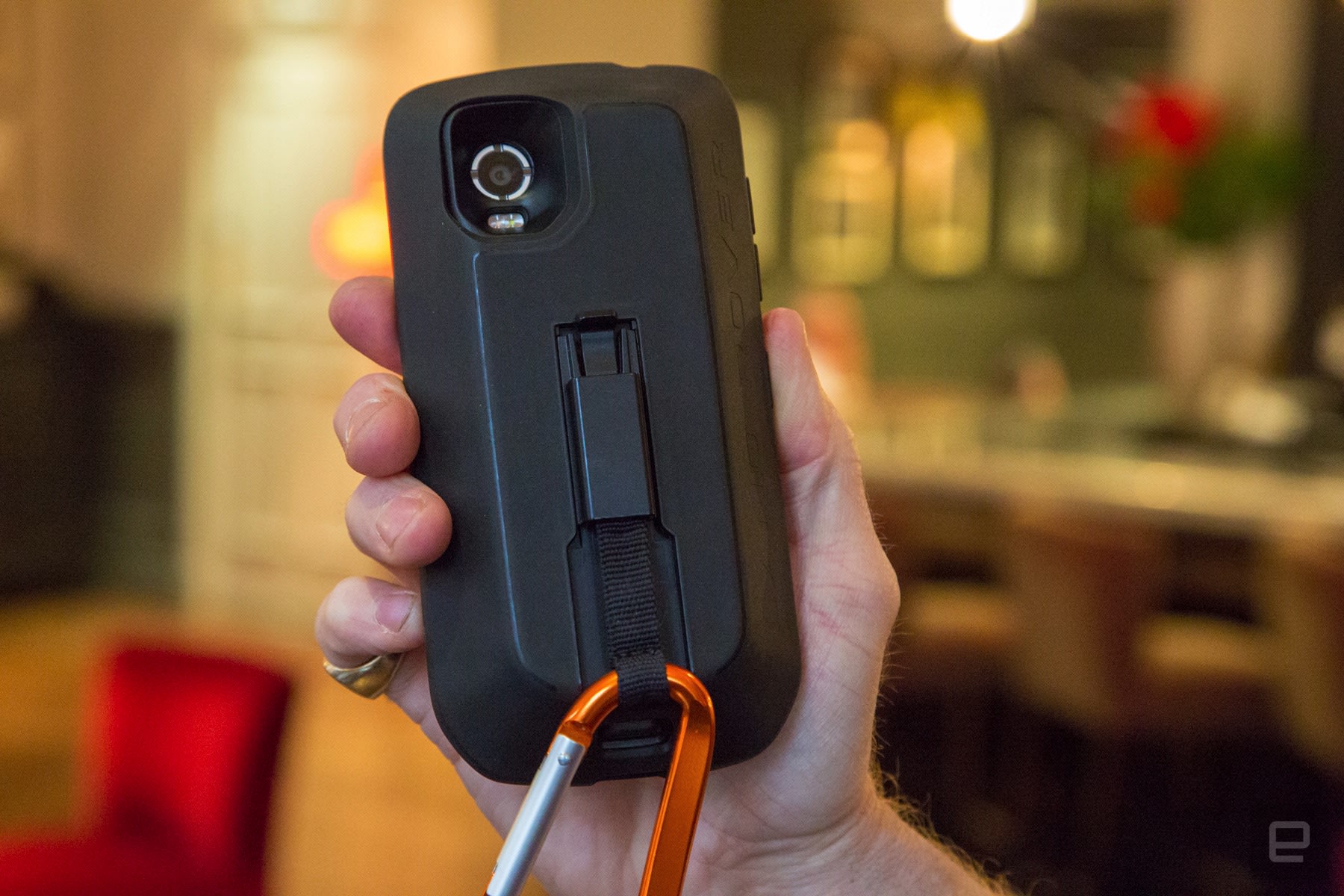
We’ve seen modular phones before, and the problem has always been hardware support. Motorola has held a number of competitions to boost Moto Mod support, however the ecosystem remains threadbare. The Jolla phone, meanwhile, is dead, and the Essential Phone still has a single accessory: a 360-degree camera (what happened to the DAC headphone adapter?) The Explore phone is a little different though, because its modular aspirations are tied to specific activities. Bullitt might make a skiing, surfing or sailing Pack in the future — but it’s not looking to redefine smartphone design, or innovate with a snap-on Polaroid photo printer.
The Land Rover Explore will go on sale for €649/£599 (roughly $800) in April. Bullitt is staying tight-lipped about the Bike and Battery Pack pricing, however a spokesperson hinted that they’ll be somewhere in the £70 to £100 range. Six-hundred quid isn’t bad for a phone considering the GPS-centric Adventure Pack is included in the box. The Explore’s spec sheet is decidedly mid-range but the ViewRanger app alone comes with maps worth roughly £100. If you’re the type that likes to spend their weekend with a pair of Merrell boots on their feet, it might not be a bad deal.
Cat’s S61 is an ideal phone for blue-collar workers
Two years ago, I was shown a Cat-branded smartphone with a thermal camera for people who work in construction and other outdoors-y, get-your-hands-dirty professions. I wasn’t the target market, of course, and struggled to judge whether the feature was a gimmick or not. Turns out it was the latter; Bullitt, the British phone maker that built the Cat S60, is back with a new model called the S61. The heat-sensing FLIR camera now goes up to 400 degrees celsius (the S60 maxed out at 120 degrees) so workers can analyze faulty engines, electronic equipment and more.
But that’s not all. The company has added a Volatile Organic Compound (VOC) sensor that can monitor nearby air quality. It’s aimed at people who work in cramped workshops (i.e. sheds) and half-built homes filled with wet paint, solvents and cleaning products. The Cat S61 will take a reading every 30 seconds and send an alert if the environment becomes unhealthy. There’s also a tiny laser system on the back that can measure distances up to 10 meters. The resulting measurements can be combined with regular photos from the S61’s rear-facing camera for easy storage and reference.

Otherwise, it’s a fairly predictable mid-to-high-end smartphone. You’ll find a Qualcomm Snapdragon 630 inside, coupled with 4GB of RAM and 64GB of internal storage. It’s powered by a beefy 4500mAh battery and runs a mostly stock version of Android Oreo (an Android P upgrade is promised) on a 5.2-inch, 1080p display. The phone is also rugged, with an IP68-certified body that can withstand 1.8-meter drops onto concrete and up to three meters of water. The S60 could dive to five meters, but you had to flick some fiddly yellow switches first — Bullitt wasn’t happy with the solution, so it’s traded some depth for a switch-free design this time.
If it wasn’t clear from the photos — the S61 is built like a tank. It has a strange, CAT-branded bulge at the top (it’s necessary for the thermal camera, presumably) physical keys (how many Android phones have physical keys anymore?!) and a textured back. The design isn’t grotesque though — if I was a plumber, carpenter or electrician, I wouldn’t feel embarrassed pulling this out of my pocket. It’s thick, admittedly — you won’t get this in a pair of skinny jeans — but it’s oddly refreshing to hold a phone that prioritizes battery life over a needlessly thin design in 2018.

The price, though, could be an issue. The Cat S61 will cost £799/€899 (roughly $1,110) when it goes on sale in the second quarter of this year. That’s a big jump over the $599 S60 and the same price as a 64GB Pixel 2 XL. It only makes sense, then, if you’re an enterprise customer who desperately want its speciality features. Otherwise, you might be better off with a regular ruggedized Android phone; one that offers durability at a slightly cheaper price-point, or with a marginally better spec shoot. Or, you could just stick with a regular flagship and buy an Otterbox protective case.
Signal Messenger receives $50 million from WhatsApp co-founder
WhatsApp co-founder Brian Acton left Facebook in 2017 to start a non-profit. Turns out that non-profit involves another messaging app: Signal. In a blog post, Signal chief Moxie Marlinspike has announced the launch of Signal Foundation, a 501(c)(3) nonprofit that was made possible by the $50,000,000 in funding Acton provided. Signal’s secure messaging app is a popular choice among privacy-focused users, including staff members of the US Senate. Even though it’s a fairly recognizable name, it’s been having financial troubles that make it hard to hire more people to develop new features.
Moxie said in the post that thanks to the funding, Signal “can now increase the size of [its] team, [its] capacity, and [its] ambitions.” Signal Foundation’s status as a non-profit means Moxie and his team won’t have to worry about putting profit first to be able to pay off investors. Acton did admit in his part of the post that their goal is to make the Signal Foundation financially self-sustaining, though it’s unclear at this point how they plan to achieve that.
While the company will be fueled by Acton’s money going forward, Signal Messenger will remain an independent entity headed by Moxie under the Foundation’s umbrella. In the future, though, they hope to offer multiple products that embody Signal’s mission of “making private communication accessible and ubiquitous” other than its Messenger app.
Source: Signal
How to Merge and Remove Duplicate Contacts in macOS and iCloud
If you’ve been maintaining and migrating the same Contacts list across Macs over the years then you’ve probably come across your fair share of duplicate contact cards. They can also appear seemingly out of nowhere after setting up iCloud Contacts on your Mac for the first time.
Unless you intentionally keep certain information for the same contact separated out for whatever reason, duplicate cards will add nothing but irritation to your day, so here we’re going to show you how to merge and/or remove them, whether you’re sat at your Mac or not.
How to Merge and Remove Duplicate Contacts on your Mac
As with any computer procedure that involves deleting data, make sure you have a backup of your system before following these steps.
Launch the Contacts app on your Mac (found in Applications/Contacts).
In the Groups pane on the left, make sure All Contacts is selected at the top of the list. (If the Groups view is hidden, select the menu bar option View -> Show Groups to reveal it.)
From the menu bar, select Card -> Look for Duplicates….
A dropdown dialog will appear telling you how many duplicate cards were found that either have the same name but contain different information, or have both the same name and the same information. To merge the duplicate cards and information, click the Merge button.
How to Remove Duplicate iCloud Contacts on PC and Mac
If you don’t have access to your Mac you can remotely delete duplicate entries in your Contacts list in the following way. Oddly, there’s no way to select multiple contacts on an iPhone or iPad running iOS 11, so this manual method is the best workaround, although bear in mind it only applies to contacts synced to iCloud.
Launch a web browser on your device or computer.
Navigate to icloud.com.
Sign in using your iCloud credentials.
Click Contacts.
Select All Contacts in the upper left corner of the screen.
Hold down the Command (⌘) key and manually click the duplicate cards you want to delete.
Click the cog icon in the lower left corner and select Delete from the popup menu.
Confirm you want to remove the selected contacts by clicking the Delete option in the dialog pane.
Related Roundup: macOS High Sierra
Discuss this article in our forums
Xiaomi Redmi Note 5 Pro review: King of the hill
With the Redmi Note 5 Pro, Xiaomi is solidifying its position at the top of India’s handset market.

Xiaomi can do no wrong in India. The manufacturer sold nearly 10 million units of the Redmi Note 4 in the country last year, and is looking to maintain that momentum with the Redmi Note 5 Pro.
Xiaomi built its entire business model on offering great value for money — and as the sales numbers indicate, the strategy has paid off handsomely for the brand. But following up on the Redmi Note 4 is a tough act, as there wasn’t much wrong with the device.
That’s why with its 2018 budget phone, Xiaomi is focusing on core upgrades in all the major areas. The Redmi Note 5 Pro introduces an 18:9 display, a dual camera at the back and a 20MP front camera with LED flash, a Snapdragon 636 chipset, and up to 6GB of RAM. Xiaomi led the category for battery life last year, and things aren’t any different this year — the Redmi Note 5 Pro has a 4000mAh battery.
With the competition also fielding increasingly powerful phones, does the Redmi Note 5 Pro have what it takes to further Xiaomi’s cause in India? Let’s find out.

Xiaomi Redmi Note 5 Pro Specs
| Operating System | MIUI 9.2 based on Android 7.1.1 Nougat |
| Display | 5.99-inch 18:9 FHD+ (2160×1080) IPS LCD panel403ppi pixel density450nits maximum brightness |
| SoC | Octa-core Qualcomm Snapdragon 636 Eight Kryo 260 cores up to 1.8GHz 14nm |
| GPU | Adreno 509 |
| RAM | 4GB/6GB |
| Storage | 64GB/64GB microSD slot up to 128GB |
| Rear camera | 12MP with 1.25um pixel size and f/2.2 lens + 5MP with 1.12um pixel size and f/2,0 lensPDAF, LED flash 1080p video recording |
| Front shooter | 20MP with LED Selfie light 1080p video recording |
| Connectivity | LTE with VoLTEWi-Fi 802.11 ac, Bluetooth 5.0, GPS, GLONASS Micro-USB, 3.5mm audio jack, IR blaster |
| Networks | LTE: 1/3/5/40/41GSM: 2/3/5/8WCDMA: 1/2/5/8 |
| Battery | 4000mAh battery Fast charging (5V/2A) |
| Fingerprint | Rear fingerprint sensor |
| Dimensions | 158.6 × 75.4 × 8.05mm |
| Weight | 181g |
| Colors | Gold, Rose Gold, Blue, Black |
About this review
I (Harish Jonnalagadda) am writing this review after using the Redmi Note 5 Pro for over two weeks in Hyderabad, India. The device is a pre-production unit provided by Xiaomi India and is running a nightly build of MIUI 9 (9.2.2.0). I tested the phone on Airtel and Jio’s 4G networks in Hyderabad.

Xiaomi Redmi Note 5 Pro Design
The Redmi Note 5 Pro marks Xiaomi’s foray into the 18:9 form factor in the budget segment. The brand led the way for bezel-less panels with the Mi Mix and the Mi Mix 2, and while the effect isn’t anywhere as striking on the Redmi Note 5 Pro, you do get a taller 5.99-inch display with significantly reduced bezels when compared to last year’s Redmi Note 4.
The switch to an 18:9 panel also means there’s an all-new design up front. The capacitive navigation buttons have made way for on-screen keys, and you can change the orientation of the back and overview buttons from the settings menu.
Round back, things are more familiar. If you ignore the camera module, the Redmi Note 5 Pro is identical to the Redmi Note 5, which in turn shares the same design aesthetic as the Redmi Note 4. The Redmi Note 4 had an iterative design that was nearly identical to the Redmi Note 3, so what we have here is a design language that’s three years old.
Like previous years, the antenna inlays at the top and bottom of the device are made out of plastic, but feature a metallic finish. There’s a minor variance in color between the inlays and the metal back, particularly on the gold version. It isn’t as noticeable on the other color options of the device.
While the aesthetic has evolved over the last three years, the design at the back is starting to look stale. The design works for the Redmi Note 5, which starts off at ₹9,999, but it would’ve made more sense for Xiaomi to differentiate the Redmi Note 5 Pro from the standard variant.
Talking about lack of differentiation from the Redmi Note 5, the Note 5 Pro also comes with a microUSB charging port. The standard is becoming outdated, and the onus is now on Xiaomi to make the switch to USB-C in the Redmi series. That said, the IR blaster is intact, as is the 3.5mm jack. The volume and power buttons offer a decent amount of tactile feedback as well.
The 18:9 panel up front is one of the best in the budget segment.
The fingerprint sensor at the back is identical to what Xiaomi has used in the past, and it is quick to authenticate and the positioning is just right. The sensor is located in the top one-third section and is right next to the natural resting position of your index finger. There’s also a more prominent curve where the back meets the mid-frame, leading to better in-hand feel.
Coming to the display, the 5.99-inch LCD panel is one of the best in this segment. Xiaomi has made a habit of offering vibrant displays in this category, and the same is true for the Redmi Note 5 Pro as well. The panel offers a resolution of 2160×1080, which is becoming the standard for the 18:9 form factor.
Colors out of the box are excellent, and you can tweak the settings to your preferences by going into the settings. The phone also comes with a blue light filter that can be configured to automatically kick in from sunset to sunrise. If you’re one to use your phone a lot during the night, you should enable the feature as it reduces strain on the eyes.
For better or worse, the camera sensor — with the lenses arrayed vertically and the flash tucked in between — is identical to that of the iPhone X. It protrudes from the back as well, which makes the phone wobble when laid on a flat surface like a table.
Overall though, the build quality as well as fit and finish are all top-notch, with Xiaomi undertaking stricter quality control measures. At 181g, the Redmi Note 5 Pro is heavier than its predecessors, and the taller panel doesn’t make it conducive to use one-handed.

Xiaomi Redmi Note 5 Pro Hardware
Xiaomi is regularly in the first wave of manufacturers to roll out Qualcomm’s latest hardware. We’ve seen that in years past, and that’s the case with the Redmi Note 5 Pro as well, which is the first device to be powered by Qualcomm’s Snapdragon 636 mobile platform.
The Snapdragon 636 is interesting as it introduces Kryo cores to the budget category. The Snapdragon 660 did the same for the mid-range segment last year, but a majority of the phones powered by the chipset — the OPPO R11 and the Xiaomi Mi Note 3 — were limited to the Chinese market.
The Snapdragon 636 features eight cores in total, with four performance cores complemented by four energy-efficient cores. We’ve seen that same combination in use in the Android space for a few years now, and it strikes the ideal balance between performance and energy efficiency.
The four high-performance cores are based on ARM’s Cortex A73, one of the fastest cores available today. The energy-efficient cores are based on the Cortex A53, a mainstay in the budget segment over the last two years. Qualcomm has offered fully custom cores in the Kryo platform before, but it is leveraging the “Built on ARM Cortex Technology” licensing agreement to build semi-custom cores.
The Redmi Note 5 Pro is on par with flagship chipsets from just a few years ago.
The license allows Qualcomm to take off-the-shelf Cortex cores and make modifications to tweak the overall performance. We’ve seen Qualcomm go down this road with the Snapdragon 820, 821, and the 835, and the chip vendor is now doing the same for the downstream Snapdragon chipsets. Going with a Cortex license has several benefits as it gives Qualcomm the ability to go to market faster — it doesn’t need to design a core from the ground-up — while retaining a competitive advantage.
Coming back to the Redmi Note 5 Pro, the Kryo cores make a tangible difference in terms of overall performance. You’re looking at anywhere from a 15-20% increase in CPU speeds and a 10% uptick in GPU performance. As we’ve seen in the benchmarks, the Snapdragon 636 is an underclocked version of the Snapdragon 660, which delivers performance equivalent to flagship chipsets from just a few years ago.
The performance on tap with the Redmi Note 5 Pro is nothing short of extraordinary, and it’s safe to say that this is the fastest phone in the budget segment by some margin. The GPU performance means that the phone can now handle visually intensive games as well, which was a limitation with last year’s Redmi Note 4.
Xiaomi Redmi Note 5 Pro benchmarks
The Redmi Note 5 Pro is also decked out with LPDDR4X RAM, which thus far has been limited to the high-end segment. It would’ve been great had the device offered UFS storage as well, but the global demand for storage meant it wasn’t viable for Xiaomi to include it in the Redmi Note 5 Pro. The phone instead features eMMC 5.0 storage, and with both variants offering 64GB of internal memory, you’re not going to run out anytime soon.
Also new with the Redmi Note 5 Pro is Wi-Fi ac as well as Bluetooth 5.0, with both features limited to the Pro variant and not available in the standard version. Talking about connectivity, the Redmi Note 5 Pro had no issues with calls, and the speaker at the bottom is astonishingly loud. In short, if you’re looking for the most bang for your buck in the budget segment, this is the phone to get.
Battery life

Xiaomi prioritized the battery segment last year, introducing a 4100mAh battery in the Redmi Note 4. The huge battery combined with MIUI’s optimizations allowed the Redmi Note 4 to run rings around its rivals. A year on, that hasn’t changed. While the Redmi Note 5 Pro has a marginally smaller 4000mAh battery, you’re guaranteed the same great class-leading battery life.
You’ll easily get a day-and-a-half worth of usage from that battery consistently, even if you’re a power user and rely on your mobile primarily for your entertainment needs. In my usage, I averaged nine hours of screen-on-time spread over two days.
My main issue with the battery on the Redmi Note 5 Pro is the lack of fast charging. With the battery easily lasting more than a day on average, more often than not you’ll be looking to top up your device in the middle of the day, and that poses problems as the bundled charger maxes out at 5V/2A. The phone itself is not compatible with fast charging, taking an agonizing two hours to get from zero to a full charge.
Fast charging isn’t a big deal on a device with such great battery life, but the lack thereof is one of the few areas where the Redmi Note 5 Pro is behind the competition.

Xiaomi Redmi Note 5 Pro Software
On the software front, it’s business as usual. The Redmi Note 5 Pro comes with the latest version of MIUI 9, but if you were hoping for Oreo, get ready to be disappointed. The phone is still based on Android 7.1.1 Nougat, with an Oreo update slated for sometime later this year.
Furthermore, with the Redmi Note 5 Pro being the first to run the Snapdragon 636, there are odd glitches along the way. My unit is on the nightly 9.2.2.0 build, and the stable 9.2.4.0 update is scheduled to make its way to the phone shortly after its release. The stable build should iron out the kinks and allow the phone to take full advantage of the Snapdragon 636.
Optimization could also be the reason why Xiaomi stuck with the Snapdragon 625 for the standard version of the Redmi Note 5. The manufacturer has been optimizing the chipset for well over a year now, to the point where it runs with nary a lag or stutter. It’ll take a few weeks at least to get the Redmi Note 5 Pro to the same level, following which we’ll hopefully see the Oreo update make its way to the device.
MIUI is a ROM that needed a visual refresh yesterday.
Apart from the lack of Oreo, the user experience on offer with the Redmi Note 5 Pro is similar to Xiaomi devices released over the course of the last twelve months. There’s a ton of customization options and more features than you’ll end up using, but that’s one of the main draws of MIUI. Xiaomi has invested considerable resources in building out features, and MIUI 9 has plenty to offer in the form of quick replies in the notification window, an all-new Mi Video app, native split-screen functionality, and much more.
Then there’s older features like Dual Apps — which let you run two instances of an app simultaneously — and Second Space, through which you’ll be able to create a separate profile on your device. The SMS app has been tailored for Indian customers, taking the information from a ticket confirmation SMS and automatically creating a card with all the relevant details highlighted.
MIUI 9: Nine new features you need to know
As I said last year, MIUI is never going to adhere to “pure” Android in terms of a visual layout, and that’s because a majority of its users are in China. The unregulated nature of the Chinese app market is what led to features like a dedicated Security app and granular control over autostart permissions.
But with usage vastly increasing in markets like India, we may see a wholesale change heading to MIUI in the coming years. The retooled notification pane is definitely a step in the right direction, but the interface as a whole is in need of a refresh to make it more modern. The recents menu, for instance, hasn’t changed from the KitKat era, and if you need an app drawer, you’ll need to look to a third-party launcher. Xiaomi will hopefully address these issues and make much-needed changes to MIUI sooner rather than later.

Xiaomi Redmi Note 5 Pro Camera
If you ignore the fact that the dual-lens arrangement at the back is identical to that of the iPhone X, there’s plenty to like in the Redmi Note 5 Pro’s camera. The phone features a 12MP primary camera that’s joined by a secondary 5MP depth camera, and up front you get a 20MP camera with LED flash.
The Redmi Note 5 Pro does a stunning job in daylight conditions, with images offering plenty of detail and accurate colors. HDR is off by default, and while the mode was more of a hindrance in past Redmi devices, it’s actually usable in the Redmi Note 5 Pro. Finally, the phone does a decent job in low-light conditions, which is a huge deal seeing as how most budget phones struggle in this area.
The camera on the Redmi Note 5 Pro beats other phones in this category by a country mile.
I put the phone to the test by using it as my daily driver during Xiaomi’s launch event earlier this month, and came away impressed with the overall results. I normally rely on either the Pixel 2 XL or the Note 8 for launch event coverage as the lighting at these venues isn’t ideal, but the Redmi Note 5 Pro did an admirable job.
The dual camera setup also enables portrait mode, which we’ve seen in the Mi 6 and more recently the Mi A1. The background blur effect is more conservative this time around, but as Xiaomi pointed out at the launch event, its edge detection algorithm is spot-on.


On the video front, you get electronic image stabilization, but miss out on 4K recording. It’s unclear why the feature was removed as the Snapdragon 636 can handle 4K video, and as good as the Redmi Note 5 Pro is at taking photos, videos aren’t the device’s forte.
Sure, the Redmi Note 5 Pro won’t blow the Note 8 out of the water, but you have to remember that the phone is available for less than one-fourth the price of Samsung’s flagship.

Xiaomi Redmi Note 5 Pro Bottom line
The Redmi Note 5 Pro is Xiaomi’s strongest showing in the budget segment in the last two years, and puts the brand in a great position as we head into the launch cycle for 2018. The 18:9 display is a much-needed change to keep the device competitive, and the Snapdragon 636 ensures class-leading performance for the foreseeable future.
This is the first Redmi device I’d consider using as my daily driver.
The Redmi Note 5 Pro is the first phone in the Redmi series I’d consider using as my daily driver. Previous phones in this series weren’t short on power, but the camera was the one area where Xiaomi lagged behind.
With the Redmi Note 5 Pro, the manufacturer is taking the lead in this category, and once again setting the benchmark for the rest of the field to follow.
Should you buy it? Absolutely
If you’re in the market for a budget phone, the Redmi Note 5 Pro should be at the top of your list. The combination of sheer hardware combined with the great camera, two-day battery life, and 18:9 panel makes the Redmi Note 5 Pro the device to beat in the budget segment.
The phone is offered in two variants — a model with 4GB of RAM and 64GB of storage, and a version with 6GB of RAM and 64GB of storage. The 4GB model retails for ₹13,999 and is on sale, and the 6GB version will be making its debut at a later date for ₹16,999. With Xiaomi making a stronger push for offline sales, it’ll be easier to get your hands on the Redmi Note 5 Pro than in previous years. The phone should be making its way to Xiaomi’s offline partners shortly after its launch, and head to the 22 Mi Home stores in the country.
See at Flipkart
 AIVAnet