


Add a HDMI port to your new Chromebook with this $17 Anker adapter
Anker’s USB-C to HDMI adapter is only $16.79 with code ANKER836. It’s $24 without the code and has not had a direct price drop from that price in many, many months.

In The Wirecutter’s roundup of the best USB-C adapters, they consider this one the best for anyone who wants to hook up a modern USB-C only laptop to an HDMI monitor or high-definition TV. Not only does this tiny adapter have a solid build quality and support 4K video and 60Hz refresh rates, it’s also designed to work with the newer Chromebooks. Users give this adapter 3.8 stars based on 192 reviews.
See on Amazon
Deal: Pixelbook on sale for $899 at various retailers ($100 off)
Amazon and Best Buy are also offering student discounts.
Chrome OS still isn’t for everyone, but for those who are already fans or want to give it a fighting chance, the Pixelbook is the best way to experience Google’s desktop/tablet operating system. The Pixelbook is expensive with a starting price of $999, but a new sale drops it to just $899.

For that $899, you’ll get the base model of the Pixelbook with an Intel Core i5 processor, 8GB of RAM, and a 128GB SSD. That’s the Pixelbook I personally use, and it runs like an absolute champ. The next model up has the same processor and RAM, but you get double the storage thanks to a 256GB SSD. You’ll pay $200 more for it, but since it’s also discounted, it’ll end up costing just $1099.
If you want as much power as possible, the Pixelbook with a Core i7, 16GB of RAM, and a 512GB NVMe SSD also gets a $100 price cut and drops to $1549.
These $100 discounts are available at all retailers the Pixelbook is sold, including Amazon, Best Buy, B&H, Newegg, the Google Store, and Walmart. However, if you’re a student and get the Pixelbook at either Amazon or Best Buy, you can score an additional 10% off any model. Thanks to that, you’ll pay just $809 for the base Pixelbook before taxes.
If you want to take advantage of this offer, the $100 discount is good through March 3.
See at Amazon
Chromebooks
- The best Chromebooks
- Should you buy a Chromebook?
- Google Play is coming to Chromebooks
- Acer Chromebook 14 review
- Join our Chromebook forums
Google AI can scan your eyes to predict heart disease
Alphabet’s health science company Verily has announced a wide range of projects, from developing smartwatches made for medical studies to mass-producing infected mosquitoes to curb their population. Scientists from the division now have a new endeavor: Assessing heart disease risk by staring into patients’ eyes.
In a paper (PDF) published today in the Nature journal Biomedical Engineering, researchers explained their method: An AI algorithm evaluated eye scans and, after refining its model with machine learning, was able to predict cardiovascular risk factors like age, gender and blood pressure. This could lead to easier and potentially quicker analysis than a blood test with roughly the same accuracy as current methods.
The study isn’t without limitations, given that it only surveyed eye images with a 45-degree field of view. More research would resolve whether the model needs to be adjusted for larger or smaller photos, and a larger data set than what the researchers used is more appropriate for deep learning. In other words, it’s not yet ready for clinical testing, but it’s a promising start for non-invasive evaluation of cardiovascular health.
Via: The Verge
Source: Nature | “rediction of cardiovascular risk factors from retinal fundus photographs via deep learning” (PDF)
Samsung Galaxy S9 Plus dual cameras detailed in latest leaks
At this rate, there might not be much mystery left to the Galaxy S9 when Samsung reveals it on February 25th. WinFuture and Evan Blass have posted a flood of leaked images and details that appear to confirm key features of the S9, particularly its cameras. Sure enough, the larger (6.2-inch) S9 Plus should have dual 12-megapixel rear cams that will give it a clear hardware advantage over the 5.8-inch standard S9 — your choice won’t boil down to screen size like it did with the S8.
The WinFuture scoop also outlines the capabilities of those cameras. Much like the W2018, the rear camera on the S9 (or main rear camera on the S9 Plus) should have the option to switch between f/1.5 and f/2.4 apertures depending on the shot you’re aiming for. You could pick f/1.5 for low light or macro shots, or switch to f/2.4 when you want more of the scene in focus. The S9 Plus’ secondary rear camera would be locked at f/2.4 and would be intended more for zoomed or portrait photos.
Other tidbits? The front 8-megapixel camera wouldn’t be remarkable to Samsung fans, but the leak support talk of super slow-motion 960FPS video. You’d also see the long-rumored, AKG-tuned stereo speakers and a brand new Exynos 9810 processor (likely a Snapdragon 845 in North America). And of course, it wouldn’t be Samsung without new colors. Coral Blue, Midnight Black, Lilac Purple and Titanium Gray would be among the initial options, although there’s a good chance some hues will be limited to specific regions or carriers.
If the rumors are right, the Galaxy S9 may ship as soon as March 8th. About the only unknown at this point is the price. There are claims the S9 might carry a premium over the S8, but these are based on third-party retailers that won’t necessarily be held to official prices. Either way, the leaks reinforce views that the S9 is closer to an S8 refresh (albeit a welcome one) than a true overhaul.
+ pic.twitter.com/T5NGjyPGkR
— Evan Blass (@evleaks) February 19, 2018
Via: SamMobile
Source: WinFuture (translated), Evan Blass (Twitter)
Google is testing a splitscreen view for Android apps on Chromebooks
The latest update to Chrome OS’ Canary test channel should make multitasking on a Chromebook easier. Now, in addition to split-screening two native Chrome OS apps on your machine, you can run a Chrome OS app and an Android app side-by-side or two Android apps. It should be mentioned that Canary is pre-alpha software and isn’t exactly stable, as 9to5 Google notes, so maybe don’t try this out on your daily driver. This could be a sign that Chrome OS tablets and Chromebooks with detachable screens are en route. The video below from Chrome Unboxed, however, shows the feature running on a Samsung Chromebook Pro which suggests it’ll work on existing convertibles too.
Via: 9to5 Google
Source: Chrome Unboxed
‘Mega Man Legacy Collection’ is headed to Nintendo Switch May 22
Mega Man fans were likely excited to hear that the next chapter in the venerable video game franchise, Mega Man 11, is slated for a release sometime this year. At the same time, Capcom announced plans to release two new Mega Man Legacy Collection compilations. Now we’ve got a date for their release on Nintendo Switch: May 22, 2018.
The first bundle brings the first six Mega Man games together, letting you shoot, slide and jump your way through the classic titles. Capcom also added a new save (almost) anywhere system so players can try tricky sections without having to worry about distant save points. In addition, there’s a new rewind feature that lest you just back up a bit before a catastrophic mistake. Mega Man Legacy Collection also has a big gallery of concept art and box design, including the original Mega Man box art. There are songs from each game, too, and a challenge collection. Regular or golden Mega Man Amiibo toy owners will be able to access eleven extra fan-made challenges that have only been available on the Nintendo 3DS version of the game.
Mega Man Legacy Collection 2 includes Mega Man 7 through 10 from the Super Nintendo era, with 16- and 32- bit iterations of the action-platformer. Mega Man 9 and 10, both 8-bit retro throwbacks, will include all previously released DLC. The second collection also has a ton of art music, and challenges for each included title, and you’ll be able to get more challenges via any Mega Man Amiibo. The first collection will run you $15 as a digital download; the second is $20. You’ll also be able to buy the first collection and a code for the second one (along with a 30th anniversary cleaning cloth — yay?) for $40 in May. We still don’t know when Mega Man 11 (or Mega Man X titles) will show up on modern platforms, but we’ll surely let you know when we do.
Source: Capcom
Hasbro’s first HasLab toy is a replica of Jabba the Hutt’s barge
At this year’s Toy Fair in New York, Hasbro announced HasLab, a new program that aims to bring to life special creations like a massive, four-foot long recreation of Jabba the Hutt’s sail barge. The company is taking inspiration from platforms like Kickstarter and Indiegogo, too: In order for the barge to become a real for-sale production item, Hasbro wants to gather 5,000 $499 pre-orders by midnight on April 3rd.
If the project reaches its funding goal, Jabba’s Sail Barge (or The Khetanna if you’re a Star Wars geek) will come with a 64-page booklet with behind-the-scenes details, set photos, interviews and blueprints of the actual set piece in the film as well as production information on the toy. The barge also comes with a 3.75-inch scale Jabba the Hutt and soft cloth sails for the top of the sand boat.
The barge itself is on display to media at the toy fair and looks even bigger than that GI Joe aircraft carrier that came out a while back. It’s incredibly detailed, too, with a tiny Ithorian (Hammerhead) skeleton in the jail. Hasbro has a few renderings you can check out to see all the little details. While the program is currently only for Star Wars-themed toys at this point, there are possible plans for other brands to make the cut, like My Little Pony or Transformers. LEGO Ideas does something similar, too, producing fan-led toys like a Minecraft set and Women of NASA. These aren’t funding campaigns, really; mostly, larger companies like LEGO and Hasbro use them as promotional platforms and as a way to gauge interest.
NASA’s Opportunity rover sees its 5,000th day on Mars
This weekend, NASA’s Opportunity rover spent its 5,000th day on Mars. While that is a feat in and of itself, it’s even more impressive when you consider that it was only planned to last 90 Martian days, or sols. Both Opportunity and its companion rover Spirit were launched towards Mars in 2003, landing on two different parts of the planet in January 2004. Neither were expected to make it through Mars’ harsh winter though, which lasts about twice as long as ours and is severely lacking in light, but NASA’s team discovered that pointing the rovers towards the north and towards the sun was enough to keep them powered through the winter. Further, making sure the rovers were on north-facing slopes each winter helped to keep them going for years longer than they were ever intended to function.
Spirit got stuck in the Martian soil in 2010, preventing it from pointing its solar panels towards the sun. And NASA eventually decided to let it go, ceasing all communications with it in 2011. But Opportunity has kept trucking, even through some not insignificant damage, and has now traveled over 28 miles and sent 225,000 images back to Earth. You can check those out here. Opportunity helped scientists discover that surface and groundwater likely existed on Mars and it’s currently about one-third of the way down Mars’ Perseverance Valley. Opportunity hit its 5,000th sol, which lasts around 40 minutes longer than an Earth day, on Saturday.
“Five thousand sols after the start of our 90-sol mission, this amazing rover is still showing us surprises on Mars,” Opportunity Project Manager John Callas said in a statement.
Via: The Verge
Source: NASA
Razor’s e-skates are equal parts Heelys and hoverboard
As a cranky, childless adult in her late thirties I’ve largely missed the boat on personal transportation trends like Razor scooters, Heelys and hoverboards. This year Razor manages to combine all of those things into its new Turbo Jetts e-skates: It’s the sort of thing that your inner child will love, even as your adult self screams, “Get off my lawn!”
The hard plastic skates go over your existing footwear, and will snap over shoe sizes youth 12 to adult 12. One of the skates has a removable lithium-ion battery, which you’ll wear on your dominant foot. Neither skate is particularly heavy and, while not exactly petite, they’re still small enough to be stowed away in a bag or backpack for a day at the playground or office.
The battery lasts for about 30 minutes, though it’s really dependent on the weight of the person wearing them: Smaller children might be able to squeeze a few more minutes out of them, while adults pushing the skates’ max weight of 176 pounds will have to recharge a lot sooner. Luckily the battery only takes one hour to power up fully: It’s a pretty good ratio between play time and charge time, one that ensures that kids won’t get too frustrated waiting to use these again.
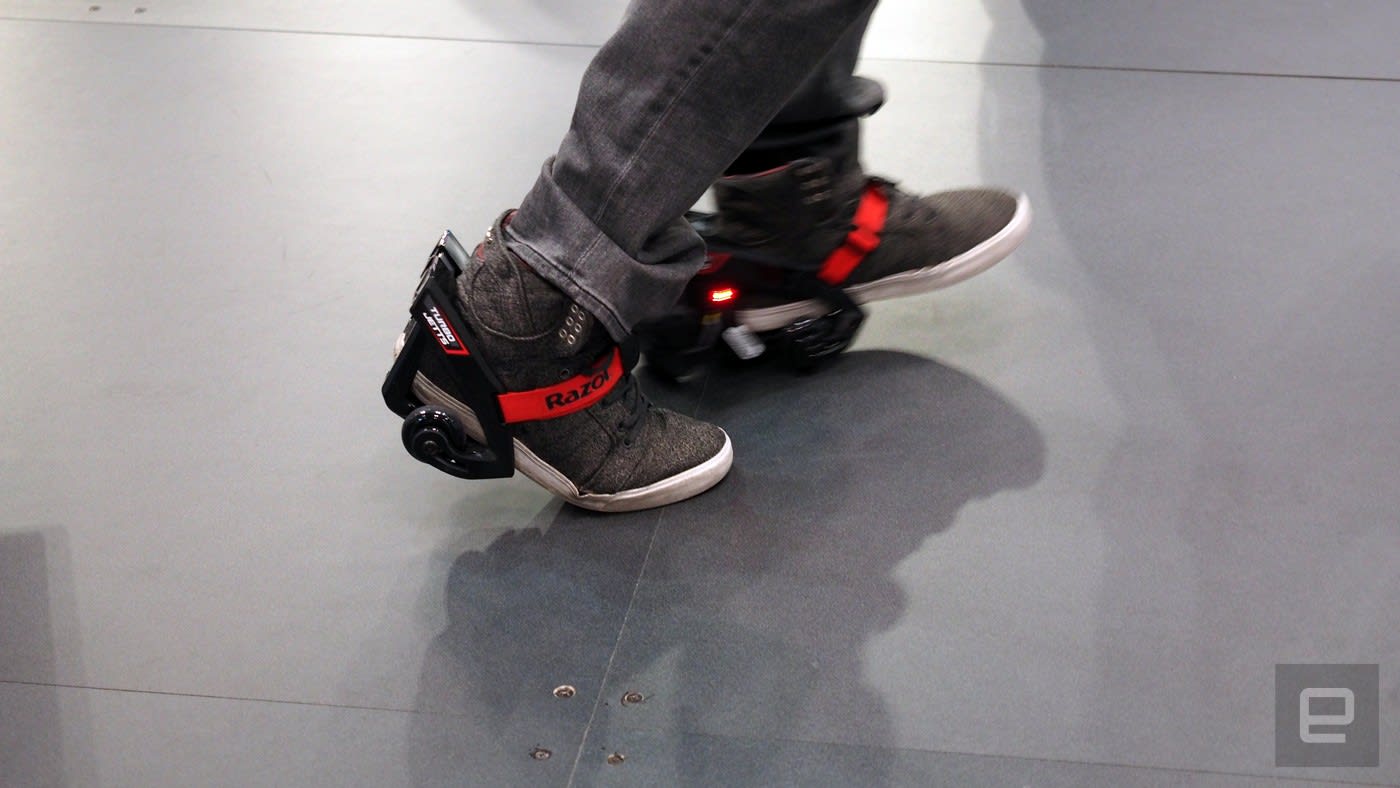
Anyone who’s ever worn a pair of Heelys will find using the Turbo Jetts second nature; it’s just a matter of pointing your toes up and letting the skates carry you forward at speeds of about 10 mph. The motor activates when the skate comes in contact with the ground, though I personally had trouble getting it going consistently.
Part of the problem is that I’ve never used Heelys or anything similar. I found myself treating the Turbo Jetts like regular roller skates a lot, as it was hard to overcome that muscle memory. It’s not going to work if you do that. After pushing off from the non-dominant foot, you really need to lean back and just let the powered skate pull you forward, keeping the non-powered skate in the rear. Though the bulk of the skates made it unlikely I’d fall backwards, I still couldn’t shake the sense I was going to fall on my butt. The need to keep one skate in front will at least keep you from falling flat on your face, but I did end up performing a few unwanted splits.
Even after struggling with the Turbo Jetts and taking a few spills at Toy Fair, I wasn’t ready to give them up. Luckily, I don’t have long to wait for my own pair — they’re available now for $130, both online and at Toys ‘R’ Us stores.
Check out the rest of our coverage from Toy Fair 2018 here.
Apple updates all of its operating systems to fix app-crashing bug
It took a few days, but Apple already has a fix out for a bug that caused crashes on each of its platforms. The company pushed new versions of iOS, macOS and watchOS to fix the issue, which was caused when someone pasted in or received a single Indian-language character in select communications apps and Apple software like Note, Safari and the app store.
Using a specific character in the Telugu language native to India was enough to crash a variety of chat apps, including iMessage, WhatsApp, Twitter, Facebook Messenger, Gmail and Outlook, though Telegram and Skype were seemingly immune. The issue was particularly troubling for iPhone users, as the affected apps would continue to crash even after reloading them, essentially shutting users out — only deleting the character using complex workarounds would liberate the app. Worse, it could even reportedly crash the entire iOS SpringBoard software that runs the home screen.
But since the issue also reportedly affected software like Safari and the App Store, Apple also included tvOS in its slew of mass updates. Per its security updates page, the following were pushed out today, which users should download if they want to avoid a stray character crashing their apps.
- The latest version of iOS is 11.2.6
- The latest version of macOS is 10.13.3
- The latest version of tvOS is 11.2.5
- The latest version of watchOS is 6.2.3
Source: Apple
 AIVAnet