


Snapchat Updating Friends and Discover Pages With ‘Tabs’ for Easier Navigation, Introduces GIPHY Support
Over the past few weeks Snapchat has been rolling out a major user interface overhaul to more and more users on its iOS and Android apps. Most users have responded negatively to the app redesign, which separates friends from brands so that users can focus on people they actually know, but condenses stories and text chats into one page.
Today, Snap Inc. announced an additional update to Friends and Discovery pages that should help make it easier for users to navigate between stories and chats.
On the Friends section of Snapchat, users will be able to cycle through tabs related to active stories, group chats, and “all” content. The Discovery section’s tabs will focus on separating publishers, creators, and the community. Snapchat said tabs will be launching fairly soon on iOS, and Android will follow in the coming weeks.
In addition to tabs, today Snapchat users will have many more GIF sticker options to choose from thanks to full support from GIPHY. Snapchat has partnered with GIPHY and greatly expanded its library of GIF stickers that users can discover and place into a story. Previously, the only GIF stickers available in Snapchat were in-house designed stickers that launched late in 2017.

Users can tap the sticker icon, type in the search field, and a new GIPHY section in results will showcase GIF stickers related to the search query. Like other stickers, GIF stickers can be scaled, rotated, pinned to a video story, and more than one can be added to a snap. Snapchat’s GIPHY support launches one month after Instagram announced a similar wide-scale support for GIF stickers in its own version of stories.
Tag: Snapchat
Discuss this article in our forums
UK National Grid plans superfast country-wide EV charging network
Range anxiety could soon be a thing of the past for electric vehicle drivers in the UK, as National Grid is proposing a network of superfast charging points that would mean 90 percent of motorists would always be within 50 miles of a charging station. The strategically-placed points would offer up to 350KW of power, drawn directly from the country’s high-voltage power grid, which is managed by the company, and could charge a car in between five and 12 minutes — much faster than the 20 to 40 minutes it currently takes.
The proposal covers 100 motorway-adjacent chargers, equating to around 35MW of electricity — enough to power 14,000 homes. According to National Grid estimates, the infrastructure required to get the fleet up and running would cost between £500 million and £1 billion, or just 60p per driver per year.
“If you overlay the motorway network over the electricity transmission network, there is a synergy,” says Graeme Cooper, project director for electric vehicles at National Grid. “We want to show that infrastructure needn’t be a barrier to EV growth and a structured and co-ordinated roll out of rapid chargers is achievable.”
We’ve seen other examples of companies pioneering EV charging across the UK before — Ecotricity has points at service stations around the country, while the government has made noises about installing charging points at petrol stations — but National Grid is the first to propose an offering that could make a meaningful difference to EV drivers. The company is currently in talks with the government about rolling out the program, and there’s no timescale involved yet, but as Cooper says, “It’s about doing it once and doing it right.”
Via: FT.com
Intruders ‘borrowed’ Tesla’s public cloud for cryptocurrency mining
Tesla isn’t immune to the plague of cryptocurrency mining hijacks, it seems. Security researchers at RedLock have reported that intruders gained access to Tesla’s Kubernetes console (where it deploys and manages containerized apps) without needing a password, exposing the EV brand’s login credentials for Amazon Web Services. From there, the attackers both abused Tesla’s cloud resources for cryptojacking and accessed private data held in Amazon’s S3 service. The culprits were creative, too.
While many of these mining attempts rely on a public mining pool, the perpetrators here installed mining pool software an d pointed a script to reach an ‘unlisted’ destination. The move made it harder to simply block the cryptojacking based on internet addresses. The intruders also masked the address of their mining pool server through CloudFlare, and minimized processor use to avoid giving away its presence.
RedLock said it notified Tesla right away when it discovered the breach, and that the automaker has already patched the flaw. It’s not clear at this point what private data was involved, although this doesn’t necessarily mean customer data. We’ve asked Tesla for comment on the incident and will let you know if it can share more.
There doesn’t appear to have been much damage at first glance, but the intrusion continues a recent trend of companies and even militaries leaving sensitive info relatively unprotected. RedLock pointed out that there have been “hundreds” of instances like this at other companies. While the solutions in these cases are sometimes straightforward, that they’re necessary at all suggests it’ll take a while before companies are diligent about preventing slip-ups like this.
Source: RedLock
Google Pay is the new Android Pay
Google recently admitted that Android Pay and Google Wallet probably didn’t need to exist as two different services. After a fictional, Highlander-style battle, it was Google Pay that emerged victorious, taking on a new name to define this united brand. And so today, Android Pay becomes Google Pay. The app still does everything you’d expect it to, though there’s a new Home tab that puts recent transactions, nearby stores and rewards in one place. The Cards tab, on the other hand, is more a catalog of your payment cards, gift cards, loyalty schemes and offers. Unexpectedly, Google Pay doesn’t actually include Google Wallet functionality, meaning you can’t use it to send or request money. Not yet, anyway.
For that, you still have to use Google Wallet, which is now called Google Pay Send to keep it on-brand, if a bit awkwardly. The services won’t be split for too much longer, though, as people in the US and UK will be able to send and request cash through the actual Google Pay app “within the next few months.” So, beyond the new naming scheme and Android Pay redesign, not a great deal is changing on day one. But soon enough, you’ll start to see the brand name appearing in more apps and on more sites, as well as a Google Pay checkout option popping up in new places like Chrome and the Assistant.
Source: Google
Nuance Discontinues Swype Keyboard for iOS and Android
After over three years on the App Store, developer Nuance has decided to discontinue the gesture-based Swype Keyboard apps for both iOS and Android devices. The company’s announcement of the iOS app’s discontinuation came earlier this month, but it’s only just begun to garner attention due to a confirmation of the Android app’s removal given to XDA Developers.
On Android, the company discontinued its Swype+Dragon for Android keyboard app, which combined Swype’s unique swipe-to-type feature with Dragon’s voice dictation. On iOS, it appears that one version of Dragon remains on the App Store in the United States, called Dragon Anywhere. Attempts to search for “Swype Keyboard,” however, do confirm the third-party keyboard app is gone from the App Store, with results surfacing rival company apps like SwiftKey.
According to Nuance, the company’s decision to shut down Swype was a “necessary” move, granting it the ability to focus on selling AI solutions in the enterprise market. Recently, Nuance has been working on voice dictation software for medical professionals, as well as placing it within vehicles.
Nuance will no longer be offering the Swype keyboard on iOS app store. We’re sorry to leave the direct-to-consumer keyboard business, but this change is necessary to allow us to concentrate on developing our AI solutions for sale directly to businesses.
We hope you enjoyed using Swype, we sure enjoyed working with the Swype community.
Although Swype is no more, users still have access to third-party iOS keyboard apps like Gboard, SwiftKey, Fleksy, Grammarly, and more. In terms of functionality, SwiftKey is the app that aligns most with Swype’s swipe-to-text abilities, letting users enter text one handed using the SwiftKey Flow feature.
 A current search for Swype on the iOS App Store
When Swype launched in the fall of 2014 alongside iOS 8, it was one of the few keyboard apps that did not require “full access” to the iPhone to function, limiting some of its feature sets but providing better user privacy.
iOS 8 updated iPhones and iPads with the ability to support third-party keyboards on a systemwide basis, and at the time Fleksy, SwiftKey, and Swype jumped to the top of the paid and free iOS App Store charts in multiple countries. Although Fleksy has had a rocky development history, Swype is the first of these initial keyboard apps to see its development discontinued completely.
Tags: Swype, Nuance
Discuss this article in our forums
Spotify Job Listings Say Company ‘On Its Way’ to Launch of First Physical Products, Hinting at HomePod Rival
Following an ad for a senior product manager last spring that hinted at Spotify’s interest in creating a hardware product, this week a collection of new job listings further suggest the launch of a physical Spotify product will be coming in the future (via Music Ally). The listings call for an Operations Manager: Hardware Product, Senior Product Manager: Hardware Production, and Project Manager: Hardware Production and Engineering.
According to the page for the Operations Manager, Spotify is “on its way” to developing and launching its “first physical products,” potentially hinting at an upcoming rival device to Apple’s HomePod. Although the job listing pages are not full confirmations of Spotify’s entry into the smart speaker market, in terms of physical hardware a speaker of some kind does make sense for the music streaming company. The “connected hardware” could also refer to devices like wireless headphones and other music-based products.
A Spotify speaker would enter the market as a competitor to products like Apple’s HomePod, which as of now can play Spotify but lacks deep integration with the service and instead favors Apple Music. Spotify’s speaker could flip that and focus on the company’s own streaming customers, of which there is a large market of more than 140 million subscribers worldwide who could be interested in a Spotify-focused speaker.
The person who gets hired for the position will help the company in setting up an operational organization for manufacturing, and build up the supply chain, sales, and marketing, all while working out of the company’s office in Stockholm. All three job listings state that the employee’s work will “impact the way the world experiences music.”
Spotify is on its way to creating its first physical products and setting up an operational organisation for manufacturing, supply chain, sales & marketing.
We are looking for a passionate and seasoned Operations Manager that will contribute in the creation of innovative Spotify experiences via connected hardware. You will define and manage Distribution, Supply, Logistics, fulfillment and Customer Service for Hardware Products. You will also work with partners to deliver the optimal Spotify experience to millions of users. Above all, your work will impact the way the world experiences music.
As the rivalry between Apple Music and Spotify has grown since the former service’s mid-2015 launch, Apple Music is now forecasted to overtake Spotify in paid subscriber numbers in the United States as soon as this summer. That prediction came from The Wall Street Journal earlier in the month, in a report that stated Apple Music’s monthly growth rates have been exceeding Spotify’s by about three percentage points. In terms of worldwide numbers, Spotify still has about 70 million paid subscribers compared to Apple Music’s 36 million.
Tag: Spotify
Discuss this article in our forums
Apple TV 4K With 64GB is Back in Stock After Extended Shipping Delays
Apple TV 4K models with 64GB of storage are finally back in stock following months of shipping delays for the larger capacity model.
64GB configurations are currently estimated for delivery in 1-2 days in the United States and several other countries on Apple’s online store, while same-day pickup is now available at dozens of Apple’s retail stores.
Back in November, shipping estimates for the 64GB model fell back to 4-5 weeks. The estimate began to shrink gradually in January and has now improved enough for next-day delivery to be a possibility again as of this week.
Apple never provided a reason for the shipping delays, but it may have been due to a recent shortage in the NAND flash storage market.
Apple TV 4K was released last September in 32GB and 64GB sizes for $179 and $199 respectively in the United States. Apple recently began selling refurbished units for $30 off in the United States, a roughly 15 percent discount.
Related Roundup: Apple TVBuyer’s Guide: Apple TV (Buy Now)
Discuss this article in our forums
Honor 9 Lite review: Making a strong case to be the budget king

On balance, this is one of the finest budget phones around right now.
The quick take
Finally, a budget Honor phone that just about ticks every box. Previous offerings have usually been very good phones, but the omission of NFC, in particular, made them hard to recommend since it blocked off access to Google Pay.
The Honor 9 Lite isn’t exactly a trimmed down version of the Honor 9, with a tall aspect ratio display and four cameras. And unless you want more internal storage or a larger screen, the Honor 9 Lite is probably a better buy than the Honor 7X. At £199 in the UK, with hardware this good and Android 8.0 Oreo, this is arguably the budget phone to get right now.
The Good
- Excellent price
- Nice-looking display
- Decent battery life
- NFC so you can use Android Pay
- Android 8.0 Oreo
The Bad
- Micro-USB not USB-C
- Fingerprint magnet
- No wireless charging
- It slides off EVERYTHING
See at Honor
Honor 9 Lite Full review

High-end phones are exciting, but they’re also utterly predictable. Every year, the most expensive smartphones cram in more features, advanced cameras, better displays, more storage and so on. The cycle is never-ending.
Where smartphones are really exciting, at least to me, is in the budget sector. There’s no race to the bottom, but there is a race to see who can pack the most into a phone for less money. And the Honor 9 Lite has mostly cracked it.
Honor phones aren’t usually the top-tier price bracket, which is one of the things that attracts people to the brand the most. The ‘other’ name to come from the Huawei factories makes great phones, and in the case of the Honor 9 Lite, is one of the absolute best budget smartphones money can buy — if it’s available in your country.
About this review
I (Richard Devine) am writing this review after a week of using a UK Honor 9 Lite provided by Honor for testing purposes. Throughout the course of the review, the phone remained on Android 8.0 Oreo beneath EMUI 8.0.
Honor 9 Lite Hardware

| Operating System | EMUI 8.0 / Android 8.0 |
| Processor | Kirin 659 |
| RAM | 3GB |
| Storage | 32GBExpandable via microSD card |
| Display | 5.65-inch 2160 x 108018:9 aspect ratio2.5D curved glass |
| Main Camera | 13MP and 2MP dual-cameras |
| Front Camera | 13MP and 2MP dual-cameras |
| SIM Card | Dual SIM or nanoSIM + microSD |
| Battery | 3000mAh |
| Colors | Sapphire Blue, Midnight Black, and Glacier Gray |
| Ports | Micro USB, 3.5mm headphone jack |
| NFC | Yes |
| Fingerprint scanner | Yes |
| Price | £199 |
The Honor 9 Lite isn’t just a low-rent Honor 9 as the name might lead you to think. It’s also a curious title to give to a phone launching this long after the Honor 9. There is, however, one striking similarity: the shiny back.
Honor makes some of the most aesthetically pleasing smartphones on the market and the Honor 9 Lite carries its namesakes handsomeness with that ridiculously shiny, stunning sapphire blue back cover. Other colors are available, but the blue is the one to get. It looks incredible.

The trade-off is that while it looks so good, it’ll only do so as long as you keep it clean. If ever a phone was designed to show off your lovely fingerprints, it’s this one. You don’t ever need to worry about firing up the front camera if you need a mirror. Thankfully, the blue portions on the front are, well, normal. The other trade-off is that it’ll slide off any table you put it on.
The color envelopes the entire phone save for the camera cutouts, and the Honor logo squeezed on the front. Often, a manufacturer logo on the front of a phone is part of a huge bezel, but not so here. The Honor 9 Lite has a 5.65-inch, 2160 x 1080 FHD+ display at 18:9 aspect ratio. Or as Honor calls it, FullView. I’m not personally sold yet on these type of displays, but on a phone this size it makes total sense.

The Honor 9 Lite is a very light, compact phone, but one that still has a large display. It’s a similar story to the LG G6. This phone is only a smidge taller and wider than the Pixel 2, but with much more display to use. You’ll still need giant hands to successfully one-hand the whole thing, but you don’t need giant pockets to put it in (and you can at least swipe the fingerprint scanner to drop the notifications tray).
The fingerprint scanner is suitably brilliant, being a Huawei-made phone. Since the Ascend Mate 7, Huawei has packed some of the fastest, most accurate fingerprint sensors into its phones, and it’s no exception here.
The fingerprint scanner is suitably brilliant
You’ve also got a raft of additional features linked to it, such as the afore mentioned notification tray access, but you can also hold it to answer a call and use it as the shutter button in the camera app, for stopping alarms and to browse through your photos in the gallery app.
These little touches make interacting with some important aspects of the Honor 9 Lite much more enjoyable with one hand without needing to explicitly use the one-handed UI mode.

Speaking of the display, it’s very nice. The default color mode pops and has both vivid colors and fairly deep blacks. You get a built-in “eye comfort” mode which will warm everything up at a schedule of your choosing, and a “smart” resolution feature that’s designed to change the screen resolution to help you save power. I’m not convinced it makes much difference, but it’s there and you can use it. You might find more life from it than I do.
The display itself is top-notch but the front is still a little too reflective, which makes looking at something other than your own reflection a little tough in any lighting.
And ending the hardware tour on a song: The Honor 9 Lite has NFC. That sound is the angels singing. The Honor 7X and Honor 6A that came in 2017 (and the former of which is more expensive than this phone) do not have NFC so you can’t use Google Pay. Being able to pay for things with your phone shouldn’t be a premium feature, and finally, Honor saw the light.
Now all we need is for the budget sector to embrace USB-C.
Honor 9 Lite Software

In years past, we’d review a phone made by Huawei and have great things to say about the hardware, and then we’d get to the software and be banging our heads on a desk. Those days aren’t missed.
It’s still entirely true that EMUI will split opinions, especially among Android purists. It’s still bright and bold, the menu system is blindingly white and by default, there’s no app drawer out front. But you can add an app drawer in settings and there are a bunch of themes you can download from the Play Store to change everything else. I found one that mixes neon app icons with a dark theme throughout the phone’s UI, and it’s much nicer.
Honor has jumped to Android Oreo so you’re not starting out with one leg in the past.
The truth is also that EMUI just performs a lot better than it once did. The “WTF” moments are few and far between and it’s just plain fast. The Honor 9 Lite is running the latest EMUI 8.0 on top of Android 8.0 Oreo, which even though we’d expect on any new phone, is still pleasantly surprising on a budget model.
There are still parts of EMUI on this phone that could be better, and you still get a nagging notification at times that an app is running in the background. Android is OK with apps running in the background, go away.
EMUI as a whole isn’t massively changed in its latest form from other phones like the Honor 7X or even the Honor 6A, both of which were mostly the same as the Honor 9. Refinement is the key, and at least with the Honor 9 Lite you’re getting Oreo as well.
Honor 9 Lite Camera

Why have two cameras on your phone when you can have four? The Honor 9 Lite packs a pair of sensors on both sides of the phone, and in both cases the same 13MP + 2MP arrangement. Why is this important? Mostly because it allows the front facing camera to shoot in portrait mode, with Honor opting for a hardware solution to the problem.
The camera app is the same as you’d find on other Honor or Huawei phones, which is a very good thing because it is packed to the rafters with features. Moving photos, HDR, manual photo and video modes, light painting, filters, time lapse and ‘variable aperture’ are all present and correct. If you like to have control, you get plenty of it with the Honor 9 Lite.
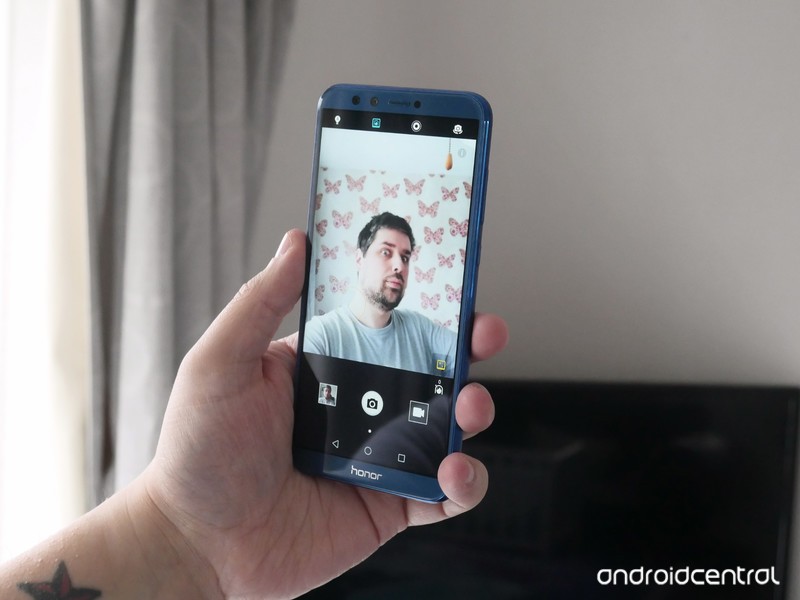
While portrait mode adds the bokeh effect to your pictures of peoples faces, the variable aperture feature allows the same thing for any photo and naturally, you have control over it, but it also allows you to shift the focus point of your photos after the fact.
There’s a selection of samples below along with just regular, every day shots, but there’s one thing I feel needs pointing out about the portrait mode: It isn’t very intuitive to use. On the Pixel 2, for example, you select portrait mode, take a photo, and you’re done. On the Honor 9 Lite you have to select portrait mode, then you have to realize you have to manually enable the bokeh effects. And adjust the “beauty” filters on the front camera because they’re all bundled together.
Portrait mode on left, no portrait mode on the right.
Did I try portrait mode a number of times, thinking it was pretty poor before I realized you had to tap on the screen to turn the bokeh on? Yes, yes I did. Why isn’t it just on? That’s the whole point of portrait mode.
The portrait mode effects are pretty consistent, but even though the Honor 9 Lite uses hardware not software, it doesn’t quite nail the edges of the subject. It’ll detect the face just fine but if you look closely around the edges of the subject, there’s some definite fuzziness.





I’ll leave you to make up your own mind on the quality, but for a £199 phone, I’m pretty happy. It isn’t going to challenge the very best phones from Huawei or anyone else, but for the most part it’s a strong enough shooter, though it does seem to struggle to get the exposure right sometimes. Hardware solutions for portrait mode means consistency and a solid result from both the front and rear cameras. Detail and color reproduction are pretty good and I particularly like the ultra snapshot feature.
As the father of two young kids, being able to double-press the volume down button to instantly launch the camera and take a photo in under a second is sometimes the difference between catching a moment and missing it entirely.
Honor 9 Lite Battery life

It’s no longer remarkable in any way that you can get through a full day comfortably on a single charge. It’s also not particularly shocking that you can go a decent chunk into the following day. I’d probably still recommend charging this phone at night, but you can happily hammer its 3000mAh battery all day and not have to worry about needing a charger before you go home.
Honor says the 9 Lite has “fifth generation smart battery saving technology” which sounds impressive. As I mentioned earlier, you still get an unnecessary notification from time to time of things running in the background, but whatever the techy reasons behind it, you’re getting good life from the Honor 9 Lite.
If you do want to try and squeeze as much life from it as you can, there’s not only a battery saver mode but an ultra battery saver mode, and a whole bunch of “optimizations” you can make to extend your battery life. Honestly, it’s 3000mAh, it’s plenty big enough. Just leave it alone, enjoy your phone and charge it when you go to bed.
Honor 9 Lite Bottom line
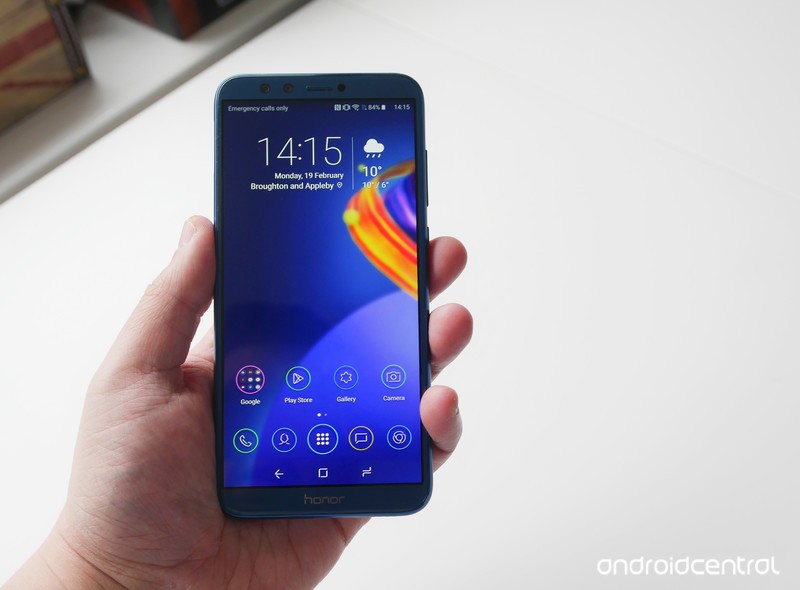
Is this the best phone you can buy for £199 right now? There’s a strong case to say yes. What you get in the Honor 9 Lite is a hardware experience comparable to more expensive, ‘flagship-class’ phones at a much lower price with a smooth, fast software experience and a strong camera wrapped up in a premium looking body. And I’m easily convinced that Honor’s Sapphire Blue is one of the best looking colors ever to grace a smartphone.
At £199 this phone might be untouchable right now
EMUI is still far from perfect, but in the Honor 9 Lite at least it comes atop Android 8.0 Oreo, so you’re not starting out with one leg in the past. And there’s no jankyness to speak of, which never used to be the case.
Quad-cameras may at first sound like a gimmick and something to look good on the box, but what it offers is that ever more important portrait mode through hardware. This means it’s reliable, produces a good quality effect and isn’t reliant on how good Huawei’s software boffins are at coding the effects.
What you get in the Honor 9 Lite is a very good phone for any price point. For £199, it’s perhaps untouchable right now.
See at Honor
The Galaxy S9 looks identical to the S8 because we’ve reached peak smartphone design

Flat, buttonless, and glass. Is this what we have asked for or the best Samsung can do?
We’ll soon be seeing the Galaxy S9 on a stage in Spain, surrounded by words like “thin” and “stylish” or “ergonomic” and “organic” or any of a long list of the regular buzzwords we always hear. And if the early looks we’ve seen from leaked press materials are correct (and come on, they are) those words are true. But we didn’t really need any leaks to know how the S9 will look overall — very thin with rounded corners, glass front and back, symmetrical in every way and a beveled edge with some fancy name to describe its geometry.
I can’t dismiss how a phone looks because a lot of people really care about it. Enough for Samsung to listen to them.
I’m the sort of person who isn’t very concerned with how my phone looks. I want to be able to use it with one hand, carry it without feeling it in my pocket, and have it do the things I need it to do without any fanfare or unnecessary fluff to get in my way. I’m pretty sure some people are the same and are only concerned with what a phone can do for them regardless how it looks on the outside. Unless it’s hideous or uncomfortable, we’re good with it.
But I have to judge how a phone looks for those people who care because that’s part of this job and people who are into how a phone looks deserve the same attention from me as people who think like I do. So I’ve been thinking: the Galaxy S9 looks a lot like the Galaxy S8, which looked a lot like the Galaxy S7 and the Galaxy S6.

Of course, there will be differences with camera lenses or fingerprint scanners and other small details. And where it counts — what the phone can do for all of us — we’ll see some of Samsung’s awesome and/or horrible ideas come into play. The Galaxy S9 will be an improvement over the Galaxy S8 even if it doesn’t look like it is. But when it comes to the design, we know what to expect, and that isn’t an accident. Samsung has decided this is the look it wants Galaxy phones to have, either because it can’t come up with a better design or, more likely, we don’t want anything else.
I’m leaning towards the latter here. Samsung can and would make a phone in the shape of a race car if it thought it would sell well. Tear away any ideas about design or innovation and you’ll find Samsung is like every other company making phones and really only wants to sell as many of them as it can because that’s what companies who stay in business do. We drive every decision Samsung makes. We have told Samsung we are finally happy with the way a smartphone is shaped and how it looks and that we’ll buy 50+ million of them if it makes them.
This isn’t only a Samsung thing. Look at Apple’s iPhone and you’ll see a very similar design. Same with Google’s Pixel or LG’s V30. Flat. Buttonless. Glass. I just look to Samsung because they are what drives the industry in you prefer an Android phone and they have been listening to feedback since the days of the Galaxy S II (remember when Roman Numerals were a thing?) morphed into the nature-inspired Galaxy S III and it was so popular the company was unable to make them fast enough.
The Galaxy S9 will probably set another new sales record, and that’s a look Samsung loves.
The Galaxy S9 looks like it will be a well-designed phone. It will be ergonomic and not dig into our hands or pockets because of squared corners or edges and the small changes from last year’s model will make it easier to use. It’s a good thing because it’s what we asked for not because Samsung can’t think of anything different or better. And Samsung will sell millions and millions of them.
Samsung Galaxy S9 and S9+
- Latest Galaxy S9 rumors and info!
- Samsung Galaxy S9 launch event set for Feb 25: ‘The camera. Reimagined.’
- The Galaxy A8+ gives us an early look at Galaxy S9 design cues
- Do you plan on getting the Samsung Galaxy S9?
- Join our Galaxy S9 forums
The Morning After: Mars 5K
Hey, good morning! You look fabulous.
This morning we’re serving up Apple updates, some information on Elon Musk’s next big tunnel plan and a check-in on a very long Martian road trip.
Small, but big.The Big Picture: A trapped atom is visible to the naked eye

This photo, Single Atom in an Ion Trap, just won the grand prize in the UK’s Engineering and Physical Sciences Research Council (EPSRC) science photo and imaging contest.
Get ’em while they’re hot.Apple updates all of its operating systems to fix app-crashing bug

Remember that single character message that’s capable of crashing chat apps on Apple devices? As promised, updates are now available for macOS, iOS, tvOS and watchOS that fix the issue and allow you to communicate using Telegu (a language native to India) in peace.
Not so boring this time.Elon Musk gets Hyperloop digging permit in Washington, DC
It’s preliminary, but this time he has it in writing.
Ages eight and up.Air Hogs’ Supernova packs motion controls in a kid-friendly drone

At this week’s Toy Fair, Spin Master is debuting its first motion-controlled Air Hogs model, the $40 Supernova. It’s not quite DJI’s Mavic Air, but it still has some sweet moves to show off in a kid-friendly form factor.
And revealed it before a fix is available.Google found another bug in Microsoft’s Edge browser

Google’s Project Zero team found a bug that would let hackers bypass the Edge browser’s security features and place malicious code within the memory of the target computer. It notified Microsoft of the issue 90 days ago and, following its policy, has now made its finding public. The only problem? Microsoft hasn’t put out a patch to fix the problem yet.
But wait, there’s more…
- The WyzeCam gets a smarter sequel that still costs only $20
- Samsung Galaxy S9 Plus dual cameras detailed in latest leaks
- What’s on TV: ‘Thor: Ragnarok,’ ‘Metal Gear’ and ‘Walking Dead’
- Hasbro’s first HasLab toy is a replica of Jabba the Hutt’s barge
- A new form of light could power next-gen quantum computers
- NASA’s Opportunity rover sees its 5,000th day on Mars
- Amazon backs Marie Curie biopic starring Rosamund Pike
The Morning After is a new daily newsletter from Engadget designed to help you fight off FOMO. Who knows what you’ll miss if you don’t Subscribe.
Craving even more? Like us on Facebook or Follow us on Twitter.
Have a suggestion on how we can improve The Morning After? Send us a note.
 AIVAnet