


Deal: Google Store offering $80 Project Fi credit with Pixel 2
Some Nexus owners are also getting 20% off promo codes.
Google’s Pixel 2 is still one of the best phones you can buy in early 2018, and if you’ve been holding off on picking one up, now may be the perfect time to do so.

Between February 15 and February 28, you can get a free $80 credit to use on Project Fi when buying a Pixel 2/2 XL through the Google Store. Google’s marketing this promo as “a month of Project Fi”, but that’s only assuming you use 6GB or more of data during a month. Project Fi costs $20/month for unlimited calls and texts and then $10 per GB of data that you use. Because of this, you could stretch that $80 credit out to cover multiple months of service if you’re conservative with your data usage.
This deal is only available to new Project Fi customers, but it’s not the only one worth keeping an eye out for. The Google Store recently started sending out emails to some folks offering 20% off the purchase of a Pixel 2 or Pixel 2 XL. The email contains a link that automatically applies said coupon to your order, and it’s being offered to “loyal Nexus owners.”
The criteria for this is unclear, but it appears that those still using a Nexus phone to this very day are the ones being granted this offer. If you’re one of the lucky ones, that 20% discount means you can get a Pixel 2 for just $519.20 and Pixel 2 XL for as little as $679.20.
You’ve got until February 28 for this promo, so be sure to keep an eagle eye on your inbox if you think this is something you qualify for.
See at Google Store
Google Pixel 2 and Pixel 2 XL
- Pixel 2 FAQ: Everything you need to know!
- Google Pixel 2 and 2 XL review: The new standard
- Google Pixel 2 specs
- Google Pixel 2 vs. Pixel 2 XL: What’s the difference?
- Join our Pixel 2 forums
Best Buy
Verizon
Google Store
Project Fi

USB-C audio: Everything you need to know

The port on the phone isn’t the only difference, but some things are the same as they have always been.
There’s a good chance the next phone you buy will support USB-C audio, even if it still has a “regular” 3.5mm headphone jack. That means we’ll soon be seeing more headphones that have a USB-C connector because that’s how this circle works — support a thing and companies will make the things. But there’s a lot of confusion about using a USB port for audio and what’s different than how we’ve been doing it for years. If you’re into electronics and love getting down and dirty you can take a look at the USB-C audio specification (direct download link) but for the rest of us here’s what you need to know.
New port, same parts

Audio of any type that can be played back on our phones needs to have a handful of specific parts to work. Moving from a 3.5 mm jack to a USB-C port doesn’t change that. Where those parts are, though, can change a lot.
You need a DAC (Digital to Analog Converter), an amplifier, and a speaker(s) to turn files into sounds on your phone. Speakers work by moving and creating a pressure wave that our eardrums pick up, and the moving parts use electromagnetism to do their thing. That pressure wave corresponds with whats called an analog signal and the variation of that signal is what creates different tones and sounds. In a nutshell, the signal waveform is what a speaker uses to vibrate, that vibration sends pressure waves to our eardrums, and they vibrate in time inside our head to make the sound. Biological magic aside, it really is that simple. If you look at an analog audio waveform and hear the sound, you can see how things line up.
Making a copy of a copy of the original audio is complicated and needs the right parts.
Files on our phone or files streamed through the internet are digital. That means they are a bunch of binary (a counting system that only uses zero and one) bits that are packed together so a computer can read them and know what to do with them. Yes, your phone is a computer! Digital files do not have any type of waveform that a speaker can use to create sound. We need something to convert them.
Complex algorithms are able to take recorded audio, which is in an analog format, convert it to a digital format like a .mp3 file for storing on a computer, and convert it back to analog when played. This data needs to be sent through the DAC for conversion to a proper waveform and then sent through an amplifier so that the waveform is made strong enough for headphones to use. There are some pretty cool things that scientists and engineers can do to “make” sound, but every phone and every portable audio player and every set of speakers need this process.
More: Does my phone have a DAC? Explaining DACs and Amps in smartphones today
A phone like the LG V30 has a very good DAC and a very good amp and a 3.5 mm headphone jack. An app plays the file, the DAC converts it to analog, the amp boosts the signal, and the 3.5mm headphone jack sends it out to whatever you have plugged in. Every phone with a 3.5 mm headphone port works exactly the same way, even those without the promise of a premium sound experience. A phone that uses the USB port for audio might not work this way, though.
A little more legroom

For an explanation, let’s turn to Bluetooth. You don’t need to physically connect Bluetooth headphones to anything, so things are built differently even if they are using the same parts. Your Bluetooth headphones have their own onboard DAC and amplifier. The digital file is sent from your phone and all the conversion is done on your head. At first, this can feel a little complicated but it’s not really. The same process is used and the only difference is where the components are. Now let’s get to USB.
There are two ways to send audio data through the USB port, and I’ll bet you can guess them: Analog and digital. Analog audio can be converted with an onboard DAC and amplifier inside your phone then sent out through the port to a passive set of headphones or an adapter. For this to work, the device needs to support whats called “audio accessory mode” and the headphones or adapter are just “dumb” connections that pass along the signal.
If you are using an active set of headphones or adapter, the audio signal being sent through the USB port is still in its digital form. That means the DAC and amplifier are inside of the headphones or the dongle, and the conversion is done there instead of the phone.
Buying USB-C headphones can be torturous; get advice from someone who has been there.
This can get messy. You need to make sure that you’re using the right “thing”. If you are using a passive adapter or headphones, your phone needs to support audio accessory mode and many don’t. The mess is because most dongles, adapters, and headphones aren’t labeled with how they are built and we don’t know if they are active or passive.
The Pixel 2 has an onboard DAC embedded in its Qualcomm Snapdragon 835 SoC, but audio accessory mode isn’t supported. That means you need a pair of active headphones or an active adapter, like the dongle that came with the phone. The HTC U11 and Essential Phone are the same, and the only phone I’ve heard (but am unable to test) that does support USB audio accessory mode was the LeEco Le Pro3. All phones should support an active adapter or headphones, though.
One more thing: Not all active USB audio products will work with all phones because manufacturers are able to use several new wires in the USB-C connection for extra features, like HTC did with the U11’s earbuds to provide active noise cancellation.
Before you buy any USB-C headphones or an adapter, find out where it works with your phone.
Is USB-C audio better?

Yes, but also no. The actual sound isn’t better just because the port has changed. As mentioned above, you still need to use the same components and manufacturers are free to choose from high-end gear or budget gear. USB-C doesn’t make anything better here, it just changes the connection.
But there are some benefits. The USB Type-C Specification 1.0 was released by the USB-IF (USB Implementers Forum) in 2014 along with the USB 3.1 specification. While not required, USB-C has plenty of tricks up its sleeve for the way it can communicate and connect. A USB-C port can support these things simultaneously:
- Audio accessory mode For passive audio or passthrough audio.
- Alternate mode This uses some of the wires in the USB connection for direct device-to-host transmission of alternate data protocols; as of 2016 this includes Thunderbolt, DisplayPort, Mobile High-Definition Link, and HDMI.
- Billboard Device Class This communicates to supply details of Alternate mode connections or to simply provide information about the connection or the device connected at either end.
- Audio Device Class 3 specification This sends analog or digital (or both) audio data through the port.
- USB Power Delivery This not only provides “fast charging” over USB, but it also supports DRP (Dual Role Power) to fast charge your phone and supply power to a connected device at the same time.
The USB Type-C specification doesn’t require these things, but they are supported. That means you can do a lot more with the USB-C port on your phone that listen to music or charge it if the company making it wants to include any of these extra modes. Some are great — HDMI or DisplayPort through the Alternate mode specifications means you can connect your phone to an AV Receiver for premium sound and mirror the screen. And charge it, and send data or charge another USB-C accessory with the right cable all at the same time.
Android, along with Chrome, Windows, macOS, and Linux all fully support the USB Type-C specification. While the audio won’t necessarily sound better because it’s using the USB-C port, there are a lot of cool things that can be done while we are listening.
It’s coming

Some phones line LG’s V series will likely support the 3.5 mm headphone jack for the immediate future. That’s great for people who have other audio gear that uses the old standards and want their phone to be a great sounding music player. But the move to USB-C for audio has happened, and eventually all portable (and possibly standalone) audio will use USB-C. That’s because it benefits the companies who make the products we love.
Omitting the headphone jack does two things for a company designing a phone. It gives them a little more space and saves them some money — two things designers love.
When you aren’t using a 3.5mm jack, you don’t have to make the phone as thick and have a few square centimeters of space on a circuit board to put other components. With AI and Machine Learning also being a thing, there are multitudes of tiny parts that need a home somewhere on a circuit board and now they have one. The headphone jack itself isn’t very expensive (though every penny counts), but if a company is not supporting any type of passive or passthrough audio connection over USB-C it doesn’t have to design, build, and solder in an amplifier for the signal. That can be a significant saving for the cost of making a phone from beginning to end.
Some of us will miss the 3.5mm jack. I know I will because I love my favorite headphones more than the phone or player they connect to. But benefits are there for users if companies choose to implement them, and smarter connections that are faster sound pretty awesome.
Qualcomm remains open to Broadcom buyout if offered more cash
When will this back and forth end?
Another day, another possibility that Qualcomm may eventually sell to Broadcom.
Reports of Broadcom being interested in acquiring Qualcomm first appeared in early November of 2017, but Qualcomm’s Board of Directors turned down the initial offering of $105 billion. Broadcom came back with a counter-offer of $121 billion, but even so, Qualcomm still refused to sell.

On February 16, 2018, Qualcomm’s Chairman of the Board, Paul Jacobs, sent a letter to Broadcom President and CEO, Hock Tan, that essentially says Qualcomm remains open to a buyout if Broadcom is willing to offer more money.
The letter starts out with Jacobs saying:
I am writing on behalf of the Board of Directors of Qualcomm Incorporated. In our February 14 meeting, Broadcom reiterated that $82.00 per share is its best and final proposal. The Board remains unanimously of the view that this proposal materially undervalues Qualcomm and has an unacceptably high level of risk, and therefore is not in the best interests of Qualcomm stockholders.
However, this is later followed up with the most worrisome part of the letter:
Our Board is open to further discussions with Broadcom to see if a proposal that appropriately reflects the true value of Qualcomm shares, and ensures an appropriate level of deal certainty, can be obtained.
Will Broadcom keep offering Qualcomm cash until a deal goes through? That remains to be seen. Broadcom’s last offer of $121 billion was supposedly its final one, but it’s been awfully adamant about buying Qualcomm for a few months now. Jacobs does say in the letter that the Board is “highly confident in Qualcomm’s ability to deliver a superior near- and long-term value to its stockholders” if an agreement can’t be reached, but the sheer fact that Qualcomm isn’t completely turning Broadcom down leaves me worried that something could still happen between the two.
Once again, it continues to be a matter of wait and see.
Broadcom buying Qualcomm could grind innovation to a screeching halt
Intel is making gaming easier for people without graphics cards
Intel is making life a little easier for PC gamers on a budget. A new driver update for its 6th-gen Core processors and above will configure a game to your rig’s specs automatically. As PC World reports, this includes the “Kaby Lake G” processors on addition to Skylake. Finally, no more fiddling in the menus on your machine running integrated graphics to get a game to run above 20FPS. At least that’s the idea. It’s a lot like how NVIDIA’s GeForce Experience works for discrete graphics cards. The first games to benefit from this include Battlefield 1, Dota 2, Grand Theft Auto V, League of Legends and Overwatch. Sure, you’ll probably lose out on shadow detail and texture filtering, but at least you’ll be able to play, period.
Via: PC World
Source: Intel
Google removes ‘View Image’ button from image search
Say goodbye to the “View Image” link in Google Images. Google announced a few changes to its image search today, one of which being the removal of its option to check out an image without visiting the site that hosts it. It might be a bummer for some, but since it was a stipulation of Google’s settlement with Getty Images, it was only a matter of time before it happened. In a tweet, Google said today that the changes “are designed to strike a balance between serving user needs and publisher concerns, both stakeholders we value.”
Today we’re launching some changes on Google Images to help connect users and useful websites. This will include removing the View Image button. The Visit button remains, so users can see images in the context of the webpages they’re on. pic.twitter.com/n76KUj4ioD
— Google SearchLiaison (@searchliaison) February 15, 2018
The Search by Image button is also being removed. Reverse image search *still works* through the way most people use it, from the search bar of Google Images.
— Google SearchLiaison (@searchliaison) February 15, 2018
In 2016, Getty Images filed a complaint against Google to the European Union claiming that the company’s image search promoted piracy. Getty Images told Time that having easy access to high-resolution photos through Google Images means “there is little impetus to view the image on the original source site.” And Getty Images’ general counsel Yoko Miyashita said at the time, “Google’s behavior is adversely affecting not only our contributors, but the lives and livelihoods of artists around the world, present and future.”
Ultimately, Google Images is a way for people to discover information in cases where browsing images is a better experience than text. Having a single button that takes people to actionable information about the image is good for users, web publishers and copyright holders.
— Google SearchLiaison (@searchliaison) February 15, 2018
The two announced earlier this month that they had reached a deal. As part of the agreement, Google will obtain a multi-year license to use Getty’s photos in its products, but it had to agree to change a few aspects of its image search. One change was the removal of “View Image” and going forward, it will also make copyright attribution more noticeable. Google also announced today that it has taken away the “Search by Image” button as well, but it noted that reverse image search through the Google Image search bar still works.
“Ultimately, Google Images is a way for people to discover information in cases where browsing images is a better experience than text,” Google said. “Having a single button that takes people to actionable information about the image is good for users, web publishers and copyright holders.”
Source: Google
Apple Resumes Selling Belkin’s InvisiGlass Ultra Screen Protector for iPhone X Following Durability Improvements
Apple this week has begun selling an updated version of Belkin’s InvisiGlass Ultra screen protector for iPhone X on its website and at its retail stores, nearly two months after the original was recalled due to quality issues.
Belkin’s product page states that the screen protector is now 0.29mm thick, compared to 0.21mm for the original InvisiGlass Ultra. As such, the new version will hopefully prove to be more durable, after dozens of customers complained about the first iteration cracking way too easily during normal day-to-day usage.
Belkin halted sales of the original InvisiGlass Ultra in late December due to a wave of negative feedback, including several one-star customer reviews. At the time, a company spokesperson told MacRumors that it considers “product quality and consumer feedback” to be of “paramount importance.”
“We have been constantly testing this product since we released the first generation of it timed to iPhone X availability and things have evolved since you and I last spoke,” a Belkin spokesperson informed MacRumors. “We identified some improvements to be made in the next generation of this product.”
Apple and Belkin appear to have been providing refunds to customers who purchased the original InvisiGlass Ultra and found it to be defective, so we recommend contacting the companies if your screen protector easily cracked.
The new InvisiGlass Ultra remains $39.95 from Apple. The updated screen protector is still listed as “coming soon” on Belkin’s website.
(Thanks, Christian!)
Related Roundup: iPhone XTag: BelkinBuyer’s Guide: iPhone X (Buy Now)
Discuss this article in our forums
Apple’s Website Promotes ‘Closing Your Rings’ as Fun Way to Maintain Active Lifestyle With Apple Watch
Apple has added a new “Close Your Rings” page to its website that highlights how the Activity app works on Apple Watch.
The page details how Apple Watch users can close the Move ring by hitting their personal goal of active calories burned, close the Exercise ring by completing at least 30 minutes of activity, and close the Stand ring by getting up and moving around for at least one minute during 12 different hours in the day.
Three rings: Move, Exercise, Stand. One goal: Close them every day. It’s such a simple and fun way to live a healthier day that you’ll want to do it all the time. That’s the idea behind the Activity app on Apple Watch.
Apple also provides tips about how to use and customize certain fitness-related features of the Apple Watch, and highlights Achievements and Monthly Challenges that can be earned by closing the rings in the Activity app.

While the page doesn’t provide any brand new information, it should be useful for people who are considering purchasing the Apple Watch. Apple has been highlighting individual features on its website more often lately, including a new page that promotes augmented reality use cases powered by its ARKit platform.
Related Roundups: Apple Watch, watchOS 4Buyer’s Guide: Apple Watch (Neutral)
Discuss this article in our forums
Embedding a tweet could violate copyright
If you’ve ever embedded a tweet on your blog, that could be a copyright violation, according to a New York federal court ruling. Numerous sites, including Time, Yahoo (which is part of Oath, Engadget’s parent company), Vox and Breitbart published stories with an embedded tweet containing an image of NFL star Tom Brady. The tweet was posted by another party, but the photographer who took the photo accused the news sites of copyright infringement for embedding it. The judge agreed, saying their actions “violated plaintiff’s exclusive display right.”
Open internet advocate group Electronic Frontier Foundation (EFF) wrote that that effectively upends ten years of precedent from a 2007 Ninth Circuit ruling called “Perfect 10 v. Amazon.” In that case, the court ruled that the hosting entity is liable for copyrights, not the company or individual who embeds or links it. That’s because anyone links to the content might not know that it’s infringing, and can’t even be certain what the server will provide. You might embed one Facebook image, for instance, and then the user who is hosting it could edit the post and change it.
Have you ever embedded someone else’s tweet on your website? A judge just said that you could be liable for copyright infringement. https://t.co/Lgw3rTI55O
— EFF (@EFF) February 16, 2018
Don’t sue me, EFF
The judge apparently rejected the Ninth Circuit’s so-called server test, in part by describing embedding — something that’s easy to do on a modern CMS — as a highly technical process only done by “coders.” That means that publishers, rather than hosts, can be held liable.
“[When the] defendants caused the embedded Tweets to appear on their websites, their actions violated plaintiff’s exclusive display right,” ruled Judge Katherine Forrest. “The fact that the image was hosted on a server owned and operated by an unrelated third party (Twitter) does not shield them from this result.”
EFF notes that the ruling could apply to any inline embedded content, and not just tweets. As such, it could cause chaos, as the 2007 ruling “has been a foundation of the modern internet,” EFF’s Daniel Nazer wrote. There may be an appeal, however, which could see the ruling overturned. The EFF, for one hopes that the new judgement doesn’t stand. “If it did, it would threaten the ubiquitous practice of in-line linking that benefits millions of Internet users every day,” wrote Nazer.
Via: EFF
Source: Godman v. Breitbart
Officials probe first possible drone-related aircraft crash in the US
US authorities have started investigating what could be the first drone-related aircraft crash in the US, according to Bloomberg. Pilots have been reporting more and more drone sightings these past few years based on data from the FAA, but most of those incidents have been harmless. That might not be the case this time around. The pilot and student flying the helicopter that crashed in South Carolina on Wednesday told investigators they saw a small drone appear in front of them while practicing maneuvers 50 feet above the tree line.
To avoid a collision, the pilot reportedly took control back from the student and performed evasive maneuvers. Unfortunately, the helicopter’s tail hit a tree, causing the pilot to lose control and resulting in a crash landing. While the FAA didn’t confirm whether a drone played a part in the crash, Bloomberg says the National Transportation Safety Board is aware that a drone may have been involved and is investigating the case with that in mind.
The incident happened above a patch of undeveloped land and is nowhere near an airport where drones are prohibited. However, under the FAA’s “Special Rule for Model Aircraft,” operators are required to fly drones within visual line-of-sight and never near traditional aircraft. According to a study commissioned by the FAA, drones could cause more structural damage to planes than birds because they have metal parts.
While authorities have yet to confirm whether a drone was truly involved in the incident, some reports are saying that the pilot saw a white DJI Phantom quadcopter. The dronemaker said in a statement that it’s “trying to learn more about this incident” and that it “stands ready to assist investigators.” Due to the nature of the incident, it also stressed its role as an “industry leader in developing educational and technological solutions to help drone pilots steer clear of traditional aircraft.”
Source: Bloomberg
Hot Wheels’ new AR track turns toy racing into a warzone
Hot Wheels may be known for little die-cast cars, but celebrating its 50th birthday this year doesn’t mean it’s stuck in the past. The brand’s already given us AI-controlled racers and cars on virtual courses, but the one thing that’s gone largely untouched is its signature plastic track. This year, Hot Wheels mixes things up with Augmoto, which takes the classic racing set and throws augmented reality on top of it. Now, road hazards and collisions can now look as cool as they do in your head, and each race becomes a lot more strategic.
On a standard Hot Wheels track, cars are placed in a mechanical launcher and shot onto the track to zoom around until they either reach the end or just run out of kinetic energy. There’s not a lot of skill or strategy involved in winning a race; it ultimately it comes down to luck. Products like Hot Wheels AI and Mindracers tried to rectify this with virtual hazards to trip up your opponent, and Augmoto expands on that idea with an AR overlay.
Players control the race from an app but, unlike Hot Wheels AI, they aren’t driving the vehicle directly. Instead, they control the plastic course via a Bluetooth connection. From the app, players can recharge the car and switch the track it’s on, but they can’t control its speed or direction. Each racer has a tiny motor to make the wheels spin, with each charge good for around 40 laps before it runs out of juice. If the car starts to slow down, the player can make a pit stop, sending them back to the starting gate to charge for up to 30 seconds. That may not seem like a lot of time but, as each lap only takes two seconds to complete, your opponents gain a pretty big lead.
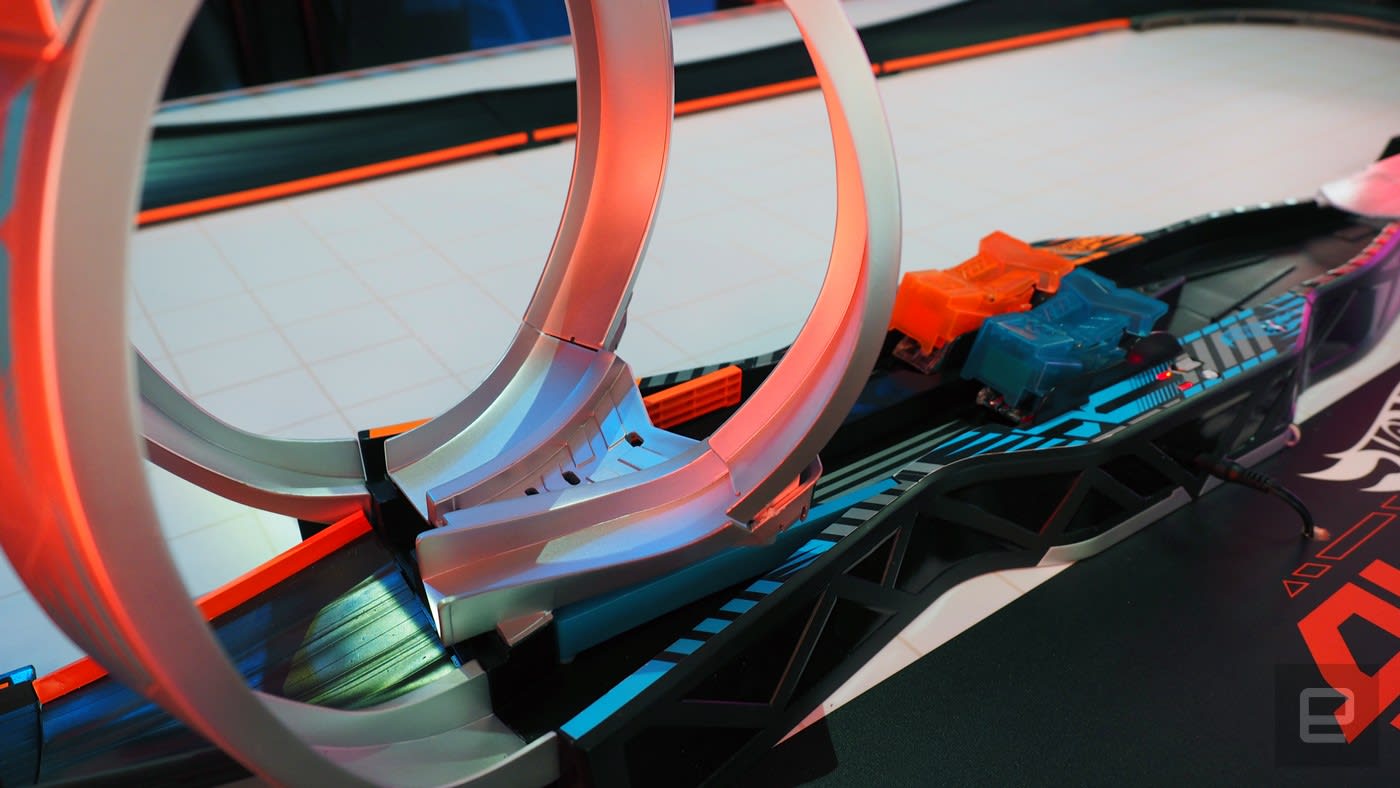
Aside from the pit stop area, the other key feature of the track is a pair of silver loops-the-loops. While they certainly look cool and it’s fun to watch cars go through them, they’re also important to the AR experience. If the player times it right they can switch their car to the loop — the switch is only open for a second, so it’s easy to miss your chance. If they succeed in making it through, the app grants them a virtual attack to use against their opponent.
The in-app rockets work a lot like the shells in Mario Kart, inflicting penalties like oil slicks and fires; in the real world this makes the starting gate hold the affected vehicle in place until the driver plays a related mini-game on their device. The games are very simple, usually asking the player to perform simple tasks like tapping the screen to put a fire out.
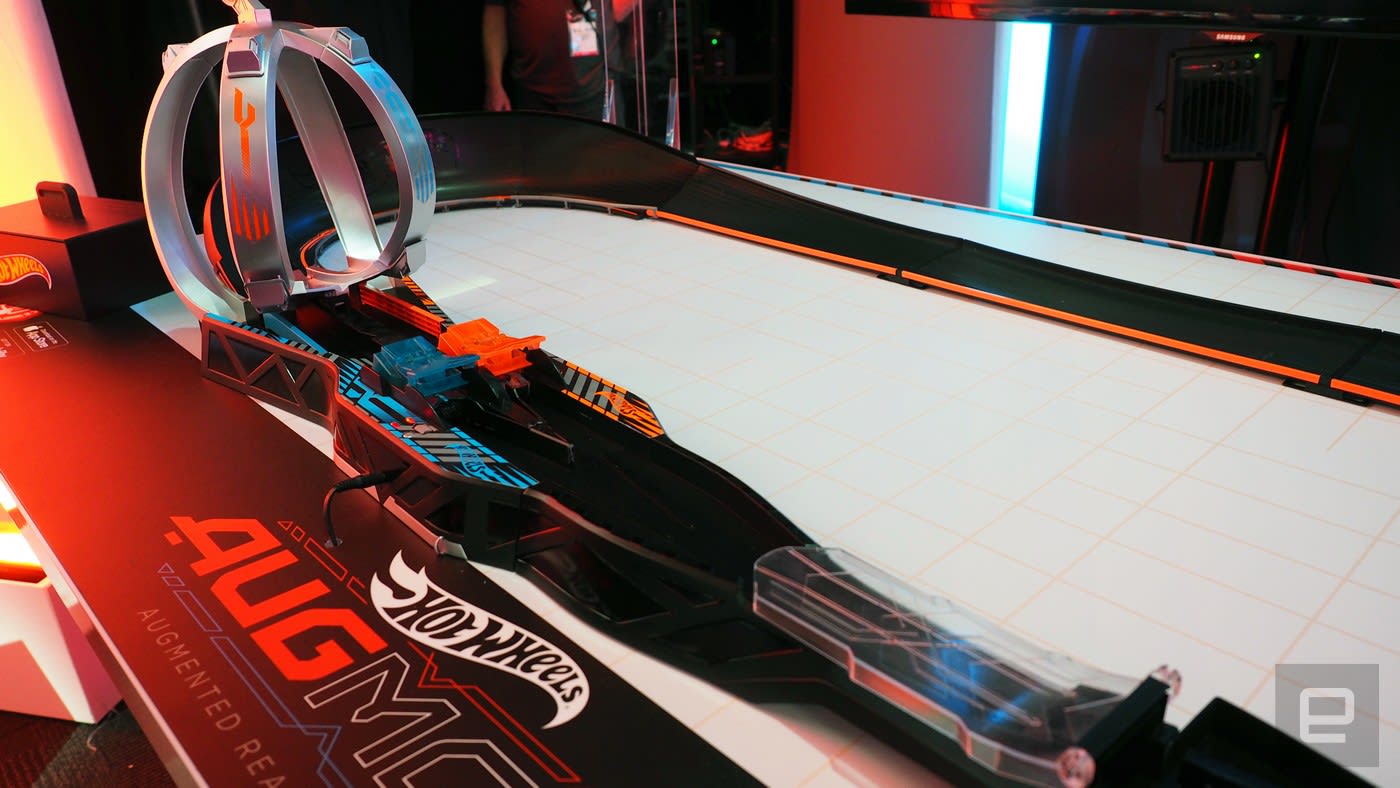
Virtual hazards aren’t the only ones a player has to deal with, though. Just like any other Hot Wheels track, there’s always a chance of the car flying off on its own. There’s also a section of the course where it narrows down to one lane — should both cars approach at the same time, one will be knocked off.
The app doesn’t keep constant tabs on the vehicles’ positions: There are no trackers inside the cars themselves and the players’ devices may not always be pointed at the course so it can’t track them with the camera. Instead, the app registers whenever the real car passes through the starting gate and removes the racer from the virtual track when it fails to complete a lap within a few seconds. To get back into the game, the car needs to be dropped back into the starting gate. The wheels will keep spinning even when the car falls off the track, so it’s best to grab it before the vehicle wanders off, or wastes too much energy.
The $200 basic set will include the plastic track and two cars; Hot Wheels will make more vehicles available after Augmoto’s launch this fall.
 AIVAnet