


Does the Nest Thermostat save you money on energy bills?
Yes. With your help.

There’s nothing magical about the Nest Thermostat. Not really, anyway. It’s a little computer bolted to your wall and connected to your home internet is all.
Metal. Plastic. Wires. Maybe some ball bearings or something. (Everything good has ball bearings. It’s a scientific fact.)
So magic? No. Able to save you money on your home energy bill? Most definitely.
I’ve used a Nest Thermostat for years. And the thing about it is this: It knows where you are. Or, more precisely, it knows where you’re not. A big part of the Nest experience (and not just the Thermostat, but across all of its products at this point) is the Home/Away Assist feature. Just like it sounds, the Nest Thermostat can tell when you’re home, and when you’re away. And it adjusts itself accordingly.
When I’m home, my Nest Thermostat gently adjusts itself to my specifications. I can set minimum and maximum temperatures depending on whether the heat is on, or the air conditioning is cranked. (And where I am in Florida, it’s not uncommon to have to flip between the two on a daily basis.) And in between those extremes, the Nest Thermostat starts to learn where I like the temperature to be when I want it to be there — and then it does the rest.
Let a Nest Thermostat shut things down when you’re not home and you’ll very quickly see its worth.
I’ve learned not to sweat the small stuff too much. If I’m a little hot, I turn the temperature down. If it’s a little cool, I’ll raise the heat a degree or two. If the Nest doesn’t happen to guess right 100 percent of the time, there’s a pretty good chance that I’m the problem. (At least I’m pretty sure that’s the case in 2018, when all of these damned gadgets are smarter than me in the first place.)
This sort of prediction can things in a more tolerable range while avoiding large swings and keeping the system on longer — which eats up a ton of energy.
But it’s when I’m “Away” that the Nest Thermostat really earns its keep. You could have it switch the system of “Off,” but that’s not all that smart. Better would be to give it a range in which to stay. That’s called “Eco” mode, and it ensures that my home doesn’t get too hot or too cold while everyone’s gone — but also that it’s not wasting electricity keeping it perfectly comfortable while there’s nobody home.

Consider: In the winter, Eco mode will let my house drop down to, say, 64 degrees when it recognizes there’s nobody home. (Those of you in the North are scoffing right now, but stay with me.) Pets won’t get too cold, but I also won’t have to heat it up too terribly much once we return. In the summer, I’ll let Eco mode get up to 78 degrees, and that way we don’t have to cool off too terribly much, but neither are we wasting the A/C on an empty house.
Here’s how Nest puts it:
Home/Away Assist uses your Nest products’ activity sensors and your phone’s location to tell when everyone has left your home. Your Nest Thermostat will wait a short while to make sure nobody’s coming back, then it will switch to Eco Temperatures. When someone returns home, your thermostat will automatically switch back to your regular temperature schedule.
That’s pretty basic stuff, right? It uses your phone’s location in combination with the sensors on Nest products (the thermostats, Nest Protect smoke detector, and Nest cameras) to tell when you’re at home. And then you’ve got minimums and maximums on temperature. But it’s that ability to tell when we’re home and when we’re not that’s made all the difference in the world. It means I don’t have to worry about manually turning off the thermostat when I’m leaving the house. (Because I will forget. A lot.)
After even just a few months of owning a Nest Thermostat — whether you’ve opted for the grandaddy Nest, or the less-expensive Nest E, that sort of savings quickly becomes evident. How much you’ll end up saving? Well, that’s up to you. It’s not magic.
See at Amazon
Nest
- Review
- News
- Specifications
- Discussion
Nest
Amazon
Apple
Best Buy
Home Depot
Lowes
Verizon Prepaid gets affordable $30/month plan and 3G mobile hotspot
Travel Pass for Mexico and Canada is also coming.
Although they may not come with as many amenities as traditional post-paid wireless plans, going the prepaid route is a great way to still get reliable service while saving those precious dollars. Verizon Prepaid is one of your best prepaid options if you rely on Verizon’s network, and starting February 20, it’s getting a few upgrades.

First off, Verizon is introducing a new $30/month plan for customers that want to spend as little as possible. You’ll get unlimited talking and texting in the U.S., but data is limited to 500 MB. That’s not a bad deal if you’re someone that uses Wi-Fi most of the time, but if you spend just $10 more, you can double your monthly data allotment to 1GB.
Verizon Prepaid Unlimited is the most expensive prepaid plan that Verizon sells at $75/month, and in addition to unlimited talk, text, and data, it now comes with 3G mobile hotspot support for free.
Lastly, Verizon’s Travel Pass is finally coming to prepaid customers. Similar to Verizon’s post-paid plans, prepaid subscribers can spend $5 for day passes so they can take their talk, texting, and data to Mexico and Canada.
As mentioned above, these changes will go into effect on Tuesday, February 20, 2018.
Best Verizon Wireless Deals of February 2018
Spotify Connect: What it is and why it’s awesome

I just want to play my music, and Spotify Connect lets me do that.
Spotify is one of the biggest names in music these days, and as such, Spotify has made deals with a vast number of products and platforms to ensure its users can easily play Spotify whenever and wherever they want. There are audio receivers, smart speakers, TVs, set top boxes, video game consoles that are Spotify-compatible, but how do you create a uniform playback experience across such a diverse product set?
You do it with a little luck, a little technological magic, and Spotify Connect.
Now, there are numerous protocols and standards for sending audio to a separate device. Sonos has theirs, Google has Cast, Apple has AirPlay, and other systems like car head units can have unique and temperamental protocols for sending and controlling music. Spotify Connect is the programming and interface that Spotify uses to bridge the gap between all of those separate controls and a single user interface.


Spotify Connect can see other Connect-enabled devices on its connected Wi-Fi network and offer them up to you under Devices Available in the Spotify playback window to listen on. You can start playing music on your phone, then use Connect to send the music to your Connect-enabled audio receiver. Want to send the music to your computer so you can keep listening while you work? Open Spotify’s desktop or web app, tap the Devices Available icon, and you can pull your currently playing queue from your phone or smart speaker to the computer’s speakers.
The following devices work with Spotify Connect:
- All Android phones and tablets running the Spotify app
- All iOS phones and tablets running the Spotify app
- Computers running the Spotify desktop app or web app
- Google Home and Chromecast products
- Sonos speakers (Spotify Premium required)
- PlayStation 4
- Xbox One
- Some Smart TVs by Samsung, Phillips, Sharp, and Sony
- Amazon Echo speakers
Find out which of your devices are compatible with Spotify Connect
The less awesome side of Spotify Connect
That said, Spotify Connect is not without drawbacks. It’s reliant upon all the devices being on the same Wi-Fi network, so if your house is big enough to need two routers, you could lose control of your music should your phone switch networks while moving from room to room. Spotify Connect is also somewhat hobbled for Spotify Free users, with many devices not working unless you’re a Spotify Premium member, including Sonos. On the note of Sonos, you have to enable Spotify’s control of Sonos speakers through the Sonos app through the Add Music Services menu.
Another small pitfall of Spotify Connect is that unlike a set protocol like Bluetooth or Google Cast, Spotify is a proprietary program and it can be removed from connected speakers and devices, which happened to some unlucky legacy speaker users when Spotify updated its Connect API. Spotify Connect is reliant not only upon Spotify’s continued updates but the continued updates by the device manufacturer, after all, so when choosing a Spotify-enabled device, choose a device that you expect long-term support from.

Whether you want to keep your jams going as you bounce from device to device or you just want to fill your home or car with music, Spotify Connect makes it as painless as possible. Has Spotify Connect helped you keep the music flowing, or has it thrown off your groove a time or two too many? Let us know!
Nokia 7+ gets revealed in first hands-on photo ahead of MWC 2018
This could be Nokia’s best Android phone yet.
During this year’s Mobile World Congress in Barcelona, HMD Global will be one of the companies announcing new products for its Nokia line of Android phones. One of the devices we see is expected to be the Nokia 7+, and shortly ahead of its official unveiling, a new hands-on picture gives us a clear look at it.

The picture shows the front of the Nokia 7+, and as you can see, this will be the first Nokia phone to adopt a modern design with slim bezels. The Nokia branding can be found near the top left next to the front-facing camera, and the fingerprint sensor will be moved to the back.
All of this lines up nicely with a leaked press render of the Nokia 7+ that we recently saw, and rumored specs for the phone include an FHD+ resolution for the screen, Snapdragon 660 processor, dual 12MP and 13MP cameras, microSD card support, and plenty more.
The Nokia 7+ will also be Nokia’s first Android One device, and unlike the Nokia 7 that was released exclusively in China last October, the Nokia 7+ should see a much wider availability.
Pricing details for the Nokia 7+ are still unknown, but we should get confirmation of that and much more in just a little over a week.
Android One Nokia 7+ with 18:9 display and dual-lens ZEISS camera surfaces
Rick and Morty is finally coming to PlayStation VR on April 10
Try to avoid playing with the Plumbus too much, and you’ll be fine.
One of the most popular PC VR games of 2017 is making its way to PlayStation VR on April 10, and in a big way. Rick and Morty: Virtual Rick-ality lets you play as a Morty clone whose job is to wander around and do the things Rick and Morty don’t have time to do. As long as you follow the rules and don’t poison yourself my mixing the wrong chemicals, you can even avoid dying most of the time! It’s a great puzzle game in a universe loved by millions, and now the game is coming to the most popular VR platform in the world today.

While it will be possible to buy the digital copy of Virtual Rick-ality and dive in, the physical box is going to be a special Collector’s Edition fans are going to want to own. This version of the game comes with:
- Rick Pop! Vinyl Figure
- 2-sided game poster
- Physical Disc
One important detail to keep in mind is the motion controllers. If you only have the standard PlayStation VR kit, you’re going to want to grab the PlayStation Move controllers to fully enjoy the game.
We don’t currently have pricing for the game yet, but this game has been available on HTC Vive and Oculus Rift for $30, so you can probably guess the standard version will run the same price while the collector box runs closer to $60. Either way, you’re getting a lot of game and some cool swag for a reasonable price.
PlayStation 4

- PS4 vs. PS4 Slim vs. PS4 Pro: Which should you buy?
- PlayStation VR Review
- Playing PS4 games through your phone is awesome
Amazon
Essential Phone now also available in Halo Gray with Alexa for $449
The absence of Alexa was definitely the problem.
On February 15, Essential launched the Essential Phone in three new colors – Ocean Depths, Stellar Gray, and Copper Black. Just one day later and seemingly out of nowhere, we have yet another color in the form of Halo Gray.

Halo Gray is most similar to Stellar Gray as they’re the only two versions of the Essential Phone with a matte finish on the back. This makes the Essential Phone look incredibly sleek, but unlike Stellar Gray’s black frame, Halo Gray has a silver, natural-colored frame.
Perhaps most peculiar is the fact that the Halo Gray Essential Phone is also the first variant to come with built-in Amazon Alexa. I don’t know if this is something current Essential Phone owners have been asking for, but nonetheless, it’s here for your pleasure or to ignore.
The Halo Gray Essential Phone will be sold exclusively through Amazon, and while pre-orders are open now, it’ll officially be released on February 21. I could care less about the Alexa integration, but Halo Gray does offer a nice proposition considering it looks nearly identical to the Stellar Gray version and costs $150 less.
Of all the Essential Phone’s new colors (Ocean Depths, Stellar Gray, Copper Black, and now Halo Gray), which is your favorite?
See at Amazon
Essential Phone
- Essential Phone review
- Essential Phone specs
- The latest Essential Phone news
- Join our Essential Phone forums!
Amazon
Best Buy
Sprint
Telus
Deal: Save $400 on Pixel 2 XL when activated on Verizon at Best Buy
The baby Pixel 2 need not apply.
We’ve seen quite a few deals on the Pixel 2 since its release last October, but a new one-day-only offer from Best Buy is one of the best yet.

As part of its President’s Day sale in the U.S., Best Buy is offering a $400 discount on the purchase of a Pixel 2 XL. You’ll need to activate the phone on Verizon in order to take advantage of this offer, but for those on Verizon or who have been thinking about switching, this is a great value.
You’ll get an instant $100 savings up-front and the remaining $300 is paid out over the course of 24 months as a $12.50/month credit. If you decide to take advantage of this deal, you’ll pay just $18.74/month for the Pixel 2 XL with 64GB of storage and $22.91/month for the 128GB model.
This sale is only available for today, February 16, 2018, so you’ll want to act on this one as fast as you can.
See at Best Buy
Google Pixel 2 and Pixel 2 XL
- Pixel 2 FAQ: Everything you need to know!
- Google Pixel 2 and 2 XL review: The new standard
- Google Pixel 2 specs
- Google Pixel 2 vs. Pixel 2 XL: What’s the difference?
- Join our Pixel 2 forums
Best Buy
Verizon
Google Store
Project Fi
US indicts 13 Russian nationals for alleged election tampering
Today, the office of special counsel Robert Mueller announced that a federal jury has indicted 13 Russian nationals on charges of conspiracy to commit wire and bank fraud, aggravated identity theft and conspiracy to defraud the US. The charges mean that these individuals are now officially wanted by the US government, though actual arrests may be hard to come by. “Defendant Internet Research Agency LLC is a Russian organization engaged in operations to interfere with elections and political processes,” says the indictment. “Beginning as early as 2014, [it] began operations to interfere with the US political system, including the 2016 US presidential election.”
The indictment alleges that the named individuals were involved in illegal use of social media platforms all in an effort to encourage political division and promote the campaign of Donald Trump. “US law bans foreign nationals from making certain expenditures or financial disbursements for the purpose of influencing federal elections,” says the indictment. “US law also bars agents of any foreign entity from engaging in political activities within the United States without first registering with the Attorney General. And US law requires certain foreign nationals seeking entry to the United States to obtain a visa by providing truthful and accurate information to the government.” The charges claim that the 13 Russian nationals violated those laws.
Developing…
Via: CNBC
Why sneakerheads are leaving eBay for Detroit startup StockX
Buying a pair of new rare sneakers is harder than reselling them on StockX. To buy new, the Yeezy or Jordan gods have to smile upon you, giving you that winning raffle ticket at a local store or letting you beat the bots online. To resell, all you have to do is go to the StockX website and set a price. You don’t take photos or haggle with potential buyers. Instead, you look at what price the shoes are selling for and list your pair at whatever amount you think someone will pay for them. Like a stock exchange, buyer and seller identities are kept from one another. StockX acts as a middleman, only releasing payment once it verifies that goods are authentic. It’s this simplicity that has helped the company earn so many loyal users.
StockX was founded in 2015 after Quicken Loans founder and CEO Dan Gilbert bought Campless — an online repository for sneaker sales data — from Josh Luber. As part of the purchase, Luber moved from his native Philadelphia to the Detroit metro area, taking up the mantle of StockX CEO and working from Gilbert’s One Campus Martius building downtown. In a little under three years, the company has become the go-to source for buying rare high-end shoes and streetwear.
Last October, after countless requests from customers, the website offered resellers and industry insiders a peek behind the curtain at its first ever StockX Day in Detroit. It gave some 200 people a chance to see the internet made real, talk to employees, see how the authentication process works and convene in real life. It brought people like Kevin Tran, who first heard of StockX from a YouTube pre-roll ad. He’s been using the site for about a year now, and between eBay and StockX, he can supplement his monthly income as a librarian by $1,500 on average. He thinks the selling fees are a little high but likes that StockX makes the process facile — especially now that he can resell Supreme streetwear there.
The day of a drop, eBay will be flooded with listings selling a $50 T-shirt for $80 to $100. Simply as a matter of course, people are going to make a purchase from someone who has 14,000 reviews versus someone who has zero. “That’s where StockX comes in and makes it that much easier for people to sell, whether you’re the new guy or you’re the 10-year vet of reselling,” Tran said.
For others, StockX’s trademark feature is that it guarantees authenticity.
“When it comes to selling a pair of Yeezys, people just have to trust the website,” Jeff Caruana, a project manager at a Chicago-based tech company, told me. He uses StockX exclusively because of how easy it is, and as of last fall, he’d bought and sold 10 pair of shoes on the site. It can take years of selling on eBay to build a good reputation, especially when you’re trying to sell sneakers that can cost as much as a month’s rent. “The value that StockX adds is at the end of the day I know I’m buying legit shoes. I’m not necessarily sure StockX would have a business if it wasn’t for all the fakes out there. People would just go to eBay or wherever else.”
Veteran reseller Fred Preston agreed. “I can have all the great feedback in the world, but if I sell one pair of fake sneakers … I’m going to be ruined, because now I’m known for selling fake merchandise,” he said. After a few years of selling shoes online in his free time, Preston dropped out of college his junior year to make it his career.
Twelve years later, his Florida-based Nonfiction Store makes high six figures selling shoes and clothing online. He estimated that 15 percent of his business comes from selling on StockX. Around half still comes from eBay, with reselling platforms Goat and Kixify rounding it out. All told, he moves between 300 and 350 pairs of shoes per month. He likes StockX because he doesn’t have to take pictures of everything he sells or write an item description. “It just makes everything simple.”
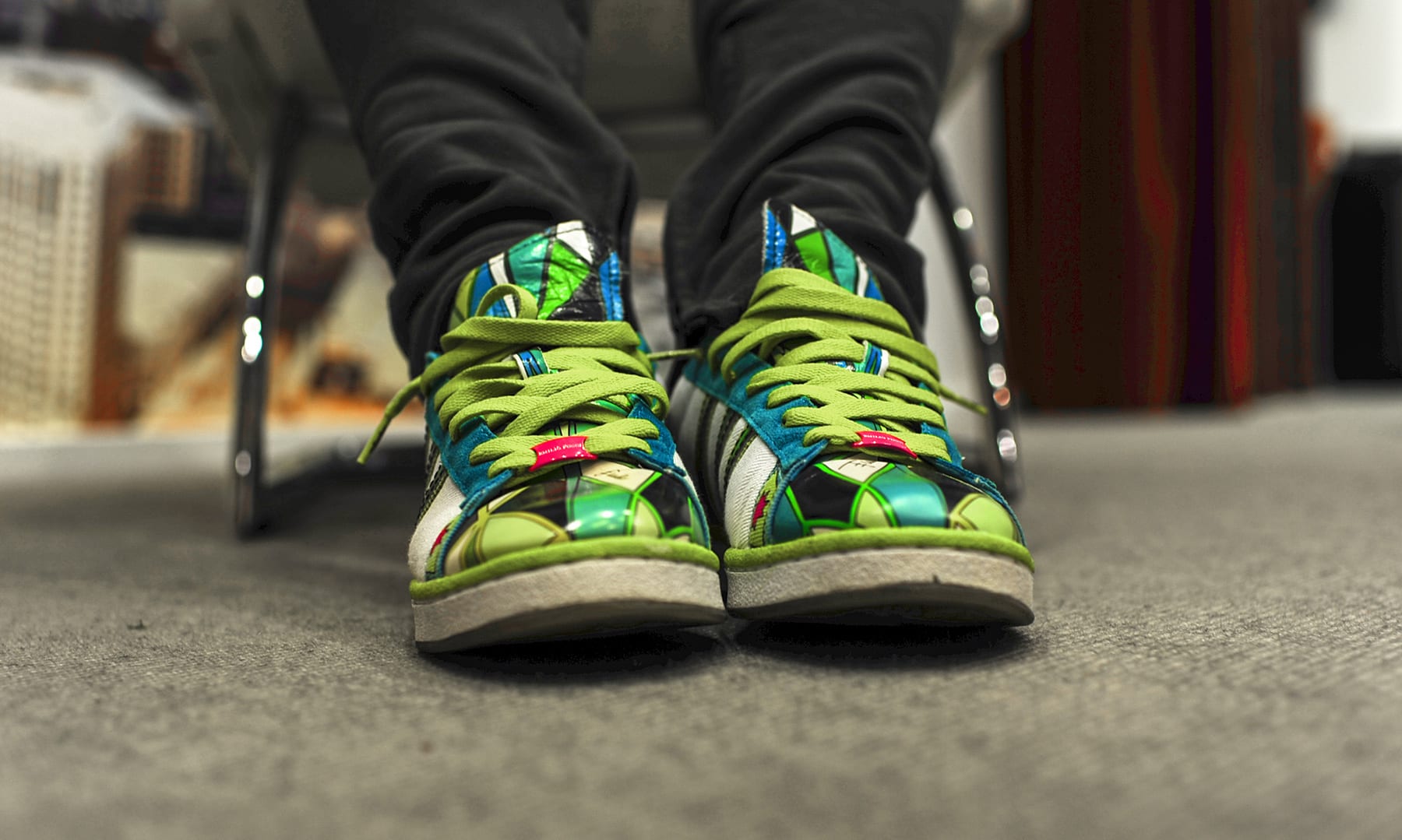
StockX CEO Josh Luber’s Adidas Century Low G3 Emilio Pucci.

CEO Josh Luber talks to the crowd at StockX Day.
The shoe market is incredibly volatile. Earlier last year, Nike flooded the market with Air Jordans and their values dropped precipitously, all but destroying the secondary market for certain models. Right now, the highest-value shoes are Yeezys from Adidas. During an extended question-and-answer session on StockX Day, a user asked Luber when the site would offer financing. Luber said the announcement was a few weeks away. “We’re gonna run that credit line up!” the seller responded excitedly.
StockX is the last of the big shoe resellers online to start offering financing. Every transaction on the site is tied to a credit card or PayPal account in some way as it is. But now Luber and Co. are offering financing to their customers through Affirm, a “no gimmick” payment service headed by PayPal founder Max Levchin. For orders over $50, financing is available at checkout for anywhere between three months and a year. Interest rates range from 10 percent to 30 percent APR depending on your credit history, and in some cases a down payment may be required.
“I think [credit] is going to change the game, maybe not in the best way.”
Some could look at a credit option from StockX as an investment opportunity and buy a dozen pair of Yeezys at $1,000 each. The dark side of this is that if Adidas wanted, it could pull a Nike and flood the market with Kanye West’s signature shoe line. It’d leave resellers who bought on credit hoping to make a quick buck in a massive lurch. In a way, that already happened last year when Adidas released Yeezy football cleats. They were massively hyped at first, and then the price dropped to the ground because, well, they’re football cleats.
“The Yeezy cleats were terrible,” Tran recalled. After the shoes didn’t move, people started using the upper material for custom pieces just so they could make some money back. Tran said that most of the time, buying something with Kanye’s name on it is a good gamble, but as with any investment, you have to take a calculated risk. “I think [credit] is going to change the game, maybe not in the best way,” Tran said.
While the audience was enthusiastic about the news, when I asked Luber about it after the room cleared, he didn’t seem excited by the prospect.
After all, StockX distinguishes itself from other resellers through an unwavering commitment to the buyers and sellers. That alone has built an incredibly loyal customer base. StockX will do practically anything to keep its customers happy, whether that’s sending discount codes in case a pair of shoes ships without a verification tag or guaranteeing that every shoe sold through the site is 100 percent authentic. Sure, you can argue that you shouldn’t invest money you can’t afford to lose, but 19-year-olds aren’t necessarily going to be the ones buying shares in Apple or GE. They will drop serious coin on sneakers or a high-end T-shirt though.
“It’s the same thing as giving a college freshman a credit card,” one sneaker industry veteran who wished to remain anonymous said. “They’re not gonna know what to do with it. They’re gonna mess their credit up for the rest of their life.”
Luber said he feels a responsibility to make sure kids aren’t going into crippling amounts of debt over sneakers. As he spoke, his face took on a pensive look, playing out in real time the classic startup conundrum of making decisions that are good for business rather than those that make you feel good. After a pause, he added that at the end of the day, StockX isn’t a financial adviser. “We debated this for a really long time,” he said. “And one of the concerns was that, but honestly, we’re the last people in the sneaker industry [to offer credit]. We can’t not have the same features that our competitors have.”
The industry veteran said that financing is just a part of retail at this point and that it could ultimately be a boon for StockX and help it hit a customer who can’t quite drop $4,000 on a red faux fur bomber jacket from Supreme. The source likened it to buying a $10,000 Rolex on credit from a jewelry store. “That watch may cost you $15,000 after all is said and done, but if that’s how you wanna do it, so be it.”

Timothy J. Seppala / Engadget
The market for counterfeit and pirated goods amounts to half a trillion dollars per year. Counterfeiters, however, aren’t just selling fake Coach purses and Rolexes in an alley anymore. The internet makes for a quick way to sell unauthorized reproductions of just about anything you can think of, including rare sneakers and streetwear.
Knock-offs aren’t easy to spot. The fake makers have gotten so good that reproductions are said to be 95 percent accurate. There are minor variations in materials, screen printing, sole pattern and stitching, but to the untrained eye they’ll pass for the real deal. Knowingly buying a clone is totally up to you. The problem comes when unscrupulous sellers try passing off fakes as the real thing.
As of this writing, StockX is the only online shoe reseller that guarantees authenticity. Every pair of Jordans, every Louis Vuitton handbag, every Rolex watch and every thread of Supreme gear that comes through its doors goes through a rigorous inspection process to ensure that your purchase is 100 percent real. This is a service StockX has provided since opening its doors. Since 2015 the site has sold and authenticated “multiple hundreds of thousands” of shoes, Luber said.
On the back wall is a Super StockX Land mural, a play on the Super Mario Bros. title screen, replete with sneaker-shaped clouds and a hypebeast Mario wearing Yeezys
Last year, eBay announced it would start authenticating luxury handbags valued over $500. In January, the auction site started taking a 20 percent commission for its Authenticate service. Comparatively, StockX takes a 9.5 percent cut of a sale from new users, and as you sell more, that percentage drops. There’s also a flat 3 percent payment-processing fee applied to all orders, regardless of how much you sell.
A tour of the 3,000 square-foot operations room at StockX reveals just how expedient the process is. The entire room smells like walking into a shoe store, and no photos are allowed. To the right is a floor-to-ceiling stack of shoe boxes roughly 20 feet high and 30 feet across. On the back wall is a Super StockX Land mural, a play on the Super Mario Bros. title screen, replete with sneaker-shaped clouds and a hypebeast Mario wearing Yeezys. The authenticators each have their own station to work from (think of it like a narrow standing cubicle), and above them hangs an oversize version of StockX’s green “verified authentic” tags.
A team of around 15 authenticators unboxes 4,000 to 6,000 pairs of shoes every day, slicing open UPS bags from sellers and poring over Jordans and Yeezys looking for telltale signs of counterfeit. Common issues are a Swoosh logo that points too high, a Jumpman that’s just a little too big or a Boost sole that doesn’t quite have the right pill pattern. Sometimes it’s not visual — maybe the glue holding the kicks together doesn’t pass a literal sniff test.
Shoes come in cycles. There are a few standards that always pass through, but for the most part, what the authenticators see mirrors what’s been released in the past month or so. Then the cycle repeats. After a pair of shoes undergoes its inspection process, it’s tagged and put back in its original box; then it makes its way to a conveyor system run by two people. They’re then put into a shipping box, pushed through an automatic taping machine, rolled down a plank of casters and put onto a pallet for shipping. That happens roughly six times per minute. The whole system was designed by a guy who worked logistics at Delta, which is probably why it feels a bit like running your carry-on items through security at the airport.

At the end of the verification process, each product gets an “authentic” tag, StockX’s guarantee that goods aren’t counterfeit.
Timothy J. Seppala / Engadget
When StockX started, the company had two authenticators working out of a closet. That was fine for the first six or seven months, when only 10 or 20 pair of shoes were coming through each day. Then 50 pairs showed up, and the authenticators were in the office until 3 AM processing the shoes. Overwhelmed with work and because there wasn’t a set system in place for authenticating, four pair of fake shoes made it through to customers in those early months.
“Buyers called us out on it, and we dealt with it,” Luber said. Each person who got a pair of fakes was taken care of “multiple, multiple times over,” and Luber said those customers are now some of the company’s biggest supporters. “It’s on us to have a process that has redundancies and has ways to mitigate [selling fake shoes],” he said. “I don’t know if anyone else could possibly claim they have such a great success rate, whatever that is, 99.997 percent, but even one [fake] creates doubt in some people.”
Luber, for his part, said he wants “all the authentication to go away.” It’s understandable. Shortly after StockX Day, the company opened a second authentication facility in Phoenix to help speed the process along, but it didn’t help during the holidays. During the shopping rush last year, orders took weeks to show up to customers, if they weren’t cancelled for one reason or another outright.
“Even one [fake] creates doubt in some people.”
For StockX to expand, it’ll have to open more satellite stations around the country and, eventually, the world. That won’t be cheap. Sneaker manufacturers could wipe authentication out completely by mass-adopting RFID tech to thwart counterfeiters though. Adidas has flirted with it before, but it’s nowhere close to mass adoption. Why would sneaker makers spend money on a process that didn’t benefit them or the original customer, anyway?
“It’s not rocket science to go out, get fakes and break them down,” Luber said. “You have to build [an authentication] process, but I’m not naïve enough to think that someone else can’t build that process.” For him, the real value of StockX is its anonymous bid-ask model that connects buyers and sellers, which can be used to sell anything online. Authentication is just “a necessary step” to offering that, Luber noted. It’s why he isn’t worried about eBay’s move into authenticating expensive handbags.
“We don’t even view eBay as a competitor anymore, and I don’t think they view us as a competitor either,” he said. Then, after a moment, his entrepreneur side made an appearance. “Which is actually really interesting, because at some point, maybe it’s a way to work with eBay.” It’s this type of thinking that might explain why StockX hasn’t given up on selling luxury purses and watches yet. By showing a continuing commitment to broadening its product offers, StockX is likely much more attractive as a business partner.
The typical buyers for high-end watches and handbags aren’t checking a sneaker-selling app; they’re going to Barneys in person or Chrono24 online, which specializes in high-end watches. Luber himself wears a retro-futuristic HM5 timepiece from MB&F that regularly resells for the price of a new Volvo, just so he can mention that StockX also sells watches when people invariably ask about it.
“You don’t need to actually have a whole makeup category just to do Kylie lip kits.”
For now, there are only two barriers between a limited item and it showing up on StockX: the ability to create a standardized product page and an authentication process. A lack of the latter is what has kept Luber and Co from selling Nintendo’s retro consoles for the past two years. If StockX had been more prepared, selling the NES and SNES Classic Editions would’ve been an easy move. Same goes for Snapchat Spectacles.
It isn’t so much offering an entire category of products as it is having a process in place for selling one-offs of just about anything. For example, Luber has even toyed with the idea of selling Kylie Jenner makeup. “You don’t need to actually have a whole makeup category just to do Kylie lip kits,” he said.
That’s how you grow StockX to be more than just a stock market for shoes. From an outside perspective, selling handbags and watches might not make sense, but the long game here is to take the bid-ask model and apply it to just about anything.

Timothy J. Seppala / Engadget

Veteran sneaker reseller Fred Preston.
Although it was called StockX Day, only about 40 percent of it was actually about sneakers. The rest was walking through Gilbert’s various properties and sitting through his (now-failed) pitch for Detroit to be the site of Amazon’s second headquarters. Throughout, the tour guides who showed us around Gilbert’s myriad downtown investments told the crowds that StockX was adding nine jobs per week, with guides giving out their contact info each time.
It happened with each group. During my tour, two of the guides got into a playful argument over who people should send their resumés to. StockX is expanding, and what better way to organically grow the company than to invite more than 150 users on their own dime to get a look behind the curtain? Representatives admitted there were a few paid influencers at the event that day, but of the handful of people I spoke with, everyone covered their own travel and lodging.
Reseller Tran flew in from southern California and said he viewed the day as a good investment of his time and money but noticed that there seemed to be ulterior motives. He reshelves your overdue library books in San Diego, which was of interest to one of the StockX employees he talked to that day. “He kind of turned to me and said, ‘Oh, Matt [Luber, Josh’s brother] and Josh are looking for someone to catalog,’” he recalled. He was flattered but told the person that he had a day job and that he was flying back home shortly. “No one actually said, ‘We’re hiring a cataloger’ or ‘We’re hiring social media [managers]’ or anything, but that’s how it felt.”
“It was definitely a recruitment event,” Preston said. “Basically, they were telling us [StockX] was hiring, and they were telling us to let our peers know as well.”
Another attendee at StockX Day, who asked not to be named, said he came away with similar feelings. He argued the event was essentially a marketing and sales pitch to sneakerheads to come to Detroit and be a part of the city. “It seemed like they were openly hiring based on my conversation with the HR lady,” he said. “They’re there to sell people on the company.”
For his part, Luber insisted that StockX Day wasn’t just a recruiting event. Later that night, he took the site’s top sellers to a VIP dinner while everyone else was treated to a rooftop party with catered food and an open bar. Luber said that StockX Day was something people had been asking for forever, and it was something the team really wanted to do. As CEO, Luber said he only does three things and that recruiting is “absolutely” at the top of that short list. “Nothing matters if not the people,” he said. “I’m never not recruiting people in any circumstance.”
Whether it was or wasn’t a recruitment day, Luber clearly loves pitching people on his company. He first recited StockX’s origin story to me last summer, but it was just a variation on the TED talk he’d given two years prior.
At StockX Day, though, Luber didn’t need to explain to the crowd of sneakerheads that the Air Jordan 3 Black Cement reissue was important. No one gasped at how quickly the shoes sold out or how much they went for on eBay; some of those gathered at Detroit’s Madison Theatre had probably waited in line for a pair themselves. They nodded along when Luber said the secondary market for buying and selling sneakers was measured in billions. These are Luber’s people, and he wants them to be the future of buying and selling goods on the internet.
Images: Timothy J. Seppala / Engadget (All)
Google is making it easier for 911 to find you in an emergency
When you call 911 from a cellphone, your location is typically sent to the call taker by a wireless carrier. But that information isn’t always so accurate. Well Google might have a better way of going about it and it tested its system across a few states in December and January, the Wall Street Journal reports. In the states where the tests took place, Google sent location data from a random selection of 911 callers using Android phones straight to the people taking those calls. The test included nearly 51,000 call centers that cover around 2.4 million people in Texas, Tennessee and Florida, and early reports of the results suggest the system is promising.
One company involved in the test told the Wall Street Journal that for over 80 percent of the 911 calls where Google’s system was used, the tech giant’s location data were more accurate than what wireless carriers provided. The company, RapidSOS, also said that while carrier data location estimates had, on average, a radius of around 522 feet, Google’s data gave estimates with radii around 121 feet. Google’s data also arrived more quickly than carrier data typically did.
This isn’t the first instance where Google has put its location data to use during emergency calls. Last year, the company updated its Phone app so that your location — including your address, a map and latitude and longitude coordinates — are automatically displayed when you call 911.
Google, RapidSOS and another company involved in the trial, West Corp., will reportedly discuss the results of the test at a 911 industry conference this week and Google says it hopes to implement the technology across the US later this year.
Source: Wall Street Journal
 AIVAnet