


Thermal cameras could be key to safer self-driving vehicles
The typical self-driving prototype is outfitted with a barrage of sensors, from cameras to LiDAR and radar to ultrasonic sensors. All of these are watching the road, other vehicles, pedestrians and, frankly, anything that could disrupt a leisurely drive. But are all of these eyes on the roadway enough? Adasky doesn’t think so.
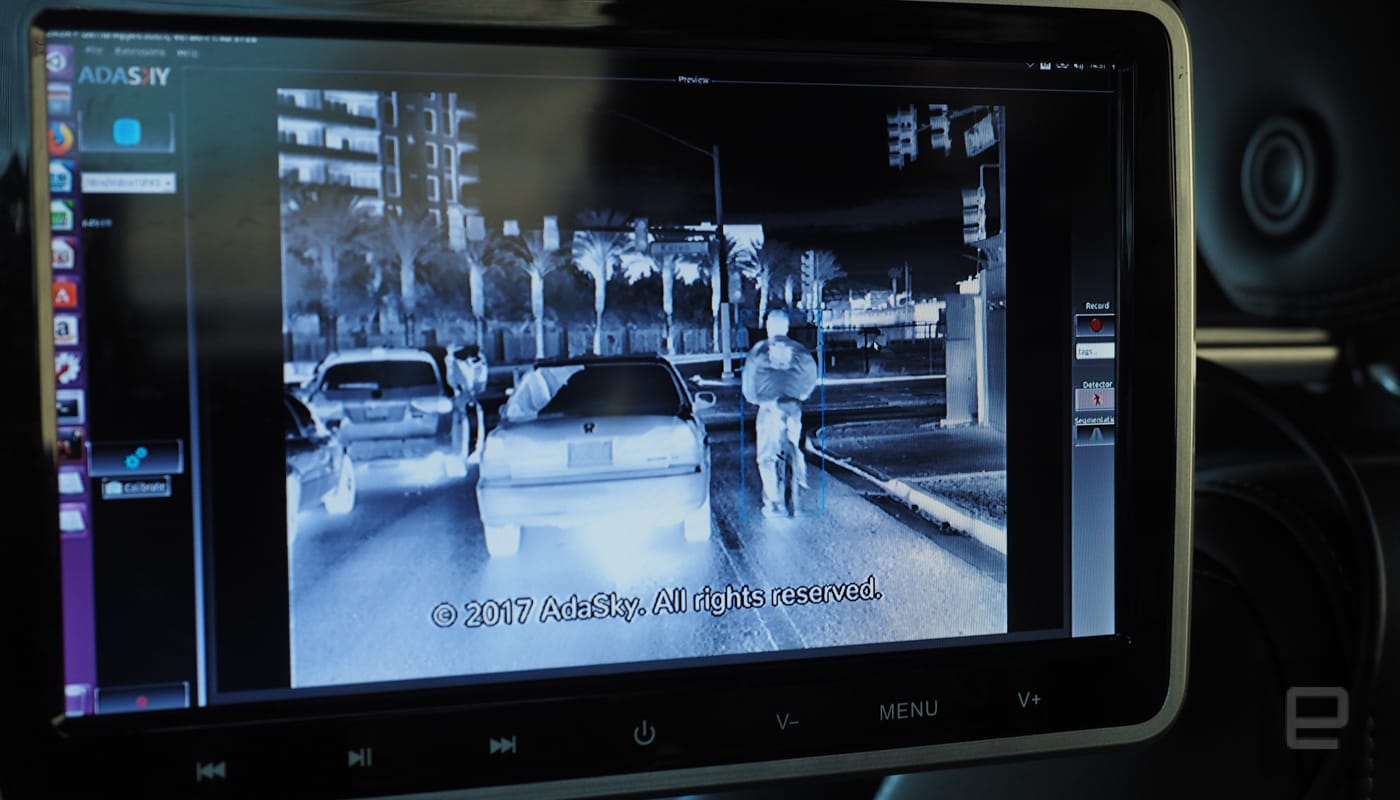
The Israeli startup is only a few months old, but it’s already built a thermal camera for a demo vehicle I had a chance to ride in. The device passively collects thermal data from the world, then converts it into a high-resolution video that the company drops into its computer-vision system. Then whatever it sees is classified as a car, person, animal, road and so on.
That’s pretty much how other sensors work, too, but during the demo, it became clear that the system could see and classify items that could be difficult to parse with the typical cameras on an autonomous car. The in-car monitor showed and classified people and animals based on their thermal signature. Even if a system like this can’t immediately determine something it sees is a person, the heat signature would at least show that it’s probably alive.
Adasky isn’t the only company looking to bring thermal vision to vehicles. Longtime thermal imaging company Flir recently announced an automotive development kit (ADK) for its car-mounted camera.
While a camera and LiDAR could have seen these things as well, in the sunny Las Vegas weather it was easy to imagine them getting lost in fog, dust and even direct sunlight with those vision-based sensors. Being able to see the difference in temperature, even on things like the road, is important.
For folks that drive in areas where black ice (ice on the road that’s invisible to drivers) is a problem, the Adasky system would be able to see the slick surface so the car could adjust its path.
This is where Adasky believes its thermal camera can help augment the sensors that are already being installed on the autonomous prototype vehicles that are already being tested on the road. It’s an additional bit of redundancy that gives the car more data to work with to see the world.
The team behind Adasky is using its years of experience developing thermal cameras for the military to make the leap into automobiles. Considering how often armed forces use thermal imaging for drones, manned vehicles and on-the-ground troops, it’s a good background to have.
Whether or not automakers are keen to add another sensor to self-driving cars of the future is yet to be seen. The companies would have to add another device to their cars. But more importantly, they would have to ingest and crunch even more data than what’s already being done. That means faster processors, quicker in-vehicle network speeds and more storage, plus figuring out how to make it all work together.

But Adasky makes a compelling argument that heat could be another way cars understand the world and determine whether or not the blob up ahead is a human in a coat or trash bag blowing into the street. Because spotting the difference is incredibly important.
Dyson’s debut EV might not showcase its next-gen battery tech
Though it had been rumored for some time prior, it was still somewhat surprising when Dyson formally revealed it was getting into the EV game. Even for a company that takes research and development to an excessive level to make some of the best vacuum cleaners (and more recently, hairdryers) around, a car is a different league of machine. The Financial Times has learned a little more about Dyson’s progress from several anonymous sources — namely that the current roadmap consists of not one, but three cars. Crucially, little birdies also said the company was considering using a lithium-ion battery to power its first EV, the same tech every automaker uses in their electric cars now. In other words, not particularly innovative for an EV set to hit the road several years from now.
Dyson has been working on solid-state batteries for a while, first investing in and then acquiring in 2015 a company specializing is such technology called Sakti3. Solid-state batteries are much safer than their liquid-based counterparts, charge faster and have a higher energy density, meaning EVs could go significantly further with no change in weight. BMW, Toyota, Fisker, Google and others are pursuing this step change in battery tech, but it’s thought Dyson could be the first to market with a solid-state EV, and the main reason it was moving into this new, competitive market in the first place.
Dyson has committed over $2 billion to its EV plans, with half of that going to solid-state battery R&D. Speaking to the FT, James Dyson would only say the company has been “investing heavily in new battery technology, solid-state battery technology… but those sorts of technologies can take some time to get there.” He added that Dyson is still on track to launch an EV in 2020/21, which is slight slip from the “by 2020” window previously announced. The FT‘s sources claim the first model could rely on lithium-ion power, however, with the second and third vehicles switching to solid-state tech.
Insiders said the first car would be a beta test of sorts, used to firm up logistics, the supply chain and to gauge public interest with a production run of just a few thousand vehicles. Later models will be manufactured as mass-market products, sources said, not that Dyson would confirm any of these rumors. Currently, the company still hasn’t settled on a manufacturing base and part suppliers, so there’s plenty still to figure out. But if the FT‘s contacts are to be believed, Dyson committing to a three-vehicle roadmap means it’s serious about creating a new side to its business. If the company ends up leaning on current-gen battery tech for its initial outing, though, it could sacrifice the splash a new entrant pulling up in possibly the first solid-state EV would make.
Source: Financial Times (paywalled)
Vimeo wants to power Facebook, Twitch and YouTube livestreams
Vimeo made clear its focus on its creator community last year when it introduced livestreaming tools, now it’s expanding its efforts with new distribution features that will help creators grow and expand their audiences. Announced today are “Simulcast” and “Publish to Social”, both designed with creators in mind and, no doubt, to help the platform develop its visibility beyond a single destination.
First up, Simulcast. This lets creators simultaneously stream live video from Vimeo to any RTMP-enabled destination, such as Facebook, Twitch, Periscope and of course, its main competitor, YouTube. The feature only needs a single input stream regardless of how many places the video is being streamed to, which means lower bandwidth costs and simpler workflow, which is handy for instances where bandwidth uplink is limited, such as conferences or outdoor events. Streams are automatically archived on Vimeo.
Next, Publish to Social. Here, creators can publish their videos directly from Vimeo to other platforms, natively, with one click. This means less time spent uploading content in various places, as creators will have a single hub where they can manage their distribution strategy, but also greater visibility for content, since platforms such as Facebook look favorably on native uploads. Publish to Social also comes with stats and a performance dashboard, so creators can see at a glance how their videos are performing across platforms. Both features are available to members of specific Vimeo payment plans, and more social platforms are slated to be added soon. Vimeo has struggled a little with the static, singular nature of its platform, so opening it up like this could make it an attractive alternative, especially to creators that are unsure of YouTube’s relationship with its users.
Valentine’s Day Sales: Save on iPhone Cases, Bluetooth Speakers, and More
In celebration of Valentine’s Day today, February 14, numerous companies have launched sales for a variety of products, ranging from iPhone and MacBook accessories to Bluetooth speakers and more. Below we’ve rounded up a few of the sales going on today, most of which will be ending by midnight tonight or early tomorrow.
Note: MacRumors is an affiliate partner with some of these vendors. When you click a link and make a purchase, we may receive a small payment, which helps us keep the site running.
Gazelle
Gazelle shoppers today can get $20 off any certified pre-owned devices priced at $200 or more on Gazelle’s website, including Apple products like recent MacBooks, iPads, and iPhones. You’ll see the discount applied automatically at checkout.
Incipio
Take 20 percent off sitewide at Incipio using the promotional code LOVE20 at checkout. The accessory company has launched separate Valentine’s Day guides for Her and Him, but the promo code will work on any product across the website.
DirecTV Now
 DirecTV Now’s updated Apple TV 4K offer is still ongoing this Valentine’s Day, and remains the best sale price for the 32GB device available online, regardless of whether or not you decide to keep paying for the streaming TV service once the prepaid period ends.
With the deal, if you sign up for three months of DirecTV Now at an upfront cost of around $105, you’ll get the 32GB Apple TV 4K for free.
DirecTV Now starts at $35/month for the “Live a Little” package, which adds up to $105 for three months of service. So the limited time offer means that you can get the latest 32GB Apple TV 4K for just $105, which is $75 cheaper than its traditional price point of $180 at Apple and other retailers. The company is expected to raise the sale back up to four weeks prepaid at $140, which is still a nice deal on the Apple TV 4K, but if you’re interested definitely check out DirecTV Now’s website for more information.
Braven
Speaker and headphone company Braven has launched a BOGO sale in celebration of Valentine’s Day, offering shoppers the chance to buy one product and get another 50 percent off when using promo code LOVEBRV.

The offer is available sitewide and can be combined across product lines, with the discount appearing at checkout. The only items excluded from the offer are any products already on sale.
Sonos
 Another ongoing sale could be a good opportunity for couples this Valentine’s Day, with Sonos offering customers the chance to purchase two Sonos One speakers for a price of $349.00. Each individual Sonos One is priced at $199.00, so this bundle saves you $49 from what would be a $398.00 price tag.
Sonos debuted the sale on the day that pre-orders for Apple’s HomePod went up, January 26, and has kept it live since then in an effort to compete with Apple’s first entry into the smart speaker market.
In terms of price, the Sonos One two-speaker bundle matches the cost of one of Apple’s $349.00 HomePod speaker. For more on the Sonos sale, visit the company’s website.
MacPaw
MacPaw is offering customers the chance to buy a CleanMyMac 3 double pack this Valentine’s Day, taking 20 percent off the total cost of the bundled software. The company said this could be a good gift for couples, since the deal nets you one license that can then be used on two separate Macs. With the offer, you can get two copies of CleanMyMac 3 for $47.96, down from $59.95.

MacPaw sells a variety of other Mac applications like Gemini and Wallpaper Wizard, and the company describes CleanMyMac as a “simple and powerful application for keeping your Mac clean, maintained, and healthy.”
Other Sales
There are plenty of other sales going on today, so we’ve listed some of them below with a brief description of the promotion or items discounted. If we see any other Valentine’s Day sales appear, we’ll add them to this list and update the post.
- Twelve South – Inspire [mac candle N°2] for $24.99, down from $29.99
- Casetify – Buy two get 20 percent off, or buy 3 get 25 percent off with promo code LOVEIT
- Griffin – Save 40 percent off sitewide with promo code LUVGRIFFIN
- Speck – 28 percent off sitewide
- JBL – Save up to 75 percent off select Bluetooth speakers and headphones
- T-Mobile – Get a free line of service when you add one line to a family plan
- Best Buy – Sphero iPhone-connected interactive Spider-Man for $34.99, down from $149.99
-
Amazon – iPhone X leather case in Black and Midnight Blue for $39.99, down from $49.99
- Walmart – Powerbeats3 Wireless Earphones for $99.00, down from $199.99
- B&H Photo – DJI Mavic Pro Fly More Combo for $949.00, down from $1,299.00
For more sales happening this week, be sure to head over to our full Deals Roundup.
Related Roundup: Apple Deals
Discuss this article in our forums
Barclays Says Second-Generation iPhone X Could Have Smaller Notch
Apple will launch a trio of new iPhone models later this year with a second-generation TrueDepth camera system, which will potentially be reduced in size, according to a research note issued today by analysts Andrew Gardiner, Hiral Patel, Joseph Wolf, and Blayne Curtis at investment bank Barclays.
While the analysts believe the new TrueDepth system will only “evolve slightly,” they predict it could allow for a “smaller notch” on the 2018 range of iPhones with Face ID, which is rumored to include a second-generation iPhone X, a larger iPhone X Plus, and an all-new mid-range 6.1-inch LCD model.
MacRumors obtained a copy of the research note, which also corroborates rumors about Apple extending Face ID to the iPad Pro this year:
Based on several data points within the 4Q17 reporting period and our supply chain meetings at CES, we remain confident that Apple is set to deploy its TrueDepth 3D sensor across the iPhone range in 2018 and to also add it to the pending iPad Pro refresh as well.
Given the complexity and multiple years spent developing the current generation of module, combined with supplier comments over the past month regarding multi-year customer commitments, we do not envisage a major change to the architectural make-up in 2018 […]
We do expect the sensor to evolve slightly, potentially reducing in size (i.e., smaller notch) and improving in specificity […] helping to further drive very strong growth [for some Apple suppliers] in 2H18 as the second generation of sensor ships in this year’s new iPhones.
A smaller notch would be a welcomed change for critics of the iPhone X design, but it remains to be seen if it will happen so soon. An earlier rumor suggested the notch won’t be reduced in size until 2019 or later, and it’s generally expected that 2018 iPhones will look virtually identical to the iPhone X.
The prevailing thought is that Apple doesn’t want to deal with the type of delays it faced with the iPhone X last year, and by keeping the hardware relatively unchanged, suppliers could avoid some retooling. However, it’s certainly possible the TrueDepth camera system could be slightly shrunk down this year.
Beyond this year, the Barclays analysts believe Apple is “working hard” on a rear-facing TrueDepth camera system for future iPhones. The technology could be ready by 2019, but it sounds too far out to know for certain.
A key discussion point regarding 2019 is whether or not Apple will be ready to insert a rear or world-facing sensor, given the additional complexity associated with a greater range and field of view and […] the potential safety implications for the human eye.
Our discussions with suppliers suggests Apple and its partners are working hard on a world-facing solution, but development is ongoing and with over 18 months to go until the 2019 iPhone cycle, not all is yet determined.
The rear-facing TrueDepth camera system would pave the way for expanded augmented reality capabilities on iPhones. Apple has repeatedly expressed a profound interest in augmented reality, and recently highlighted some use cases of the technology in areas like education and gaming with a new page on its website.
Bloomberg News previously reported that Apple is exploring rear-facing 3D sensing, to be added to iPhones as early as 2019, while KGI Securities analyst Ming-Chi Kuo agrees the technology won’t be ready in 2018, so there does appear to be consensus about back-and-front TrueDepth being a next-year feature.
Apple’s trio of new iPhones should be announced in September as usual, while the new iPad Pro with Face ID could debut in June.
Related Roundup: 2018 iPhonesTags: Barclays, TrueDepth
Discuss this article in our forums
YouTube TV gets TBS, TNT, Cartoon Network, CNN and a price bump
It’s been almost a year since Google first announced YouTube TV, its $35-per-month service for cord cutters. Since then, Google has been iterating to improve on a product that was solid at launch — but today marks the biggest expansion of YouTube TV thus far. The service now has access to a host of new channels from the Turner network, including TNT, TBS, Cartoon Network, CNN, Turner Classic Movies and a few others. For sports fans, YouTube is also adding NBA TV and the MLB Network as well.
But there’s a bit of bad news that comes along with this: New YouTube TV subscriptions will now cost $40, up from the $35 price that the service has cost since launch. The price increase will hit on March 13th, so new potential customers still have a month to get in the door and lock in the $35 rate; existing subscribers won’t see a change to their bill at all.
YouTube’s Heather Moosnick said that the decision to add channels and raise the price is a result of a balance between content and price that the company has been paying attention to since YouTube TV launched. “We’ve looked at both qualitative and quantitive info to understand what is the perfect package for our users, the vast majority of whom otherwise stopped watching live TV,” she said. “Live sports was a key driver in terms of getting new users interested and subscribing to [YouTube TV].”
The timing of this expansion is no accident; the NBA All-Star game is taking place this Sunday, while the NCAA basketball tournaments are only a few weeks away. But even non-sports fans will probably find something to like in this expansion, which gives YouTube TV a comparable channel lineup to competitive services from Hulu and Sony.
This new price also puts YouTube TV in line with both Sony’s PS Vue service as well as Hulu’s live TV plan, both of which cost $40 per month. Of course, each option has different perks — Hulu comes with access to the service’s extensive on-demand catalog and original content, while YouTube and Sony both offer unlimited cloud DVR storage, for example.
If you’re intrigued but don’t have YouTube TV in your area, check again: as of today, YouTube TV is available in all of the top 100 US markets, which the company says covers 85 percent of households in the country. And YouTube has focused on making sure it has as much local broadcast programming as possible when it enters new markets; Moosnick said that while not every market has all four big broadcast networks, they have three plus the other on demand in many cases. Compared to the competition, she said that YouTube TV has “by far the most” local programming.
For those who’ve been considering an over-the-top video streaming service, now is a good time to find out if YouTube TV is right for you. There’s a month left to get in at the $35 price point, and there’s still a free week to give it a shot before putting down your cash.
The original ‘Dead Space’ is free… on EA Origin
Beloved horror survival game Dead Space is now available completely free on PC. The 2008 sci-fi hit is the newest addition to EA’s “On the House” offering, and as long as you grab it directly from Origin it’s yours without charge, to play and keep forever. That said, it’s not clear how long the promotion will run for, so you should probably download it sooner rather than later.
Dead Space, made by the now defunct Visceral Games, has actually enjoyed a stint On the House before, kicking off the campaign back in 2014. It’s arguably one of the better horror games of the last decade, so its revival on the freebie platform is likely a catalyst to get people on board with EA Origin, which isn’t hugely revered by the gaming community. In it, you play Isaac Clarke, an engineer trapped in space forced to fight off Necromorphs with improvised weapons made from scavenged mining equipment. This isn’t a straightforward shoot-’em-up, either, as overcoming your enemies often means tearing them limb from limb in a pretty grizzly fashion. So now you can satiate your blood lust and get your jump scares without having to pay a penny.
Via: RockPaperShotgun
Source: Origin
Master ‘Civilization VI’ with these starting tips for new players and veterans
Whether you’re a series newcomer or a Deity-level veteran, Civilization VI offers a lot to chew on. If you’re an absolute Civ virgin, the game’s thorough tutorial and adviser system are great for helping you get your bearings. Once you have the basics down, we have a few less immediately obvious tips based on our experience with the game that will help you master the particular intricacies of Civilization VI.
City planning and amenities
City planning
The addition of urban sprawl, which now makes buildings and wonders take up tiles on the map, has completely changed the puzzle of laying out your cities. Whereas before you would mostly be concerned with what improvable resources would fall within a new city’s borders, now it behooves you to really think through how you want to specialize each city, since they are limited to one district for every three citizens (unless you’re Germany, which raises that cap by one). Unique district variants that certain leaders have also do not count against this limit, and cost half as much to produce.
Familiarize yourself with the adjacency bonuses of each district type (we’ve been using this cheat sheet from Reddit user iotafox), such as mountains for Campuses and Holy Sites, or rivers for Commercial Hubs. Before you found each city, take both your overall plan and the particulars of the surrounding geography into account and plan where you want to build particular districts and wonders in order to maximize their benefits. Campuses, Holy Sites, Theater Squares, Commercial Hubs, and Industrial Zones all get bonuses for being next to other districts, so you generally want to pack them together as closely as possible. This is reinforced later in the game once Espionage is unlocked, since your defending spies on counterintelligence duty are placed in a particular district, and protect it and all of its surrounding tiles from sabotage.
Also of note, you no longer need to found cities on the coast in order to build naval units. Any city with a coast tile within its workable range (three tiles from the city center) can build a Harbor district to achieve the same effect. The Harbor unlocks with Classical Era technology (Celestial Navigation), and settling a coastal city does activate the Boost for Sailing, so settling on the shore is still key if you want to take to the sea early (if you’re playing as Norway, for example).
Two new systems limit the growth of your cities. The Nationwide happiness rating has been replaced by a localized amenities score in each city, and a new stat, Housing, limits how large a population any given city can support. You will want to proactively take both into account when planning how to grow your cities, in order to avoid inefficient periods of no or limited growth.
Amenities
Amenities, the new city-by-city version of the series’ “happiness” system, can boost or hamper your city’s productivity depending on how well you “pamper” its citizens. Every city needs to maintain a net “Amenities” score of zero or higher to function normally, requiring one amenity for every two citizens starting at three. Falling below zero, which may occur after factors like “war weariness” and bankruptcy cause the score to drop, will slow growth and nonfood yields. Eventually, failing to raise your amenities score will lead to Barbarians spawning in your borders.
Conversely, high amenities can boost growth and yields. Every improved luxury resource provides one amenity point to up to four cities. Additional copies of each resource are only good for trading. The amenities bonus from luxury goods is automatically distributed to where they are most needed. Great people, world wonders, policies, religion, national parks, and buildings in the entertainment complex can also boost your amenities score. The complex has no adjacency bonuses, and several of its buildings provide Amenities to all city centers within six tiles, so take that into account when placing them.
Gmail will be AMP’d up using a speedy new tech that makes emails pretty
Google’s Gmail Product Manager Aakash Sahney said on Monday, February 13 that the company’s popular email client will be injected with Accelerated Mobile Pages (AMP). What this means for you is that Gmail will not only be faster, but more interactive than before. For instance, rather than clicking on a link within a received message, users can interact with content without leaving the Gmail client.
“AMP started as an effort to help publishers, but as its capabilities have expanded over time, it’s now one of the best ways to build rich webpages,” Sahney said. “With this came the opportunity to modernize one of the most popular places where people spend their time: email.”
AMP is an open-source framework created for a richer web experience. It consists of three core components: HTML web page code with “restrictions” that promise fast, reliable performance, a JavaScript library capable of rendering AMP-based pages extremely fast, and a dedicated Google Cache reservoir to cache AMP-based pages.
Technically, this new platform is called AMP for email and Google is now providing a sneak peak in a Gmail Developer Preview. This will start the ball rolling for service developers who want a richer interaction than boring emails with static links and images. Sahney said Pinterest, Booking.com, and Doodle are already working on new email methods that take advantage of AMP.
“Imagine you could complete tasks directly in email. With AMP for Email, you’ll be able to quickly take actions like submit an RSVP to an event, schedule an appointment, or fill out a questionnaire right from the email message,” Sahney said.
Google first introduced the AMP Project in October 2015 after collaborating with technology companies, news publishers, and the European Digital News Initiative to improve the internet’s performance on mobile devices. Among the named collaborators were Twitter, LinkedIn, WordPress, and more than 30 other companies and news agencies.
AMP-based pages began to appear in Google search results as “Top Stories” on mobile in February 2016. They weren’t fully integrated into mainstream search results until the following September. Around 900,000 web domains published more than 2 billion AMP-based pages by May 2017, including Twitter, which automatically began linking to AMP-based pages in its Android and iOS clients.
Just on the search front, Google claims that AMP-based pages load from a Google search in less than one second and use 10 times less data than an equivalent page not based on AMP technology. According to the AMP Project webpage, Gizmodo now publishes all pages using the AMP foundation and saw an immediate performance increase after the initial switch — three times better page load performance and an increase in traffic due to those faster load times.
Now that technology is coming to Gmail. “We’re opening up new possibilities for companies to engage with their audiences, and we can’t wait to see what developers will build,” Sahney said.
The AMP for Email specification is now available for developers as a preview. Jump on the bandwagon to sign up for the preview.
Editors’ Recommendations
- You’ll soon be able to get Google AMP quality without that pesky AMP URL
- The latest Firefox revs up browsing by stitching more threads into your CPU
- How to use Chrome’s Reading List on iOS and Android
- Force Block extension now blasts evil ‘The Last Jedi’ spoilers in Chrome
- Snapchat continues to seep outside the app with Snap Map on the web
Microsoft will use a blockchain to decentralize data for better control
Microsoft said on Monday, February 13, that it plans to use blockchain technology to give you more control over your digital identity. Alex Simons, director of program management at Microsoft’s Identity Division, says the company invested in incubating a set of ideas relying on blockchain technology over the last 12 months. Monday’s update will be the first of many regarding how Microsoft plans to use that technology to create decentralized identities (DIDs).
The word “blockchain” is typically associated with cryptocurrency platforms. In its basic form, a blockchain contains a network of encrypted data blocks. This data doesn’t reside within a central location, nor is it managed by one specific entity. Instead, these data blocks are “chained” between participating PCs scattered across the globe. This data cannot be altered or hacked because all blocks have a cryptographic hash of the previous block along with their transaction data and a timestamp.
In a sense, a blockchain is an open, digital ledger that records all transactions, but is not maintained by one party. That is the problem with most if not all internet-connected services: your information and transactions are stored on servers, which can be infiltrated by hackers looking for juicy personal data. Even more, all data written to any given block cannot be altered unless the previous blocks are altered, too.
While a blockchain is essential for decentralized transaction recording, it’s also great for storing your personal information. According to Microsoft, a blockchain would eliminate the need to provide “broad consent” to “countless apps and services.” Your identity wouldn’t be duplicated and spread out across multiple providers such as Twitter, Facebook, Instagram, Google Play, Amazon, and so on.
“Today, apps, services, and organizations deliver convenient, predictable, tailored experiences that depend on control of identity-bound data. We need a secure encrypted digital hub (ID hubs) that can interact with user’s data while honoring user privacy and control,” adds Ankur Patel from Microsoft’s Identity Division.
Of course, this isn’t a platform Microsoft can tackle alone. It’s working with individuals and organizations through the Decentralized Identify Foundation to create an ecosystem that supports decentralized identities. There are four basic components in this initiative: A W3C-based specification that defines a Decentralized Identifier, an encrypted identity datastore, a server that revolves DIDs across blockchains, and another W3C-based spec called Verified Credentials.
The big goal is to make this blockchain foundation scalable. It needs to expand as devices, organizations, users, and even new technology jumps into the mix without hitting a threshold. Patel says that several blockchain communities will increase block sizes to increase capacity, but this method not only degrades decentralization but cannot handle the transaction of a world-scale platform.
That said, the “transactions” aspect doesn’t necessarily mean purchases between entities. The company is likely referring to transactions between your data and services accessing that data. There is a permanent record of what those apps and services use. How you will be able to control those transactions remains to be seen.
Microsoft will begin experimenting with blockchains using Authenticator as its test subject.
Editors’ Recommendations
- Australian companies may soon be using a national facial recognition database
- What is a blockchain? Here’s everything you need to know
- How to mirror your smartphone or tablet on your TV
- How to clear cookies in your browser
- Looking for online privacy and security? Here are the best VPNs for Android
 AIVAnet