


The Skydio R1 might be the smartest consumer drone in the sky
Autonomous features in commercially available drones are nothing new. Heck, I’m old enough to remember when DJI Phantoms didn’t even offer follow-along technology. Shorter version: Most every drone worth its rotors possesses some level of autonomy. But then there’s Skydio’s R1, which ratchets things up a notch. Or two.
The R1 isn’t so much a drone as it is a flying, self-positioning action camera. It’s sole purpose is to record the person it’s following. Built by a team of former-MIT engineers, the R1 relies on the 13 cameras studded throughout its exterior to see the world around it and the same NVIDIA Jetson chip used in self-driving vehicles as a processing hub to navigate.
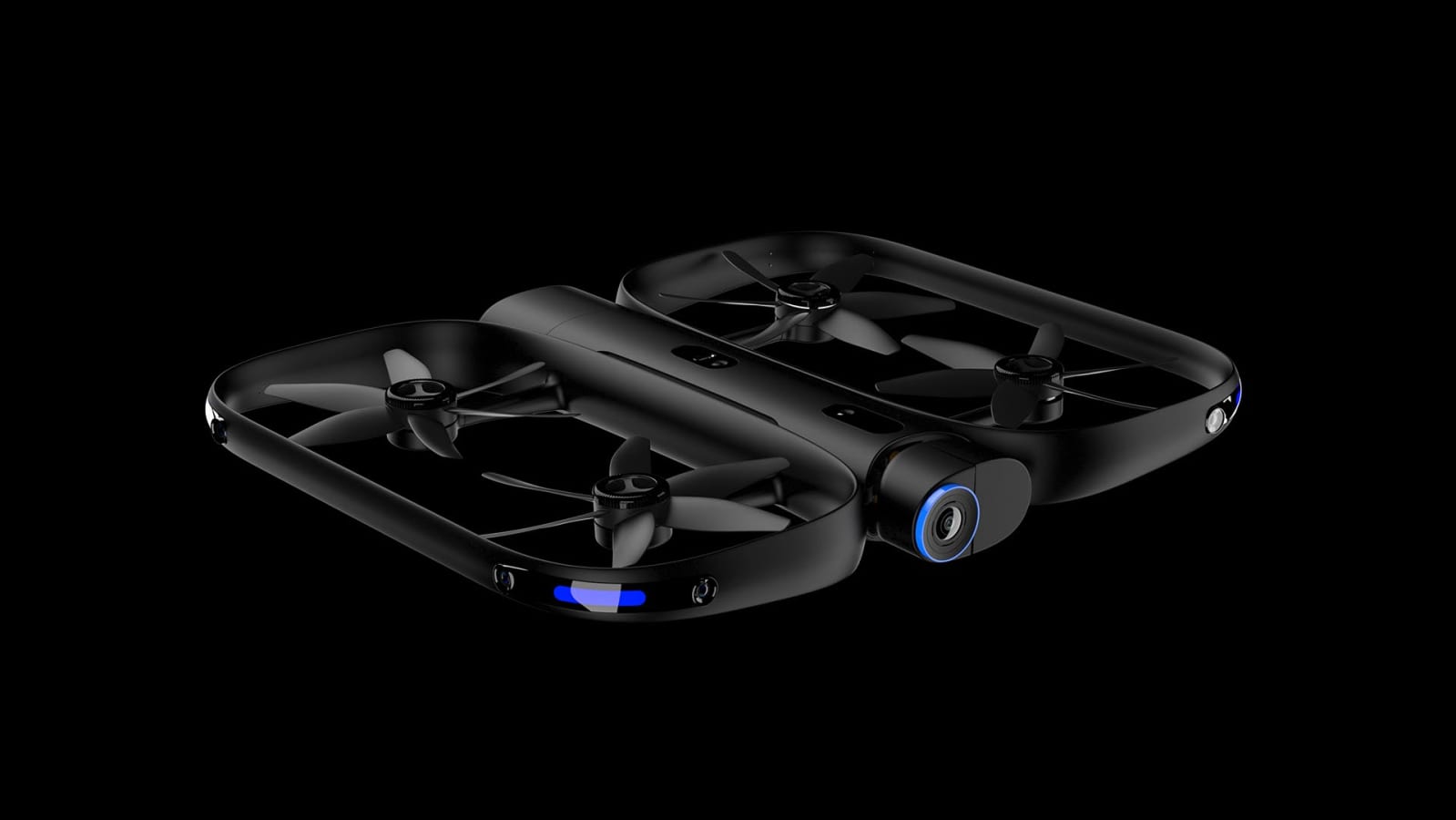
And good lordy, can it navigate. Ok so, you know how the Phantom 4 has obstacle avoidance tech? It’s where the drone, upon sensing that it will strike a low-hanging branch or phone pole, will stop following its target and hover a safe distance from the obstruction. The R1, however, does not care. During a recent demo in San Francisco’s Jefferson Square Park, the R1 easily dodged trees, power lines and more than a few curious dogs while keeping its camera trained on me.
What’s more, having the drone track me — either following, leading or steadily circling — did not require that I have my phone in my hands or even out of my pocket. The R1 is purpose-built for autonomous flight, and I can’t overstate this. You literally launch the app, launch the drone (either from the ground or from your hand), pick what filming behavior you want the drone to exhibit and go about your business. Most drones have autonomous features to supplement their manned flight. The R1 offers manual controls for the R1 almost as an afterthought — because the autonomy is that good.
The R1 uses its cameras, rather than GPS, to generate navigational information in real time. This enables it to make quicker decisions (i.e. fly faster) as well as be able to operate indoors. DJI had already made a number of advancements in this space already, however, the company’s Active Track technology does still require a GPS signal — making tracking and avoidance at the same time a more cautious affair.
Navigating by sight alone is a huge deal and not a trick many UAVs are capable of achieving — not at this speed and responsiveness, at least. What’s more, the R1 can top 20 mph. That’s slower than most of DJI’s drones, but fast enough to keep up with runners and bikers.
The R1 does have other drawbacks. For one, its battery life is around 16 minutes. That’s only enough recording time for one, maybe two, trips down the trail before you have to hot swap its battery packs. There’s also the issue of its 64GB of onboard storage, which is not expandable. Granted, you’ll likely run through your supply of batteries before your supply of storage, but the R1’s 4K primary camera is no slouch when it comes to consuming memory. Also, the system doesn’t work over water. The AI can’t figure out how to navigate the constantly shifting features of lake surfaces, and the drone itself is not waterproof.

There’s also the product’s price. You can pick up a DJI Phantom 4 Pro from Best Buy, right now, for $1,500. If you want something with more of an action-sport focus, there’s the AirDog II for $1,299. If you want an R1, however, you’d better sell that superfluous kidney of yours because this drone will set you back a solid $2,500.
That said, if you have the ways and means or just wealthy, gullible parents, this is the selfie drone you want. It works with both Android and iOS and you can pull content either from the onboard hard drive or just chop and share a quick video from the mobile app. Best of all, it will follow you to the ends of the earth (assuming they’re a 16-minute trip away).
Apple HomePod review: A great speaker that’s not so smart
For Apple, being late to the smart speaker party isn’t necessarily a sin. The company’s ethos — as explained by CEO Tim Cook time and again — is that Apple cares more about being the best than being first. The $349 HomePod is proof that’s not always true. Apple put considerable time and effort into making its first smart speaker sound better than its rivals, and I’d argue they succeeded. After a few solid days of testing, I can honestly say the HomePod is the best smart speaker I’ve ever heard — it’s just not very smart in the ways I was hoping.
Embracing the ecosystem
Just to be clear up front: Anyone who isn’t an ardent Apple user should probably just move on. The HomePod requires that you have an iOS device for the initial setup process and an Apple Music subscription to play some tunes. (You’ll be offered a three-month free trial if you aren’t already a subscriber.) In other words, if you’re primarily a Spotify person (like me) or an Apple Music user who prefers Android devices, the HomePod isn’t for you. Beyond that, the lack of audio inputs and a Bluetooth implementation that doesn’t allow for streaming from devices means your musical options are limited.
If you’re already a citizen of Apple’s walled garden, setting up the HomePod takes mere moments. Assuming Bluetooth is on and you’re running the latest version of iOS, just place your phone or iPad near the HomePod — you’ll be asked to share your Apple account settings and run through a few “Hey Siri” tests. You’ll also be asked whether you’d like the HomePod to handle what Apple refers to as “personal requests” — that is, whether it can have access to your notes or incoming messages. If you agree, the HomePod can tap into that stuff only if the associated iOS device is on the same Wi-Fi network, but that still means people at home with you could feasibly muck around with appointments or send messages to your contacts. If this sounds troubling, you can decline during setup (you could always do it later) or revoke support for personal requests after the fact.
Once all that’s done, it’s time to start listening.

Chris Velazco/Engadget
Audio quality
Let me preface this bit by mentioning I’m not an audiophile. I appreciate great sound, but I’ve never felt compelled to go out of my way to become an audiophile. Because of that, the HomePod seems tailor-made for me. This is a tiny, mesh-covered speaker that sounds fantastic, and I didn’t have to do much other than plug it in and start asking to hear some tunes. No surprise there: That’s basically what Apple has been promising since it first unveiled the HomePod last summer.
After spending more time with the HomePod, I’ve come to appreciate just how good this thing sounds. I’ve been testing it alongside some of its most notable competitors too, though, and as great as the HomePod sounds, it’s not for everyone.
For a better understanding of why the HomePod sounds the way it does, let’s take a peek under the hood. Long story short, Apple built an array of seven tweeters along the HomePod’s base and a top-firing woofer right in the center. More important, there’s an A8 chipset — you know, the one from the iPhone 6 — embedded in the touch panel at the top of the HomePod, tuning the output from each of those speakers to suit the space it’s in. While it plays your music, the HomePod listens to how the audio it’s playing reflects off surfaces and obstacles nearby to build a model of the space around it. Since you’ll probably move the HomePod at least once, a built-in accelerometer ensures that the speaker knows to reassess its surroundings when you put it down again.

Apple
That environmental data is used to determine which parts of a song should be routed through which speaker inside the HomePod, a process that helps build a surprisingly spacious soundstage. A singer’s vocals, for example, are likely to be blasted right at you while an underlying piano melody is concentrated around the sides to give it a more ambient feel. The level of complexity at play here is downright wild for a speaker of this size.
Over the past few days, I’ve asked the HomePod to play an eclectic mix of music, and with very few exceptions, every track I tried sounded bright and balanced. And, thanks to the HomePod’s omnidirectional design, you can walk around it without noticing any massive differences in sound.
One of the most notable things about the HomePod is the excellent job it does highlighting the myriad moving parts of a song. The main brass melody in “Tank!” (of Cowboy Bebop fame) gets the star treatment for most of the song, but elements like the ever-present bongo and shaker never get lost in the mix. On previous listens through different speakers and headphones, it was easy to forget that they’re there, but the HomePod did a great job balancing those bits and letting them shine. It’s not going to be as immersive as a pair of high-end bookshelf speakers, but if you close your eyes, the leap isn’t a huge one.
In general, you can expect the HomePod to emphasize vocals and mids, and that’s usually a great thing. Brian May’s guitar solo and Freddie Mercury’s growl in “Somebody to Love” felt punchy and present, while the piano and drums provided a solid foundation for the mids and highs to dance on. In Kesha’s “Praying,” her voice does most of the heavy lifting, but the HomePod’s excellent clarity revealed the tremolo in her words during the relatively bare first half. The effect isn’t always perfect, though: In They Might Be Giants’ “Ana Ng,” John Linnell’s nasal croon seemed to rise above the rest of the mix, overshadowing the rest of the instruments.

Chris Velazco/Engadget
Meanwhile, songs like Paul Simon’s “You Can Call Me Al” show off the nuance of Apple’s woofer design: The jaunty bass line gets just as much attention as Simon’s tumbling vocals, and it really shines once the band drops out and the slap solo kicks in. Ditto for grungy, fuzzy rock like Silversun Pickups’ “Panic Switch,” a song that lives or dies depending on how its driving, repetitive bass line is rendered alongside the hazy lyrics.
The thing about the HomePod’s approach to bass is that it’s deep and surprisingly powerful at times, but never overdone. The iPhone chip inside the speaker is always managing the woofer to ensure there’s no distortion, even at maximum volume. The flip side is that songs that revel in those low frequencies, like Childish Gambino’s “Redbone” and Kendrick Lamar’s “All the Stars”, can sometimes feel less impactful. This constant balancing act clearly works better for some songs than others, but overall I’d say it’s a net positive.
What the HomePod seems to lack is pure, unabashed sonic power. It’ll fill most living rooms (and conference rooms, for that matter) just fine, but it struggles to saturate significantly larger spaces. If that’s what you’re after, Google’s $399 Home Max does a better job. If you’re sitting right in its line of fire, the Home Max’s sound reaches out, grabs you and doesn’t let go until the song is over. The soundstage feels noticeably wider too, because of its dual woofers and tweeters. Meanwhile, you’ll have to wait for Apple to issue a software update before you can pair two HomePods in stereo.
The Home Max’s power comes at a price, though. At high volumes, Google’s speaker sometimes sounds distorted and indistinct, as though you were wading through a sort of musical soup. The HomePod lacks that raw oomph but instead aims for balance even at maximum volume.

Expect to see this a lot.
Chris Velazco/Engadget
Making do with Siri
There are two ways to interact with the HomePod: You can either walk up to it and tap the touch-sensitive top panel or just start talking to it. Either way, it doesn’t take long to realize that Siri — or at least this particular version of Siri — isn’t as capable as other voice assistants.

Chris Velazco/Engadget
Let’s start with the good. Thanks to the HomePod’s six far-field microphones, the device is very good at picking up “Hey Siri” requests, even when you have music blasting away at max volume. Sometimes whispering was enough to trigger Siri while music was playing and the HomePod still responded correctly. Siri’s voice recognition has been mostly spot-on, too — I can count on one hand the number of times it bungled one of my requests (and on two of those occasions I happened to be cramming chips into my maw). And when it was time to start sending text messages to friends and colleagues via the HomePod, that was all peachy too.
In my experience, Siri makes for a thoughtful DJ as well. Full disclosure: I’ve been an Apple Music subscriber since launch, but mostly because I keep forgetting to cancel it. I’m honestly a little glad that’s the case — even with infrequent use, Apple Music has proven it has a solid understanding of my eccentric musical tastes. Unlike what some of my fellow reviewers reported, Siri never presented a truly bizarre choice when I asked it to “play something I’d like” — it was all either stuff I’d listened to in the past or tracks that were similar to others in my collection.
Siri was also surprisingly good at finding playlists to suit my moods or genre preferences, but I often didn’t love a lot of those songs. (That’s mostly a matter of taste, though.) Still, the selection of tracks Siri ran through when I told the HomePod it was party time did the trick, so I’m willing to give Apple’s playlist creators some leeway. Oh, and the HomePod also doubles as a solid smart home hub, so I could control my assortment of Philips Hue lights without trouble just by asking.

Chris Velazco/Engadget
This is all basic functionality, and Apple was right to ensure that Siri could handle these tasks. The thing is, the HomePod doesn’t exist in a vacuum. Having used the multiple versions of Amazon’s Echo and Google’s Home in the past, I have certain expectations of a smart speaker. There are a few third-party integrations here, but no way to order pizzas or hail an Uber. Those examples may seem frivolous, but the fact that they exist at all is a testament to just how broad the support for assistants like Alexa has become. The value of Amazon’s and Google’s head start is undeniable.
That’s not to say that the HomePod is devoid of third-party support. You can ask Siri to fire off messages via WhatsApp or WeChat, both of which worked flawlessly. And if you’re the sort who fastidiously creates to-do lists and sets reminders to keep yourself on track, Siri handily ties into Evernote and Remember the Milk, among other services. We’ll certainly see more apps embrace Siri for the HomePod in time, but the limited functionality right now makes this smart speaker a tough sell for some.
Even if we put third-party support aside, Siri on the HomePod still feels limited. Alexa and Google Assistant can, for instance, handle multiple timers at once. They can peer into your calendar and tell you what’s next on your schedule (Alexa needs some external skills for this), which Siri simply can’t do right now. Siri also can’t initiate phone calls, even when the iOS device it’s associated with is on the same network. Before receiving the HomePod, I had hoped Apple’s devotion to building a smart speaker that connected to a tightly defined list of devices and services meant the integrations themselves would be tight as well. That might eventually be the case, but it isn’t now.

Chris Velazco/Engadget
There are other shortcomings, too. Remember how the HomePod can field personal requests and provide access to data and services stored on an associated iOS device? That wouldn’t be an issue if Siri on the HomePod could identify users by their voices, as it already does on the iPhone. Right now, however, anyone could ask my HomePod to play my unread text messages or send a text to a contact, and as long as my phone was nearby, Siri would comply without hesitation. I don’t have anything to hide, but the principle still stands: If my phone can recognize my voice, the HomePod should be able to as well. This is stuff that Google’s Assistant has already figured out, and it at least offers some protection of your privacy.
Ironically, too, for a device that’s only valuable if you’ve bought into Apple’s ecosystem, the HomePod’s version of Siri sometimes works strangely with other Apple products. You generally don’t need to worry about the iPhone picking up on commands intended for the HomePod; Siri on my iPhone X was quick recognize the difference though I still got the occasional trademark “I’m listening” sound. I wish I could say the same for the Apple Watch, though. If you have “Hey Siri” voice commands enabled on your watch and its screen is on, it’ll interpret your requests at the same time the HomePod. This led to a few situations where, after asking Siri to play something it thinks I would like, two different songs started playing on the HomePod and the iPhone. Great.

Chris Velazco/Engadget
Wrap-up
In a way, the HomePod is a remarkably pure machine: it’s meant to make your music sound great, and that’s about it. Viewed purely through that lens, the HomePod is a fantastic first attempt and one that delivers on its promise. Taken as a whole, though, the company’s first smart speaker feels like a work in progress. Over time, software updates will iron out some of these early wrinkles and add features to make the HomePod a more intelligent, more capable companion. For now, though, it’s a technical marvel and a tough sell all rolled into one.
Google plans Snapchat-esque stories for mobile search results
Assuming you have a basic understanding of social media and haven’t been living under a rock for the last year, you’re going to be familiar with “Stories” — full screen displays of content that you can swipe or tap through, which are available for a limited time. Snapchat got the ball rolling, Instagram got on board, Facebook followed suit, and now Google is getting in on the action, following the initial report it would back in August. According to a Google blog post, “AMP Stories” are in the works, and soon they could completely shake up the look of your search results.
“AMP” stands for Accelerated Mobile Pages — optimized web pages displayed on your smartphone via Google search results, and as the name would suggest, they load fast (in around a second) and use ten times less data than non-AMP pages (although they have created some controversy — their URL prefix can make link sharing a pain, and some publishers have annoyed Google by offering stripped-back content on these pages instead of the full experience). Now, instead of seeing the usual text links, you’ll see image- and video-orientated stories, much like the ones you see on Instagram et al.
The difference, of course, is that these stories aren’t coming from your old college friend who’s bought a new guitar, or from an ex-colleague who’s shakily Snapchatting their commute, but from publishers with cash to spend on the format. Back in October, Recode reported that Google planed to pay said publishers to commit to its version of stories. CNN, Conde Nast, Hearst, Mashable, Vox Media and The Washington Post are just a few of the brands Google has partnered with for this developer preview, with examples of stories including swipeable top 10 lists, explainers and animations. The Washington Post used the format to create a timeline of North Korea’s participation in the Olympics.
AMP Stories will appear in search results over time, although you’ll find them now if you go purposefully looking for them — you might see a carousel of stories content from a partner publisher if you search directly for them. It’s not yet clear how Google will surface these stories, nor how publishers can be certain they’ll be included in search results. And they’ll want some certainties before they invest time and resources into the format, as all AMP stories will have to be created from scratch. Google will have to make sure it offers the right tools to publishers to encourage take-up of AMP Stories, because they’ll be the ones that’ll ultimately determine its success.
Source: Google Developers
‘Star Trek Discovery’ failed to do what good sci-fi does
This article contains mild spoilers for the first season of ‘Star Trek Discovery’.
At its best, science fiction does more than just entertain, or ensure its cliffhanger is strong enough that you come back next week. The cool spaceships and robots are just the framework through which we explore the anxieties and morals of our society at large. And we’re at such a febrile point in history that we need sci-fi to ground us in what’s coming in the not-too-distant future. I’ve been preaching patience for a while now, but I don’t think that I can defend Star Trek Discovery any further. The conclusion of its debut season has shown that, for all the promise of its raw material, it’s been a big disappointment. The show lacked soul, and a theme, to the point where it has devoted its running time to celebrating its own coolness rather than exploring any sort of idea.
Sci-fi is everywhere right now, and the small screen has become a welcoming home for so many great sci-fi shows about so many things. Altered Carbon, which debuted last week, comes with the structural question about if it’s right to use science to achieve immortality. Black Mirror continually asks questions — and preys upon our anxieties — about humanity’s relationship with technology and information.
And there is plenty for a sci-fi series to play around with right now, including the role of truth in a world where information is a weapon, how automation threatens to render huge numbers of us obsolete and how we will cope in a post-work world. Or if humanity can indeed survive given the looming threat that climate changes poses to us all. What about the fact that most of us have the sum total of human knowledge, and yet have become less capable of engaging with the outside world?
Instead, Discovery gave me 15 episodes of serialized storytelling that, as Alex Kurtzman admitted to TrekMovie, was worked out backwards. Now, lots of TV shows are plotted in this manner, but with this series it led to incidents and character development that took place because the storyline demanded it. I doubt even he could explain, in a single sentence, what Discovery’s overarching theme was, or if it had one at all.
If it was about remaining true to your principles in a time of violence, then that didn’t really work, since the Federation only survived in the end by threatening an act of genocide. If it was about respecting other people’s viewpoints, then why didn’t we see any of them play out in the show? There’s a hint of a redemptive arc with Burnham regretting her decision to mutiny, but the show already said that she was, in hindsight, probably right. If it was a warning about meddling with technology you don’t understand, how come the spore drive worked so successfully for much of the war?

For the better half of a century, the Star Trek franchise was the daddy of wrestling with Big Ideas, even if they’re often tackled melodramatically. In the ’60s, the show examined how the US — because the Federation is always an idealized version of America, no matter the decade — behaves on the world stage. First airing just two years after the Civil Rights Act, it imagined a world where people weren’t judged on their race or religion.
From Next Generation through to Voyager, the theme was this idea that groups of people, no matter how diverse, can put aside their differences and work together. The team would find a problem, and look for an inventive way to solve it that actually sought to make things better, rather than worse. Hell, they were even prepared to put their own comfort at risk to do the right thing for other people.
By comparison, Discovery seemed so enamored with its underwhelming Mystery Box-type surprises that it lost all sense of its soul. One problem with Mystery Box shows — which hinge on hints and twists developing over years — is that they often can’t work in an age of hyperconnectivity. Back in 2015, Rick and Morty co-creator Dan Harmon said that “Payoff-based TV” was dead because “the audience is essentially a render farm.”
It’s one of the reasons that Discovery, like Westworld before it, was a little underwhelming, because its big gosh-reveal twists were no match for Reddit. We were just four episodes in before someone started poking around cast lists to work out that Ash Tyler was secretly Voq. Similarly, the Mirror Universe-Lorca plot was being kicked around as early as November, but Discovery banked on these big twists as the basis for its season.
Speaking of the Mirror Universe, the arc that dogged the final half of Discovery’s first season left me full of gripes. From a storytelling perspective, a show about people’s opposite selves only makes sense when you’re well-acquainted with their OG counterpart. We had barely gotten to know “our” crew before we had to meet their evil, goatee-wearing equivalents. And yet, we spent weeks in the universe of space racists without exploring anything about their, uh, space racism.

If you wanted to examine the worrying rise in crypto-fascism that appears to be dogging the political sphere, then Star Trek’s Mirror Universe would be an ideal place to start. Are all Mirror-humans born specifically hating other people, or is it drilled into them through education and brainwashing? Was there a charismatic but neglectful leader who sparked this whole philosophy off in the service of furthering their own agenda? Are there good, or otherwise benign Terrans who are coerced into complying with facism out of fear? Here’s one: If space racists are so worried about purity, then why don’t they hate humans from other ethnicities?
Unfortunately, we didn’t get any time for any of that, because we had to watch some prolonged action sequences shot on a TV show budget. When Captain Lorca showed his true colors, he did so by shouting buzzwords about strength and purity into the ISS Charon’s PA system. I would have loved, for instance, some explanation of why the Terran Empire’s technology and spaceship design is identical to the Federation’s*? (Yes, I know, it’s just a show, I should really just relax.)
I mean, there’s actual a historical precedent here: In the 1930s, a number of Jewish scientists fled Germany, fearing for their lives. Albert Einstein, Niels Bohr James Franck, Leo Szilard, Otto Frisch and Hans Bethe were all forced to escape to the UK and US. Later, Einstein’s work was dismissed by German scientists as “Jewish world-bluff;” degenerate physics. Many of these people would work on the Manhattan Project, creating the world’s first atomic weapon. You can bet that, over a longer period of time, the Terran Empire would be leagues behind the Federation in terms of technology.
I didn’t hate Discovery so much as I found the whole thing to be a disappointment, especially since many of its elements were perfect. The main cast are, without fail, universally excellent, and often carried writing that was poor, clunky, or both. I’m sad that fellow brits Jason Isaacs and Shazad Latif are no longer on the show, but carry a torch for standouts like Anthony Rapp, Doug Jones and Mary Wiseman. Discovery looks beautiful, with cinema-quality effects and production design, and it feels almost real in a way that few Star Trek shows ever achieve. You can tell that it was made with love and plenty of money.
It’s just a shame that all of the time, effort and money went into creating a show that’s entirely forgettable.
Images: Jan Thijs / CBS / Netflix
Apple Music student discounts come to 82 new regions
Apple has increased the number of markets where students can grab a discount on their Apple Music subscription. As iMore’s Rene Ritchie notes, the deal is being offered in 82 new regions — 79 now and a further three on February 26th — including Israel, Poland, Portugal and the Philippines. Pricing varies by country, but as a general rule students get half-off (in the US, for instance, it’s $4.99 instead of $9.99 per month.) Apple uses UniDAYS to verify the listener has enrolled at a college or university, and will periodically check their status while the four-year discount applies.
Apple’s student membership was available before in a bevy of countries including the US, the UK, Germany, Ireland and Denmark. At the end of the month, however, it will be accessible in “nearly all the countries where Apple Music is available,” a spokesperson told us. That’s important as the company goes head-to-head with Spotify, Tidal, Amazon, Google and others. Apple has 36 million subscribers, which is impressive (and growing fast in the US) but a long way off Spotify’s market-leading 70 million. To close that gap, Apple needs to convert more trial users into paying customers. Student discounts, while not a new idea, are an effective way of grabbing new users and making them loyal subscribers after graduation.
Via: Rene Ritchie (Twitter)
Samsung’s Galaxy S9 may offer its own version of Apple’s Animoji
Samsung has a history of going toe-to-toe (or sometimes, finger to finger) with Apple on features with its Galaxy S phones, and the Galaxy S9 may be no exception to the rule. ETNews sources have claimed that the S9 will include a “3D emoji” feature that — surprise! — counters the Animoji you find on the iPhone X. The smartphone would reportedly use upgraded facial recognition (no word on how closely it matches the iPhone) to create 3D faces that mimic your facial expressions and add a little spice to your messages. The technology would also lead to “more secure financial transactions,” which implies that you could use your face for Samsung Pay in the same way that iPhone X owners can stare at their device to use Apple Pay.
The rumor also reinforces some previous leaks, including a rear camera with aperture control (as bright as f/1.5), dual rear cameras on the larger S9 Plus and stereo speakers. And like it or not, the Bixby hardware button would remain — hopefully Bixby 2.0 fares better here.
There’s no guarantee that you’ll see us making funny faces at the S9 when it’s unveiled on February 25th. ETNews has a mixed track record when it comes to scoops. The outlet did accurately predict an upgraded LG V30, however, and much of what it has described is at least consistent with what we’ve heard before. If so, the S9 really will be an evolution of the S8 that focuses more on adding popular features than reinventing the wheel.
Via: Android Authority, The Verge
Source: ETNews (translated)
Samsung’s Galaxy S9 Expected to Copy iPhone X’s Animoji Feature
Samsung’s upcoming Galaxy S9 and Galaxy S9 Plus will reportedly copy one of the iPhone X’s most popular new features: Animoji.
Korean website ETNews claims the flagship smartphones will have a new 3D emoji function that is “more advanced” than Animoji. Like on the iPhone X, users will be able to choose from various 3D characters, including animals, that mimic facial movements as tracked by the Galaxy S9’s facial recognition sensors.
Samsung should reveal the name of its Animoji competitor when the Galaxy S9 and Galaxy S9 Plus are unveiled at Mobile World Congress on February 25. Many details about the smartphones have already leaked, including entire images of the devices shared by Evan Blass, hinting at many features that can be expected.
While rumors suggest the next major version of Android will include support for smartphones with a so-called notched design, like the iPhone X, it appears that the Galaxy S9 and Galaxy S9 Plus will retain slim bezels along the top and bottom of the display for the front camera, microphone, and sensors.
3D emojis will be powered by the Galaxy S9’s facial recognition system, which is expected to remain less secure than Face ID on the iPhone X. Other biometric options will include a rear fingerprint sensor and an iris scanner.
Samsung is rumored to release the Galaxy S9 and Galaxy S9 on Friday, March 16, with pre-orders expected to begin about two weeks prior.
Tags: Samsung, etnews.com, Animoji, Galaxy S9
Discuss this article in our forums
‘Rise of the Tomb Raider: 20 Year Celebration’ Coming to Mac This Spring
Just over two years after “Rise of the Tomb Raider” first launched as an Xbox console exclusive in late 2015, Feral Interactive today announced that it will bring the definitive edition of the game to macOS and Linux this spring. Called “Rise of the Tomb Raider: 20 Year Celebration,” the Mac game will be a port of the same title that launched for PS4 in late 2016, bundling the base game with all special add-on and DLC pack content.
“Rise of the Tomb Raider” is a sequel to the series reboot “Tomb Raider” from 2013, letting players control Lara Croft in a new adventure as she seeks an artifact rumored to grant immortality and believed to be located in the lost city of Kitezh. Players control Lara through what developer Crystal Dynamics refers to as “guerrilla combat,” configuring Lara’s loadout with new tools and weapons, including customizable items like poisoned arrows and explosive shotgun shells.
Downloadable content found in the 20 Year Celebration edition includes add-ons like Blood Ties and Baba Yaga, two standalone stories that place Lara at home in Croft Manor and in the Siberian wilderness, respectively. There are also a pair of horde mode levels set in the same locations, called Lara’s Nightmare and Cold Darkness Awakened, where players fight off waves of infected enemies.
Other modes and add-on content includes:
Endurance Mode: Two players team up to survive the dangerous forest while plundering crypts for relics.
Extreme Survivor Challenge: In the hardest difficulty setting for the main campaign, players overcome difficult limits of save points, resources, ammunition, and health.
5 Classic Skins: Nostalgic skins from Tomb Raider history: Croft Manor, Tomb Raider II, Tomb Raider II Bomber Jacket, Chronicles Catsuit, and Angel of Darkness.
12 Outfits: Ancient Vanguard (Byzantine-era chain mail), Apex Predator (bear fur, animal claws, and warpaint), Shadowrunner (tactical vest and watch cap), and the reimagined Antarctica outfit inspired by Tomb Raider III.
Expedition Cards: Players use cards in Expedition Mode to boost their score, modify their abilities, and apply cosmetic effects like Big Head Enemies.
Feral Interactive has not yet announced specific Mac system requirements, a launch date, or how much the game will be, but said this information “will be revealed closer to release” in the spring. Currently, the PS4 version of “Rise of the Tomb Raider: 20 Year Celebration” is priced around $30.
Tags: Feral, Tomb Raider
Discuss this article in our forums
UK government has its own AI for detecting extremist videos
Stemming the tide of extremist online content has been a major focus for tech giants in recent times, but despite their efforts, the UK parliament has condemned companies such as Facebook, YouTube and Twitter for “consciously failing” to take robust enough action. To mitigate the problem, the Home Office has developed its own AI program that can detect Islamic State (IS) propaganda online with a 99.99 percent success rate.
The technology works by analyzing video content during the upload process, preventing it from reaching the internet in the first place — a vast improvement on the average 36 hours it takes tech firms to remove extremist content, and an improvement still on the two-hour-limit the UK government demanded last year. According to the Home Office, it automatically detects 94 percent of IS propaganda with 99.99 percent accuracy and will be made available to all internet platforms, particularly smaller sites such as Vimeo and pCloud, which have seen an increase in IS propaganda. According to the Home Office, IS supporters used more than 400 unique online platforms to spread propaganda in 2017.
The tool’s development is the result of the government’s impatience with tech companies — it’s demonstrated what’s possible in a bid to strong-arm larger firms into taking meaningful action and to help smaller companies that don’t have the resources required to tackle the problem. And Home Secretary Amber Rudd says she hasn’t ruled out forcing companies to use the technology. Speaking to the BBC she said, “We’re not going to rule out taking legislative action if we need to do it, but I remain convinced that the best way to take real action, to have the best outcomes, is to have an industry-led forum like the one we’ve got. This has to be in conjunction, though, of larger companies working with smaller companies.”
However, the technology has been met with criticism from some quarters. Open Rights Group, for example, raises the question of legal accountability for content removal. In a blog post, campaigner Jim Killock writes, “We need to be worried about the unwanted consequences of machine takedowns. Firstly, we are pushing companies to be the judges of legal and illegal. Secondly, all systems make mistakes and require accountability for them; mistakes need to be minimised, but also rectified.”
The Home Office has not publicly detailed the methodology behind the video assessment, but says that of one million randomly-selected videos, only 50 would require additional human review. Bearing in mind that Facebook has around two billion users, that could add up to a significant volume of (potentially unjustly) flagged content every day, which is another factor tech giants have taken into account in their own automated systems. Last year the Global Internet Forum to Counter Terrorism saw the likes of Google, Twitter and Facebook come together to discuss classification techniques, engineering solutions and reporting, with these kinds of false positives in mind.
In a statement given to TechCrunch, a Facebook spokesperson said it shares the goals of the Home Office and that its current approach is working, “but there is no easy technical fix to fight online extremism”. However, the development of this new tool suggests the Home Office disagrees, and that tech firms need to do more to combat the issue, or risk being forced into taking action.
Source: gov.uk
Huawei gets caught soliciting fake reviews for the Mate 10 Pro on Best Buy
Huawei got over 100 people to contribute positive reviews for its unreleased Mate 10 Pro on Best Buy.

Huawei’s Mate 10 Pro is slated to make its debut in the U.S. sometime later this month, with the phone currently up for pre-order at Best Buy for $799 (with all purchases coming with a $150 Best Buy gift card).
That’s a decent price for what is a great phone in its own right, but Huawei isn’t doing itself any favors with its latest marketing tactic. The company asked potential “beta testers” on Facebook to contribute reviews on the Mate 10 Pro’s Best Buy listing, asking them to “tell us why you WANT to own the Mate 10 Pro in the review section of our pre-sale Beat Buy retail page.”
As spotted by 9to5Google, the Mate 10 Pro’s Best Buy listing is littered with fake praise for the device as a result.
To put things into context, an unreleased phone has an overall customer rating of 4.8 out of 5 on the retailer, with 95% of “customers” recommending the product. The contest ran from January 31 to february 9, and most of the 108 “reviews” of the device are from that time period.

As Alex noted in his review, the Mate 10 Pro has a lot going for it — including class-leading battery life and an excellent camera — so there’s really no reason for Huawei to solicit fake reviews in the first place. Some of the fake reviews even feature replies from Huawei’s customer care account, which include quotes like, “Thank you for your nice comments on the marvelous Mate 10 Pro.”
By soliciting fake reviews, Huawei violated Best Buy’s guidelines, as the retailer prohibits “advertisements, “spam” content, or references to other products, offers, or websites.” The reviews submitted during the contest window reference all of the above, so it’s likely Best Buy will scrub the fake endorsements from its listing.
Huawei Mate 10
- Huawei Mate 10 Pro review
- Huawei Mate 10 series specs
- Huawei Mate 10 Pro U.S. review: Close to greatness
- Join the discussion in the forums
- More on 2016’s Mate 9
 AIVAnet