


Verizon will begin locking phones to deter thieves
Verizon currently has the most generous unlocked phones policy of all wireless carriers, but according to CNET, that will be changing soon. In an effort to combat phone theft, Verizon will begin locking the phones it sells to consumers starting Monday. While the phones will immediately be unlocked as soon as the customer activates service, later this spring the wireless carrier will begin keeping phones locked for a certain amount of time after purchase.
This is actually standard practice among US wireless carriers. AT&T, T-Mobile and Sprint all require devices to be paid off before they can be unlocked; there’s also an unlocking waiting period, ranging from 14 to 50 days after a customer makes a request. Verizon will not require customers to have paid off their phones to unlock them, and will continue to allow customers to use unlocked phones from other carriers.
Verizon claims that the focus of this policy change is scammers and thieves who target brand new phones. Unlocked phones are a valuable target because they can be quickly resold on the domestic or international market. The timeline of this change isn’t clear, but Verizon said it will provide an update before the policy goes into place.
This change could really affect Verizon customers who travel internationally. Using an unlocked phone overseas is a standard practice for frequent travelers; it’s simple to buy a SIM card and swap it out for your own. It’s not clear whether Verizon will unlock the phone early at a purchaser’s request once the policy is in place.
Source: CNET
Snapchat brings Snap Map to the web
Last year, Snapchat released Snap Map, collections of public Stories laid out on a map so you can check out what your pals are up to or see if anything interesting is happening nearby. Now, Snapchat has made the map viewable on the web. Whether you’re on Snapchat or not, you can head over to map.snapchat.com and view public Stories from around the world.
Snapchat says it’s bringing Snap Map to the web in order to give everyone a look into events going on around them. The in-app version has allowed users to see what’s going on in places outside of where they live and has become a tool for discovery and engagement during breaking news events, according to the company. In that regard, the web version of Snap Map can be embedded into other websites and Snapchat says it hopes the map will become a resource for media outlets. However, giving everyone a peek at what Snapchat offers could entice more people to sign up, which is also surely at play here.
This is one of the rare instances where Snapchat seems to be following the lead of other social platforms instead of the other way around. Instagram has brought more and more of its features to the web, while Snapchat is just getting started. Last month, for example, Snapchat began allowing users to share certain Stories outside of the app.
For users concerned that their Stories will be available on the web for anyone to see, only those that you’ve opted to share publicly through Snap to Our Story can be uploaded to Snap Map. The content is also moderated before it’s loaded to Snap Map and won’t show users’ locations through their Actionmojis. The web map is available now and you can check it out here.
Source: Snap Map
iOS 12 Said to Feature Animoji in FaceTime, Deeper Siri Integration, and Do Not Disturb Improvements
Apple’s alleged plans to double down on the quality of its iPhone, iPad, and Mac software platforms, rather than rush to introduce new features, have been revealed in more detail by Mark Gurman at Bloomberg News.
The report claims that Apple’s software engineers will have more discretion to delay features that aren’t as polished, with the company essentially shifting to more of a two-year roadmap for iOS and macOS, rather than trying to release major feature-packed upgrades every single year without question.
Instead of keeping engineers on a relentless annual schedule and cramming features into a single update, Apple will start focusing on the next two years of updates for its iPhone and iPad operating system, according to people familiar with the change. The company will continue to update its software annually, but internally engineers will have more discretion to push back features that aren’t as polished to the following year.
The report describes Apple’s new strategy as a “major cultural shift,” and an admission that its recent software updates have suffered from an uncharacteristic number of bugs, ranging from a critical root superuser vulnerability on Mac to iMessages appearing in the wrong order across Apple devices.
Apple’s commitment to a fast-paced iOS release schedule already led some features to be delayed regardless, including Apple Pay Cash and Messages on iCloud, so the new strategy would likely involve not announcing or testing those features in beta until they are much closer to being ready for public release.
Despite the increased focus on under-the-hood refinements, iOS 12 is still expected to include some significant new features, including Animoji in FaceTime, which will enable people to place virtual faces over themselves during video calls.
Additionally, in iOS 12, Apple is planning deeper Siri integration in the iPhone’s search view, Do Not Disturb improvements that will give users more options to automatically reject phone calls or silence notifications, a redesigned version of its Stocks app, and a multiplayer mode for augmented reality games.
As previously reported, Apple is also expected to make it possible for developers to release apps that work across iPhone, iPad, and Mac, starting with iOS 12 and macOS 10.14, which should be introduced at WWDC 2018 in June.
Last month, Gurman reported that developers will be able to design a single third-party app that works with both a touchscreen, and a mouse or trackpad, depending on whether it’s running on an iPhone, iPad, or Mac. Apple would presumably also streamline its own apps on the desktop and mobile.
The report didn’t reveal exactly how the process will work, but Apple could be planning to release a new SDK with new APIs that enable true cross-platform functionality. Right now, Apple’s UIKit and AppKit frameworks provide the required infrastructure for iOS and macOS app user interfaces respectively.
Today’s report reiterates other features that are delayed, including redesigned home screens on iPhone, iPad, and CarPlay, tabbed apps on iPad, and the ability to view two screens from the same app side by side on iPad.
Related Roundup: iOS 12Tags: Siri, bloomberg.com, FaceTime, Animoji, Do Not Disturb
Discuss this article in our forums
‘Alto’s Odyssey’ Launching on iOS and tvOS February 22
iOS game developer Snowman today announced that “Alto’s Odyssey” will launch on the iOS and tvOS App Stores on Thursday, February 22. With the confirmation of a release date, Apple today shared a new card on the iOS App Store noting the launch, along with snippets of an interview with the game’s developers (via TouchArcade). The game was originally set to debut in the summer of 2017 but got delayed because “it takes longer to build things right.”
Alto’s Odyssey is a sequel to the original 2015 game “Alto’s Adventure,” and will introduce a few new pieces of gameplay into the endless runner formula from the first game, like wall jumping, balloon bouncing, and more. Characters can be unlocked and each will have their own abilities, and players will be able to relax a bit with a “Zen Mode” that removes all coins, power ups, and scores to focus on exploration.
“We want to make sure both games feel connected,” says Harry Nesbitt, lead artist and programmer for the eight-person Team Alto. “They’re part of the same world, so they need to feel like they’re painted with the same brush. But we also want to celebrate the new desert environment and explore everything it has to offer.”
Instead of a snowy location, Alto’s Odyssey takes place in a desert and players will control Alto through the franchise’s “one-touch trick system” to chain combos and complete level goals. The sequel also has a Photo Mode, where players can pause the game and take pictures of their trips through the desert to share online with friends and family.
Alto’s Odyssey is a universal iOS app, and supports the iPhone, iPad, and Apple TV, syncing progress across all devices. The game is up for pre-order today [Direct Link] ahead of its February 22 launch date, priced at $4.99 “with no ads or in-app purchases.”
Tag: Alto’s Odyssey
Discuss this article in our forums
Microsoft makes it easier to preview Windows apps
If you’re looking to get a peek at what cool features are coming to Windows apps in the future, then you pretty much need to run an Insider build. But Microsoft realizes that some folks don’t want to run beta software on their machine, which is why it’s developing a way to test apps inside retail versions of the OS. Right now, a handful of Windows 10 apps have been opened up to let users see what’s coming down the pipeline, regardless of their Insider status.
This won’t “radically change WIP as we know it”. This is just us trying to make it easier for those who want to test app updates on both Insider builds or retail. More to come. https://t.co/f4gvixos6h
— Brandon LeBlanc (@brandonleblanc) February 11, 2018
The program was picked up by Thurrott.com, and currently enables would-be testers to preview Windows Camera, Microsoft Photos, Alarm, and a handful of other apps. Microsoft isn’t saying too much about how this will work in future, although Microsoft’s Brandon LeBlanc did confirm the program’s existence. In a tweet, LeBlanc wrote “This is us just trying to make it easier for those who want to test app updates on both Insider builds or retail.” Hopefully, in the not-too-distant future, we can all put our two cents in and make these apps the best they can be.
Via: Windows Central
Source: Thurrott
Hasbro’s new AR helmet puts you inside Iron Man’s armor
Children love to role play, whether it’s pretending to cook in a toy kitchen or swinging plastic swords at each other in the backyard. But lately, more than just about anything else, kids want to be superheroes. To help, toy companies like Hasbro sell costumes, weapons and other props so kids can live out their Captain America and Iron Man fantasies.
But a plastic shield will only take you so far: It can’t give you super strength or speed, and you certainly can’t throw it at bad guys and have it return to your hands afterward. But Iron Man’s a little different, since so much of his power is tied up in the suit. His armor enables him to fly, blast enemies and view the world through its informative heads-up display. The latter element is what Hasbro’s new Hero Vision Iron Man AR helmet aims to imitate, using a phone to display its own custom HUD so kids can feel like they’re really wearing the armored Avenger’s suit.
Disappointingly, the AR app isn’t an overlay that feeds you information about the world around you, a la Tony Stark’s J.A.R.V.I.S. (or F.R.I.D.A.Y. in the later films). Instead, it’s a basic action game, based partially on the upcoming Infinity War movie and developed with input from Marvel Studios. The main villain is Thanos, who pops out of a portal to growl and gesticulate menacingly before sending waves and waves of generic drones to attack you. You aim by looking at the enemies, locking on to your target and raise your hand to fire.
It’d be a fairly generic shooter if it were just a phone game; the magic is unlocked when you’re fully kitted out in Iron Man’s helmet and gauntlet. The helmet is a standard plastic costume piece on the outside, but inside it has a slot for your device and a fully adjustable eyepiece that should accommodate most children’s faces. Adults can wear the helmet too, but the eyepiece will be a bit snug. I was forced to remove my glasses when I put it on.
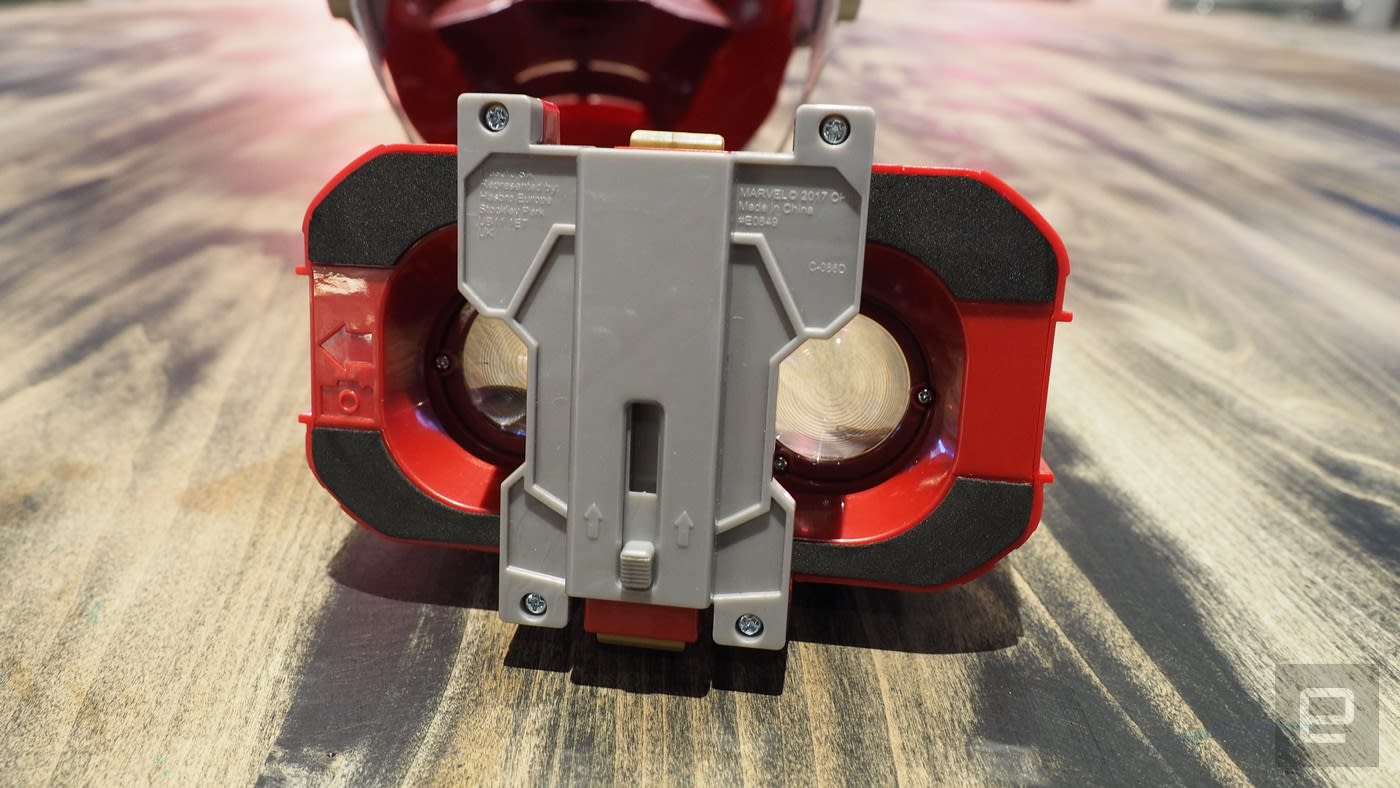
There are no headphones inside the helmet, which relies entirely on your handset for sound. It’s fairly low-tech in general: The front of the visor doesn’t glow in any way and in fact, you can see the phone through the eye holes. It’s a bit of a let down visually, but it’s a necessary evil so the phone’s camera can see your surroundings. The helmet does an excellent job of blocking out light: I was completely blind when the phone wasn’t actually on. However, the phone and goggles can also be removed from the helmet so the kids can just pretend to be Iron Man the old-fashioned way, sans game.
There’s a small red gauntlet with markings on it that allows the app to track your hand movements. It also has pegs to place “Infinity Stones” on, which function as power-ups in the game.
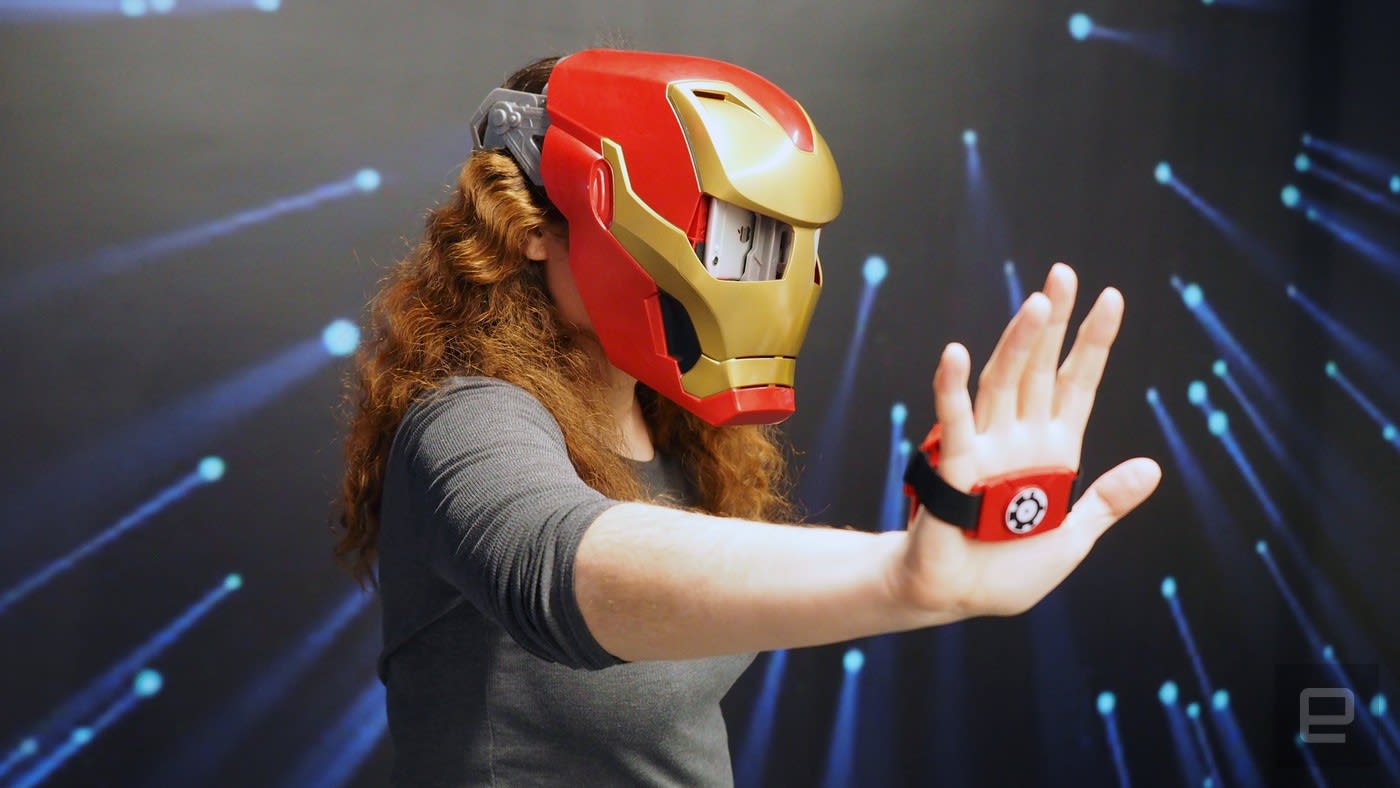
I put the helmet on sans glasses, and tried my hand at a few rounds of fighting Thanos’ minions and protecting an unnamed city. The first few levels were a little dull and served as a tutorial, but eventually it started to get a little frantic. I was turning in every direction to take out enemies before they hit me, putting up my hand to block incoming fire and listening to the cacophony of sound effects and voices reverberating in the helmet.
The conference room I was playing in at the time wasn’t terribly exciting, but I could see a backyard making for a more interesting backdrop. There’s also a freeplay mode planned, which would allow a kid run around with the HUD on, firing at their friends and pets but not having to worry about refilling ammo or taking down galactic villains.
Each round doles out in-game currency that allows you to purchase better weapons and armor, but there’s no real-world cash involved, so parents won’t have to give out their credit card info here. The game is completely self-contained and doesn’t rely on an internet connection. Everything’s stored on the device, so Hasbro doesn’t need to collect kids’ personal data and the game stays COPPA-compliant. Instead, the function of traditional in-app purchases have been replaced by the physical Infinity Stone toys, which Hasbro plans to make and sell more of later this year. As for the main set, it’ll be released this spring for $50, and includes the helmet, gauntlet and one Infinity Stone, just in time for kids to act out their favorite scenes from the new Marvel movie.
Android P might support ‘notched’ displays
It sounds like Google is taking inspiration from the iPhone X display’s notch for the next version of Android. The idea is for Android Pistachio Ice Cream (the software version’s internal name, according to Bloomberg) is to win potential iPhone customers over by offering a similar look to its OS. While some like Samsung have outright mocked the cut-out, other manufacturers like Essential (above) have embraced it. This move makes it sound like Google expects more of the latter than the former, which means you can likely expect to find more phones with all manner of sensors tucked into the space in the future. Chinese OEM Huawei is rumored to join the notched-display party as well.
What else can we expect from Android P? More Google Assistant in more places — potentially in the the home screen search bar — along with better battery life and apparently even support for foldable displays and multiple screens. Bloomberg’s sources are mum on any other details, but we’re closer to Google’s annual I/O conference, typically held each May, than we are away from it so more details (and rumors) likely aren’t far off. We’ve reached out to Google for more information and will update this post should it arrive.
Source: Bloomberg
HomePod Teardown Reveals Hidden 14-Pin Connector, 16GB Storage, and Very Low Repairability
iFixit has completed an exhaustive teardown of the HomePod and found that, while the speaker appears to have a simple design on the outside, it will likely be extremely difficult for customers to complete do-it-yourself repairs.
HomePod’s mesh has a drawstring
The teardown experts, who admit there might be a better way to open the HomePod that they’ve yet to learn, were forced to use a variety of tools to gain access to the internal components, including a heat gun, a guitar pick, a knife, and after all else failed, even a hacksaw and an ultrasonic cutter.
Underneath the rubber foot, iFixit found a hidden 14-pin connector that they speculate is probably used to test or program HomePods on pogo pins during assembly in Taiwan. Given the port sits below a layer of strong adhesive, it’s unclear if it will be used for any other purpose, such as diagnostic testing.
 HomePod’s hidden 14-pin port
Digging further, the team found the HomePod has an Apple A8 chip, as advertised, likely paired with 1GB of RAM layered underneath. There’s also a 16GB flash storage chip from Toshiba, although users can’t store songs on the speaker directly, as music must be streamed from Apple Music or an AirPlay source.
HomePod also has a two-part power supply, composed of an inner block handling the AC/DC conversion, and an outer ring distributing power to all eight of the speakers. The seven tweeters each have a conductive screw post.

In the end, the teardown concludes that the HomePod is very durable, but extremely difficult to open. This might explain why Apple is charging $279 to replace the HomePod entirely if it is damaged, unless only the power cable is damaged, in which case Apple charges a more reasonable $29 fee to have it repaired.

There’s also AppleCare+ for HomePod, which adds up to two incidents of accidental damage coverage, each subject to a service fee of $39 in the United States, plus the upfront cost of the plan. But even then, it still appears that Apple is simply replacing damaged HomePods outright beyond power cable repairs.
Related Roundup: HomePodTags: iFixit, teardownBuyer’s Guide: HomePod (Buy Now)
Discuss this article in our forums
Google ‘Embracing’ Notch Design in 2018 Android Update, Preparing for New Wave of iPhone X Clones
Google’s upcoming software update for its Android smartphone operating system will “embrace” an iPhone X notch-like design, according to people familiar with the company’s plans speaking to Bloomberg.
With the software, referred to as Android P, Google is readying a “new generation” of Android smartphones that will be “mimicking” the iPhone X’s front-facing camera cutout design.
Just like iPhone X, this cutout is believed to be where Android smartphone makers will be placing cameras and other sensors to help Android phones compete with Apple devices in the high-end market.
While Google controls the Android software, many other companies manufacture Android devices and have the ability to tweak the software as they see fit. Because of this, Bloomberg pointed out that “not all Android phones will have notches.”
In total, Google’s plan for Android P — shortened from Pistachio Ice Cream — is to convince more iOS users to switch sides by “improving the look of the software.”
While Android dominates the middle and low-end of the global smartphone market, Apple controls much of the high-end with users who spend more on apps and other services. Embracing the notch may help change that. The design will mean more new Android phones with cutouts at the top of their screens to fit cameras and other sensors. That will likely support new features, helping Android device makers keep up with similar Apple technology.
[…]building notch capabilities into Android suggests Google expects the iPhone X look to catch on more broadly.
Otherwise, Android P will reportedly focus heavily on Google Assistant and improving its abilities. Tighter software integration with the AI assistant will allow developers to integrate it inside of their apps, and Google is considering adding the assistant into the search bar on the Android home screen, but “neither of these changes are finalized for introduction this year.” Android P is said to also introduce improved battery life on smartphones and support new designs, including “multiple screens and foldable displays.”
Following the launch of the iPhone X, clones of the device began appearing around the world, including in China with the LEAGOO S9 smartphone and its notch-inspired design. Many users have disliked Apple’s notch design, and Android smartphone maker Samsung played into that criticism by making fun of the notch in a Samsung Galaxy ad posted on the weekend of the iPhone X launch.

While Android P is said to be a “dramatic” overhaul amid support for notch designs on a growing number of Android smartphones, Apple’s own iOS update in 2018 is believed to be focused more on stability. In January, it was reported that Apple has chosen to delay new software features until 2019 — like a home screen refresh, Mail improvements, CarPlay updates, and more — and instead focus on addressing performance and quality issues this year.
Related Roundup: iPhone XTags: Google, AndroidBuyer’s Guide: iPhone X (Buy Now)
Discuss this article in our forums
Apple Joins Group Investment in OLED Microdisplay Company eMagin Amid Ongoing AR/VR Efforts
Apple has joined a group of companies investing in OLED microdisplay maker eMagin, believed to be part of Apple’s overall virtual and augmented reality hardware strategy. LG, Valve, Immerex, and Stillwater Holdings have all joined in on the investment with Apple, which is said to be worth up to a total of $10.6 million (via TechCrunch).
eMagin confirmed the investment, stating that it will use the money for “working capital and general corporate purposes.” The company created “a new kind of display” to use in VR headsets that allows for sharper images, which it believes will help fuel the “next generation” of AR and VR devices.
eMagin’s technology is notable in that it has created a new kind of display that can be used in VR headsets, which provides a sharper image by using a denser layout of lines (versus the pixels commonly used in existing products). This helps reduces the so-called “screen door” effect on the display and makes what you see up close through the headset much sharper.
“We believe that our direct patterning technology is a key differentiator for enabling next generation AR/VR hardware for the consumer and enterprise segments because of the brightness and the pixel density afforded by the technology,” the company notes.
For Apple, the last few years have seen a ramp up in the hiring of talent and acquisitions of companies that all revolve around its AR/VR efforts. Since 2015, Apple has purchased several companies in this area, but some acquisitions date back even further. A few of these AR/VR acquisitions made by Apple include companies like Metaio, Faceshift, Emotient, Flyby Media, RealFace, and VRvana.
Apple has already put the technology behind Faceshift to use with Animoji in iPhone X, but outside of software the company’s plans for a hardware product in the AR/VR space remain unclear. Right now, plans for a pair of “smart glasses” or VR headset are believed to be in prototype stages, so if they do ever launch it will still be a few years down the road. More recently, a report suggested that Apple is ramping up development on an AR headset running a new operating system called “rOS.”
Apple CEO Tim Cook has said that any AR/VR hardware from Apple is a few years away because “the technology itself doesn’t exist to do that in a quality way.” At the time, Cook said that one of the biggest challenges for building such an AR headset today would be the display technology required to make it work, suggesting the new eMagin investment could be helping Apple in this area. One of the last major reports regarding Apple’s interest in AR hardware was the company’s meeting with potential AR glasses suppliers, said to have happened at CES last month.
Tags: Apple VR Project, augmented reality, eMagin
Discuss this article in our forums
 AIVAnet