


How to track, star, and delete messages with WhatsApp for Android

Sending messages is easy, but what do you with them after the fact?
Sure, sending messages is great, but how do you know the recipient is even reading them? What if you want to save some special messages for later? What is someone is throwing shade and you want to delete that nasty message? WhatsApp has some useful ways of getting these jobs done!
- How to check the status of your sent message in WhatsApp
- How to star messages in WhatsApp
- How to view all of your starred messages in WhatsApp
- How to delete messages in WhatsApp
How to check the status of your sent message in WhatsApp
Like virtually any messaging app, WhatsApp sends and receives read receipts. These are usually little messages or icons that let you know that your message has not only been received by the intended device, but that the owner of said device has at least glanced at it. Here’s how to tell!
Launch WhatsApp from your Home screen or from the app drawer.
Tap the chat you’d like to view.
Look for the check marks on the right of your sent messages. Your sent messages appear on the right side of the screen.
- One grey check mark means your message has been sent.
- Two grey check marks mean your message has been delivered.
-
The checkmarks turn blue when your message has been read

Some people turn off their read receipts so that they’re not being hounded to respond once the sender knows his or her message has been read. In these cases, you’ll be able to tell that your message has at least been delivered, but you won’t know if the recipient has read it.
If you don’t know how to turn your own read receipts on and off, you can check out How to set up and start using WhatsApp!
How to star messages in WhatsApp
Writing a collaborative story and your friend just laid down the best sentence you’ve ever seen? Something like “Then the cat barked?” You have to star it and save it for later! WhatsApp gives you that ability and even lets you unstar it later, when you realize that that was one of the dumbest things you’ve ever read. Here’s how!
Launch WhatsApp from your Home screen or from the app drawer.
Tap the chat you’d like to view.
Tap and hold the message you want starred.
Tap the star button at the top of the screen. A little star icon will now appear next to the message in the chat.

To unstar a message, follow the same steps.
Now you can quickly access your starred messages when you don’t feel like skimming through days of conversation.
How to view all of your starred messages in WhatsApp
You’ve been starring messages like a message-starring machine (that is so a real thing). You’ve got the directions to a party starred and now you need to look back because, like any good friend, you’ve forgotten them. Here’s how!
Launch WhatsApp from your Home screen or from the app drawer.
Tap the menu button on the top right of your screen. It’s the three vertical dots.

Tap Starred messages.
Tap the message to view it in the chat.

From the starred messages window you can also choose to unstar all by tapping the menu button on the top right of the screen.
Now you can star and save all the messages you’d like so that, later on, you can make a bowl of popcorn and take a stroll down WhatsApp memory lane. Ahh… Memories.
How to delete messages in WhatsApp
You’ve said something stupid. Your friend has said something hurtful and/or stupid and/or both. Either way, these messages are sitting in your chat window and you’re sick of looking at them. You can delete them from your phone by following these easy steps:
Launch WhatsApp from your Home screen or from the app drawer.
Tap the chat you’d like to view.

Tap and hold the message you’d like to delete.
Tap the delete button at the top of your screen. It’s the little trash can.
Tap Delete to delete the message from your phone. You can tap Cancel if you’ve changed your mind.

You can delete multiple messages by tapping and holding the first one, tapping everything else you want to delete, and then tapping the delete button. This will free up some room on your phone and will also keep your chat windows clean if you don’t like them cluttered up with photos and other media.
Just remember that deleting messages from your phone does not delete them on the other end, so the recipients in your chat will still be able to see everything you’ve sent until they delete it themselves.
In Amazon’s new sci-fi series, social media destroys the world
Amazon’s Electric Dreams on Prime streaming might not make you feel bad about your technology habits the way Netflix’s Black Mirror does, but the tech juggernaut has plans to remedy that with its latest show. The Feed is based off a book by the same name from author Nick Clark Windo, covering what happens when we’re able to download a social media feed directly into our skulls. But instead of sharing links to news sources of questionable repute, you’re sharing every thought and emotion you have. And you can see those of everyone else. The story picks up when the titular social network collapses and the world along with it.
The Walking Dead’s executive producer Channing Powell will lead the show and write a handful of episodes, according to Deadline, along with British production house Studio Lambert. It’ll be a ten-part series, but it sounds like the first season won’t cover the entirety of the book. “[The producers] see it as a returnable property and have already begun outlining ideas for seasons two and three,” Deadline writes.
The most interesting wrinkle here, perhaps, is that the source material only arrived in bookstores (and on Amazon, of course) last month. There isn’t a release date yet, but given the tech juggernaut’s penchant for optioning book-based ideas, if you get started fast enough, maybe your novel could be next.
Source: Deadline
Apple Picks Up ‘Little America’ TV Show Written by The Big Sick’s Kumail Nanjiani and Emily V. Gordon
Apple has picked up a new TV show called “Little America,” a half-hour anthology series written by Kumail Nanjiani and Emily V. Gordon, the duo behind popular movie “The Big Sick,” and Lee Eisenberg, who produced comedy series “SMILF” and will serve as showrunner.
According to Deadline, “Little America” is based on a series of true stories featured in Epic Magazine that paint a portrait of America’s immigrants. From the magazine description:
Everyone here came from somewhere else. Even Native Americans crossed the Bering Strait at some point. This is the basic American idea — an identity open to all — but it can be easy to forget from inside. And that’s when politics can turn ugly, as it has recently, with our political narrative becoming a story of blame and fear. “Little America” is meant to counter that narrative with a fuller portrait of our most recent arrivals. Here we present just a few stories.
You’ll meet a woman who kissed a car for 50 hours. A man who escaped communism via zip-line. A Hindu Mayor of a small Kansas town. These stories are a small, collective portrait of America’s immigrants. And thereby a portrait of America itself.
The show will reportedly look at “the funny, romantic, heartfelt, inspiring, and unexpected lives of immigrants in America.” Nanjiani and Gordon will executive produce, alongside Alan Yang, “Master of None” co-creator, and Eisenberg.
“The Big Sick,” written by Nanjiani and Gordon, won multiple award nominations and was the highest-grossing indie movie of 2017. Nanjiani is also known for his work on “Silicon Valley.”
“Little America,” alongside Apple’s “Are You Sleeping” drama starring Octavia Spencer, are two projects that are being developed for straight-to-series consideration.
Apple has already inked deals for several other shows that will go straight to series, such as an untitled morning show drama starring Jennifer Aniston and Reese Witherspoon, an “Amazing Stories” reboot from Steven Spielberg, an untitled space drama from Battlestar Galactica creator Ronald D. Moore, a series written by “La La Land” creator Damien Chazelle, a Kristen Wiig comedy series, See, an epic world-building drama, and Home, a docuseries focusing on incredible homes.
Apple now has at least nine television shows in the works, and details about each one can be found in the original content section of our Apple TV roundup.
Related Roundup: Apple TVTag: Apple’s Hollywood ambitionsBuyer’s Guide: Apple TV (Buy Now)
Discuss this article in our forums
Snapchat lets you create personalized Lenses for parties
If you post to Snapchat without a dancing hotdog or puppy face, did you even Snapchat? The platform already offers a baffling range of filters and AR novelties to play with, and now it’s getting even more. From today, users will be able to create their very own personalized face lenses for events and celebrations, and have access to a whole bunch of new caption styles.
There are over 150 lens templates ready to tinker with. Find them in the “Filters and Lenses” menu under settings (or visit snapchat.com/create from desktop), add your unique text, enter the time and location that you want your creation to be visible (from 20km to 5 million square feet) and you’re good to go. Just make sure you check out three hours before your event so your Lens runs on time. Prices will be based on location size, how long you want your Lens to run for, and how dynamic it is.
Also today, Snapchat is rolling out new caption styles. Users can select one (or two) from a range of artistic offerings, including brush, italic, glow, rainbow and gradient, among others, to personalize their Snaps. These are available for Snapchatters on iOS and Android, while custom Lenses are available for iOS users in the US, with global and Android availability coming soon.
A state-run wireless network isn’t a crazy idea, just ask Mexico
America’s mobile infrastructure isn’t good enough, at least according to former National Security Council officer Brigadier General Robert Spalding. Spalding’s briefing document said the US was lagging behind China in wireless, and the solution was to build its own federal 5G network. The memo cost Spalding his job and sent parts of Washington DC into fits of apoplexy over the proposals. But this idea, deemed too radical to even discuss in the US, has actually been implemented in countries like Mexico, Rwanda and Australia.
Spalding was advocating for an Open Access Wireless Network (OAWN), a country-wide cellular network that uses all the spectrum allocated for a band. Imagine that, instead of auctioning the 4G spectrum off to businesses, a nation builds and runs the infrastructure itself. Carriers would then buy capacity on the network to sell on as their own service, much like MVNOs (like Boost, Cricket and Project Fi) do on major US networks today.
The only difference between the current situation in the US and an OAWN is that in the latter, service is near-universal, so coverage is no longer a major selling point. Since the whole spectrum is allocated to a single network, the overall speeds are significantly faster, which is better for consumers. Lower cost, faster speeds and better distribution means 5G may be able to connect rural areas that remain without any access. It’s one of the reasons the OECD backs OAWNs as a way of increasing access and lowering prices to the internet.
Competition is essential to ensure prices remain low, making it harder for new companies to enter the mobile business. Infrastructure is sufficiently expensive that even a billion-dollar conglomerate like Google thought about, and then shied away from, competing with Verizon and AT&T. Mexico is a good example of what happens when a single entity has de-facto monopoly control over a country’s telecommunications.
Carlos Slim’s América Móvil is Mexico’s principal communications provider through its subsidiaries, Telmex and Telcel. It controls up to 80 percent of the country’s landline market and almost 70 percent of its mobile business. As far back as 2012, Mexico believed Telcel was too powerful, and sought ways to curb its dominance. Investopedia believes Móvil has blocked competitors by charging high fees to rivals looking to build businesses in Mexico. High prices and poor service have consequently become common gripes, and something had to give.
The Mexican government decided to establish its own OAWN in 2014, called Red Compartida (“Shared Network”). Altan Redes is building the network, which will cost around US$7 billion coming from a mix of public and private sources. Crucially, Altan is barred from launching its own wireless service, making it an impartial provider of capacity that it can sell on to others. Red Compartida is expected to begin on March 31st, 2018, covering just 30 percent of the population, but it’s hoped that by 2023, that figure will reach 92 percent.
The aims of Red Compartida are best described by local paper Excelsior: “There will be no first- and second-class Mexicans,” as “the infrastructure will guarantee the same quality for all.” It remains to be seen, however, if the expenditure and effort that has gone into the project will bear fruit. The infrastructure will need to work as intended, and entry needs to be cheap enough that new companies are encouraged to enter the market. But, so far, things are looking good.
Mexico’s attempt is the most notable, but it’s not the only place, by any means, that has thought about such a project. Kenya, South Africa and Russia have all considered, or attempted, to build an OAWN, but each one has stalled. Rwanda is the only other successful case, and it partnered with South Korea’s KT to build a country-wide 4G network that, by the start of 2018, covered 95 percent of the country. Given that only eight percent had access in 2014, that’s quite an achievement, but it’s hard at this early stage to determine if the effort has improved competition and lowered prices.
At this point in the life of OAWNs, it’s hard to judge if they are objectively better than the market-based status quo in many countries. This is made all the harder by the vitriol produced by the incumbent telcos, who have a justifiable reason for these projects to fail. The GSMA, which represents global mobile carriers, has published several reports decrying the practice.
Critics of OAWNs will likely point to Australia, which began building an open-access broadband network in 2007. Back then, the country pledged the National Broadband Network would connect fiber to every home and push Australia to the top of the world speed rankings. But the Financial Times describes the reality where, as recently as September, adoption has been slow, speeds sub-par and prices high. A 2016 report found the service had reached only 350,000 premises, and only 260,000 of those could actually order it.
“The provision of universal, high-speed capacity,” writes Tooran Alizadeh for The Conversation, “has been transformed into a patchwork of final speeds.” The reasons for the NBN’s ostensible failure have been down to the rollout, which was poorly implemented. Part of that was because, as Alizadeh alleges, the first sites chosen for connection were done so for political, rather than technical reasons.
Australia’s case may serve as a warning to other nations looking to adopt open-access networks, but that may be a mistake.There are obvious benefits such a system provides, argues Professors Peter Cramton (University of Maryland) and Linda Doyle (Trinity College Dublin). They describe the current US model as “an oligopoly where the regulator has a constant fight to maintain competition and promote innovation.”
Cramton and Doyle explain that, in many countries, “two or three carriers […] dominate the wireless market due to the enormous economies of scale in network infrastructure.” “Entry is nearly impossible,” they add, unless they had tens of billions to buy spectrum and build infrastructure to match incumbents. “The trick is to create an open-access market that allows anyone with a good idea to gain access to mobile communications at competitive rates.”
Nintendo will convert Gold Points into Switch game discounts
If you buy a lot of Switch games, good news — Nintendo is about to reward you with some discounted software. The company announced in a blog post today that you’ll soon be able to spend Gold Points — earned by purchasing Nintendo games — on Switch software in the eShop. Each Gold Point is worth one British pence, which means you’ll need to buy a lot of games (a £40 game on the eShop will net you 200 Gold Points, or £2) before you can get something substantial for free. If you don’t have enough points, you can always make up the difference with regular cash.
The change will come into effect in “early March” for UK and European Switch owners. (We’ve asked Nintendo for confirmation that the same scheme will be available in the US.) Gold points are valid for a year, which means you can wait and accrue a sizeable stack of games before cashing in their associated points on a new title. Nintendo trialed the concept the last year with a smattering of 3DS and Wii U titles. It was a temporary promotion, however, and limited to “Nindies” such as Runner2, Art of Balance and Zen Pinball 3D. Expanding the concept to Switch is a smart way to boost the system’s already impressive software attach rate.
From early March, you’ll be able to use #MyNintendo Gold Points in #NintendoSwitch #eShop.
More details here: https://t.co/a6GSxZ45AL pic.twitter.com/MipJDaQPkh
— Nintendo of Europe (@NintendoEurope) February 8, 2018
Source: Nintendo (Blog Post)
GDC 2018 will feature the event’s first film festival
The Game Developers Conference (GDC) takes place in San Francisco next month and this year’s event includes the GDC’s first ever film festival. For three days starting March 19th, the GDC will host a selection of documentary and narrative films focused on the art and culture of video games, and Q&As with the filmmakers will follow most of the screenings.
Each day of the festival with be themed. The first day, focused on international works, will feature screenings of Branching Paths, Moleman 4 — Longplay and the premiere of Heting Chen’s Indie Games in China. The second puts the spotlight on webseries with the premiere of the feature-length version of The CheckPoint Series and two work-in-progress screenings of Noclip: Horizon: Zero Dawn and Area 5’s Outerlands. The last day features works on arcade history and includes Touching Sounds, The Lost Arcade and the premiere of Josh Tsui’s Insert Coin: Inside Midway’s 90s Revolution.
Anyone with a GDC 2018 pass can view the films and admittance is on a first-come first-served basis. GDC 2018 kicks off on March 19th and runs through the 23rd.
NASA tests treatment that could slow astronauts’ muscle loss
Even though astronauts exercise everyday while they’re aboard the International Space Station (ISS), they still experience a fairly significant loss of muscle mass. So much so that they require physiotherapy once they return to Earth. However, researchers with the Houston Methodist Research Institute and the Novartis Institute for Biomedical Research are testing a device that can continuously administer a medicine that may help prevent muscle deterioration, Seeker reports. The team sent 40 mice to the ISS in December, some with devices that deliver the drug and some with devices that just deliver an inactive solution. Half returned to Earth in January and the other half will do so this month.
The device is an implanted nanochannel delivery system that can administer the medicine automatically on its own. And the drug is formoterol, a medication that relaxes muscles and is used to treat asthma and chronic obstructive pulmonary disease. The researchers are evaluating how the device and the drug work on muscle loss in the mice and while astronauts stand to benefit from this type of treatment, so do people on Earth. Those with diseases that keep them immobile for months also experience significant muscle deterioration and would benefit from a drug that could help slow or prevent that loss. Additionally, the device could administer other types of drugs such as HIV treatments that must be taken regularly without interruption.
The device isn’t yet approved by the FDA, so it will be some time before it can be tested on humans. But as we gear up to crewed missions to Mars, which will require astronauts to live in microgravity for far longer periods of time than those who work on the ISS, a muscle-loss intervention will be required. And one like this that astronauts won’t have to administer themselves and can last for months on end seems to be an ideal solution.
The research team is also working on a version of the device that can be controlled remotely. It’s scheduled to be tested on the ISS sometime next year.
Via: Space.com
Source: NASA
How to buy a camera in 2018
Smartphones have replaced dedicated cameras for most folks, but weirdly, that’s a good thing for photography lovers. With fewer boring point-and-shoots, manufacturers are focusing on building incredible cameras like Sony’s RX100 Mark V compact, the Fujifilm X-T2 mirrorless and Nikon’s high-end, full-frame D850 DSLR. For $500 and up, these models deliver faster shooting than ever, 4K video, wireless mobile sharing and more.
Performance and features vary wildly beyond that, though, and there are often several excellent choices in the same price range and camera category. Which model to get, then, depends strongly on your budget and what you’re planning to do, whether it be tourism, art photography or student films. I’m here to break down all the features of each model, look at the subtleties and help you ask yourself the right questions.
The basics

DSLRs have a reflex mirror that lets you look directly through the lens at your subject. When you take a shot, the mirror jumps out of the way to expose the sensor. All of that adds bulk and, for most models, means you can’t see the “decisive moment” when you take a photo.
At the same time, the mirror allows DSLR makers to put autofocus phase-detect sensors directly into the light path via a secondary mirror. Those measure the distance to your subject before you even take the picture, making autofocus nearly instantaneous. You lose that advantage, however, when you shoot videos or photos in live-view mode with the mirror up.
Mirrorless and compact cameras rely on electronic viewfinders (EVFs) or, in many cases, just a rear display. EVF quality has improved a lot over the past few years but still lacks the clarity of a DSLR’s optical display. Many EVFs also have a touch of lag, so the scene you see may be a few milliseconds behind reality. On the other hand, unlike an optical viewfinder, an EVF shows exactly what the final image will look like.
For autofocus, most mirrorless cameras have contrast-detect autofocus that must “hunt” for proper focus via a sort of trial-and-error method. That means mirrorless cameras generally have slower AF performance than DSLRs when taking photos. There is no disadvantage, however, in autofocus performance when shooting video.
DSLRs and mirrorless cameras let you change lenses, but you’re stuck with what’s built into a compact camera. While that’s great for portability, a single lens means you’re going to sacrifice something. Fujifilm’s X100F, for instance, has a fast but fixed 35mm-equivalent f/2.0 lens and no zoom. Sony’s RX100 V has a 24-70 mm zoom, but it’s slower at the telephoto end (f/2.8) and less sharp than a prime lens.
DSLR vs. mirrorless vs. compact

So should you get a DSLR, mirrorless or high-end compact camera? And do you need a one-inch, micro four-thirds, APS-C or full-frame sensor? How many megapixels? What about the low-light sensitivity?
Let’s break these things down with some nice charts. Bear in mind that the points apply in most but not all cases. For instance, recent DSLRs and mirrorless cameras have improved live-view autofocus, vastly closing the AF performance gap.
| DSLR | Mirrorless | Compact |
| Best battery life | Less battery life | Least battery life |
| Purity/clarity of optical viewfinder, but you can’t see the final result | Electronic viewfinder or rear display only, less clarity but what you see is what you get | Electronic viewfinder or rear display only, less clarity but what you see is what you get |
| Fastest, most accurate autofocus | Good autofocus but a notch below DSLR | Another notch below mirrorless |
| Most lens options for Nikon and Canon, allows maximum creativity and choice | Good lens options, lack of a mirror means smaller lenses and slightly better optics than a DSLR | Only one lens means less creative control but lightest, least bulky option |
| Heaviest and bulkiest, good for professionals but bad for tourists who want to pack light | Much lighter than a DSLR but also less stable for video and when shooting with large lenses | Extremely light, often pocketable size |
Sizing up sensors
Think of camera sensors like sports cars but in reverse: The bigger the sensor, the sportier and more expensive the camera. With that extra performance, though, more things can go wrong when you make a mistake.
Full-frame is the Lamborghini of sensors, available on pricey cameras like Sony’s A7R III, the Nikon D850 and 5D Mark IV from Canon. At a size equivalent to 35mm film (36 x 24 mm), it offers the best performance in terms of image quality, low-light capability and depth of field. It’s also the most expensive and finicky. While images can look beautiful when you shoot at f/1.4, the depth of field is so razer thin that your subject’s nose might be in focus but not her eyes. This can also make video shooting difficult.

The next size category is APS-C (around 23.5 x 15.6 mm), offered on most of Fujifilm’s X-series lineup, Sony’s A6500 and the Canon 7D Mark II, among many other models. It’s cheaper than full frame, both for the camera body and lenses, but still brings most of the advantages. You get still get dreamy bokeh, high ISOs for low-light shooting and relatively high resolution. With a sensor size equivalent to 35mm movie film, it’s ideal for shooting video, and focus is less demanding than with full-frame cameras.
Micro Four Thirds (17.3 x 13 mm), a format shared by Panasonic, Minolta and Olympus for all of their mirrorless cameras, is the next step down in sensor size. It offers more even lower resolution, bokeh and light-gathering capability than APS-C and full frame but allows for smaller and lighter cameras and lenses. For video, you can still get reasonably tight depth of field with good prime lenses, but focus is easier to control. If you want a DSLR, none are available with Micro Four Thirds sensors.
The other common sensor size is Type 1 (1 inch). That’s used mostly by compact models like Sony’s RX100 V and the Panasonic Lumix G7X II. The smaller size permits a smaller camera body and lens but still offers much better image quality than a smartphone. Most high-end compacts, unlike many DSLRs and mirrorless models, offer 4K video.
It’s worth mentioning that Sony makes the sensors for nearly all other camera manufacturers nowadays, with the exception of Canon and, in some cases, Nikon. Earlier this year, Sony told Imaging Resource in a since-deleted article that it keeps its best technology for itself.
| Full frame | APS-C | Micro Four Thirds | Type 1 |
| Largest size (36 x 24mm) and highest resolution, up to 50 megapixels | Second largest size (22.2 x 14.8mm Canon and 23.5 x 15.6mm others), resolution up to 24 megapixels | 17.30 x 13mm sensor size, resolution up to 20 megapixels | 13.20 x 8.80mm sensor size, resolution up to 20 megapixels |
| Largest pixels for dimly lit photos and video with less noise, usable up to ISO 104,200 | Pixels still big enough for low-light photos but more noise than full frame | Not the best for low light, with the exception of purpose-built models like Panasonic’s GH5s | Even the best models like Sony’s RX100 V will be noisy above ISO 6400 |
| Razer-thin depth of field for artistic bokeh | The sweet spot for video, but fewer artistic bokeh possibilities than full frame | Decent but not spectacular bokeh | You’ll need to zoom in and use a low f/stop for blurred backgrounds |
| Narrow depth of field creates problems with focus and bright sunlight | Easier to control focus and shoot in bright light | Focus and light more easily controlled | Relatively easy to nail focus, even wide open |
Video

If video is why you’re buying a mirrorless or DSLR camera and decent photos are just a bonus, then your needs change radically. For vlogging, you probably want a “selfie”-type flip out rear screen — an item that’s not available on any Sony mirrorless camera, but can be found on other models like Canon’s Rebel T7i and the Panasonic GH5.
Here are a few other things you need to ponder. Does your camera line-skip for video recording, or readout the whole sensor? Sony’s A7S II and A7R III, for instance, read the whole sensor, but only in cropped APS-C mode. The A6500 and the GH5, by contrast, scan the entire sensor and super-sample, giving you crisp video with no nasty moire and aliasing artifacts.
Is rolling shutter, or the “jello” effect that can skew video, well controlled? All CMOS cameras have it, but it varies a lot by model. It’s pretty brutal on Sony’s A7S and A7S II, for instance, but much better on the Sony A9 and Panasonic GH5.
Other things to consider: How’s the form factor for video (smaller isn’t necessarily better)? How long can you shoot before the camera heats up or stops? Does it support 10-bit HDR video? Is there a microphone and/or a headphone jack? (if you do a lot of interviews, it’s preferable to have both.) How’s the video autofocus? With its fast, accurate Dual Pixel AF, Canon models like the 7D Mark II and Rebel T7i are the gold standard for vloggers and one-man-band shooters, but Sony’s latest models are catching up.
OUR TOP PICKS
Best cameras if money is no object
Over the past few months, a pretty clear consensus has emerged about the top two cameras on the market: the Sony A7R III and Nikon D850. That’s convenient, because the Nikon is a DSLR and the Sony a mirrorless camera, and each model plays to the strengths of its category. Yet neither model has any real weak spots, and image quality is spectacular on both. Another dark horse is Canon’s 5D Mark IV, but it’s due for a refresh and can no longer keep up with newer rivals.
The Sony A7R III
Until recently with Sony’s A7 series, you got to choose the A7S models for low-light capability or resolution with the A7R. The A7R III mirrorless breaks that mold, because with a 42.4-megapixel sensor and 102,400 max ISO, it does both of those things well. It can even go where high-resolution cameras aren’t supposed to, shooting 10fps in bursts and recording 4K video internally with a full (albeit cropped) sensor readout. Autofocus speeds are faster than ever for both video and photos too, thanks to improved contrast detection AF and faster processing. For what you get, the $3,200 asking price is actually reasonable.
Nikon D850
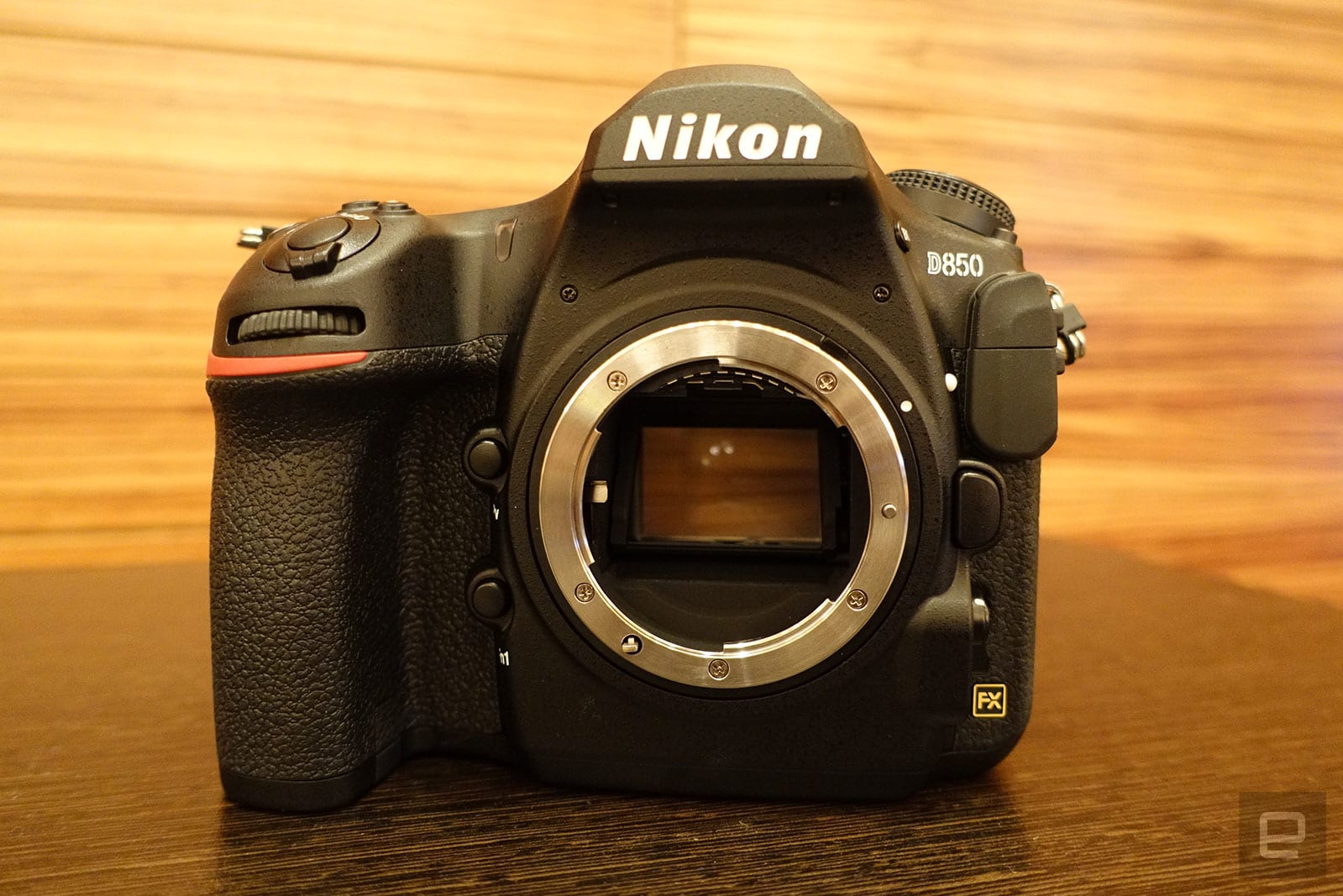
If mirrors are more your thing, Nikon’s $3,300 D850 is the camera du jour. With a 45.7-megapixel sensor and max 102,400 ISO, image quality is on par with Sony’s A7R III. It can also shoot fast, at up to 7fps, which is far from the 14fps of the more professional D5 but, again, incredibly good for such a high-res camera. Nikon has upped its video game as well with the D850 by introducing 4K internal recording. Choosing between the A7R III and D850 is a tough call, but Nikon’s model has better handling and speed for pro photographers while Sony takes the prize for video shooters.
Best mirrorless cameras
Sony A7R II, A7S II, A7 II
Sony is currently the only game in town for full-frame mirrorless cameras. If the new A7R III is too rich for your blood, however, Sony still manufactures the high-resolution 42.4-megapixel A7R II and low-light monster 12.4-megapixel A7S II, both priced around $2,500. If that’s still too much, consider the $1,100 24.3-megapixel A7 II, which has built-in 5-axis stabilization. All three cameras are great for video, thanks to built-in microphone and headphone inputs, but if you need 4K, you’ll have to spend more — the A7 II is limited to 1080p.
Fujifilm X-T2

If you like your controls manual and your bodies classic, the $1,600 Fujifilm X-T2 already has you sold. But underneath that lovely exterior, there’s much-improved performance over its predecessor, the X-T1, especially for autofocus. With a new 24.3-megapixel X-Trans III CMOS sensor and image processor, you can shoot up to 8fps in burst mode and capture 4K video at 30fps. Compared to its main rival, Sony’s A6500, the X-T2’s better handling gives it an edge for shooting stills while the Sony excels at video.
Sony A6500
Sony’s central theme when it launched the $1,400 Alpha A6500 mirrorless was speed. Thanks to a buffer that’s baked directly onto the sensor, you can focus in five-hundredths of a second and shoot at 11fps for up to 30 seconds, capturing more than 300 shots. And when it comes to video, the A6500 is the APS-C champ, handling 4K at up to 30fps by sampling the entire 6K sensor, making for crisp, artifact-free video.
Panasonic GH5 and GH5s
Video shooters have embraced the GH5 ($2,000) and new GH5s ($2,500). Despite the smaller sensor and reduced bokeh compared to, say, the Sony A7S II, the GH5 is the only mirrorless consumer camera to offer 10-bit, high-data-rate 4K-video recording. That gives you a large amount of control over video in postproduction, letting you tweak the colors to a fine degree. It also allows producers to create HDR videos that are perfect for today’s modern TVs and projectors. You also get both headphone and microphone inputs.
Olympus OM-D E-M10 Mark III
Money is an object for many of us, and that’s where Olympus’ sweet, badly named OM-D E-M10 Mark III comes in. For just $650, you get everything a beginning- to intermediate-level shooter could want, like manual adjustment dials, a compact size, 2.36-million-dot electronic viewfinder, 5-axis in-body stabilization and 4K, 30fps video. The drawback is its Micro Four Thirds 16.1-megapixel sensor that’s both smaller and lower resolution than on rival cameras. Image quality is good, but you’ll get more noise and less-dynamic range in low-light images. Battery life is not the best either.
Best DSLRs
Nikon D810
With the D850 now at the top of Nikon’s DSLR food chain (bar the pro-oriented D5), the full-frame D810 became a lot more interesting. The new model pushed the D810’s price down to around $2,400, but it’s still an ideal portrait and landscape camera, thanks to the 36.3-megapixel filterless design. It’s a lot bulkier than mirrorless models like the Sony A7R II, but many photographers find that gives it better stability, toughness and handling. For video, you’ll want to look elsewhere if you need 4K, as the D810 is limited to 1080p.
Canon EOS Rebel T7i
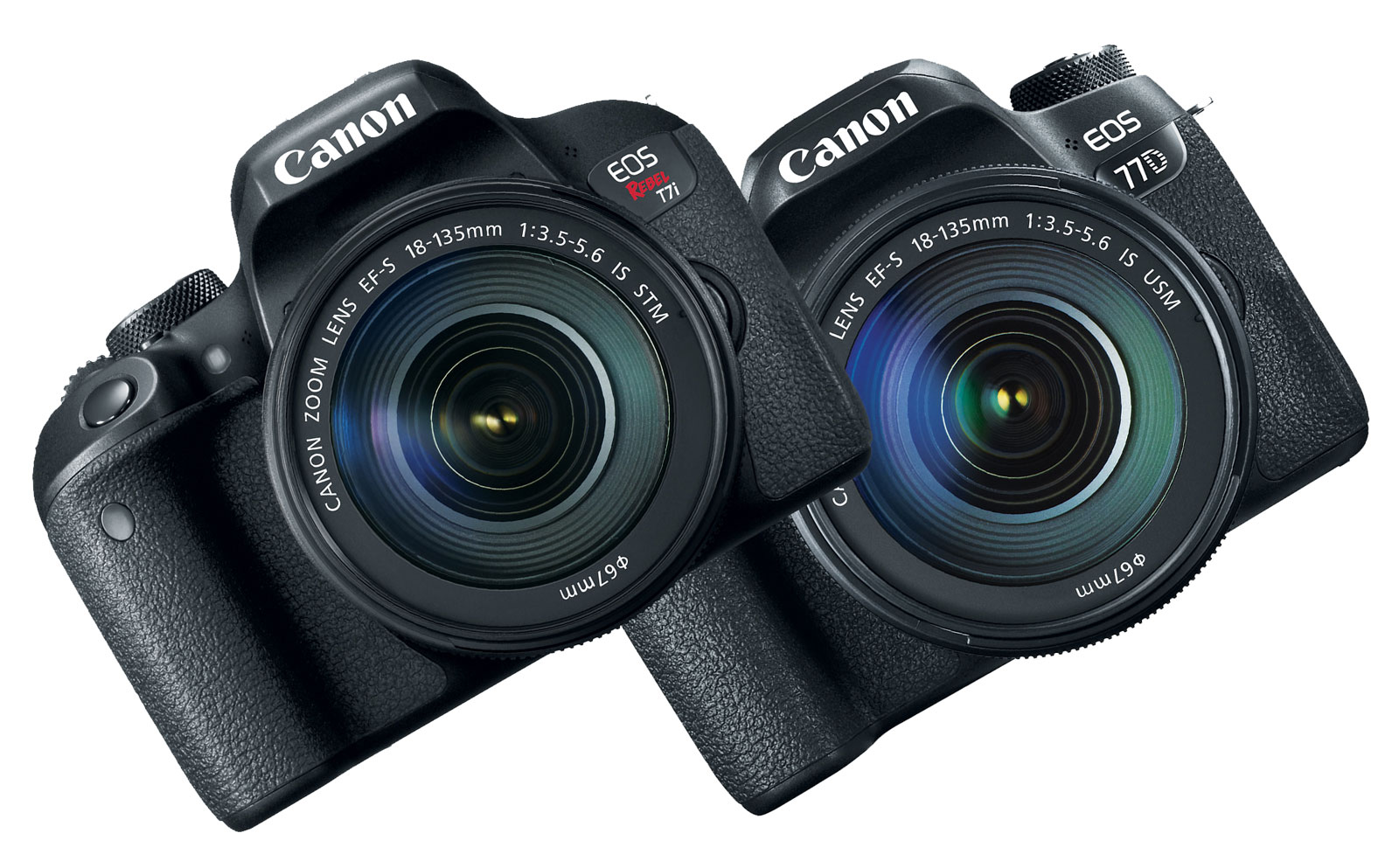
Nikon and Canon both offer numerous APS-C sensor DSLRs, but the best value of the bunch might be the Rebel T7i, launched last year. For $750, you get a 24.2-megapixel, 45-point autofocus sensor that shoots at 6fps with better low-light capability (up to 25,600 ISO) than before. It has NFC, WiFi and Bluetooth capability for quick sharing and a less fiddly user interface. Drawbacks? As with other DSLRs, there’s a frustrating lack of support for 4K video.
Nikon D3400
The fact that you can find Nikon’s D3400 with no fewer than two kit zooms for less than $600 makes it one of the true bargains out there. The 24.2-megapixel sensor delivers great image quality, and performance is decent, thanks to the 11-point autofocus system and 5fps continuous shooting. Bonus features include a flip-up rear screen and Nikon’s SnapBridge Bluetooth for easy file sharing. On the downside, that screen isn’t a touchscreen, and video resolution is limited to 1080p.
Compact cameras
Fujifilm X100F
If you like to record while walking around or are a travel photographer who wants the best in your pocket, there’s Fujifilm’s X100F. The fixed 23mm f/2.0 lens is a hard sell, but like any prime, it offers better quality than a zoom. Apart from that, you get everything you could want in a compact, like 8fps burst shooting, a hybrid optical/EVF and 24.3-megapixel X-Trans sensor seen in the X-Pro2 and X-T2. It also features easy-to-use manual dials and squeezes all of that into an elegant, tiny package.
Sony RX100 Mark V

Sony’s flagship compact has such a high level of impressive technology that it’s worth every penny of its admittedly high $1,000 asking price. You get a fast 24-70mm equivalent f/2.8-2.8 lens, a 2.36-million-dot OLED EVF, optical image stabilization and a 20.1-megapixel sensor. The standout feature, however, is the speed: You can shoot 24 RAW images per second for 150 shots and focus on your subject in just .05 seconds. As with other Sony cameras, the RX100 V’s Achilles’ heel is its handling; you’ll have to contend with a wonky menu system and a limited selection of manual controls.
Panasonic Lumix TZ100/ZS100
If you’re looking for a superzoom and don’t want to spend an insane $1,700 on Sony’s RX10 IV, take a look at the Panasonic Lumix ZS100. For about $1,000 less ($700), you get an EVF, 1-inch sensor, f/2.8-5.9 25-250mm equivalent zoom, 5-axis optical stabilization, 10fps continuous shooting and 4K video at 30fps. Sure, the zoom range and shooting speeds aren’t as impressive as Sony’s RX10 IV, but almost nobody needs those features and the ZS100 is less than half its weight and size.
Wrap-up
There’s never been a better time to buy a camera, as new DSLR, mirrorless and compact models can handle just about everything you throw at them. At the same time, cameras are among the most technologically complicated devices you can get and can cost thousands of dollars, so making the right decision is crucial. The key is to decide what you want to do with one and find the model with the features that best fit. Once you’ve narrowed it down, head to a camera store so you can find the one that feels the best in your hands.
Lawsuit claims Google ‘knowingly sold’ Pixels with microphone issues
Shortly after Google released its first branded smartphones in 2016, the Pixel and Pixel XL, some early adopters reported a microphone issues. While they were fixed in phones produced later, the problems disabled all three mics on the devices and often cropped up at odd times, like when holding the devices in different ways or in cold temperatures. Now the search giant faces a class-action lawsuit alleging that the company knew about the issues but sold the phones anyway.
At the time, a Google employee on the Pixel support forums stated that it might be caused by “a hairline crack in the solder connection on the audio codec,” internal damage that might even be caused by simply dropping the phone a short distance. The search giant supposedly prevented in later phones with tweaks in the manufacturing process, but didn’t offer a fix for current phones — just replacement under warranty.
The lawsuit (PDF) claims that even some phones replaced under warranty experienced the microphone issues — and regardless of the fixes in place, continued to knowingly sell Pixel and Pixel XL devices with the defect.
“Despite receiving hundreds of complaints shortly after launch — and admitting the phones have a “faulty microphone” — Google continues to sell the Pixel phones without telling purchasers about the microphone defect. Moreover, instead of fixing the defective Pixel phones, providing refunds, or replacing the devices with non-defective phones, Google has replaced defective phones with other defective phones, resulting in many consumers repeatedly experiencing the microphone defect,” the lawsuit stated.
We reached out to Google for comment on the matter and will update when we hear back.
Via: 9to5Google, Fast Company
Source: “Patricia Weeks and Waleed Anbar, et al v. Google LLC” (PDF)
 AIVAnet