


What’s next for SpaceX after its successful Falcon Heavy flight?
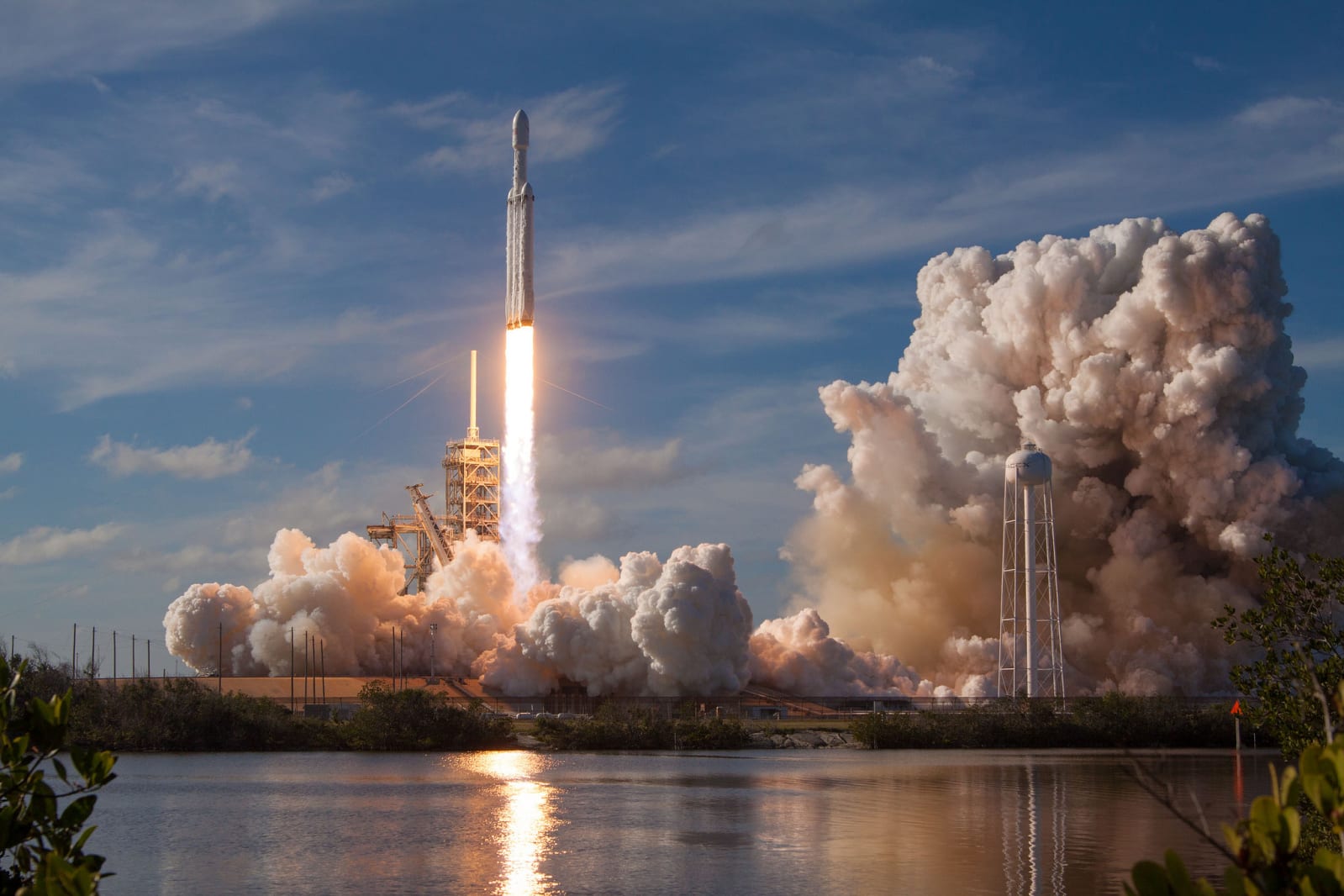
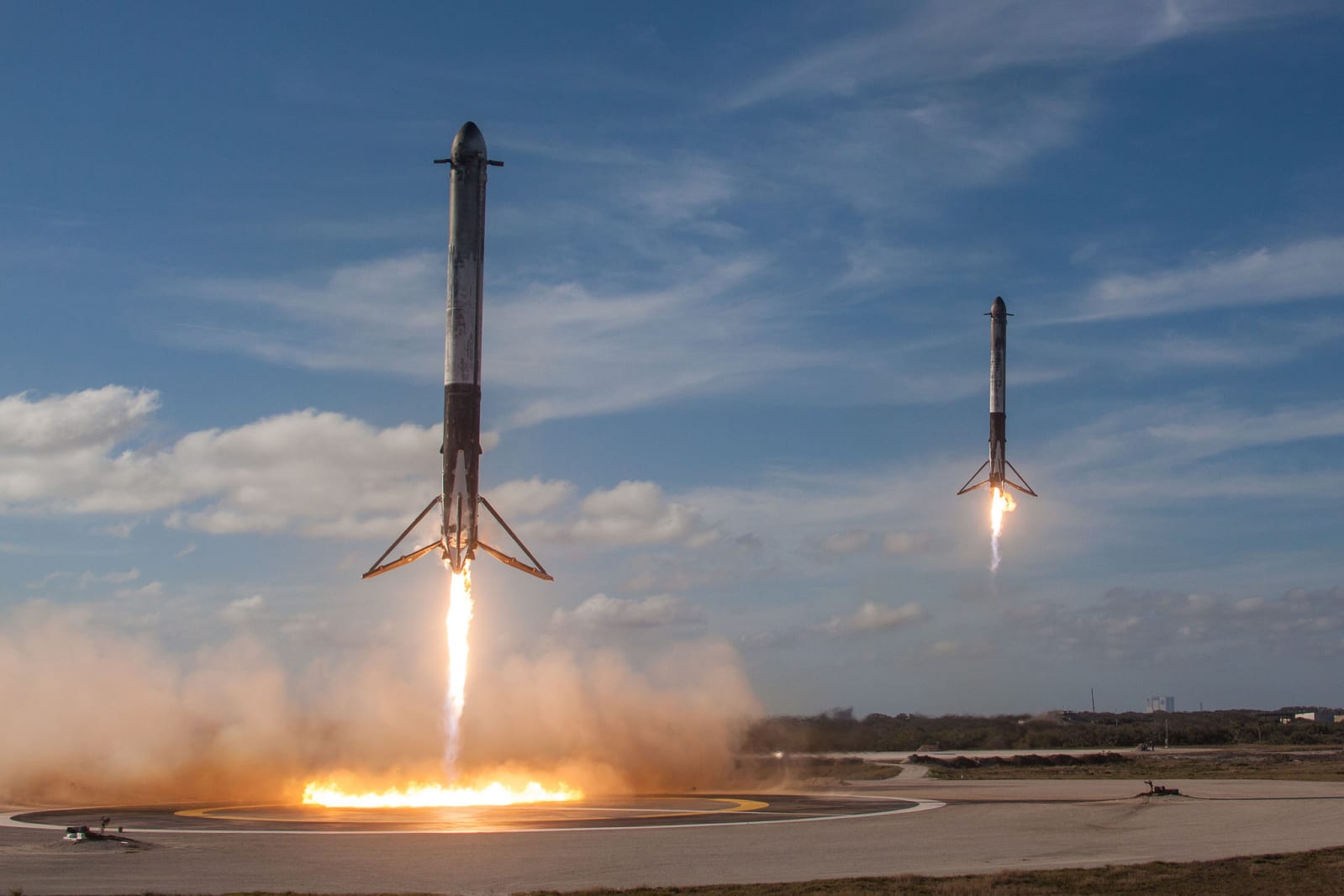
Yesterday, SpaceX successfully launched its Falcon Heavy rocket to much fanfare. After numerous delays due to upper-level winds, the rocket lifted off at 3:45 PM ET on Tuesday. The rocket worked perfectly, delivering the test payload into orbit (a red Tesla roadster) and coasting for six hours before performing another engine burn to take it deeper into the solar system. SpaceX was even able to land two of the three boosters in beautiful synchronization. The core booster was lost because of low propellant; it slammed into the ocean at around 300 miles per hour, 300 feet from the drone ship.
This is a huge milestone for SpaceX. The question now is: What’s next?
There were a lot of expectations pinned on this rocket, if not this specific launch. It would have been disappointing (rather than catastrophic) if the rocket had failed; SpaceX could have attempted another Falcon Heavy launch in another few months, assuming the launch pad survived. It was a test flight, not a make-or-break launch. But it was crucial for what’s to come.
With the successful Falcon Heavy maiden voyage, SpaceX has proven that it’s capable of lifting massive cargo into orbit. The rocket is, after all, now the biggest and most powerful operational rocket in the world. It’s second only to the Saturn V rockets of the Apollo era in terms of lift power to low Earth orbit (though the Space Shuttles had more thrust power at launch).
This means that SpaceX now has a launch vehicle capable of lifting over twice the payload of any other operational rocket. But right now, the Falcon Heavy only has a few additional launches scheduled. Customers include a Saudi Arabian communications satellite, the US Air Force and a test of solar sail technology from The Planetary Society. However, as NASA’s own behemoth rocket, the Space Launch System (SLS) continually overruns budgets and is delayed, it’s conceivable the organization could turn to SpaceX for its heavy-lift needs. Additionally, now that SpaceX has proven the Falcon Heavy works, it will encourage more customers to book launches.
The Falcon Heavy’s low price is another mark in its favor. While there isn’t a lot of transparency around how much the rocket launches cost, it’s clear that SpaceX is generally priced lower than its competitors. Last year, Ars Technica analyzed a 2014 GAO (Government Accountability Office) report for the cost estimates for launches with rival ULA (United Launch Alliance), and came up with a predicted $422 million per launch. In comparison, the Falcon Heavy (which can lift significantly heavier payloads to low Earth orbit) is advertised at $90 million per launch on SpaceX’s website. Additionally, on the post-launch press call, Elon Musk stated that the Falcon Heavy project’s total cost was about $500 million. The cost of NASA’s SLS, when all is said and done, will be about $1 billion — per launch.
But SpaceX isn’t stopping with the Falcon Heavy. On the pre- and post-launch press call, it was clear that while Musk was excited about the Falcon Heavy, he had already turned his attention to something bigger: the BFR (or Big Fucking Rocket).
“I was looking at Falcon Heavy, and thought it’s a bit small,” Elon Musk said on the pre-launch press call.
Musk surprised reporters when he revealed that the Falcon Heavy would likely not be human-rated (certified to carry people). Instead, development on BFR has been going so well that the company now envisions skipping human-rating the Heavy entirely.
The BFR is a reusable spaceship/rocket combination designed to deliver payloads (and people) into orbit as a part of SpaceX’s Interplanetary Transport System. According to Musk, the booster (called the BRB, or Big Rocket Booster) will return to Earth, much like the Falcon 9 and Falcon Heavy, around 10 minutes after the rocket takes off. The ship is actually the more complex part of the equation. Building a reusable spacecraft that can survive the heat of Earth reentry is incredibly challenging; it was one of the most difficult parts of designing the Space Shuttle.
But the BFR’s spaceship isn’t designed to just hang out in low Earth orbit. The Falcon 9 can take care of that; it’s designed to head out beyond our orbit. That much-hyped Moon tourist flight? That will now take place on the BFR instead of the Falcon Heavy, according to Musk. But this also means that the ship has to be able to survive reentry at interplanetary, rather than orbital, velocities. The spaceship portion of the BFR might be ready for “short hopper flights” as early as 2019, said Musk, with a full test flight in the next three to four years.
The bottom line is that development on the Falcon Heavy is pretty much over. Musk is happy with its performance and ready to turn it into a workhorse rocket. Musk commented that SpaceX could even strap another two boosters to the rocket to make it even more powerful, labeling it the “Falcon Super Heavy.” Indeed, the versatility of the Falcon Heavy launch is one of its strongest attributes. “It’s up to customers what they might want to launch,” Elon Musk said at a post-launch press conference. “But it can launch things direct to Pluto and beyond. No stop needed.”
That being said, the end product of the Falcon Heavy is largely finalized. “Most of our engineering resources will be dedicated to BFR,” Musk said. It makes sense — after all, the ambition of the BFR is quite breathtaking, and it’s not going to be easy. Though SpaceX’s achievements may seem effortless, it’s anything but. This week, Musk revealed to reporters that the Falcon Heavy program was almost cancelled three separate times because of its sheer difficulty. It turned out that creating a heavy lift rocket was a lot more complicated than strapping three Falcon 9s together, and making a human-rated interplanetary travel system is going to be even more difficult.
From the aforementioned challenges of reentry to the sheer size of the booster and its 31 massive engines, there’s a lot to figure out. And there’s no guarantee that SpaceX will be able to do it. Considering its track record, though, it seems safe to say the company is well-suited to making it happen.
While the Falcon Heavy was indeed a huge step forward for SpaceX, and the test launch went better than anyone could have anticipated, it’s clear that this is just a stepping stone in SpaceX’s ambitions. The achievement is notable in and of itself, but it’s even more remarkable for what it heralds: a new era in interplanetary spaceflight and a bright future for the ambitions of SpaceX.
Inline images: SpaceX
Police in China are scanning travelers with facial recognition glasses
Police in China are now sporting glasses equipped with facial recognition devices and they’re using them to scan train riders and plane passengers for individuals who may be trying to avoid law enforcement or are using fake IDs. So far, police have caught seven people connected to major criminal cases and 26 who were using false IDs while traveling, according to People’s Daily.
The Wall Street Journal reports that Beijing-based LLVision Technology Co. developed the devices. The company produces wearable video cameras as well and while it sells those to anyone, it’s vetting buyers for its facial recognition devices. And, for now, it isn’t selling them to consumers. LLVision says that in tests, the system was able to pick out individuals from a database of 10,000 people and it could do so in 100 milliseconds. However, CEO Wu Fei told the Wall Street Journal that in the real world, accuracy would probably drop due to “environmental noise.” Additionally, aside from being portable, another difference between these devices and typical facial recognition systems is that the database used for comparing images is contained in a hand-held device rather than the cloud.
Obviously, there are privacy concerns regarding this technology and not everyone believes police should be using it. Amnesty International’s William Nee told the Wall Street Journal, “The potential to give individual police officers facial recognition technology in sunglasses could eventually make China’s surveillance state all the more ubiquitous.” Last month, reports surfaced that China was using facial recognition to geo-fence residents of the Muslim-dominated Xinjiang region of the country, a move that has attracted criticism from a number of human rights groups. China is also working on building a facial recognition database that will contain info on all of its 1.3 billion citizens.
This time of year is one of the busiest travel periods in China as this month hosts the lunar new year. Around 389 million train trips are expected to take place during this year’s Spring Festival as well as 65 million trips by air.
Via: Gizmodo
Intel’s all-in-one Xeon chip will speed up car connectivity
Intel’s Xeon chips normally reside in distant server rooms or brawny workstations. But that’s not ideal for the modern internet, where connected cars, VPNs, streaming video and other tech frequently needs computing power somewhere in between. That’s where its newly launched Xeon D-2100 processor might come into play. The system-on-a-chip is designed to bring the performance of a Xeon to the “edge” of a network, where that extra speed might be more effective. It includes up to 18 cores and the requisite hooks for four 10Gbps Ethernet ports, but uses ‘just’ 60W to 110W of power. In other words: you could tuck some of these into a local office without the demands that normally come with server chips.
The company hasn’t divulged pricing, although it’s safe to presume you won’t be buying one for home use. And in case you’re wondering: yes, there will be software updates to make sure they aren’t vulnerable to Meltdown and Spectre security flaws.
Ideally, these CPUs would eliminate bottlenecks that you sometimes see when cloud services depend on very remote servers. Your car might not be stuck waiting for traffic data, and you might have an easier time watching that hot new streaming TV show at the same time as everyone else. All told, you should spend more time actually using cloud services and less time twiddling your thumbs.
Source: Intel
Google Photos uses AI to make videos for multiple occasions
Google Photos has been making themed videos from uploaded pictures for a while now. Originally introduced in late 2016, the AI-powered videos have already substituted for for an actual Mother’s Day card. You can also see all your smiles from 2017 in a special selfie compilation video. Now Google is expanding its automatic video creation chops again with nine different themed movie sets that you can create via the Google Photos app or on the web. The service is rolling out to most countries today, with more to come over the next year.
The themes are pretty self-explanatory; themed movie titles include “They Grow Up So Fast,” “Meow Movie,” “Selfie Movie,” “Valentine’s Day Movie” and “In Loving Memory.” All you need to do is open the Google Photos app, tap on the Assistant tab and then tap on Movie. You can also make a quick flick on the web, too. Once you’ve chosen a theme and the people or pets to start in it, Google will do the rest, adding appropriate photos and canned music. I clicked on Selfie Movie and it just told me to wait; the site sent me a notification on my iPhone soon after to let me know the movie was done. Tweaking the result is pretty easy via the iOS or Android app’s movie editor. That’s a good thing: the selfie movie it made for me was pretty, well, basic, but that will likely depend on the photos you have uploaded to the service.
Source: Google
Apple to Offer Presentation on ARKit at This Year’s Game Developers Conference
Apple will be hosting a session at this year’s Game Developers Conference for the first time, offering an introduction to ARKit, its augmented reality platform for developers.
The session will be presented by Michael Kuhn, who leads Apple’s ARKit engineering team.
Entitled “Introduction to Apple’s ARKit: Best practices and recent updates,” the talk will cover core concepts of the ARKit framework and the ARKit API. It’s designed to teach game developers how to get started with ARKit, and it will cover ARKit best practices.
This session introduces core concepts of the ARKit framework, it’s underlying principles, and the ARKit API. It explains how to get started with ARKit using the different tracking and scene understanding capabilities as well integration into rendering/game engines. The session also highlights best practices for AR like starting an experience, placing objects in the real world, interacting with them and implications for games. In addition it explains basic concepts and challenges of AR and Computer Vision to help avoid common pitfalls and allow the creation of great experiences.
Apple has not previously offered developer sessions at GDC, but this is the first GDC since the launch of ARKit and Apple is likely hoping to get more game developers interested in implementing augmented reality features.
ARKit was introduced as part of iOS 11 back in September of 2017, and since then, developers have incorporated augmented reality features into more than 2,000 apps. Major improvements are coming to ARKit with the launch of iOS 11.3 and ARKit 1.5, which may come out right around when GDC takes place and will likely be a topic of discussion.

ARKit 1.5 can map irregularly shaped surfaces for better detection of ambient surroundings, it can recognize and map vertical surfaces like walls and doors, and it includes an image detection feature that works on everything from movie posters to bar codes.
The 2018 Game Developers Conference will kick off on March 19 at the Moscone Center in San Francisco, and it will last until March 23.
Tag: ARKit
Discuss this article in our forums
Here Are 150+ New Emoji Coming to iPhones and iPads Later This Year
The Unicode Consortium today announced it has finalized a new set of 157 emoji that companies like Apple will be able to implement later this year. There are actually only 77 new emoji in total, as some have multiple skin tones.
Jeremy Burge, who runs the popular emoji-themed website Emojipedia, has shared sample images of every new emoji in an Apple-like style to show how they might look on devices like the iPhone, iPad, and Mac.
Emoji 11.0 will include several new hairstyles and types, including male and female faces with red hair, curly hair, gray hair at a younger age, and no hair or baldness, along with hot and cold faces, and woozy and pleading faces.

Other notable inclusions are new male and female superhero and supervillain options, a face with a party hat, and emojis for well-known activities such as sewing, knitting, lacrosse, softball, frisbee, chess, and skateboarding.

New animals and insects include a kangaroo, parrot, peacock, swan, badger, llama, lobster, hippopotamus, raccoon, and mosquito.
New food options include a bagel, lettuce, mango, and cupcake, among others, while new objects range from a fire extinguisher and test tube to a toilet paper roll and sponge. There’s even a pirate flag and an infinity symbol.

Emoji 11.0 will be part of the Unicode 11.0 standard, scheduled for release this June. The new emoji typically start showing up on mobile devices in August or September, so expect to see them on iPhones and iPads around iOS 12. The new emojis should extend to the Mac and Apple Watch at some point too.
Next up will be Emoji 12.0, part of the Unicode 12.0 standard, scheduled for release around March 2019. New guidelines in Emoji 12.0 will allow for emojis that currently face to the left or right only to face either direction.
Tags: emoji, Unicode Consortium
Discuss this article in our forums
iTunes Chief Eddy Cue Says Apple Will Share Details on its TV Plans in ‘a Little Bit of Time’
Apple iTunes chief Eddy Cue today spoke at Variety’s 2018 Pollstar Live event in Los Angeles, California, where he discussed Apple Music and the Music Business with Variety Executive Music Editor Shirley Halperin.
Cue’s talk wasn’t streamed live for viewers at home to watch, but several attendees shared Cue’s major talking points on Twitter.
Image via Stacey Cohen White
Unsurprisingly, some of the discussion focused on the HomePod, which is officially launching this Friday. According to Cue, the HomePod will use its built-in A8 chip and AI algorithms to automatically adjust the bass, treble, and other settings on a song-by-song basis, so there won’t be a need for users to fuss with settings.
In fact, Apple is confident enough in the HomePod’s ability to make these adjustments that there are no built-in options to allow users to manually adjust sound.
Cue didn’t want to share information about Apple’s upcoming original programming plans, despite the fact that the company has inked deals for eight TV shows so far. He did, however, say that we may hear “a lot more” about Apple’s plans in “a little bit of time,” suggesting Apple will share details on its television goals later this year.
Details are light on the other points that Cue covered in his talk, but should more information surface on what he had to say, we’ll update this post.
Related Roundup: Apple TVTags: Eddy Cue, Apple MusicBuyer’s Guide: Apple TV (Buy Now)
Discuss this article in our forums
YouTube App for Apple TV Receives Major Redesign
The YouTube app for the Apple TV received a complete design overhaul today, introducing a new interface that’s similar in design to the YouTube app for iOS, YouTube on the desktop, and the YouTube app for other television platforms.
Rather than a single navigation bar at the top that links to sections like Search, Home, and Subscriptions, there’s a new universal search bar that’s easier to access along with dedicated categories like Recommended, Entertainment, Food, Music, Gaming, Technology, Comedy, and more, which makes it easier to find new content relevant to your interests.

A navigation bar on the left side of the screen provides access to your subscriptions, library, and viewing history, and there’s a new, more detailed settings section.

While today’s update lists 4K videos as “4K” in the video app, it does not appear that YouTube is supporting 4K content on the Apple TV at this time. When viewing details about a video, maximum available resolution is still listed as 1920 x 1080.

Today’s revamped YouTube Apple TV app comes just a few days after YouTube officially introduced its separate YouTube TV app for the Apple TV, allowing YouTube TV subscribers to access live content.
The new YouTube app for Apple TV is available now, and it can be installed by going to the YouTube app in the App Store and choosing “update” if it does not update automatically.
Related Roundup: Apple TVTag: YouTubeBuyer’s Guide: Apple TV (Buy Now)
Discuss this article in our forums
 AIVAnet