


Intel’s ‘Vaunt’ smartglasses could be the iPhone of augmented reality
Google Glass was awful. It never quite took off — and for good reason. It was bulky, unintuitive, and it made you look like a Glasshole. It gave AR glasses a bad name, but Intel aims to change all that with its new Vaunt smartglasses.
Dieter Bohn over at The Verge got an exclusive behind-the-scenes look at the next-generation smartglasses, and it’s hard not to get excited about their potential. These are, first and foremost, glasses. They’re just regular old prescription or non-prescription glasses you would wear during the day and charge at night. There’s not a computer attached to your head or some weird bulky attachment to your existing glasses.
Just look at these things. Without the serial numbers on them, you’d never notice someone wearing a pair and just walking down the street — or attending a meeting in the office.
The computing power comes from your smartphone, which the glasses connect to over bluetooth. The Vaunt glasses use some impressive technology to beam a few limited notifications into your field of view. They’re not designed to constantly ping you with Twitter updates or emails — the display is intended to offer context-sensitive information like directions, an incoming phone call, or even a restaurant’s Yelp rating.
Let’s take a step back for a second, these are pretty limited use-cases and that’s to be expected. Think about the first generation iPhone, what it was — and wasn’t — capable of right out of the box. There were only a handful of Apple-designed applications. In time though, it grew into the massive ecosystem we know today. As Intel’s Itai Vonshak points out, there was no Uber, Lyft, Instagram, or Snapchat when smartphones first hit it big. Those came later, and that’s what Intel is banking on here.
They intend to roll out the first set of real AR glasses for real people, and see what happens. That’s the thing the budding smartglasses market has been missing — an actual product. Not a concept, or expensive headpiece like the Magic Leap, but a pair of AR glasses with some basic functionality — something people would actually wear everyday. Put them out there, see what people end up doing with them, and most importantly, find out what people want to do with them.
Intel will be start up an “early access program” later this year.
Editors’ Recommendations
- Felix Gray’s new anti-glare specs make you look good while protecting your eyes
- Apple AR glasses: News and rumors about ‘Project Mirrorshades’
- Look into the future using the first smart glasses with Alexa control
- ‘Smart’ sunglasses from Vuzix work with Android and iOS, will debut at CES
- Let just the right amount of light in with Halio smart-tinting glass
HP aims to impress VR developers with its new Z4 workstation options
HP might not be the first name you think of when you hear about virtual reality, but it’s looking to change that with the new configurations it has added to its long-standing Z4 desktop workstation.
Trying to wrangle in the professional virtual reality creators, such as game developers and simulation artists, this HP Z4 refresh is specced out with a wildly powerful Intel ‘Skylake-X’ processor in addition to being bundled with some exciting goodies.
More specifically, the new HP Z4 workstation PC is equipped with an 18-core, 36-thread Core i9-7980XE processor whose clock speeds range from 2.6GHz to 4.4GHz, thanks to Intel’s Turbo Boost Max technology. There is no telling how much this exact model will cost, but judging by the $1,999 price tag of the processor alone, it ought to be expensive.
That said, it can be bought with the company’s own Mixed Reality headset included, seeing to it that you don’t have to go out and buy one for a separate $449 cost. That is not a bad deal for an HMD that can display 1,440 x 1,440 pixels per eye at up to a 90Hz refresh rate. Still, here is hoping that the headset is discounted enough to make the bundle worth it.
Fortunately, HP was aware that some Z4 users would prefer a lower price tag to a ridiculous amount of cores, which is why it’s offering cheaper workstation models for as low as $1,499. Of these, there will be a version of the Z4 featuring an eight-core i7-7820X saddled into the CPU socket. None of these options, including the top-end Core i9 variant of the HP Z4, however, will be available until March.
In the meantime, the existing HP Z4 will continue to be sold, assembled with the Intel’s more expensive and industrial-grade Xeon processors. Unless you’re planning on using it as a server, though, your best bet will be to hold off until March.
What’s more, HP plans on continuing its sale of the HTC Vive Business Edition despite having its own Windows Mixed Reality headset which, mind you, has been refined since the last time we saw it.
Now called the “Professional Edition,” this model differs as a result of its double-cushioned padding and a front-hinged display that lets you toggle between the real world and the VR world. The cushions can be removed as well, making for an undeniably cleaner VR experience when you think about it. Otherwise, it’s the same as the $349, non-professional HP Mixed Reality headset of the past.
Editors’ Recommendations
- Windows Mixed Reality news: Here’s everything you need to know
- HP supercharges Spectre x360 15-inch with Intel 8th-Gen Core and AMD Vega graphics
- Apple iMac Pro news: everything you need to know about the professional desktop
- The best VR innovations at CES 2018 so far
- Lenovo’s Mirage Solo, two compact 180-degree video capture cameras coming soon
This $6 electronics screwdriver repair kit belongs in your toolbox
The Intey Magnetical Precision 58-piece Electronics Repair Tool Set falls to just $5.52 when you use code JM7NB3HC at checkout. It includes two specially-designed bits for smartphones, and a wide variety of other bits for commonly-used electronics. This is magnetized so you won’t have to scramble around for teeny-tiny parts. It also comes with a plastic case, and various shafts and a driver for different types of projects.

Pro tip: keep your screws in an ice cube tray when repairing electronics. Just please, whatever you do, don’t knock it over.
See at Amazon
AR stickers and new user interface come to Google’s Motion Stills
The new goodies are part of Motion Stills’ v2.0 update.

Back in July, Google brought its Motion Stills app to Android. Motion Stills was previously an iOS exclusive, and it allows you capture short video clips and turn them into GIFs that you can share on your favorite social media platforms. Motion Stills is now being updated to v2.0, and it comes with a few big changes.

The most notable part of the 2.0 update is the addition of AR stickers. There are currently six different stickers to choose from, including a T-Rex, alien, gingerbread man, chicken, robot, and planet Earth. Only one sticker can be added at a time, but you can place them wherever you’d like and resize them as you see fit.
Motion Stills’ AR stickers aren’t quite as impressive as what you’ll find with the ones in the Google Camera app, but unlike those, Motion Stills doesn’t require you to have the Pixel Visual Core in order to get in on the AR fun.
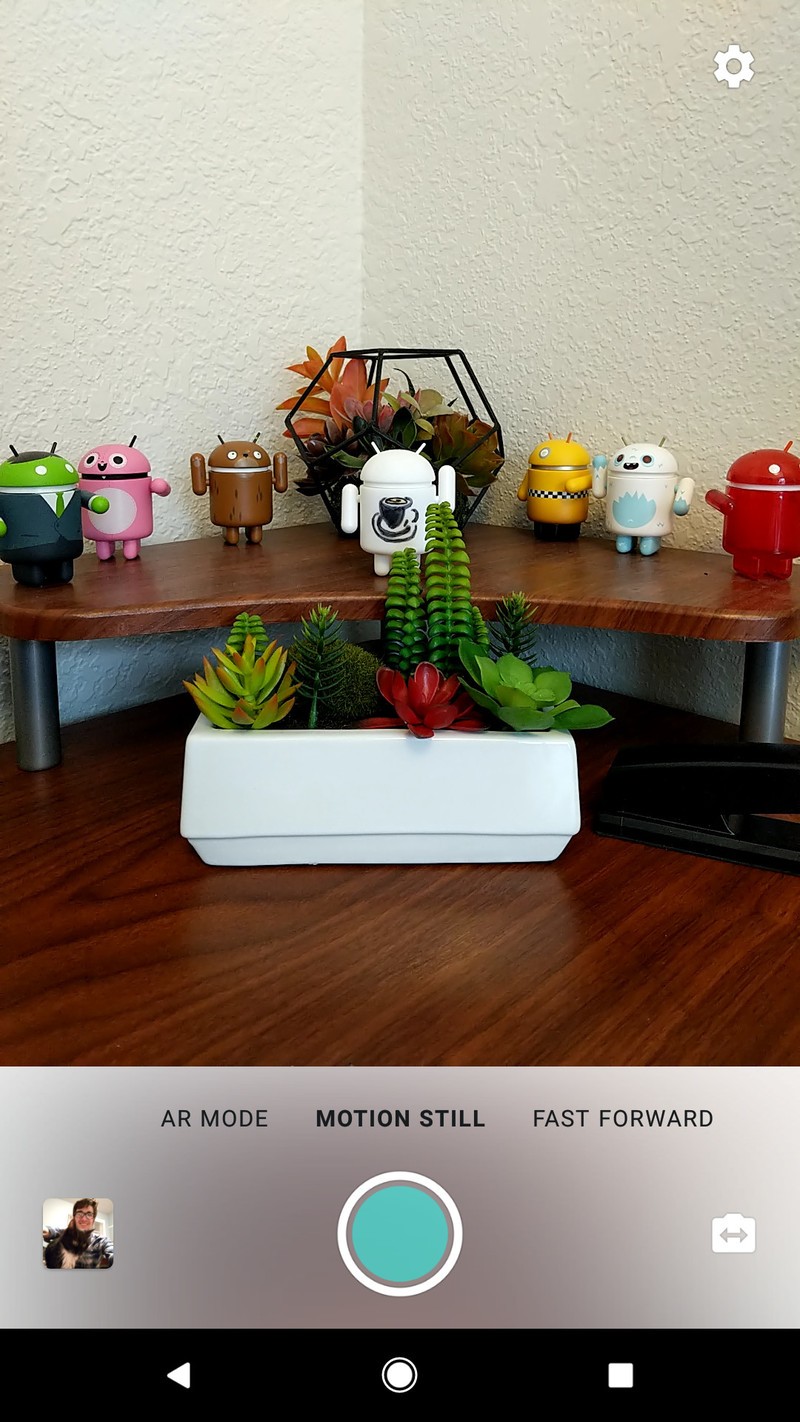

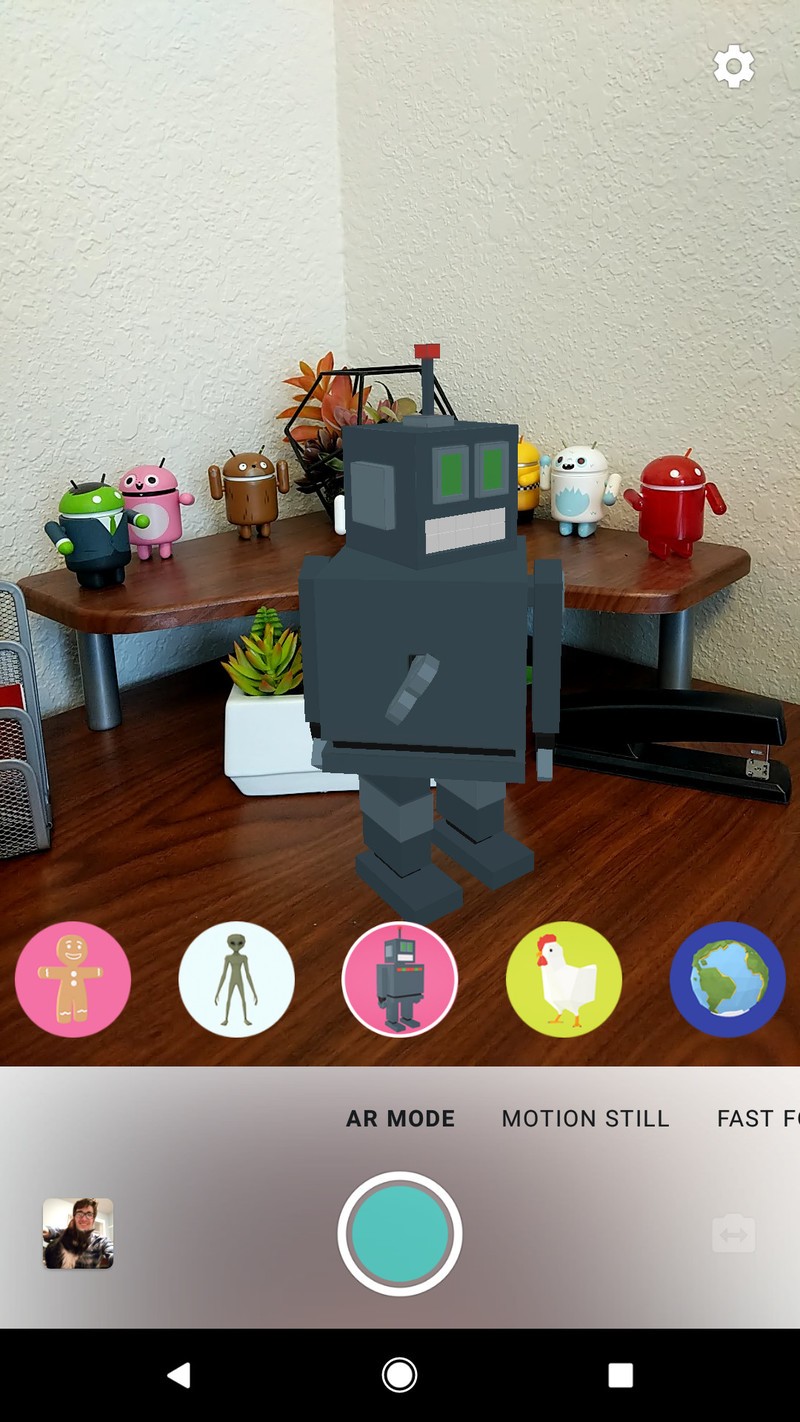
Also new is an updated user interface that should make it a bit easier to navigate through the app. Motion Stills now looks much more like a traditional camera app, with a capture button in the center and different modes above it for switching between Motion Still, Fast Forward, and AR Mode.
Motion Stills 2.0 is rolling out to the Google Play Store now, but if you want to download it ASAP, check out the APK file here.
The Pixel’s AR Stickers are the most fun you can have with a camera
Hubble provides the cosmic background to a dark French opera
Grandiose space images from NASA’s Hubble telescope might be the last thing you’d expect see in an early 20th century French opera. However, Marco Brambilla, the artist behind epic video art installations and Kanye West’s “moving painting” music video for Power, has done just that. He created the video backdrop for a new production of Claude Debussy’s Pelléas et Mélisande, currently running at the Opera Ballet Vlaanderen in Antwerp, Belgium.
Pelléas et Mélisande, based on the “libretto” play by Maurice Maeterlinck, is Debussy’s only opera and regarded as one of the greatest ever. The story depicts Prince Golaud, who discovers the mysterious Melisandé lost in forest, setting up a love triangle with Golaud’s half-brother. The set design by Marina Abramović features a giant, crystal-covered convex mirror that merges into the floor and act like an eye with Brambilla’s video backdrop as the “iris” at the center.
Brambilla used collages of Hubble and NASA images to create the backdrop. “Both the libretto and the music have always screamed of the cosmos to me,” Brambilla said. “Since the text deals with the recurring theme of the eyes and sight, Marina Abramovic’s set design uses seven monolithic crystals and an onstage projection disc as the pupil of a symbolic eye. This becomes a portal into the subconscious where my videos unfold and heighten the tension and drama unfolding onstage.”
The play, with its themes on the creation and destruction of relationships, is perfectly suited to other aspects of Hubble, too. Many of the telescope’s most famous images, like Pillars of Creation and the Carina Nebula, depict the births and deaths of stars and galaxies.
Pelléas et Mélisande was already ahead of its time when it debuted in 1902, so naturally it was misunderstood by critics and cast alike. It has seen avant-garde interpretations before, perhaps most famously by French artist Jean Cocteau in the 1960s. By incorporating and reinterpreting modern space imagery, however, the latest version may be the most visually spectacular version yet.
Via: Wallpaper
Source: Opera Ballet Vlaanderen
Air Force general behind government 5G memo leaves White House
That scrapped proposal for a goverment-run 5G network is triggering a political fallout. A senor official has confirmed to the Washington Post that the author of the memo pushing for the 5G network, Brigadier General Robert Spalding, has left his position as the National Security Council’s senior director for strategic planning and returned to the Air Force. He wasn’t fired, the insider claimed, and this wasn’t prompted by the leak — rather, the Council decided against renewing his position in part because his push for government 5G had “gone beyond his role.”
Brig. Gen. Spalding’s last day in the White House was January 31st, or 3 days after the memo surfaced at Axios. He wasn’t officially punished, according to the tipster, so he’s free to take whatever job he’s qualified to handle.
The general isn’t known to be responsible for the leak, but that apparently didn’t matter. Reportedly, officials had already been worried that he was “too aggressive” in promoting the idea, distributing it widely and effectively circumventing the deliberative process. Supposedly, some officials indirectly blame him for the leak because of that circulation.
This is water under the bridge when the White House has shelved the idea, and the FCC’s chairman has rejected the concept. You could argue that it was a bad idea from the outset, for that matter — private carriers already have a head start and would likely sue the FCC to either block the plan or insist on playing a part. Even so, the departure sends a strong signal to anyone who would bring up a similar plan in the future.
Via: Military.com
Source: Washington Post
Tweak Spotify’s recommendation tech to create custom playlists
If you’re looking for a way to fine-tune your Spotify experience, you might want to check out Nelson, a web-based playback jukebox of sorts on app-maker website Glitch. You choose as many genres as you like before tweaking some of the Spotify API’s various parameters, and Nelson will compile a custom set of songs. You can even have it create a playlist right on Spotify for you.

Originally tweeted out by Arielle Vaniderstine, a “developer advocate engineer” at Spotify, Nelson is very much a version one release on Glitch. It’s an internal project that feels more like a toy than an exact tool or proper feature. Still, it’s a blast to goof around with, and the playlists it creates appear right in your Spotify app, if you choose to do so. I clicked “Ambient,” “Disco,” “Electronic” and “Happy” and got a playlist that started with Wild Cherry’s “Play That Funky Music.” It’s a happy disco song, for sure, but sometimes the results are a bit puzzling.

The different variables you can tweak are explained at the Spotify developer blog. There are things like “acousticness,” “danceability,” “instrumentalness, “loudness” and “speechiness.” There’s even a measure for the amount of happiness conveyed by a track, called “valence.” You can change these values in Nelson with a slider and the resulting playlist (which will play in your browser by default) should match your selections.

Via: The Verge
Source: Arielle Vaniderstine
Sondors’ three-wheeled EV is affordable and stylish
Starting a new car company is tough. In fact, it’s nearly impossible. Then Tesla pulled it off. As we transition from the internal combustion engine to electrification, startups and even a few established players are taking a chance on EVs. Building a three-wheeled autocycle isn’t revolutionary, exactly. But making an EV starting at $10,000, with all the usual amenities, makes it a car worth watching. Plus, it looks spectacular.
I got a chance to drive the $1 million prototype of this Italian-designed car in Malibu last week. The one-off vehicle isn’t street legal or ready for actual roads. It didn’t have working seat belts and couldn’t reach the speeds the company says the final production model will be capable of. But once I put it in gear and depressed the accelerator, it seemed like, with some fine tuning (not to mention passenger restraints), the car would be at home cruising through a residential neighborhood.
Behind the wheel, steering and braking worked as advertised, even if the car was poky off the line and I wasn’t able to do anything resembling freeway speeds. I got it up to a whopping 28 miles per hour in a beach parking lot, where I yanked the wheel left and right to test stability. Three-wheeled cars have had a bad rap since the Reliant Robin episode of Top Gear where they rolled a three-wheeled car every time it took a turn. Before you get concerned about the safety of future drivers, though, it’s important to remember that the Robin in question was actually set up to roll over when it turned.
So, yeah, the Sondors is stable even if it’s still in the prototype stage.
When the car does go into production — which the company expects to happen in April 2019 — the base model will have a range of 75 miles. Add an additional $3,000 for a range of 150 or $6,000 for a 200-mile reach. The zero-to-60 time will range from eight seconds to about five, which is pretty quick for a car that costs less than most used vehicles.
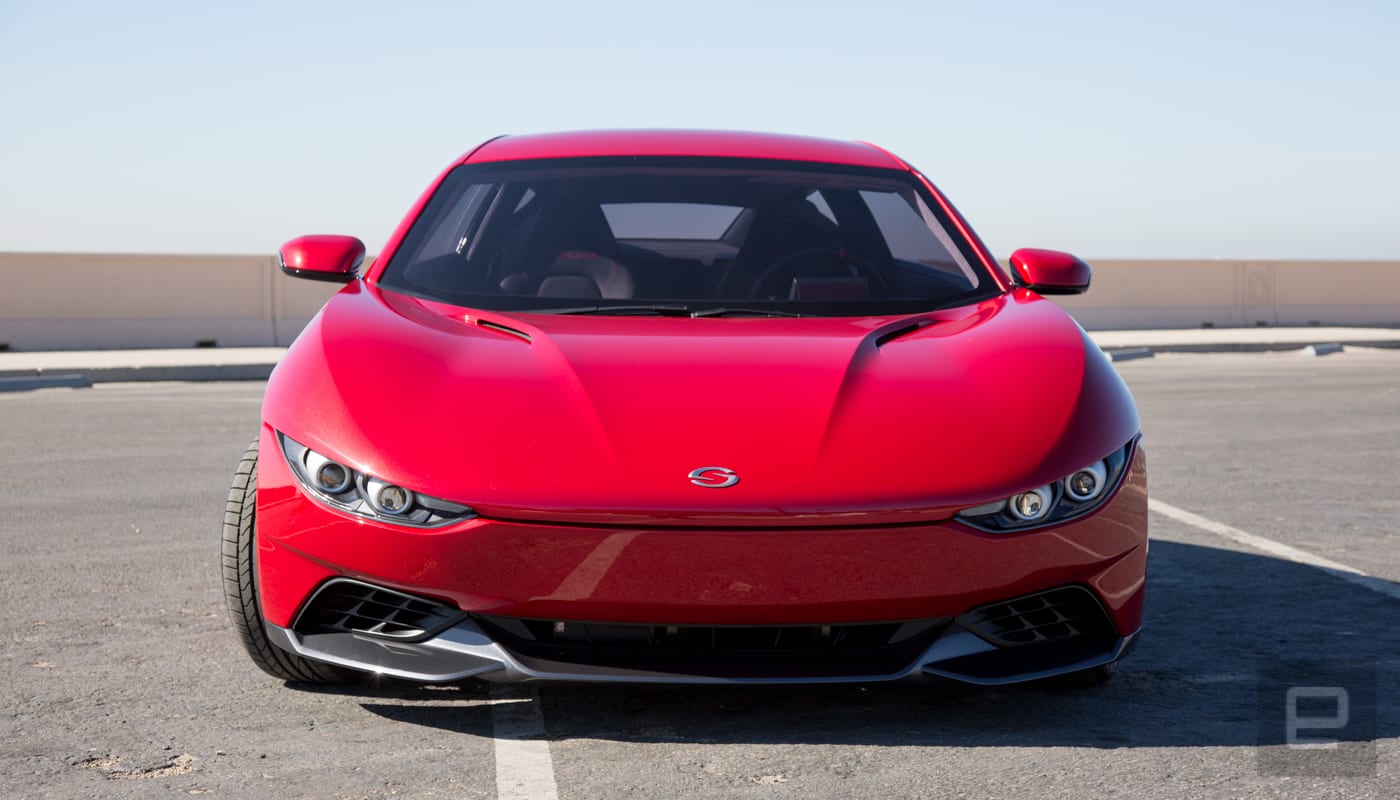
Those speeds are thanks to a rear-mounted motor that will push out 170 horsepower and a whopping 323 pounds of torque to the front wheels. Sadly, none of that power was evident during my drive.
What Sondors did deliver in its prototype was the design of the car, which is exquisite. If the company is able to get its car into production next year, expect a lot of people to buy the vehicle based purely on its looks. Photos of the car don’t quite do it justice. During the four hours I spent with the vehicle, multiple people stopped to remark on how beautiful it was and wondered if it was on sale.
Of course, gawking at a three-wheeled car at the beach is far different from actually buying a niche vehicle.
Sondors CEO Storm Sondors seems fine with that. He says the car comes in response to the needs of Sondors’ bike customers. He adds that the company wants to start slow, producing cars for the needs of its current customers and first adopters. He understands that scale is tough, especially when building a car.
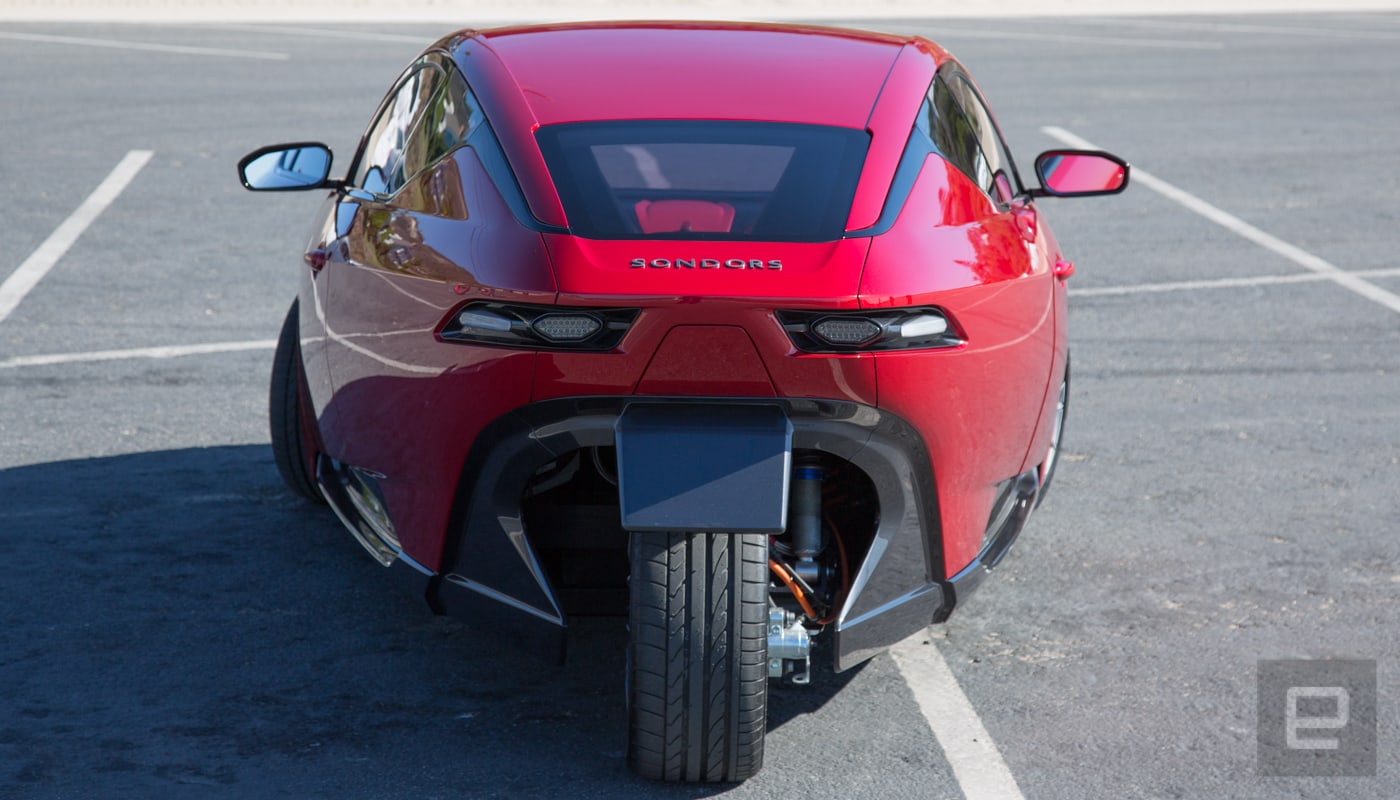
Indeed, even building 1,000 cars is challenging. The company does have experience producing electric bicycles, but cars are a different beast. Plus, there’s that $10,000 asking price — that’s cheaper than most used cars these days. It’s safe to say that delivering something that inexpensive is going to be a monumental feat.
But I hope Sondors can pull it off. The world needs more affordable cars that catch the eye as well as reduce emissions. I just hope the production model is faster than the prototype.
Facebook may share ad money to lure creators from YouTube
Facebook has been gearing up its Watch platform for months, now. Originally launched last August, it already has tons of shows on tap (for US audiences, at least). The company may even spend $1 billion on original video this year in hopes to catch Netflix and Hulu, and it’s been running ads in front of Watch videos for a while. Now, according to a report on CNBC, Facebook is talking to media buyers about expanding the Watch service to more individual creators to rival YouTube’s similar business model.
According to CNBC‘s sources, Facebook wants to create a tiered advertising system that would allow creators to upload their content for free, then earn revenue from ads placed into the videos. That way, says CNBC, Facebook can fill its Watch platform with content it won’t have to pay for up front. CNBC‘s sources say that Facebook pays some creators for rights to their shows in the range of $10,000 to $500,000 per episode, while other shows are uploaded for free as a “partner.” As CNBC notes, It’s getting harder for creators to make money on YouTube, though the Google-owned company is trying to fix that. Facebook may also be looking at video to help keep users on its site for longer periods of time to reverse the current trend. We’ve reached out to Facebook for comment and will update this post when we hear back.
Source: CNBC
Apple briefly pulled Telegram over child pornography distribution
When Apple temporarily pulled Telegram from the App Store over “inappropriate content,” it left many wondering just what that content was. We now know: 9to5Mac has learned that the company removed the app after discovering that people had been distributing child pornography through the app. Apple both contacted Telegram’s team and authorities (including the National Center for Missing and Exploited Children) to both address the specific violation and to ensure that there were “more controls” in place to prevent a repeat.
As a rule, internet services use a range of safeguards to prevent the spread of child porn, such as shared hash lists that prevent a file on one site from being posted elsewhere. It’s not certain what solutions Telegram implemented, but the relatively short turnaround (its software was back within hours) suggests it didn’t require a fundamental change.
The nature of the discovery might provide a clue as to how it was distributed. Telegram’s bread and butter is end-to-end encrypted messaging, which should rule out a non-participant directly intercepting the messages (including Apple itself). The 9to5 team suggests that the material may have been made public through a third-party plugin. Your privacy should remain intact as a result — Apple may have just been fortunate enough to spot the vile content and take action.
Via: The Verge
Source: 9to5Mac
 AIVAnet