


Sony Xperia X and X Compact get Android 8.0 Oreo
The build number for both phones changes to 34.4.A.0.364.
Back in 2016, Sony impressed us with the release of the Xperia X and Xperia X Compact. The former is what Alex Dobie referred to as “the Android workhorse”, whereas the latter offered one of the best user experiences at the time for a small-sized phone. Now in early 2018, both phones are getting new life with updates to Android 8.0 Oreo.

The Oreo update changes the build number of the phones from 34.3.A.0.252 to 34.4.A.0.364, and each phone gets the standard array of Oreo goodies you’ve come to expect – including picture-in-picture, Oreo’s new emoji style, faster performance, and quite a lot more.
When it comes to Oreo updates, Sony’s been one of the better companies in regards to updating as many of their phones as quickly as possible. Since Oreo’s release, we’ve seen it pushed to the Xperia XZ/XZs, Xperia XZ Premium, and more.
On a similar note, Oreo for the Xperia X and X Compact comes just a few days after Sony confirmed it releases software updates for its flagship phones for two years after their release.
Sony CEO Kaz Hirai steps down, CFO Kenichiro Yoshida to take over
Android Oreo
- Android Oreo review!
- Everything new in Android Oreo
- How to get Android Oreo on your Pixel or Nexus
- Oreo will make you love notifications again
- Will my phone get Android Oreo?
- Join the Discussion
Smartphones are great — don’t ruin them with foldable gimmicks

There’s been a lot of talk about foldable/bendable smartphones lately, and while it’s a neat idea, I’m not sold on it quite yet.
Samsung, one of the biggest smartphone manufacturers in the world, is getting ready to drop a bombshell on the industry. Rumors surrounding a “Galaxy X” phone with a foldable screen have existed for some time, but recent rumors and reports from Samsung itself indicate that 2018 may be the year this finally comes to market.
The idea of a foldable/bendable phone is exciting considering all of the technical and mechanical challenges required to make it work, but for me, I’m still not convinced this is something that’ll serve any real purpose aside from marketing gimmicks.
History often repeats itself
Let’s take a trip back to 2011. Rebecca Black’s ‘Friday’ was a thing people actually listened to; Prince William and Catherine Middleton were just married; and Kyocera released the Echo, a foldable Android phone with two displays. The Echo’s two screens allowed you to share posts on Facebook while watching a YouTube video at the same time, have a larger canvas for playing games, and more. It was an interesting idea, but limitations in both hardware and software prevented it from being anything special.
Previous foldable phones have left much to the imagination.
A few years later in 2017, ZTE came out of the gate with the Axon M – another take on a foldable smartphone with two separate displays joined together by a hinge. The Axon M is a much more polished phone than the Echo, and while things like Android’s split-screen mode make the software side of things more usable, it still ended up feeling like a concept device rather than a phone you’d want to use day after day.
ZTE’s already said that it plans on continuing with the Axon M series to create a phone that’s eventually a single display with a bendable design, and this is the same route Samsung aims to take with the Galaxy X. That’d be a huge leap compared to the foldable phones we’ve seen so far, but early concepts still leave me with a lot of questions.
Give and take
Looking specifically at the Galaxy X, one concept shows a very narrow phone that’s surrounded by rather large bezels above and below its display. You’d use the phone in the traditional candy bar shape like normal, but a bending mechanism near the middle of the screen would allow the phone to fold up into itself. With a concept like this, the idea is that you can have a large phone and then fold it up for easier portability.

In order to achieve this design, it’s expected that internal components (such as the battery, processor, etc.) are positioned above and below the hinge mechanism inside – resulting in those large bezels you see on the front. It’s admittedly well thought-out for this form factor, but is any of it worth it?
Screens may bend, but what about internal components?
Starting with the display, using a foldable OLED panel means that you won’t have a glass screen over it. Instead, it’s likely that Samsung will have to cover the Galaxy X with plastic. Phones like the Moto Z2 Force have adopted plastic/polycarbonate covers in favor of glass, and while plastic does have the benefit of being more shatter-resistant and flexible, it picks up scratches the second you take it out of the box.
Then there’s the issue of components. The concept for the Galaxy X with its internals positioned in a way so they’re not actually bending is smart, but as the renders show, this will likely result in bulkier overall designs. Technology is always evolving and it’s possible Samsung and other companies will be able to clean up the aesthetics throughout multiple iterations, but I don’t envision there being a bendable motherboard or battery anytime soon. These are components that are essential to every smartphone, and they serve as real obstacles when trying to bend the case they’re housed in.

Lastly, we’ve got to consider the durability aspect of this venture. Any time you introduce moving parts to something, it creates an added vulnerability and better chance of things going awry. It’s easy enough to cause irreversible damage thanks to a solid drop with current phones, so what’s going to happen when a new point of weakness is added? What if the hinge gets bent in the opposite direction? These are all questions that have yet to be addressed, and they’re things we need to keep in mind if we really want a world of foldable phones.
A game of wait and see
Samsung’s been known to experiment with radical ideas in the past. Things like the Galaxy Round and Galaxy Beam were one-flop wonders that never saw successors, but devices such as the original Galaxy Note and Galaxy Note Edge introduced ideas that eventually become staples of Samsung products.
I’m perfectly fine with Samsung and other companies trying new things. That’s how we figure out what works and what doesn’t so we can move on to bigger and better projects. Samsung will release the Galaxy X either late this year or early next year, and depending on how the market reacts, will decide whether or not this is something it wants to continue with.
If it chooses to do the latter, I can only hope that the industry reserves foldable phones to their own category rather than forcing the entire market to adopt the new form factor. The mixture of 16:9, 18:9, bezel-less, and non-bezel-less phones in their current form offer plenty of variety to choose from, and they do so without compromising an entire product for slightly better portability.
Your turn to chime in
Now that I’ve done my ranting, I’d like to hear from you. Do you think foldable phones are a fad, or do you truly believe they’re the next big step the industry should take? Sound off in the comments below, and I’ll do my best to respond to as many of ya’ll as I can.
LG publishes patents for two foldable phone concepts
Samsung Galaxy Note 8
- Galaxy Note 8 review
- Galaxy Note 8 vs. Galaxy S8+
- Which Note 8 color is best?
- Complete Galaxy Note 8 specs
- Join our Galaxy Note 8 forums
Verizon
AT&T
T-Mobile
Sprint
Best Buy
Honor 7X in limited edition red now available in the U.S. for $199
A limited number of units will be sold, so you’ll want to act fast.
The Honor 7X is one of the best budget Android phones you can buy in early 2018, and while it’s already quite the looker in its regular form, customers in the United States can now get the device in a stunning red color.

This red version of the Honor 7X was first announced for select markets during CES in January, and now it’s officially available for purchase in the States. You’ll pay the same $199 price as you would for the normal 7X, but because this is a limited edition run, Honor is only selling a certain number of them.
Along with this, Honor will also be giving away the red 7X to ten lucky people. To enter, head to Instagram and share a video with Honor that’s a reenactment of the very first time you met someone (or something) you love.
The red Honor 7X is available to purchase now, so to ensure you get your hands on a unit before they’re all sold out, click/tap that button below ASAP.
See at Honor
OnePlus 5T in Lava Red coming to North America and Europe on February 6 ‘while supplies last’

Feast your eyes on this.
OnePlus is apparently finding success releasing limited-edition colors of its phones, because it just keeps cranking them out. The latest is the “Lava Red” OnePlus 5T, which fans will note was announced for a few markets at the end of 2017. Now, it’s coming to North America and Europe.
Starting on February 6, while supplies last, you can pick up this absolutely gorgeous Lava Red OnePlus 5T. As is often the case it’s only for the top-spec 8GB of RAM and 128GB storage model, but for the same $559/£499/€559 price — no premium charge for this premium-looking color.
See at OnePlus
The Lava Red OnePlus 5T is simply gorgeous. The color is on the bright side, which attracts attention even more so than the Sandstone White limited edition color announced just a handful of weeks ago — and beyond even the bright red OnePlus silicone case. But unlike Sandstone White, Lava Red isn’t going to be marred by discoloration concerns — the finish is hard and slick like the original Midnight Black color. But just like Sandstone White, the entire front of the Lava Red color is black so you don’t have to worry about distraction when you’re actually using the phone.
This is the Lava Red OnePlus 5T

Red is notoriously tough to capture properly on camera, particularly when there’s so much of it like the full back of the OnePlus 5T, but it does indeed tend to have a deep pink to orange hue to it when it’s in bright light. It doesn’t quite have the rich, lusty colors of the Raspberry Rose LG V30, but this is beautiful in its own way.
OnePlus fans who have held out this long to buy a OnePlus 5T are being rewarded with these great color options, and I personally think Lava Red is the best of the bunch — provided you’re interested in being the center of attention when it comes out of your pocket.
If the limited edition nature of the Lava Red OnePlus 5T wasn’t enough of a motivator, OnePlus is also offering free priority shipping for those who grab one in the first two days. A sweet treat, delivered extra fast by acting early. Sales open on February 6 at 10:00 a.m. ET in North America and 10:00 a.m. CET in Europe.
See at OnePlus
OnePlus 5T and OnePlus 5
- OnePlus 5T review: Come for the value, not the excitement
- OnePlus 5T specs
- Should you upgrade from the OnePlus 3T?
- OnePlus 5T vs. Galaxy S8: Beast mode
- All of the latest OnePlus 5T news
- Join the discussion in the forums
OnePlus
Amazon
Press release:
OnePlus is excited to bring the OnePlus 5T Lava Red, a color variant powerfully radiant and synonymous with the OnePlus brand.
The color, which first launched in other regions at the close of 2017, has been hotly anticipated and we now have a limited number coming to North America and Europe while supplies last.
To achieve the glowing red, the OnePlus 5T Lava Red undergoes an extensive design process – being anodised between two sandblasting techniques before adding an anti-fingerprint layer to create a pristine finish. OnePlus’ attention to detail is reflected clearly in the OnePlus 5T Lava Red’s matching red ceramic fingerprint sensor.
The limited edition OnePlus 5T Lava Red, only available with 8GB of RAM and 128GB of storage, will go on sale on February 6th at 10am ET / 10am GMT / 10am CET on OnePlus.net for $559 in the US, £499 in the UK, and €559 in the rest of Europe, while supplies last.
Offers and bundles:
Order the OnePlus 5T Lava Red before February 8th to qualify for free priority shipping and receive your device within 2-3 days. Take advantage of a 15% discount when purchasing two of the same accessories, including OnePlus Bullets (V2), a selection of OnePlus Bumper Cases, a selection of OnePlus Silicone Cases and the OnePlus backpacks
Honor View 10: New update adds face recognition features
The Honor View 10 is one of our favorite affordable Android flagships right now, and it’s just recently gotten a new update that makes it even more competitive.
It’s all about new ways to interact with your phone using your face. The new update adds the promised face unlock feature, which rivals the OnePlus 5T in speed and accuracy. Notifications on the lock screen can be hidden until the phone recognizes your face and unlocks. And there are new ways to leverage face recognition in day-to-day use — like smart rotate, which keeps your phone’s rotation tied to that of your face.
Check out the video above for rundown of all the Honor View 10’s face recognition features in this latest software update.
- Honor View 10 review
- Android Central on YouTube
- Honor View 10 video review
Intel unveils smart glasses that you might want to wear
Intel has launched an impressively light, regular-looking set of smart glasses called Vaunt, confirming rumors from Bloomberg and others. Seen by The Verge, they have plastic frames and weigh under 50 grams, a bit more than regular eyeglasses but much less than Google Glass, for example. The electronics are crammed into the stems and control a very low-powered, class one laser that shines a red, monochrome 400 x 150 pixel image into your eye. Critically, the glasses contain no camera, eliminating the “big brother” vibe from Glass and other smart glasses.
Vaunt is mainly aimed at giving you relatively simple heads-up notifications. Intel says that the glasses are more stealthy than a smartwatch, allowing you to check notifications while doing other activities. In one demo, it showed that you could see a person’s birthday and other pertinent personal info while you’re chatting with them on the phone. The motion sensors can also detect whether you’re in the kitchen, for instance, and give you recipes or a shopping list.
You might be worried about having a laser beamed into your eyeball, but “it is so low-power that it’s at the very bottom end of a class one laser,” Intel New Devices Group’s Mark Eastwood told the Verge. On top of that, the display isn’t even visible unless you look at it, making it unobtrusive for wearers. As it’s beamed onto the back of your retina, it’s always in focus, regardless of whether you have prescription or non-prescription lenses.
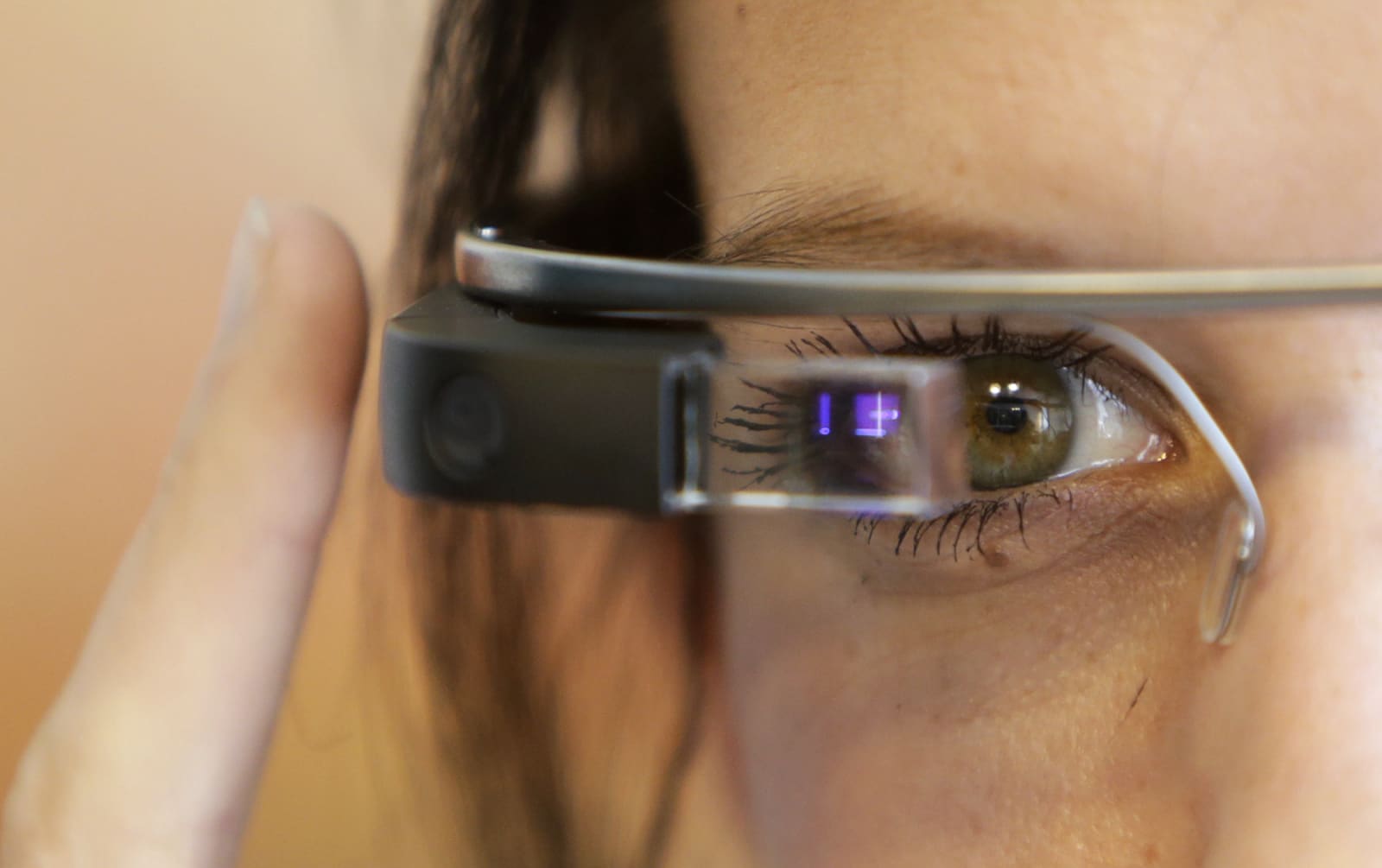
Intel’s Vaunt has no built-in camera like Google Glass (REUTERS/David W Cerny)
Other feature include Bluetooth to link with your smartphone, a processor for apps, a compass and accelerometer so that Vaunt can tell which way you’re looking and where you are. Future models may contain a microphone that works with voice assistants like Alexa or Siri.
When it comes to giving commands, Intel wants Vaunt to have “no social cost,” in terms of making you do something distracting during a conversation. Rather, you might be able to control it using head nods or other, more subtle gestures.
Intel hasn’t commented on rumors that it might sell off part or all of Vaunt once it develops the product. However, it has said that it’s not likely to take the product to market itself, but instead rely on OEMs, much like it does with PCs and other hardware.
As for apps, Intel emphasized that Vaunt will be a wide open platform. It’s getting set to launch an early access program and SDK so that developers can discover for themselves what they can do with it. Programs will generally run from your mobile device, but some apps or specific features might be powered by the glasses themselves.
It’s clear that the product is still in the early development stages and could go in a lot of different directions. And bear in mind that Intel has tried a lot of experiments lately, especially in wearables, that didn’t go anywhere. Still, the concept of stealthy, hands-free notifications from a product that many folks already wear does have merit, so it’ll be interesting to see where it goes.
Source: The Verge
Nike will reward your workouts with shoes and Apple Music playlists
Nike is gamifying fitness even further with its new reward system for the Nike Plus app. These range from unlocking curated playlists on Apple Music, guided meditation exercises on Headspace, Class Pass credits or maybe even a custom t-shirt for your efforts.
“The premise is simple: The more active you are, the more you get rewarded,” Nike writes. “Whether you run more miles through the Nike Run Club app or do five new strength routines in the Nike Training Club app this month, every time you stride or rep, your physical achievements trigger rewards.” It’s a cool way to go beyond badges for your profile and notifications on your phone, and actually make your efforts worth something tangible.
TechCrunch notes that there’s also a Birth Month promo, where, during your birthday month, you’ll get discounts that last all month long, and gifts when you buy certain items — maybe even a free pair of tickets to a home game for your favorite team.
You’ll also have access to a quintet of exclusive shoes this month, including a special-release Nike Zoom KDX, and the Kyrie 4 iD and Epic React Flyknit in White Fusion. Nike says the unlocks will start rolling out in its main app today. The shoemaker says that the ultimate goal is “a personalized experience for members that seamlessly combines digital and physical intersections with Nike.”
The company has already seen success in doing just that with its AR app for shoe shopping, so expecting more like this probably isn’t out of the question.
Source: Nike
A tiny NASA satellite mapped Earth’s atmospheric ice
Last May, NASA launched a small, bread loaf-sized satellite into orbit around Earth. Dubbed IceCube, the satellite’s mission was to measure cloud ice in our planet’s atmosphere — a challenging task that researchers have previously only been able to perform in limited ways. Sensing ice clouds requires measurements at a range of frequency bands but particularly within what are known as submillimeter wavelengths, or electromagnetic wavelengths that fall in between those of microwave and infrared waves. The problem is, instruments that can take those kinds of measurements have previously had to be on board high-altitude research aircraft, meaning measurements were limited to the areas where those aircraft were flying. Launching a satellite that can perform those measurements could open up what parts of the atmosphere can be studied, and that’s where IceCube comes in.
IceCube was developed in partnership with Virginia Diodes Inc. and was done in a relatively short amount of time on a comparatively low budget. And the main goal was to be able to show that this type of project could produce a useful piece of equipment. “This is a different mission model for NASA,” said Dong Wu, one of the researchers on the IceCube team. “Our principal goal was to show this small mission could be done. The question was, could we can get useful science and advance space technology with a low-cost CubeSat developed under an effective government-commercial partnership.” In that regard, the mission appears to be a success, and as a bonus, researchers now have the first map of global atmospheric ice distribution. This will help scientists study cloud ice and how it affects our planet’s climate and will allow for better weather and climate models. “With IceCube, scientists now have a working submillimeter radiometer system in space at a commercial price,” said Wu. “More importantly, it provides a global view on Earth’s cloud-ice distribution.”
Source: NASA
NikePlus Members Can Now Earn Apple Music Subscriptions and Exclusive Playlists
NikePlus members can now earn free Apple Music subscriptions and exclusive playlists by completing workouts or purchasing select Nike products.
Nike didn’t reveal exactly how to unlock the perks, but by achieving various milestones in the Nike+ Run Club or Nike+ Training Club apps in a given month, NikePlus members can earn rewards such as a free one-month Apple Music subscription or access to exclusive Nike playlists that include high-energy mixes.
Meanwhile, NikePlus Members who purchase Nike’s Epic React Flyknit running shoes in its exclusive White Fusion color will unlock up to four months of free access to Apple Music. The shoes are available for $150 starting today exclusively for NikePlus members in the United States, and on February 22 for non-members.
 Nike’s Epic React Flyknit running shoes in White Fusion colorway
NikePlus membership is free, with registration available on the web and through the Nike, Nike SNKRS, Nike+ Run Club, or Nike+ Training Club apps for iPhone. Apple Music is one of three new so-called NikePlus Unlocks, alongside rewards from fitness class startup ClassPass and meditation app Headspace.
Tags: Apple Music, Nike+
Discuss this article in our forums
SpaceX’s Falcon Heavy launch gets a spacesuit-clad ‘Starman’
The debut launch of the Falcon Heavy will be a serious and complex affair, but SpaceX boss Elon Musk is trying to boost the fun level to maximum. Not only is he using a cherry red Tesla Roadster as ballast for the first test, he’s placed a dummy wearing SpaceX’s stylish new space suit in the driver’s seat, according to a new Instagram post. “Starman in Red Roadster,” Musk wrote, a reference to the fact that the EV will supposedly be blasting David Bowie’s Space Oddity.
Starman in Red Roadster
A post shared by Elon Musk (@elonmusk) on Feb 4, 2018 at 9:50pm PST
SpaceX’s pressure spacesuit will eventually be used by astronauts during trips to the International Space Station (ISS) aboard the Crew Dragon Capsule. They’ll keep astronauts alive if there’s a depressurization or other problem aboard the Dragon, but aren’t meant for spacewalks. The launch aboard the Falcon Heavy figures to be the suit’s first trip into space, but as with the Roadster, it’s likely just for cosmetics and fun, not any serious testing.
The launch is already tricky, with Musk saying at one point that the odds of success were about 50/50. On Saturday, though, SpaceX amped up the degree of difficulty, confirming that it will attempt to land all three of the Falcon Heavy’s booster rockets. Two will alight on land at the Kennedy Space Center, and the other will set down on SpaceX’s Of Course I still Love You droneship in the Atlantic.
Source: Elon Musk (Instagram0
 AIVAnet