


Huawei’s Mate 10 Pro is available to pre-order in the US
American carriers may have been pressured into dropping Huawei’s Mate 10 Pro from their lineup, but you can now buy one independent of a carrier if you feel it didn’t get a fair shake. Pre-orders for the company’s flagship smartphone are available today at Amazon, Best Buy, B&H, Newegg and Microsoft. Blue and gray variants are available to order right now, with “mocha brown” coming soon. The handset still costs a fairly stiff $800, but Huawei is sweetening the deal — if you order before the February 18th ship date, you’ll get a $150 gift card at the store in question. Given that there’s no native headphone jack, you might want to use that money to get a pair of Bluetooth headphones.
As before, the Porsche Design version of the Mate 10 Pro is also arriving on February 18th. It’s functionally the same phone in most respects, but doubles the storage to 256GB and gives you a spruced-up all-glass shell. Every version available in the US has a 6-inch, 2,160 x 1,080 AMOLED screen, Huawei’s in-house Kirin 970 octa-core processor, 6GB of RAM, dual rear cameras (one 12MP, one 20MP) and a front 8MP cam. The hook, as always, is a dedicated AI processing unit that accelerates tasks like image recognition and translation.
This wasn’t how things were supposed to go for Huawei. It was originally expected to offer the Mate 10 Pro through AT&T, making it the first Chinese phone vendor to get a US carrier deal for a flagship phone, with all the advertising that comes with it. Congress, however, was reportedly so wary of Chinese surveillance (without firm evidence it was present on Huawei’s phone) that it pushed AT&T to drop the handset. The pre-orders are great if you’re tired of the usual smartphone choices, but they represent a consolation prize for Huawei — it was hoping for much more.
Via: PR Newswire
Source: Amazon, Best Buy, B&H
Sony’s latest PlayStation headset looks awfully familiar
Sony has yet another wireless PlayStation headset coming soon. Last year it was the misnomered $150 Platinum Wireless Headset, and this time it’s a new Gold Wireless Headset. The refreshed cans take the basic form factor of the company’s stereo headset and shoehorn virtual 7.1 surround sound into it, in addition to wireless capabilities and compatibility with PlayStation VR. There are also new ear-cups and a redesigned headband in addition to a pair of hidden noise-cancelling microphones.
While it’s compatible with PSVR via an included 3.5mm audio cable, unlike the $60 Turtle Beach Stealth 350VR headset, this doesn’t feature an internal amp. Meaning, when you’re using this pair of Sony cans with the company’s VR helmet, sound is going to be much quieter because of the passive connection.
It’s really unfortunate that Sony releases a headset every year, alternating names, without adding much to them and without addressing bigger problems. The high prices are a bummer too when you can get better ones that cost quite a bit less and are better quality. These new Gold headsets are expected to ship by month’s end.
Source: PlayStation Blog (EU), PlayStation Blog (US)
Google flips on Pixel 2’s HDR+ feature for your go-to photo apps
The Pixel 2 and Pixel 2 XL include Pixel Visual Core, Google’s first custom imaging chip that allows for HDR+ quality pictures in third-party apps like Instagram and Snapchat. But Pixel 2 users haven’t been able to take advantage of those capabilities because the co-processor hasn’t been enabled. Well, they’ll be able to soon because Google announced today that it’s turning on Pixel Visual Core, bringing the HDR+ technology that’s been available through the Pixel 2’s main camera app to other photography, social media or camera apps.
Pixel Visual Core uses computational photography and machine learning to boost image quality in third-party apps that allow users to take photos. Now that it’s enabled, Pixel 2 users can just take a pic in another app, and Pixel Visual Core will automatically make it brighter, more detailed and clearer. You can check out a before and after above.
Google says the update that will switch on Pixel Visual Core is rolling out over the next few days along with other software improvements. Additionally, new winter sports-themed AR stickers should be available later this week.
Lyft Line’s pre-tax commuter perks are available in 18 cities
Lyft Line was built from the start to make daily ridesharing more affordable, but it really comes into its own if you can use a commuter benefits card. It lets you use pre-tax dollars to pay for a ride, cutting up to 35 percent of the price. It’s a good thing, then, that you no longer have to worry about where those cards are available — Lyft has expanded the use of commuter benefits to all 18 US cities where Line operates. Provided your employer offers the cards in the first place, you now have a low-cost way to commute to work without taking a bus or train.
Your company will have to offer benefits from a handful of providers (Ameriflex, Benefit Resource, Benefit Solutions, Navia, WageWorks or Zenefits) for this to work. You’re not guaranteed to get a discount just by living in a Lyft Line area. However, Lyft clearly hopes companies will embrace the idea — it helps staff get to work quickly without pressuring them into buying a car. Yes, it’s ultimately meant to boost adoption of Lyft’s shared services, but it could be helpful if it gives you a speedy commute while sparing you the costs of personal vehicle ownership.
Via: TechCrunch
A US Paralympian designed Team USA’s snowboard prosthetics
Mike Schultz was a professional snowmobile racer, and a damn good one at that. But in 2008, his life’s course took a turn after a competition accident shattered his left knee and left him clinging to life. When his injuries began causing his kidneys to shut down, doctors decided to amputate the leg just above the knee.
“I spent a total of 13 days in the hospital and was able to get back home on Christmas Eve to a whole new world of challenges,” he told Engadget. “Later that spring, after learning how to walk on my everyday prosthetic leg, I realized pretty quickly that I needed a plan B to get back into sports and the fun activities that I wanted to do.” That plan B turned out to be designing his own prosthetic leg — one purpose-built to handle the rigors of extreme sports — and starting a fabrication company, Biodapt, to produce it. Thus, the Moto Knee was created.
Unlike the mechanical prosthetic that he relearned to walk on — or even the powered, computer-controlled one he uses daily — the Moto Knee is designed for riding. “When you walk, you need the leg to swing back and forth underneath you,” Schultz explained. “It needs to flex at a certain point, then extend as you follow through your gait. Now, that function doesn’t really help at all while I’m standing on my dirt bike or snowmobile.” Instead, the Moto Knee mimics a squatting motion.
“I needed a knee system that would have some spring resistance in it to help keep extended while I’m standing up,” he continued. “Then allow it to absorb the impact from the rough terrain.” As such, the knee can be adapted to a wide variety of activities, from skiing to horseback riding, “basically any type of board sport,” Schultz said. “Whether it be wakeboard, skateboard or snowboard. Water sports, water skiing, ice skating, anything where your main action with your leg is to have your quadriceps engaged to push off from or to absorb pressure and impact.”
And though the knee is adaptable to work with a variety of lower-leg prosthetics, Schultz has also developed a corresponding ankle joint to work alongside it, dubbed the Versafoot. “For my equipment, we’re not about running. We’re about wheels, action sports, and that type of thing,” Schultz said. “So we want range of motion and shock absorption. The foot itself has 28 degrees of ankle motion as you press into it, or you put weight into it. A typical running or walking foot has kind of around 10 to 12, at max, flex at the toe.”
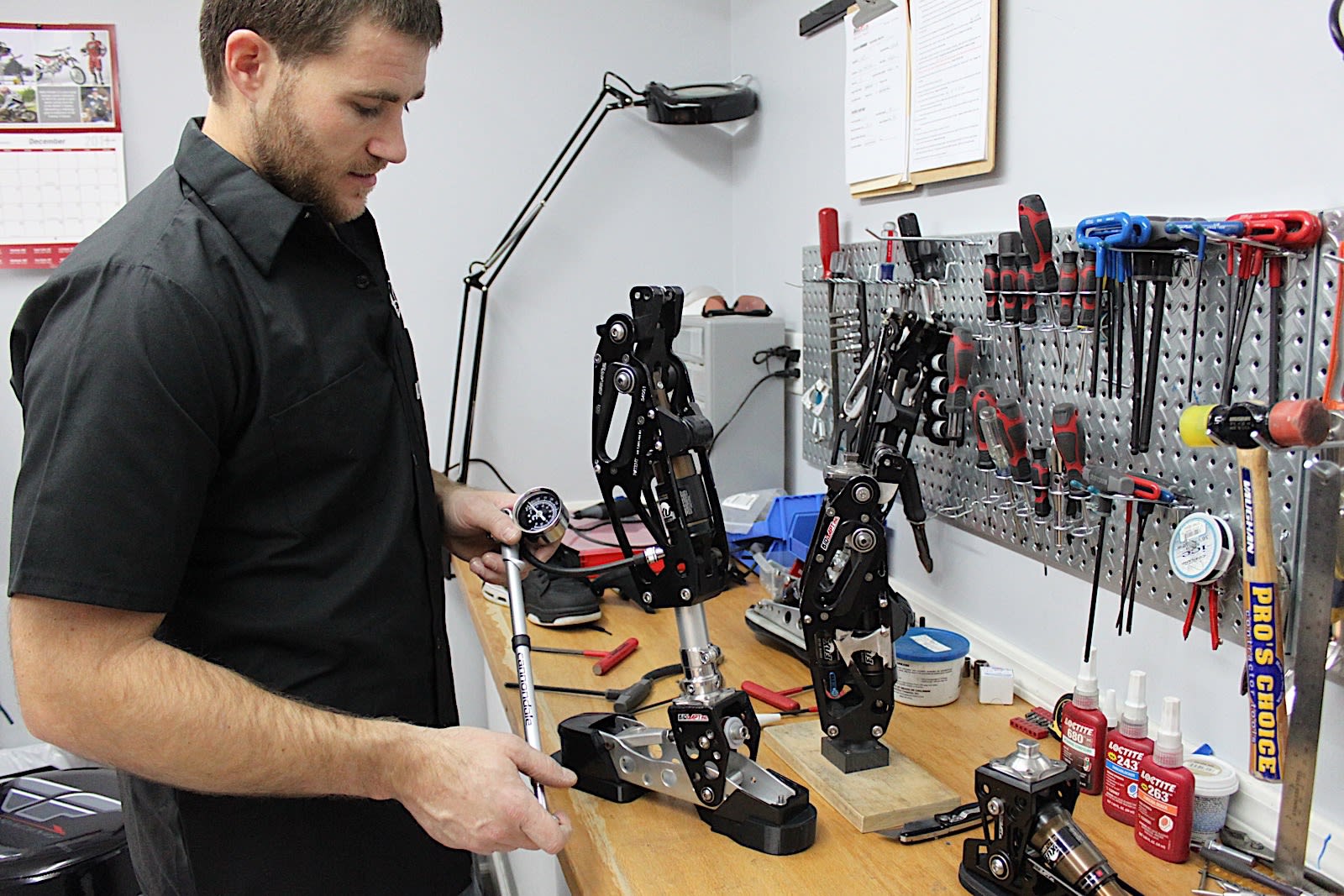
However, despite the capabilities of his prosthetics, Schultz does not see them as as imparting any sort of significant competitive advantage. “The only thing that some of the guys questioned right away… I had to put an electric shifter on my dirt bike because I can’t flex my ankle on demand to shift gears, so I had to put an electric system on it,” he told Engadget. “People were like, ‘Whoa, what’s that? Are you sure? Can you do that?’ I’m like, ‘Come on, look at me, man. I’ve got one leg.’ But my physical disability far outweighs the enhancement I’m gonna get with this push button shifter.”
That may not be the case for much longer, however. International competitions such as the Paralympics, which Schultz will be competing in come March, do not allow the use of actively powered prosthetics. In fact, the International Paralympic Committee rulebook explicitly states:
Equipment that results in sport performance not primarily being generated by the athlete’s own physical prowess but being generated by automated, computer aided, or robotic devices is prohibited in IPC Sanctioned Competitions and Events, and at Paralympic Games.
Regardless, the state-of-the-art developments continue to march forward at a rapid pace. “At this time in the manufacturing industry, the sky is the limit with design, and prototyping options with 3D printing, and all this new CAD technology,” he crowed. “I’m working on kind of three different modifications to some new equipment that I’m working on. I can’t really tell what they are, but I will be utilizing some of the latest 3D printing technology. It’s a great time to be in the development industry for sure.”
In fact, both he and the rest of his boardsport teammates competing in Pyeongchang will be doing so using his company’s prosthetics (not to mention a few members of his international competition). Beyond that, the sky truly is the limit, according to Schultz.
Prosthetics are getting smarter and more responsive by the day. “They’re using implants in the muscles to control sensors. Radio sensors that control limbs, which is awesome,” he said. Of course, that sort of technological advancement does not come cheap. “A drawback with all of that technology is it’s extremely expensive,” he conceded. “So it makes it unreachable for a lot of people, so that might slow things down a little bit.”
And even Schultz is wary of the pace of these advancements though he remains hopeful. “It’s a slow process especially when you get into implants, and nerve integration, and that type of thing. They’ve gotta do their homework and make sure it all works out well in the long run. But, the direction they’re going is really cool.”
New laser technology could improve how scientists study molecules
We use lasers for a lot of things, from cutting metal to improving eyesight, but lasers have their limitations. One major holdup is that they can only emit certain types of light. Researchers have gotten around this particular limitation by using what are known as optical parametric oscillators, which allow regular laser light to be converted into other wavelengths of light that may be useful for certain areas of research. One example is studying how molecules behave. However, these gadgets have their limitations too. They typically have weak outputs and they require extreme stability and precision, making them hard to use outside of highly controlled lab environments. But researchers at Stanford may have found a way around this issue and their work could make these systems more efficient and easier to use.
Here’s how these oscillators work. Laser light is filtered through a crystal, which converts that light into those other wavelengths that researchers need. That light is then reflected off of a series of mirrors, which results in ultra-short bursts of light in a new wavelength. With traditional setups, the output of that converted light is pretty low, but with two tweaks to the system, the Stanford team was able to bump it up. Making the mirrors less reflective — a counterintuitive move — and making the light take longer to reflect off of all of those mirrors gave the researchers access to even more wavelengths, which means scientists can get ever more detailed looks at molecules.

This new system is more efficient than others and could be better suited to analyzing the behavior of and detecting molecules. For example, in the future, such a system could potentially be able to scan the air to detect pollutants. And because this system isn’t as sensitive to movement, it stands to be useful outside of the lab. “You talk with people who have worked with this technology for the past 50 years and they are very skeptical about its real-life applications because they think of these resonators as a very high-finesse arrangement that is hard to align and requires a lot of upkeep,” Alireza Marandi, one of the researchers on the project, said in a statement. “But in this regime of operation these requirements are super relaxed, and the source is super reliable and doesn’t need the extensive care required by standard systems.” Marc Jankowski, another researcher on the team, said, “We’ve worked on these sources for years and now we’ve gotten some clues that will really help bring them out of the lab and into the world.”
The work was recently published in Physical Review Letters.
Image: L.A. Cicero
Via: Stanford
Source: Physical Review Letters
iPad Remains World’s Most Popular Tablet as Apple Outsold Samsung and Amazon Combined Last Year
iPad remains the world’s most popular tablet by a significant margin, having outsold competing devices from rivals Samsung and Amazon combined last year, according to data shared by research firm IDC today.
Apple sold a total of 43.8 million iPad units in 2017, as confirmed by its quarterly earnings results, while IDC estimates that Samsung and Amazon shipped 24.9 million and 16.7 million tablets respectively on the year. The combined Samsung-Amazon total of 41.6 million tablets is 2.2 million lower than iPad sales.
Apple captured a 26.8 percent share of the tablet market in 2017, meaning that roughly one in every four tablets sold last year was an iPad. Apple’s tablet market share rose 2.5 percentage points year-on-year.

Last week, Apple reported revenue of $5.8 billion from iPad sales in the fourth quarter of 2017, representing growth of six percent compared to the year-ago quarter. Apple’s average selling price of an iPad was $445, up slightly from $423 in year-ago quarter, suggesting more higher-priced iPad Pro sales.
Apple’s growth in iPad sales, albeit relatively flat, contrasted with the overall tablet market’s 6.5 percent decline in shipments in 2017 compared to 2016. iPad has been the world’s most popular tablet since shortly after it launched.
Shifting focus to this year, Apple is rumored to launch at least one new iPad Pro model with slimmer bezels, no home button, and Face ID. We haven’t heard much about the lower-cost 9.7-inch iPad and iPad mini, but each could certainly receive a routine speed bump this year among other upgrades as well.
Related Roundups: iPad Pro, iPad mini 4 (2015), iPad (2017)Tag: IDCBuyer’s Guide: 10.5″ iPad Pro (Neutral), iPad Mini (Don’t Buy), 12.9″ iPad Pro (Neutral), iPad (Don’t Buy)
Discuss this article in our forums
iTunes Discounts Cloverfield, Mission: Impossible, and Jack Ryan Movie Bundles by Between $5-$25
Apple on iTunes recently discounted a few bundles for movies in the Cloverfield, Mission: Impossible, and Jack Ryan franchises. The sale prices have gone live on iTunes alongside the reveal of new trailers for the latest entries in each franchise (as well as an all-new Cloverfield movie on Netflix), which happened during last night’s Super Bowl LII.
We’ve listed all of the bundles and prices below, as well as a few other notable movie discounts happening this week on iTunes.
- Cloverfield 2-Movie Bundle (4K) – $19.98, down from $24.99
- Jack Ryan 4-Movie Bundle (HD) – $19.96, down from $29.99
- Mission: Impossible 5-Movie Bundle (HD) – $24.99, down from $49.99
- Cloverfield (4K) – $9.99, down from $14.99
- 10 Cloverfield Lane (4K) – $9.99, down from $14.99
- Get Out (4K) – $9.99, down from $14.99
- Baby Driver (4K) – $9.99, down from $19.99
There are also a few returning deals happening today for products like the Apple Watch and iPad mini. Target has once again discounted the Apple Watch Series 1 by $70 in both 38mm ($179.99) and 42mm ($209.99). Similar to the last sale from a few weeks ago, the only devices marked down are the aluminum watches with Sport bands in Silver/White and Space Gray/Black. All models are available to ship for free, and you can get free shipping to your local Target as well, depending on stock.
 Note: MacRumors is an affiliate partner with some of these vendors. When you click a link and make a purchase, we may receive a small payment, which helps us keep the site running.
At Best Buy, the retailer has the iPad mini 4 (Wi-Fi only, 128GB) at $299.99, down from $399.99, in Gold, Space Gray, and Silver. The new offer matches the tablet’s discounted price last seen in sales leading up to and following the holidays at Best Buy and Target. For those who purchase an iPad mini 4, Best Buy has also discounted Speck’s StyleFolio Case for the tablet to $18.99, down from $34.99.
For more information on sales happening this week, be sure to head over to our full Deals Roundup.
Related Roundup: Apple Deals
Discuss this article in our forums
LG has officially stopped selling phones in China
LG’s calling it quits with China – at least when it comes to selling smartphones.
For the past 11 quarters, LG’s mobile division has been bleeding money. This has resulted in executive shakeups and rumored delays of the LG G7, and amidst all the current drama, it’s been reported that LG’s mobile division has officially left Chinese markets.

Chinese news network Sohu recently confirmed this, getting a representative at LG’s Beijing office to say “LG mobile phone business has quit China.”
While that may sound like a huge blow to LG, it’s really not that surprising when you look at what was previously being offered in the country. The most current phone listed on LG’s Chinese website is the LG G5 SE – a less powerful version of the original G5 that was released back in May of 2016.
LG will continue to sell other consumer electronics in China, but as of now, its smartphone business is officially over. It’s unclear if this is a decision of LG’s recently appointed CEO for its mobile division, but if sales in the country were so stagnant that no new devices were released in 2017, it probably makes the most sense for the company to cut its losses and focus on markets where sales are a lot more substantial.
We’re not expecting LG to unveil its G7 flagship at MWC later this month and instead could see an upgraded version of the V30 with new AI features.
The U.S. smartphone industry has an LG problem
Stream the Roku library in 4K with a $48 refurbished Premiere+
If you don’t have a Roku yet, you should. It’s a great way to stream.
This deal includes two refurb streaming devices. The Roku Premiere+ is down to $47.99, $10 off its street price. The Roku 3600R streaming stick is also on sale for $29.99 from a price around $35. This deal is part of Amazon’s Gold Box, which means the prices are temporary.

The Roku Premiere+ goes for $75 new, and the Roku streaming stick sells around $48 when it’s in stock.
These are both part of the older Roku lineup, released at least a couple years ago. That shouldn’t really be a big deal though because really what you need a Roku for is the ability to access Roku’s extensive content library. Get everything you stream, from Netflix to YouTube, all in one place. The only difference between the two devices really is what do you want to stream it in – HD or 4K?
See on Amazon
 AIVAnet